Key Takeaways
- Montana offers only two narrow legal doors: a mental-health emergency detention under Title 53, Chapter 21, and an alcohol-commitment petition under Title 53, Chapter 24 2, 4.
- Common myths waste weeks: a 72-hour hold does not deliver someone to your chosen rehab, and refusal of treatment is not legal proof of incapacity 2, 4.
- Evidence on coerced treatment is weak; a 2025 review of 42 studies found only 1 showing reduced substance use, so commitment is a safety tool, not a treatment plan 14.
- Document specific incidents with dates, times, and facts, because any Montana petition requires concrete allegations from someone with direct knowledge, not general worry 6.
- Match the phone call to the situation: 911 for immediate danger, 988 for mental-health crisis, a county attorney for commitment questions, and a licensed provider for voluntary admission 2, 3, 4.
- Open a parallel conversation with a treatment provider about medical detox, co-occurring care, and family hand-off, so a bed exists the moment your loved one agrees 15, 16.
- CRAFT and motivational approaches outperform confrontational interventions for helping reluctant adults accept care and protect the relationship you will need afterward 17.
- Stop reading and call 911 or 988 immediately if there is overdose, suicidal intent, weapons, or impaired driving, since the emergency statute exists for exactly those moments 2.
What Montana Law Actually Lets You Do When Your Loved One Refuses Help
You are probably reading this after another hard night. Maybe the front door slammed at 2 a.m., or you found the bottles again, or the phone call from the ER made your stomach drop. You want to know one thing: can you make your adult loved one go to rehab in Montana?
The honest answer is mostly no, and partly yes, and it matters which part applies to your situation.
Montana law does not let you drop a refusing adult into a residential program the way movies suggest. Addiction alone does not authorize commitment. A mental disorder may co-occur with chemical dependency, but the statutory criteria still have to be met before anyone can be held 1. There are two narrow legal doors: an emergency mental-health pathway under Title 53, Chapter 21, and a separate alcohol-commitment petition under Title 53, Chapter 24 2, 4. Neither is a shortcut to a private rehab bed of your choosing.
What you can do is real, and it counts. You can document specific facts. You can call the right number when the situation is a true emergency. You can talk to a licensed treatment provider about voluntary admission, medical detox, and family-engagement approaches that research shows move reluctant people toward care 17.
The rest of this guide walks you through what each pathway actually requires, the myths that waste precious days, what the outcome evidence really says, and a step-by-step plan for tonight and next week. You are not failing your loved one by learning the limits. You are getting ready to help them for real.
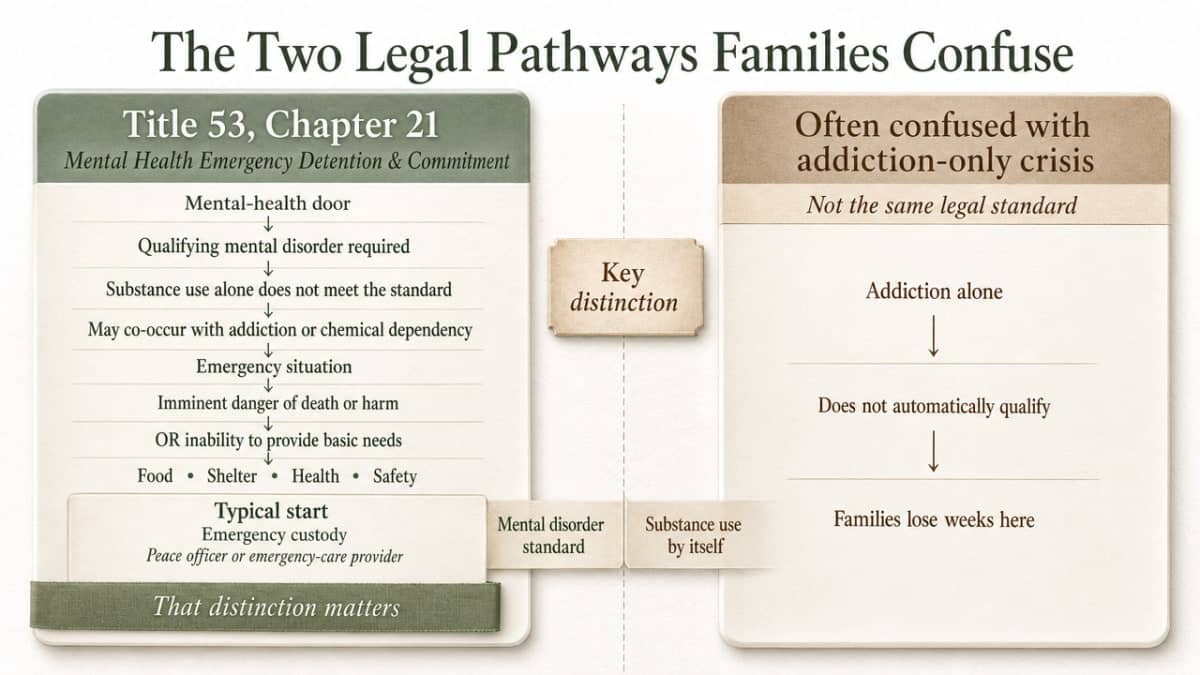
The Two Legal Pathways Families Confuse
Title 53 Chapter 21: Mental Health Emergency Detention and Commitment
The first door is a mental-health door, not an addiction door. That distinction matters, and it is where a lot of families lose weeks they cannot afford.
Under Montana law, an involuntary hold or commitment under Title 53, Chapter 21 requires a qualifying mental disorder plus one of the statute’s specific conditions. A mental disorder may co-occur with addiction or chemical dependency, but substance use by itself does not automatically meet the standard. An “emergency situation” includes imminent danger of death or harm, or a substantial, consistent inability to provide for basic needs like food, shelter, health, or safety 1.
There are two ways this pathway typically starts.
The first is emergency custody by a peace officer or emergency-care provider. That person can hold your loved one only long enough to contact a professional for evaluation. If the professional agrees an emergency exists, detention and treatment can continue for up to 72 hours. A private facility or hospital cannot be used without its express consent, and a bed has to be available before transfer 2.
The second is a 72-hour mental-health hold triggered by a written request from a qualified mental-health professional, not by you. It applies when, because of a mental disorder, the person cannot provide basic needs, has caused injury, or is an imminent threat to self or others 3.
Beyond those 72 hours, longer commitment requires a county-attorney petition, a hearing, professional evaluation, and a merits hearing or jury trial 8. The county attorney can file only after a written request from someone with direct, factual knowledge; general statements that your loved one drinks too much or refuses rehab will not carry it. The petition must lay out concrete facts 6.
Title 53 Chapter 24: The Alcohol Commitment Petition
The second door is narrower and specific to alcohol. If your loved one’s crisis is primarily driven by alcohol, Montana has a separate court process under Title 53, Chapter 24.
Here is what is different, and why it matters to you.
Under this chapter, a spouse, guardian, relative, certifying physician, or the chief of an approved public treatment facility may petition. “Family member” is defined broadly enough to include a spouse, parent, child, or household member whose life has been affected by the chemically dependent person’s actions 5. So yes, as the person reading this at 11 p.m., you likely qualify as a petitioner.
But being allowed to petition is not the same as winning one.
The allegations must meet statutory grounds: habitual lack of self-control with alcohol use, likely physical harm to self or others, or incapacitation by alcohol so severe that the person cannot make a rational decision about the need for treatment 4. “Incapacitated by alcohol” is not just being drunk. It is impaired judgment so severe that rational decision-making about care is gone 5.
And here is the sentence families most need to hear: a refusal to undergo treatment does not, by itself, constitute evidence of lack of judgment about the need for treatment 4. Your loved one saying “no” is not proof of incapacity. That is a legal wall built on purpose.
If a petition succeeds, the initial commitment period is 40 days unless the person is discharged sooner. Any further period of up to 90 days requires a new court order and fresh statutory grounds 4.
This is not a fast process. It is a due-process proceeding with hearings, an evaluation, and the respondent’s right to counsel. Families who expect a quick order the same week they file are usually setting themselves up for grief.
What Neither Pathway Guarantees
Even when the law works, it does not deliver what most families are picturing.
A court can order commitment to a state hospital, a behavioral-health inpatient facility, a community facility, a community program, or an appropriate course of treatment, with statutory time limits and a least-restrictive-placement principle guiding the choice 7. Notice what is not on that list: your first-choice private residential rehab, on your timeline, with the room you toured.
Montana’s definition of a treatment facility is broad. It includes recovery residences, hospitals, health or counseling centers, and other entities providing alcohol and drug services 10. Falling within that category does not mean the facility has an open bed, the right level of care for your loved one’s medical needs, or the legal consent to accept someone held involuntarily 2.
So the honest picture is this: even a successful legal process may land your loved one somewhere other than where you hoped, for a period the court sets, under conditions the court supervises. That is not failure on your part. That is how the statutes protect due-process rights while trying to keep people alive.
The better use of your energy usually starts with a real conversation about voluntary admission.
Four Myths That Send Families Down the Wrong Road
Take a breath. The myths below are the ones that eat weeks of your life and leave your loved one no closer to care. Naming them straight is not cruel. It is how you stop wasting the energy you need for the parts that actually help.
Myth 1: A 72-hour hold puts my loved one in rehab. It does not. Emergency detention under Montana law is short-term stabilization triggered by a peace officer, an emergency-care provider, or a written request from a mental-health professional, and it hinges on a qualifying mental disorder plus danger, injury, or inability to meet basic needs 2, 3. It is not a delivery service to your first-choice residential program.
Myth 2: If I call and say my adult child needs rehab, the county will pick them up. A county attorney can file a commitment petition, but only after a written request from someone with direct, factual knowledge, and the petition has to include concrete facts, not general worries about drinking or drug use 6. Your call starts a legal process; it does not skip one.
Myth 3: Refusing rehab proves they are too impaired to decide. Montana’s alcohol-commitment statute says the opposite in plain language: a refusal to undergo treatment does not, by itself, constitute evidence of lack of judgment about the need for treatment 4. “No” is not proof of incapacity, no matter how frustrating that feels at 1 a.m.
Myth 4: Any licensed rehab has to take a committed person. No, they do not. A private facility or hospital cannot be used without its express consent, and a bed has to be available before transfer 2. Falling within the statutory category of a treatment facility does not mean the clinical fit, the open bed, or the legal consent lines up on your timeline 10.
Knowing what is not true is not a setback. It is the first honest ground you can stand on.
What the Evidence Says About Forcing Someone Into Treatment
Before you spend the next two weeks trying to build a commitment case, it helps to know what the research actually shows about coercive treatment. The picture is not what most families are told.
Start with a small but sobering U.S. study. Researchers followed 22 hospital patients who were discharged to involuntary commitment for substance-use disorders. Within one year, 100% relapsed and every patient had at least one emergency-department visit. 78.6% had at least one hospital admission. 82% carried additional medical comorbidity, and 71% carried psychiatric comorbidity on top of the substance-use disorder 12. That is a retrospective study of 22 people, not a national trial, and it cannot prove that commitment caused those outcomes. But it shows what one real cohort looked like a year after legal detention: still sick, still using, still cycling through hospitals.
Bigger reviews land in a similar place. A RAND synthesis found that commitment may push some people into treatment initiation, but the evidence does not support durable engagement or lasting health improvement from commitment alone 13. A 2025 peer-reviewed review of 42 studies on involuntary treatment for severe substance-use disorders found only 7 with any improved outcome, mostly retention, and only 1 that showed reduced substance use 14. That is not a rounding error. That is the whole evidence base saying: coercion is not a reset button.
A broader legal-and-clinical review adds one more layer you should hear. Coercive commitment has been linked to trauma, damaged family relationships, and, in some populations, increased overdose risk after release, when tolerance has dropped and use resumes 11.
None of this means legal intervention is wrong when someone is about to die tonight. It means commitment is a narrow safety tool, not a treatment plan. If you have been carrying the belief that a court order will fix this, you can set that weight down. What actually moves the needle is getting the right level of care, quickly, from a provider who can meet your loved one’s medical and psychiatric needs 15, 16. That is a harder truth, and it is a more useful one.

A Realistic Action Plan When Tonight Is Not an Emergency
Write Down What Actually Happened
Get a notebook, or open a note on your phone. Start tonight, before the details blur into the last six months of hard nights.
Write down what you saw and heard, with dates and times. Not your interpretation. The facts. “October 14, 11:40 p.m. Found empty fifth of vodka in the truck. Slurred speech, could not stand without the counter. Refused water. Passed out on the couch.” “October 16, 6 a.m. Vomiting blood. Would not let me call anyone.” “October 19. Missed third shift this month. Boss called me.”
Why this matters: any legal pathway in Montana turns on concrete facts, not general worry. A commitment petition has to include the actual facts supporting the allegations, from someone with direct knowledge 6. “He drinks too much” will not move a county attorney. “On these three dates, this is what happened” might.
The notebook also protects you. On the hard mornings when your loved one insists it was not that bad, you have a record. And when you finally sit down with a clinician or an attorney, you hand over something they can actually work with, instead of trying to reconstruct a year of chaos from memory at 9 a.m.
Call the Right Number for the Situation in Front of You
Different situations need different phone calls. Using the wrong one wastes hours you may not have.
If your loved one is in immediate physical danger right now, threatening suicide, overdosing, or violent, call 911. A peace officer can take a person into custody long enough to contact a professional for emergency evaluation, and if that professional agrees an emergency exists, detention can continue for up to 72 hours 2. This is the door that opens fastest, and only when the safety facts are actually there.
If the crisis is mental-health flavored but not an active 911 situation, dial 988. The Suicide and Crisis Lifeline routes to trained counselors and can connect you with Montana mobile crisis teams where they operate. They can help you think through whether a written request from a mental-health professional for a 72-hour hold is realistic, based on the statutory criteria of mental disorder plus danger, injury, or inability to meet basic needs 3.
If you are trying to build a longer alcohol-commitment case, your call is to a county attorney’s office and, in most cases, an attorney of your own. They will tell you whether the facts in your notebook clear the statutory bar of habitual lack of self-control, likely physical harm, or alcohol-related incapacity 4.
If tonight is another hard night but not an active emergency, your best call is to a licensed treatment provider about voluntary admission. That is the next step.
Talk to a Treatment Provider About Voluntary Admission
Here is the shift most families never get told to make: while you are researching commitment, also open a parallel conversation about voluntary care. The two are not opposites. They are back-up plans for each other.
Call a licensed provider and ask specific questions. Is medical detox available, and how quickly? Rapid availability matters, because ambivalence is part of addiction and the window to say yes can close in an hour 16. What does the assessment look like for co-occurring medical and psychiatric conditions? Individualized care that addresses medical, mental, and social needs, including medication when clinically appropriate, is what the evidence supports 15. What levels of care do they offer if residential is not the right first step, and what happens after discharge?
Ask about family involvement too. Some providers can coach you on approach language and set up a warm hand-off so that if your loved one says yes on Tuesday morning, there is a bed and a plan by Tuesday afternoon.
Montana’s Elk Ridge Recovery admissions team is one place to have that conversation about a reluctant loved one. You are not committing to anything by asking questions. You are getting ready for the moment your loved one says, “okay, fine.” That moment tends to come without warning. Being ready for it is one of the most useful things you can do this week.
CRAFT and Motivational Approaches: The Long Game That Works
Here is the part most families never hear from the internet or the well-meaning cousin who did an intervention on TV once. The best evidence we have does not support coercion as the strategy that changes lives. A 2025 peer-reviewed review of 42 studies on involuntary treatment for severe substance-use disorders found only 7 with any improved outcome, and just 1 that showed reduced substance use 14. Read that again. Out of 42 studies, one showed that legal force actually lowered how much people used.
So what does work over months instead of one bad night?
CRAFT, or Community Reinforcement and Approach Family Training, is a family-based method built for exactly your situation: an adult loved one who refuses care. NIAAA reports that CRAFT has been shown more effective than a confrontational intervention for helping a person accept treatment 17. It teaches you how to reinforce sober behavior, step back from arguments that always end the same way, keep yourself safe, and use the moments when your loved one is open, even briefly, to move toward care.
Motivational enhancement therapy sits in the same family of approaches. It helps a person weigh the pros and cons of treatment, build their own confidence, and write a change plan in their own words 17. When the ambivalence is honored instead of steamrolled, the yes tends to hold longer.
This is slower work. It does not feel like doing something on the nights you want to break down the door. But it protects the relationship you will need on the other side of this, and it lines up with what the outcome research actually says. Ask a licensed provider whether they offer CRAFT-informed family sessions, and start there.
When You Should Stop Reading and Call 911 or 988
Close the browser if any of this is happening right now.
If they are talking about suicide but not in immediate physical danger, dial 988. Trained counselors can stay on the line with you, help you decide the next move, and connect you to Montana mobile crisis resources where those teams operate.
You are not overreacting. The statute exists for this exact moment. Make the call, then come back and keep reading.
Talk through Montana involuntary rehab options now
Get honest answers about helping a loved one enter treatment when they’re not willing.

Frequently Asked Questions
Can I legally force my adult family member into rehab in Montana?
Mostly no. Addiction alone does not authorize commitment in Montana. There are two narrow doors: emergency mental-health detention when a qualifying mental disorder plus danger, injury, or inability to meet basic needs is present 1, 2, and a separate alcohol-commitment petition with specific statutory grounds 4. Neither guarantees admission to a private rehab of your choosing.
What is the difference between a 72-hour mental health hold and an alcohol commitment petition?
A 72-hour hold is short-term emergency stabilization, triggered by a peace officer, emergency-care provider, or a written request from a mental-health professional, and it hinges on a mental disorder 2, 3. An alcohol-commitment petition is a court process under Title 53, Chapter 24, with hearings, an evaluation, and an initial commitment period of 40 days when statutory grounds are met 4.
Who can file an alcohol commitment petition in Montana?
A spouse, guardian, relative, certifying physician, or the chief of an approved public treatment facility may petition 4. “Family member” is defined broadly and includes a spouse, parent, child, or household member whose life has been affected by the person’s alcohol use 5. Being allowed to petition is not the same as winning one; the facts still have to meet the statutory grounds.
Does refusing treatment mean my loved one lacks the judgment to decide?
No. Montana’s alcohol-commitment statute says plainly that a refusal to undergo treatment does not, by itself, constitute evidence of lack of judgment about the need for treatment 4. “Incapacitated by alcohol” means impaired judgment so severe that rational decision-making about care is gone 5. A hard “no” at 1 a.m. is not the same thing as legal incapacity, no matter how it feels.
If a court orders commitment, will my loved one go to the rehab I chose?
Probably not. The court can order placement in a state hospital, behavioral-health inpatient facility, community facility, community program, or an appropriate course of treatment, under a least-restrictive-placement principle 7. A private facility cannot be used without its express consent, and a bed has to be available 2. The disposition is controlled by the court and the available facilities, not by your first choice.
What should I do tonight if my loved one refuses help but is not in immediate danger?
Write down what actually happened today with dates and times, so any later legal or clinical conversation has real facts to work with 6. Then call a licensed treatment provider about voluntary admission, medical detox availability, and CRAFT-informed family sessions, which the evidence shows outperform confrontational approaches for reluctant loved ones 15, 17. Small step, real progress. You are doing the right work.
References
- 53-21-102. Definitions – MCA – Montana Legislature. https://mca.legmt.gov/bills/mca/title_0530/chapter_0210/part_0010/section_0020/0530-0210-0010-0020.html
- 53-21-129. Emergency situation — petition — detention — exception – MCA. https://mca.legmt.gov/bills/mca/title_0530/chapter_0210/part_0010/section_0290/0530-0210-0010-0290.html
- 53-21-154. 72-hour mental health hold – MCA – Montana Legislature. https://mca.legmt.gov/bills/mca/title_0530/chapter_0210/part_0010/section_0540/0530-0210-0010-0540.html
- 53-24-302. Involuntary commitment of alcoholics — rights – MCA. https://mca.legmt.gov/bills/mca/title_0530/chapter_0240/part_0030/section_0020/0530-0240-0030-0020.html
- 53-24-103. Definitions – MCA – Montana Legislature. https://mca.legmt.gov/bills/mca/title_0530/chapter_0240/part_0010/section_0030/0530-0240-0010-0030.html
- 53-21-121. Petition for commitment — contents of — notice of – MCA. https://mca.legmt.gov/bills/mca/title_0530/chapter_0210/part_0010/section_0120/0530-0210-0010-0120.html
- 53-21-127. Posttrial disposition – MCA – Montana Legislature. https://mca.legmt.gov/bills/mca/title_0530/chapter_0210/part_0010/section_0270/0530-0210-0010-0270.html
- Civil Commitment Statute Memo. https://archive.legmt.gov/content/Committees/Interim/2023-2024/Transition-Review-Commission/Meetings/January-2024/6-_Civil_Commitment_Statute_Memo_to_TRC.pdf
- Appendix with Civil Commitment Statutes. https://archive.legmt.gov/content/Committees/Interim/2023-2024/Transition-Review-Commission/Meetings/January-2024/6-_Appendix_with_Civil_Commitment_Statutes.pdf
- 53-24-310. Definitions – MCA – Montana Legislature. https://mca.legmt.gov/bills/mca/title_0530/chapter_0240/part_0030/section_0100/0530-0240-0030-0100.html
- Involuntary Civil Commitment for Substance Use Disorders: Legal Aspects. https://pmc.ncbi.nlm.nih.gov/articles/PMC9790954/
- Outcomes for Patients Discharged to Involuntary Commitment for Substance Use Disorders From the Hospital. https://pubmed.ncbi.nlm.nih.gov/36995493/
- Involuntary Civil Commitment Laws: An Uncertain Promise for Successful Treatment and Recovery. https://www.rand.org/pubs/research_briefs/RBA3054-20.html
- Involuntary Treatment for Severe Substance Use Disorders. https://pmc.ncbi.nlm.nih.gov/articles/PMC12048394/
- Treatment and Recovery. https://nida.nih.gov/publications/drugs-brains-behavior-science-addiction/treatment-recovery
- Principles of Drug Addiction Treatment: A Research-Based Guide. https://nida.nih.gov/sites/default/files/podat-3rdEd-508.pdf
- FAQs: Searching for Alcohol Treatment. https://alcoholtreatment.niaaa.nih.gov/FAQs-searching-alcohol-treatment