Key Takeaways
- Day one at residential treatment is triage, not full programming — staff focus on medical safety, immediate needs, and getting you through the first night.
- Admission covers consents, vitals, withdrawal screening, medication reconciliation, and a room walkthrough; deeper psychosocial and trauma work waits 24 to 72 hours 1.
- Repeated questions from different staff are intentional cross-checks that determine tonight’s medication timing and withdrawal risk, especially with alcohol, benzos, or opioids 2, 6.
- Federal rule 42 CFR Part 2 keeps substance-use records private, so employers, family, or co-parents receive no information without your specific written consent 8.
The drive there is the hardest part
Whatever route you’re taking — up 93 from Missoula, east from Kalispell, in from Billings — the drive to residential treatment is almost always worse than the arrival itself. Your brain is running every worst-case scenario at once. What if withdrawal hits in the car? What if they judge you? What if you can’t handle it and want to leave? What if your job finds out? What about your kids?
None of that is irrational. It’s what happens when a person who has spent months or years managing a substance decides, on purpose, to stop managing it alone.
Here’s what actually helps: knowing that day one is not treatment starting at full volume. It’s a safety net being set. The first 24 hours are built to answer three questions, in order:
- Are you medically safe right now?
- What do we need to know to keep you safe tonight?
- What can wait until tomorrow?
That’s it. No group confrontation. No trauma deep-dive. No forced disclosures. Most of the anxiety you’re feeling right now is day three collapsed into day one in your head.
Let’s walk through what the day actually looks like.
Before you walk through the door
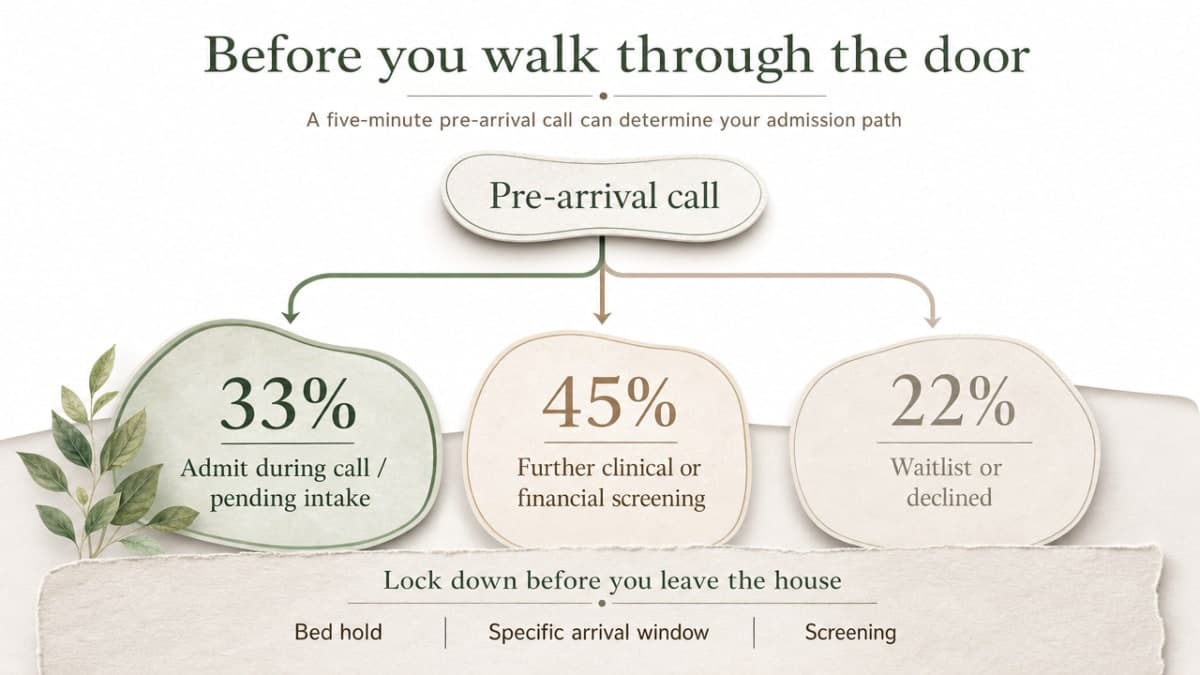
The most useful thing you can do before arrival day is a phone call. Not a tour, not a Google search rabbit hole at 2 a.m. — a call to confirm that everything you’re about to worry about in the car has already been sorted.
Admission pathways vary more than most people realize. In one audit of residential programs serving adults with opioid use disorder, 33% of programs offered admission during the call or pending an intake evaluation, 45% required further clinical or financial screening before admitting, and 22% placed callers on a waitlist or declined admission outright 10. That’s the reason a five-minute pre-arrival call matters so much. You want to be in that first group when you show up.
Here’s what to lock down before you leave the house:
- Bed hold. Confirm your room is being held for a specific arrival window, not a general “today.”
- Screening already done. The pre-assessment call covers substances, last use, medical history, and current medications so no one is starting from zero at the front desk.
- Insurance or payment. Verified in advance, in writing if possible. You don’t want to be signing financial paperwork mid-withdrawal.
- Transportation. If you’re driving from Missoula, Billings, or across the Idaho line, know who’s driving, who has your keys after, and whether sober transport is being arranged.
- Detox routing. If withdrawal is likely — alcohol, benzos, opioids — confirm whether you’ll go straight to medical detox on-site or start there and step into residential after.
Pack light. A duffel with a week of comfortable clothes, toiletries in original containers, any current prescription bottles with the labels intact, a photo ID, insurance card, and a book or journal is enough for day one. Anything else you forget, someone can bring later or you can request.
Leave your work laptop at home. Tell one trusted person where you are and give them the main number. That’s the whole pre-arrival job.
The first hour: check-in, consents, and the questions that matter tonight
You walk in. Someone is expecting you. That’s the first thing to notice — the front desk is not surprised, your name is on a list, and the person at the door already knows roughly why you’re there. You do not have to explain yourself to a stranger while your hands are shaking.
The first hour breaks into three short pieces: paperwork, a medical look-over, and a room. That’s it.
Paperwork. You’ll sign consent to treatment, acknowledge patient rights, and go through releases of information — who staff can and can’t talk to about your care. This is also where you’ll confirm the eligibility and administrative pieces that were started on the phone 5. If you’re too shaky to read carefully, say so. Someone will read it with you.
The medical look-over. A nurse or clinician will ask a specific, ordered set of questions and take your vitals. Clinical guidance for admission on day one calls for identifying every substance and last use, screening for withdrawal with a validated scale when appropriate, taking vital signs and relevant health information, and assigning a preliminary risk level 1. Blood pressure cuff, pulse, temperature, a few questions about seizures, prior detox, current medications, allergies. If you use alcohol, expect a direct question about your last drink and whether you’ve ever had a withdrawal seizure or DTs — that’s a safety question, not a character question 2. If you use opioids, expect a precise question about your last dose and what it was, because the timing of any medication started tonight depends on it 6.
The broader assessment — full psychosocial history, treatment planning, goals, deeper mental-health work — is not happening in this hour. Clinical guidance places that fuller assessment inside the first 24 to 72 hours, once you’re stable enough to actually participate in it 1. Tonight is triage, not autobiography.
Your room. Then someone walks you to where you’ll sleep. They show you the bathroom, where meals happen, where the nurses’ station is, and how to find staff at 3 a.m. if you need them. You can sit down. You can put the bag down. The hard part — getting through the door — is done.
Why the medical questions feel repetitive (and why that’s a good sign)
Within your first few hours, you may notice something that feels frustrating: different people keep asking you the same things. The nurse asked about your last drink. Then the intake clinician asked again. Then someone with a laptop asked a third time, slightly differently. By the fourth round, you’re wondering if anyone is talking to each other.
They are. The repetition is on purpose.
Each person asking has a different job, and each job needs an independent answer:
- The nurse is calculating withdrawal risk tonight — timing of last use, prior seizures, current vitals, what medication might be needed in the next six hours 1. If you drink heavily, they need a direct answer about your last drink and any history of withdrawal seizures or DTs, because alcohol withdrawal can range from uncomfortable to life-threatening and the setting has to match the risk 2.
- The intake clinician is running a broader screen — drinking pattern, symptom checklist, co-occurring mental-health needs — that shapes what tomorrow looks like 3.
- The mental-health assessor is asking about mood, anxiety, trauma history, suicide risk, and psychiatric medications, because roughly half the people who walk into residential treatment have a co-occurring condition that changes how care is delivered 4.
If you use opioids, expect the timing question to come up more than once, and precisely. The exact hour of your last dose determines whether a medication like buprenorphine can be started safely, and naltrexone can’t be started at all until you’ve been opioid-free for a specific window — starting it too early can trigger severe precipitated withdrawal 6. Getting that timeline wrong is a same-night safety issue, so two people confirming it is not redundancy. It’s a check.
Answer as accurately as you can, every time, even when it feels like they should already know. Tonight’s medication plan depends on it.
Your phone, your job, your kids: privacy on day one
The fear that someone will find out is often bigger than the fear of treatment itself. Your employer. Your kid’s other parent. Your in-laws. The custody attorney. The credit union that pulls your background for a loan. If you’re carrying any of that in the car with you, this is the section to read twice.
Federal law treats substance-use-disorder records differently from ordinary medical records. 42 CFR Part 2 is the specific rule, and it protects records of anyone receiving SUD services from being shared without your written consent, with only narrow legal exceptions 8. In February 2024, HHS finalized an update aligning parts of the rule with HIPAA and HITECH, and covered treatment providers had to comply by February 16, 2026 — so the framework in place when you walk in the door is the newer, tighter one 7.
What that means on day one, in plain terms:
- Your employer does not get a call. Not from admissions, not from the nurse, not from your counselor. If FMLA or short-term disability paperwork needs to go out, you sign a specific release naming exactly who gets what.
- Your family does not get updates unless you say so. Even your spouse. You’ll be asked who, if anyone, staff can confirm you’re here to, and what they can discuss. You can name one person, several, or no one.
- Your kids’ other parent doesn’t get a heads-up either. Custody-adjacent disclosures require your written release naming that person and that purpose.
The phone question is separate from the privacy question, and it’s the one most people ask first. Phone policies vary by program and by phase of care — often more limited during detox and the first days of residential, then expanded as you stabilize. Ask specifically: when can I call my kids, when can I check on work, and what happens if there’s an emergency. Get the answer before you hand the phone over. That single conversation removes about half the panic.
Meeting your counselor for the first time
Somewhere in the first day — usually not the first hour, sometimes not until the next morning if you arrived late or went straight into detox — you’ll sit down with the person who will be your primary counselor. This is a different conversation from the medical screening. Nobody is taking your blood pressure. Nobody has a checklist of last-use timestamps.
It’s mostly you talking, and them listening.
You do not have to have your story polished. You do not have to explain how you got here in a way that makes sense. If you cry, that’s fine. If you’re too foggy to string a sentence together, that’s fine too — they’ve seen it, and they’ll come back later. The point of this first sit-down is not to extract information. It’s to start a working relationship.
That relationship has more clinical weight than it looks like it does. In a study of 303 young adults followed through residential treatment from intake to discharge, people who built a stronger alliance with their counselor early on had greater reductions in psychological distress by the time they left 9. Early honesty is not just good manners. It measurably changes how the rest of your stay goes.
Say the true thing, even if it’s small. Say you’re scared. Say you don’t trust this yet. Say you’re only here because your sister drove you. That is a real starting point, and it’s more useful to your counselor than a version of yourself you think they want to hear.
The afternoon and evening: room, meals, and settling in
Once the medical piece is handled, the pace slows down on purpose. The rest of day one is not programming. It’s you, in a quieter room than you’ve been in for a while, with permission to eat and sit down.
Someone will show you where meals happen and when. If it’s between meals when you arrive, a snack shows up. If your appetite is gone — which is normal in early withdrawal or when your nerves are shot — no one is going to push a full plate on you. Broth, crackers, fruit, water. Whatever you can keep down.
You’ll unpack. A staff member usually goes through your bag with you, not to accuse you of anything, but to check medications against what you reported and set aside anything that isn’t allowed on the unit. Prescription bottles get logged so the nursing team can dose them on schedule. It takes a few minutes and it’s done.
Then there’s a stretch of unstructured time before the evening check-in. This is the part people don’t expect. You can lie down. You can walk the grounds if you’re cleared to. You can meet the two or three other residents who happen to be around, or you can not. Nobody is going to make you introduce yourself to a room.
Expectations for tomorrow get set here, not before. Someone — often the case manager or your primary counselor if you’ve already met — will walk you through what the morning looks like: wake time, medication pass, breakfast, the first group or one-on-one on your schedule. Establishing realistic expectations for the first week is a standard early task, and it happens once you’re stable enough to actually hear it 5. If you’re too tired to absorb the schedule, ask for it in writing. That’s a normal request.
By evening, most of what needed to happen on day one has happened. You are safe, you are fed, you have a bed, and someone knows your name.
What day one includes — and what it doesn’t
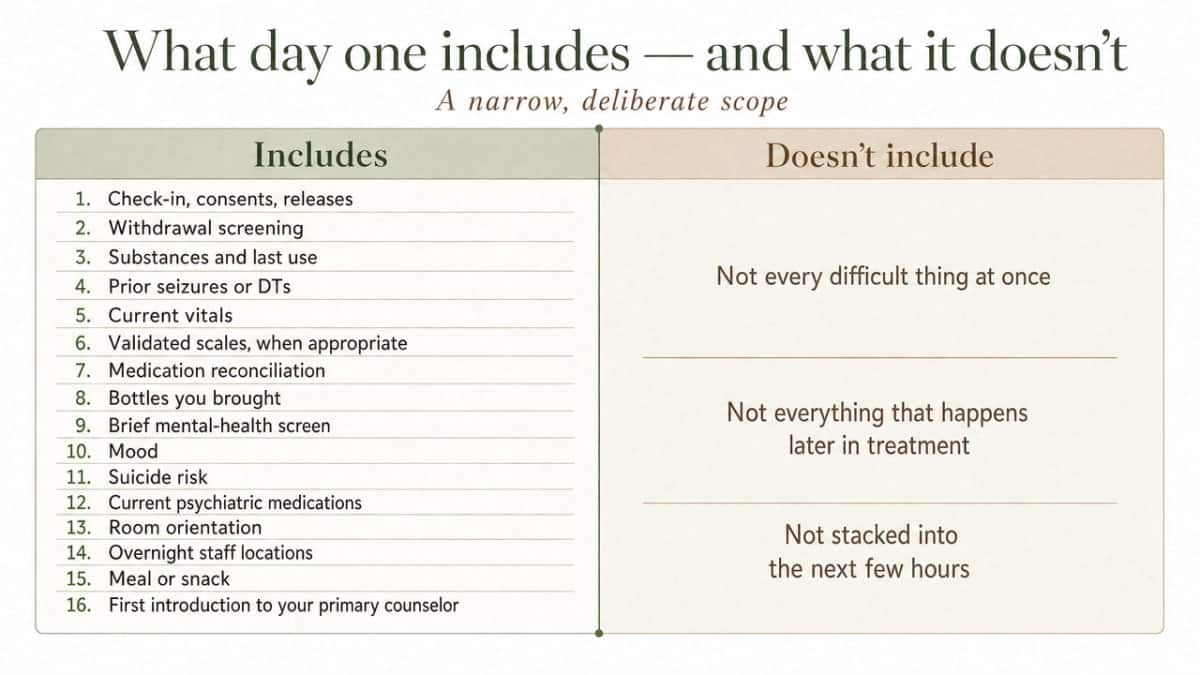
A lot of first-day panic comes from imagining every difficult thing that will eventually happen in treatment, all stacked into the next few hours. That’s not the day you’re walking into. Day one has a narrow, deliberate scope, and knowing where the line is drawn makes the door easier to walk through.
Here’s the split, laid side by side.
What day one includes:
- Check-in, consents, and releases of information
- Withdrawal screening — substances, last use, prior seizures or DTs, current vitals — using validated scales when appropriate 1
- Medication reconciliation with the bottles you brought
- A brief mental-health screen covering mood, suicide risk, and current psychiatric medications
- Room orientation and a walkthrough of where staff are located overnight
- A meal or snack, whatever you can keep down
- A first, unstructured introduction to your primary counselor
- A preliminary risk level and a plan for the next 12 hours
What day one does not include:
- Group confrontation or being asked to share your story in a room
- Trauma processing or deep therapeutic work
- Family sessions or mediated calls with people at home
- Detailed discharge planning or aftercare decisions
- A finished treatment plan with weekly goals
- Any expectation that you’ll be articulate, composed, or emotionally available
The broader assessment — the fuller psychosocial history, the treatment plan you’ll actually work from, the co-occurring diagnostic picture — is designed to happen inside the first 24 to 72 hours, once you’re stable enough to participate in it honestly 1. Not tonight. Tonight is triage.
If you’re arriving with a mental list of everything you think you’re supposed to say, put the list down. Nobody is asking you to perform recovery on day one. They’re asking you to be safe until morning. That is a much smaller task, and it is the only one on the schedule.
The first night: sleep, checks, and what to do if you can’t rest
Here’s the truth nobody tells you: you probably won’t sleep well. Not the first night. That’s not a failure — it’s a body doing exactly what it should do when the substance it was expecting doesn’t arrive on schedule.
A nurse will check on you overnight. If you’re in medical detox or flagged as at-risk for withdrawal, those checks are more frequent — vitals, a look at how you’re doing, sometimes a medication if your withdrawal scale scores climb. Alcohol withdrawal in particular can escalate overnight, which is why the setting has to match the risk in the first place 2. The checks are the whole point of being here instead of at home. Wake up, see a face, go back down. That’s the design.
If you can’t sleep, you don’t have to lie there and fight it. Get up. Tell the night staff. Ask for water, a snack, something to read. If your mind is racing, say so — anxiety on night one is expected, and there is usually something the nurse can offer.
Morning comes. You made it through. That is the entire assignment for tonight.
An honest note on whether residential is the right setting
One thing worth saying before your first night ends: residential is not automatically the right answer for every person, and pretending otherwise would be dishonest.
For people with opioid use disorder, one study comparing treatment settings found residential care was associated with greater six-month retention but not twelve-month retention, and was not consistently superior to outpatient care once medication for opioid use disorder was factored in 11. That’s a real finding, and it deserves to be named on day one rather than buried.
What residential does give you, especially in the first week, is structure you don’t have to build yourself, medical eyes on withdrawal, and a physical distance from the people, places, and routines that were feeding the substance. If that’s what you needed to walk through the door tonight, that’s a legitimate reason to be here. If, a few weeks in, you and your team decide a lower level of care makes more sense for the next phase, that’s not a failure — it’s the same clinical judgment that got you admitted, applied to what’s changed.
Tonight, the setting is doing exactly what you needed it to do. Sleep if you can.
Talk With Someone Who Gets Day One Nerves
Get real answers and reassurance about your first day, directly from an experienced admissions team.
Frequently Asked Questions
Can I bring my phone to rehab?
You can bring it, but phone policies vary and are often more limited during detox and the first days of residential care, then expanded as you stabilize. Before you hand it over, ask three specific questions: when can I call my kids, when can I check on work, and what happens if there’s a real emergency. Getting clear answers up front removes most of the panic around losing contact.
Will my employer or family find out I’m here?
Not unless you say so. 42 CFR Part 2 protects substance-use-disorder records from being shared without your written consent, with only narrow legal exceptions 8. The 2024 final rule tightened that framework further 7. On day one, you’ll be asked exactly who staff can confirm your presence to and what they can discuss. You can name your spouse, one friend, several people, or nobody at all. Your employer does not get a call.
What happens if I’m still in withdrawal when I arrive?
That’s expected, and it’s part of why you’re coming in. A nurse will take your vitals, ask about last use, prior seizures or DTs, and current symptoms, then assign a preliminary risk level 1. If you’re withdrawing from alcohol or benzos, the setting is designed to catch escalation overnight 2. If you use opioids, the exact hour of your last dose determines what medication can be started safely 6. You’ll be watched, not left alone.
Why do different staff members ask me the same questions?
Because each person has a different job and needs an independent answer. The nurse is calculating tonight’s withdrawal risk 1. The intake clinician is running a broader screen that shapes tomorrow 3. The mental-health assessor is checking mood, trauma history, suicide risk, and psychiatric medications, since co-occurring conditions change how care is delivered 4. The repetition isn’t disorganization. It’s cross-checking. Answer honestly every time, even when it feels like they should already know.
Can I leave if I change my mind on day one?
Residential treatment is voluntary. You are not locked in. If you decide to leave, staff will ask you to talk it through with a clinician first, because leaving in the middle of withdrawal carries real medical risk, especially with alcohol or benzos 2. That conversation isn’t a trap — it’s a safety check. Most people who feel like leaving in the first 24 hours are reacting to fear or physical symptoms that will look different by morning.
Will I have to talk about trauma or share in a group on the first day?
No. Day one is triage, not therapy. The broader psychosocial assessment is designed to happen inside the first 24 to 72 hours, once you’re stable enough to actually participate 1. Trauma processing, group work, and family sessions come later, at a pace your care team sets with you. Tonight, nobody is asking you to share your story in a room or explain how you got here. You just have to be safe until morning.
References
- WDM guidance. https://mn.gov/dhs/assets/WDM%20Guidance_9.8.2025_tcm1053-706303.pdf
- Alcohol Use Disorder: From Risk to Diagnosis to Recovery. https://www.niaaa.nih.gov/health-professionals-communities/core-resource-on-alcohol/alcohol-use-disorder-risk-diagnosis-recovery
- Screen and Assess: Use Quick, Effective Methods. https://www.niaaa.nih.gov/health-professionals-communities/core-resource-on-alcohol/screen-and-assess-use-quick-effective-methods
- TIP 42: Substance Use Disorder Treatment for People With Co-Occurring Disorders. https://library.samhsa.gov/sites/default/files/SAMHSA_Digital_Download/PEP20-02-01-004.pdf
- TIP 27: Comprehensive Case Management for Substance Abuse Treatment. https://library.samhsa.gov/sites/default/files/sma15-4215.pdf
- Opioid Use Disorder: Treating. https://www.cdc.gov/overdose-prevention/hcp/clinical-care/opioid-use-disorder-treating.html
- Fact Sheet 42 CFR Part 2 Final Rule. https://www.hhs.gov/hipaa/for-professionals/regulatory-initiatives/fact-sheet-42-cfr-part-2-final-rule/index.html
- Understanding Confidentiality of Substance Use Disorder (SUD) Patient Records. https://www.hhs.gov/hipaa/part-2/index.html
- The Role of Therapeutic Alliance in Substance Use Disorder Treatment. https://pmc.ncbi.nlm.nih.gov/articles/PMC3345301/
- Admission Practices And Cost Of Care For Opioid Use Disorder Residential Treatment. https://pmc.ncbi.nlm.nih.gov/articles/PMC8638362/
- Association between treatment setting and outcomes among individuals with opioid use disorder. https://pmc.ncbi.nlm.nih.gov/articles/PMC9389731/