Key Takeaways
- Adventure therapy works as an adjunct to clinical care, sitting on top of medical detox, MAT, and evidence-based psychotherapy rather than replacing any of them 2, 4.
- The clinical spine — physician-led detox, medication-assisted treatment, CBT, contingency management, and concurrent dual-diagnosis care — has to come first before outdoor work can do anything meaningful 3, 4.
- Outdoor modalities map to specific mechanisms: hiking regulates stress and trauma symptoms, water-based work builds group cohesion, and climbing delivers graded exposure and mastery 11, 9, 14.
- When vetting a program, ask who supervises outdoor blocks, whether MAT and concurrent co-occurring care are standard, and what the aftercare continuum looks like after residential ends 10, 24.
What You’re Actually Buying When a Program Says ‘Adventure Therapy’
If you’re reading this, you already know how tired you are. So let’s skip the pep talk and get to the honest part: when a rehab program advertises “adventure therapy,” what are you actually getting?
Sometimes it means a hike on Tuesday and a fishing trip on Friday, tacked onto a treatment schedule that isn’t really doing much. Other times it means something more serious — outdoor work that is planned, supervised by clinicians, and tied to what you’re doing in individual and group therapy. Those are two very different products, and the difference matters for your recovery.
Adventure therapy, as the research actually describes it, is an adjunct. It sits on top of clinical treatment. It doesn’t replace medical detox, medication-assisted treatment, or evidence-based psychotherapy — it works alongside them and, when done well, helps you stay engaged long enough for those clinical tools to take hold .
At Elk Ridge Recovery in Montana, hiking, fishing, kayaking, and community outings are built around a spine of physician-led detox, residential care, dual-diagnosis support, and MAT. Not the other way around. As you read the rest of this piece, keep that frame in mind: the wilderness is the setting. The treatment is the treatment.
The Clinical Spine That Has to Come First
Detox, MAT, and the Medical Layer You Can’t Skip
Before anyone hands you a paddle or a pair of hiking boots, your body has to be safe. That’s the honest starting point.
If you’ve been using alcohol, benzodiazepines, or opioids at any real volume, stopping suddenly can be dangerous. Withdrawal from alcohol and benzos can trigger seizures. Opioid withdrawal, while rarely deadly on its own, is brutal enough to push most people right back to use within hours. Physician-led medical detox exists to keep you safe through that window and to make the next stage of treatment actually possible.
Medication-assisted treatment is the second piece of that medical layer. For opioid use disorder, medications like buprenorphine and methadone reduce cravings and stabilize brain chemistry so you can do the psychological work. NIDA describes addiction as a treatable chronic condition that responds to care addressing your medical, mental, social, and family needs — not willpower alone .
At Elk Ridge, medical detox and MAT sit at the base of the program. You are not asked to hike a ridge on day two. You are asked to sleep, eat, take your prescribed medication, and let your nervous system settle. Everything else — including any outdoor work — is built on that stability.
Evidence-Based Therapy: CBT, Contingency Management, and CRA
Once your body is stable, the real work starts in the therapy room. And here’s where you should push any program hard: what specific, evidence-based therapies do they actually deliver?
The 2024 ASAM/AAAP clinical guideline for stimulant use disorder is one of the clearest maps we have. It names contingency management as a primary component of treatment, alongside cognitive behavioral therapy, the community reinforcement approach, and the Matrix Model . These are not soft add-ons. They are the tools with the strongest evidence for helping people reduce use and stay in treatment.
CBT teaches you to notice the thoughts and situations that feed use, and to build different responses. Contingency management uses small, structured rewards for verified progress — negative drug screens, session attendance, medication adherence. It sounds almost too simple, but the data are consistent: a meta-analysis of patients on medication for opioid use disorder found contingency management meaningfully improves treatment outcomes . The community reinforcement approach rebuilds the parts of your life — relationships, routines, work — that make sobriety feel worth defending.
Elk Ridge layers these approaches through individual therapy, group therapy, and relapse prevention work. When you step outside for a hike or a fishing block later, you’re bringing those skills with you. That’s the point. The outdoor time doesn’t replace CBT — it gives you a real setting to practice what CBT taught you that morning.
Dual Diagnosis: Treating Depression, Anxiety, and PTSD Alongside Use
You probably already know this in your body, even if no one has said it plainly: the drinking or the using is often carrying something underneath it. Depression. Anxiety that won’t quiet down. Trauma from things you may have never fully told anyone.
Trying to treat the substance use without treating what’s underneath is one of the fastest routes back to relapse. The ASAM/AAAP guideline is explicit that co-occurring disorders should be treated concurrently, using integrated behavioral care rather than a hand-off between two separate systems . NIDA takes the same position — effective treatment addresses the whole person, not one diagnosis at a time .
Dual diagnosis care at a program like Elk Ridge means your therapist and your prescriber are on the same team, working the same treatment plan. If you have PTSD, trauma-focused therapy is part of your week, not something you’re told to “get to later.” If you have depression or anxiety, medication management runs alongside your substance use treatment, not in a separate silo.
This is also where the outdoor layer earns its place. A quiet walk in the trees isn’t therapy — but it’s a setting where a nervous system can finally exhale enough for therapy to reach you.
What the Research Actually Says About Outdoor Work in Recovery
You deserve honest numbers, not a brochure. So here’s where the research on nature-based work in addiction treatment actually stands right now.
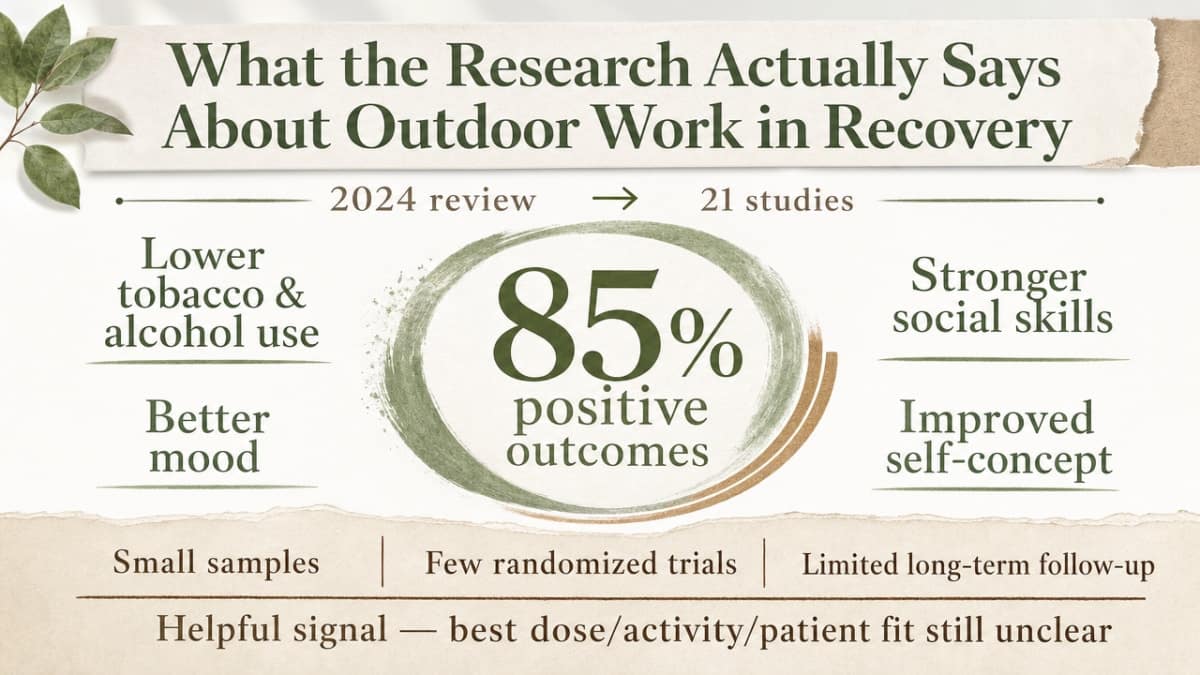
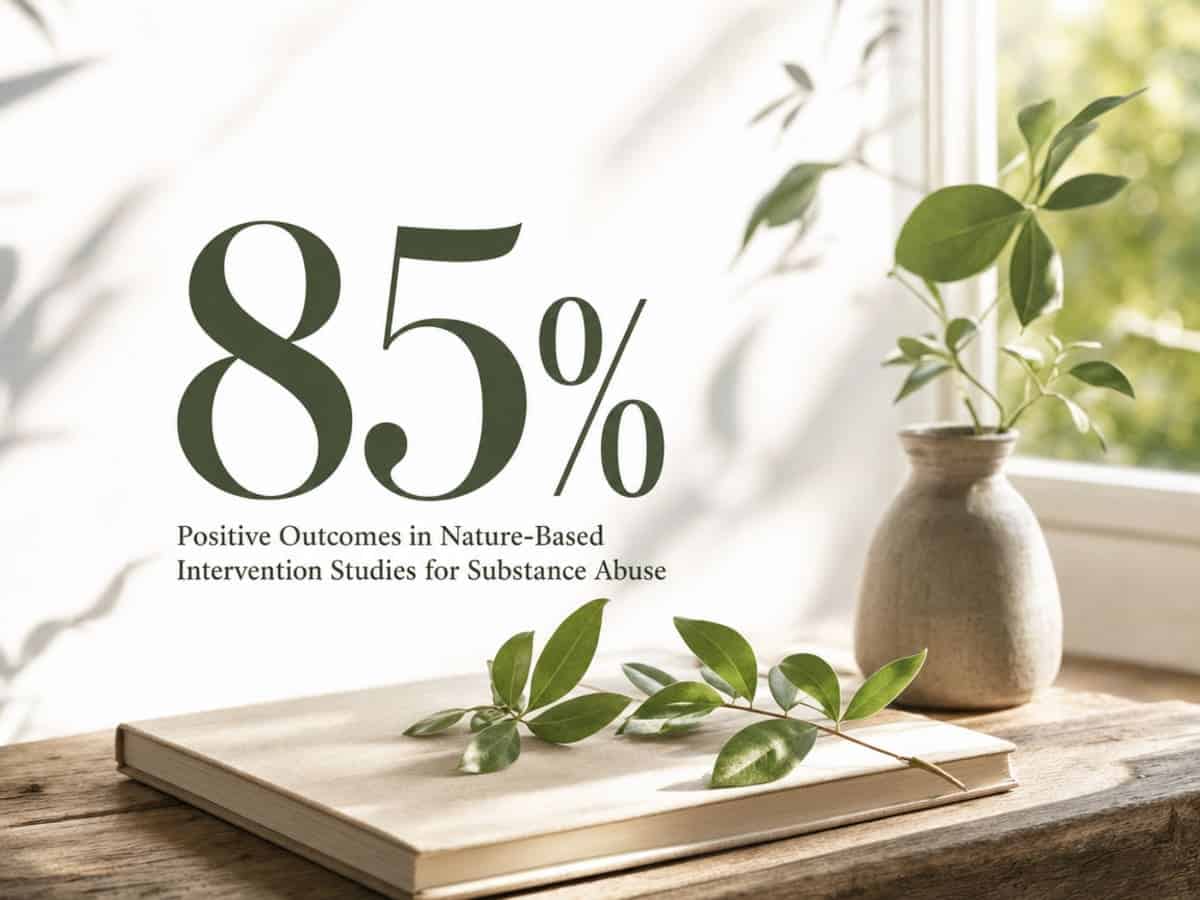
A 2024 review looked at 21 studies of nature-based interventions used in drug-dependence contexts — everything from gardening programs to structured outdoor time to forest-based work. Of those 21 studies, 85% reported positive outcomes: reductions in tobacco and alcohol use, better mood, stronger social skills, and improved self-concept . That’s a meaningful signal. It tells you outdoor programming isn’t just decorative.
However, this evidence often comes from small samples, few randomized controlled trials, and limited long-term follow-up . This means while outdoor work appears helpful across various settings, researchers are still determining the optimal dose, activity, or patient profile.
A separate randomized trial of an adventure therapy program showed real short-term gains in psychological health, but no significant long-term difference versus standard care once follow-up stretched out . This doesn’t dismiss adventure therapy; it emphasizes the need for outdoor work to be part of an ongoing clinical continuum, ensuring short-term gains are sustained.
How Each Outdoor Modality Maps to a Clinical Mechanism
Hiking and Walking Therapy: Stress Regulation and Trauma Symptom Change
Walking is the workhorse of any outdoor program, and that’s not an accident. The research on it is some of the strongest.
A pilot randomized trial with veterans carrying PTSD compared hiking in natural settings versus hiking in urban ones. The group hiking in nature had greater improvement in PTSD symptom scores at both 12 and 24 weeks . A separate study of veterans in trauma-focused treatment found that on days when they spent more time outdoors, they had greater reductions in PTSD symptoms the following day . The setting matters. The dose matters.
There’s also a delivery model called walking psychotherapy — actual therapy sessions done in motion rather than in an office chair. A 2022 feasibility trial found patients and therapists both accepted the format, and PTSD symptoms improved over 12 weeks . Movement plus conversation plus open sky seems to loosen something that a windowless room can lock down.
For you, this means the afternoon hike at Elk Ridge isn’t scenic filler between sessions. It’s a nervous-system regulator and, in some formats, a therapy container. If sitting still with your own thoughts has felt impossible for years, walking gives your body something to do while your mind catches up.
Fishing, Kayaking, and Water-Based Work: Group Cohesion and Focused Attention
Water changes people. Anyone who has stood in a river with a fly rod at dusk already knows this — the attention narrows, the internal chatter quiets, and you’re suddenly, simply, present.
The clinical case for water-based work comes mostly from sailing research with veterans. In one study, a structured sailing adventure therapy program was linked to improved psychological flexibility and, importantly, higher completion rates for residential SUD treatment — with no increase in injuries, anxiety, or negative affect . A related mindfulness-based sailing program for veterans with psychiatric and substance use disorders showed gains in both psychological flexibility and mindfulness .
Fishing and kayaking on Montana rivers won’t look like an offshore sail, but the active ingredients are similar: shared task, shared risk at a manageable level, shared quiet. That mix is what the process-factors research points to as therapeutic — mindfulness during the activity, perceived helpfulness of the group, and the adventure experience itself all correlate with better psychosocial outcomes week to week .
The group in the boat becomes something you don’t often get in early recovery: a set of people you’re actually doing something with, not just talking about doing something with.
Climbing and Higher-Challenge Activities: Mastery and Anxiety Exposure
Higher-challenge activities do something different from a walk in the trees. They give you a small, contained problem you can actually solve with your own hands and feet — and that experience of mastery is hard to come by when your life has felt out of control for a long time.
A randomized pilot trial tested climbing as an add-on to standard treatment for people with severe anxiety disorders and PTSD. The format was feasible, implementation was acceptable, and anxiety decreased across groups . Climbing is essentially graded exposure with a harness — you meet a manageable fear, breathe through it, and reach the next hold. Your brain files away proof that fear can be felt and moved through, not just avoided or numbed.
You don’t need to be athletic for this to work. What matters is the structure: a clinical team choosing the challenge level, a supervised setting, and a debrief afterward that connects what happened on the wall to what happens when a craving hits at 9 p.m. That’s the difference between recreation and treatment.
Retention and Craving: Why the Combined Model Holds People in Treatment
Here’s the honest problem with rehab: it doesn’t work if you leave early. That’s not a criticism of you or anyone else who has walked out — it’s just the math. Every evidence-based therapy in the world only helps if you stay long enough to receive it. Retention is the hidden variable that decides whether treatment does anything at all.
This is where the combined model earns its keep. A narrative review of nature-based adjuncts in substance use disorder treatment reported that ten months after a three-day camping-based intervention, the relapse rate was 31% in the intervention group and 58% in the comparison group . This meaningful gap, while from a narrative review with limited controls, aligns with findings from other outdoor-adjunct studies.
The mechanism seems to run through both engagement and craving. In the same review, patients with SUD who took a one-hour walk in nature showed significantly reduced craving compared with pre-walk levels and with craving after a city walk . A 2024 study of residential inpatients in the Venetian Lagoon found that short structured nature experiences reduced craving and improved wellbeing inside the treatment setting . The sailing research with veterans points the same way: participants were significantly more likely to complete residential SUD treatment than a comparison group receiving treatment as usual .
None of this means the outdoors is doing the healing. It means the outdoors is helping you stay in the room long enough for the healing to reach you. At Elk Ridge, that translates into a schedule where a rough craving spike in the morning gets met with therapy, medication if you need it, and later that day, a walk along a river that gives your body somewhere else to put the energy. You’re not being distracted from your recovery. You’re being carried through the hardest hours of it.
A Day at Elk Ridge: How the Schedule Alternates Clinical and Outdoor Blocks
The best way to picture a combined program is to walk through a weekday. Not a highlight reel. Just an ordinary Wednesday in residential care.
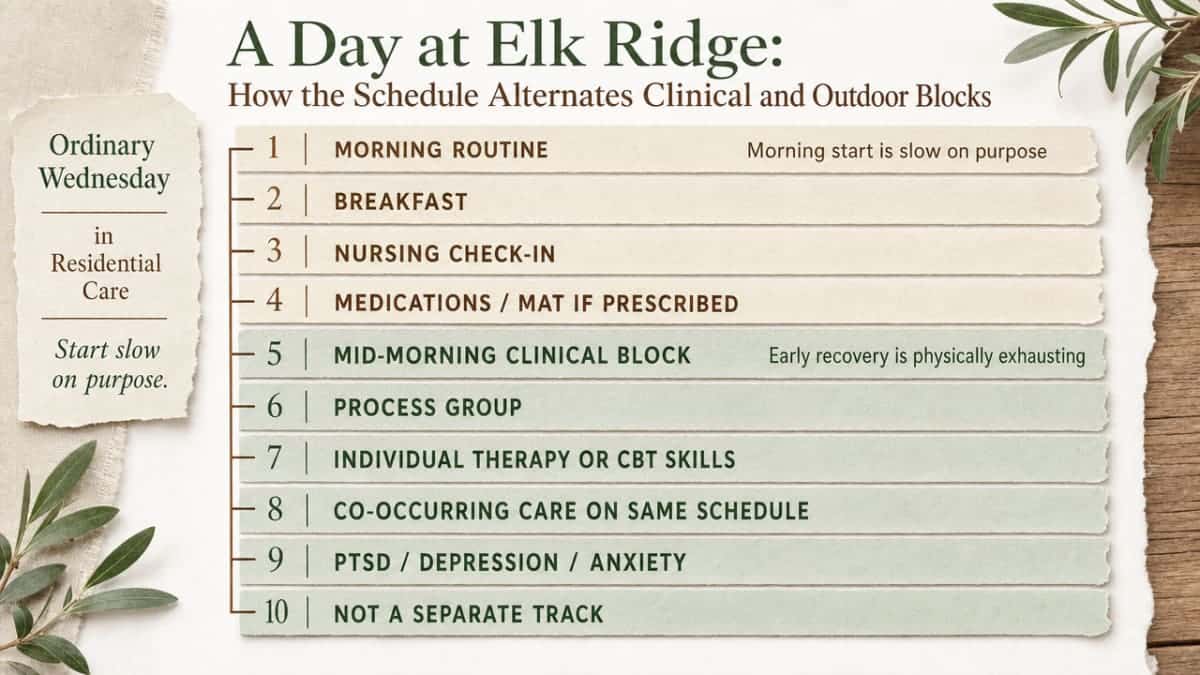
Mornings start slow on purpose. Breakfast, a check-in with nursing, and whatever medications are part of your plan — including MAT if that’s what your treatment team has prescribed. Early recovery is physically exhausting, and pushing a rope-course pace at 7 a.m. would work against everything the clinical team is trying to build.
Mid-morning is where the clinical spine does its heavy lifting. You’ll typically have a process group, then individual therapy or a CBT-focused skills session later in the block. If you’re being treated for a co-occurring condition like PTSD, depression, or anxiety, that work runs on the same schedule — not shunted off to a separate track . Contingency management check-ins, when they’re part of your plan, also fit into this window. Small, structured, evidence-based .
After lunch is when the outdoor layer opens up. Depending on weather, cohort, and your own physical readiness, that might be a guided hike on a nearby trail, a fishing block along a river, or a lower-intensity wellness session on the property. The clinical team chooses the activity and the intensity. You’re not sent out alone with a fishing rod and told to think about your choices.
Late afternoon brings the piece that makes the outdoor work therapeutic rather than recreational: the debrief. A short group reflection that connects what came up on the trail — the frustration, the quiet, the moment your mind actually stopped racing — to the skills you worked on that morning. This is the same process research points to when it identifies mindfulness and group adventure experiences as the ingredients that correlate with better psychosocial outcomes .
Evenings wind down with dinner, a 12-step or peer support option, and personal time. Sleep is treated as part of treatment, not an afterthought.
You’re not being entertained. You’re being held inside a rhythm designed to make the clinical work reach you.
The Montana Setting as a Therapeutic Tool, Not a Backdrop
Montana isn’t a mystical healing land. It’s a place with specific features that happen to matter for early recovery.
The first is privacy. Residential care in a densely populated area means running into a version of your old life every time you step outside. A private property tucked into forest and ridgeline removes that pressure. You’re not managing who sees you. You’re not curating a story for anyone. That drop in social vigilance frees up cognitive room for the actual work.
The second is sensory calm. Fewer sirens, fewer screens, longer sightlines, more sky. A study of residential inpatients with addiction found that short structured nature experiences reduced craving and improved wellbeing inside the treatment setting . The setting itself does something measurable, even before an activity begins.
The third is altitude and access. Forests, rivers, and trails within minutes of the property mean outdoor blocks aren’t a logistical event — they’re part of the daily rhythm. Population-level data even hint that greener environments correlate with lower current smoking and higher quitting among ever-smokers . Environment matters. Yours, starting now, can be one that stops fighting your recovery.
The Continuum: Detox, Residential, PHP, IOP, and Aftercare
Recovery isn’t a single stop. It’s a sequence, and the outdoor work has to travel with you through each stage or it stops mattering.
The first stage is medical detox — days, not weeks, focused on getting your body safe. Outdoor work here is minimal by design: short walks, fresh air, sleep. Nothing more.
Residential care is where the combined model does its most visible work. Days alternate between individual therapy, group, medication management, and structured outdoor blocks — hiking, fishing, kayaking, wellness sessions — all supervised by the clinical team. This is where the research signals are strongest: structured nature experiences inside residential care are associated with reduced craving and improved wellbeing , and supervised adventure programming is linked to higher residential completion rates .
Partial hospitalization steps you down without letting go. You keep most of the clinical intensity — therapy, dual-diagnosis care, MAT — while spending nights in supportive housing. Outdoor blocks stay in the schedule, just fewer of them. Intensive outpatient follows a similar pattern at a lighter dose, letting you begin rebuilding work, family, and routine while therapy continues.
Then comes aftercare and alumni programming — the piece that decides whether short-term gains hold. The adventure therapy RCT that showed strong short-term psychological benefits but no long-term difference from standard care is a warning: without ongoing support, gains fade. Elk Ridge’s aftercare, peer support, and sober activities exist to keep the clinical work — and the outdoor rhythm — alive after you leave.
Honest Questions to Ask Any Program That Advertises Adventure Therapy
If a program’s website leads with sunset photos and mentions therapy somewhere near the footer, that’s telling you something. Here are the questions worth asking on the phone before you commit to anywhere — Elk Ridge included.
Who runs the outdoor blocks? A licensed clinician on the trail is very different from a recreation staffer with a first-aid card. The process-factors research on adventure therapy is clear that clinically supervised experiences with structured reflection drive the psychosocial gains, not the activity itself .
How is medical detox handled, and can I stay on MAT? If either answer is vague or discouraging, keep calling. NIDA and ASAM/AAAP both frame medication and integrated behavioral care as core to effective treatment .
How do you treat co-occurring depression, anxiety, or PTSD — concurrently or later? Concurrent is the evidence-based answer .
What happens after residential ends? Ask about PHP, IOP, aftercare, and alumni support. Short-term adventure gains fade without continued clinical care .
You’re allowed to ask hard questions. A program worth your trust will welcome them.
Ready to Explore Clinical and Adventure Healing?
Connect with a recovery specialist who understands both clinical care and adventure therapy.
Frequently Asked Questions
Is adventure therapy a replacement for medical detox and clinical treatment?
No. Adventure therapy is an adjunct, not a substitute. The research supports outdoor work as something that sits on top of clinical care — detox, MAT, CBT, contingency management, and dual-diagnosis treatment — and helps you stay engaged long enough for those tools to work . A program leading with hikes and mentioning therapy as an afterthought is not the same thing.
Can I still receive medication-assisted treatment (MAT) at a program that offers adventure therapy?
Yes, and you should insist on it if your treatment team recommends it. At Elk Ridge Recovery, MAT is part of the medical layer that runs alongside residential care and outdoor programming. NIDA frames medication as central to effective addiction treatment, and the ASAM/AAAP guideline treats integrated medical and behavioral care as standard . Outdoor blocks are scheduled around your medical needs, not the other way around.
What if I’m not physically fit or outdoorsy? Do I have to hike and kayak to get treatment?
You don’t. The clinical team matches outdoor activities to your physical readiness and preference — a slow walk, a fishing block sitting by a river, or a quiet wellness session on the property all count. Even short, low-intensity nature exposure has been linked to reduced craving and better mood in residential inpatients . Treatment adapts to your body. Your body doesn’t have to perform for treatment.
How does adventure therapy help if I have co-occurring depression, anxiety, or PTSD?
Outdoor work can support what your clinical team is already treating. A pilot randomized trial found veterans who hiked in nature had greater PTSD symptom improvement at 12 and 24 weeks than an urban-hiking group , and a climbing add-on trial reported decreased anxiety alongside standard care . Concurrent treatment of your co-occurring condition — not later, not separately — is the evidence-based standard .
What questions should I ask a rehab program that advertises adventure therapy?
Ask who supervises the outdoor blocks, whether licensed clinicians run the reflection work, and how the activity connects to your therapy plan. Ask about detox, MAT access, and how co-occurring conditions are treated. Ask what happens after residential — PHP, IOP, aftercare, alumni. Process factors like clinical supervision and structured reflection are what drive the psychosocial gains, not the activity itself .
Does adventure therapy actually reduce the chance of relapse?
The signal is promising but honest. A narrative review reported a 10-month relapse rate of 31% after a camping-based intervention versus 58% in the comparison group, and supervised sailing programs were linked to higher residential completion rates . However, an adventure therapy RCT showed short-term psychological gains without long-term differences from standard care . Translation: outdoor work helps if aftercare keeps the clinical continuum going.
References
- Harnessing the healing power of nature: a review of natural therapies for drug dependence. https://pmc.ncbi.nlm.nih.gov/articles/PMC11570648/
- Recovery Horizons: Nature-Based Activities as Adjunctive Interventions in Substance Use Disorders. https://pmc.ncbi.nlm.nih.gov/articles/PMC11571177/
- The ASAM/AAAP Clinical Practice Guideline on the Management of Stimulant Use Disorder. https://pmc.ncbi.nlm.nih.gov/articles/PMC11105801/
- Treatment and Recovery | National Institute on Drug Abuse. https://www.nida.nih.gov/publications/drugs-brains-behavior-science-addiction/treatment-recovery
- The Value of Outdoor Behavioral Healthcare for Adolescents. https://pmc.ncbi.nlm.nih.gov/articles/PMC6702774/
- Virtual Nature as an Intervention for Reducing Stress and Improving Mood in People with Substance Use Disorder. https://pmc.ncbi.nlm.nih.gov/articles/PMC7256771/
- Safety and psychological impact of sailing adventure therapy among Veterans with substance use disorders. https://pmc.ncbi.nlm.nih.gov/articles/PMC6098347/
- Process factors explaining psycho-social outcomes in adventure therapy. https://pmc.ncbi.nlm.nih.gov/articles/PMC6776024/
- Safety and psychological impact of sailing adventure therapy among Veterans with substance use disorders. https://pubmed.ncbi.nlm.nih.gov/30219467/
- Process factors explaining psycho-social outcomes in adventure therapy. https://pubmed.ncbi.nlm.nih.gov/28922006/
- Nature versus urban hiking for Veterans with post-traumatic stress disorder: a pilot randomised trial conducted in the Pacific Northwest USA. https://pmc.ncbi.nlm.nih.gov/articles/PMC6419581/
- The effect of time outdoors on veterans receiving treatment for PTSD. https://pmc.ncbi.nlm.nih.gov/articles/PMC9231102/
- Walking psychotherapy as a Health Promotion strategy to improve mental and physical health for patients and therapists: clinical open-label feasibility trial. https://pmc.ncbi.nlm.nih.gov/articles/PMC9011427/
- Climbing as an add-on treatment option for patients with severe anxiety disorders and PTSD: feasibility analysis and first results of a randomized controlled longitudinal clinical pilot trial. https://pmc.ncbi.nlm.nih.gov/articles/PMC9313589/
- Mindfulness-based therapeutic sailing for veterans with psychiatric and substance use disorders. https://pmc.ncbi.nlm.nih.gov/articles/PMC8657294/
- Nature-based experience in Venetian Lagoon: effects on craving and wellbeing in addict residential inpatients. https://pmc.ncbi.nlm.nih.gov/articles/PMC9591033/
- The Impact of Gardening on Well-being, Mental Health, and Quality of Life: an umbrella review and meta-analysis. https://pmc.ncbi.nlm.nih.gov/articles/PMC10114831/
- Residential greenness and substance use among youth and young adults: associations with alcohol, tobacco, and marijuana use. https://pmc.ncbi.nlm.nih.gov/articles/PMC8748599/
- Neighbourhood greenspace and smoking prevalence: Results from a nationally representative survey in England. https://pmc.ncbi.nlm.nih.gov/articles/PMC9985552/
- Contingency Management for Patients Receiving Medication for Opioid Use Disorder: A Systematic Review and Meta-analysis. https://pmc.ncbi.nlm.nih.gov/articles/PMC8586970/
- A systematic review of exercise intervention program for people with substance use disorder. https://pmc.ncbi.nlm.nih.gov/articles/PMC9389445/
- Nature-based activities as adjunctive interventions in substance use disorders. https://pmc.ncbi.nlm.nih.gov/articles/PMC10848527/
- The value of outdoor behavioral healthcare for adolescent substance users with comorbid conditions. https://pmc.ncbi.nlm.nih.gov/articles/PMC10471296/
- Short- and Long-Term Outcomes of an Adventure Therapy Obesity Treatment Program: Randomized Controlled Trial. https://pmc.ncbi.nlm.nih.gov/articles/PMC10968253/