Key Takeaways
- Around Billings, co-occurring disorders are the norm, not the exception—Montana data shows one in three adults in the public mental health system also have a substance use diagnosis 9.
- Integrated care means one team, one setting, and one plan treating both conditions together, not a therapist and rehab operating in separate silos 2.
- Being told to get sober before mental health treatment, or vice versa, reflects a program’s limits, not a rule about you—SAMHSA’s ‘no wrong door’ standard applies 4.
- Before choosing a Billings-area program, ask who prescribes your medications, whether one plan covers both conditions, and whether your team stays with you as care steps down 6.
When One Diagnosis Isn’t the Whole Story
If you’re reading this, you’re probably tired. Maybe you’ve been through a detox before and it didn’t hold. Maybe the anxiety came roaring back the second the drinking stopped, or the drinking started up again because the depression never really lifted. Maybe you’re the spouse, the parent, the adult child watching someone you love get bounced between a rehab program and a psychiatrist who don’t seem to talk to each other.
That exhaustion has a name in the clinical world: co-occurring disorders. When a substance use problem and a mental health condition show up in the same person at the same time, treating one and ignoring the other almost never works. Federal guidance has said so for years. The preferred model is integrated care, where both conditions get treated together, by the same team, under one plan 1.
Around Billings, this isn’t a rare situation. It’s closer to the norm than the exception among people who walk through the door of a behavioral health program. Which means if you’ve been told your case is complicated, or that you have to pick a lane before anyone will help you, you’ve been told something that doesn’t match the evidence.
The rest of this guide walks you through what integrated dual diagnosis treatment actually looks like in and around Billings, how to spot a program that does it well, and what to expect from the first phone call through long-term recovery. You don’t have to have it all figured out to take the next step. You just need to know what to look for.
How Common Co-Occurring Disorders Really Are in Montana
If you’ve been made to feel like your situation is unusual — like most people in treatment have just one thing going on and you’re the complicated one — the numbers say otherwise.
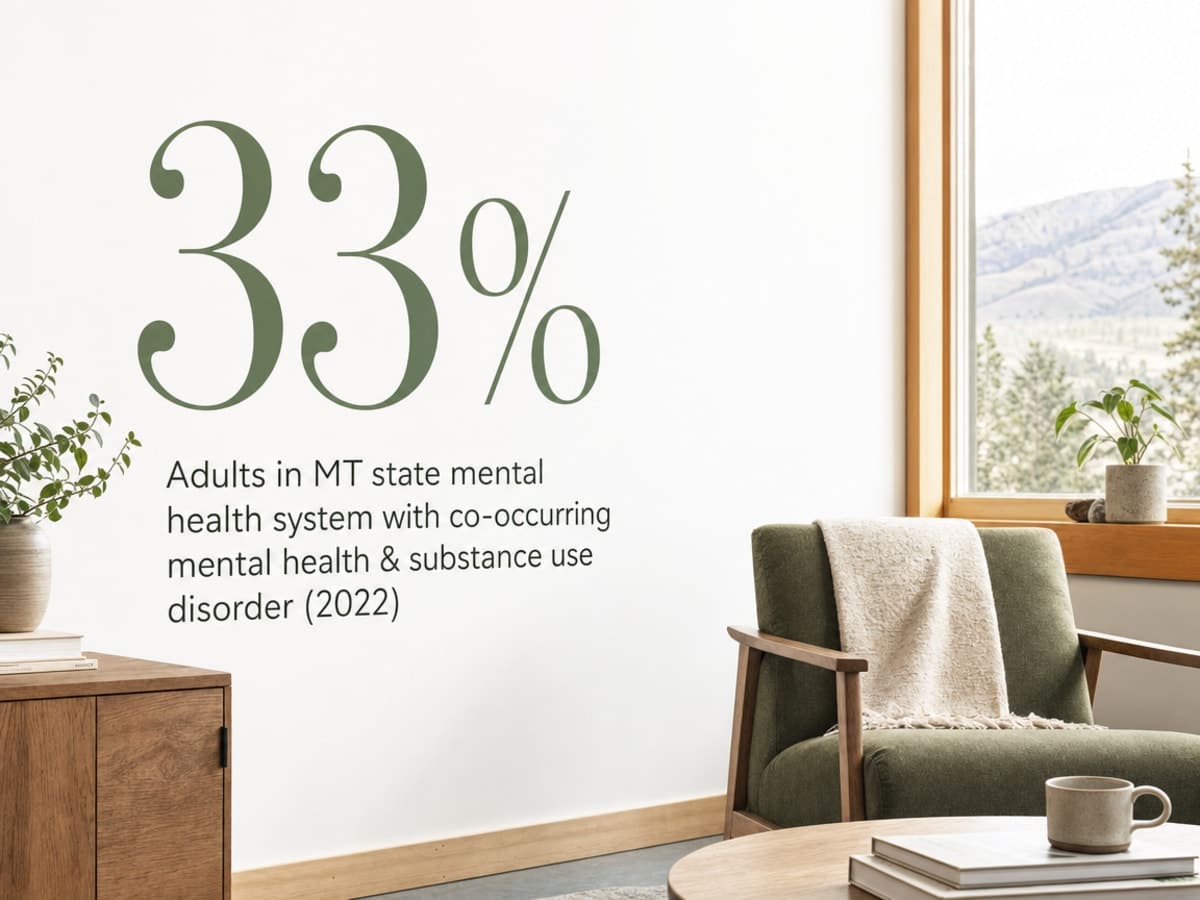
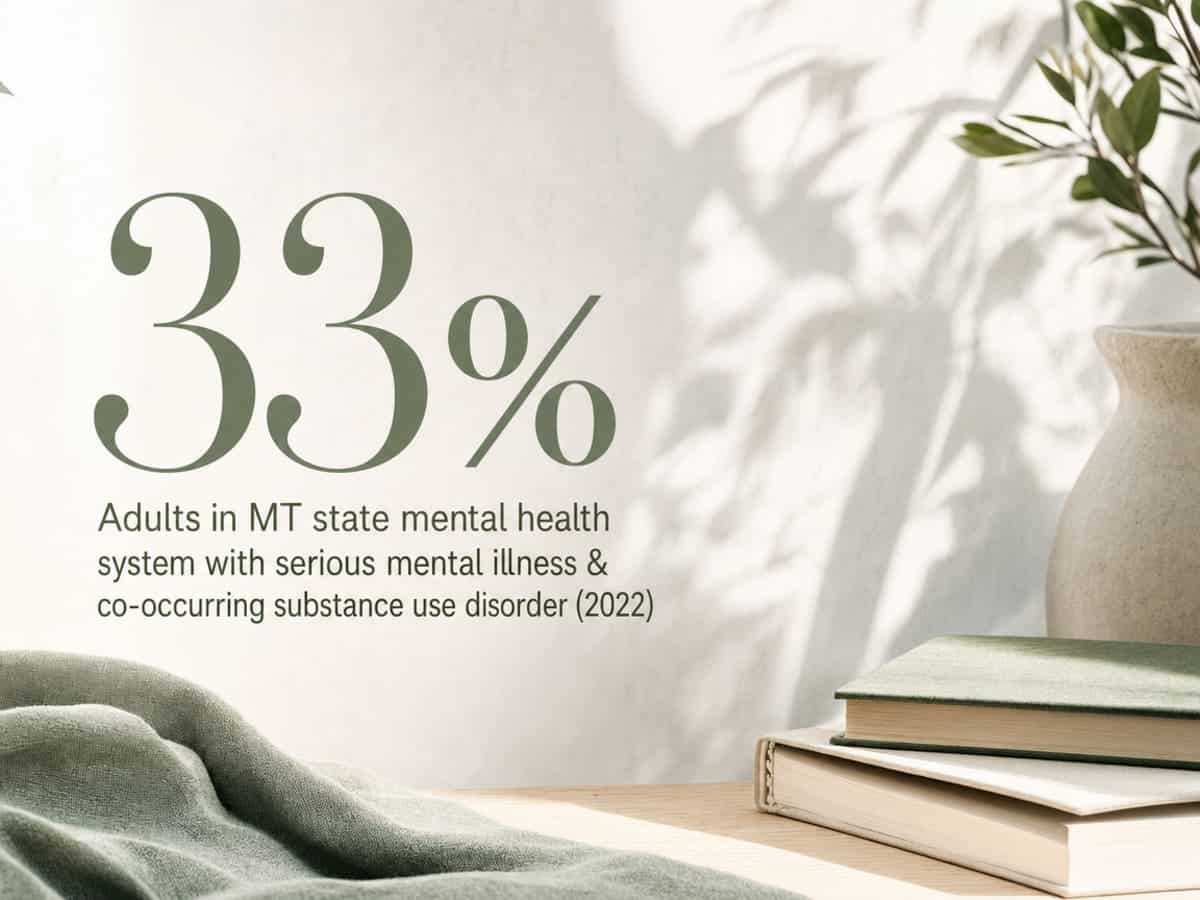
In Montana’s 2022 Uniform Reporting System data, 33% of adults served by the state mental health authority had a co-occurring substance use disorder. Among adults with a diagnosed serious mental illness in that same system, another 33% also carried a substance use diagnosis. Both figures sit above the national average 9. That’s not a small subgroup. That’s one in three of the adults Montana’s public mental health system is already working with.
Read that again if you need to. If you’re sitting in Billings wondering whether it’s realistic to expect a program to actually treat both your PTSD and your drinking, or your bipolar and your stimulant use, the answer is that the majority of people walking into Montana behavioral health services are dealing with some version of the same overlap. You are not the exception the system was built to handle around. You are much closer to who the system is actually seeing.
What ‘Integrated’ Actually Means (and What It Doesn’t)
The word integrated gets used loosely in treatment brochures, so it helps to know what it actually means in the guidance that shapes how programs are built. SAMHSA’s Evidence-Based Practices KIT defines integrated treatment as care in which the same clinicians, or the same team of clinicians, working in one setting, deliver both the mental health and the substance use interventions in a coordinated way 2. One team. One setting. One plan. That’s the standard.
Now compare that to what most people have actually experienced. In parallel care, you see a therapist for the depression on Tuesdays and a substance use counselor at a different agency on Thursdays. The two providers rarely talk. Your medication list lives in one chart, your relapse history in another, and you become the messenger carrying pieces of your own story between them. In sequential care, someone tells you to get sober first and come back for the mental health work later — or the reverse, that you need to stabilize the bipolar diagnosis before anyone will touch the drinking. Both approaches leave you doing the hardest coordination work yourself, at the exact moment you have the least energy for it.
Integrated care removes that burden. Your psychiatrist knows what your counselor is working on this week. Medication decisions get made with your substance use history in the room, not in spite of it. When symptoms shift — the anxiety spikes, the cravings return, the sleep falls apart — one team notices and adjusts, instead of two separate providers each seeing half the picture.
This isn’t a preference or a philosophy. Federal guidance names integrated treatment the preferred model for co-occurring disorders 1, and the research SAMHSA compiled shows it produces better substance use, psychiatric, and day-to-day functional outcomes than treating the conditions separately 2. So when you’re looking at a Billings-area program, the question isn’t whether they say they treat dual diagnosis. Almost every program will say yes. The question is whether the same clinical team is holding both parts of your care in the same plan, or whether they’re quietly handing you back the coordination job you came in trying to put down.
The ‘Wrong Door’ Problem and Why It Keeps Happening
You’ve probably lived some version of this. You called a substance use program and were told they couldn’t take you until the bipolar diagnosis was stable. You called a psychiatric clinic and were told to come back after 30 days sober. You walked into an ER during a crisis and got discharged with two phone numbers and no plan. Each door you tried turned you around and pointed you at a different door.
SAMHSA has a phrase for the fix to this: no wrong door. The standard is that any door you walk through — a primary care office, an addiction program, a mental health clinic, a crisis line — should screen you for both conditions and get you connected to integrated care, not send you back out to find the “right” one yourself 4. In practice, that means every substance use program should have real procedures for spotting a co-occurring mental health condition and doing something useful about it, not just noting it in a chart 6.
Why does the wrong-door problem keep happening anyway? Some of it is funding streams that pay one agency to treat addiction and another to treat mental illness, with no line item for coordinating the two. Some of it is old training that taught clinicians to stay in their lane. Some of it is a genuine staffing shortage — in Billings and across Montana, the psychiatrist who can prescribe and the counselor who can do trauma work are not always in the same building.
None of that is your problem to solve. But knowing the standard exists changes what you’re allowed to ask for. If the first program you call tells you to get treatment somewhere else first, that’s not a diagnosis of your case. That’s a description of their limits.
What a Good Intake in Billings Should Feel Like
The first phone call sets the tone. If the person on the other end asks about both your mental health history and your substance use in the same conversation — not one as an afterthought tacked onto the other — that’s a good sign. National standards say everyone showing up for either kind of treatment should be screened for the other condition as a matter of routine, not as a special request you have to make 4.
When you come in for the full assessment, expect it to take longer than you might want. A thorough dual diagnosis intake covers a lot of ground: how you got here, what you’ve tried before, what medications you’re on and which ones actually helped, your family history, any trauma that shapes how you react to stress, your physical health, your housing and work situation, who’s in your corner and who isn’t. TIP 42 lays out a 12-step assessment that walks through engagement, screening for both disorders, level-of-care decisions, diagnosis, disability, strengths, cultural needs, problem areas, your stage of readiness for change, and a treatment plan built from all of it 1. That’s not a checklist to endure. It’s the difference between a plan that fits you and one that fits a template.
You should leave intake knowing three things: who is on your team, what the first two weeks look like, and how medication decisions will get made. If the intake ends with a vague “we’ll figure that out later,” ask again. You’ve earned specific answers. And if you’re too worn out to ask, bring someone who can ask for you. Showing up is already a win. The rest is what the program owes you.
Levels of Care: How Treatment Steps Down Over Time
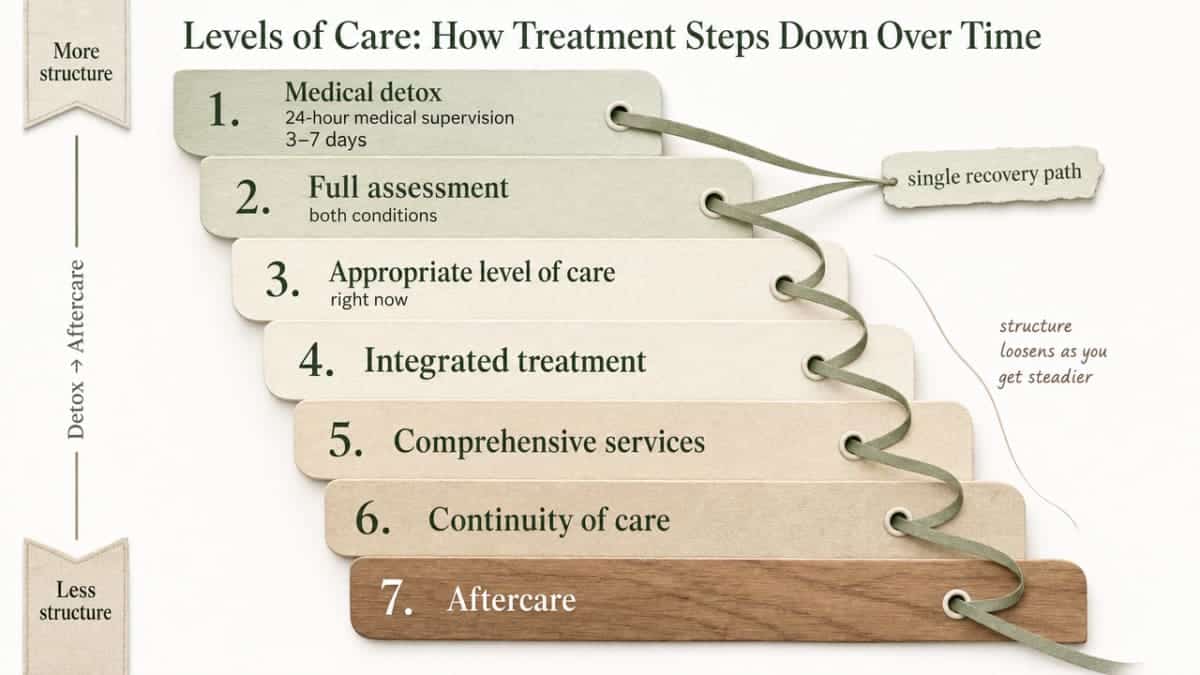
Dual diagnosis treatment isn’t one program. It’s a path with steps, and the point of the steps is to give you exactly as much structure as you need at each stage, then loosen the structure as you get steadier. TIP 42’s guiding principles name this directly: everyone should have access to care, a full assessment of both conditions, the appropriate level of care for where they are right now, integrated treatment, comprehensive services, and continuity of care as they move between levels 6. That last piece — continuity — is what turns a stack of separate programs into a single recovery.
Here’s what the continuum usually looks like around Billings, top to bottom.
- Medical detox
- Comes first if your body is physically dependent on alcohol, benzodiazepines, or opioids. This is 24-hour medical supervision, usually 3 to 7 days, focused on getting you through withdrawal safely. Dual diagnosis matters even here: psychiatric medications you were on before shouldn’t just disappear, and new symptoms that surface as substances clear need someone paying attention.
- Residential inpatient
- A live-in program, typically 30 to 90 days, where you sleep on-site and your days are structured around therapy, groups, medication management, and rest. For a co-occurring presentation, this is where the same team should be treating the trauma, the mood disorder, or the psychosis alongside the substance use — not sending you offsite once a week to see a separate psychiatrist.
- Partial hospitalization (PHP)
- The step down. You spend most of the day in treatment — often 5 or 6 hours, 5 days a week — but sleep at home or in sober housing. It gives you real-world reps while keeping the clinical intensity high.
- Intensive outpatient (IOP)
- Drops the hours further, usually 9 to 15 per week across 3 or 4 days. You’re working, parenting, going to school, and treatment fits around that life instead of replacing it.
- Standard outpatient
- Weekly or twice-weekly therapy plus medication check-ins. By this point, you’re mostly living your life and using treatment to maintain what you’ve built.
- Aftercare and alumni support
- Keeps the connection going after formal treatment ends — recovery coaching, peer groups, check-ins that catch a wobble before it becomes a relapse.
Two things matter more than the labels. First, the same treatment plan should follow you from one level to the next. If detox hands you off and residential starts your assessment from scratch, that’s a break in continuity, and it’s the kind of gap the TIP 42 principles are meant to close 6. Second, you don’t have to march through every step. Some people start at IOP. Some skip residential. The right entry point is the one that matches where you are today, not a template.
The Stages of Real Recovery, Not the Brochure Version
Recovery from co-occurring disorders doesn’t happen in one clean arc. It happens in stages, and knowing which one you’re in changes what actually helps. SAMHSA’s Advisory built on TIP 42 organizes dual diagnosis work around a stage-wise model, so treatment can meet you where you are instead of demanding you show up ready for the finish line 1.
The first stage is engagement. You might not be sure you want treatment yet. Maybe you agreed to the intake to keep the peace at home, or because a judge said so, or because you’re just tired enough to sit down. That’s a valid starting point. A good program spends this stage building trust, not lecturing you about motivation you don’t feel yet.
Next comes persuasion. You’re in the room, but you’re still weighing whether the work is worth it. This is where honest conversations about what your drinking or your untreated PTSD is actually costing you start to land. Progress here looks like curiosity, not commitment.
Active treatment is the stage most brochures show — the therapy groups, the medication adjustments, the concrete skill-building. It’s real work, and it’s also usually shorter than people expect. The heavy lifting happens because the first two stages already happened.
Finally, relapse prevention is the long tail. Symptoms shift. Life happens. A good plan expects that and builds in the check-ins and community supports that catch a slip before it becomes a spiral 7. You are not failing when a stage takes longer than you wanted. You are doing the actual thing.
Medication, Therapy, and Community: Why All Three Matter
Good dual diagnosis treatment leans on three legs at once. Take one away and the whole thing wobbles. The research on co-occurring alcohol use disorder and mental health conditions is direct about this: behavioral therapy, pharmacotherapy, and recovery support in your community should all be part of the plan, not treated as separate menus you pick from 7.
Medication is where a lot of people have been burned before. Maybe a doctor wouldn’t prescribe anything until you were sober. Maybe a rehab took you off a mood stabilizer that was actually working. In integrated care, medication decisions get made with your substance use history in the room. A psychiatrist who sees the whole picture can weigh which antidepressant, anti-anxiety option, or medication-assisted treatment for opioid or alcohol use fits your body and your risks. You get to ask what a medication does, how long it takes to work, and what to do if it doesn’t.
Therapy is where the patterns get named and slowly rewired. That might be trauma-focused work, cognitive behavioral therapy, motivational approaches, or group sessions where you hear your own story in someone else’s words. The point is that the therapist knows about the drinking and the counselor knows about the PTSD, because they’re on the same team looking at one plan 2.
Community is the leg most brochures skip. Peer support, family sessions, 12-step or SMART meetings, a sponsor, a sober coworker who texts on Friday nights — these hold the work together between appointments. You are not supposed to do this alone, and needing people is not weakness. It’s the design.
Access Realities: Distance, Weather, and Waitlists
Getting to care in this part of the country is its own kind of work. If you’re driving into Billings from Miles City, Glendive, or somewhere out past Roundup, you’re already weighing gas, time off work, childcare, and whether the pass will be clear in February. That’s before you’ve made a single clinical decision. Any honest conversation about dual diagnosis treatment here has to name that first.
A few things help. Ask any program you call about their virtual or hybrid options for the outpatient levels of care — a lot of therapy and medication check-ins can happen over video once you’re past the residential stage, which cuts the drive down to the appointments that really need to be in person. Ask about lodging or sober housing partnerships if you’re coming from far enough that daily travel isn’t realistic during PHP or IOP. Ask what happens if a snowstorm cancels a week of sessions — a program with a real plan will have one.
Waitlists are real too. Montana’s behavioral health workforce is stretched, and the scale of need is not small — SAMHSA’s PATH data recorded 55,542 persons contacted in Montana reporting a co-occurring disorder in the 2022 period alone 8. When a program tells you there’s a wait for residential, ask what you can start today. Sometimes that’s an outpatient assessment, a medication consult, or a peer support connection that holds the ground until a bed opens. Waiting empty-handed is different from waiting with something in motion. Push for the second one.
Six Questions to Ask Any Billings-Area Program
When you’re this tired, you don’t need a scorecard. You need a short list of questions that quickly separates a program that actually does integrated dual diagnosis work from one that just puts the words on the website. Bring these to your next call.
- Who prescribes my psychiatric medications, and are they on the same team as my substance use counselor? If the answer involves a referral to an outside psychiatrist, that’s parallel care, not integrated care 2.
- Will one treatment plan cover both conditions, or two separate plans? One plan is the standard 1.
- How do you screen for a co-occurring condition when someone comes in for just one? A good program screens everyone for both, every time 4.
- What happens as I step down from residential to PHP to IOP — does my team change? Continuity of care is one of the guiding principles for a reason 6.
- How do you handle a mental health crisis mid-treatment without discharging me? Programs built for dual diagnosis expect symptom shifts and adjust; they don’t send you elsewhere.
- What can I start this week if there’s a waitlist for the level of care I need? A real answer means something is moving.
If a program stumbles on more than one of these, keep calling.
Finding a Way Forward
Here’s what you actually need to hold onto. Dual diagnosis isn’t a complication. It’s the shape of what most people around Billings are already living with, and the care that works treats both conditions together, from the same team, under one plan 2. That standard exists. You get to ask for it.
You don’t have to feel ready. You don’t have to have the mental health piece figured out before you address the substance use, or the other way around. Showing up for the call is the win today. Sitting through the assessment is the win next week. One honest conversation with a prescriber who sees the whole picture is the win after that. Small, real steps stack.
If you’re weighing your options in Montana, Elk Ridge Recovery is one place to start that conversation. Whatever door you pick, pick one this week.
Connect Directly for Dual Diagnosis Support Today
Speak with an admissions specialist about integrated treatment options tailored for dual diagnosis in Billings.
Frequently Asked Questions
What is dual diagnosis treatment?
Dual diagnosis treatment is care for someone who has both a mental health condition and a substance use disorder at the same time. Instead of treating one and hoping the other resolves on its own, an integrated program addresses both conditions together, with the same clinical team and one treatment plan. Federal guidance names this the preferred model for co-occurring disorders 1.
How is integrated care different from seeing a therapist and a rehab program separately?
Integrated care means the same clinicians or team, working in one setting, deliver both the mental health and substance use interventions in a coordinated way 2. Seeing a therapist at one place and a rehab at another is parallel care. You end up carrying pieces of your story between providers who rarely talk. Integrated care puts both conditions in one plan and takes that coordination job off your shoulders.
Do I have to be sober before I can get mental health treatment in Billings?
No. That old rule doesn’t match current standards. SAMHSA’s guidance follows a “no wrong door” approach: any program you walk into should screen you for both conditions and connect you to integrated care, not turn you away until you handle one on your own first 4. If a provider tells you to get sober before they’ll treat your mental health, that’s a limit of their program, not a rule about you.
What levels of care are available for dual diagnosis treatment near Billings?
The continuum usually runs from medical detox to residential inpatient, then partial hospitalization (PHP), intensive outpatient (IOP), standard outpatient, and aftercare. You step down as you get steadier. What matters most is that integrated dual diagnosis care threads through every level and that your treatment plan follows you between them, which is one of the core guiding principles for co-occurring care 6.
What should I expect from a good intake assessment?
Expect it to take time and cover both sides of your history in the same conversation. A thorough dual diagnosis intake walks through engagement, screening for both conditions, level-of-care decisions, diagnosis, strengths, cultural needs, stage of readiness, and a treatment plan built from what you shared 1. You should leave knowing who’s on your team, what the first two weeks look like, and how medication decisions get made.
How do I know if a Billings-area program can actually treat both conditions?
Ask direct questions. Is the psychiatrist prescribing my medications on the same team as my substance use counselor? Will one plan cover both conditions? Do you screen everyone for the other condition at intake? Does my team stay with me as I step down between levels? Integrated programs answer these clearly. Programs that stumble or point you to outside referrals are running parallel care with a dual diagnosis label 2.
References
- Substance Use Disorder Treatment for People with Co-Occurring Disorders (Advisory based on TIP 42). https://library.samhsa.gov/sites/default/files/pep20-06-04-006.pdf
- Integrated Treatment for Co-Occurring Disorders: The Evidence (EBP KIT). https://library.samhsa.gov/sites/default/files/ebp-kit-the-evidence-10242019.pdf
- Integrated Treatment for Co-Occurring Disorders: How to Use the Evidence-Based Practices KITs. https://library.samhsa.gov/sites/default/files/ebp-kit-how-to-use-the-ebp-kit-10112019_0.pdf
- Managing Life with Co-Occurring Disorders. https://www.samhsa.gov/mental-health/serious-mental-illness/co-occurring-disorders
- Substance Abuse Treatment for Persons With Co-Occurring Disorders. https://library.samhsa.gov/product/substance-abuse-treatment-persons-co-occurring-disorders/sma10-4531
- Chapter 2—Guiding Principles for Working With People Who Have Co-Occurring Disorders (from TIP 42, NCBI Bookshelf). https://www.ncbi.nlm.nih.gov/books/NBK571016/
- Integrating Treatment for Co-Occurring Mental Health Conditions. https://pmc.ncbi.nlm.nih.gov/articles/PMC6799972/
- Demographics: Co-Occurring Disorder – PATH PDX, Montana. https://pathreports.samhsa.gov/reports/public/state/2022/29/secdemographicsco_occurring_disorder
- Montana 2022 Uniform Reporting System Mental Health Data Results. https://www.samhsa.gov/data/sites/default/files/reports/rpt42763/Montana_0.pdf
- Final Alcohol, Tobacco and Other Drugs (ATOD) Task Force Report. https://formergovernors.mt.gov/martz/content/drugcontrol/FINAL_ATOD_Task_Force_Report.pdf