Key Takeaways
- Integrated dual diagnosis care in Bozeman means one team treats mental health and substance use together in a shared plan, rather than sequential referrals or parallel providers who never coordinate.
- Evidence shows integration reliably improves depression, anxiety, and PTSD symptoms, but substance use outcomes depend heavily on program design, addiction medications offered, and aftercare strength 1.
- Montana’s rural terrain, workforce shortages, and the fact that 33% of adults in the state mental health system carry co-occurring disorders shape what local care realistically looks like 6.
- Before committing to a Bozeman program, ask who shares the chart, whether stage-wise care accepts people still using, which addiction medications are prescribed, and what months two through twelve include.
When one condition keeps pulling the other back
You already know the pattern. The depression lifts a little, so you drink less. Then a hard week hits, the drinking climbs back, and the depression settles in deeper than before. Or the panic wakes you at 3 a.m., the pills quiet it, and the pills start running your day. Whichever came first stops mattering. They move together now.
If you have tried getting help before in Bozeman or anywhere in Montana, you may have run into a version of this: a therapist who says get sober first, come back later. A treatment program that treats the drinking but tells you to see a psychiatrist for the rest. Two clinicians who never talk to each other. You leave each appointment feeling like half of you was in the room.
Integrated dual diagnosis treatment is built to end that split. One team, one plan, both conditions held at the same time. This piece walks you through what that actually looks like, what the research honestly supports, and how to find it near you.
What integrated dual diagnosis treatment actually means
Integrated dual diagnosis treatment means one clinical team treats your mental health condition and your substance use at the same time, in the same plan, with the same people in the room. Not two parallel tracks that occasionally exchange notes. Not a sequence where you have to finish one before you’re allowed to start the other. Both conditions are treated as connected from the first assessment forward.
SAMHSA’s guidance is direct about this: integrated care is the preferred model for people with co-occurring disorders, and it’s considered a best practice rather than an experimental add-on 12. In practice, that shows up as a few concrete things. Your psychiatrist and your addiction counselor share a chart and a treatment plan. Group and individual sessions address depression, anxiety, PTSD, or bipolar symptoms alongside cravings, triggers, and use patterns. Medication decisions consider both sides at once, so an antidepressant and a medication for alcohol or opioid use disorder can be started together instead of one being held hostage to the other.
There’s also a philosophy underneath it. Integrated dual diagnosis treatment is described in federal guidance as a unified approach that pulls together psychological, pharmacological, educational, and social pieces into one plan rather than a stack of referrals 15. It uses stage-wise care, motivational techniques, and a long-term, community-based view instead of expecting a single 30-day stay to resolve years of intertwined symptoms 13. If you’ve been told to pick a lane before, this is the model built around the fact that you can’t.
The honest evidence: what integration reliably delivers
Here’s the part most treatment center websites won’t tell you plainly: integrated care is not a magic upgrade that fixes everything faster. It reliably helps with some things and only modestly helps with others. Knowing the difference up front protects you from disappointment and lets you push for the parts that actually matter.
A 2023 systematic review and meta-analysis compared integrated dual diagnosis programs with non-integrated care across published trials. Integrated treatment significantly improved psychiatric symptoms compared to non-integrated approaches. But for substance use outcomes and treatment retention, the researchers found no significant advantage for integration on its own 1. That’s not a reason to skip integrated care. It’s a reason to understand what you’re buying.
What integration reliably delivers, based on the research: better mood, less anxiety, fewer PTSD symptoms, and a clinical relationship that holds both sides of what’s happening to you. A randomized trial of integrated care for co-occurring depression and substance use found larger reductions in depressive symptoms and stronger treatment engagement than usual care 10. A trial of integrated CBT for co-occurring anxiety and substance use found greater anxiety reduction and higher completion rates than standard SUD treatment alone 11. The mental health side of the equation moves.
What integration alone doesn’t guarantee: dramatic drops in drinking or drug use, or long-term retention. Those outcomes depend on the specific program design, whether care is stage-wise, whether medication for addiction is on the table, and how strong the aftercare tail is 13. Poorly designed integrated programs can add cost and complexity without adding clinical benefit 14.
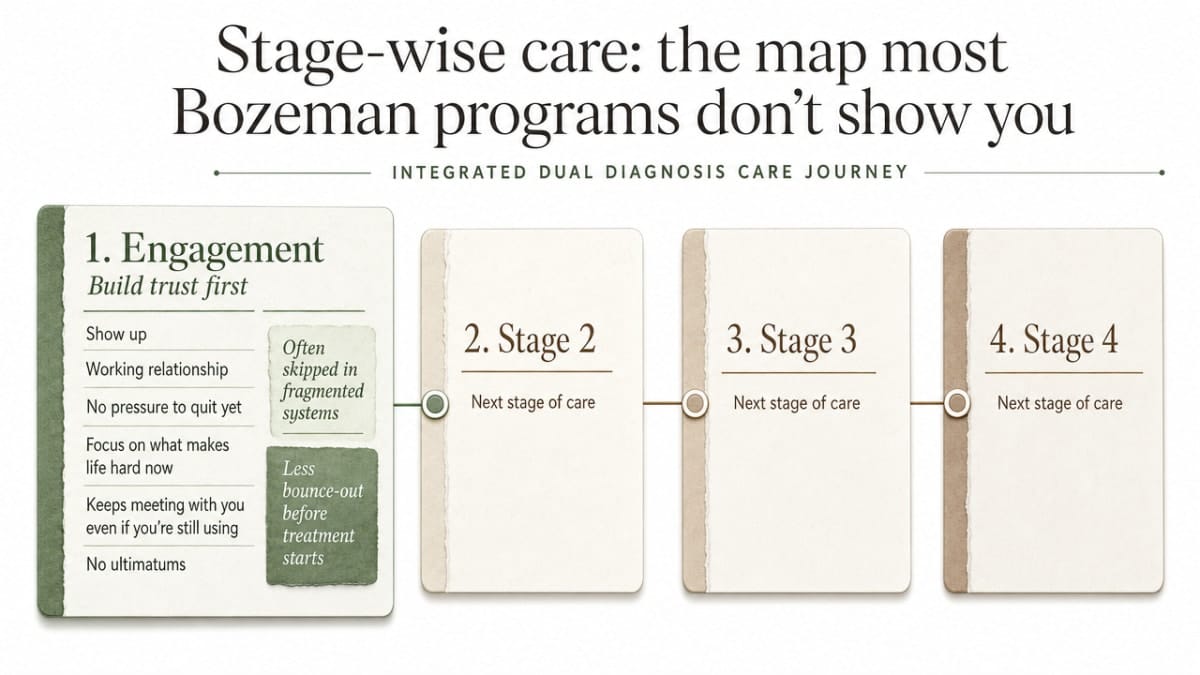
Stage-wise care: the map most Bozeman programs don’t show you
Engagement: building a working relationship first
The first stage of integrated dual diagnosis treatment isn’t about quitting anything. It’s about showing up. In stage-wise care, engagement means the clinical team’s only real goal is building a trusting working relationship with you, whether or not you’ve decided to change your use yet 13. That might sound soft. It’s actually the part most fragmented systems skip, which is why so many people bounce out before real treatment starts.
What it looks like in practice: intake calls that don’t quiz you on how many drinks you had last week. A first appointment focused on what’s making your life hard right now. A counselor who accepts that you may still be using and keeps meeting with you anyway. If a Bozeman program greets you with an ultimatum, that’s not engagement. Coming to one appointment counts as progress here.
Persuasion: making change feel possible
Once you’re actually in the room, persuasion is the stage where the work turns toward wanting something different. You’re not being sold on sobriety. You’re being helped to notice, on your own terms, how your use and your mental health symptoms feed each other, and what a small change might open up 12. Motivational techniques do most of the lifting here.
This stage often includes psychiatric assessment, starting or adjusting medications for depression, anxiety, or bipolar symptoms, and mapping out what harm reduction could look like before full abstinence is on the table. If you leave a session feeling a little more curious and a little less cornered, the persuasion stage is doing its job. That’s a real win, even if nothing about your use has changed yet.
Active treatment: doing the clinical work
Active treatment is the stage most people picture when they hear the word rehab, but in an integrated model it’s only one part of a longer arc. Here you and your team work directly on reducing substance use and treating the mental health condition at the same time, in coordinated sessions rather than parallel appointments 13. Cognitive behavioral therapy, trauma-focused work when appropriate, group therapy that addresses both sides, and medication management all happen inside one plan.
This is where residential, partial hospitalization, or intensive outpatient care in Bozeman usually lives. Expect structure: daily or near-daily contact, measurable goals, and a clear read on what’s working. Expect setbacks too. A hard week doesn’t drop you back to stage one. Active treatment is designed to hold both progress and slips without the team disappearing on you when things get messy.
Relapse prevention and the long tail
Relapse prevention is the stage that decides whether the work sticks, and it’s the stage most programs shortchange. Integrated dual diagnosis treatment is explicitly designed as long-term and community-based, not as a discrete 30- or 90-day event 13. After the intensive weeks end, you still need psychiatric follow-up, ongoing therapy, medication continuity, peer or mutual-support connection, and a plan for the moments when depression flares or a craving hits at the wrong hour.
This is also where the honest evidence matters most. Because integrated care shows its strongest gains on psychiatric symptoms rather than on substance use outcomes on its own 1, the aftercare tail is where addiction outcomes actually get won or lost. When you’re evaluating a Bozeman program, ask specifically what months two, six, and twelve look like. If the answer gets vague, you’ve found the weak spot.
How Montana shapes the care you can actually get
Where you live changes what treatment can look like, and Montana is honest about that in ways coastal treatment guides usually aren’t. Bozeman sits in the Gallatin Valley with real distance between it and the next town over. Winter closes roads. Small-town referral networks mean the counselor who assessed your brother in high school might be the same person picking up your intake call. That’s not a flaw. It’s the terrain integrated care has to work with.
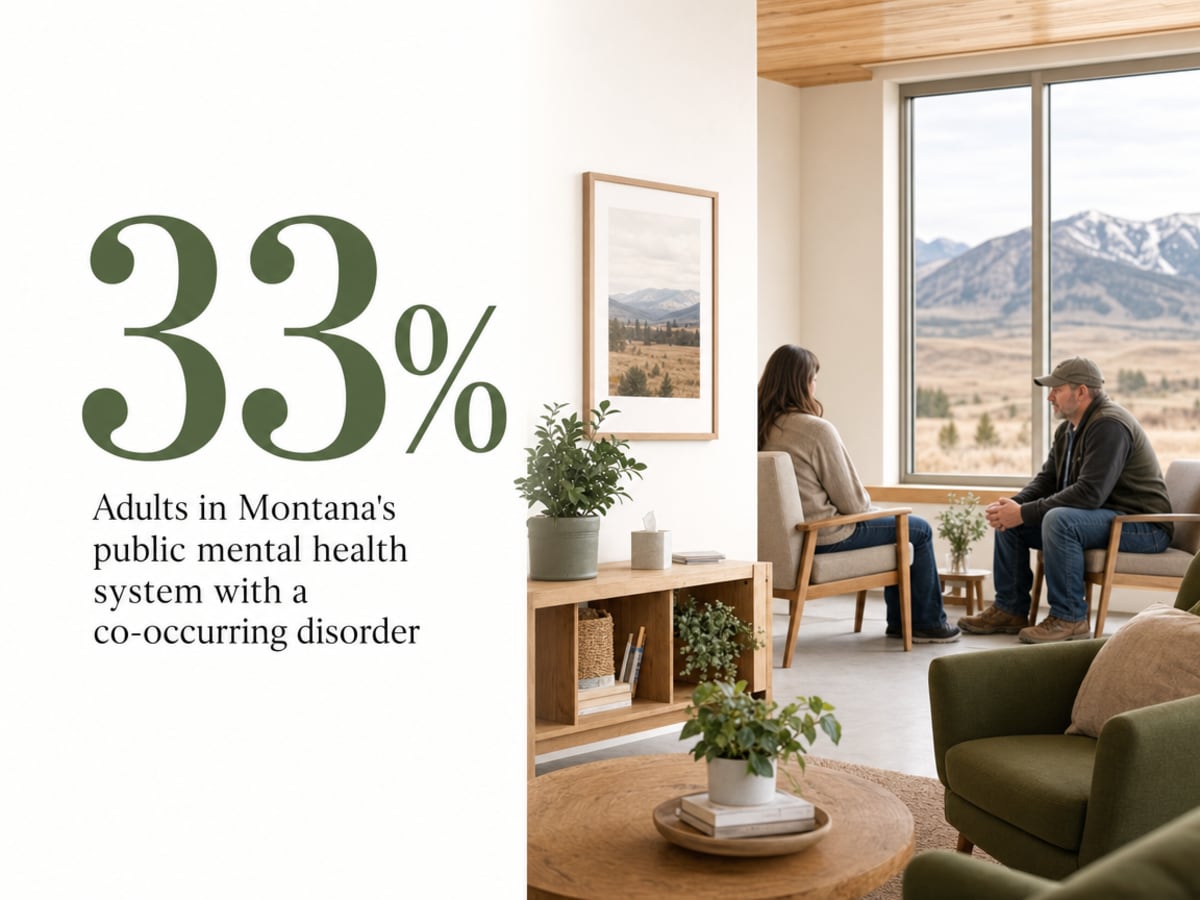
The local need is not abstract. According to Montana’s 2022 Uniform Reporting System data, 33% of adults served by the state mental health authority had a co-occurring mental health and substance use disorder 6. That’s roughly one in three people already inside the public system carrying both diagnoses at once. If it feels like you’re the only one trying to hold both, you’re not.
What that means practically for Bozeman: demand for integrated care outstrips the number of clinicians credentialed to deliver it, and the workforce shortage federal guidance names as a barrier in rural and frontier areas shows up here too 12. Waitlists happen. Drive times to a psychiatrist can stretch. Telehealth fills real gaps for medication management and therapy between in-person visits, especially in January when the pass is closed and you can’t make it in.
The Montana context also shapes what wellness looks like. Aftercare that leans on the Bridgers, the rivers, and small-group outdoor time isn’t decoration. It’s a way to build the kind of long, community-based tail integrated care needs to actually work.
What integrated care looks like for specific conditions
Depression paired with alcohol or drug use
If you’ve been drinking to soften the flatness, or using to feel anything at all, you already know how tangled depression and substance use get. Treating one without the other tends to leave you back where you started within weeks.
Inside an integrated program, depression and alcohol or drug use are addressed in the same plan by the same team. That usually means antidepressant management alongside behavioral therapy, with a counselor tracking how your mood and your use move together week to week. A randomized trial of integrated care for co-occurring substance use and depression found larger reductions in depressive symptoms and stronger treatment engagement than usual care, with smaller effects on substance use itself 10.
Read that honestly. Your mood is likely to lift meaningfully. The drinking or drug use will need its own dedicated work inside the same plan, not as an afterthought.
Anxiety disorders and substance use
Anxiety and substance use build a fast loop. The drink or the pill quiets the racing chest at night. The next morning, the anxiety comes back sharper, and the fix that worked yesterday is already the problem.
Integrated care for anxiety disorders usually pairs cognitive behavioral therapy focused on anxiety with concurrent treatment of the substance use, rather than making you complete one before starting the other. A randomized trial of an integrated CBT program for co-occurring anxiety and substance use disorders found greater anxiety reduction and higher treatment completion rates than standard SUD care alone, with mixed effects on substance use 11.
What that means for you: the panic, the avoidance, the 3 a.m. spiral can start easing while you’re still sorting out your relationship with the substance. You don’t have to white-knuckle sobriety first.
PTSD and substance use: the ‘no wrong door’ finding
If you’ve avoided treatment because you’re afraid someone will make you talk about the worst thing before you’re ready, this section is for you. A common belief, even among clinicians, is that you have to be stable and sober before trauma work can begin. The research pushes back on that hard.
A meta-analysis of randomized trials for adults with co-occurring PTSD and substance use disorders compared trauma-focused therapies, non-trauma-focused therapies, and SUD-focused care. All three approaches produced medium to large improvements in both PTSD and substance use outcomes, with small and mostly non-significant differences between them. The authors describe this as a“no wrong door” finding: there isn’t one required entry point for PTSD/SUD recovery3.
In practice, that gives you room. If you can tolerate trauma-focused work now, an integrated program in Bozeman can offer it alongside substance use treatment. If you can’t, starting with SUD-focused care or non-trauma-focused therapy is a legitimate path, not a stall. The door you walk through counts.
Serious mental illness with a co-occurring SUD
If you or someone you love is living with schizophrenia, schizoaffective disorder, or bipolar I alongside a substance use disorder, the stakes are higher and the coordination has to be tighter. Hospitalizations, medication changes, and housing stability all sit in the same plan as the substance use work.
A systematic review of integrated treatment for serious mental illness and co-occurring substance use disorders found that integrated approaches often improve engagement and some clinical outcomes, though the overall evidence is mixed and limited by small samples 9. Federal guidance points to assertive community treatment, integrated case management, and long-term, community-based support as the model best matched to this population 12.
Look for a Bozeman program that names how it coordinates psychiatric care, case management, and substance use treatment inside one team. Fragmented care fails this group first.
Medication, therapy, and how they fit together
A real integrated plan isn’t just “therapy plus a pill.” It’s four pieces working the same problem from different angles at the same time. NIAAA-supported guidance describes integrated dual diagnosis treatment as one plan that pulls together psychological, pharmacological, educational, and social interventions for people carrying a mental health condition alongside a substance use disorder 4. When any one of those pieces is missing, the plan tends to wobble.
The therapy piece is what most people picture: cognitive behavioral therapy, motivational work, trauma-focused sessions when you’re ready, and group work that treats both sides in the same hour. The pharmacological piece runs alongside it. That can mean an antidepressant, a mood stabilizer, or an anti-anxiety medication that isn’t habit-forming, prescribed by a psychiatrist who knows what you’re using. It can also mean medication for the addiction itself, sometimes called MAT: naltrexone or acamprosate for alcohol, buprenorphine or naltrexone for opioid use disorder. Inside integrated care, these aren’t sequenced. They’re started together.
The education piece is easy to underestimate. Understanding how a nightly drink flattens the same brain systems your antidepressant is trying to lift changes what you do at 9 p.m. The social piece, family sessions, peer support, help with housing or work, is what keeps the plan alive between appointments.
When you ask a Bozeman program how they treat both conditions, listen for all four pieces in the answer. If one is missing, that’s the gap you’ll feel later.
If you’re the family member helping someone get care
This section is for you, not the person you’re worried about. Loving someone through co-occurring depression and drinking, or PTSD and pills, is its own kind of exhausting. You’ve probably read more about treatment options than they have. You may also be the one making the calls.
A few things worth knowing. First, you don’t have to wait for rock bottom or a clean pledge before an integrated program will talk to you. The first stage of this kind of care is designed to build a relationship with someone who hasn’t decided to change yet 13. An intake conversation is a legitimate starting point, even if your person is still using tonight.
Second, ask programs how they involve family. Federal guidance names family and social support as core pieces of integrated dual diagnosis care, not extras 12. Family sessions, education about how the two conditions feed each other, and clear communication about the treatment plan help you stop guessing.
Third, take care of your own footing. You cannot out-love a co-occurring disorder. Getting your person to one appointment is a real win. So is going to bed at a normal hour yourself.
How to evaluate a Bozeman program before you commit
Picking a program while you’re already exhausted is a lot to ask. A short list of questions can do most of the work for you. Bring it to the intake call. If the answers get vague, you’ve learned something.
Ask who holds both conditions in one plan. You want to hear that a psychiatrist or psychiatric provider and an addiction counselor share the same chart and meet about your case, not that they’ll refer you out for the other half. Integrated care is defined by that shared clinical ownership, not by having both services in the same building 12.
Ask about stage-wise care and what happens if you’re not ready to quit yet. A program built on engagement and persuasion won’t turn you away for still using at intake 13. Ask which medications for addiction they prescribe, and whether antidepressants or mood stabilizers can start alongside them rather than after. Ask specifically what months two, six, and twelve look like, because the aftercare tail is where substance use outcomes are actually won 1.
For trauma, ask whether trauma-focused and non-trauma-focused options are both available so the door matches where you are today 3. For family, ask how they’re included. If a program can answer these plainly, that’s a real signal. Making the call is already a step worth counting.
Speak With a Bozeman Dual Diagnosis Specialist
Connect directly for tailored guidance on integrated mental health and substance use recovery in Bozeman.
Frequently Asked Questions
Do I need to be sober before I can get mental health treatment in an integrated program?
No. Integrated dual diagnosis care is built to meet you where you are, including if you’re still using tonight. The first stage is about building a working relationship, not passing a sobriety test 13. A psychiatric assessment and medications for depression, anxiety, or mood symptoms can start alongside the substance use work. Showing up to the intake call counts.
How is integrated dual diagnosis treatment different from seeing a therapist and a substance use counselor separately?
In integrated care, one clinical team owns both conditions inside a shared plan and shared chart, rather than two providers working in parallel 12. That means medication decisions, therapy focus, and goals move together instead of contradicting each other. Fragmented care often leaves you translating between clinicians. Integrated care puts that coordination on the team, not on you.
Does integrated treatment actually work better than standard care?
For your mental health, yes, fairly consistently. A 2023 meta-analysis of dual diagnosis programs found integrated care significantly improved psychiatric symptoms compared to non-integrated approaches, but showed no consistent advantage for substance use outcomes or retention on its own 1. Translation: expect meaningful mood and anxiety gains. Substance use progress depends on program design, medication options, and how strong the aftercare is.
Can I start trauma-focused therapy for PTSD while I’m still using?
Often, yes. A meta-analysis of PTSD and substance use trials found trauma-focused, non-trauma-focused, and SUD-focused approaches all produced meaningful improvements in both PTSD and substance use, with few significant differences between them 3. The researchers describe it as a “no wrong door” finding. If you’re ready for trauma work, it can happen now. If you’re not, that’s also a real path.
Are medications like antidepressants or MAT part of integrated dual diagnosis care?
Yes, and ideally started together rather than sequenced. Integrated care combines psychological, pharmacological, educational, and social interventions in one plan 4. That can include antidepressants or mood stabilizers alongside medications for addiction, like naltrexone or acamprosate for alcohol, or buprenorphine or naltrexone for opioid use disorder. Ask any Bozeman program specifically which addiction medications they prescribe inside the integrated plan.
What should my family do if I’m not ready to commit to treatment yet?
Have them call anyway. Integrated programs are designed to engage people who haven’t decided to change, and family involvement is a core piece rather than an extra 12. They can ask about family sessions, education on how the two conditions feed each other, and what an initial conversation looks like with no commitment attached. One phone call is a legitimate first step.
References
- Integrated vs non-integrated treatment outcomes in dual diagnosis: a systematic review and meta-analysis. https://pmc.ncbi.nlm.nih.gov/articles/PMC10157410/
- A Systematic Review of Gender‑Responsive and Integrated Substance Use Treatment for Women. https://pubmed.ncbi.nlm.nih.gov/36283062/
- Efficacy and Acceptability of Interventions for Co‑occurring Posttraumatic Stress Disorder and Substance Use Disorders: A Meta‑analysis. https://pmc.ncbi.nlm.nih.gov/articles/PMC8819868/
- Integrating Treatment for Co-Occurring Mental Health Conditions. https://pmc.ncbi.nlm.nih.gov/articles/PMC6799972/
- 2023 National Survey on Drug Use and Health: Montana State‑Level Estimates. https://www.samhsa.gov/data/sites/default/files/reports/rpt56188/2023-nsduh-sae-state-tables_0/2023-nsduh-sae-state-tabs-montana.pdf
- Montana 2022 Uniform Reporting System Mental Health Data Results. https://www.samhsa.gov/data/sites/default/files/reports/rpt42763/Montana_0.pdf
- Montana 2019 Uniform Reporting System Output Tables. https://www.samhsa.gov/data/sites/default/files/reports/rpt27956/Montana%202019%20URS%20Output%20Tables/Montana%202019%20URS%20Output%20Tables.pdf
- Integrated Care for People with Co‑occurring Mental Health and Substance Use Problems: A Systematic Review of Economic Evaluations. https://pubmed.ncbi.nlm.nih.gov/34491640/
- Integrated Treatment of Substance Use and Serious Mental Illness: A Systematic Review. https://pubmed.ncbi.nlm.nih.gov/30322257/
- Integrated Care Models for Co‑occurring Substance Use and Depression: A Randomized Controlled Trial. https://pubmed.ncbi.nlm.nih.gov/31971758/
- Integrated Treatment for Co‑occurring Substance Use and Anxiety Disorders: A Randomized Trial. https://pubmed.ncbi.nlm.nih.gov/28079716/
- Substance Use Disorder Treatment for People with Co-Occurring Disorders. https://library.samhsa.gov/sites/default/files/pep20-06-04-006.pdf
- Integrated Treatment for Co-Occurring Disorders: The Evidence. https://library.samhsa.gov/sites/default/files/ebp-kit-the-evidence-10242019.pdf
- Integrated care – panacea or white elephant? A review of integrated care concepts and outcomes. https://research.monash.edu/en/publications/integrated-care-panacea-or-white-elephant-a-review-of-integrated-/
- Integrated Treatment for Co-Occurring Disorders (SAMHSA Digital Download). https://library.samhsa.gov/sites/default/files/SAMHSA_Digital_Download/PEP20-02-01_004.pdf