Key Takeaways
- Integrated dual diagnosis care means one team, one chart, and one plan treating mental health and substance use together, rather than sequentially or in parallel silos 4.
- Bozeman’s winters, geographic isolation, and small-town privacy concerns shape how well a program will hold, so ask about confidentiality, virtual check-ins, and missed-session protocols.
- Montana’s parity law and Medicaid pathways under Title 53, Chapter 6 support both SUD and mental health services, but coverage only supports integration if one team bills both sides 8, 9.
- Before committing, compare programs on team structure, dual screening at intake, a single written plan, stage-wise phases, and whether they track substance use, symptoms, housing, and employment 5, 1.
When the last treatment worked, until it didn’t
If you are reading this, something has already gone sideways. Maybe you finished a 30-day program last spring and felt steady until the anxiety came back in October. Maybe your loved one saw a therapist for the depression, quietly kept drinking, and no one on either side of that care ever compared notes. That pattern is not a personal failure. It is what happens when two conditions that feed each other get treated on separate tracks.
Co-occurrence is common enough that federal guidance treats it as the rule rather than the exception, and the clinical direction is clear: both conditions need to be addressed at the same time, not one after the other 2. Sequential care, where you are told to get sober first and deal with the mental health piece later, tends to hand the substance use back its best reason to return 5.
So before you spend another season white-knuckling through a Bozeman winter, it is worth understanding what integrated dual diagnosis care actually is, what it looks like on the ground here, and how to tell whether the program you are considering will hold.
What integrated dual diagnosis care actually means
One team, one setting, two conditions treated at once
The clearest working definition of integrated care comes from SAMHSA’s evidence-based practices review: the same clinicians, or a single team of clinicians, working in one setting, deliver mental health and substance use interventions together in a coordinated way 4. That sentence sounds bureaucratic until you translate it into what it means for you on a Tuesday morning.
It means the psychiatrist who adjusts your antidepressant knows exactly how many days you have been sober and what your cravings looked like last weekend. It means the counselor working through your trauma is not waiting on faxes from another agency to find out whether your sleep is improving on the new medication. It means when you tell one person on the team something hard, you do not have to repeat it three more times to three more strangers.
One team. One chart. One treatment plan that treats you as a whole person rather than two half-cases sitting in different waiting rooms.
That structure is what lets a clinician catch the thing a siloed system misses: the fact that your drinking spiked the week your anxiety medication was cut in half, or that a rough family session on Thursday is why you skipped Friday’s group. Small signals connect quickly when the people watching are actually in the same room.
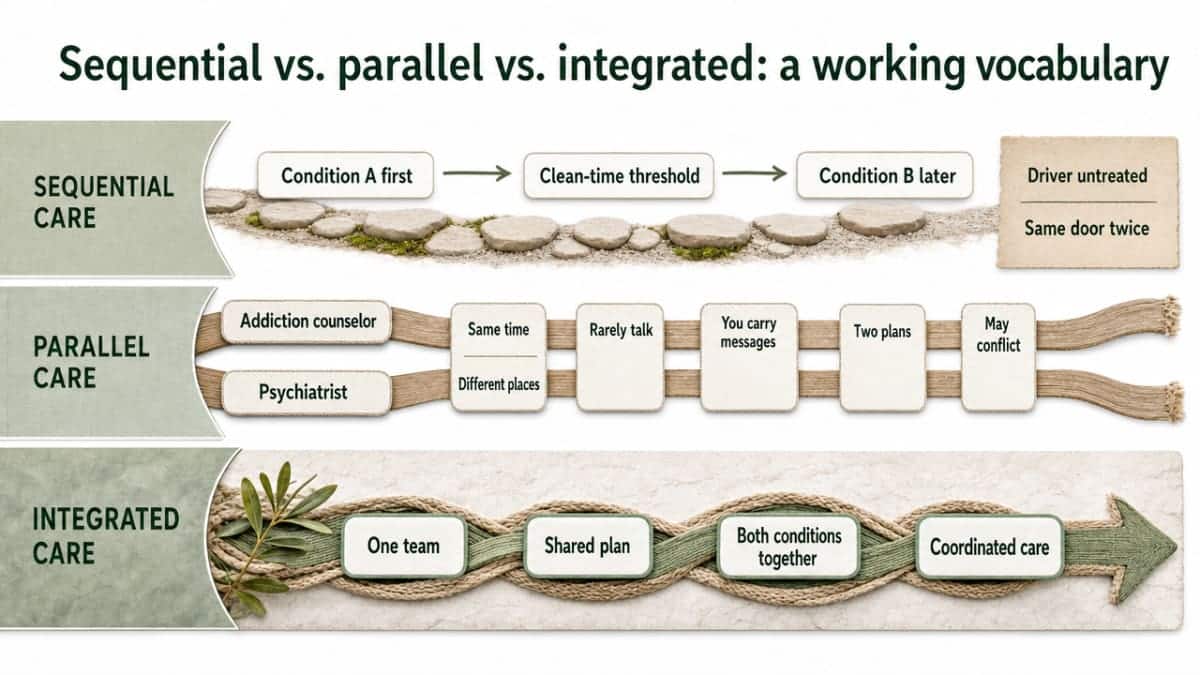
Sequential vs. parallel vs. integrated: a working vocabulary
Three words get used loosely in this field, and knowing the difference will save you months.
- Sequential care
- Treats one condition, then the other. You are told to get sober first, and only after some clean-time threshold will a provider engage the depression or the PTSD. In practice, this asks you to hold a fragile new sobriety together while the very thing that drove you to drink goes untreated. It is the model most likely to send someone back through the same door twice.
- Parallel care
- Treats both conditions at the same time, but in different places, by different people, who rarely talk. You see the addiction counselor on Mondays and the psychiatrist on Wednesdays, and you become the messenger between them. You end up translating, scheduling, and reconciling two treatment plans that occasionally contradict each other. Most people trying to survive a co-occurring diagnosis do not have the bandwidth to also be their own care coordinator.
- Integrated care
- The third option, and it is the one the peer-reviewed guideline literature actually endorses. A recent synthesis of international guidelines concludes that integrated models produce better outcomes and are the most cost-effective approach when one team delivers both addiction and mental health services within the same setting 6.
Here is why the distinction matters when you are calling programs in Bozeman: a facility can honestly say it “treats co-occurring disorders” and still be running a parallel model with two separate teams under one roof. That is not the same thing. Ask who writes the plan, who meets about your case, and how often those clinicians are in the same conversation. If the answer is that the addiction team and the mental health team meet weekly and share one plan for you, you are looking at integration. If the answer is that they share a building but not a chart, you are looking at parallel care with better marketing.
Why co-occurring conditions pull each other under
Two conditions that share a nervous system do not politely take turns. Depression makes drinking feel like the only quiet in the room. Drinking, over time, deepens the depression. PTSD flares at 2 a.m., so you use something to sleep, so the sleep architecture worsens, so the flashbacks get louder. Each side of the loop borrows fuel from the other.
When a program treats only one side, the untreated side keeps refilling the tank. That is why sequential interventions carry a higher risk of relapse: you stabilize one condition while the other quietly rebuilds the pressure that will eventually break the stabilization 5. It is not a matter of willpower. It is a matter of physiology and timing.
Integrated care assumes the loop from day one. The treatment plan does not wait for you to earn access to psychiatric care by staying sober long enough. Both conditions get worked on in the same week, by people who understand that a bad night of sleep and a strong craving are often the same story told twice.
What good care looks like on the ground
Concurrent screening and comprehensive assessment
Good dual diagnosis care starts before the treatment plan is written. It starts with someone taking the time to screen you for both conditions on the same day, in the same conversation, no matter which door you walked through.
SAMHSA’s guidance is direct on this point: everyone entering substance use treatment should be screened for co-occurring mental disorders, and everyone entering mental health treatment should be screened for substance misuse 5. Not asked once at intake and forgotten. Screened, with structured tools, and then followed up with a comprehensive assessment that maps how the two conditions interact for you specifically.
A comprehensive assessment does more than list your diagnoses. It looks at the sequence of them. Which came first. What was happening in your life when the drinking picked up. Whether the panic attacks predate the pills or arrived after. It documents your trauma history, your medical picture, your sleep, your support system, your housing, and the pattern of what has and has not helped before 1.
If an intake feels like a checklist someone rushed through in twenty minutes, that is a signal. A real assessment takes time because it is trying to see the whole shape of what you have been carrying.
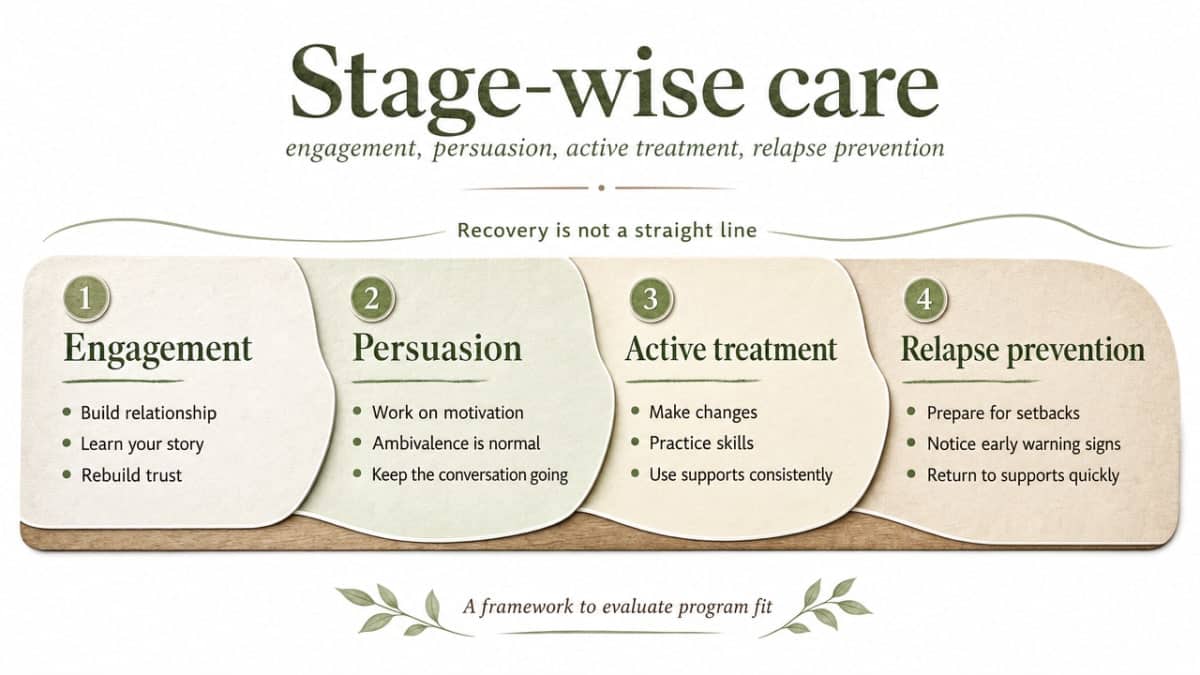
Stage-wise care: engagement, persuasion, active treatment, relapse prevention
Recovery does not arrive on a straight line, and integrated programs are built to meet you where you actually are on any given week. The clinical framework for this is called stage-wise care, and it has four rough phases that a competent team will name and work through with you 1.
Engagement is the first phase, and it is often the quietest. The goal is simply to build a working relationship. You show up. The team learns your story. Nothing dramatic is asked of you yet. If you have been burned by treatment before, this phase is where trust starts being rebuilt, one appointment at a time.
Persuasion is the phase where motivation gets worked on directly. You are in the room, but you are not yet sure you want to change everything the clinical team thinks you should change. That ambivalence is normal, and a good program treats it as information rather than resistance. The work here is helping you connect what you actually want in your life to the changes that would make it possible.
Active treatment is what most people picture when they think of rehab: consistent therapy, medication management, group work, skills practice, real behavioral change. Both the mental health and the substance use pieces are being worked on in the same week, by the same team 5.
Relapse prevention is the long tail. It is the phase where you and the team plan for the winters, the anniversaries, the family reunions, and the ordinary Tuesdays that can knock a recovery sideways. A program that hands you a discharge folder and wishes you luck has skipped this phase. A program that plans it with you is doing the work.
Outcomes an integrated program should be able to move
If you are going to spend weeks or months inside a program, you have every right to ask what it is trying to change and how it will know if it worked. The honest answer is that integrated dual diagnosis care is not a mood boost. It is a set of specific, measurable outcomes that the research literature has watched integrated programs move over time.
SAMHSA’s evidence-based practices review names four domains where integrated treatment shows results that non-integrated care tends to miss: reduced substance use, improved psychiatric symptoms, more stable housing, and better employment outcomes 4. Notice what is on that list. Two of the four are clinical. Two of the four are the parts of a life that make clinical gains stick.
That matters when you are evaluating a Bozeman program. Ask what they track and how often. A program that measures only whether you completed the calendar is measuring the wrong thing. A program that measures your substance use, your depression or anxiety scores, whether you have stable housing, and whether you are working or in school by discharge is measuring what actually determines whether the next year of your life looks different from the last one.
Small wins along the way count too. A full night of sleep. One honest conversation with a clinician. The first week without the 3 a.m. spiral. Those are not consolation prizes. They are the early signal that both conditions are finally being treated at once.
Bozeman and Gallatin Valley: the local texture that shapes care
Mountain-town isolation, winter strain, and small-town privacy
Bozeman is a small city inside a big landscape, and both of those facts shape what recovery looks like here. When the light drops in November and the temperature settles below freezing for weeks at a time, the coping habits that were manageable in July get louder. A drink after work becomes three. The trailhead you used to reset your head is icy by 4 p.m. The isolation is not imagined. It is geographic, and it is seasonal.
Privacy is its own weight. In a town this size, you may share a pew, a gym, or a job site with someone you would rather not run into on the way to a group meeting. That worry can quietly keep people out of care for months. It is worth naming out loud when you call a program: ask how they handle confidentiality, scheduling, and the small logistics that let you show up without your neighbor knowing your business.
None of this is a reason to wait. It is a reason to choose a program that already understands the ground you are standing on, and that treats the mental health side and the substance use side in the same building, on the same week, by the same people 4.
Distance, seasonality, and staying engaged between visits
The Gallatin Valley spreads out. If you live in Belgrade, Manhattan, Big Sky, or one of the smaller communities pressed against the mountains, a weekly drive to a Bozeman clinic in a January whiteout is not a small thing. Missed appointments turn into missed weeks. Missed weeks turn into a quiet slide.
Stage-wise care is built to account for this kind of drift. The engagement and persuasion phases assume that showing up is itself part of the work, and a good program will plan around your road and your calendar rather than punish you for the weather 1. Ask about virtual check-ins, evening groups, and how the team stays in contact when a storm shuts a pass. Ask what happens after a missed session, not just before one.
The goal is a treatment rhythm that survives a Montana winter, because the winter is coming either way.
Paying for it: Montana parity law and Medicaid pathways
What commercial insurance is required to cover
If you have commercial insurance through a job in Bozeman or a plan you buy yourself, Montana law is on your side more than most people realize. The Montana Mental Health Parity Act was written with a specific purpose: to keep the same level of parity between mental health and physical health benefits that existed in federal law as of January 1, 2017 8. In plain terms, a plan cannot make it harder to get mental health or substance use care than it is to get care for a broken arm or a heart condition.
That protection covers the components of dual diagnosis treatment together, not just one side of it. Copays, visit limits, prior authorization hoops, and network access rules for behavioral health services are not supposed to be more restrictive than the equivalent rules on the medical side of your plan.
Montana also built in an enforcement layer. Under state law, insurers offering mental health or substance use benefits must submit parity compliance reports to the state commissioner, documenting analyses consistent with federal parity requirements 7. If a plan is quietly making dual diagnosis care harder to access, that reporting requirement is the paper trail. Ask your insurer, in writing, for the parity analysis. You are allowed to.
Montana Medicaid pathways for SUD and mental health center services
If you are on Montana Medicaid, dual diagnosis care is reachable through two connected doors. The first is the substance use disorder services pathway, governed by Title 53, Chapter 6 of Montana law and the Administrative Rules of Montana, which sets out the SUD services Medicaid can reimburse 9. That is the door that covers the addiction side of your care: assessment, counseling, medication-assisted treatment, and the levels of care that go with them.
The second door is the mental health center pathway. Medicaid-enrolled mental health centers in Montana operate under the same Title 53, Chapter 6 framework and Title 37 administrative rules, and they can deliver or coordinate care for co-occurring mental and substance use disorders 10. That is the door that covers the psychiatric side: diagnostic evaluation, therapy, medication management, and case coordination.
A decision framework: was your last program truly integrated?
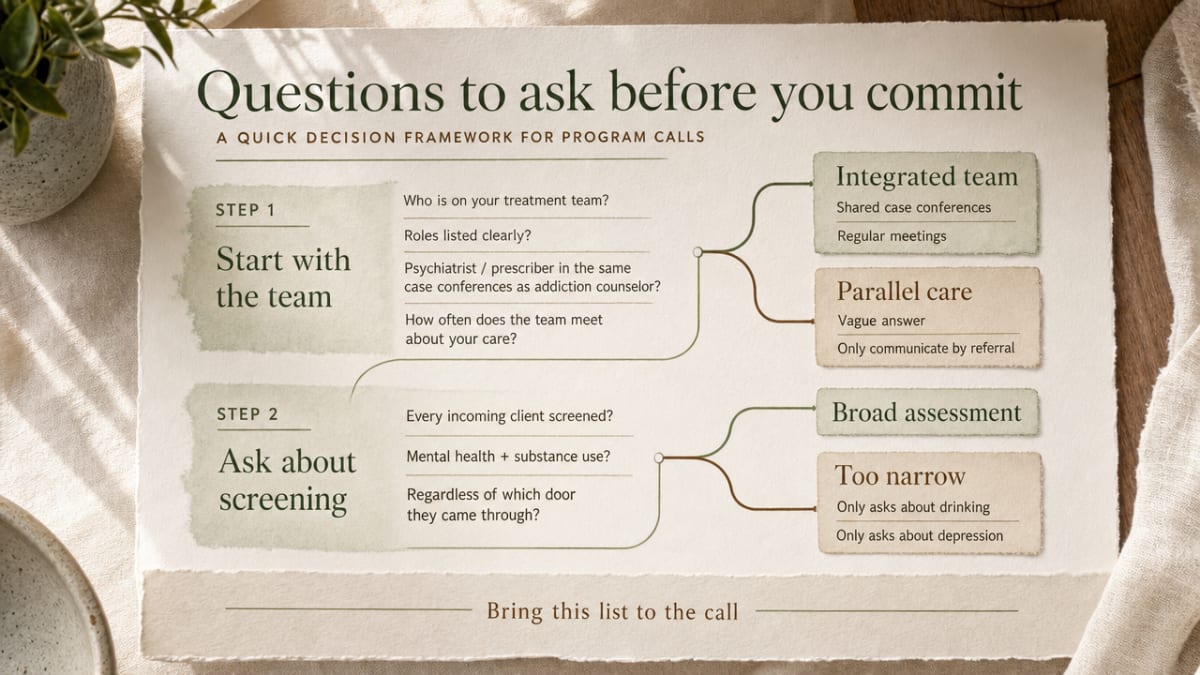
Questions to ask before you commit
Before you fill out another intake packet, spend twenty minutes on the phone with a real question list. The right answers will tell you more than any brochure.
Start with the team. Ask who will be on your treatment team, by role, and whether the psychiatrist or prescribing clinician sits in the same case conferences as the addiction counselor. Ask how often that team meets about your care. If the answer is vague, or if the mental health provider and the SUD provider only communicate by referral, you are looking at parallel care 4.
Ask about screening. A program following current guidance will screen every incoming client for both a mental health condition and substance use, regardless of which door they came through 5. If the intake only asks about drinking, or only asks about depression, the assessment is already too narrow.
Ask what the treatment plan looks like on paper. Is there one plan that names both conditions and links the interventions, or two separate plans stapled together? Ask how the plan gets updated when one condition shifts.
Ask about phases. A program that can describe engagement, active treatment, and relapse prevention as connected stages is working from a stage-wise framework rather than a fixed 30-day script 1. Ask what happens if you are not ready for active change on day one.
Ask about medication. Who prescribes, how often you will be seen, and how psychiatric medications are coordinated with any medication-assisted treatment for the substance use side.
Write the answers down. Compare them across two or three programs. The pattern will be obvious.
Signals of a program that will hold across a hard winter
Beyond the intake questions, a few signals tell you whether a program is built for the long stretch, not just the first thirty days.
What the team measures. A program that tracks substance use, psychiatric symptoms, housing stability, and whether you are working or in school by discharge is watching the outcomes that actually predict a different next year 4. A program that only tracks completion is measuring attendance.
How they talk about setbacks. Ask, plainly, what happens if you use during treatment. A program grounded in integrated care will treat a slip as clinical information that adjusts the plan, not as grounds for discharge. Sequential-minded programs still exist that will push you out the door for the very symptom you came in to treat 5.
Aftercare that is planned, not promised. Before you enroll, ask what week 12 looks like. Who calls you. What group you step down into. How the team stays in contact when a January storm keeps you home for a week.
The quieter signal. When you describe your history on the phone, does the person on the other end connect the pieces, or write them down as separate items? The team that already sees the loop is the team most likely to help you break it.
Taking the next step in Bozeman
The hardest part is usually the phone call, not the treatment. If you have made it this far in the article, you already know more than most people do when they dial: you know what integrated care means, what to ask, and what a Bozeman program should be able to answer without hesitation.
Pick two or three programs. Ask the questions from the last section. Write the answers down. The team that describes one plan, one chart, and one weekly case conference is the team most likely to hold across a hard winter. Elk Ridge Recovery is one option in that conversation, and whatever you choose, choose care that treats both conditions at once. You have already carried this longer than you should have had to.
Speak With Bozeman Dual Diagnosis Specialists Now
Connect directly with an admissions expert for guidance on integrated dual diagnosis treatment options in Bozeman.
Frequently Asked Questions
How is dual diagnosis treatment different from going to rehab and seeing a therapist separately?
In separate care, two providers work two plans and rarely compare notes. You end up carrying messages between them. Integrated dual diagnosis treatment puts the same clinicians in one setting, working from one coordinated plan that addresses both conditions at once 4. That structure lets the team catch how a medication change on Monday shows up in cravings by Friday.
Does Montana insurance have to cover dual diagnosis treatment?
Yes. The Montana Mental Health Parity Act requires the same level of parity between mental health and physical health benefits that federal law required as of January 1, 2017 8. Copays, visit limits, and prior authorization for behavioral health cannot be more restrictive than medical benefits. Insurers must also file parity compliance reports with the state commissioner 7.
Can I get dual diagnosis care in Bozeman if I’m on Montana Medicaid?
Yes, through two connected pathways. Montana Medicaid covers substance use disorder services under Title 53, Chapter 6 9, and separately covers mental health center services under the same framework and Title 37 administrative rules 10. Ask a Bozeman program whether it is enrolled to bill both, and whether one team will work both sides of your plan.
What questions should I ask a Bozeman program to confirm it’s truly integrated?
Ask who is on your team, how often they meet about your case, and whether one written plan names both conditions. Ask if every client is screened for both substance use and a mental health condition at intake, regardless of which door they came through 5. If the mental health and addiction providers only communicate by referral, that is parallel care.
Which mental health conditions are commonly treated alongside substance use?
Depression, anxiety disorders, PTSD, and bipolar disorder show up most often alongside alcohol or drug use, and NIMH notes that substance use and mental disorders frequently co-occur and should be addressed together rather than sequentially 2. A comprehensive assessment should map how the two interact in your specific history, including sequence, trauma, sleep, and medical picture 1.
What outcomes should I expect an integrated program to track?
A program grounded in the evidence tracks four domains: reduced substance use, improved psychiatric symptoms, more stable housing, and better employment or school outcomes 4. Ask how often the team measures each and how the plan adjusts when scores shift. A program that only tracks whether you completed the calendar is measuring attendance, not the changes that make the next year hold.
References
- Substance Use Disorder Treatment for People with Co-Occurring Disorders (TIP). https://library.samhsa.gov/sites/default/files/pep20-06-04-006.pdf
- Substance Use and Mental Health. https://www.nimh.nih.gov/health/topics/substance-use-and-mental-health
- Integrated treatment of substance use and psychiatric disorders. https://www.ncbi.nlm.nih.gov/pmc/articles/PMC5471132/
- Integrated Treatment for Co-Occurring Disorders: The Evidence. https://library.samhsa.gov/sites/default/files/ebp-kit-the-evidence-10242019.pdf
- Substance Use Disorder Treatment for People With Co-Occurring Disorders (SAMHSA TIP, PEP20-02-01-004). https://library.samhsa.gov/sites/default/files/SAMHSA_Digital_Download/PEP20-02-01_004.pdf
- Concurrent (Dual) Disorder Management Guidelines. https://pmc.ncbi.nlm.nih.gov/articles/PMC13117480/
- 33-22-707. Parity compliance records – Montana Code Annotated. https://mca.legmt.gov/bills/mca/title_0330/chapter_0220/part_0070/section_0070/0330-0220-0070-0070.html
- 33-22-701. Purpose (Montana Mental Health Parity Act). https://archive.legmt.gov/bills/mca/title_0330/chapter_0220/part_0070/section_0010/0330-0220-0070-0010.html
- Substance Use Disorders – Medicaid Provider (Montana). https://medicaidprovider.mt.gov/32
- Mental Health Center – Medicaid Provider (Montana). https://medicaidprovider.mt.gov/59