Key Takeaways
- Butte residents can access outpatient therapy, medication management, and community services locally, but fully integrated residential programs usually require travel to Missoula, Helena, Bozeman, Kalispell, or Billings 12.
- Integrated care means one clinical team treats both substance use and mental health inside a single plan, unlike coordinated or co-located models that often leave patients translating between providers 7.
- Sequential treatment, addressing sobriety first and mental health later, can increase relapse risk; concurrent care from week one is associated with better outcomes on both sides 5, 11.
- Before choosing a program, ask whether therapist and prescriber share one team, whether intake screens both conditions, and what the residential-to-outpatient handoff back to Butte looks like 6, 3.
When One Diagnosis Was Never the Whole Story
You already know something the first program probably missed.
Maybe you got sober and the anxiety came roaring back louder than before. Maybe the antidepressants helped for a while, and then the drinking crept in around the edges. Maybe you watched someone you love finish a 30-day stay, come home clean, and quietly fall apart within a month because nobody ever really treated the trauma underneath.
That pattern has a name. When substance use and a mental health condition show up together, it is called a co-occurring disorder, and it is common enough that federal treatment guidance now assumes providers will screen every person for both, not one or the other 6. The old approach, get sober first and we’ll deal with the depression later, is exactly the setup that keeps sending people back to square one.
If you live in or near Butte, you have probably felt the second problem too. Options look thinner out here. The word “integrated” gets used loosely. Programs advertise dual diagnosis on a website and then, in practice, run substance use groups with a mental health referral bolted on the side.
This guide is for the decision in front of you. What integrated care actually is, how to tell it apart from a lookalike, what to expect from a real assessment through aftercare, and how to build a plan that holds once you are back home in Silver Bow County. No directory. No ranking. Just the questions worth asking and the answers worth listening for.
What ‘Integrated’ Actually Means (And What It Doesn’t)
The Difference Between Coordinated, Co-Located, and Fully Integrated Care
Programs use the word “integrated” the way restaurants use the word “fresh.” It sounds like a promise. It rarely comes with a definition.
SAMHSA actually splits integration into three distinct models, and knowing the difference changes what you listen for on an intake call 7.
- Coordinated care
- Your substance use treatment happens at one place and your mental health treatment happens at another. The two providers talk to each other, in theory. They share notes, sometimes. As a patient, you feel this as two waiting rooms, two intake forms, two treatment plans, and the quiet job of translating between them. When one provider adjusts a medication, the other might not know for weeks.
- Co-located care
- Puts both services under one roof. You walk into one building. You may even see your therapist and your prescriber on the same afternoon. But the teams often still operate as separate departments with separate charts and separate goals. As a patient, it feels more convenient. It does not always feel like one plan.
- Fully integrated care
- The model federal guidance actually recommends 7. The same clinical team treats both conditions inside one treatment plan. Your therapist knows what your psychiatrist changed on Tuesday. Your group facilitator knows you are in an early stage of change on the drinking and a later stage on the depression. The medication decisions and the therapy decisions are made by people who talk to each other every week, not every quarter.
SAMHSA also uses a phrase worth carrying with you: “no wrong door” 7. It means that whether you first show up asking for help with anxiety or asking for help with alcohol, you should be screened for both, at that first visit, in that first setting. If the front door only asks about one, that tells you something about what is behind it.
When you call a program in or near Butte, you do not have to ask which model they use in those exact words. You can ask whether the therapist and prescriber sit on the same team, whether there is one treatment plan or two, and whether the intake screens for both mental health and substance use from the first appointment. The answers sort programs faster than any brochure.
Why Sequential Treatment Keeps Failing People
The old logic sounded reasonable. Get the drinking or the pills under control first. Once you are stable, we can look at the depression, the trauma, the panic, whatever is underneath. One thing at a time.
Think about why, from the inside.
If you are drinking to manage untreated PTSD, and a program helps you stop drinking but does not touch the PTSD, you are now sober and unmedicated for the thing that was driving you to drink. The nervous system does not care that you made a decision. It still floods. The relapse that follows is not a character failure. It is a predictable outcome of treating half the problem.
The same pattern shows up the other way around. Someone gets stable on an antidepressant, life feels manageable, and nobody addresses the daily drinking that is slowly undoing the medication. Six months later the depression is back and the drinking is worse and the story becomes “the meds stopped working.”
Concurrent treatment does not mean everything gets solved in the first week. It means nothing gets deferred to a later program that may never happen. When a plan treats both conditions from day one, the pieces stop competing. That is the shift that changes what recovery feels like at month three, month six, and the first hard month back at home.
What Real Integrated Care Includes
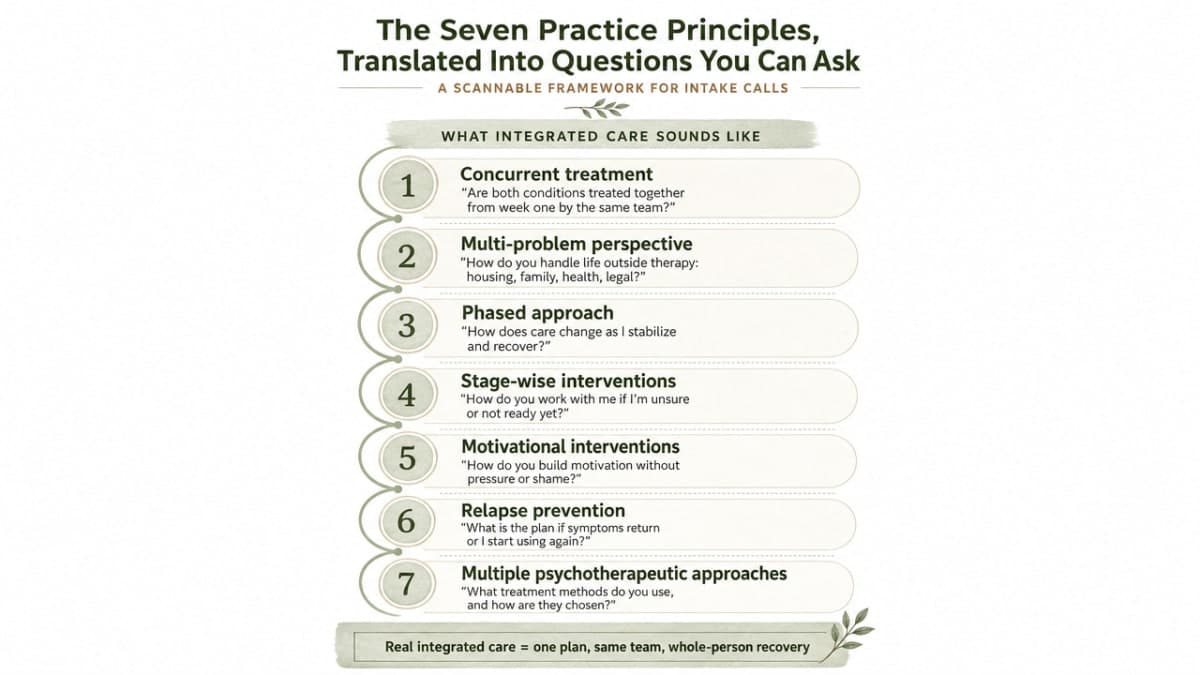
The Seven Practice Principles, Translated Into Questions You Can Ask
Federal guidance is unusually clear about what an integrated program is supposed to do. SAMHSA’s practice publication for co-occurring disorders lays out seven principles that separate real integrated care from a program that has just added the words to its website 5. You do not need to memorize them. You need to know what they sound like when you ask about them out loud.
Concurrent treatment. Both conditions are treated at the same time, in the same plan. Ask: “Will my mental health condition and my substance use be treated together, starting week one, by the same team?”
Multi-problem perspective. Housing, family, physical health, and legal issues are treated as part of recovery, not distractions from it. Ask: “How do you handle the parts of my life outside of therapy hours?”
Phased approach. Care meets you where you are, whether you are still deciding to change or already deep into rebuilding. Ask: “How do you adjust treatment if I am not ready to stop yet?”
Motivational interventions. Clinicians are trained to work with ambivalence rather than argue you out of it. Ask: “What happens if I disagree with the plan?”
Pharmacotherapy. A prescriber who understands both psychiatric medications and medications for substance use disorders is part of the team, not a referral. Ask: “Is there a psychiatrist or psychiatric provider on staff who prescribes for both sides?”
Comprehensive services. Group, individual, family, and case management run together, not as add-ons. Ask: “Which of these are included, and which are separate referrals I have to arrange myself?”
Reduction of negative consequences. The goal includes harm reduction, not just abstinence measured on a calendar. Ask: “How do you measure progress besides days sober?”
SAMHSA names integrated care the preferred model for co-occurring disorders and warns that sequential treatment can raise relapse risk 5. That is why these seven questions matter. Any one of them can be dodged with a warm answer. Ask three or four in a row, and you will hear quickly whether the program has actually built its clinical model around integration or just its marketing.
What a Good Assessment and Treatment Plan Look Like on Paper
A real integrated assessment is not a checklist you fill out in the parking lot. It takes hours, sometimes across more than one appointment, and it looks at both sides of the picture with the same seriousness.
Expect questions about substance use going back years: what you use, how much, how often, what happens when you stop. Expect equally detailed questions about mood, sleep, anxiety, trauma history, past psychiatric care, current medications, suicidal thoughts, and how your mental health shifts when you are using versus when you are not. SAMHSA’s consensus guidance is direct about this: every person entering substance use treatment should be screened for co-occurring mental health conditions, and every person entering mental health treatment should be screened for substance use 6. If one whole half of that conversation never happens at intake, you are looking at a program that has not built integration into its front door.
The written treatment plan that comes out of a good assessment has a few markers you can look for. It names both conditions specifically, not as “substance use with mental health concerns.” It identifies which behaviors and symptoms the team is targeting first, and which ones will get attention later in a stage-wise sequence 3. It lists concrete interventions tied to each target, the clinician responsible for each, and how progress will be measured over time 3.
You can ask to see the plan. You can ask who wrote it and who signed off. You can ask how often it gets updated and who updates it. A plan that changes only at 30, 60, and 90 days is a paperwork rhythm. A plan that changes when your medication changes, or when a new memory surfaces in therapy, or when a family session goes sideways, is a living document. That difference is what stage-wise, individualized planning actually feels like in practice.
How Outcomes Compare When Care Is Truly Integrated
Here is the piece of evidence worth carrying into your decision, stated once and clearly.
When researchers compare integrated treatment to nonintegrated care for people with co-occurring disorders, integrated programs are associated with better outcomes on both sides of the diagnosis, meaning less substance use and improved psychiatric symptoms over time 1. A systematic review of dual disorder programs reached a similar conclusion: integrated approaches often lead to improvements in both substance use and psychiatric outcomes compared with usual care 11.
A few honest caveats belong with that finding. The research covers a range of program designs, from tightly controlled trials to community implementations, and the size of the benefit varies 1. Not every study measured the same outcomes over the same timeframe. The direction of the effect, though, is consistent. When both conditions are treated together by one team with one plan, people tend to do better on both, not just one.
What that looks like from inside your own life is quieter than a chart. It looks like a month where the depression does not spike after you stop drinking, because someone was watching for it and adjusted the medication. It looks like a therapy session where you can talk about the panic attacks without being told to bring that up with a different provider. It looks like a discharge summary that a Butte-area outpatient clinician can actually use, because it treats you as one person rather than two problems that happened to share an address.
That is the outcome the evidence is pointing toward. Not a miracle. A steadier floor.
Accessing Care From Silver Bow County
What Can Realistically Be Done Locally
Some pieces of dual diagnosis care can happen without leaving town.
Outpatient therapy, medication management with a prescriber, community mental health services, primary care follow-up, peer support groups, and standard substance use counseling all exist inside Silver Bow County in some form. If your situation is stable enough for outpatient level of care, and you already have a working relationship with a therapist and a prescriber who talk to each other, you may be able to build something close to integrated care locally by stitching those pieces together carefully.
The honest limitation is that fully integrated programs, where one clinical team owns both the mental health and substance use side inside a single plan, are harder to find in rural areas than in cities. Researchers describe funding silos and workforce shortages as ongoing barriers to integrating mental health and substance use services, and those barriers hit rural systems the hardest 12. That does not mean local care is not worth pursuing. It means you may have to do more of the coordinating yourself, or ask a case manager to do it for you in writing.
A useful local starting point is a full biopsychosocial assessment with a provider willing to screen both sides at the first visit 6. If that door opens, and the provider can either treat both or make a warm handoff to someone who can, you have a real foundation to build on close to home.
When Travel Within Montana Makes Sense
Travel becomes the right call when the level of care you need is not something outpatient can hold.
If you need medical detox, if the drinking or using has become dangerous to stop alone, if the depression has turned into thoughts of not being here anymore, if past outpatient attempts have not held, or if home is the exact environment that keeps pulling you back under, residential treatment somewhere else in Montana is often the more honest choice. Residential and partial hospitalization programs cluster in larger towns, and reaching one usually means a drive to Missoula, Helena, Bozeman, Kalispell, or Billings.
The drive is not the point. The concentration of clinical staff is. A fully integrated program needs a psychiatric prescriber, therapists trained in both substance use and mental health treatment, medical staff, and case managers who all work off the same treatment plan 3. That team is easier to assemble where the population supports it.
The Residential-to-Outpatient Handoff Across Distance
The month after residential is where a lot of recovery quietly falls apart, and distance makes that month harder if nobody plans for it.
Before you sign into a residential program in another part of Montana, ask what happens on discharge day. A good program starts planning your step-down before you finish the first week, not the last. That plan should name the specific outpatient clinician or intensive outpatient program you will see back near Butte, the date of your first appointment, who is sending your records, and who is prescribing your medications between the last day inside and the first day outside. If any of those pieces are missing, the handoff is a wish, not a plan.
Stage-wise treatment planning assumes your care keeps moving as your needs change, and that continuity has to survive a change of address 3. Ask whether the residential team will call your outpatient provider directly, not just fax records. Ask how long your prescriber will keep prescribing after discharge if the local appointment gets delayed. Ask about telehealth follow-up with the residential clinicians during the first few weeks home, since a video session with someone who already knows your story can carry a lot of weight while you rebuild a local team.
The distance is manageable. The gap in care is what you are protecting against.
Building a Treatment Path That Holds After You Go Home
The plan you leave with matters more than the program you leave.
A sturdy path home is not one appointment on the calendar. It is a small set of people who know your full story, and a rhythm that keeps them talking to each other after the residential team is out of the picture. That means an outpatient therapist and a prescriber who exchange notes, not just referrals. It means a case manager or a family member holding the phone list when you cannot. It means built-in points where the plan gets revisited, because your needs at month one are not your needs at month four 3.
A few pieces are worth insisting on before you sign discharge paperwork.
- A warm handoff to a Butte-area outpatient provider, with the first appointment already on the books.
- A medication bridge that covers the gap between your last inside prescription and your first outside refill.
- A crisis plan written down, with a number to call at 2 a.m. that is not just 911.
- A stated stage of change for each condition, so the next clinician does not start you back at square one 3.
- A family session, if family is part of your life, that gives the people around you language for what integrated recovery actually asks of them.
The first ninety days home are where most of the drift happens. Missed appointments turn into missed weeks. A rough Tuesday turns into a quiet slip nobody hears about until it is not quiet anymore. Building in a check-in every seven days for the first month, even a short one, is not overkill. It is the shape of a plan that is designed to hold.
You can also give yourself permission to change the plan out loud. Recovery is stage-wise, and the goals that made sense in week two of residential may not fit the person you are in month three at home 3. Telling your outpatient team the truth about what is working and what is not is not backsliding. It is how integrated care stays integrated once you are the one carrying it.
Making the Call
Making the call is the hardest sentence in this whole guide, and also the shortest.
You do not have to know which program yet. You do not have to know your insurance details, your exact diagnosis, or what you want to say. You need a phone, ten minutes, and a willingness to ask two or three of the questions from earlier in this piece. Whether the therapist and prescriber sit on the same team. Whether the intake screens both sides from the first visit 6. Whether the plan will treat both conditions at the same time, starting week one 5.
If the answers are vague, you have learned something useful and you can call the next number. If the answers are clear, you have found a door worth walking through.
Elk Ridge Recovery is one of those numbers in Montana, and integrated dual diagnosis care is part of what they do. Whoever you call first, call someone today.
Connect With Local Dual Diagnosis Experts Now
Get real answers and support for integrated treatment in Butte—right when you need it most.
Frequently Asked Questions
What is dual diagnosis treatment?
Dual diagnosis treatment is care for someone living with both a substance use disorder and a mental health condition at the same time. Federal guidance calls this integrated treatment, where one clinical team addresses both conditions inside a single plan rather than treating them separately or in sequence 5. The point is that the two conditions shape each other, so the care has to as well.
How do I know if a Butte-area program actually offers integrated care?
Ask three questions on the intake call. Does the therapist and the prescriber sit on the same team. Is there one treatment plan or two. Does your first appointment screen for both mental health and substance use, not just the one you called about 6. Vague answers usually mean coordinated or co-located care, not fully integrated care 7. Clear answers tell you the model is real.
Can I get dual diagnosis treatment in Butte, or do I need to travel?
Outpatient therapy, medication management, and community mental health services exist locally, and you can build something close to integrated care by stitching them together with a case manager. Fully integrated residential programs are harder to reach in rural Montana because of workforce and funding limits 12, so higher levels of care usually mean a drive to Missoula, Helena, Bozeman, Kalispell, or Billings.
Why is treating substance use and mental health at the same time better than one after the other?
Sequential treatment, get sober first and then handle the depression or trauma, leaves half the problem untouched during a fragile window. SAMHSA warns that this sequence can increase relapse risk and recommends concurrent care instead 5. When both conditions are treated by the same team from week one, people tend to see improvement on both substance use and psychiatric symptoms, not just one side 11.
What should an integrated assessment include?
A real assessment takes hours and covers both sides in depth. Expect detailed questions about substance use history and detailed questions about mood, sleep, anxiety, trauma, past psychiatric care, current medications, and suicidal thoughts. SAMHSA’s consensus panel is direct: every person entering substance use treatment should be screened for mental health conditions, and every person entering mental health treatment should be screened for substance use 6.
What happens after residential treatment ends?
Discharge should not be a handshake. A solid step-down plan names your outpatient clinician back near Butte, the date of your first appointment, who is sending records, and who is prescribing between the last day inside and the first day outside. Stage-wise planning assumes your care keeps changing as your needs change 3, so build in weekly check-ins for the first month and expect the plan to evolve.
References
- Integrated Treatment for Co-Occurring Disorders: The Evidence. https://library.samhsa.gov/sites/default/files/ebp-kit-the-evidence-10242019.pdf
- Integrated Treatment for Co-Occurring Disorders: How to Use the Evidence-Based Practices KITs. https://library.samhsa.gov/sites/default/files/ebp-kit-how-to-use-the-ebp-kit-10112019_0.pdf
- Integrated Treatment for Co-Occurring Disorders: Building Your Program. https://library.samhsa.gov/sites/default/files/ebp-kit-building-your-program-10112019.pdf
- Integrated Treatment for Co-Occurring Disorders Evidence-Based Practices (EBP) KIT. https://library.samhsa.gov/product/integrated-treatment-co-occurring-disorders-evidence-based-practices-ebp-kit/sma08-4366
- Substance Use Disorder Treatment for People with Co-Occurring Disorders. https://library.samhsa.gov/sites/default/files/pep20-06-04-006.pdf
- Substance Use Disorder Treatment for People With Co-Occurring Disorders (TIP-related excerpt). https://library.samhsa.gov/sites/default/files/SAMHSA_Digital_Download/PEP20-02-01_004.pdf
- Managing Life with Co-Occurring Disorders. https://www.samhsa.gov/mental-health/serious-mental-illness/co-occurring-disorders
- Evidence-Based Practices for Co-Occurring Disorders. https://www.usf.edu/cbcs/mhlp/tac/documents/behavioral-healthcare/samh/understanding-ebps-for-cooccurring-disorders.pdf
- Integrated treatment of substance use and psychiatric disorders. https://pubmed.ncbi.nlm.nih.gov/19215796/
- Co-occurring substance use and mental disorders: epidemiology and research issues. https://pubmed.ncbi.nlm.nih.gov/16825918/
- Integrated treatment of dual disorders: A systematic review. https://pubmed.ncbi.nlm.nih.gov/26871201/
- Barriers to integrating mental health and substance use services in primary care. https://pubmed.ncbi.nlm.nih.gov/24855343/