Key Takeaways
- Lewis and Clark County recorded 262 suspected opioid overdose events between 2018 and early 2023, while local OUD diagnoses at Purview Health Center rose 84.5% from 2019 to 2022 8.
- Medical detox in Helena now pairs with buprenorphine, methadone, or naltrexone induction, cutting overdose death risk in half and closing the dangerous post-detox tolerance gap 6.
- Montana Medicaid covers all three FDA-approved MAT medications and counseling with no duration limits, and residential providers without on-site MAT must connect patients to an OTP or OBOT 4, 5.
- Before calling, weigh which medication fits your history and rural access needs, confirm insurance or Medicaid enrollment support, and obtain naloxone from any Montana pharmacy under the standing order 11.
What’s actually happening with opioids in Lewis and Clark County
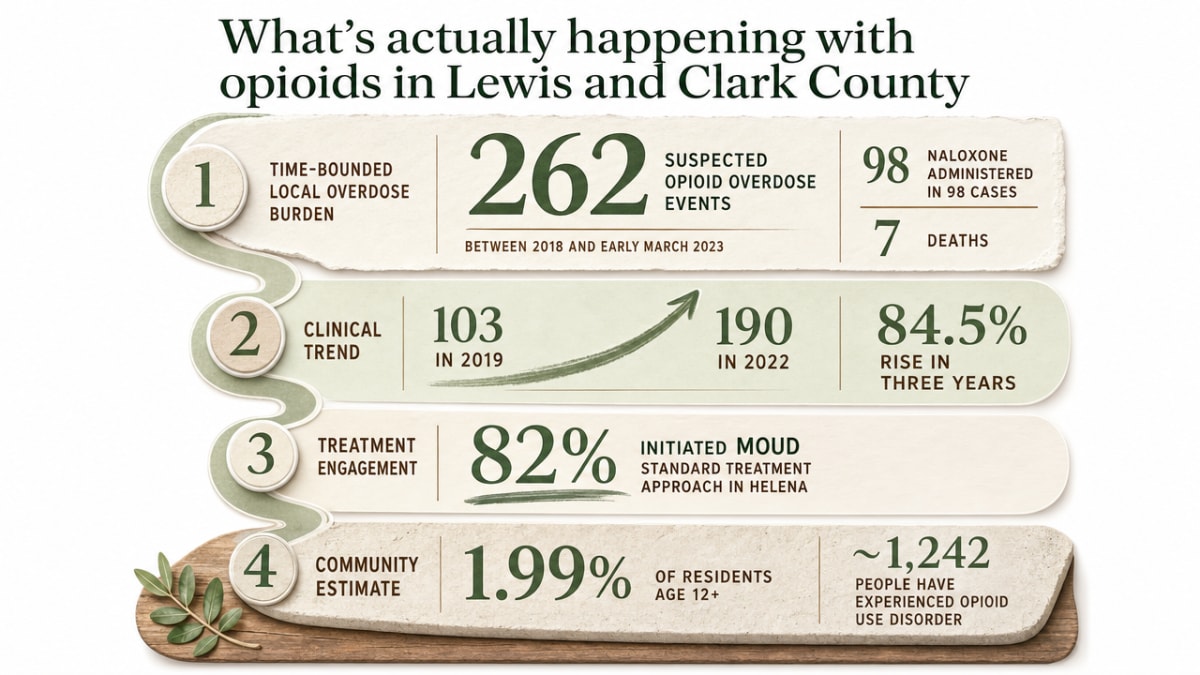
Between 2018 and early March 2023, Lewis and Clark County recorded 262 suspected opioid overdose events, with naloxone administered in 98 of those cases and seven resulting in death 8. This indicates a significant local impact of the opioid crisis.
Clinical data further illustrates this trend. Opioid use disorder diagnoses at Purview Health Center increased from 103 in 2019 to 190 in 2022, an 84.5% rise in three years. Approximately 82% of these patients initiated medications for opioid use disorder (MOUD) 8. This high rate of MOUD initiation signifies that medication-assisted treatment is a standard approach for individuals seeking help in Helena.
The Lewis and Clark County Behavioral Health System Report estimates that about 1.99% of residents aged 12 and older, roughly 1,242 people, have experienced opioid use disorder in the past year 9. This substantial number highlights the widespread nature of the issue and the local system’s efforts to expand capacity to meet the demand for treatment.
The data suggests that more individuals in the Helena area are receiving diagnoses, accessing medication-based treatment, and surviving overdoses due to naloxone. This indicates that seeking help is becoming more common and accessible, reducing the isolation often associated with opioid use disorder.
Why detox is where this has to start
Opioid withdrawal can be an intensely painful experience, characterized by physical symptoms like bone aches, sweats, nausea, and restlessness. This severe discomfort often drives individuals back to opioid use, making it difficult to quit without support. It’s a biological response to chemical dependence, not a lack of willpower.
Medical detox addresses this physical crisis by managing withdrawal symptoms in a supervised setting. Its purpose is to stabilize individuals physically, allowing them to remain in treatment long enough for other interventions to be effective.
During medically supervised detox, a physician monitors vital signs and administers medications to alleviate severe withdrawal symptoms. Crucially, buprenorphine or methadone induction can begin within days. This is vital because the period immediately following detox, when tolerance has decreased but cravings persist, carries the highest risk for fatal overdose. Initiating MAT during or directly after detox significantly reduces this risk; patients on methadone or buprenorphine halve their risk of overdose death 6.
A supervised detox provides two key benefits: it eases the acute physical withdrawal phase and facilitates a smooth transition to the next level of care, whether residential stabilization or an immediate MAT prescription. The current standard of care prioritizes comfort, safety, and medication to support recovery.
How MAT medications actually work in your body
Methadone, buprenorphine, and naltrexone side by side
Three FDA-approved medications are used to treat opioid use disorder, each interacting with brain receptors differently.
- Methadone
- A full opioid agonist. It fully binds to the same receptors as illicit opioids, providing a steady, long-acting dose that prevents withdrawal and reduces cravings without causing euphoria. Due to its potency and federal regulations, methadone for OUD must be dispensed at a certified Opioid Treatment Program (OTP), often requiring daily visits initially 4. It is frequently chosen for individuals with a long history of high-dose opioid use.
- Buprenorphine (often known as Suboxone when combined with naloxone)
- A partial agonist. It binds to opioid receptors but only partially activates them, effectively reducing cravings and limiting euphoric effects. It also has a built-in safety margin against overdose. Buprenorphine can be prescribed in a standard office visit and filled at a local pharmacy, making it more accessible across Montana 4.
- Naltrexone (available in an extended-release form as Vivitrol)
- An opioid antagonist. It completely blocks opioid receptors, preventing opioids from having any effect. Because it blocks receptors, individuals must be fully detoxed and opioid-free for 7 to 10 days before starting naltrexone to avoid precipitated withdrawal. It is administered as a monthly injection, eliminating the need for daily medication 4.
All three medications share a critical outcome: patients on methadone or buprenorphine reduce their risk of overdose death by half 6. This significant reduction is why MAT is considered the standard of care. Montana Medicaid covers all three medications without time limits 4. The choice of medication is a discussion with a prescriber.
Answering the ‘trading one addiction for another’ question
The idea that MAT is “trading one addiction for another” is a common misconception that can deter people from seeking life-saving treatment. Addiction is characterized by compulsive use despite harmful consequences, leading to chaos and disruption.
In contrast, methadone and buprenorphine, when taken as prescribed, stabilize brain chemistry, allowing individuals to regain normal functioning, maintain employment, care for their families, and escape the cycle of illicit drug seeking. These medications treat a chronic medical condition that alters brain chemistry, similar to how insulin treats diabetes.
The National Institute on Drug Abuse (NIDA) clarifies that these medications are not substitutes for addiction but rather reduce its harms and cut the risk of overdose death by half 6. If someone questions the use of MAT, it often stems from their own discomfort or misunderstanding, not medical fact. Choosing MAT is choosing to prioritize one’s health and life.
What week one of residential care actually looks like
Modern residential treatment programs differ significantly from outdated perceptions. The initial week focuses on medical stabilization and assessment rather than immediate therapeutic intensity.
- Day one — intake and stabilization: includes a comprehensive history, vital sign assessment, and a detailed account of substance use. If not already started during detox, a prescriber will discuss buprenorphine, methadone induction through a partner OTP, or naltrexone once medically appropriate 4. The primary goals are rest and nourishment, with no expectation of immediate emotional processing.
- Days two through four are typically the most challenging and require close monitoring. Staff manage acute or protracted withdrawal symptoms with medications for sleep, nausea, and comfort, adjusting MAT doses to control cravings. Activities are limited to short group sessions and individual check-ins. Progress during this period is measured by physical stability, such as sleep and appetite, rather than emotional breakthroughs.
- By days five through seven, physical symptoms usually subside, allowing for increased engagement. Individuals begin meeting with counselors, participating in groups focused on cravings and relapse triggers, and developing a treatment plan. Family contact often resumes, and outdoor activities may be introduced. This phase marks a return to basic physical well-being.
Research on rural MAT indicates that consistent engagement with medication and counseling leads to significant reductions in opioid use and overdose risk 7. The first week of residential care establishes the physical stability necessary for this engagement, emphasizing presence and comfort over willpower. The initial objective is simply to remain in treatment, building a foundation for subsequent recovery efforts.
Why the moment to use these resources is now
Delaying treatment, perhaps until after holidays or when insurance is fully sorted, is a decision with increasing risks compared to previous years.
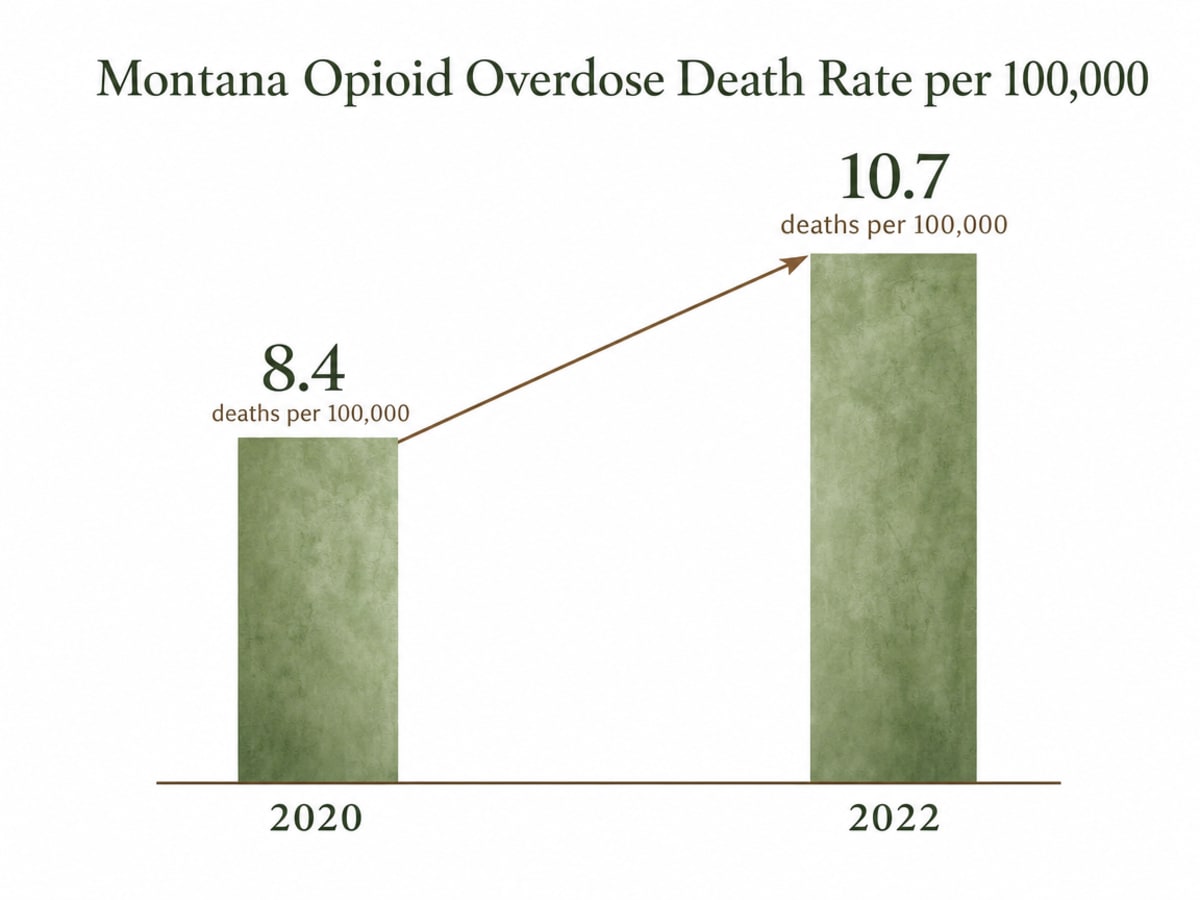
Montana’s opioid overdose death rate rose from 8.4 per 100,000 in 2020 to 10.7 per 100,000 in 2022, a 27% increase in two years 3. The prevalence of fentanyl in the illicit drug supply has made overdoses more frequent and lethal, even with small dosing errors.
Simultaneously, treatment accessibility has improved. Montana Medicaid covers all three MAT medications without limits on duration 4. The state’s 2024–2028 strategic plan aims to expand treatment slots in Federally Qualified Health Centers and Medicaid-covered settings 3. Additionally, residential providers not offering on-site MAT are now required to facilitate off-site access 5. This means the support infrastructure is growing while the dangers of untreated opioid use disorder are escalating.
Waiting is not a neutral choice; it involves a gamble against a more dangerous drug supply, while foregoing available resources like improved coverage, increased capacity, and policies favoring access to treatment.
Paying for treatment: what Montana Medicaid and insurance actually cover
Concerns about treatment costs often cause hesitation. Understanding actual coverage in Montana can alleviate these worries.
Montana Medicaid covers all three FDA-approved MAT medications—methadone, buprenorphine, and naltrexone—in all approved forms. There are no limits on how long individuals can remain on these medications, nor are there caps on medically necessary counseling and behavioral therapy 4. This comprehensive coverage ensures that MAT, which includes both medication and counseling, is fully supported.
The provider manual specifies that MAT encompasses FDA-approved medications combined with behavioral therapies and support services, delivered by office-based prescribers and certified opioid treatment programs 10. While prior authorization and visit frequency rules exist, providers manage these with Medicaid. It’s important to note that once methadone or buprenorphine treatment begins, Montana Healthcare Programs will not cover other opioids, Tramadol, or Carisoprodol, a safety measure 10.
For uninsured individuals, Montana Medicaid expansion covers adults up to 138% of the federal poverty level. Most treatment centers have staff dedicated to assisting with enrollment or identifying alternative funding options before an initial appointment. Therefore, proof of insurance is not required to begin the process.
Private insurance, whether employer-sponsored or marketplace-based, covers opioid use disorder treatment as an essential health benefit under the Affordable Care Act (ACA). Specifics like copays, in-network facilities, and prior authorization for residential care vary by plan. Admissions teams at treatment centers can verify benefits, a free service that does not create an obligation and typically takes less than an hour.
In summary, financial barriers to treatment are often less significant than perceived, as Montana’s policies are designed to facilitate access to care.
Getting to care when you live outside Helena proper
For residents of Lewis and Clark County living outside Helena, geographical distance can pose a challenge to accessing treatment. However, strategies exist to overcome this.
Buprenorphine is often the most practical medication for rural residents. It can be prescribed by an office-based provider and filled at a local pharmacy, requiring only a monthly appointment and prescription refill 4. If monthly travel to Helena or a nearby town is feasible, buprenorphine is a viable option. Naltrexone, administered as a monthly injection, is even less demanding once the required 7-to-10-day opioid-free period is met 4.
Methadone presents more logistical challenges due to federal regulations requiring it to be dispensed daily, initially, from a certified Opioid Treatment Program 4. If methadone is the appropriate medication, treatment programs can coordinate OTP linkage or transportation. Montana now mandates that residential providers without on-site MAT connect patients to an OBOT or OTP 5.
Rural MAT research confirms that while distance is a barrier, individuals in resource-limited areas who consistently engage with medication experience significant reductions in opioid use and overdose risk 7. Inquiring about telehealth options, extended prescription intervals, and case management for transportation can further improve access, as the system has become more flexible.
Naloxone: keeping yourself or someone you love alive in the meantime
While navigating treatment options, obtaining naloxone is an immediate and critical step. It should be kept readily accessible.
Naloxone was documented in 98 of the 262 suspected overdose events in Lewis and Clark County between 2018 and early March 2023 8. These instances represent lives saved because someone nearby had naloxone and was able to administer it.
Carrying naloxone is crucial for anyone who uses opioids, has a loved one who uses, or is in any stage of recovery. It provides a vital window of time during an overdose, allowing for emergency medical response or access to treatment.
Making the call and what happens after
Initiating contact with a treatment center can be the most difficult step, but subsequent processes are managed by professionals.
When calling an admissions line, a staff member will gather information about substance use history, current withdrawal status, safety, and insurance details (Medicaid, private, or uninsured). For uninsured callers, assistance with Medicaid enrollment or other funding pathways is provided. No specific documents or prepared statements are necessary; simply stating “I think I need help with opioids” is sufficient.
Most individuals are scheduled for intake within 24 to 72 hours, sometimes sooner if a detox bed is available and withdrawal is active. If transportation is an issue, many programs offer rides within Lewis and Clark County and beyond. For those likely to benefit from methadone, the intake team will arrange OTP linkage beforehand, as Montana requires residential providers without on-site MAT to connect patients to it 5.
The path after the initial call is a continuum of care, typically involving detox, residential stabilization, step-down programs like Partial Hospitalization (PHP) or Intensive Outpatient (IOP), and ongoing outpatient care with MAT. Programs like Elk Ridge Recovery offer this integrated continuum, ensuring smooth transitions between levels of care. The initial call is not a commitment to a long-term plan, but rather to the next conversation about treatment options.
Connect With Helena’s Compassionate Recovery Team Now
Get direct support to discuss your next steps toward opioid addiction recovery in Helena.
Frequently Asked Questions
Do I have to go through withdrawal alone before I can start MAT?
No. Buprenorphine and methadone can both be started while you are still in withdrawal. Buprenorphine, in fact, requires you to be in mild withdrawal before the first dose. In a medical detox setting, a prescriber times induction to rapidly reduce cravings and symptoms 4. Naltrexone is the only medication that requires a full 7 to 10 opioid-free days before starting.
Will Montana Medicaid cover methadone or buprenorphine long-term?
Yes. Montana Medicaid covers methadone, buprenorphine, and naltrexone in all approved forms with no cap on how long you can stay on any of them. Additionally, there are no limits on medically necessary counseling and behavioral therapy 4. You do not need to plan an exit date from your medication; coverage continues as long as medically necessary.
Can I get methadone in Helena, or do I have to travel?
Methadone for opioid use disorder can only be dispensed from a federally certified Opioid Treatment Program (OTP), often requiring daily dosing initially 4. This means fewer locations compared to buprenorphine. If methadone is the right fit, treatment intake teams will coordinate OTP linkage before your arrival, and Montana now requires residential providers without on-site MAT to connect you to an OTP 5. It is advisable to specifically ask about methadone access when you call.
How long does residential treatment usually last?
The duration of residential treatment depends on individual history, substances used, and initial stability. Detox typically lasts 5 to 10 days. Residential stabilization usually extends for 28 days or longer, followed by a step-down to partial hospitalization, intensive outpatient, and then standard outpatient care, with MAT continuing throughout. The key is maintaining continuity of care through each transition to protect progress.
How do I get naloxone in Helena without a prescription?
Montana has a statewide standing order, coordinated through the Director’s Office in Helena, which allows any pharmacy to dispense naloxone without an individual prescription 11. You can walk into a pharmacy, ask for naloxone (the nasal spray is common), and receive it. If you have Medicaid or most private insurance, the cost is typically covered or minimal. No doctor visit is required. It is recommended to keep one dose on you and one at home.
What if I’ve tried treatment before and relapsed?
Relapse is a common part of opioid use disorder for many individuals and does not indicate an inability to recover. Often, a previous treatment plan may have lacked a crucial component, such as medication. Rural MAT research shows that individuals who remain engaged with both medication and counseling experience significant reductions in opioid use and overdose risk compared to those who do not 7. Starting treatment again is a valid and important step.
References
- Summary of Opioid Use in Montana. https://dphhs.mt.gov/assets/publichealth/EMSTS/Data/Opioid_Drug_Use_Summary.pdf
- Get Help. https://dphhs.mt.gov/opioid/gethelp
- Montana Substance Use Disorder Task Force Strategic Plan 2024–2028. https://dphhs.mt.gov/assets/publichealth/EMSTS/opioids/SUDsStrategicPlan2024.pdf
- Montana State Plan Amendment MT-21-0005 Approval Package. https://www.medicaid.gov/medicaid/spa/downloads/MT-21-0005.pdf
- Approval of Montana’s HEART Monitor Reentry Reinvestment Plan. https://www.medicaid.gov/medicaid/section-1115-demonstrations/downloads/montan-heart-monitor-reentry-reinvestment-plan-approval.pdf
- Medications to Treat Opioid Use Disorder: Overview. https://www.drugabuse.gov/publications/research-reports/medications-to-treat-opioid-addiction/overview
- Outcomes of Medication-Assisted Treatment for Opioid Use Disorder in Rural Settings. https://pubmed.ncbi.nlm.nih.gov/31343575/
- Opioid in Lewis and Clark County, Montana. https://www.lccountymt.gov/files/assets/county/v/1/health/documents/opioidfactsheet_lcph-march-2023.pdf
- Lewis and Clark County Behavioral Health System Report Update. https://www.lccountymt.gov/files/assets/county/v/1/health/documents/strong-roots-coalition/2024-lewis-and-clark-county-behavioral-system-report-jg-research-and-evaluation.pdf
- 550 Medication Assisted Treatment (MAT). https://dphhs.mt.gov/assets/BHDD/MedicaidManual/550MAT.pdf
- Montana Statewide Standing Order for Naloxone Opioid Antagonist. https://dphhs.mt.gov/assets/publichealth/EMSTS/opioids/Naloxone2026StandingOrder.pdf