Key Takeaways
- Helena residents have local access to physician-supervised detox, MAT with methadone, buprenorphine, or naltrexone, and step-down care through residential, PHP, IOP, and outpatient settings.
- Lewis & Clark County saw 145–196 overdose incidents annually from 2021–2023, with naloxone used in roughly 37–39% of events, making post-reversal follow-through a local priority 17.
- Montana Medicaid covers all three FDA-approved MAT medications and counseling, but will not pay for concurrent opioid pain medications, tramadol, or carisoprodol while you are in treatment 12, 14.
- Before choosing a program, compare medication options, travel and weather realities, telemedicine availability for buprenorphine or naltrexone follow-ups, and case management support for work, custody, and housing concerns.
What Recovery Actually Looks Like When You Live in Helena
If you are reading this at 2 a.m. with a bottle of pills on the counter, or between shifts at the Capitol, or in your truck outside a pharmacy in Helena Valley, the first thing worth saying is this: what you have is a medical condition, not a character flaw. Opioid use disorder is a treatable chronic brain disease, and the treatments that work best combine FDA-approved medication with counseling and real-life support 5.
Recovery in Helena has a shape you can actually picture. It usually starts with a phone call, moves into a few days of physician-supervised medical detox so your body stops fighting you, and then shifts into medication-assisted treatment (MAT) using methadone, buprenorphine, or naltrexone to steady your brain chemistry 18. From there, you step into residential care, a partial hospitalization program, or intensive outpatient, depending on what your life looks like right now. Counseling, peer support, and case management wrap around the medication so you are not doing any of this alone.
You do not need to be at your worst to qualify for help, and you do not need to white-knuckle withdrawal on your bathroom floor. You do not need to have your insurance figured out before you make the call. What you need is a starting point, and Helena has one. The rest of this guide walks you through what happens next, what it costs, and what you can protect while you get well.
The Local Picture: Overdose, Naloxone, and Why Timing Matters
Helena is not immune to what is happening across Montana, and the numbers close to home tell a story that matters for anyone weighing whether to make the call. Lewis & Clark County recorded 145 overdose incidents in 2021, then 196 in 2022, then 150 in 2023, with naloxone used in roughly 37–39% of those events 17. That means first responders and bystanders here are reversing overdoses on a regular basis, and it also means a lot of people are surviving one close call and going home without ever being connected to treatment.
That gap is the part worth paying attention to. Naloxone saves the life in the moment. It does not touch the brain chemistry that made the overdose likely in the first place, and it does not stop the next one from happening a week later. In Helena, the AHEC regional office anchors behavioral health planning for North Central Montana, which puts the city at the center of how care actually reaches people in surrounding towns and reservations 10. When you live here, you are closer to real treatment options than most Montanans are.
Timing matters in a specific, non-dramatic way. The window right after an overdose, an ER visit, a court date, or a scary night alone is when your motivation and your medical need line up. If you have already had a reversal, or watched someone you love have one, you already know the pattern is not going to fix itself. Reaching out now, before the next episode, is not a leap. It is the reasonable next step, and Helena has the pieces in place to meet you when you take it.

Why ‘Just Trading One Drug for Another’ Is the Wrong Frame
You have probably heard it, maybe from a family member, maybe from someone at a meeting, maybe in your own head at 3 a.m.: taking buprenorphine or methadone is just swapping one addiction for another. It sounds like tough love. It is actually the single biggest reason people in Montana die of overdoses they did not need to die from.
Here is what the evidence actually says. A five-year study in a Federally Qualified Health Center found that patients on MAT had a 51% reduction in emergency department utilization compared with usual care, alongside drops in criminal involvement and new HIV and hepatitis C infections. And yet only about 11% of people with opioid use disorder in the U.S. actually receive any of the three FDA-approved medications 3. The problem is not that MAT does not work. The problem is that most people who would benefit never get it, often because someone told them it was cheating.
The National Academies of Sciences, Engineering, and Medicine looked at the same evidence and did not hedge. Their consensus report concluded that FDA-approved medications for OUD are effective, save lives, and that“effective agonist medication used for an indefinite period of time is the safest option for treating OUD”4. That is not a marketing line from a drug company. That is the country’s most cautious scientific body telling you, in writing, that staying on medication is safer than coming off it.
The distinction that matters is between dependence and addiction. Physical dependence on buprenorphine or methadone, taken as prescribed, is a stable, predictable state. Your brain gets what it needs. You do not chase a high, you do not lose hours to withdrawal, you do not overdose in a gas station bathroom. Addiction to illicit opioids is the opposite: unpredictable dose, unpredictable purity, and in the fentanyl era, unpredictable survival 18.
If someone you trust has told you MAT is a cop-out, they are wrong, and they are working from a script that predates the evidence. You are allowed to take a medication that keeps you alive. That is not trading. That is treatment.

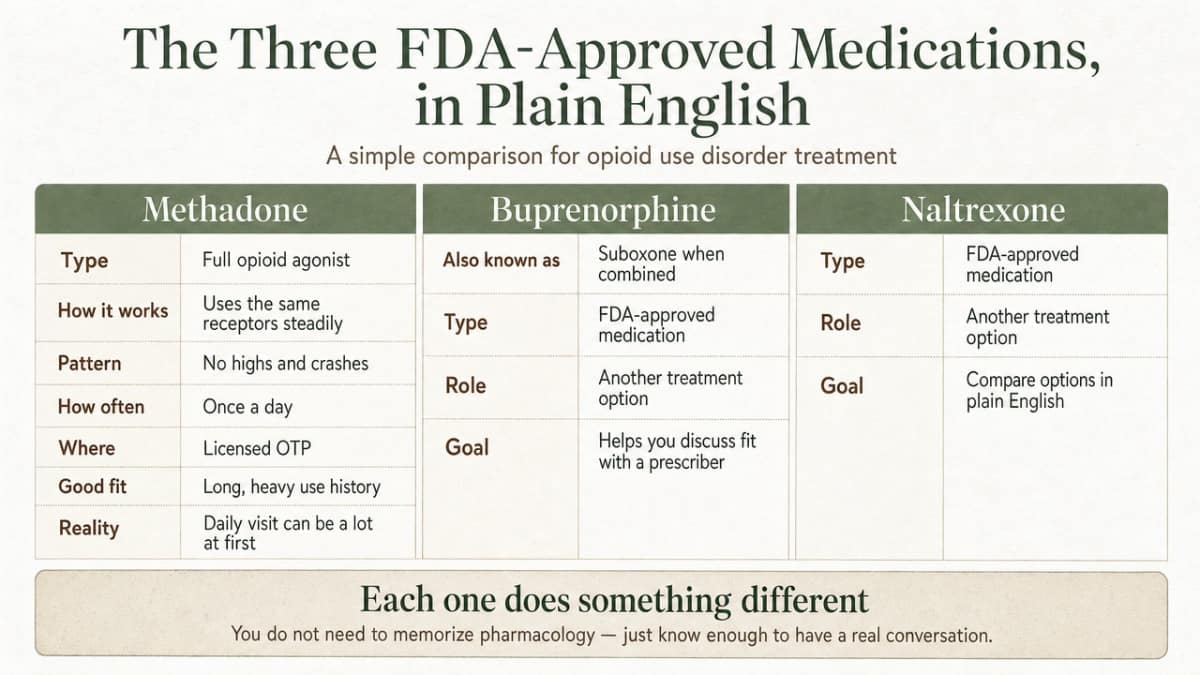
The Three FDA-Approved Medications, in Plain English
There are three medications the FDA has approved to treat opioid use disorder, and each one does something different. You do not need to memorize the pharmacology. You just need to know enough to have a real conversation with a prescriber and to push back if someone tries to talk you out of the one that fits your life.
- Methadone
- A long-acting full opioid agonist. It occupies the same brain receptors that heroin, fentanyl, and prescription pills do, but steadily, without the highs and crashes. You take it once a day at a licensed opioid treatment program (OTP), which in Montana means a facility with SAMHSA certification and DEA registration 11. The daily visit is a lot at first. For people with a long, heavy use history, it is often the medication that finally holds.
- Buprenorphine (you may know it as Suboxone when combined with naloxone)
- A partial agonist. It quiets cravings and withdrawal, but it has a ceiling effect, which makes overdose on the medication itself much less likely. Any qualified prescriber can now write for it in an office setting, so you can pick it up at a pharmacy like any other prescription. For most people starting MAT in Helena today, buprenorphine is the practical entry point.
- Naltrexone, usually given as a monthly injection (Vivitrol)
- Different. It blocks opioid receptors entirely rather than activating them. That means you have to be fully detoxed before your first dose, or it will trigger sharp withdrawal. It fits people who want a non-opioid option and can commit to the induction window.
Here is the piece worth holding onto: NIDA’s review of the evidence found that patients receiving methadone or buprenorphine are more likely to stay in treatment and less likely to use heroin than those receiving psychosocial treatment alone 20. Montana Medicaid covers all three medications under the MAT benefit, so cost should not decide which one you try 14. The right medication is the one you will actually take, prescribed by someone who knows your history. If the first one does not fit, you and your prescriber can switch.
The Helena Treatment Pathway, Week by Week
One of the reasons people put off getting help is that the whole thing feels like a fog. You know you need something, but you cannot picture what Monday actually looks like, or Friday, or the Tuesday six weeks from now when your kid has a soccer game. The pathway below is the version most Helena residents move through. Yours will not match it exactly, but the shape holds.
The First Call and Medical Detox
The first call is shorter than you think. Someone on the other end asks what you have been using, how much, how long, and when you last used. They ask about other medications, mental health history, and whether you have a safe place to sleep tonight. They are not building a case against you. They are figuring out how sick you are going to get when the opioids leave your system, and how fast a bed needs to open.
Medical detox usually runs five to seven days for opioids. You check in, a physician assesses you, and within hours you are on medication that blunts the worst of withdrawal — muscle pain, vomiting, the crawling-out-of-your-skin restlessness, the anxiety that convinces you every decision you have ever made was wrong. Most Helena programs start buprenorphine during detox rather than after, because waiting until you are fully sick is cruel and unnecessary 18. Vital signs are checked around the clock. You sleep more than you expect on day two, less than you want on day three.
MAT Induction and Residential or PHP Care
Once your body has stabilized, your prescriber dials in a maintenance dose. This is MAT induction — the stretch of days when buprenorphine, methadone, or naltrexone gets titrated to the level that quiets cravings without sedating you. You will feel the difference. The internal noise drops. You can hold a conversation without counting the minutes until your next dose of something illicit.
From there, most people step into residential inpatient care for roughly 28 to 45 days, or into a partial hospitalization program (PHP) that runs six or more hours a day, five days a week, while you sleep at home or in sober housing. Residential makes sense if your home environment is unsafe, if you have tried outpatient before and it did not hold, or if you simply need to be away from the phone, the dealer, the roommate. PHP works when you have a stable place to sleep and someone to be accountable to at night.
Either setting layers the same things on top of your medication: individual therapy, group therapy, peer support, and case management for the practical mess opioid use leaves behind — court dates, back rent, a suspended license. This combination is not optional dressing on the pharmacology. NIDA’s review found that patients on methadone or buprenorphine plus counseling stay in treatment longer and use less heroin than those in psychosocial care alone 20. The medication holds the biology. The therapy rebuilds the reasons to stay.
IOP, Outpatient, and What Month Six Feels Like
After residential or PHP, most people step down into an intensive outpatient program (IOP) — typically three sessions a week, three hours each, often in the evening so you can work during the day. You keep your MAT prescription, keep a therapist, and start practicing recovery inside your actual life instead of a controlled setting. IOP is where you find out which triggers were about the drug and which were about the job, the marriage, the grief you never touched.
Standard outpatient comes next, usually once a week, and can continue for months or years alongside ongoing MAT. Retention is the whole game here. The evidence is consistent that people who stay on medication and stay connected to counseling do better on nearly every measure that matters — overdose, illicit use, employment, family stability 7.
Month six does not feel like a movie. You are not glowing. You are showing up to work, sleeping through the night most nights, and noticing that a bad afternoon no longer ends with a pill. Be honest with your care team about how you feel on the medication — some people notice mild cognitive fog, and while MAT patients function far better than untreated peers, research also shows some measurable differences from healthy controls 8. That is a conversation with your prescriber, not a reason to stop.
What Montana Medicaid Actually Covers for MAT
Cost is one of the top reasons people in Helena stall out before making the call, so it is worth being clear about what Montana Medicaid actually pays for. Since October 2020, in line with federal SUPPORT Act requirements, Montana Medicaid must cover all FDA-approved medications for opioid use disorder — methadone, buprenorphine, and naltrexone — along with the counseling and behavioral therapies that go with them 14, 15. That coverage is not a pilot. It is a required benefit under the state plan.
On the provider side, methadone has to come from an opioid treatment program with SAMHSA certification and DEA registration, while buprenorphine and naltrexone can be prescribed in office-based settings 11. Behavioral health referral and coordination are built into the MAT benefit, meaning your prescriber and your counselor are supposed to be talking to each other, not leaving you to relay messages 12.
If you are uninsured, Montana Medicaid enrollment can often be handled during intake at a treatment program, and case management is part of what MAT providers are set up to do. Do not let a paperwork question stop you from picking up the phone.
Distance, Weather, and Telemedicine: Access Around Helena
Helena has more in-person options than most Montana towns, and that matters. If you live in the city itself, you can usually get to a prescriber, a counselor, and a pharmacy without a two-hour drive. But recovery does not respect the calendar, and a blizzard on I-15 in February does not care that your buprenorphine appointment is at 9 a.m. Access here is real, but it is weather-dependent, and that shapes how you should plan.
The pressure gets sharper the further out you live. Research on rural MOUD access in Western states, including Montana, has documented that geography, weather, and limited OUD and mental health workforce all hinder treatment access, with prescribers concentrated in urban hubs 1. If you are driving in from Townsend, Lincoln, Augusta, or East Helena, you already know the calculus — every appointment is a half-day.
Telemedicine has changed what is possible. A retrospective study of buprenorphine and naltrexone delivered by telemedicine in a rural OUD setting found outcomes comparable to in-person care, which means a video visit for a MAT check-in is not a lesser version of treatment — it is treatment 9. Montana Medicaid recognizes telemedicine for behavioral health under federal and state rules, so many follow-up MAT visits can happen from your kitchen table 11. Methadone still requires in-person dosing at a certified OTP, but buprenorphine and naltrexone often do not. Ask about a hybrid schedule up front. It is one of the most practical things you can protect.
Protecting Your Job, Your Kids, and Your Housing While You Get Care
One of the quiet reasons people stall is not the treatment itself. It is the fear that asking for help will cost you everything you are trying to protect. That fear is not irrational, but it usually gets bigger than the actual risk. A few practical things worth knowing before you make the call.
- On work: the Family and Medical Leave Act can cover time in treatment for eligible employees, and treatment is protected differently than active use under most workplace policies. Buprenorphine and naltrexone are prescribed medications, taken as directed, and do not require you to disclose a diagnosis to anyone beyond HR if you need leave. Many people in Helena complete IOP in the evenings and never miss a full week of work.
- On kids: voluntarily entering treatment is treated very differently from a positive test in a crisis. Case managers at MAT programs are used to coordinating with family court and CPS when it comes up, and staying on medication is consistently viewed as protective, not disqualifying 4. Ask for a case manager on day one.
- On housing and pain care: tell your MAT prescriber about any surgery, injury, or dental work in advance so pain can be managed within the rules — Montana Medicaid will not cover concurrent opioids while you are in MAT, so coordination has to run through your prescriber, not a separate urgent care visit 12.
Protecting what matters starts with telling one person the truth. The rest gets built from there.
Taking the First Step This Week
The hardest part is picking up the phone. Not the withdrawal, not the paperwork, not the conversation with your boss. The phone. If you can get past that, Helena has people who will do the rest of the heavy lifting with you.
This week, try one thing. Call a Helena treatment program and ask two questions: how soon can you start medical detox, and can they help you sort out Medicaid or insurance during intake. That is the whole call. You do not have to explain yourself or promise anything.
Elk Ridge Recovery is one Montana option that offers physician-led detox, MAT, and residential care built around the pathway laid out here. Whichever door you choose, the door exists. Making the call is not the last hard thing you will do. It is the first thing that starts working in your favor.
Speak With a Helena Recovery Specialist Now
Connect directly for guidance on your next steps toward safe, supported opioid recovery in Helena.
Frequently Asked Questions
Is medication-assisted treatment just trading one drug for another?
No. Taking buprenorphine, methadone, or naltrexone as prescribed produces stable physical dependence, not addiction — no chasing highs, no overdose risk from unknown fentanyl. The National Academies concluded that FDA-approved medications for OUD are effective, save lives, and that long-term agonist medication is the safest option for treating OUD 4. It is treatment, not a moral compromise.
Does Montana Medicaid cover opioid addiction treatment in Helena?
Yes. Since October 2020, Montana Medicaid must cover all three FDA-approved MAT medications — methadone, buprenorphine, and naltrexone — plus the counseling and behavioral therapies that go with them 14, 15. One rule to plan for: while you are in MAT, Medicaid does not pay for concurrent opioid pain medications, tramadol, or carisoprodol, so pain care runs through your MAT prescriber 12.
What happens during medical detox, and how long does it last?
Opioid detox usually runs five to seven days. A physician assesses you at intake, then starts medication — often buprenorphine — to blunt withdrawal symptoms like muscle pain, vomiting, and severe anxiety. Vitals are monitored around the clock. Detox alone is not treatment, and the National Academies is clear that detox without follow-on medication elevates overdose risk once tolerance drops 4. MAT should start before you leave.
Can I get MAT through telemedicine if I live outside Helena?
For buprenorphine and naltrexone, often yes. A retrospective study of telemedicine-delivered MAT in a rural OUD setting found outcomes comparable to in-person care 9. Montana Medicaid recognizes telemedicine for behavioral health under federal and state rules 11. Methadone still requires in-person dosing at a certified opioid treatment program, but many follow-up visits for other MAT medications can happen by video from home.
Will going to treatment cost me my job, my kids, or my housing?
Usually the opposite. FMLA can protect eligible employees taking leave for treatment, and buprenorphine and naltrexone are prescribed medications you take as directed. In family court and CPS matters, voluntarily entering treatment and staying on medication is consistently viewed as protective, not disqualifying 4. Ask for a case manager on day one — coordinating with employers, courts, and landlords is part of what MAT programs do.
How long will I need to stay on medication for opioid use disorder?
There is no fixed endpoint, and that is a feature, not a flaw. The National Academies concluded that agonist medication used for an indefinite period is the safest option for treating OUD 4, and retention on medication consistently predicts better outcomes 7. Some people stay on MAT for years, some longer. The right length is however long keeps you stable, decided with your prescriber — not a calendar.
References
- Barriers for Implementing the Hub and Spoke Model to Expand Medication for Opioid Use Disorder in Rural Areas. https://pmc.ncbi.nlm.nih.gov/articles/PMC8411614/
- Medication Assisted Treatment for Opioid Use Disorder. https://pmc.ncbi.nlm.nih.gov/articles/PMC8389722/
- Medication-Assisted Treatment for Opioid Use Disorder in a Federally Qualified Health Center. https://pmc.ncbi.nlm.nih.gov/articles/PMC7278292/
- Medications for Opioid Use Disorder Save Lives. https://www.ncbi.nlm.nih.gov/books/NBK541393/
- Introduction (Medications for Opioid Use Disorder Save Lives). https://www.ncbi.nlm.nih.gov/books/NBK541397/
- Medication-Assisted Treatment for Opioid Use Disorder. https://stacks.cdc.gov/view/cdc/78827/cdc_78827_DS1.pdf
- Trends in abstinence and retention associated with Medication Assisted Treatment for opioid use disorder. https://pmc.ncbi.nlm.nih.gov/articles/PMC7751497/
- Effects of Medication-Assisted Treatment (MAT) for Opioid Use Disorder on Functional and Cognitive Outcomes. https://pmc.ncbi.nlm.nih.gov/articles/PMC7302321/
- Outcomes for patients receiving telemedicine-delivered medication-assisted treatment for opioid use disorder: A retrospective study. https://pmc.ncbi.nlm.nih.gov/articles/PMC7861202/
- Montana AHEC Behavioral Health Needs & Training Assessment Report 2024. https://healthinfo.montana.edu/reports/2024%20AHEC%20BH%20Needs%20Assessment.pdf
- Addictive and Mental Disorders Division Medicaid Services Provider Manual (Effective 10/01/2019). https://dphhs.mt.gov/assets/BHDD/MedicaidManual/AMDDMedicaidManualeff10012019.pdf
- 550 Medication Assisted Treatment (MAT). https://dphhs.mt.gov/assets/BHDD/MedicaidManual/550MAT.pdf
- Medication Assisted Treatment Form (Montana Medicaid Provider). https://medicaidprovider.mt.gov/docs/forms/MATForm05062022.pdf
- Medication-Assisted Treatment and Physicians Services Medicaid State Plan Amendments 02-21-2021. https://dphhs.mt.gov/assets/hrd/PublicNotices/MedicationAssistedTreatmentPhysiciansPublicNotice022121.pdf
- Routine State Plan and Waiver Amendments Approved or Pending Approval after November 2020 Montana Health Coalition Meeting. https://dphhs.mt.gov/assets/waivers/RoutineStatePlanandWaiverAmendmentsApprovedorPendingApprovalafter11-2020MTHealthCoalitionmtgthrough9-7-2.pdf
- Overdose Prevention Data Channel – Montana. https://www.cdc.gov/overdose-prevention/data-channel/index.html
- Lewis and Clark County Behavioral Health System Report Update (2024). https://www.lccountymt.gov/files/assets/county/v/1/health/documents/strong-roots-coalition/2024-lewis-and-clark-county-behavioral-system-report-jg-research-and-evaluation.pdf
- Summary of Opioid Use in Montana. https://dphhs.mt.gov/assets/publichealth/EMSTS/Data/Opioid_Drug_Use_Summary.pdf
- Montana Substance Use Disorders Task Force Strategic Plan. https://dphhs.mt.gov/assets/publichealth/EMSTS/opioids/MontanaSubstanceUseDisordersTaskForceStrategicPlan.pdf
- Medications to Treat Opioid Use Disorder. https://www.drugabuse.gov/publications/research-reports/medications-to-treat-opioid-addiction