Key Takeaways
- Fentanyl has reshaped Flathead County’s overdose risk, with Montana’s opioid death rate more than doubling from 2014 to 2023, making medical stabilization more urgent than in past years 4.
- Methadone, buprenorphine, and extended-release naltrexone each carry different dosing rules, clinic requirements, and induction timing — the right fit depends on your schedule, health history, and local access in Kalispell 11.
- MAT is not substitution; stable, measured dosing paired with counseling keeps people engaged, and methadone shows stronger retention in head-to-head research when that matters most 14.
- Before starting, compare medication logistics, Montana Medicaid coverage rules including monthly check-ins, whether residential or office-based care fits your situation, and what prior detox attempts revealed about missing supports 13.
What the First 72 Hours of Stopping Opioids Actually Feel Like
You already know the shape of it. The restless legs at hour eight. The sweat that soaks through a shirt by hour twelve. The stomach that turns on you around hour eighteen, and the certainty by hour twenty-four that you cannot do this alone.
Here is what changes when you start medication-assisted treatment inside a medical setting instead of white-knuckling it at home. On day one, a clinician takes vitals, asks what you used and when, and starts a medication timed to your withdrawal — not to a schedule on a wall. If buprenorphine is the plan, you wait until mild withdrawal shows up on purpose, because starting too early can make things worse for a few hours. If methadone is the plan, dosing starts lower and moves up as your body tells the team what it needs. Federal guidance is specific about this: dosing should be individualized, not capped by program policy, and psychosocial support should run alongside from the start 2.
By day two, the muscle cramps loosen. Nausea eases enough to keep down toast and broth. You might sleep three hours in a row for the first time in months.
By day three, the noise in your head gets quieter. Not gone. Quieter. That is the window where the real work begins — and where being somewhere safe, with people who have seen this exact hour before, matters most.
Why Medication Became the Standard, Not the Shortcut
For a long time, the story about opioid recovery was that you had to want it badly enough. Detox, willpower, meetings, and if it didn’t hold, you were told to try harder. That story left a lot of people dead.
What researchers learned across decades of watching what actually keeps people alive is that opioid use disorder changes the brain in ways willpower can’t reach on its own. Medication changes those signals back — enough that you can sleep, eat, hold a thought, and use the counseling and community that follow. That’s why federal clinical guidance names three medications — methadone, buprenorphine, and naltrexone — as the FDA-approved foundation of care, not one option among many 11. And that’s why the same guidance is clear that medication alone isn’t the plan either; psychosocial treatment of “sufficient intensity and duration” runs alongside it 2.
So when you hear MAT called the standard of care, that’s what it means. Not a shortcut around the hard work. Not a softer version of recovery. The hard work is still there — the honesty, the counseling, the rebuilding. Medication just makes it possible for your brain and body to show up for it.
The Fentanyl-Era Shift in Flathead County
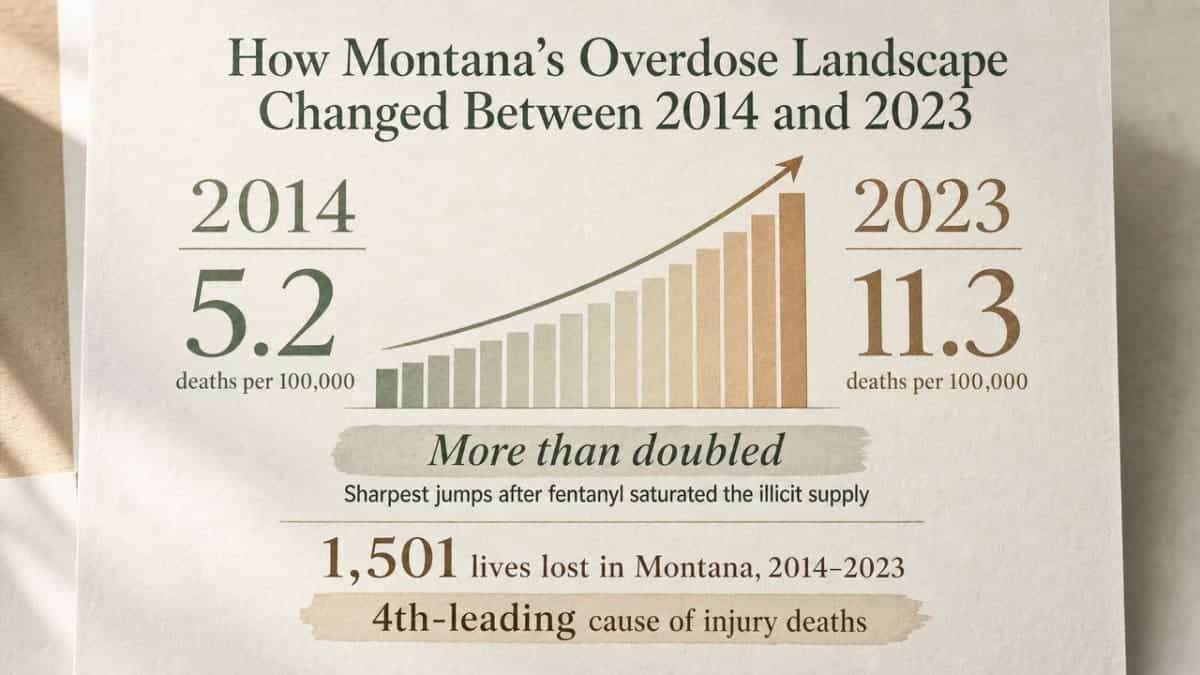
How Montana’s Overdose Landscape Changed Between 2014 and 2023
The opioids on the street in the Flathead today are not the opioids of a decade ago. That matters for you, because it changes what you’re actually up against — and why the option of medical stabilization is more important now than it was even five years ago.
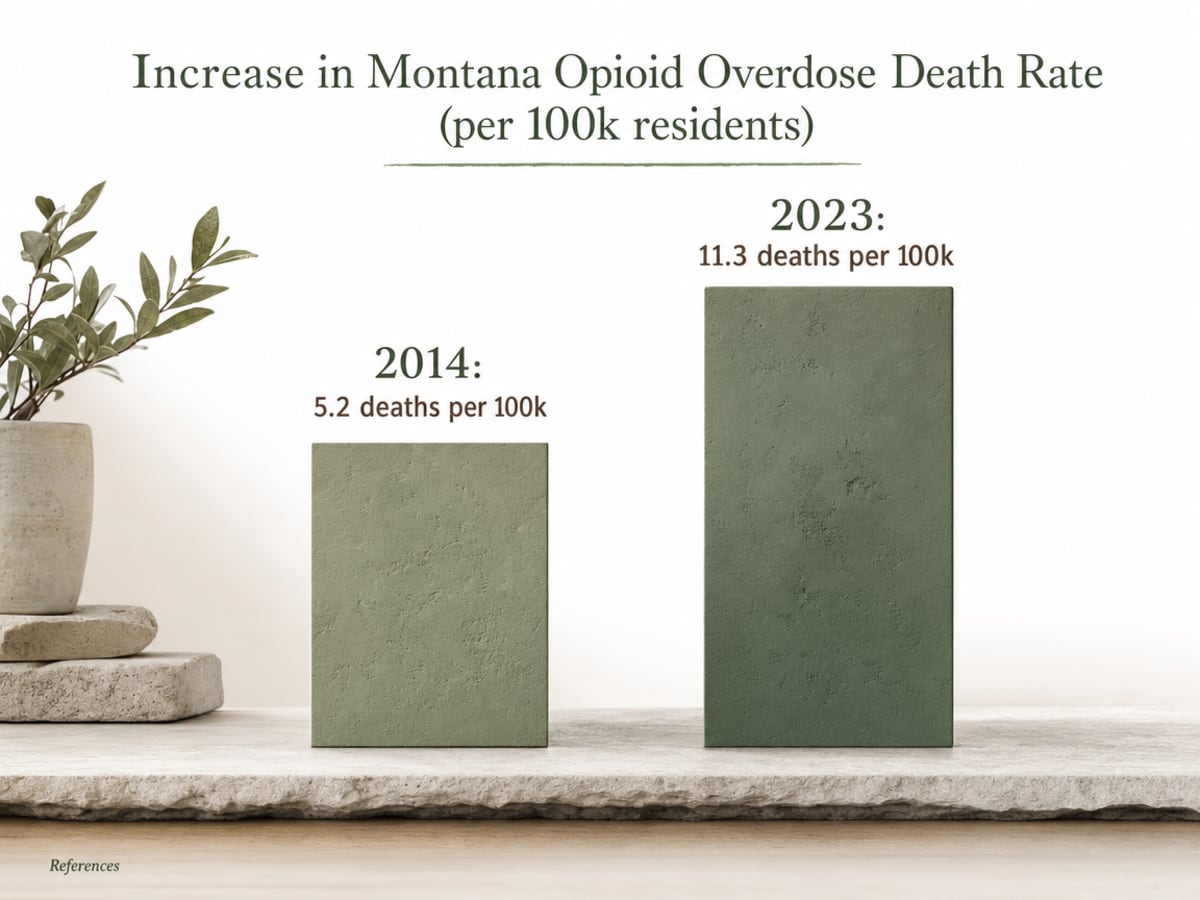
The state’s own numbers tell the story cleanly. Montana’s opioid overdose death rate more than doubled between 2014 and 2023, climbing from 5.2 deaths per 100,000 residents to 11.3 deaths per 100,000 residents, with the sharpest jumps arriving after fentanyl saturated the illicit supply 4. Drug overdoses became the fourth-leading cause of injury deaths in Montana over that same stretch, accounting for 1,501 lives between 2014 and 2023 4.
What that means in practical terms: the heroin or pill you used two years ago is not what’s in the bag or the counterfeit tablet now. Fentanyl is roughly fifty times more potent than heroin, and it doesn’t mix evenly. One pill in a batch can have a trace amount. The next pill can have enough to stop your breathing. There is no way to eyeball it, no tolerance you’ve built that reliably protects you, and no “I know my dose” that holds up against a supply this unpredictable.
What This Means for Someone Deciding Whether to Start Treatment in Kalispell
Flathead County is not spared from any of this. State surveillance data documented 57 opioid overdose deaths in the county between 2020 and 2024, with fentanyl driving most of the recent activity in the illicit supply 12. These are your neighbors, your coworkers, people you may have used with.
Here’s the part worth sitting with. You may have told yourself, reasonably, that you’d get treatment when things got bad enough. The current supply doesn’t give you that runway. “Bad enough” and “too late” now sit uncomfortably close together, and the space between them is measured in a single dose you didn’t know was hot.
That’s not meant to scare you. It’s meant to name why starting sooner — while you can still make the call, while you can still walk into an intake — is a different decision now than it would have been for someone in your shoes in 2014. Local access to MAT, paired with medical detox and residential structure, exists precisely because the margin for figuring it out on your own has narrowed.
The Three Medications, Explained Without the Marketing Gloss
Methadone: Daily Clinic, Strongest Retention
Methadone is the oldest of the three, and the one with the deepest track record. It is a full opioid agonist, which means it activates the same receptors as heroin or fentanyl — but slowly, steadily, at a dose calibrated to hold you level for about 24 hours. No high. No crash. Just a floor under your feet.
The catch is how you get it. Methadone for opioid use disorder is dispensed only through certified opioid treatment programs, and early in care that means showing up at the clinic every morning for your dose. Take-home doses are earned over months as you demonstrate stability. In a place like Kalispell, where the nearest OTP may be a drive, that daily requirement is a real logistical weight — and one of the reasons residential stabilization matters at the front end.
What you get in return is retention. People stay on methadone longer than they stay on other options, and staying in treatment is what keeps people alive. Federal guidance is explicit that dosing should be individualized and not capped by program policy — your dose is what your body needs, not what a schedule dictates 2.
Buprenorphine: Office-Based, More Flexible, Requires Mild Withdrawal First
Buprenorphine — often prescribed as buprenorphine/naloxone under brand names like Suboxone — is a partial agonist. It occupies the same receptors, but it hits a ceiling. Past a certain dose, more medication does not produce more effect, which is part of why the overdose risk is lower than with methadone or street opioids.
The biggest practical difference is where you can get it. Buprenorphine can be prescribed in a regular medical office and picked up at a pharmacy. No daily clinic trip. For someone in the Flathead Valley trying to hold onto a job, drive kids to school, or care for a parent, that flexibility is not small.
The induction is the tricky part. You have to be in mild withdrawal before your first dose — usually 12 to 24 hours after your last short-acting opioid, longer for methadone or fentanyl. Start too early and buprenorphine can knock other opioids off the receptors and throw you into what’s called precipitated withdrawal. Uncomfortable, not dangerous, and entirely preventable with a clinician timing it with you 11.
Extended-Release Naltrexone: Monthly Injection, No Opioid in Your System
Naltrexone is the outlier. It is not an opioid at all. It is a blocker — it sits on the receptors and stops any opioid from working. Take heroin or fentanyl while it is active, and you will feel almost nothing.
Extended-release naltrexone (the brand name is Vivitrol) is a once-a-month injection in a clinic. No daily pill, no daily dosing decision, no craving-management medication to remember. For some people, that simplicity is exactly what makes it stick.
The requirement is real, though: you have to be fully off all opioids for roughly 7 to 10 days before your first shot, or the injection will trigger sudden, severe withdrawal. That’s why naltrexone tends to fit best after a supervised detox — inside a residential stay, where the wait can happen safely with medical support, not alone in a bedroom counting hours 11.
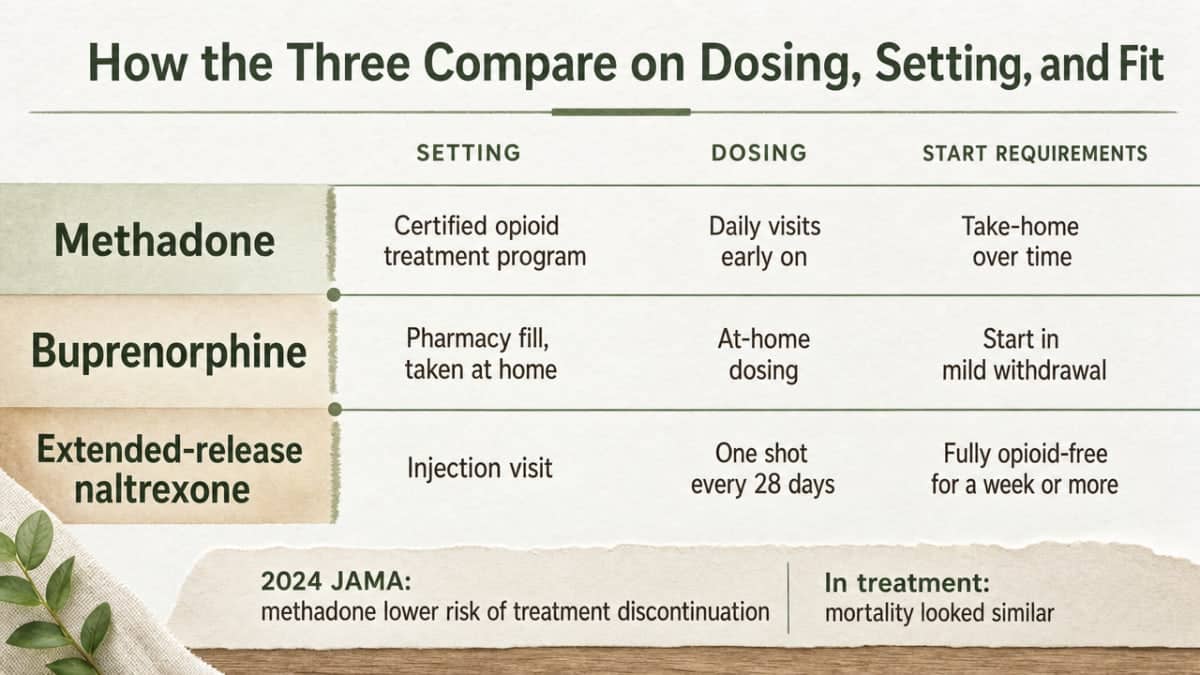
How the Three Compare on Dosing, Setting, and Fit
When you put the three side by side, the tradeoffs get concrete:
- Methadone means a daily trip to a certified opioid treatment program early on, with take-home privileges earned over time.
- Buprenorphine can be filled at a pharmacy and taken at home, but requires you to be in mild withdrawal to start.
- Extended-release naltrexone is a single shot every 28 days, but you have to be fully opioid-free for a week or more before that first injection.
The outcome data is worth being honest about. In a 2024 JAMA study comparing buprenorphine/naloxone and methadone head-to-head, methadone showed a lower risk of treatment discontinuation, meaning people were more likely to stay on it long enough to benefit; mortality while actively in treatment looked similar between the two 14. A 2025 population-level modeling study that factored retention into the math reached the same direction — better overall outcomes with methadone once you account for how many people stay engaged 15.
That does not make methadone the automatic answer. Retention is not the only variable. Your work schedule, your driving distance to a clinic, your history with prior medications, whether you’re pregnant, what other medications you take, whether you have someone at home who can help you get to appointments — all of it matters. The right medication is the one you will actually stay on, in the life you actually live. A good intake conversation weighs all of that with you, not for you.
‘Am I Just Trading One Drug for Another?’ The Honest Answer
This is the question that keeps people out of treatment for years, so it’s worth answering plainly.
No. You are not trading one drug for another. You are trading a chaotic, unpredictable dose of a street opioid that can stop your breathing for a measured, medically supervised dose of a medication that keeps your brain from screaming at you every four hours. Methadone and buprenorphine both act on opioid receptors — that part is true. What’s different is everything else: the dose is stable, the timing is predictable, there is no high to chase, and your body stops burning through its day trying to avoid withdrawal.
The outcome data backs this up in a way that’s hard to argue with. When researchers followed people on buprenorphine/naloxone versus methadone in a 2024 JAMA study, methadone had a lower risk of treatment discontinuation — meaning people stayed engaged in care long enough for the rest of recovery to take hold 14. A 2025 population-level modeling study reached the same conclusion once retention was factored in 15. Staying alive and staying in treatment is the point. That’s not substitution. That’s stabilization.
If someone in your life tells you MAT isn’t “real” recovery, they are working from an old script. The people who study this for a living stopped writing that script a decade ago.
What a Residential MAT Stay in Montana Actually Looks Like
Medical Detox and Induction: Days 1 Through 7
The first week is not one experience. It is three, stacked on top of each other.
- Day 1 is intake and stabilization. A physician takes your history, checks vitals, screens for other medications and medical conditions that change what’s safe, and starts a comfort protocol — things like clonidine for the sweating and racing heart, an anti-nausea medication, something to help you sleep. If methadone is the path, a low starting dose goes in and the team watches how your body responds over the next several hours. If buprenorphine is the path, the clock starts on getting you into mild withdrawal so the first dose lands cleanly.
- Days 2 and 3 are induction proper. Doses adjust upward based on what your body is telling the team, not on a schedule taped to a wall. Federal guidance is explicit here: dosing should be individualized, program-wide caps are contrary to the medical literature, and both medical and psychosocial care should run at “sufficient intensity and duration” from the start 2.
- Days 4 through 7 are the settle. The acute withdrawal loosens its grip. Vitals normalize. You start being able to sit through a meal, a conversation, a short walk. Nursing checks continue, dose fine-tuning continues, and the counseling piece — which has been offered gently since day one — starts to feel like something you can actually engage with instead of endure.
Stabilization Weeks: Sleep, Meals, and the First Clear-Headed Morning
Weeks two and three are quieter, and quieter is the point.
You start sleeping through the night — not every night, but most. The 3 a.m. wake-up with your heart pounding stops happening. You eat three meals in a day and one of them tastes like something. Your hands stop shaking when you pour coffee. You notice the light coming through the window at breakfast and it does not hurt.
These are small things. They are also the things you have not had in a long time, and getting them back is what makes the rest of the work possible. A brain that has slept and eaten can sit in a group. A body that is not in withdrawal can go on a walk with someone and talk about hard things without needing to leave.
The medication is doing exactly what it is supposed to do here: taking the physical noise down so you can start hearing yourself think again. Staff are checking in on your dose, adjusting as needed, and watching for the signs — irritability, cravings creeping back in the afternoon — that mean a small tweak is worth making.
Counseling and Peer Support: Why the Medication Isn’t the Whole Story
The medication holds the floor steady. It does not, on its own, teach you what to do with the rest of your life.
That is what the counseling and peer support are for. Individual therapy gives you a place to look at the things underneath — the pain that started this, the losses that stacked up, the relationships that need repair or, sometimes, distance. Group work puts you in a room with people who know the exact hour you’re describing because they’ve been in it too. Federal clinical guidance is clear that medication and psychosocial treatment are meant to run together, not one before the other 11.
Peer support is the piece that surprises people. Sitting across from someone two years further down the road than you — someone who lost the same things, felt the same shame, and is now living a life that looks like a life — does something no clinician can. It makes the next chapter concrete. It gives you a version of yourself to walk toward.
Cost, Coverage, and Montana Medicaid’s MAT Requirements
Cost is the wall a lot of people hit before they even get to the intake call. Here is what actually applies in Montana, in plain terms.
Montana Medicaid covers medication-assisted treatment for opioid use disorder. The state’s Medicaid manual is specific about what qualifies:
- You need a diagnosed moderate or severe OUD.
- Treatment has to be clinically appropriate for you.
- You have to agree to the plan of care.
Once you are in, the program requires monthly check-ins as a condition of ongoing dispensing 13. Those check-ins are not a hurdle designed to trip you up. They are the built-in touchpoint where your dose gets reviewed, your counseling stays connected, and someone catches a problem before it becomes a relapse.
If you have private insurance, MAT is almost always a covered behavioral health benefit, though the specifics of copays, prior authorization, and in-network providers vary. If you are uninsured, ask about Medicaid eligibility at intake — a case manager can often help you apply the same day. Do not let a guess about cost make the decision for you. Call, ask, and get a real number before you rule anything out.
If You’ve Tried to Stop Before and It Didn’t Hold
If you’ve been to detox before and ended up using again, you are not the exception. You are what the research predicts when opioid use disorder gets treated with willpower instead of medicine.
Here is what usually went wrong. A short detox flushes your system, your tolerance drops, and you walk out into the same phone, the same street, the same supply — with cravings that peak in the weeks after, not during, the acute withdrawal. That is why relapse after detox-only is common, and why it is more dangerous now: your lowered tolerance meets a fentanyl-heavy supply, and the dose that felt normal a month ago is not the dose in your hand today.
MAT changes that equation. Medication holds the craving down long enough for the counseling, the sleep, and the new routines to take root. If it didn’t hold before, that’s information about what the plan was missing — not a verdict on you.
How to Take the Next Step This Week
You do not have to have it figured out. You have to make one call.
Here is what actually happens when you do. You will be asked a handful of questions — what you have been using, how much, how long, whether you have other health conditions, whether you have insurance or Medicaid. That is the intake. It takes about twenty minutes. Nobody is grading you. If you have Medicaid, a case manager can confirm coverage on the spot 13. If you do not, they can help you apply or walk through other options before you hang up.
Pick a day this week. Not next month, not after one more try on your own. Call in the morning if you can — your resolve is usually strongest before noon, and intake staff can often get you assessed the same day or the next.
If you are the family member reading this: make the call with them, not for them. Sit on the couch, put it on speaker, and let them answer. That small act — being in the room while they do the hard thing — is often what tips the decision from someday to today.
Connect for MAT Support in Kalispell Now
Get guidance on safe, structured opioid detox and recovery options in Kalispell when you reach out today.
Frequently Asked Questions
Is medication-assisted treatment just replacing one opioid with another?
No. Methadone and buprenorphine act on opioid receptors, but the dose is stable, measured, and timed to hold you level — no high, no crash, no chasing withdrawal. Federal clinical guidance names these medications as the FDA-approved foundation of opioid use disorder care, paired with counseling 11. That’s stabilization, not substitution.
Which MAT medication is right for me—methadone, buprenorphine, or naltrexone?
That depends on your life, not a chart. Methadone means daily clinic visits early on but has the strongest retention data 14. Buprenorphine can be filled at a pharmacy and taken at home. Naltrexone is a monthly shot but requires being fully opioid-free first. A good intake conversation weighs your schedule, health history, and supports with you.
Does Montana Medicaid cover MAT for opioid use disorder?
Yes. Montana Medicaid covers MAT when you have a diagnosed moderate or severe OUD, treatment is clinically appropriate, and you agree to the plan of care. Monthly check-ins are required for ongoing dispensing — a built-in touchpoint for reviewing your dose and counseling 13. If you’re uninsured, a case manager at intake can often help you apply the same day.
How long do I need to stay on MAT?
As long as it’s helping — which for many people is measured in years, not weeks. Federal guidance is explicit that there should be no arbitrary limits on treatment duration; the decision belongs to you and your clinician 2. Some people taper eventually. Others stay on medication indefinitely. Both are legitimate. Staying alive and staying in recovery is the point.
What if I’ve tried detox before and relapsed?
That’s not a verdict on you — it’s information about what the plan was missing. Detox alone drops your tolerance without addressing the cravings that peak weeks later, which is why relapse after detox-only is common and, in a fentanyl-heavy supply, more dangerous. Medication holds cravings down long enough for counseling, sleep, and new routines to take root.
Do I have to go to residential treatment, or can I start MAT as an outpatient?
Both paths exist. Office-based buprenorphine works well if you have stable housing, support at home, and are not in active heavy use. Residential makes sense when the supply around you is fentanyl-heavy, prior attempts didn’t hold, or you need a safe wait before a naltrexone induction. An honest intake conversation will tell you which fits your situation.
References
- Review of Medication-Assisted Treatment Guidelines and Measures for Opioid and Alcohol Use. https://aspe.hhs.gov/sites/default/files/migrated_legacy_files//146866/MATguidelines.pdf
- Federal Guidelines for Opioid Treatment Programs (2024). https://library.samhsa.gov/product/federal-guidelines-opioid-treatment-programs-2024/pep24-02-011
- Overdose Prevention Data Channel. https://www.cdc.gov/overdose-prevention/data-channel/index.html
- Drug Overdose Deaths in Montana 2014–2023. https://dphhs.mt.gov/assets/publichealth/EMSTS/Data/DrugOverdoseDeaths_2014-2023.pdf
- Montana Substance Use Disorder Task Force Strategic Plan 2024. https://dphhs.mt.gov/assets/publichealth/EMSTS/opioids/SUDsStrategicPlan2024.pdf
- Drug Overdose Mortality: Stats of the States. https://www.cdc.gov/nchs/state-stats/deaths/drug-overdose.html
- Provisional Drug Overdose Death Counts. https://www.cdc.gov/nchs/nvss/vsrr/drug-overdose-data.htm
- DOSE Dashboard: Nonfatal Overdose Emergency Department and Inpatient Hospitalization Discharge Data. https://www.cdc.gov/overdose-prevention/data-research/facts-stats/dose-dashboard-nonfatal-discharge-data.html
- Drug Overdose Deaths in the United States, 2002–2022. https://www.cdc.gov/nchs/products/databriefs/db491.htm
- QuickStats: Rates of Deaths from Drug Poisoning and Drug Poisoning Involving Opioid Analgesics—United States, 1999–2013. https://www.cdc.gov/nchs/products/databriefs/db394.htm
- TIP 63: Medications for Opioid Use Disorder. https://library.samhsa.gov/sites/default/files/pep21-02-01-002.pdf
- Summary of Opioid Use in Montana. https://dphhs.mt.gov/assets/publichealth/EMSTS/Data/Opioid_Drug_Use_Summary.pdf
- 550 Medication Assisted Treatment (MAT). https://dphhs.mt.gov/assets/BHDD/MedicaidManual/550MAT.pdf
- Buprenorphine/Naloxone vs Methadone for the Treatment of Opioid Use Disorder. https://pubmed.ncbi.nlm.nih.gov/39418046/
- Population-Level Health Benefits and Harms Associated With Buprenorphine/Naloxone vs Methadone. https://pubmed.ncbi.nlm.nih.gov/41632156/