Key Takeaways
- Opioid dependence hits the Flathead Valley hard, with fentanyl driving most Montana overdose deaths and rural distance, weather, and small-town privacy shaping how people seek care 10.
- Medication-assisted treatment with methadone, buprenorphine, or naltrexone is the clinical standard for opioid use disorder, and long-term medication consistently outperforms detox-only approaches 1, 4.
- Buprenorphine access across Montana has more than doubled since 2015, meaning Kalispell-area providers can now start medication in regular medical offices without the wait times of a decade ago 12.
- Before calling, compare which medications a program offers, whether induction can happen at the first visit, what level of care fits your situation, and how insurance, Medicaid, or sliding-scale options apply.
What opioid dependence looks like in the Flathead Valley right now
If you’re reading this from Kalispell, Whitefish, Columbia Falls, or anywhere along the lake, you probably already know the shape of this problem in your own life. You know what it feels like when the alarm goes off and the first thought isn’t coffee. You know the math of pills and hours. You know the way fentanyl has crept into supplies that used to be predictable, and you know somebody, maybe several somebodies, who didn’t wake up.
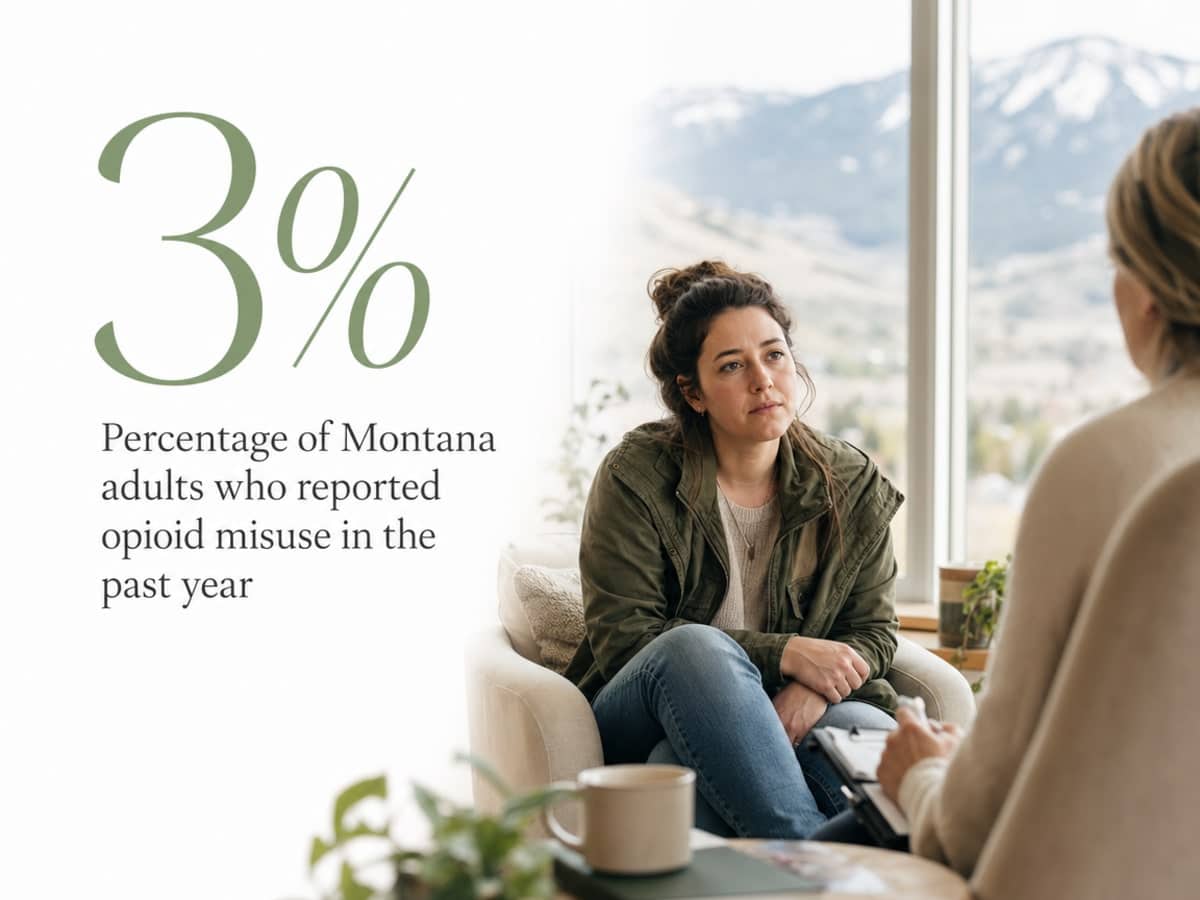
Here is the local picture, sourced and small enough to hold. About 3% of Montana adults report opioid misuse in the past year, and from 2020 through 2024, roughly three in five unintentional overdose deaths in the state involved an opioid, most often fentanyl 10. That isn’t a national statistic borrowed to make a point. That is your neighbors, your coworkers at the mill or the hospital or the ski hill, your cousin in Evergreen.
The Flathead Valley adds its own texture to that data. Distance is real here. Winter is real. Privacy in a small town cuts both ways, so does the fear that someone at the pharmacy counter went to school with your mom. If you’ve been putting off treatment because it feels exposed or logistically impossible, that hesitation is not a character flaw. It’s a rational response to a place where care has historically been scattered.
What’s changed is that opioid dependence is now understood as a medical condition with medications that work, and Montana has been slowly building the infrastructure to deliver those medications closer to where you actually live. You don’t have to detox alone in a spare bedroom to prove you’re serious. That was never the standard of care. It just felt like the only option.
The rest of this guide walks you through what treatment actually involves, in plain language, so the next call you make feels less like a leap and more like a step you can see the ground under.
The treatment path, in plain language
Medication-assisted treatment is the clinical standard, not a compromise
You may have heard someone call medication-assisted treatment “trading one drug for another.” That framing is old, and it’s wrong. Every major federal and clinical body treating opioid use disorder now points to the same conclusion: medication combined with counseling is the standard of care, and skipping the medication piece makes recovery measurably harder.
The CDC tells clinicians to offer or arrange evidence-based treatment, usually MAT with buprenorphine or methadone paired with behavioral therapy, whenever opioid use disorder is present 6. SAMHSA’s core reference for the field, TIP 63, is organized entirely around the three FDA-approved medications and how to use them well 1. When you walk into a program in Kalispell that offers MAT, you are not settling for a lesser version of recovery. You’re getting what the evidence says works.
What this means for you, in practical terms: the medication is not the finish line and it is not a moral failing. It is a tool that quiets the part of your brain that has been screaming for opioids every few hours for months or years. Once that noise drops, you can actually do the work — the therapy, the sleep, the meals, the honest conversation with the people you love — that made no sense to attempt while you were in constant withdrawal.
If you’ve tried to quit cold before and it didn’t hold, you weren’t weak. You were fighting your own neurochemistry without the equipment clinicians would now hand you on day one.
The three FDA-approved medications and who each one tends to fit
There are three medications the FDA has approved for opioid use disorder: methadone, buprenorphine, and naltrexone 1. Each one works differently in your body, and the choice between them is a real conversation with a clinician — not a coin flip. The ASAM National Practice Guideline was updated in 2020 specifically to help clinicians match the medication to the person in front of them, and it walks through dozens of scenarios where one option makes more sense than another 3.
Here is what each medication actually does, in language that matches how you’d explain it to a friend.
- Methadone
- A long-acting opioid taken once a day, usually as a liquid, at a licensed opioid treatment program. It occupies the same receptors that heroin, fentanyl, or oxycodone were hitting, but steadily — no highs, no crashes, no withdrawal between doses. For people with heavy or long-standing fentanyl use, methadone often holds when other options don’t. The tradeoff is structure: because it’s tightly regulated, you’ll typically go to a clinic in person, especially at the start 2.
- Buprenorphine
- Often prescribed as Suboxone, which is buprenorphine combined with naloxone, it partially activates those same receptors, enough to stop cravings and withdrawal, but with a built-in ceiling that makes overdose from the medication itself much less likely. It’s prescribed by physicians, nurse practitioners, and physician assistants in regular medical offices, which is why more Kalispell-area providers can offer it than can offer methadone. It fits well if you want treatment that looks more like a normal doctor visit and less like a daily clinic stop.
- Naltrexone
- The monthly injectable is called Vivitrol. It’s the outlier — not an opioid at all. It blocks the receptor entirely, so if you use an opioid on top of it, you won’t feel the effect. The catch is that you have to be fully detoxed before you start — usually seven to ten days opioid-free — which is why it’s often begun during or right after a residential stay. It can fit if you’ve cleared the acute withdrawal window and want a medication that carries no opioid activity of its own.
The NIH clinical review names buprenorphine (as BUP/NLX) and methadone as the preferred treatments, with naltrexone as a strong alternative when the first two aren’t accessible or aren’t what you want 4. All three are legitimate. The right one is the one you’ll actually take.
Why long-term medication beats detox-only, even when you want it to be over
It’s natural to want a hard stop. Detox, a couple of rough weeks, and then done — the way it works in the movies. If that fantasy is running in the back of your mind right now, you’re not alone, and you’re not wrong to want it.
Staying on buprenorphine, methadone, or naltrexone for months or years isn’t a sign that you haven’t recovered. It’s a sign that you’re using the medical option that keeps you alive and functional while the rest of your life — work, relationships, sleep, your relationship with yourself — gets rebuilt. People stay on blood pressure medication for decades without anyone questioning their character. This is the same category of decision.
How long you stay on medication is a conversation you’ll keep having with your clinician. It’s not a sentence. It’s a plan that gets revisited.
What withdrawal actually feels like, and why supervision changes it
If you’ve been through opioid withdrawal before, you don’t need a stranger to describe it. You know the restless legs at 2 a.m., the sweat that soaks the sheets, the diarrhea, the yawning that won’t stop, the muscle aches deep enough that your bones seem to hurt. You know the anxiety that pulses through your chest like a second heartbeat, and the specific misery of knowing exactly which substance would make it stop in ten minutes.
Here is the honest timeline for most short-acting opioids like heroin, oxycodone, or fentanyl: the first symptoms usually start 8 to 24 hours after your last use. They peak somewhere between day two and day four. The acute physical piece eases up over roughly a week, but the flatness, the poor sleep, and the cravings can hang on for weeks or months. Methadone withdrawal moves slower and stretches longer. Fentanyl, because of how it stores in your body, can produce withdrawal that comes in unpredictable waves and lasts longer than users expect from prior experience with heroin or pills.
Medical supervision doesn’t erase withdrawal. It changes what withdrawal costs you. In a supervised setting, buprenorphine or methadone can be started during the withdrawal window itself — often within the first day — and the worst of the symptoms drop within hours of the first dose 1. Non-opioid medications handle the nausea, the muscle cramps, the sleep, the blood pressure spikes. You get fluids. Someone checks on you. You are not alone in a bathroom counting the hours.
There is also a safety reason supervision matters that people don’t always hear until it’s too late. Your tolerance drops fast during withdrawal. If you leave detox and use at your old dose, your body no longer knows what to do with it, and overdose risk climbs sharply in the days after. Staying connected to medical care through and past the withdrawal window is what protects you from the most dangerous moment of the whole process.
You don’t have to be brave enough to white-knuckle this. That was never the test.
Levels of care: detox, residential, outpatient, and what each one asks of you
Treatment is not one thing. It’s a set of settings that offer different amounts of medical support, different amounts of structure, and different demands on your calendar. Most people don’t move through all of them in a straight line, and that’s fine.
Medical detox is the most intensive starting point. You stay onsite, usually for three to seven days, while clinicians manage the acute withdrawal window with medications, fluids, and monitoring. This is where a buprenorphine or methadone induction often happens, so you leave detox already on the medication that will carry you forward 1. If you’ve been using fentanyl heavily, if you’ve had a recent overdose, or if you have other medical conditions like heart problems or a pregnancy, detox is the safest first door.
Residential inpatient treatment picks up where detox ends, typically running two to four weeks or longer. You live at the facility. Meals, sleep, therapy, medication management, and group work are built into the day. What residential care buys you is distance from the phone numbers, the neighborhoods, and the routines that were shaping your use. It’s not a retreat. It’s a controlled environment where your only job is to stabilize.
Partial hospitalization (PHP) and intensive outpatient (IOP) are the middle rungs. PHP usually means five or six hours of clinical programming most weekdays, with you sleeping at home or in sober housing. IOP is lighter — often nine to fifteen hours a week — and fits around a job or school. Both keep you connected to a treatment team, group therapy, and medication management while you re-enter regular life gradually.
Standard outpatient care is where most long-term MAT lives: a prescriber visit every few weeks or once a month, ongoing counseling, and check-ins that get less frequent as things settle. This is the level of care many people stay at for years, and staying there is a marker of success, not a lack of it 4.
The honest question isn’t which level is best. It’s which level matches where your body and your life actually are this week. A clinician doing your intake assessment will walk through that with you — the ASAM framework was built to make that a real conversation, not a template 3. You can start at any door and step up or step down as you go.
How Montanans are actually getting on MAT
You may be picturing MAT as something rare, something you’d have to drive to Seattle or Salt Lake to find. It isn’t. It’s already the way thousands of your fellow Montanans are handling opioid dependence right now, quietly, in the same clinics and offices where they get the rest of their health care.
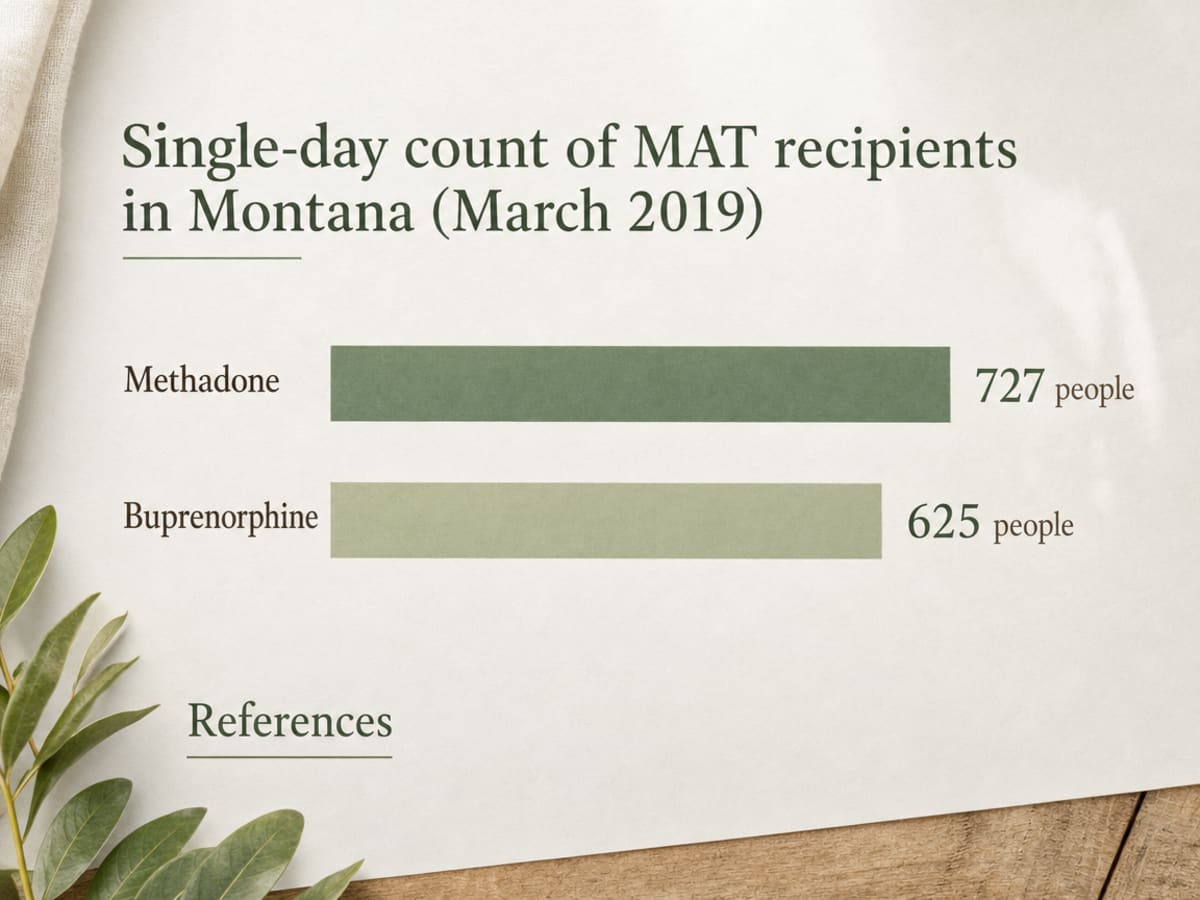
On a single day in March 2019, SAMHSA counted 727 people in Montana receiving methadone at opioid treatment programs and 625 receiving buprenorphine as part of substance use treatment 12. That’s a snapshot, not a total — the number of people who’ve cycled through MAT over a year is much larger. But the shape of it matters. Both medications are load-bearing pieces of the state’s response, not fringe options. Methadone runs through the licensed opioid treatment programs the federal government tightly regulates 2. Buprenorphine runs through regular medical practices, which is why it reaches further into rural counties like Flathead.
What this means for you in Kalispell: when you call a treatment program and they mention buprenorphine, or when a provider recommends a methadone clinic, you’re being offered the same medications that hundreds of other Montanans are picking up this week. The state has been actively working to grow that capacity — expanding naloxone training and pushing to add full-service opioid treatment programs is written into Montana’s substance use disorder strategy 11.
You’re not on a strange path. You’re on the one the evidence and the state have both been pointing toward.
Buprenorphine access has grown — and that changes what’s possible near Kalispell
A decade ago, if you lived in the Flathead Valley and wanted to start buprenorphine, your options were thin. You’d likely have to drive, wait weeks for an intake, or piece something together informally through a friend of a friend. That reality has shifted, quietly but measurably.
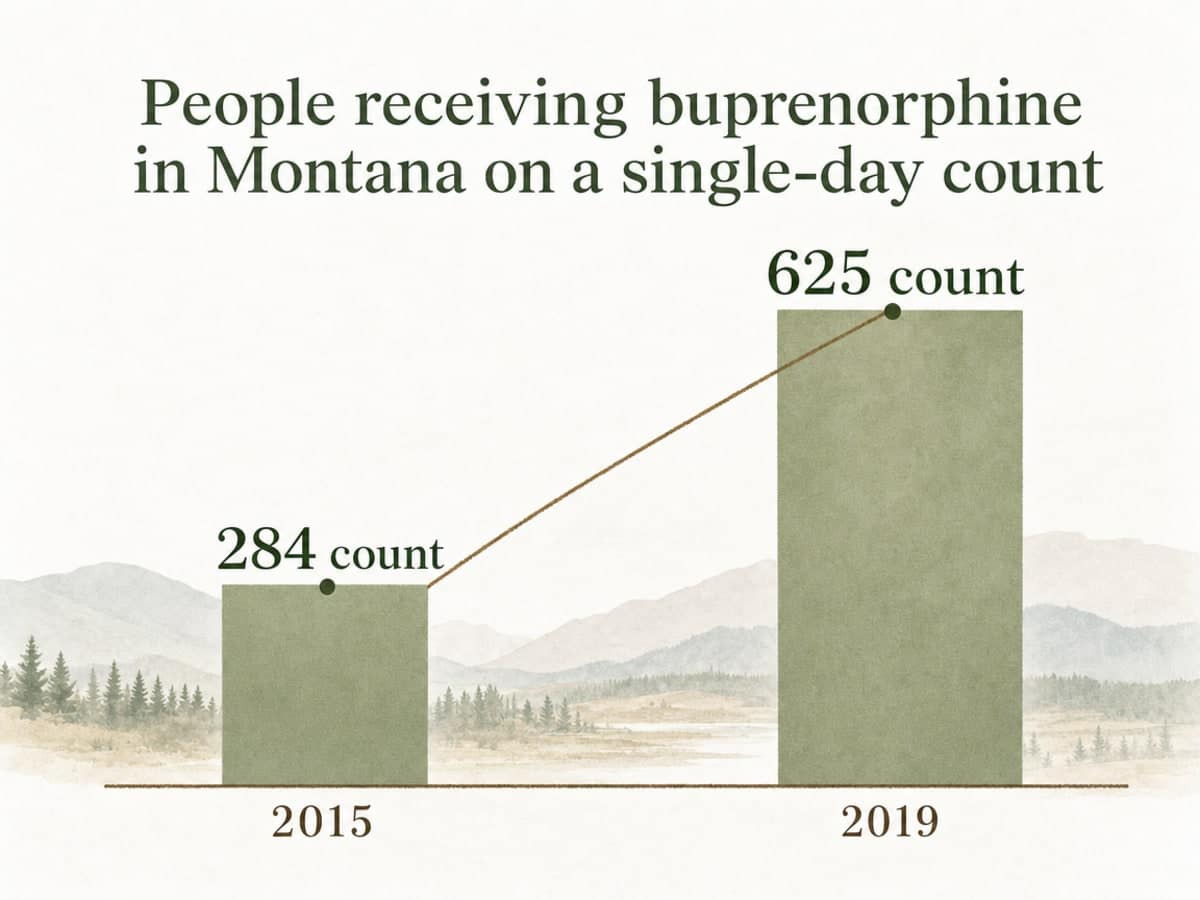
On a single day in March 2019, SAMHSA counted 625 Montanans receiving buprenorphine as part of substance use treatment. Four years earlier, in 2015, that same single-day count was 284 12. That’s more than double the number of people on a legitimate, prescribed pathway, in the same state, over four years. And the trend hasn’t reversed since — federal policy has continued to loosen prescriber requirements, meaning more physicians, nurse practitioners, and physician assistants across Montana can now start you on buprenorphine without special waivers.
What that growth means for you, sitting in Kalispell right now: the odds that a provider within reasonable driving distance can prescribe buprenorphine are meaningfully better than they were when someone you know may have first tried to get help. You are not chasing a scarce resource. You’re stepping into a system that has been building capacity around you.
If you were told years ago that no one nearby could help, that answer is out of date. It’s worth asking again.
Naloxone belongs in your treatment plan from day one
Here is something that can sit oddly at first: a good treatment program will hand you naloxone on the way in, not just on the way out. That isn’t the program betting against you. It’s the program treating your safety the way federal guidance says to treat it.
The CDC’s prescribing guideline is direct about this. Clinicians should offer naloxone to patients with opioid use disorder and to the household members and significant others who live with them 7. The reason is simple. The riskiest moments in early recovery are the ones no one plans for — a slip after a hard week, a relapse when tolerance has already dropped, an accidental exposure to fentanyl in something that wasn’t supposed to contain it. Naloxone doesn’t erase those moments. It buys the minutes that keep them from being final.
If you’ve never used it, the basics are worth knowing before you’re the one holding the box. Nasal naloxone goes into one nostril. If the person doesn’t respond within two to three minutes, you give a second dose 9. You call 911 either way. Fentanyl often needs more than one dose, so having a spare matters more than it used to. SAMHSA’s overdose toolkit walks family members through the whole sequence in plain language, and it’s worth reading with the people you live with, not by yourself 8.
Montana has been actively expanding naloxone training as part of its statewide response, so if you don’t have any at home yet, ask about it at intake 11. Carrying naloxone isn’t a prediction about you. It’s a promise to the people who love you.
Making the first phone call: what to say and what to expect
The call is the hardest part. Once you’re actually on the phone, the person answering has heard some version of your story hundreds of times, and they are not scoring you.
You don’t need a script, but if it helps to have one, this works:“I think I have a problem with opioids, and I want to know what my options are.”That’s it. You don’t have to name amounts, dates, or how you started. You don’t have to be sober when you call. You don’t have to have insurance figured out. You don’t have to be sure you’re ready — ambivalence is normal, and a good intake coordinator will meet you there.
Here’s what usually happens next. The intake person will ask some basic questions: what you’ve been using, roughly how much, how long, whether you’ve had any overdoses or medical complications, and whether you have somewhere safe to sleep tonight. If you’re in acute withdrawal or medically fragile, they’ll route you toward detox first. If you’re stable enough to start as an outpatient, they’ll schedule an assessment, usually within a few days. The ASAM framework clinicians use is designed to match your level of care to what your body and life actually need right now, not to slot you into whatever bed is open 3.
A few things worth knowing before you dial. You can ask whether they offer buprenorphine, methadone, or naltrexone, and whether medication can start at your first visit. You can ask if they take your insurance or Medicaid. You can ask a family member to sit with you while you make the call, or to make it for you — that’s allowed, and it’s often how it happens.
If the first place you call has a wait or isn’t the right fit, call another. That isn’t failure. That’s just Tuesday.
Paying for care in Montana without pretending you know the numbers
Money is the question that stops a lot of people from making the call, so let’s take it seriously without pretending anyone can quote you a price sight unseen.
Here is what’s true. Most Montana treatment programs accept a mix of private insurance, Medicaid, and self-pay, and Montana Medicaid covers medication-assisted treatment — the medication itself and the counseling that goes with it. If you have Medicaid, buprenorphine, methadone, and naltrexone are on the table. If you have private insurance, MAT is typically a covered behavioral health benefit, though the specifics of copays, prior authorization, and in-network providers vary by plan.
What you can do before the first call: pull out your insurance card, or find out whether you qualify for Medicaid. What you don’t have to do: figure any of this out alone. Intake coordinators verify benefits for you every day. Ask directly whether they offer a sliding scale or scholarship beds if you’re uninsured. The answer is often yes. The cost of not calling is the one you already know.
Speak With a Kalispell Recovery Specialist Now
Connect directly for support and guidance tailored to opioid addiction recovery in Kalispell.
Frequently Asked Questions
Do I have to quit opioids before I start treatment in Kalispell?
No. For buprenorphine and methadone, you actually need to still have opioids in your system when you start — the medication is induced during early withdrawal, not after you’ve toughed it out alone. Only naltrexone requires being fully opioid-free first, usually seven to ten days 1. Call while you’re still using. That’s not a disqualifier. That’s the door.
Which medication is right for me — methadone, buprenorphine, or naltrexone?
That’s a conversation with a clinician, not a self-diagnosis. Methadone often holds for heavy or long-term fentanyl use. Buprenorphine fits people who want treatment inside a regular medical office. Naltrexone works once you’re fully detoxed and want no opioid activity at all. The ASAM guideline was updated in 2020 specifically to help clinicians match the medication to your history and goals 3.
How long does opioid withdrawal last, and can medication really make it easier?
For short-acting opioids, symptoms usually start 8 to 24 hours after your last use, peak around day two to four, and ease over about a week. Fentanyl often stretches longer in unpredictable waves. Buprenorphine or methadone started during the withdrawal window can drop the worst symptoms within hours of the first dose 1. Medication doesn’t erase withdrawal. It changes what it costs you.
Do I need residential treatment, or can I start with outpatient care?
Both are legitimate starting points. Residential fits if you’ve had a recent overdose, heavy fentanyl use, unstable housing, or medical complications. Outpatient with MAT works if you’re stable enough to sleep at home and get to appointments. Long-term pharmacologic treatment through outpatient care is what the evidence actually recommends over detox alone 4. An intake assessment will help you land at the right level.
Will my insurance or Medicaid cover opioid addiction treatment in Montana?
In most cases, yes. Montana Medicaid covers medication-assisted treatment, including the medication and counseling. Private insurance typically covers MAT as a behavioral health benefit, though copays and prior authorization vary by plan. If you’re uninsured, ask directly about sliding-scale fees or scholarship beds. Intake coordinators verify benefits every day — you don’t need to figure out the paperwork before you call.
How do I help a family member in Kalispell who isn’t ready to call yet?
Get naloxone in the house. The CDC recommends it for household members of people with opioid use disorder, and Montana has been expanding free training and distribution 7, 11. Learn how to use it — one nasal dose, a second if there’s no response in two to three minutes 9. Keep the relationship open. Ambivalence is part of this. The day they’re ready, you want the phone to still ring.
References
- TIP 63: Medications for Opioid Use Disorder. https://library.samhsa.gov/sites/default/files/pep21-02-01-002.pdf
- Federal Guidelines for Opioid Treatment Programs (2024). https://library.samhsa.gov/product/federal-guidelines-opioid-treatment-programs-2024/pep24-02-011
- ASAM National Practice Guideline for the Treatment of Opioid Use Disorder – 2020 Focused Update. https://www.samhsa.gov/resource/ebp/asam-national-practice-guideline-treatment-opioid-use-disorder
- Treatment of Opioid Use Disorder. https://www.ncbi.nlm.nih.gov/books/NBK558319/
- Opioid Use Disorder Treatment. https://nida.nih.gov/nidamed-medical-health-professionals/treatment/opioid-use-disorder-treatment
- CDC Clinical Practice Guideline for Prescribing Opioids for Pain. https://www.cdc.gov/mmwr/volumes/71/rr/rr7103a1.htm
- CDC Clinical Practice Guideline for Prescribing Opioids for Pain. https://stacks.cdc.gov/view/cdc/122248/cdc_122248_DS1.pdf
- SAMHSA Overdose Prevention and Response Toolkit. https://library.samhsa.gov/sites/default/files/overdose-prevention-response-kit-pep23-03-00-001.pdf
- Five Essential Steps for First Responders. https://library.samhsa.gov/sites/default/files/five-essential-steps-for-first-responders.pdf
- Summary of Opioid Use in Montana. https://dphhs.mt.gov/assets/publichealth/EMSTS/Data/Opioid_Drug_Use_Summary.pdf
- Montana Substance Use Disorders Task Force Strategic Plan. https://dphhs.mt.gov/assets/publichealth/EMSTS/opioids/MontanaSubstanceUseDisordersTaskForceStrategicPlan.pdf
- Behavioral Health Barometer: Montana, Volume 6. https://www.samhsa.gov/data/sites/default/files/reports/rpt32843/Montana-BH-Barometer_Volume6.pdf