Key Takeaways
- Libby residents face real geographic barriers to opioid care, with the nearest treatment hubs two-plus hours away in Kalispell or Missoula, which shapes medication choice and visit frequency.
- Unsupervised withdrawal is dangerous because tolerance drops within days, and NIDA confirms medications for opioid use disorder save lives and reduce overdose deaths 5.
- Choosing between an OTP (daily in-person methadone) and OBOT (buprenorphine from a regular clinic and pharmacy) determines whether recovery fits around Lincoln County work, family, and winter roads.
- Before starting, compare provider Medicaid enrollment, how many monthly visits can be telehealth 6, detox supervision options, and whether case management is available to coordinate transportation and paperwork 3.
What opioid dependence looks like in the Kootenai Valley
If you live in Libby, opioid dependence doesn’t usually announce itself. It starts as a prescription after a logging injury, a shoulder surgery, or a car wreck on Highway 2. Then the refills run out, the pain comes back, and something you didn’t ask for takes over your mornings.
You know the shape of it by now. The clock-watching. The sick sweat that starts about 12 hours after your last dose. The way a whole day in the Kootenai Valley can shrink down to one question: how do I not feel like this?
You are not imagining how bad it is. And you are not alone in it, even if the small-town quiet makes it feel that way.
Across Montana in 2023, ground-transporting EMS agencies responded to 969 suspected opioid overdose calls — an average of 81 every month, compared to 87 monthly in 2022 and 76 in 2021 8. Those are the calls that made it to 911. The people breathing through withdrawal in a trailer off Highway 37, or white-knuckling a Sunday alone in Troy, don’t show up in that count at all.
Lincoln County sits far from the state’s larger treatment hubs. Kalispell is about two and a half hours east. Missoula is farther. That distance is real, and it shapes almost every decision you’ll make about care — from which medication your prescriber can offer, to how often you have to show up in person, to whether telehealth can fill the gaps.
Here is what the rest of this guide will do. It will walk you through what actually works for opioid withdrawal, what Montana Medicaid pays for, and how to close the geography between you and evidence-based care. No lectures. Just the pathway, laid out plain.
Why willpower is not the treatment for opioid withdrawal
If you’ve tried to quit on your own and ended up back where you started, that is not a character flaw. That is pharmacology.
Opioids rewire the brain’s opioid receptors over months of use. When you stop, those receptors don’t just go quiet — they scream. Bone-deep aches. Vomiting. Diarrhea that won’t let you leave the bathroom. Anxiety that feels like your skin is trying to crawl off. Sleep that won’t come. And underneath all of it, a craving so loud it drowns out every good reason you had for stopping.
Most people can white-knuckle through the first 24 hours. Very few can white-knuckle through day three, alone, in a house where the old bottle is still in the medicine cabinet.
Willpower is not the missing ingredient. Medical support is. The good news is that the treatment for opioid dependence is well-defined, evidence-backed, and covered by Montana Medicaid. You just need to know the steps.
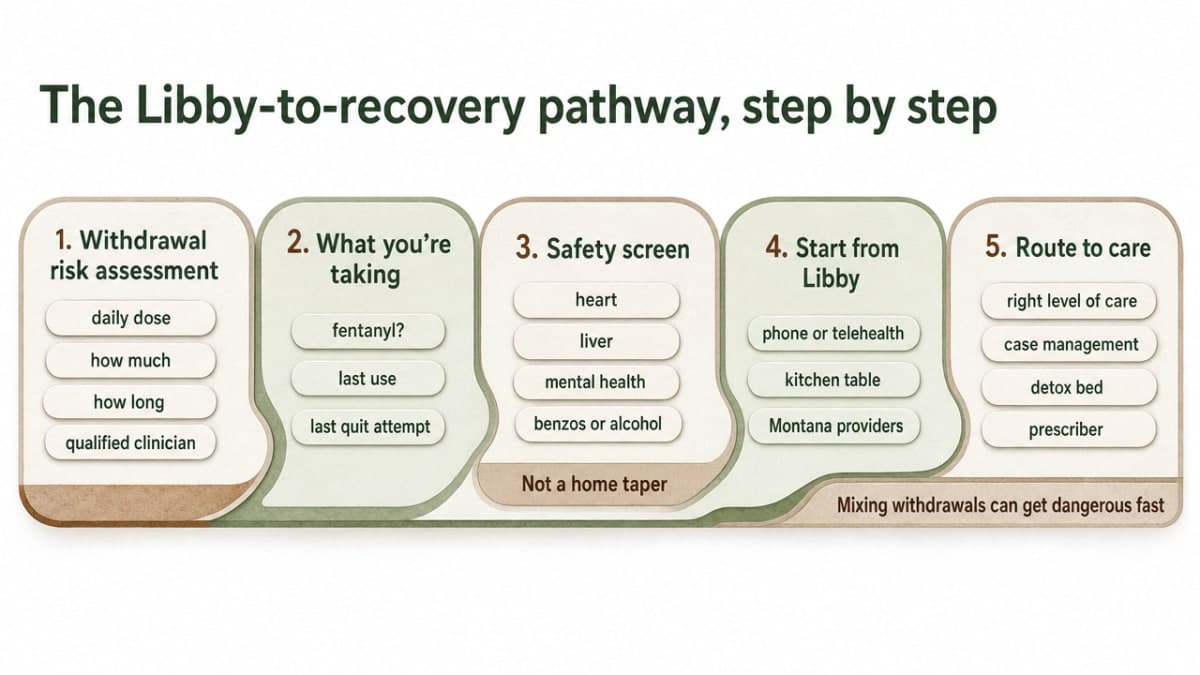
The Libby-to-recovery pathway, step by step
Start with a withdrawal risk assessment, not a home taper
Before anything else, you need someone qualified to look at what you’re actually taking, how much, and for how long. That’s a withdrawal risk assessment, and it takes maybe an hour.
A clinician will ask about your daily dose, whether fentanyl is in the picture, how long since your last use, and what happened the last time you tried to stop. They’ll ask about your heart, your liver, your mental health, and any benzos or alcohol in the mix. Mixing withdrawals is where things get dangerous fast.
You can start this call from your kitchen table in Libby. Many Montana providers do intake assessments by phone or telehealth, then route you to the right level of care. If you’re on Medicaid, this is the moment case management can start pulling threads for you — finding a detox bed, a prescriber, a ride 3.
What you shouldn’t do: taper yourself at home off a bottle you’re rationing. Home tapers off short-acting opioids almost always fail, not because you’re weak, but because the math of receptor withdrawal doesn’t cooperate with willpower. Let someone else hold the plan for the first few days.
Medical detox: the first 3 to 7 days under supervision
Medical detox is the part everyone dreads and the part that changes everything.
In a supervised setting — usually a licensed detox unit inside a treatment center or hospital — you’re monitored around the clock while your body clears opioids. Nurses check your vital signs. A physician manages the symptoms that hit hardest: the muscle cramps, the nausea, the racing heart, the sleeplessness. Medications like clonidine, anti-nausea drugs, and sometimes an early dose of buprenorphine can take the sharpest edges off.
Most opioid detoxes run three to seven days. Fentanyl detox often runs on the longer end, because fentanyl stores in body fat and comes out slower than people expect.
Here’s what matters about doing this under supervision rather than alone. Your tolerance drops within a few days of stopping. If you relapse at your old dose after even a short break, the overdose risk jumps hard — which is exactly why NIDA states that medications for opioid use disorder “are safe and effective and save lives” and reduce opioid-related overdose deaths when used with counseling 5.
Detox alone is not treatment. It clears the drug from your system. It does not repair the receptors that will keep asking for the drug for weeks and months afterward. That’s what the next step is for.
MAT induction: methadone, buprenorphine, or naltrexone
Once you’re through the worst of acute withdrawal, you and your prescriber choose a medication to quiet the craving and stabilize the receptors. Under Montana Medicaid, this is called Medication Assisted Treatment, and it’s defined as FDA-approved medications combined with behavioral therapies and support services — a whole-patient approach to opioid use disorder 6.
Three medications are approved for opioid use disorder. Each does something different.
- Methadone
- A long-acting full opioid agonist. It occupies the same receptors as heroin or oxycodone, but slowly and steadily, so you don’t feel high and you don’t feel sick. It’s dispensed daily, in person, at a federally licensed Opioid Treatment Program.
- Buprenorphine (often as Suboxone)
- A partial agonist. It calms the receptors without the full opioid effect and has a ceiling that makes overdose much less likely. It can be prescribed in a regular doctor’s office and picked up at a pharmacy.
- Extended-release naltrexone (Vivitrol)
- A monthly injection that blocks opioids entirely. You have to be fully detoxed — usually 7 to 10 days opioid-free — before your first shot, or it triggers precipitated withdrawal.
To qualify for MAT under Montana Medicaid, you generally need a diagnosis of moderate or severe opioid use disorder and a willingness to engage in the medication plus support services 6. Prior authorization is not required for MAT services under Montana’s bundled MAT payment structure, which was designed to remove that barrier at the front door 7. And while you’re in MAT, opioids, tramadol, and carisoprodol are non-covered — the program is protecting your progress 6.
Residential care or intensive outpatient after induction
Medication quiets the craving. It doesn’t rebuild the life the drug hollowed out. That’s what the next 30 to 90 days are for.
You have two main paths here, and neither one is a failure of the other.
Residential treatment means you live at a treatment facility while you stabilize. You sleep there, you eat there, you do therapy there. For someone coming out of Libby, this often means driving east — the closest full-continuum residential programs are in the Kalispell area, with additional options in Missoula and beyond. If your home environment is where the drug lives, or if you’ve relapsed after outpatient attempts before, residential gives your brain a fenced yard to heal in.
Intensive outpatient (IOP) means you sleep at home and drive to programming three to five days a week, usually three hours a day. Montana’s HEART Medicaid waiver specifically covers IOP alongside MAT, which makes this a real option for people who need to keep working or parenting 4.
Either path continues your MAT. Neither one asks you to white-knuckle it. What they add is group therapy, individual counseling, family sessions, and the daily practice of being a person again without the drug in the middle of everything.
Aftercare, case management, and staying connected from Lincoln County
The month you come home is the month the work gets quiet — and quiet is where opioid relapse likes to happen.
Aftercare is the structure that keeps you connected once you’re back in your own kitchen. It usually means continuing MAT with a prescriber, weekly or biweekly counseling, a peer support meeting or recovery group, and a case manager checking in on the practical stuff. Under Montana Medicaid, MAT includes at least one check-in per month — in person or by telehealth — for medication dispensing and clinical review 6.
Targeted case management is the piece rural readers often underestimate. A case manager helps you keep Medicaid active, coordinate with your prescriber, sort out transportation, and reconnect with housing or work supports 3. From Libby, that person is sometimes the only reason a monthly appointment in Kalispell actually happens.
Recovery from Lincoln County is possible. It just takes a plan that respects the drive, the weather, and how easy it is to slip back into isolation. Aftercare is that plan.
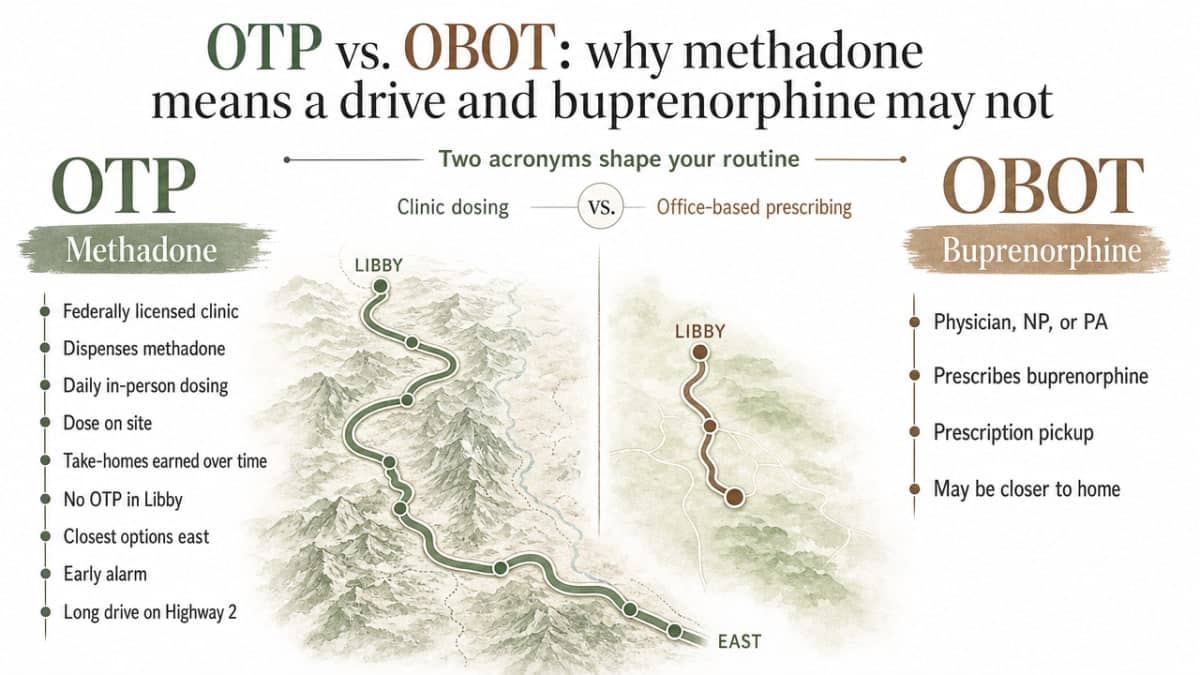
OTP vs. OBOT: why methadone means a drive and buprenorphine may not
Two acronyms decide a lot about your daily life in recovery: OTP and OBOT. Knowing the difference tells you whether you’ll be driving to Kalispell every morning or picking up a prescription at a pharmacy closer to home.
An Opioid Treatment Program (OTP) is a federally licensed clinic that can dispense methadone for opioid use disorder. Methadone rules are strict — for most of your first months in treatment, you show up in person, daily, to receive your dose on site. Take-home doses are earned over time. There is no OTP in Libby. The closest options sit east, which for many Lincoln County residents means a very early alarm and a long drive on Highway 2.
Office-Based Opioid Treatment (OBOT) is different. An OBOT provider is a physician, nurse practitioner, or physician assistant who can prescribe buprenorphine (usually as Suboxone) from a regular clinic office. You pick up the prescription at a pharmacy like any other medication. Montana leans on both OTP and OBOT providers to deliver MAT to state residents, including Medicaid members 4.
Under Montana’s bundled MAT payment structure, both program types are covered without prior authorization when medical necessity criteria are met 7. That matters in a rural county — it means the wait between deciding and starting isn’t held up by paperwork.
The practical takeaway: if daily travel to an OTP isn’t survivable given your job, your kids, or winter roads, ask about buprenorphine through an OBOT prescriber. It’s the same evidence-based treatment, delivered on a schedule Libby life can actually hold.
“Am I just trading one drug for another?”
This is the question that keeps people out of treatment longer than almost any other. It usually comes from someone who loves you and doesn’t understand yet. Sometimes it comes from your own head at 3 a.m.
Here is the straight answer. Methadone and buprenorphine are opioids in the chemistry sense. They bind to the same receptors that heroin, fentanyl, and oxycodone bind to. That part is true.
What they don’t do is get you high, run your day, or push you toward the next dose. Taken as prescribed, they occupy the receptors steadily, so the craving quiets and the withdrawal stays off. You go to work. You pick up your kids. You forget, for hours at a time, that any of this is a fight.
The National Institute on Drug Abuse is direct about this:medications for opioid use disorder “are safe and effective and save lives,” and MAT “reduces opioid use, opioid-related overdose deaths, criminal activity, and infectious disease transmission” 5.That is not substitution. That is treatment for a chronic medical condition, the same way insulin treats diabetes.
Naltrexone doesn’t touch opioid receptors as an agonist at all — it blocks them. So if the word “opioid” on a medication label is the sticking point, that’s a third option worth asking about 5.
You are not swapping addictions. You are giving your brain the steady input it needs to stop running the emergency drill every four hours.
What treatment actually costs in Montana
One of the loudest reasons people in Libby put off calling for help is money. You already know what a bad month looks like when the drug is running the budget. The idea of adding a treatment bill on top of that feels impossible.
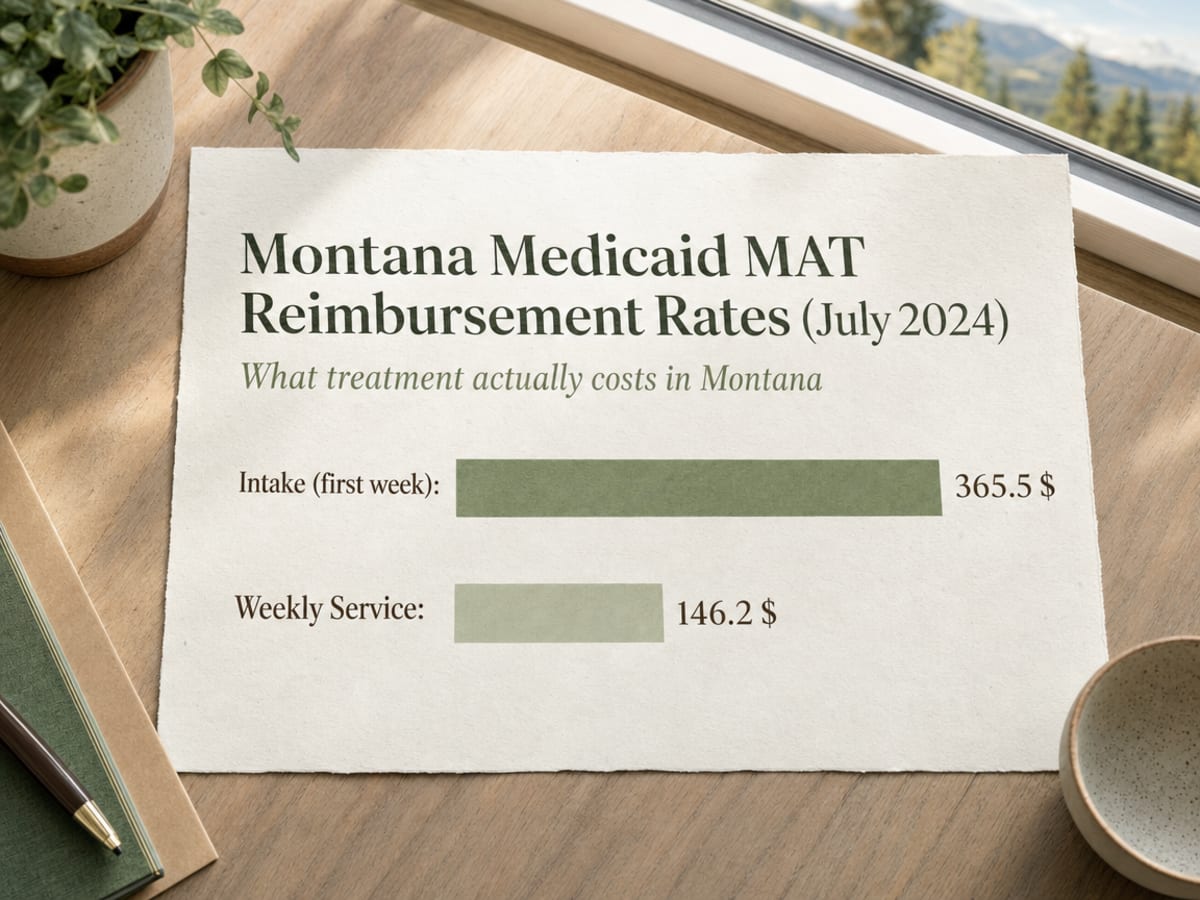
Here is what usually surprises people: if you qualify for Montana Medicaid, MAT is a defined, reimbursable service — not an out-of-pocket luxury. The state pays providers a set rate for your first week of MAT and a separate weekly rate after that, bundled to cover the medication, dispensing, and required clinical touchpoints 6.
The specific numbers are public. Under the July 2024 Montana Medicaid SUD fee schedule, MAT intake (billed as H0016) reimbursed at $365.50 for the first week of enrollment, and weekly MAT (H0016 HG) reimbursed at $146.20 per week 1. The July 2025 update nudged both figures up: $376.47 for intake and $150.59 per week 2.
You don’t need to memorize those numbers. What matters is what they tell you. Montana has built a payment structure that expects people to walk in the door for MAT and expects providers to be paid for delivering it — every week, without prior authorization holding up the start 7.
A few practical notes on cost from Libby:
- If you’re already on Medicaid, ask any prospective provider whether they’re enrolled as an OTP or OBOT Medicaid MAT provider. That single question tells you whether the bundled rate applies to your care.
- Counseling is often billed separately from the MAT bundle, so ask what your therapy visits will look like on paper 7.
- If you’re not on Medicaid but think you might qualify, a case manager can help you apply while your care is being arranged 3. Don’t let paperwork be the reason day one gets postponed another month.
- Residential treatment and detox are priced differently than outpatient MAT. Ask each program for a clear, written explanation of what your coverage includes and where you’d owe anything.
Money will not be zero. But it is almost never what people expect walking in, and it is almost never the reason treatment doesn’t happen once someone starts asking the right questions.
Rural access: telehealth check-ins and the monthly in-person rule
Living in Libby means the nearest MAT prescriber might be a two-hour drive on a good day, and a much longer one when Highway 2 is icy or the Kootenai Valley is socked in with smoke. Montana’s MAT rules were written with that reality in mind — mostly.
Here is the piece that helps you. Under Montana Medicaid, MAT requires at least one check-in per month, and that check-in can happen in person or by telehealth 6. That single line matters. It means most of your monthly contact with your prescriber — the questions, the dose adjustments, the how-are-you-really conversation — can happen from your living room in Libby, over a phone or a laptop.
Here is the piece that still costs you gas money. The medication itself has to be dispensed, and how often you show up in person depends on which medication you’re on. If you’re on methadone through an OTP, in-person dispensing is the rule, especially early in treatment. If you’re on buprenorphine through an OBOT prescriber, your prescription can go to a pharmacy, and telehealth can carry more of the follow-up load.
A few things to line up before your first appointment so telehealth actually works from Lincoln County:
- Reliable cell or internet signal for at least one room in your house. If home isn’t private enough, a public library or a clinic room can serve as your telehealth spot.
- A pharmacy you can reach without a full day’s drive, and a plan for who picks up if you can’t.
- A case manager who knows your county and can help arrange transportation for the in-person visits that do happen 3.
Ask any prospective provider two direct questions: How many of my monthly visits can be telehealth? And what’s the minimum in-person schedule for the medication you’d prescribe me? Their answers tell you whether their program is actually built for someone driving in from Libby.
Signs treatment access is beginning to reach rural Montana
It’s easy to feel like nothing is changing when you’re the one white-knuckling a Tuesday in Libby. But the statewide picture has started to shift, and it’s worth knowing why.
Montana’s own data shows opioid-related emergency department visits declining every year since 2021 across the 2020–2024 period 10. That trend doesn’t erase what any single family is going through this month in Lincoln County. It doesn’t prove any one program worked. What it does suggest is that the combination of expanded MAT access, the HEART Medicaid waiver bringing IOP and MAT into coverage, and more prescribers willing to treat opioid use disorder is starting to show up in the numbers 4.
The system around you is not the same one it was five years ago. Bundled MAT payments removed the prior-authorization delay at intake 7. Telehealth check-ins made monthly contact possible from a living room in Libby 6. Case management became a covered service that helps rural patients actually reach appointments 3.
None of that guarantees your recovery. But it means the door is more open than it used to be — and it opens for you this week, not someday.
How to take the first concrete step this week
You don’t have to solve the whole thing today. You have to make one call.
Here is what that call looks like from Libby. Pick a morning this week when you can find 30 quiet minutes. Have your Medicaid card nearby if you have one, a rough list of what you’re using and how much, and a phone number where a case manager can reach you back.
Then work down a short list, in this order:
- Call a Montana MAT provider — an OTP or OBOT enrolled with Medicaid — and ask for an intake assessment. Under Montana’s bundled MAT structure, no prior authorization is required to start 7. Ask whether the first appointment can be by phone or telehealth.
- Ask about detox. If you’re using daily, request a withdrawal risk assessment and ask where their supervised detox happens. Do not plan to detox alone at home.
- Ask for a case manager. Targeted case management can help you sort Medicaid, transportation from Lincoln County, and the handoff between detox, MAT, and aftercare 3.
If you’re the family member reading this, you can make the call on someone’s behalf and hand them the phone once a real person picks up. That single move — dialing the number they couldn’t dial — is often the whole difference.
You have already done the hardest thing, which is admitting the shape of what’s happening. The rest is logistics, and logistics have answers. When you’re ready to talk to a Montana team that handles detox, MAT, and residential care together, Elk Ridge Recovery is one place to start.
Speak With Someone Who Understands Recovery Now
Connect directly for support and guidance on starting opioid addiction treatment in Libby, MT.
Frequently Asked Questions
Can I get buprenorphine prescribed in Libby, or do I have to drive to Kalispell or Missoula?
Buprenorphine can be prescribed by any qualified physician, nurse practitioner, or physician assistant enrolled as an Office-Based Opioid Treatment provider under Montana Medicaid 7. That means it doesn’t have to be dispensed at a specialty clinic — a regular provider’s office can write the prescription and you pick it up at a pharmacy. Call clinics in Libby first and ask directly whether they have an OBOT prescriber on staff.
What happens if I show up to an ER in Libby in active opioid withdrawal?
Emergency departments can treat acute withdrawal symptoms and, increasingly, start buprenorphine right there to bridge you to ongoing care. If you’re safe to go home, they should hand you a referral to an OBOT or OTP prescriber. If you’re not safe — mixed withdrawals, dehydration, cardiac issues — they can admit you or arrange transfer to a supervised detox unit. Going in is not an overreaction.
Will my employer or neighbors find out I’m in MAT?
Your medical records are protected under federal privacy law, and SUD treatment records get an extra layer of protection beyond standard HIPAA. Your employer does not get told you’re in MAT unless you tell them or file for FMLA leave that requires documentation. Prescriptions filled at a Libby pharmacy look like any other prescription on the outside. Small-town privacy is a real worry — but the paper trail is quieter than you think.
How long do people usually stay on methadone or buprenorphine?
There’s no fixed timeline. Some people stay on MAT for a year, some for five years, some indefinitely. The National Institute on Drug Abuse treats opioid use disorder as a chronic condition, and MAT as legitimate long-term treatment — not a stepping stone you’re supposed to rush off of 5. The right length is whatever keeps you stable. That’s a conversation you have with your prescriber, not a countdown clock.
What if my family member refuses treatment but I know they’re using?
You can’t force an adult into care, but you can shorten the distance to yes. Keep naloxone in the house and know how to use it. Learn what withdrawal looks like so you can respond, not panic. Ask a Montana MAT provider whether they take third-party calls from family — many do intake questions this way. When your person is ready, having the number already dialed matters more than any speech.
Does Montana Medicaid require prior authorization before I can start MAT?
No. Under Montana’s bundled MAT payment structure, prior authorization is not required for MAT services when medical necessity criteria are met 7. That was a deliberate policy choice to remove a delay at the front door. You still need to meet clinical eligibility — generally a moderate or severe opioid use disorder diagnosis and willingness to engage in the medication plus support services 6— but no paperwork wait between assessment and starting.
References
- Substance Use Disorder Medicaid Provider Fee Schedule Effective July 2024. https://medicaidprovider.mt.gov/docs/feeschedules/2024/July2024SUDMedicaidFeeSchedule.pdf
- July 2025 Substance Use Disorder Medicaid Provider Fee Schedule. https://medicaidprovider.mt.gov/docs/feeschedules/2025/July2025SUDMedicaid.pdf
- Mental Health Center – Medicaid Provider Notice on SUD and Adult MH TCM Criteria. https://medicaidprovider.mt.gov/59
- July 1, 2022 HEART Waiver Approval Document. https://dphhs.mt.gov/assets/MedicaidWaivers/MTHEARTApprovalDocument.pdf
- Medications to Treat Opioid Use Disorder. https://www.drugabuse.gov/publications/research-reports/medications-to-treat-opioid-addiction
- 550 Medication Assisted Treatment (MAT). https://dphhs.mt.gov/assets/BHDD/MedicaidManual/550MAT.pdf
- Proposed Medication Assisted Treatment (MAT). https://dphhs.mt.gov/assets/MedicaidTribalConsultation/December2018/ProposedMedicationAssistedTreatment12042018.pdf
- EMS Suspected Opioid Overdose Report. https://dphhs.mt.gov/assets/publichealth/EMSTS/Data/2023EMSOpioidOverdose.pdf
- Drug Overdose Deaths in Montana 2014–2023. https://dphhs.mt.gov/assets/publichealth/EMSTS/Data/DrugOverdoseDeaths_2014-2023.pdf
- Summary of Opioid Use in Montana. https://dphhs.mt.gov/assets/publichealth/EMSTS/Data/Opioid_Drug_Use_Summary.pdf