Key Takeaways
- A real partial hospitalization program runs at least 20 clinical hours per week with physician direction — anything lighter is intensive outpatient wearing a different name 1, 3.
- Medical necessity means PHP is for people who can’t be safely treated at a lower level of care, and legitimate programs document that clearly from intake 4.
- Push admissions teams for specifics on physician direction, dual diagnosis capability, MAT access, group size, and a written weekly schedule before committing.
- Confirm insurance or Medicaid coverage in writing before day one, including who handles prior authorization and what your out-of-pocket cost will be.
- PHP sits above IOP and standard outpatient on the continuum, and most people stepping down from residential care within 30 days belong in PHP first.
- Research shows PHP produces meaningful symptom improvement and holds its own against inpatient care for appropriately selected patients 5, 6.
- Aftercare shapes outcomes more than the program brochure — ask when discharge planning starts, how MAT continuity works, and whether the first IOP appointment is scheduled before you leave 9, 10.
- In rural Montana, ask about transportation support and telehealth-blended PHP so distance doesn’t force you to drop out by week two.
The Step-Down Week Nobody Warns You About
The days right after residential discharge are strange. You’ve built a rhythm inside a place that held you steady, and now the door’s open and the schedule you leaned on is gone. That gap between structure and real life is where a lot of people slip, not because they aren’t trying, but because nothing was built to catch them in the middle.
That middle is what a partial hospitalization program is for. It’s the step-down rung most people don’t hear about until they’re standing on it, trying to figure out where to go tomorrow morning.
If you’re searching for a PHP near you right now, or a family member is doing that searching for you, take a breath. The fact that you’re even reading this means you’re already doing the harder-than-it-looks work of protecting what you built in residential care.
What follows is a plain guide to sorting real programs from lighter ones, checking what insurance actually covers, and choosing a program that hands you off well when PHP ends. Not a pitch. A map for the week ahead.
What Actually Counts as a Real PHP (Not Just a Day Program)
Here’s the thing that trips people up: not every program that calls itself “day treatment” or “intensive outpatient plus” actually meets the bar of a partial hospitalization program. Some are lighter. Some are heavier on group therapy and lighter on clinical oversight. Knowing what separates a real PHP from a dressed-up day program is the first filter you can apply before you even pick up the phone.
The clearest line is intensity. Federal Medicaid guidance describes PHPs as programs that generally feature 20 or more hours of clinically intensive programming per week 1. Montana’s own Addictive and Mental Disorders Division Medicaid Manual puts it just as plainly for substance use PHP: a minimum of 20 hours of skilled treatment services per week 3. That number isn’t a nice round marketing figure. It’s the operational floor payers and regulators use to decide whether something functions as a PHP at all.
So when a program’s schedule adds up to twelve or fifteen hours a week, you’re not looking at PHP. You’re looking at intensive outpatient or something lighter, no matter what the website says.
Intensity alone isn’t enough, though. A real PHP also brings a few structural pieces you should hear about on the intake call without having to dig:
- Physician or psychiatric direction, not just a licensed therapist running groups
- Skilled clinical services — individual therapy, group therapy, medication management, psychoeducation — bundled into a coordinated weekly plan
- An interdisciplinary team, so your medical, psychiatric, and substance use needs aren’t siloed
- Active discharge planning built into the program from day one, not tacked on at the end
For substance use specifically, Montana Medicaid ties SUD partial hospitalization to ASAM-aligned service components, which is another way of saying the program should look like structured addiction treatment, not a drop-in support group 2.
The Medical-Necessity Litmus Test
“cannot be safely and appropriately treated in a less restrictive level of care”4. That’s the medical-necessity standard, and it does two things at once for you.
First, it tells you what a PHP is actually for. Not a wellness tune-up. Not a general support group. It’s for a moment when you need more than weekly outpatient can hold, but not the locked doors of inpatient. If you just came out of residential care and your clinical team is recommending PHP, that’s usually the fit. Your risk of destabilizing is still real enough that a lighter setting would leave gaps.
Second, it gives you a way to pressure-test a program’s legitimacy. Ask the admissions coordinator how they document medical necessity for each admission. A program that runs real PHP will answer without hesitation: a psychiatric or physician assessment, a written treatment plan tied to specific symptoms and functional impairments, and periodic reviews to justify continued stay. A program that hesitates, or waves the question off, is telling you something about how it will handle your care and your coverage when things get complicated.
You don’t need to memorize regulatory language. You just need to know the door you’re walking through is the right one for where you actually are this week.
What to Ask an Admissions Team Before You Say Yes
Most admissions calls last about twenty minutes. In that window, you’re supposed to figure out whether a program can hold you through one of the most fragile stretches of your recovery. That’s a lot to ask of a phone conversation, especially when you’re tired and the person on the other end is warm and reassuring.
The fix is simple. Go in with a short list of questions that force specific answers, not brochure language. If a coordinator can’t answer them clearly, that’s information too.
Staffing, Physician Direction, and Dual Diagnosis
Ask who runs the program clinically. You want a name and a credential: a psychiatrist or physician who directs care, not just signs paperwork. Ask how often you’ll actually see that person, and who covers when they’re out.
Then ask about the team around them. A real PHP has an interdisciplinary staff — a prescriber, licensed therapists, nurses, and case managers who talk to each other about your case each week. Ask how case conferencing works and how often your treatment plan gets reviewed.
If you’re stepping down from residential care for a substance use disorder, dual diagnosis capability isn’t optional. Depression, anxiety, PTSD, and bipolar disorder ride along with addiction more often than not. Ask directly: does the program treat co-occurring mental health conditions in-house, or will you be referred out for the psychiatric piece? Referred-out care in this stretch tends to fall through the cracks.
MAT Access, Group Size, and a Real Weekly Schedule
If medication-assisted treatment is part of your recovery, or might become part of it, ask whether the program prescribes and manages MAT on-site — buprenorphine, naltrexone, or vivitrol — or whether you’ll be coordinating with an outside prescriber. Coordination is possible. It’s also one more thing that can slip in week one.
Ask about group size. A therapy group of eight to twelve people functions differently than a group of twenty-five. You want a number, not a range.
Then ask for a sample weekly schedule in writing before you commit. What does Monday actually look like, hour by hour? How many individual therapy sessions per week versus group hours? What about family sessions, psychiatric appointments, and case management time? Add it up. If the total doesn’t land near the 20-hour clinical intensity floor that defines a real PHP 1, 3, you’re being offered something lighter under the same name.
Insurance and Montana Medicaid: What Coverage Actually Looks Like
Money worries at this stage are exhausting, and you shouldn’t have to solve them alone. But you do need a rough map of what your coverage will actually pay for before you commit to a program, because a mismatch here is the kind of thing that derails good clinical decisions two weeks in.
If you’re on Montana Medicaid, the good news is that PHP is a recognized level of care on both sides of the behavioral health line. For substance use, the state plan ties SUD partial hospitalization to ASAM-aligned service components, which is Medicaid’s way of saying the program has to look like real, structured addiction treatment to be reimbursed 2. For mental health PHP, Montana’s administrative rule requires a documented need for care that “cannot be safely and appropriately treated in a less restrictive level of care” before coverage kicks in 4. Any Montana program that runs PHP for Medicaid enrollees is built to meet those standards or they don’t get paid. That’s actually useful information for you: it means a program’s willingness to bill Medicaid is a small signal of legitimacy on its own.
If you’re on commercial insurance, the questions are similar but the paperwork lives in different places. Ask the admissions team three things:
- Are they in-network with your specific plan, or out-of-network with a single-case agreement option?
- Who handles the prior authorization and continued-stay reviews — them or you?
- What’s your estimated daily or weekly out-of-pocket cost after your deductible?
A program that can’t give you a rough number in writing is one you’ll be arguing with a billing office about later. That’s the last thing you need in week one of step-down. Good programs assign a benefits coordinator who calls your insurer, verifies coverage before your first day, and tells you what to expect — not after, but before you show up.
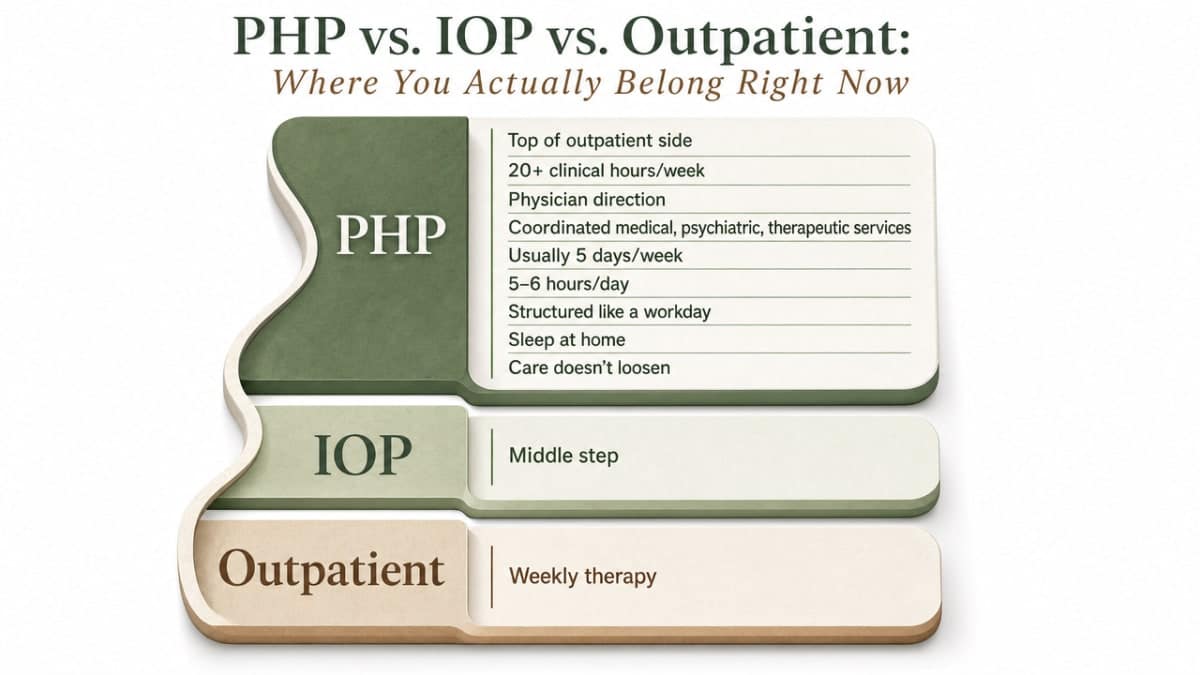
PHP vs. IOP vs. Outpatient: Where You Actually Belong Right Now
You’re probably being pulled in two directions right now. One voice says you’re doing well enough to drop straight to weekly outpatient and get back to your life. Another says you’re still shaky and maybe residential wasn’t long enough. Both of those voices can be honest, and both can be wrong. The continuum exists precisely because there’s a middle.
Here’s the ladder, in plain terms.
Partial hospitalization sits at the top of the outpatient side. Federal guidance and Montana’s Medicaid manual both anchor PHP at 20 or more hours of clinically intensive programming per week, with physician direction and coordinated medical, psychiatric, and therapeutic services 1, 3. In practice, that usually means five days a week, five to six hours a day, structured like a workday. You sleep at home. Your care doesn’t loosen.
Intensive outpatient is the next rung down. IOP typically runs somewhere in the range of 9 to 19 hours per week — often three days, three hours each — and it’s been shown to be an important, evidence-supported part of the continuum, effective for most people seeking care 11. It gives you back more of your day. It also asks more of you: managing time, triggers, and transportation without the daily container PHP provides.
Standard outpatient is what most people picture when they think of therapy — a weekly individual session, maybe a group, medication check-ins as needed. It’s the maintenance rung, not the rebuilding rung.
So where do you actually belong? A rough gut check: if you’re within the first 30 days of residential discharge, still adjusting medications, still working out how to get through unstructured hours without using or destabilizing, PHP is usually the right fit. If you’ve had a few weeks of steady footing, are back to work or family responsibilities, and your clinical team agrees your risk has dropped, IOP is the natural next step. Outpatient comes after that, once your routine holds on its own.
The step-down isn’t a single decision. It’s PHP for a stretch, then IOP for a stretch, then outpatient — with aftercare woven through all of it. If a program near you can’t describe that arc on the first call, they’re not planning for your recovery. They’re planning for your admission.
The Evidence: What PHP Can and Can’t Do for You
It helps to know what the research actually says about programs like the one you’re about to enter, so your expectations match reality instead of a brochure.
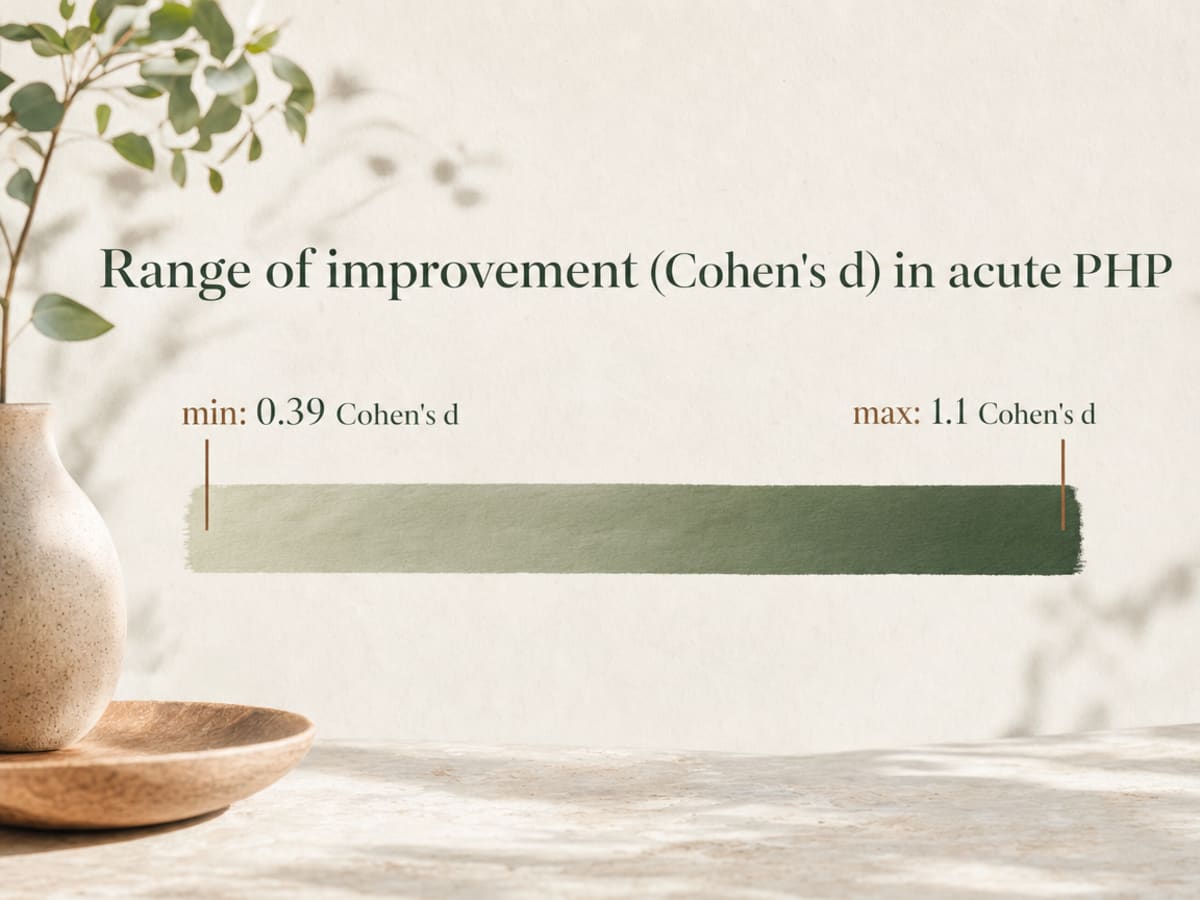
On the near-term side, PHP tends to do what it says on the tin. One study of 2,000 adults in acute partial hospital treatment found significant improvement across every symptom and cognitive domain measured, with effect sizes ranging from Cohen’s d of 0.39 (a small-to-medium effect) up to 1.1 (a very large effect) 6. Worth scoping: the mean stay in that study was about 5.3 days, and the population was mixed psychiatric acuity, not specifically SUD step-down. So the takeaway isn’t “PHP will fix everything.” It’s that a well-run acute PHP can move the needle noticeably, and quickly, on the symptoms that make daily life hardest right now.
Zoom out and the picture stays reasonable. A systematic review comparing partial and full hospitalization for adults in psychiatric distress found no evidence of differential outcome between the two settings for appropriately selected patients, and noted that patients and families were more satisfied with partial hospitalization in the short term 5. Translation: for the right person at the right moment, PHP holds its own against a hospital bed, and people generally prefer sleeping at home.
Here’s what PHP can’t do. It can’t compress months of recovery work into a few weeks. It can’t substitute for what happens after you leave. And the evidence base has real gaps — study quality varies, follow-up periods are often short, and comparisons across diagnoses are thin. The realistic frame is this: PHP is a strong tool for stabilizing and building forward momentum during a specific window. What you do with that momentum, and what your program helps you plan for once the window closes, is where the longer story gets written.
Why Aftercare Decides the Outcome, Not the Brochure
Here’s the part nobody puts on the tour: the program you pick matters less than what that program hands you on your last day. PHP is a stabilizing container. It’s not the finish line. The months after you walk out are where the real story of your recovery gets written, and the discharge plan you leave with is what carries the work forward or lets it drift.
The numbers tell that story clearly enough. In one study of adults leaving PHP for alcohol use disorder, less than a third of the sample relapsed to alcohol use at the one-month follow-up 9. That’s a real win — meaning most people held. In a separate follow-up of patients treated for opioid use disorder in inpatient or partial hospitalization settings, roughly 40% reported complete abstinence one month after discharge 10. Both numbers point the same direction: PHP can absolutely set you up to hold ground in the fragile first month, and a meaningful share of people do. They also make clear that the first 30 days are the vulnerable stretch, and what fills them is a discharge plan, not a certificate.
So when you’re vetting a program, ask about the exit, not just the entrance. Specifically:
- Who builds your aftercare plan, and when does it start — day one or the last week?
- Do they schedule your first IOP or outpatient appointment before you discharge, with a warm handoff to that clinician?
- How do they handle MAT continuity so there’s no gap in prescriptions?
- Is there an alumni or peer support network you can plug into that same week?
- What’s the plan if you have a rough weekend two weeks in — who do you call?
A program that treats discharge as an event, not a process, is one you’ll be rebuilding your own bridge from. A program that starts planning your step-down on intake day is one that understands what the research keeps showing: the brochure doesn’t decide your outcome. The Tuesday after you leave does.
For the Family Member Doing the Vetting
If you’re the one making calls while your person rests, catches their breath, or tries to sleep off the exhaustion of residential care, this part is for you.
You didn’t sign up to become an amateur case manager, and yet here you are with a notepad and a list of phone numbers. That work matters. The handoff week is the wobbliest stretch, and having a second brain in the room asking questions is one of the quiet advantages your person has right now.
A few things worth holding onto:
- You’re allowed to ask the same question twice. If a coordinator’s answer about physician direction or discharge planning felt vague, ask again. Warmth on the phone is not the same as clinical rigor.
- You don’t have to pick the closest program. You have to pick the one that can actually hold your person for the next stretch, with real weekly clinical hours and a real plan for what comes after PHP ends.
- Ask whether family sessions and family education are part of the program. Your role in the next 90 days matters, and a good program will bring you in, not leave you guessing from the parking lot.
- Watch for programs that promise fast, easy, or guaranteed outcomes. Recovery isn’t linear, and any team pretending otherwise is selling comfort, not care.
One last thing. Take care of yourself this week too. The vetting is important. So is eating a real meal and calling someone who knows what you’re carrying.
The Montana Access Reality: Distance, Transportation, and Telehealth-Blended PHP
Here’s something a national PHP article won’t tell you: in Montana, the nearest program that meets the 20-hour clinical intensity floor 3 might be an hour and a half away. Maybe more if you’re in Libby, Lewistown, or anywhere the road matters as much as the map. That’s a real problem, and pretending it isn’t doesn’t help you.
A few things worth thinking through before you rule a program out on distance alone.
Ask whether the program offers transportation support, either directly or through a case manager who can coordinate rides. Some Montana Medicaid enrollees qualify for non-emergency medical transportation, and a good admissions team will know how to help you apply for it. Ask.
Ask about telehealth-blended PHP. A number of Montana programs now run hybrid schedules — some clinical hours in person each week, the rest by secure video from home. That’s not a workaround. For a rural adult in early step-down, it can be the difference between attending the full program and dropping out by week two.
The closest program isn’t always the right one. But the right one has to be reachable on a Tuesday morning when you’re tired.
A Short Decision Framework for the Week Ahead
You don’t need a spreadsheet. You need a short list you can run every program through in one sitting. Here it is.
- Does the weekly schedule actually add up to real PHP intensity? If the hours don’t land near the 20-hour clinical floor, it’s a different level of care wearing the same name.
- Is there a named physician or psychiatrist directing your care? Not signing paperwork. Directing.
- Does the program handle dual diagnosis and MAT on-site? Referred-out care in week one tends to slip.
- Will they verify your insurance or Medicaid coverage in writing before day one?
- Does discharge planning start at intake, with a scheduled IOP handoff before you leave?
- Is the program reachable on a bad Tuesday — through transportation help, a hybrid telehealth option, or both?
Pick the program that says yes to most of these. Not the closest one. Not the prettiest brochure. The one that can hold you through the next stretch and hand you off well when it ends.
Connect Now for Personalized PHP Guidance Nearby
Get clarity and support for your next steps in structured addiction recovery today.

Frequently Asked Questions
How many hours per week should a real partial hospitalization program offer?
A legitimate PHP generally runs at 20 or more hours of clinically intensive programming per week 1. Montana’s Medicaid manual sets the same floor for SUD partial hospitalization 3. If a program’s weekly schedule lands closer to 9 to 15 hours, it’s likely intensive outpatient or something lighter, regardless of what the marketing says.
Does Montana Medicaid cover PHP for substance use and mental health treatment?
Yes. Montana’s state plan recognizes SUD partial hospitalization with ASAM-aligned service components 2, and the state’s administrative rule sets medical-necessity and program-structure requirements for mental health PHP reimbursement 4. Coverage isn’t automatic, though. The program has to document that you need care that can’t be safely delivered at a lower level, and continued-stay reviews follow.
What’s the difference between PHP and IOP, and how do I know which one fits me right now?
PHP runs 20+ clinical hours weekly with physician direction 1. IOP typically runs 9 to 19 hours and works as an effective step-down for most people 11. If you’re in the first weeks after residential discharge, still adjusting medications or working out how to hold unstructured hours, PHP usually fits. Once your footing steadies, IOP is the next rung.
What questions should I ask an admissions team before enrolling?
Ask who directs the program clinically and how often you’ll see them. Ask for a sample weekly schedule in writing so you can add up the clinical hours yourself. Ask whether dual diagnosis and MAT are handled on-site or referred out. Ask how insurance verification and prior authorization get done, and when discharge planning starts. Vague answers are answers.
What happens after PHP ends, and why does the discharge plan matter so much?
The first 30 days after discharge are the vulnerable stretch. In one study of adults leaving PHP for alcohol use disorder, less than a third relapsed within a month 9, and roughly 40% of people treated for opioid use disorder reported complete abstinence at one month 10. What fills those days — a scheduled IOP handoff, MAT continuity, peer support — is what carries the work forward.
What if the nearest PHP is hours away? Is telehealth-blended PHP a legitimate option in Montana?
For many rural Montana adults, the closest program that hits the 20-hour intensity floor 3is a long drive. Ask admissions teams about hybrid schedules that combine in-person clinical hours with secure video sessions, and ask whether they can help you apply for non-emergency medical transportation through Medicaid. A reachable program you can actually attend beats a closer one you’ll drop from by week two.
References
- Joint CMCS and SAMHSA Informational Bulletin – Medicaid. https://medicaid.gov/federal-policy-guidance/downloads/cib-01-26-2015.pdf
- Montana State Plan Amendment (SPA) #: 23-0023. https://www.medicaid.gov/medicaid/spa/downloads/MT-23-0023.pdf
- Addictive and Mental Disorders Division Medicaid Manual. https://dphhs.mt.gov/assets/BHDD/MedicaidManual/AMDDMedicaidPolicyManual7.1.2020.pdf
- Mont. Admin. r. 37.86.3006 – MENTAL HEALTH OUTPATIENT PARTIAL HOSPITAL SERVICES, REQUIREMENTS. https://www.law.cornell.edu/regulations/montana/Mont-Admin-r-37.86.3006
- Partial versus full hospitalization for adults in psychiatric distress: a systematic review of the published literature (1957-1997). https://pubmed.ncbi.nlm.nih.gov/11329384/
- Outcomes of Acute Partial Hospital Treatment: Comparison of Two Programs. https://pubmed.ncbi.nlm.nih.gov/29303947/
- Patient Outcomes in Transdiagnostic Adolescent Partial Hospitalization Programs: A Systematic Review. https://pubmed.ncbi.nlm.nih.gov/37271333/
- Inpatient versus outpatient care, partial hospitalisation and waiting list for people with eating disorders. https://pubmed.ncbi.nlm.nih.gov/30663033/
- Alcohol treatment outcomes following discharge from a partial hospitalization program. https://pmc.ncbi.nlm.nih.gov/articles/PMC6419972/
- Quality of Life and Well-being following Inpatient and Partial Hospitalization Treatment for Opioid Use Disorder. https://pmc.ncbi.nlm.nih.gov/articles/PMC5968820/
- Substance Abuse Intensive Outpatient Programs: Assessing the Evidence. https://pmc.ncbi.nlm.nih.gov/articles/PMC4152944/