Key Takeaways
- Montana’s HEART 1115 Medicaid waiver, approved in July 2022, now covers residential SUD care at ASAM levels 3.1, 3.2-WM, 3.3, and 3.5 in Billings programs 1, 7.
- Medicaid pays for clinical services but not room and board, which is covered at some Billings programs through state block-grant funds, sliding-scale fees, or private pay 5, 10.
- On the first call, confirm the ASAM level the program admits to, how room and board is funded, transportation options from your county, and bed availability that week.
- Plan logistics around MET Transit hours — weekdays until roughly 8 p.m., Saturdays until 6 p.m., and no Sunday service — so discharges and visits are not stranded 6.
What the last three years changed for rural Montana families
If you are reading this at a kitchen table in Roundup, or in a hospital hallway in Billings, or in a truck parked outside a house you cannot go back into tonight, you already know the hard part. Getting someone you love into residential addiction treatment used to feel like a puzzle with half the pieces missing. That has genuinely changed since 2022, and it is worth understanding why before you make the next call.
The biggest shift is who pays. Montana’s HEART 1115 Medicaid waiver, approved by CMS in July 2022, opened the door for Medicaid to cover short-term residential and withdrawal management stays in facilities that used to fall outside federal reimbursement rules 7. The state’s most recent HEART Initiative Report shows that 1,612 members received treatment through HEART-expanded services, with Medicaid now covering ASAM levels 3.1, 3.2-WM, 3.3, and 3.5 1. In plain terms: several of the residential levels of care available in Billings are now on the Medicaid card in a way they simply were not three years ago.
The urgency has not eased. In late March 2025, DPHHS issued a health advisory documenting six suspected fentanyl overdoses in Yellowstone County over four days, including one death, while noting it was not yet clear whether the cluster reflected a longer trend or an unusual batch in the local supply 2. Whatever it turned out to be, it is the kind of week that pushes a family from thinking about treatment to needing a bed.
You are not late. You are not the first person to feel behind. The system is more navigable than it was, and the next few sections walk you through it, step by step, without pretending any of this is easy.
The levels of care Billings programs actually offer
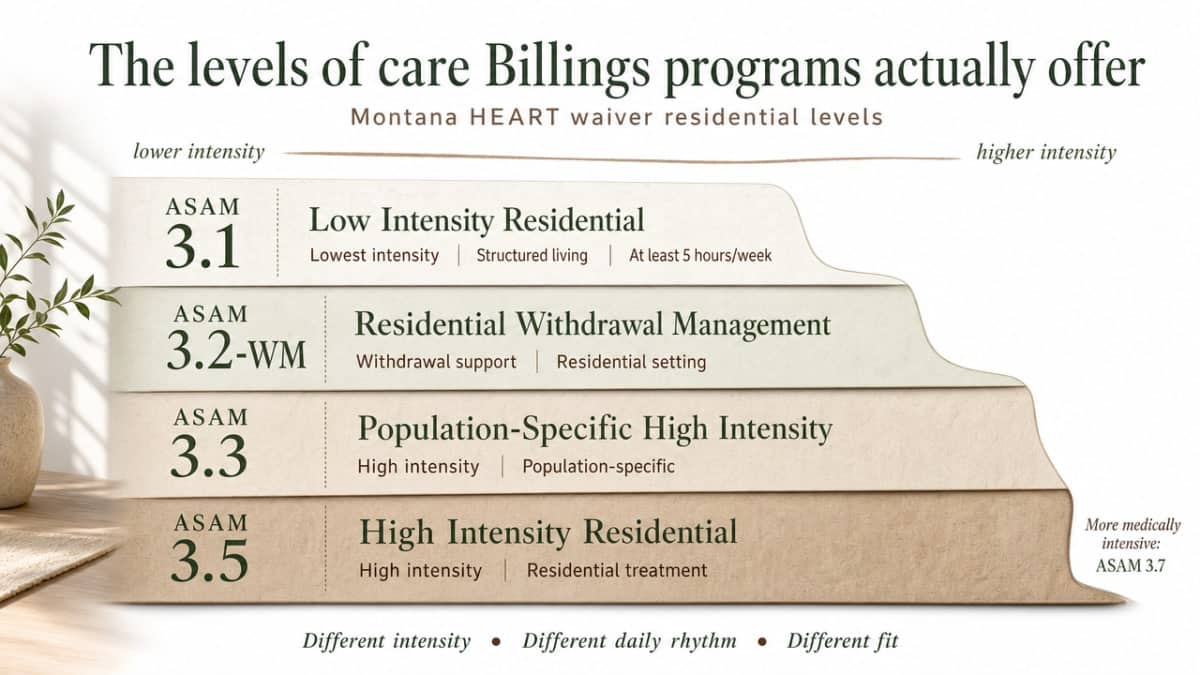
When someone tells you a Billings program is “residential,” that word covers more than one thing. Montana’s state-approved substance use disorder programs are organized around ASAM criteria, and the rules spell out several distinct residential levels:
- ASAM 3.1 Clinically Managed Low Intensity Residential
- ASAM 3.2-WM Clinically Managed Residential Withdrawal Management
- ASAM 3.3 Clinically Managed Population-Specific High Intensity Residential
- ASAM 3.5 Clinically Managed High Intensity Residential
- Alongside the more medically intensive ASAM 3.7 9
Each one is a different intensity of care, a different daily rhythm, and a different fit for what your person is walking in with.
Here is the short translation. ASAM 3.1 is the lowest-intensity residential option — a structured living environment with at least five hours a week of professionally directed treatment, useful for someone who needs stability and accountability more than round-the-clock clinical eyes 7. ASAM 3.5 sits at the other end of the clinically managed range: 24-hour structured residential treatment with a full clinical week, appropriate for someone whose use, mental health, or life circumstances make outpatient impossible right now. ASAM 3.2-WM is residential withdrawal management — the safe landing pad when the first job is getting through withdrawal without a hospital admission. ASAM 3.3 is a high-intensity residential level built for populations who need cognitive accommodations or specialized programming.
The reason the level matters to you, sitting on the outside of the system, is money and access. Under Montana’s HEART waiver, Medicaid now covers ASAM 3.1, 3.2-WM, 3.3, and 3.5, and the state reports 1,612 members received treatment through HEART-expanded services in its most recent Initiative Report 1. The waiver also requires Montana to keep the statewide average residential length of stay at 30 days or less, which shapes how programs plan discharge from day one 7. That does not mean everyone leaves at day 30. It means the system is built around short-term, focused stays with a strong step-down plan.
The chart below lines up the four Medicaid-covered residential levels so you can see, at a glance, which door you are actually knocking on when a Billings program says yes.
| ASAM level | What it is | Medicaid-covered under HEART | Length-of-stay context |
|---|---|---|---|
| 3.1 Low Intensity Residential | Structured living, min. 5 hrs/week professionally directed treatment 7 | Yes 1 | Counts toward 30-day statewide average 7 |
| 3.2-WM Residential Withdrawal Management | Clinically managed withdrawal support in a residential setting 9 | Yes 1 | Short-term, stabilization-focused 7 |
| 3.3 Population-Specific High Intensity | High-intensity residential with programming for specific clinical needs 9 | Yes 1 | Counts toward 30-day statewide average 7 |
| 3.5 High Intensity Residential | 24-hour structured residential treatment, full clinical week 7 | Yes 1 | Counts toward 30-day statewide average 7 |
What pays for what: Medicaid, room and board, and the parts nobody warns you about
Money is where most families get blindsided. Not because anyone is trying to hide anything, but because Medicaid coverage for residential treatment is layered, and the layers do not always line up with what the bill looks like at the end of the stay. If you understand the two big rules — what HEART covers, and what Medicaid legally cannot pay for — you will not be caught off guard by a room-and-board charge or a coverage gap.
The good news is that the ground has moved in your favor. The tricky part is that residential treatment in Montana is funded by a patchwork: Medicaid pays for the clinical services, state block grant dollars quietly pick up room and board at some programs, and the rest can land on the family. The 2023 Substance Abuse Block Grant report confirms that most of Montana’s PWID block-grant funds go toward room and board at six residential treatment programs, several of them in the Billings area 5. That funding exists precisely because Medicaid does not cover that piece — a rule worth knowing before you sign anything.
The HEART waiver in plain English
Here is what the HEART 1115 waiver actually did. Before July 2022, federal Medicaid rules blocked payment for many residential SUD stays in facilities that met the definition of an “institution for mental diseases,” or IMD. That rule kept a lot of Montana beds off the Medicaid card. The HEART waiver carved out an exception for short-term residential and withdrawal management stays, which is why coverage now reaches the ASAM levels most Billings programs actually operate 7.
Two conditions came with that exception, and they shape the experience you will have. First, Montana has to keep the statewide average length of stay at 30 days or less across residential settings — not a hard cap on any one person, but a pressure on the system to plan discharge from admission day 7. Second, Montana committed to expanding the residential continuum on the State Plan side too, including ASAM 3.3 and 3.2-WM, which signals that capacity for high-intensity and withdrawal management care should keep growing 8. If your first call gets a “no beds this week,” that is not the end of the road.
Coverage-at-a-glance table
Here is the piece nobody warns you about clearly enough: Medicaid pays for the treatment, not the bed and the meals. Montana’s 2023 State Plan Amendment spells it out — rehabilitative services under Medicaid do not include room and board, and the services covered cannot be delivered inside a traditional IMD without a waiver like HEART 10. That is why some programs bill Medicaid for therapy, groups, medical management, and MAT, and then either use state block-grant funds, sliding-scale fees, or a private pay component to cover the roof over the person’s head.
| Cost component | Medicaid pays? | Where the money comes from |
|---|---|---|
| Clinical services at ASAM 3.1, 3.2-WM, 3.3, 3.5 | Yes, under HEART 1 | Montana Medicaid via HEART 1115 waiver 7 |
| Room and board during residential stay | No 10 | State block grant at some programs 5; private pay; sliding scale |
| Medically monitored withdrawal management | Yes at ASAM 3.2-WM 1 | Montana Medicaid via HEART 7 |
| Stays beyond the 30-day statewide average | Case-by-case, not a hard cap 7 | Medicaid if medically necessary; step-down often preferred |
When you call a program, ask two questions in one breath: “What does Medicaid cover, and what is the room-and-board arrangement?” A straight answer means the program has thought this through. A vague answer means you keep asking until you get one.
From the phone call to the bed: the first 48 hours
The first phone call is the hardest part, and you have already thought about making it more times than you can count. Here is what actually happens after you dial, so you can picture it before you are living it.
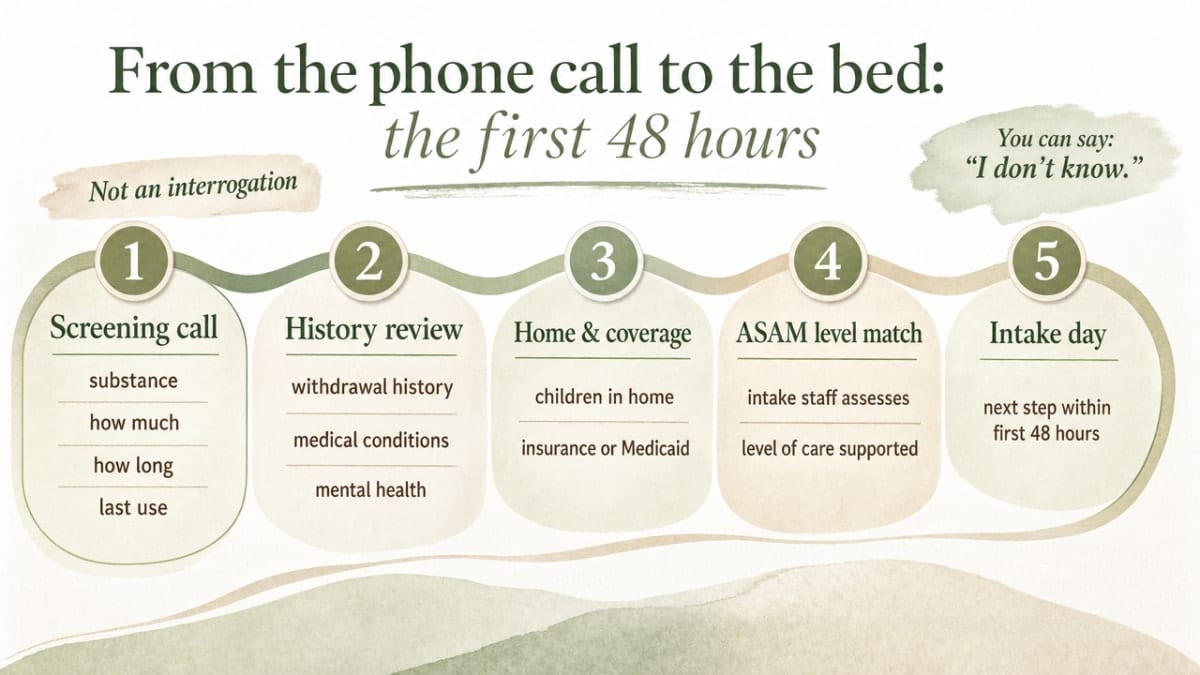
Call one is a screening call. Someone on the other end will ask about the substance, how much, how long, the last use, any withdrawal history, any medical or mental health conditions, whether there are children in the home, and what insurance or Medicaid your person has. It is not an interrogation. It is the intake staff trying to figure out which ASAM level of care matches what is actually going on, because Montana’s state-approved programs are required to place people at the level their assessment supports 9. If you do not have every answer, say so. “I don’t know” is a real answer and they will work with it.
From that screening, one of three things happens:
- The program says yes and starts the authorization process.
- The program says yes but does not have a bed today and puts your person on a hold list.
- The program says the level does not match — someone screening at ASAM 3.2-WM for withdrawal management may need to start there before stepping up to 3.5.
If it is the third answer, ask for a warm handoff to a program that admits at the right level. Do not hang up and start over cold.
Authorization is the piece that happens behind the scenes but shapes your timeline. Montana Medicaid requires prior authorization for SUD services, with continued-stay reviews built into the standards for coverage and reimbursement 11. For Medicaid members, the program typically handles the paperwork. For commercial insurance, expect a benefits verification call and possibly a peer-to-peer clinical review. This is usually a same-day or next-day process when someone is in crisis. If a program tells you it will take a week, that is a signal to keep calling other programs in parallel.
- Screening call. Substance, timeline, medical history, insurance. Intake staff match to an ASAM level 9.
- ASAM level match. Program confirms it admits at the level the assessment supports, or refers to one that does 9.
- Authorization. Medicaid prior authorization or commercial insurance benefits check runs in the background 11.
- Transportation coordination. Program, family, or sober transport service plans the drive in from home county.
- Intake day. Arrival, medical clearance, bag search, orientation. First 24 hours are mostly stabilization.
While authorization runs, the transportation conversation starts. If your person is driving in from Miles City or Wolf Point, someone needs to be behind the wheel who is not withdrawing. That might be you. It might be a peer support specialist your local behavioral health center can dispatch. It might be a sober transport service the program contracts with. Ask on the first call — programs that serve rural Montana routinely have this conversation and can tell you the local options.
Intake day itself is quieter than families expect. There is a medical check, a bag inspection for prohibited items, paperwork, and a walkthrough. The first 24 hours inside are mostly about eating, sleeping, and letting the nervous system settle. Real programming starts on day two or three. If you dropped someone off and they called that first night sounding shaky, that is not a sign it is not working. It is what the first night looks like.
You made the call. That is the step most people do not take. Everything after it is logistics, and logistics have answers.
Driving in from Lewistown, Miles City, Hardin, or the Hi-Line
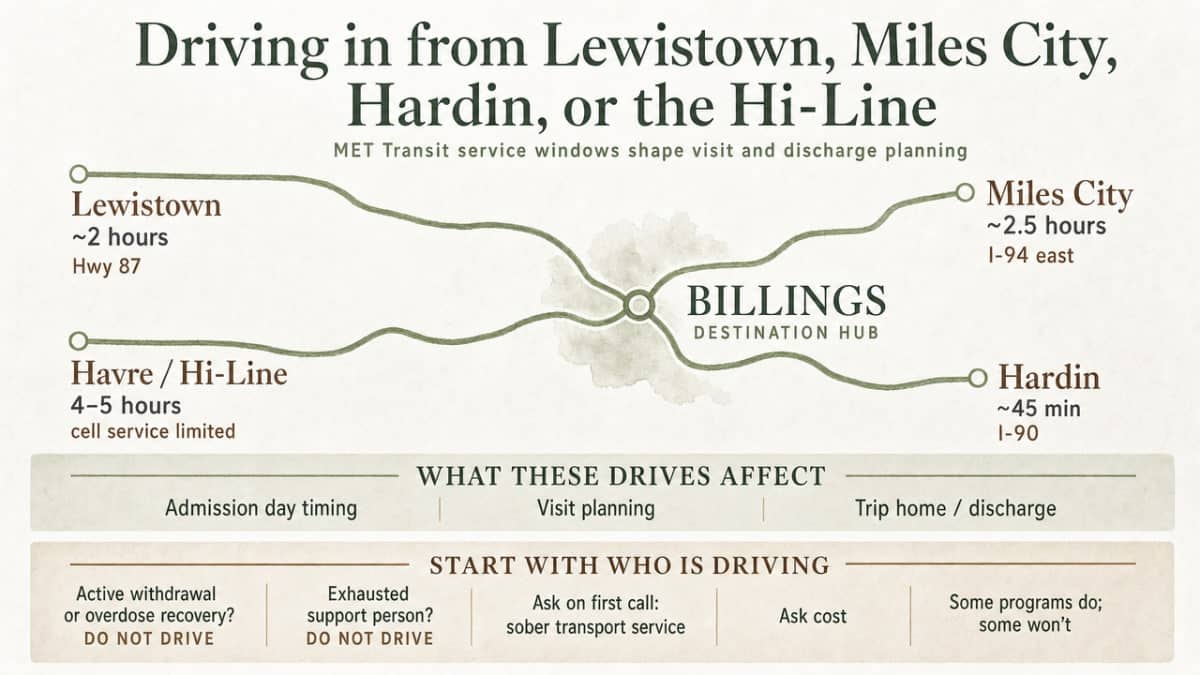
Billings is a hub because of geography, not because anyone planned it that way. If you live in Lewistown, you are looking at roughly two hours on Highway 87. From Miles City, about two and a half hours east on I-94. Hardin is close enough to feel doable, forty-five minutes down I-90. Havre and the Hi-Line towns are the hardest — four or five hours through country where cell service comes and goes. Those drives shape everything about how a family plans admission day, visits, and the trip home.
Start with who is driving. If your person is in active withdrawal or coming off an overdose, they should not be behind the wheel, and honestly, neither should someone who has been up for three days worrying. Ask the program on the first call whether they contract with a sober transport service and what the cost looks like. Some do. Some will coordinate with a peer support specialist from your local behavioral health center or tribal health program to ride along. If the answer is no on both counts, a family member driving in a caravan of two vehicles is the workable backup — one to bring the client, one to bring you home.
Gas up before you leave. Pack water and food for the road. Bring the insurance card, photo ID, any current medication bottles, and a phone charger. If there are minor children, arrange care for at least 72 hours — intake day rarely wraps up when families expect it to.
Once your person is admitted, the second logistics question is how you get back for family sessions, visits, or discharge. If you are staying in Billings for a stretch, MET Transit is the local bus system, and its hours dictate what you can realistically plan:
- Weekday service runs from 5:45 a.m. to approximately 8:00 p.m.
- Saturday service runs from 8:00 a.m. to approximately 6:00 p.m.
- No Sunday service at all 6
That last piece matters. If discharge lands on a Sunday, someone with a car needs to be there — the bus is not an option, and rideshare coverage in Billings is thinner than in a bigger city.
| Day | Service window | Planning note |
|---|---|---|
| Weekdays | 5:45 a.m. – ~8:00 p.m. | Widest window for family sessions, appointments, and step-down visits 6 |
| Saturday | 8:00 a.m. – ~6:00 p.m. | Shorter window; confirm return trip before heading out 6 |
| Sunday | No service | Arrange a car for Sunday discharges, visits, or appointments 6 |
None of this is glamorous. It is a lot of driving, a lot of coffee, a lot of hours in a waiting room. But every one of those miles is you showing up. That counts, even when it does not feel like it does.
What actually helps once someone is inside
You will want to know, at some point, whether any of this actually works. The honest answer is yes, with caveats worth carrying with you. A 2019 systematic review of 23 studies on residential treatment found moderate-quality evidence that it improves outcomes across substance use and other life domains, though the authors flagged attrition and study-design limits that mean you should read anyone’s success-rate advertisement with a raised eyebrow 4. Moderate-quality evidence is real evidence. It is not a guarantee, and anyone selling you one is selling.
The more useful question is what makes residential care work when it does. A 2023 realist review dug into the mechanisms and grouped them under three themes: belonging, meaning in life, and self-determination 3. That language sounds soft until you translate it. Belonging is the roommate who has been where your person is. Meaning is the moment someone remembers they used to love welding, or their kid’s laugh, or being useful to somebody. Self-determination is the small daily choice — showing up to group, taking the med, saying the true thing out loud — that starts to rebuild a sense of agency that addiction had swallowed.
Practically, this means the programs that help most are the ones where your person is known by name within a week. Ask on the intake call about the staff-to-client ratio, whether peer support specialists with lived recovery experience are on the team, and how family is looped into treatment planning. Ask what a normal day looks like — group therapy, individual sessions, medical check-ins, meals, movement, quiet time. If the answer is vague, keep asking. If the answer is specific, that is a program that has thought about the human being walking through the door.
One more thing worth naming. Medication for opioid or alcohol use disorder — buprenorphine, naltrexone, methadone coordination — is not a moral question. It is a clinical tool, and access varies across Montana residential facilities 7. If MAT is part of the plan your person needs, ask directly whether the program provides it on-site or coordinates with an opioid treatment program. A yes is not weakness. It is the plan working.
Packing, paperwork, and what to say when you call
Two lists and a script. That is what you actually need before the first call and before the drive to Billings, and having them written down means you are not trying to remember what year the last hospitalization was while an intake coordinator waits on the other end.
Paperwork to have within arm’s reach.
- Photo ID for your person.
- Insurance card or Medicaid ID number.
- A list of current medications with doses, or the bottles themselves.
- Names and dates of any past treatment, detox, or psychiatric admissions — approximate is fine.
- A short medical history: seizures, pregnancies, chronic conditions, allergies.
- Emergency contact and, if there are minor children, the name of whoever is caring for them and for how long.
- If probation or a court is involved, the officer’s name and phone number.
Bag to pack.
- Seven to ten days of clothes that layer, comfortable shoes, weather-appropriate outerwear.
- Toiletries without alcohol in the first three ingredients.
- A small amount of cash.
- A paperback if your person reads.
- Leave the laptop, the vape, the mouthwash, and anything sharp.
The program will give you their own list — ask for it in writing and follow it exactly, because contraband checks at intake are thorough and nobody wants their favorite hoodie confiscated on day one.
What to say when you call. Try this:“I’m calling about my [son, partner, brother]. He’s been using [substance] daily, last use was [time]. He has [Medicaid / this insurance]. We’re driving in from [town]. What level of care do you admit at, do you have a bed this week, and what do I need to bring?”Four sentences. That is enough to start.
If you are a referrer or case manager coordinating from outside Billings
A quick audience shift: the rest of this article is written to families, but this section is for the peer support specialist, tribal health worker, ED social worker, probation officer, or rural clinic case manager who is trying to land someone in a Billings bed from three counties away. You already know the map. Here is what saves you time.
- Screen to an ASAM level before you call, not after. Montana’s state-approved programs place at the level the assessment supports, and calling with a documented level shortens the intake conversation dramatically 9. If your client screens at 3.2-WM, say so up front — that signals withdrawal management first, step-up second, and stops the program from routing you to the wrong queue.
- Run Medicaid authorization in parallel with your bed search. Prior authorization and continued-stay reviews are built into Montana’s SUD reimbursement standards, and programs handle the paperwork, but your documentation on last use, prior treatment episodes, and co-occurring conditions is what makes the review move in hours instead of days 11. Fax it or secure-email it during the first call.
- Keep a short list of two or three Billings programs with warm-handoff relationships. When the first says no beds, the second call takes ninety seconds.
Speak With a Local Billings Treatment Specialist
Get guidance on next steps and support options tailored for the Billings area.
Frequently Asked Questions
Does Montana Medicaid cover residential addiction treatment in Billings?
Yes, for the clinical piece. Under Montana’s HEART 1115 waiver, Medicaid now covers residential services at ASAM levels 3.1, 3.2-WM, 3.3, and 3.5, which are the levels most Billings programs operate 1. What Medicaid does not pay for is room and board during the stay — that piece is covered by state block-grant funds at some programs, sliding-scale fees, or private pay 10. Ask the program directly how they handle both pieces on your first call.
How long does someone typically stay in residential treatment?
Montana’s HEART waiver requires the state to keep the average residential length of stay at 30 days or less across all its programs 7. That is a statewide average, not a hard ceiling on your person. Some people stay two weeks, some stay closer to sixty days when medically necessary. What matters more than the number is the step-down plan — most residential stays are designed to hand off to partial hospitalization, intensive outpatient, or sober living rather than end cold.
If Medicaid covers treatment, why am I being asked to pay for room and board?
Because federal Medicaid rules say rehabilitative services do not include room and board payments 10. That is not the program overcharging you. It is a coverage line drawn in Washington. In Montana, state block-grant dollars pick up room and board at six residential programs, and the 2023 report confirms Billings hosts several of them 5. If a program cannot explain how the roof-and-meals piece is funded for your person, keep asking — the answer exists somewhere in the intake team.
How do I get someone from a rural county like Garfield or Rosebud into a Billings program?
Start with the intake call to the Billings program and ask two questions: do they contract with a sober transport service, and can they coordinate with a peer support specialist from your local behavioral health center or tribal health program to ride along. If both answers are no, a two-car caravan with a family driver is the workable backup. Plan around MET Transit hours once your person is admitted — no Sunday service, so Sunday discharges need a personal vehicle 6.
What is the difference between ASAM 3.1, 3.2-WM, 3.3, and 3.5?
They are different intensities of residential care, all recognized by Montana’s state-approved programs 9. ASAM 3.1 is low-intensity — structured living with at least five hours a week of directed treatment. ASAM 3.2-WM is residential withdrawal management, the safe landing for getting through withdrawal. ASAM 3.3 is high-intensity residential built for populations needing specialized programming. ASAM 3.5 is 24-hour structured residential with a full clinical week 7. Your person’s assessment determines the level — it is not a menu you pick from.
Does residential treatment actually work?
The honest answer: moderate-quality evidence across 23 studies says yes, it improves outcomes across substance use and life domains, though study attrition and design limits mean nobody can promise you a percentage 4. What the research points to is why it works when it does — belonging, meaning, and self-determination, built through daily contact with people who have been there and staff who know your person by name 3. Ask about staff-to-client ratio and peer support. That is where the mechanism lives.
References
- DPHHS MCA 16-12-122: HEART Initiative Report. https://dphhs.mt.gov/assets/heartinitiative/HEARTInitiativeReport2024.pdf
- DPHHS HAN Advisory: Increased suspected fentanyl overdoses in Yellowstone. https://dphhs.mt.gov/assets/publichealth/HAN/2025/DPHHSHANADVISORY2025-IncreasedinsuspectedfentanyloverdosesinYellowstone.pdf
- A realist review of residential treatment for adults with substance use disorder – PubMed. https://pubmed.ncbi.nlm.nih.gov/36747370/
- The effectiveness of residential treatment services for …. https://pubmed.ncbi.nlm.nih.gov/31254749/
- 2023 SABG Report – dphhs. https://dphhs.mt.gov/assets/BHDD/Prevention/substanceabuseblockgrant/2023SABGReport.pdf
- Plan A Trip. https://www.billingsmt.gov/3077/Plan-A-Trip
- July 1, 2022 HEART Waiver Approval. https://dphhs.mt.gov/assets/MedicaidWaivers/MTHEARTApprovalDocument.pdf
- Final Montana HEART 1115 Demonstration Waiver Request. https://dphhs.mt.gov/assets/MedicaidWaivers/FinalMontanaHEART1115DemonstrationWaiverRequest.pdf
- Mont. Admin. r. 37.27.101 – STATE APPROVED PROGRAMS, PURPOSE. https://www.law.cornell.edu/regulations/montana/Mont-Admin-r-37.27.101
- Montana State Plan Amendment (SPA) #: 23-0023. https://www.medicaid.gov/medicaid/spa/downloads/MT-23-0023.pdf
- Mont. Admin. r. 37.27.902 – SUBSTANCE USE DISORDER SERVICES: AUTHORIZATION REQUIREMENTS. https://www.law.cornell.edu/regulations/montana/Mont-Admin-r-37.27.902