Key Takeaways
- A residential stay in Billings generates two funding streams: clinical care flows through Medicaid or insurance, while room and board is reimbursed separately through an AMDD contract 5.
- Montana’s HEART 1115 waiver, approved in 2022, allows Medicaid to pay for short-term residential SUD care in larger facilities once blocked by the federal IMD exclusion 12.
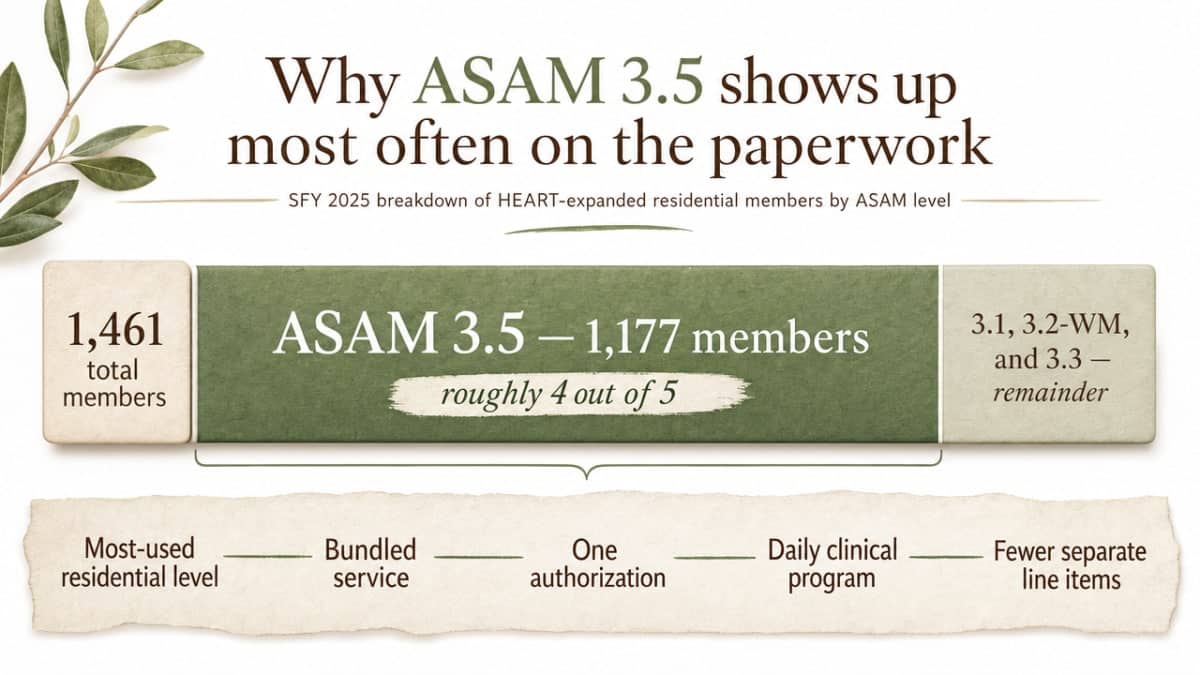
- ASAM level drives the paperwork, and 3.5 dominates the caseload—1,177 of 1,461 HEART members used it in fiscal year 2025—billed as a bundled rate based on staffing intensity 8.
- Family therapy is built into the clinical bundle, not an add-on, and showing up for sessions strengthens both outcomes and the medical necessity case for continued stay 1.
What the bill actually looks like when your spouse goes to residential treatment in Montana
You already know this is a lot. You have probably been holding a phone in one hand and a legal pad in the other, trying to figure out how a residential stay in Billings actually gets paid for. Take a breath. The answer is knowable, and once you see the shape of it, the paperwork stops feeling like a wall.
Here is the first thing to understand: it is not one bill. A residential stay in Montana is usually a stack of bills, and each layer answers a different question about who pays for what.
The clinical care — the therapy hours, the group sessions, the medical management, the nursing coverage — is one stream. Since Montana’s HEART 1115 waiver was approved in 2022, Medicaid can reimburse this clinical bundle for adults who meet medical necessity criteria, even in larger residential facilities that used to be excluded from federal Medicaid funding 12. That single policy change is why Medicaid coverage for residential treatment in Billings looks different today than it did a few years ago.
The room and board — the bed, the meals, the roof — is a separate stream. Montana’s provider manual is explicit: room and board for a member’s stay is a non-Medicaid service, reimbursed through a contract with the state’s Addictive and Mental Disorders Division rather than through the Medicaid claim itself 5. That is not a loophole or an oversight. It is how the system is built.
Then there is family involvement — your part. Family therapy sessions are usually folded into the clinical program, not tacked on as an extra you have to arrange, and there is strong federal guidance that family counseling improves engagement, retention, and outcomes 1.
The rest of this guide walks through each layer, in the order you will meet it. You do not need to memorize the whole system tonight. You just need to know what questions to ask tomorrow morning.
ASAM levels of care, translated for a spouse who never asked to learn this
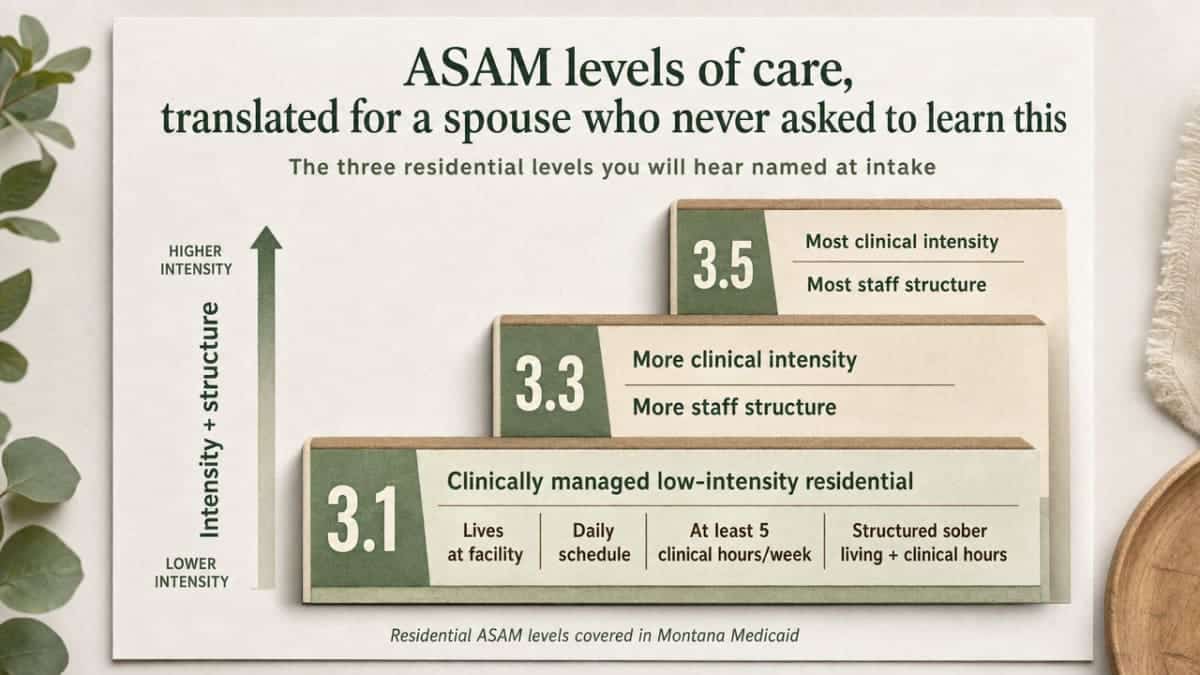
The three residential levels you will hear named at intake
When the intake coordinator says “three point one” or “three point five,” they are naming a level of care from the American Society of Addiction Medicine. It is a shorthand for how much clinical intensity your spouse needs and how many staff hours a day the program is built to provide. Montana Medicaid covers all of the ASAM-recommended levels of care in the residential range, which was not always true 11.
Here are the three you are most likely to hear:
- ASAM 3.1 — clinically managed low-intensity residential.
- Think of this as structured sober living with real clinical hours built in. Your spouse lives at the facility, follows a daily schedule, and receives at least five hours of clinical services a week. It is appropriate for someone who needs a stable environment and ongoing counseling, but not round-the-clock medical oversight.
- ASAM 3.3 — clinically managed population-specific high-intensity residential.
- This level is designed for adults who need a slower pace and more repetition, often because of cognitive impairment or long-standing use. It sits in the middle of the residential ladder.
- ASAM 3.5 — clinically managed high-intensity residential.
- This is the level most people picture when they hear “rehab.” 24-hour structured care, daily clinical programming, and a bundled service package built around staffing intensity 12.
You do not have to pick the level. A licensed clinician does that during the assessment, based on medical necessity criteria. Your job is just to know what the numbers mean when they get said out loud.
Why ASAM 3.5 shows up most often on the paperwork
If you keep seeing “ASAM 3.5” on the paperwork, there is a reason. It is, by a wide margin, the level of residential care Montana Medicaid members use most.
In state fiscal year 2025, 1,461 Medicaid members received treatment through HEART-expanded services, and 1,177 of them were in ASAM 3.5 clinically managed high-intensity residential care 8. That is roughly four out of every five people in the expanded residential caseload. The other levels — 3.1, 3.2-WM withdrawal management, and 3.3 — split the remainder among them.
A few things are worth knowing about why the numbers tilt this way.
First, ASAM 3.5 is a bundled service. The waiver describes it as a package paid based on staffing intensity, which means one authorization covers the daily clinical program rather than a long list of separate line items 12. That is simpler for facilities to bill and often simpler for you to follow.
Second, 3.5 is where the beds are. Montana added lower-intensity residential levels more recently, and the workforce and physical capacity for those levels is still catching up. A facility with 24-hour staffing is set up to run 3.5 by default.
Third, medical necessity criteria route most adults with moderate-to-severe substance use disorders into 3.5 at admission. That is not a red flag. It is the level built for the acuity most people arrive with.
If your spouse is placed in 3.5, the paperwork will look familiar to the intake staff. That is one less thing weighing on you.
The HEART waiver and why Medicaid can now pay for a residential stay in Billings
For a long time, if a residential facility in Montana had more than 16 beds, Medicaid could not pay for the stay. That was the IMD exclusion — an old federal rule that treated larger residential mental health and addiction facilities as “Institutions for Mental Diseases” and locked them out of federal Medicaid dollars. It is the reason your friend from a few years back might have told you Medicaid “doesn’t cover rehab.” That used to be closer to true than it should have been.
Then, on July 1, 2022, CMS approved Montana’s HEART 1115 demonstration waiver. In plain language, the waiver gave the state federal permission to spend Medicaid dollars on SUD treatment and withdrawal management for short-term residents in facilities that meet the IMD definition 12. That is the sentence that changed the landscape in Billings.
A few pieces of that are worth slowing down on.
The clinical program is bundled. For clinically managed residential treatment, the waiver pays a single bundled rate based on staffing intensity rather than itemizing every group and individual session 12. That is why the Medicaid side of the bill looks cleaner than you might expect.
There is a ceiling on how long each authorization runs. For ASAM 3.1, prior authorization may be issued for as many days as deemed medically necessary, up to 90 days at a stretch 4. That number matters. It tells you the outer edge of what a single authorization window can hold, and it gives you a concrete anchor when you are asking the clinical team how long your spouse will actually be there.
Coverage now spans the full residential continuum. As of October 1, 2022, Montana Medicaid added ASAM 3.1, 3.2-WM, and 3.3 to the benefit package, meaning members have access to every ASAM-recommended level of care 11. Before the waiver, the ladder had missing rungs. Now it does not.
None of this means Medicaid pays for everything a residential stay costs. It does not — the room and board layer is still its own conversation, coming up next. But if you have been carrying an old assumption that Medicaid simply will not cover a real residential program in Billings, you can set that down. The rules changed. You are not fighting the system your friend fought three years ago.
The two bills families do not see coming: clinical care vs. room and board
Here is the part that catches almost every family off guard. When your spouse enters residential treatment in Billings, the stay generates two separate financial conversations, not one. If you only prepare for the clinical side, the second envelope in the mail will feel like a betrayal. It is not. It is just how Montana built the system.
Bill one: the clinical care. This is the therapy hours, the group work, the medical management, the nursing coverage, the case management, and — in ASAM 3.5 — the bundled 24-hour clinical program. For a Medicaid member who meets medical necessity, this is the piece Medicaid reimburses. In ASAM 3.1, the clinical therapy hours are billed to Medicaid on the claim; in ASAM 3.5, it is packaged as a bundled service based on staffing intensity. Either way, the clinical stream flows through the Medicaid card.
Bill two: the room and board. This is the bed your spouse sleeps in, the three meals a day, the laundry, the physical roof of the building. Montana’s provider manual is unambiguous about how this piece gets paid:“Room and board for the member’s stay is a non-Medicaid service and is reimbursable through contract with AMDD” 5.The Addictive and Mental Disorders Division holds separate contracts with residential providers to cover this layer for eligible members, so in many cases the family never sees a room-and-board bill at all — it is handled between the facility and the state. But it is a different funding stream, on a different piece of paper, with its own eligibility rules.
Two things are worth sitting with here.
First, this split is not a billing error the facility is trying to fix. It is baked into how Medicaid defines residential care nationally, and Montana’s manual simply reflects that structure. When the billing office says “room and board is separate,” they are not upselling you. They are describing the architecture.
You are not being difficult by asking. You are doing the work of a partner who plans to still be standing on day 90.
The funding stack at a glance
You have been holding a lot of moving pieces. Here is one table you can screenshot and bring to the intake call, so the stack stops being abstract.
Each row is one residential level of care Montana Medicaid covers under the HEART waiver 12. Read across to see who typically pays for the clinical care, who covers the room and board, and how long a single authorization window can run.
| ASAM level | What the clinical bundle usually includes | Payer for clinical care | Payer for room and board | Typical authorization window |
|---|---|---|---|---|
| 3.1 — low-intensity residential | At least 5 hours/week of counseling, case management, structured sober environment | Medicaid (clinical therapy hours), commercial insurance, or private pay | Non-Medicaid; AMDD contract for eligible members, otherwise private pay or sliding scale 5 | Up to 90 days per authorization, as medically necessary 4 |
| 3.3 — population-specific high-intensity residential | Slower-paced daily programming, repetition-based curriculum, clinical oversight | Medicaid, commercial insurance, or private pay | Non-Medicaid; AMDD contract or private pay 5 | Varies; set by medical necessity review |
| 3.5 — clinically managed high-intensity residential | 24-hour structured program billed as a bundled service based on staffing intensity 12 | Medicaid (bundled rate), commercial insurance, or private pay | Non-Medicaid; AMDD contract or private pay 5 | Varies; set by medical necessity review |
Two notes before you take this to the phone call. Family therapy sessions are woven into the clinical bundle at every level, not billed as a separate service you have to add. And the dollar figures are intentionally missing — contracted rates, sliding-scale eligibility, and commercial reimbursements vary by facility and by plan. Ask intake to fill in the blanks for your specific situation. That is a normal question, not a hard one.
Where commercial insurance and private pay fit in
Not every family in Billings is working with a Medicaid card. If your spouse is on your employer plan, or you have marketplace coverage, or the household is planning to pay privately, the shape of the bill changes — but the two-layer structure does not.
Commercial insurance handles the clinical care on its own terms. Most plans will authorize residential SUD treatment when medical necessity criteria are met, but the mechanics look different than Medicaid. Instead of a bundled state rate, you are usually looking at a per-diem or level-of-care rate the plan has negotiated with the facility, with utilization review every few days rather than a single 90-day window. Ask two questions on the first call: is the facility in-network, and what is the current authorization length. The answers set your out-of-pocket ceiling for the clinical layer.
Room and board still sits outside most commercial plans, the same way it sits outside Medicaid. Commercial insurers generally pay for the treatment happening in the building, not the building itself. Some facilities roll room and board into a single private-pay rate for commercial patients; others invoice it separately. Either way, ask before admission.
Private pay is the cleanest paperwork and the heaviest household lift. You are covering both layers directly, often with a deposit at intake and monthly billing after. Many programs offer sliding-scale arrangements, scholarship beds, or payment plans — none of these are advertised loudly, but most intake coordinators will tell you what exists if you ask plainly. Montana’s chemical dependency Medicaid policies also continue to be updated, so if your spouse’s eligibility is borderline, it is worth a fresh check rather than trusting last year’s answer 7.
Family therapy is not a bonus feature. It is part of the clinical case.
If you have been treating your role as the person waiting on the other end of the phone, please stop. The evidence is clear that you are part of the treatment, not a visitor to it.
Federal SUD treatment guidance is direct on this point: family counseling in substance use disorder care is positively associated with increased treatment engagement, better retention, cost-effectiveness, and improved outcomes for both the individual and the family 1. That is not a soft claim from a marketing brochure. It is the consensus in the guidance clinicians are trained on.
A 2026 systematic review of randomized controlled trials reinforced it. Across the trials reviewed, family-based interventions improved both substance use outcomes and family functioning compared with individual-focused treatments 2. Two things moved, not just one. The person in the bed got better, and the relationship they were coming home to got better. Those outcomes are linked.
Here is what that means for the bill in front of you. Family sessions in a Montana residential program are folded into the clinical bundle, not invoiced as a separate service you have to arrange or fund on the side. When Medicaid or a commercial plan reimburses the clinical care at ASAM 3.1, 3.3, or 3.5, the family therapy component is part of what that reimbursement is paying for. You do not have to trade your involvement against the budget.
What you can do — what actually helps the clinical case — is show up when the family sessions are scheduled. Ask the clinical team early: when does family programming start, how often, in person or by video, and what does the facility need from you to make it happen. If distance, work, or childcare will make some sessions hard, say so at intake so the team can plan around it. The federal guidance acknowledges that family involvement is not always simple to arrange, and good programs build flexible engagement into the schedule rather than treating your attendance as optional 1.
One more thing worth naming. Your presence in a family session is not just emotional support for your spouse. It is clinical data. The counselor is watching how you talk to each other, where the old patterns pull, what is possible when you both have language for what happened. That work belongs on the treatment plan. It is why length of stay matters — which is the next piece.
How length of stay gets authorized, and how to advocate for more time
Length of stay is where the billing system and the clinical case meet. It is also where you have more voice than you probably think.
Here is how the mechanics actually work. When your spouse is admitted, the clinical team submits a prior authorization to the payer — Medicaid, a commercial plan, or both if there is dual coverage. The authorization approves a specific number of days at a specific ASAM level. For ASAM 3.1, that authorization can run up to 90 days as medically necessary 4. For 3.3 and 3.5, the window is set through medical necessity review and revisited at intervals defined by the plan.
When the days on the current authorization start running low, the clinical team submits a continued stay request. They document what is still unresolved — withdrawal symptoms that are still surfacing, co-occurring mental health work that is mid-course, family sessions that have not yet happened, discharge plans that are not solid. The payer reviews and either extends the stay or steps the level of care down.
What you can do is make sure the clinical record reflects the whole picture. Ask the primary counselor, by name, what has been documented about family involvement, home environment, and discharge readiness. If the plan is for your spouse to come home to you, the payer’s reviewer needs to know what home looks like — what the recovery supports are, what the risks are, what work still needs to happen in family sessions before discharge is safe. That information does not appear on its own. It appears because someone put it there.
If a continued stay is denied, ask about the appeal. Denials get overturned when the clinical documentation is complete and the medical necessity argument is specific. You are allowed to advocate. That is not interference. That is the partnership showing up on the record.
Questions to ask the intake coordinator before you sign anything
You do not have to sound like a billing expert on the intake call. You just have to ask five or six specific questions and write down the answers. Here is the list to keep next to the phone.
What ASAM level is my spouse being admitted at, and why that one? The level drives everything else — the clinical bundle, the payer mix, the length of stay. If you hear “3.5,” you now know that is the most common residential level in Montana’s expanded caseload and that it is billed as a bundled service based on staffing intensity 12.
Is the clinical care going through Medicaid, our commercial plan, or private pay? Ask them to say it plainly. If Medicaid, ask what the prior authorization covers and when it renews — for ASAM 3.1, a single authorization can run up to 90 days as medically necessary 4.
Is room and board covered for us, or are we responsible for any part of it? Get this in writing. Montana’s manual is explicit that room and board is a non-Medicaid service reimbursed through the AMDD contract, but contracted slots are finite and eligibility rules apply 5.
When does family programming start, and how do we join? Ask for the schedule, the format, and what the team needs from you.
Who do I call when something is unclear? Get a name. A real person. That is the number you will need at 9 p.m. on a Tuesday.
Speak With Someone Who Understands Your Journey
Get answers and encouragement to start moving forward—real support is just a call away.
Frequently Asked Questions
Does Montana Medicaid pay for residential treatment in Billings?
Yes, for adults who meet medical necessity criteria. Since the HEART 1115 waiver was approved in 2022, Montana Medicaid can reimburse the clinical care for short-term residential SUD stays, including in facilities with more than 16 beds that used to be shut out by the old IMD exclusion 12. The clinical bundle flows through Medicaid. Room and board is a separate funding stream.
Why is room and board billed separately from the clinical care?
Because Medicaid was not designed to pay for the bed and the meals in a residential facility. Montana’s provider manual states plainly that room and board is a non-Medicaid service, reimbursed through contract with the state’s Addictive and Mental Disorders Division rather than the Medicaid claim 5. For many eligible members that contract covers the room-and-board layer entirely. Ask intake whether it covers your household.
How long can my spouse stay in residential treatment before it has to be re-authorized?
It depends on the ASAM level. For ASAM 3.1, a single prior authorization can run up to 90 days as medically necessary 4. For 3.3 and 3.5, the initial window is set through medical necessity review and revisited at intervals the payer defines. When the days run low, the clinical team submits a continued stay request documenting what work is still unresolved.
What is the difference between ASAM 3.1, 3.3, and 3.5?
They describe how much clinical intensity your spouse needs. 3.1 is low-intensity residential with at least five hours of counseling a week and a structured sober environment. 3.3 is a slower-paced, population-specific high-intensity program. 3.5 is 24-hour clinically managed care billed as a bundled service based on staffing intensity 12. A licensed clinician picks the level at assessment, based on medical necessity, not on preference.
Is family therapy actually part of the treatment, or is it something extra we have to arrange?
It is part of the treatment. Family sessions are folded into the clinical bundle at each ASAM level, not billed as an add-on. Federal SUD guidance is clear that family counseling is positively associated with better engagement, retention, cost-effectiveness, and outcomes for both the individual and the family 1. Ask the clinical team when family programming starts and what format works for your schedule.
What if we have commercial insurance instead of Medicaid?
The two-layer structure still holds. Commercial plans typically authorize the clinical care at a negotiated per-diem or level-of-care rate, with utilization review every few days. Room and board usually sits outside the plan and is either bundled into a private-pay rate or invoiced separately. Ask two questions on the first call: is the facility in-network, and what does the current authorization cover. Get answers in writing.
References
- Chapter 1—Substance Use Disorder Treatment (SAMHSA TIP 63 context). https://www.ncbi.nlm.nih.gov/books/NBK571084/
- Family-Based Interventions for Substance Use Disorders: A Systematic Review of Randomized Controlled Trials. https://pmc.ncbi.nlm.nih.gov/articles/PMC13068785/
- Family Intervention Models for Young Adults with Substance Use Disorders. https://pmc.ncbi.nlm.nih.gov/articles/PMC11572604/
- July 1, 2022 Montana HEART Demonstration Approval (Section 1115). https://www.medicaid.gov/medicaid/section-1115-demonstrations/downloads/mt-heart-demo-ca.pdf
- Addictive and Mental Disorders Division Medicaid Services Provider Manual (Effective 10/01/2019). https://dphhs.mt.gov/assets/BHDD/MedicaidManual/AMDDMedicaidManualeff10012019.pdf
- Proposed AMDD Manual (Effective 07/01/2019). https://dphhs.mt.gov/assets/BHDD/MedicaidManual/AMDDMedicaidManualeff07012019.pdf
- Substance Use Disorders – Montana Medicaid Provider Information. https://medicaidprovider.mt.gov/32
- Healing and Ending Addiction through Recovery and Treatment Update June 2025. https://dphhs.mt.gov/assets/heartinitiative/June2025/HEARTUpdateJune2025.pdf
- Healing and Ending Addiction through Recovery and Treatment (HEART) Report 2025. https://dphhs.mt.gov/assets/StatutorilyRequiredReports/MCA16-12-122HEARTReport9-1-25.pdf
- DPHHS MCA 16‑12‑122: HEART Initiative Report 2024. https://dphhs.mt.gov/assets/heartinitiative/HEARTInitiativeReport2024.pdf
- HEART Initiative Strategies and Progress Report 2023. https://archive.legmt.gov/content/Publications/fiscal/2025-Biennium/Section-B/Interim/HEART-Initiative-Progress-Report-2023.pdf
- July 1, 2022 HEART Waiver Approval. https://dphhs.mt.gov/assets/MedicaidWaivers/MTHEARTApprovalDocument.pdf