Key Takeaways
- Montana recognizes five ASAM residential levels (3.1, 3.2-WM, 3.3, 3.5, 3.7), and knowing which level a Bozeman program is licensed for shapes the clinical fit.
- Residential care removes daily triggers and pairs 24-hour structure with integrated treatment for co-occurring anxiety, depression, or PTSD, which matters given local opioid and stimulant burden.
- Montana Medicaid’s HEART Waiver covers short-term residential SUD care and withdrawal management at levels 3.1, 3.2-WM, and 3.3, making Gallatin Valley care more reachable than it was.
- Before admitting, compare ASAM licensure, overnight staffing, co-occurring treatment approach, and whether the discharge plan schedules outpatient follow-up inside the 14-day continuity-of-care window.
Deciding whether to step away for 30 to 90 days
If you are reading this, some part of you already knows something has to change. That takes more than most people realize. Sit with that for a second before the noise in your head crowds it out.
Thirty to ninety days away from your house, your job, your phone, your people. Yes, that sounds like a lot. That reaction makes sense. It is a lot. It is also the length of stay that most severe substance use cases actually call for, with residential care sitting between a short medical stabilization and the months of follow-up that come after 10.
Here is what this article will not do. It will not tell you that rehab is magic, that a bed in the Gallatin Valley will fix everything, or that success is guaranteed. The evidence for residential treatment is moderate, and outcomes depend heavily on what you do next 14. What it will do is walk you through what residential care actually looks like in Montana: the levels of care the state recognizes, what the first week feels like, how Medicaid and the HEART Waiver may cover it, and how to tell whether a specific program is set up to help you land on your feet.
Read at your own pace. You do not have to decide today. You just have to keep reading.
What residential treatment actually means in Montana
The five ASAM residential levels the state recognizes
“Residential” is not one thing. In Montana, it is five different things, and the difference between them matters more than the brochures usually admit.
State rule 37.27.101 lists the SUD levels of care Montana officially approves for reimbursement. Five of them fall inside what most people think of as residential care: ASAM 3.1, 3.2-WM, 3.3, 3.5, and 3.7 3. Each one describes a different intensity of clinical and medical support, and where you land depends on what you are using, how your body is reacting, and what else is going on with your mental health.
Here is the plain-language version:
- Level 3.1 is clinically managed low-intensity residential care, closer to a supportive, structured living environment with scheduled clinical hours.
- Level 3.3 is population-specific and slower-paced, designed for people who need more time to absorb information, often because of cognitive or long-term substance-related impairment.
- Level 3.5 is clinically managed high-intensity residential care, the level most adults with severe SUD picture when they hear the word rehab: full days of group and individual therapy, 24-hour staffing, but not a hospital.
- Level 3.7 is medically monitored, meaning nursing and physician oversight are part of the daily setup.
- Level 3.2-WM is withdrawal management in a residential setting, for people whose detox needs are real but not severe enough to require a hospital bed.
You do not have to memorize this. The intake clinician does the placement. But knowing the letters and numbers means you can ask, out loud, which level a program is offering you and why.
Licensure, 24-hour staffing, and why it matters at intake
There is a floor under all of this, and it is worth knowing about before you sign anything.
Under Montana rule 37.27.106, an SUD facility has to be state approved and licensed to be reimbursed for facility-based treatment 4. That is not a marketing distinction. It is the line between a program that operates inside Montana’s clinical and billing framework and one that does not. If a place cannot tell you clearly which ASAM level it is licensed to provide, or waves you off when you ask, treat that as information.
The other piece is staffing. Clinically managed residential programs are defined by 24-hour structured treatment, meaning someone qualified is awake and on-site through the night, not just on call from home 24. That matters most in the first few days, when sleep is broken, cravings are loud, and a co-occurring anxiety or trauma response can flare without warning.
Why the structure of residential care helps some people more than outpatient
Outpatient care asks you to change your life while still living inside it. For a lot of people that works. For someone in active, severe use — especially with a co-occurring mental health condition — it can be like trying to rebuild an engine while the car is still moving down I-90.
Residential care removes that variable. You are not driving home past the gas station where you always stop. You are not sleeping next to the person you use with. You are not answering the group text at 9 p.m. that leads to a bad night. The environment does some of the work your willpower has been asked to do alone, and that shift shows up in the numbers.
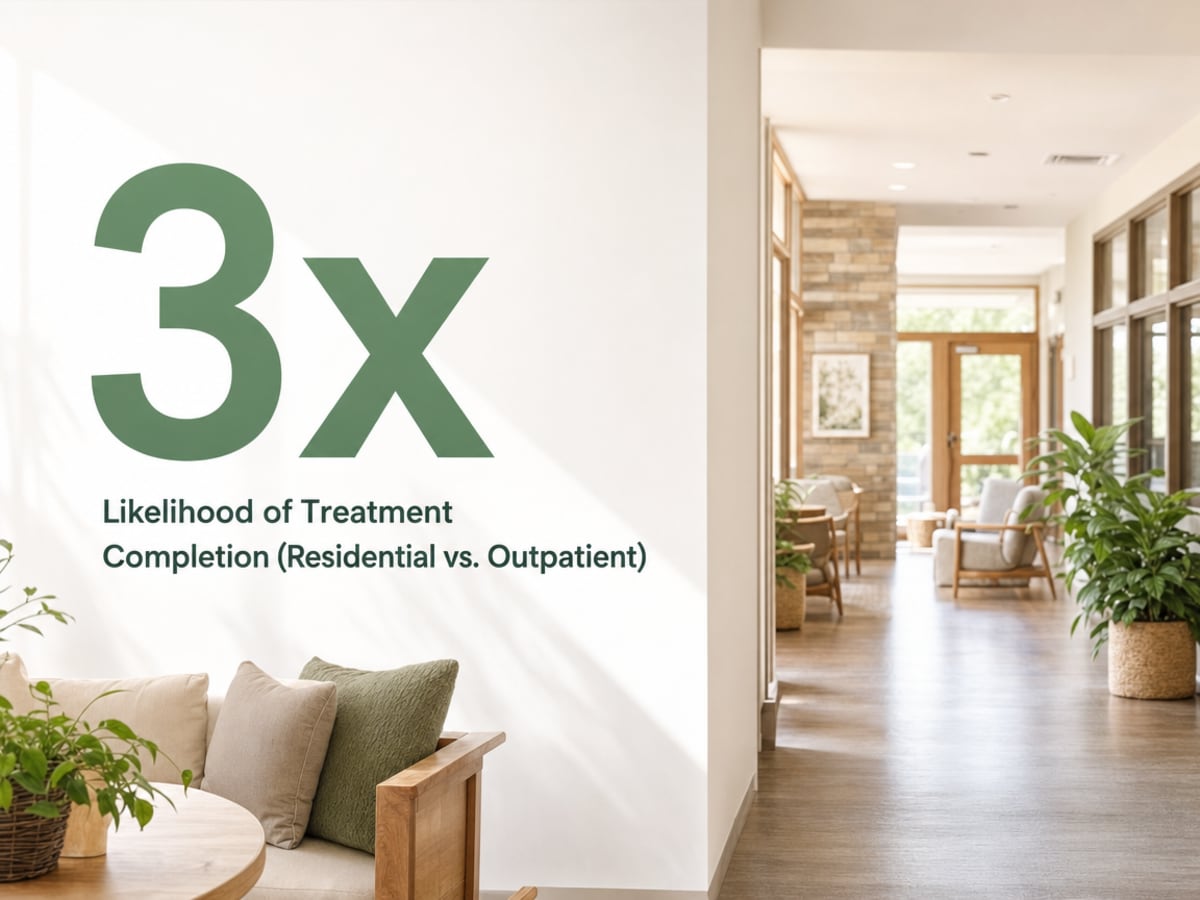
SAMHSA’s synthesis on co-occurring disorder treatment settings found that residential SUD clients are about three times more likely to complete treatment than outpatient clients 9. That is not a claim that residential care cures anything, and it is not a promise that you will be in the completion group. It is a signal about what a 24-hour structured environment does to your odds of finishing what you started.
There is a second piece worth naming. A realist review of residential treatment for adults found that what actually drives change in these settings tends to come down to three things:
- the sense of belonging you build with staff and peers,
- the meaning you start attaching to your own days, and
- the slow return of self-determination — the feeling that you get to choose what happens next 15.
Those things are hard to grow when you are still white-knuckling your Tuesday.
None of this makes outpatient wrong. It makes residential right for a specific season, when the structure is what your recovery cannot yet supply on its own.
What the first week and the middle weeks feel like
Arrival, medical stabilization, and the first 72 hours
The first day is mostly paperwork, vitals, and a long conversation with a clinician who wants to know what you have been using, how much, and when you last used. Answer honestly. The dose in your bloodstream shapes what happens next, and there is nothing you can say that they have not heard.
If your body needs withdrawal management, that piece often comes first. NIDA is clear that detox on its own is not treatment and does not cure a substance use disorder — it is the medical bridge that gets you steady enough to actually use the therapy that follows 6. Depending on what you were using, this can mean a few days of medication support for alcohol or benzodiazepine withdrawal, or a rougher stretch of sleep disruption and craving for stimulants. Nurses check on you. Someone brings you food you probably will not want.
The first 72 hours are not about insight. They are about sleep, hydration, and letting the fog lift. If you feel numb, or weepy, or furious at everyone who told you to come — that is the nervous system, not a sign you made the wrong call. Let it pass.
The daily rhythm: groups, individual sessions, and quiet time
By the end of the first week, a schedule starts to make sense. Mornings tend to open with a check-in group — how you slept, what you are dreading, what you noticed. Then a psychoeducation block, where a counselor walks the room through something concrete: how cravings work in the brain, what a trigger actually is, why your sleep is wrecked.
Afternoons usually hold your individual therapy session a few times a week, a process group where people talk about what is actually going on, and some form of movement or outdoor time. In the Gallatin Valley that might mean a walk with the Bridgers in view, a yoga block, or a supervised trip outside. Evenings soften. Journaling. A 12-step or peer meeting if that is part of the program. Lights out earlier than you are used to.
What surprises most people is the quiet. There is time between things. No phone buzzing, no shift to pick up, no bar to close. That silence is uncomfortable at first and then, slowly, useful. NIDA’s core principles remind clinicians that no single treatment fits everyone, so a good program will adjust the mix for you rather than run you through a template 5.
Treating the substance use and the co-occurring conditions together
Most adults who land in residential care are not just dealing with substances. Anxiety that has been running the show for a decade. Depression that got heavier every year. PTSD from something you have never told anyone about. If any of that sounds familiar, you are not an unusual case — you are the case.
The point of residential is to treat both sides at once, in the same building, by a team that talks to each other. SAMHSA’s guidance on co-occurring disorders in residential settings notes that this integrated approach generally improves substance use, mental health, and day-to-day functioning together, rather than fixing one and leaving the other for later 9. That matters because untreated depression or trauma is one of the fastest paths back to using.
There is a longer-arc reason too. A study of adults with co-occurring conditions found that staying in residential for at least 90 days, then continuing outpatient mental health care after discharge, was linked to reduced substance use at six months 16. Length of stay is not a punishment. It is what gives the mental health work enough runway to actually stick.
Where residential fits in the full recovery arc
Here is the part most people miss when they picture rehab: residential is a chapter, not the whole book. If you walk in thinking those 30 to 90 days are the finish line, you are setting yourself up to be blindsided by week two after discharge.
For adults with severe substance use disorder, the sequencing that shows up in the clinical literature runs roughly like this:
- Three to seven days of medically managed withdrawal to get your body steady.
- Then one to three months in residential care, where the deeper work actually happens.
- Then continuing care — outpatient, groups, medication management, whatever your plan calls for — that keeps going after you leave 10.
That last piece is not optional garnish. It is the part that holds the middle piece in place.
How long should continuing care last? Longer than most people want to hear. The research on step-down and follow-up care argues for at least 3 to 6 months, and up to 12 months for a more durable recovery 11. That does not mean 12 months of intensive treatment. It means 12 months of some kind of consistent touchpoint — a weekly group, a monthly counselor visit, a peer support meeting you actually show up to.
Read the arc backward and it clicks. If you are picking a Bozeman-area residential program, you are not just picking the 30 to 90 days. You are picking a team whose discharge plan already has your outpatient provider, your first appointment date, and your continuing care schedule written down before you pack up your room. Anything less is handing you the middle of a book with the last chapters missing.
Paying for it in Montana: Medicaid, the HEART Waiver, and private coverage
Money is usually the second question after “do I really need this,” and it deserves a straight answer.
If you have Montana Medicaid, residential treatment is likely reachable in a way it was not a few years ago. The state’s HEART Section 1115 demonstration waiver, approved in 2022, authorized Medicaid payment for short-term residential SUD treatment and withdrawal management, and pulled ASAM levels 3.1, 3.2-WM, and 3.3 into covered clinically managed residential care 24. Translation: the bundled cost of a 24-hour structured stay at those levels can be billed to Medicaid instead of falling on you or your family.
That coverage is being used. In SFY24, 1,350 Montanans with serious substance use disorders received Medicaid-reimbursable clinically managed residential services through the HEART Waiver 1. You are not asking for something rare or experimental.
If you have private insurance through work or the marketplace, the levers are different. Most plans cover residential SUD care, but they will want a clinical justification for the level of care and typically authorize stays in shorter increments than you might expect. The intake team should handle that back-and-forth for you. Ask them who does the utilization review calls, and whether they will appeal a denial if one comes.
If you have neither, ask anyway. State-approved programs have to work inside Montana’s licensure and billing framework 2, and most keep a small number of sliding-scale or scholarship options. The worst answer you can get is no. You already know how to survive that.
The Bozeman and Gallatin Valley reality
Local burden: opioids, stimulants, and the workforce gap
You are not imagining that this is worse than it used to be. Montana’s own 2024 opioid report documents ongoing opioid-related morbidity and mortality across the state, and calls out the need to expand access to evidence-based treatment, including medications for opioid use disorder 20. That is state-agency language for: demand is real, and the system is still catching up.
Stimulants matter here too, arguably more than the national conversation admits. From 2020 to 2024, 381 Montanans died from an unintentional methamphetamine overdose, and the 2024 stimulant overdose death rate reached 7.3 per 100,000 residents 21. If your use pattern involves meth, or meth and something else, you are not on the fringe of what Bozeman-area programs are set up to treat. You are close to the center of it.
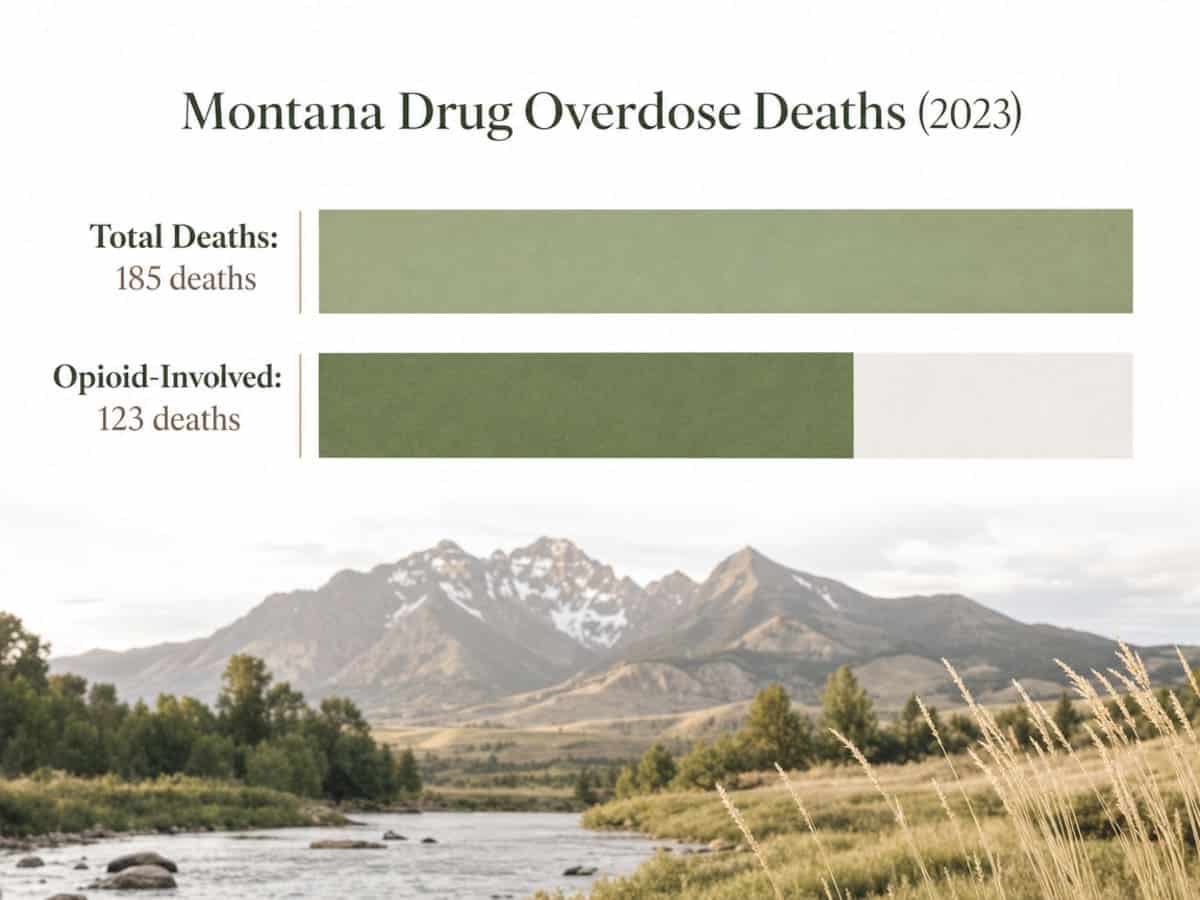
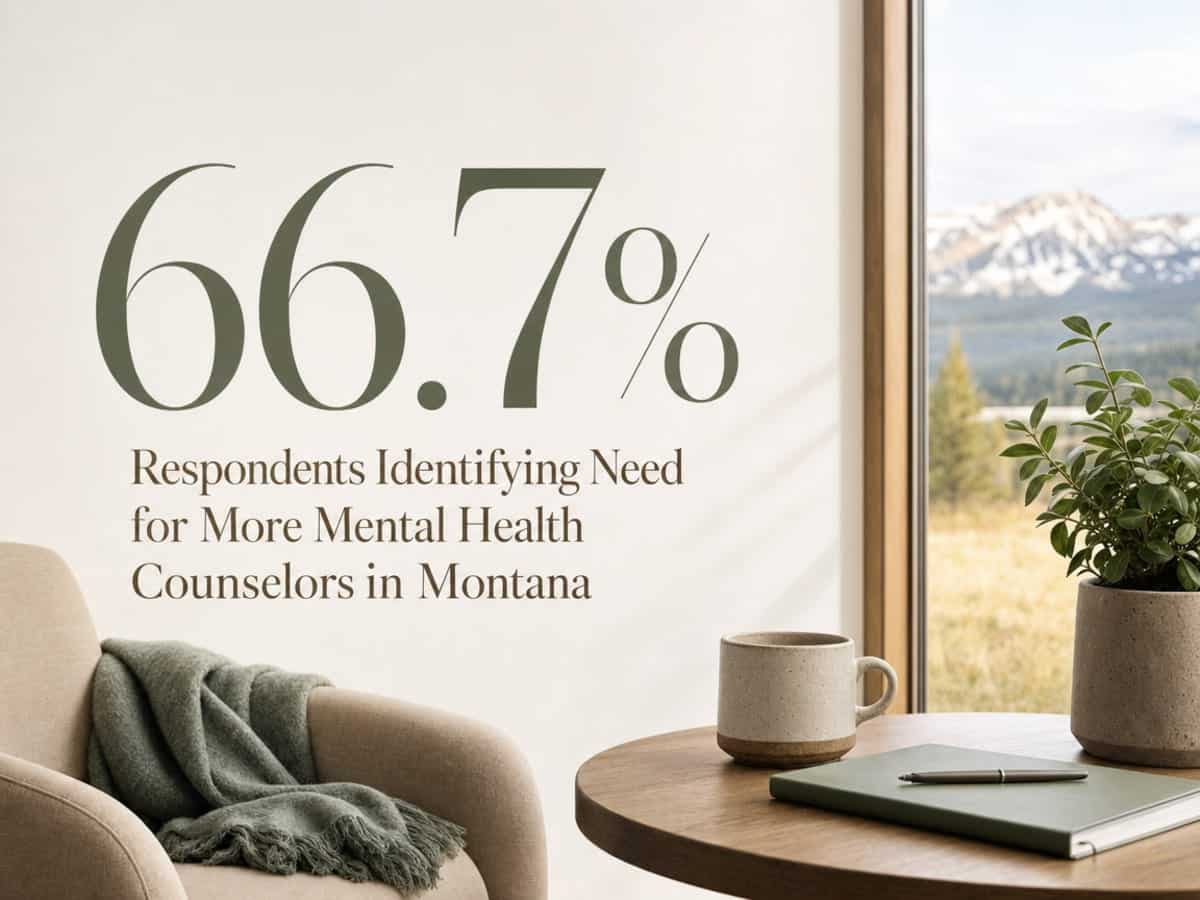
Now the harder piece. Montana’s 2024 behavioral health needs assessment found that two out of three respondents named more mental health counselors as the top unmet need in the state 23. That workforce gap shows up in the Gallatin Valley as waitlists, tight scheduling for individual therapy hours, and step-down providers who are booking weeks out. It is not a reason to stall. It is a reason to start the intake call today rather than next month, and to ask specifically about counselor caseloads and how quickly your discharge appointments can be locked in.
Driving in from Belgrade, Livingston, or farther out
Distance is part of this decision, so let’s name it.
If you are coming in from Belgrade, it is a short run down Jackrabbit or the interstate. From Livingston, you are crossing Bozeman Pass, which in January can add real time and real anxiety to the day. From farther out — Big Sky, Ennis, Three Forks, White Sulphur Springs — you are looking at an hour or more, and a plan for who drives you in.
Ask the program two things before admit day:
- Can someone from your side transport you, or does the intake team coordinate a pickup.
- Once you discharge, is the outpatient step-down close enough to your actual home that you will still show up in week six, when the newness has worn off.
A discharge plan that requires a 90-minute drive twice a week rarely survives a Montana winter.
Discharge planning is where residential either sticks or slips
Ask any counselor who has done this work for a decade what separates the residential stays that hold from the ones that fall apart, and most of them will say the same thing. It is not the therapy inside the walls. It is what got scheduled before you walked out.
So when you are still inside the program, in week two or three, start asking your counselor these things out loud:
- Who is my outpatient provider going to be.
- Is that first appointment on the calendar yet, and is the date inside 14 days of my discharge.
- What does my continuing care look like at month two, month four, month six.
- If you are on medication for opioid or alcohol use disorder, who is prescribing it after I leave, and when is that handoff happening.
The evidence on why this matters is not soft. Adults with co-occurring conditions who stayed in residential for at least 90 days and then continued outpatient mental health care after discharge showed reduced substance use at six months 16. The residential piece and the outpatient piece are load-bearing together. Either one alone carries less weight than the two connected.
A good discharge plan looks boring on paper. A name. A phone number. A date. A refill schedule. A backup plan for the first weekend you are home alone. If your plan is vague, push. This is the part of your treatment where being a little demanding is exactly the right instinct.
Honest questions to ask before you say yes
Before you sign the admission paperwork, pick up the phone one more time. A good program will welcome hard questions. A shaky one will get impatient.
Ask what ASAM level they are licensed to provide, and whether that level matches what the intake clinician thinks you need 3. Ask who is physically in the building overnight in your first week. Ask how they handle co-occurring anxiety, depression, or PTSD in the same treatment plan, not as a separate referral for later 9.
Ask about discharge before you ever admit. Who becomes your outpatient provider. Is that first appointment scheduled inside the 14-day window that quality research treats as the continuity-of-care standard 12. If you take medication for opioid or alcohol use disorder, who prescribes it after you leave, and when does that handoff happen.
Ask what happens if insurance denies additional days. Ask what a normal length of stay actually looks like for someone with your history.
If the answers are specific, that is a good sign. If they are vague or annoyed, keep dialing.
Take the Next Step Toward Stability Today
Speak directly with an admissions expert for immediate guidance on residential treatment options in Bozeman.
Frequently Asked Questions
How long does residential treatment in Bozeman usually last?
For adults with severe substance use disorder, the clinical literature describes a typical residential stay of one to three months, sitting between a shorter withdrawal management period and months of outpatient follow-up 10. Your exact length depends on what you use, your history, and your insurance authorization. Thirty days is common. Sixty or ninety days is not unusual when the work needs more runway.
Does Montana Medicaid cover residential addiction treatment?
Yes, for eligible adults. Montana’s HEART Section 1115 waiver, approved in 2022, authorized Medicaid payment for short-term residential SUD care and withdrawal management, including ASAM levels 3.1, 3.2-WM, and 3.3 as bundled 24-hour structured treatment 24. Coverage runs through the state’s provider framework and the Behavioral Health and Developmental Disabilities Division Medicaid Manual 2. Ask the intake team to verify your specific plan and level.
What happens if I need medical detox before residential care?
If your body needs to withdraw safely first, that piece comes before the therapy work. NIDA is direct: detox alone is not treatment and does not cure a substance use disorder — it is the medical bridge to what comes next 6. Expect a few days of monitored stabilization, then a handoff into the residential program. A good team schedules that handoff before you finish withdrawal, not after.
Can residential programs treat anxiety, depression, or PTSD alongside substance use?
Yes, and they should. SAMHSA’s guidance on co-occurring disorders in residential settings shows that integrated treatment — addressing substance use and mental health in the same building, by a team that talks to each other — generally improves substance use, mental health, and day-to-day functioning together 9. Ask the program directly how they handle dual diagnosis. If they refer mental health care out, that is a gap worth naming.
What should I ask a Bozeman-area program before I agree to admit?
Ask which ASAM level they are licensed to provide and whether it matches what the intake clinician recommends 3. Ask who is physically in the building overnight in your first week. Ask how they treat co-occurring conditions in the same plan. Ask whether your first outpatient appointment will be scheduled inside 14 days of discharge, the continuity-of-care window quality researchers use as a benchmark 12.
What happens after I discharge from residential treatment?
You step down into continuing care — outpatient sessions, groups, medication management, peer support — that keeps the residential work anchored to your daily life. The research argues for at least 3 to 6 months of continuing care, and up to 12 months for a more durable recovery 11. Your discharge plan should already name your outpatient provider, first appointment date, and medication handoff before you leave.
References
- section 1115 heart demonstration waiver legislative summary. https://archive.legmt.gov/content/Publications/services/2024-agency-reports/MCA_53-2-215_HEART_Waiver.pdf
- Substance Use Disorders – Medicaid Provider – Montana.gov. https://medicaidprovider.mt.gov/32
- Mont. Admin. r. 37.27.101 – STATE APPROVED PROGRAMS, PURPOSE. https://www.law.cornell.edu/regulations/montana/Mont-Admin-r-37.27.101
- Mont. Admin. r. 37.27.106 – STATE APPROVED PROGRAMS, SUBSTANCE USE DISORDER FACILITIES. https://www.law.cornell.edu/regulations/montana/Mont-Admin-r-37.27.106
- Principles of Drug Addiction: A Research-Based Guide (Third Edition). https://nida.nih.gov/sites/default/files/podat-3rdEd-508.pdf
- Quick Guide – National Institute on Drug Abuse (NIDA). https://nida.nih.gov/sites/default/files/samhsa_detoxification_and_substance_abuse_treatment.pdf
- Substance Use Disorder Treatment Outcomes – PMC – NIH. https://pmc.ncbi.nlm.nih.gov/articles/PMC12180564/
- Residential and inpatient treatment of substance use disorders in …. https://pmc.ncbi.nlm.nih.gov/articles/PMC10782522/
- Chapter 7—Treatment Models and Settings for People With Co-Occurring Disorders. https://www.ncbi.nlm.nih.gov/books/NBK571024/
- EARLY INTERVENTION, TREATMENT, AND MANAGEMENT OF SUBSTANCE USE DISORDERS. https://www.ncbi.nlm.nih.gov/books/NBK424859/
- The Continuing Care Model of Substance Use Treatment – PMC. https://pmc.ncbi.nlm.nih.gov/articles/PMC4007701/
- Predictive validity of two process-of-care quality measures for residential substance use disorder treatment. https://pmc.ncbi.nlm.nih.gov/articles/PMC4672518/
- The effectiveness of residential treatment services for substance use disorders: a systematic review. https://pubmed.ncbi.nlm.nih.gov/31254749/
- Residential treatment for individuals with substance use disorders: assessing the evidence. https://pubmed.ncbi.nlm.nih.gov/24445598/
- A realist review of residential treatment for adults with substance use disorder – PubMed. https://pubmed.ncbi.nlm.nih.gov/36747370/
- Stability of Outcomes Following Residential Drug Treatment …. https://pmc.ncbi.nlm.nih.gov/articles/PMC3146302/
- Is residential treatment effective for opioid use disorders? A longitudinal comparison of treatment outcomes among opioid dependent, opioid misusing, and non-opioid using emerging adults with substance use disorder. https://pmc.ncbi.nlm.nih.gov/articles/PMC4253677/
- Overdose Prevention Data Channel – CDC. https://www.cdc.gov/overdose-prevention/data-channel/index.html
- NVSS – Drug Overdose Deaths – CDC. https://www.cdc.gov/nchs/nvss/drug-overdose-deaths.htm
- Opioid Use in Montana (2024). https://dphhs.mt.gov/assets/BHDD/PreventionResources/OpioidUse2024Final.pdf
- Summary of Methamphetamine Use in Montana. https://dphhs.mt.gov/assets/publichealth/EMSTS/Data/Meth_Drug_Use_Summary.pdf
- Montana State Health Improvement Plan 2024-2028. https://dphhs.mt.gov/assets/publichealth/ahealthiermontana/2024StateHealthImprovementPlanDraft_publiccomment.pdf
- Draft – 2024 AHEC BH Needs Assessment. https://healthinfo.montana.edu/reports/2024%20AHEC%20BH%20Needs%20Assessment.pdf
- July 1, 2022 HEART Waiver Approval. https://dphhs.mt.gov/assets/MedicaidWaivers/MTHEARTApprovalDocument.pdf