Key Takeaways
- Butte referrers juggle three simultaneous pressures: clinical level-of-care matching, Montana Medicaid prior authorization, and geographic logistics along the I-15 and I-90 corridors.
- Selecting the correct ASAM residential tier upfront—3.1, 3.2-WM, 3.3, 3.5, or 3.7-WM—prevents rejected authorizations and unsafe placements, especially when withdrawal risk requires 24/7 RN coverage 8.
- Prior authorization is mandatory at every residential level and turnaround can run 48 to 72 hours, so submit complete ASAM packets immediately and keep a backup facility identified 5.
- Compare programs on documented client rights policies, staffing that matches the advertised ASAM level, transport arrangements, and discharge planning that starts on day one under the HEART waiver’s 30-day average 6, 7.
What Butte referrers are actually solving for
If you’re making calls from a Butte-Silver Bow clinic, ER, drug court desk, or family kitchen table, you understand the challenges of arranging residential care. The difficulty lies in coordinating all necessary components before the opportunity passes.
You’re addressing three main issues simultaneously. First, the clinical aspect: determining the appropriate ASAM residential level and ensuring safe withdrawal management. Second, the financial aspect: navigating Montana Medicaid coverage, prior authorization requirements for ASAM 3.1 and higher, and securing timely approval. Third, the geographic aspect: Butte’s limited bed availability often necessitates referrals involving travel via I-15 or I-90, requiring a transport plan and communication with families about when they will see their loved one again.
This process is complex, and acknowledging this reality is crucial. Approaching residential treatment as a coordinated handoff with a time constraint is more effective. While the state has expanded coverage through the HEART waiver, reimbursing residential episodes across multiple ASAM levels, expanded coverage does not guarantee automatic access 3. The following sections detail the decision-making process, from matching level of care to prior authorization timing and discharge planning from day one.
Matching ASAM residential levels to what Butte clients actually need
The five residential levels in plain terms
ASAM’s residential tiers are distinct, and selecting the incorrect one can lead to wasted bed days or rejected prior authorizations. Here’s how they apply to referrals from Butte.
- ASAM 3.1
- Clinically managed low-intensity residential care. This involves a structured living environment with integrated counseling, offering approximately five hours of clinical services per week. It suits clients who are stable but cannot maintain sobriety in their current living situation, such as individuals leaving detox or those whose relapse patterns are linked to their living companions.
- ASAM 3.2-WM
- Clinically managed residential withdrawal management. This is a supervised detox setting for individuals whose withdrawal is expected to be manageable without extensive medical intervention, but who still require continuous observation.
- ASAM 3.3
- Clinically managed population-specific high-intensity residential care, often designed for clients with cognitive impairments or other functional limitations that make a standard 3.5 setting unsuitable.
- ASAM 3.5
- Clinically managed high-intensity residential—the level commonly associated with “rehab.” It features full days of programming, a structured environment, longer stays, and is frequently reimbursed by Montana Medicaid for adults with moderate to severe SUD.
- ASAM 3.7-WM
- Medically managed inpatient withdrawal, a higher level of care than 3.2-WM, requiring active medical oversight during detox.
Accurately determining the level of care initially streamlines subsequent processes like authorization, transport, and length of stay. Errors necessitate redoing the referral packet.
Why some withdrawal cases require medical oversight beyond residential settings
A common challenge for Butte referrers is deciding whether a clinically managed residential detox bed is sufficient for a client in active withdrawal, or if a setting with constant nursing supervision is necessary.
Montana’s licensing regulations clearly differentiate these levels. For ASAM 3.2-WM, facilities must have sufficient staff on duty 24/7 to supervise, observe, and support intoxicated or withdrawing clients, but these staff are not required to be RNs 8. In contrast, ASAM 3.7-WM mandates an RN on-site 24/7 to monitor clients and administer services 8. This staffing difference is the key distinction between residential and medically managed detox programs.
Advocating for a higher level of care when clinically indicated is not an overreaction; it demonstrates effective coordination.
The Montana Medicaid coverage pathway from referral to admission
Prior authorization at 3.1 and above: what to file and when
Prior authorization is a critical step that cannot be overlooked. In Montana, it is required for all residential levels of care your Butte client might enter—ASAM 3.1, 3.2-WM, 3.3, 3.5, and 3.7—meaning approval is necessary before a bed can be secured 5.
Reviewers look for a cohesive narrative: a current ASAM assessment aligning the six dimensions with the requested level, a diagnosis, documentation of previous treatment attempts and their outcomes, and a clear justification for why this level is the least restrictive yet effective option. For instance, if a client has failed outpatient treatment twice in the past year, this should be noted. If a seizure history precludes a 3.2-WM setting, document this in dimension two and directly request 3.7-WM. Incomplete packets lead to delays, which can be detrimental given time constraints.
Regarding timing, submit the authorization request immediately upon completing the assessment. Do not wait for transport plans or family discussions. Authorization turnaround times vary, and a reserved bed at a partner facility can be lost if approval extends beyond 48 to 72 hours.
While the receiving facility typically files the authorization, you, as the referrer, provide the clinical narrative. Send your assessment, progress notes, and rationale in a single, comprehensive packet. A clear handoff expedites approval.
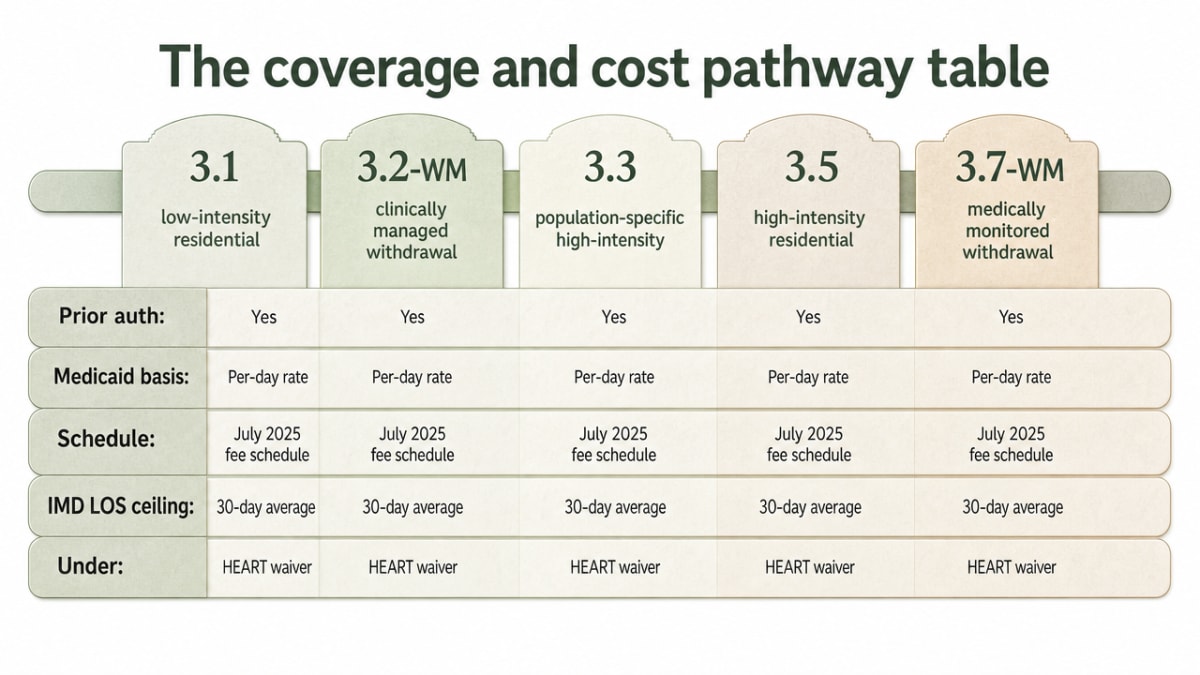
The coverage and cost pathway table
This table provides a concise overview for your referral calls. All residential ASAM levels covered by Montana Medicaid require prior authorization, have a defined per-day reimbursement structure under the July 1, 2025 SUD fee schedule, and any stay in an IMD-qualifying facility is subject to the HEART waiver’s 30-day average length-of-stay ceiling 4, 5, 6.
| ASAM level | Prior auth required | Medicaid reimbursement basis | LOS ceiling in IMD-qualifying settings |
|---|---|---|---|
| 3.1 (low-intensity residential) | Yes | Per-day rate on July 2025 fee schedule | 30-day average under HEART waiver |
| 3.2-WM (clinically managed withdrawal) | Yes | Per-day rate on July 2025 fee schedule | 30-day average under HEART waiver |
| 3.3 (population-specific high-intensity) | Yes | Per-day rate on July 2025 fee schedule | 30-day average under HEART waiver |
| 3.5 (high-intensity residential) | Yes | Per-day rate on July 2025 fee schedule | 30-day average under HEART waiver |
| 3.7-WM (medically managed inpatient withdrawal) | Yes | Per-day rate on July 2025 fee schedule | 30-day average under HEART waiver |
It’s important to note that the fee schedule does not impose an explicit day limit on individual authorizations; the 30-day figure represents an average across the IMD population, not a strict cap on a client’s stay. Additionally, per-day rates are code-specific and change with updates, so consult the current fee schedule before discussing costs with families.
How expanded Medicaid is actually being used across the state
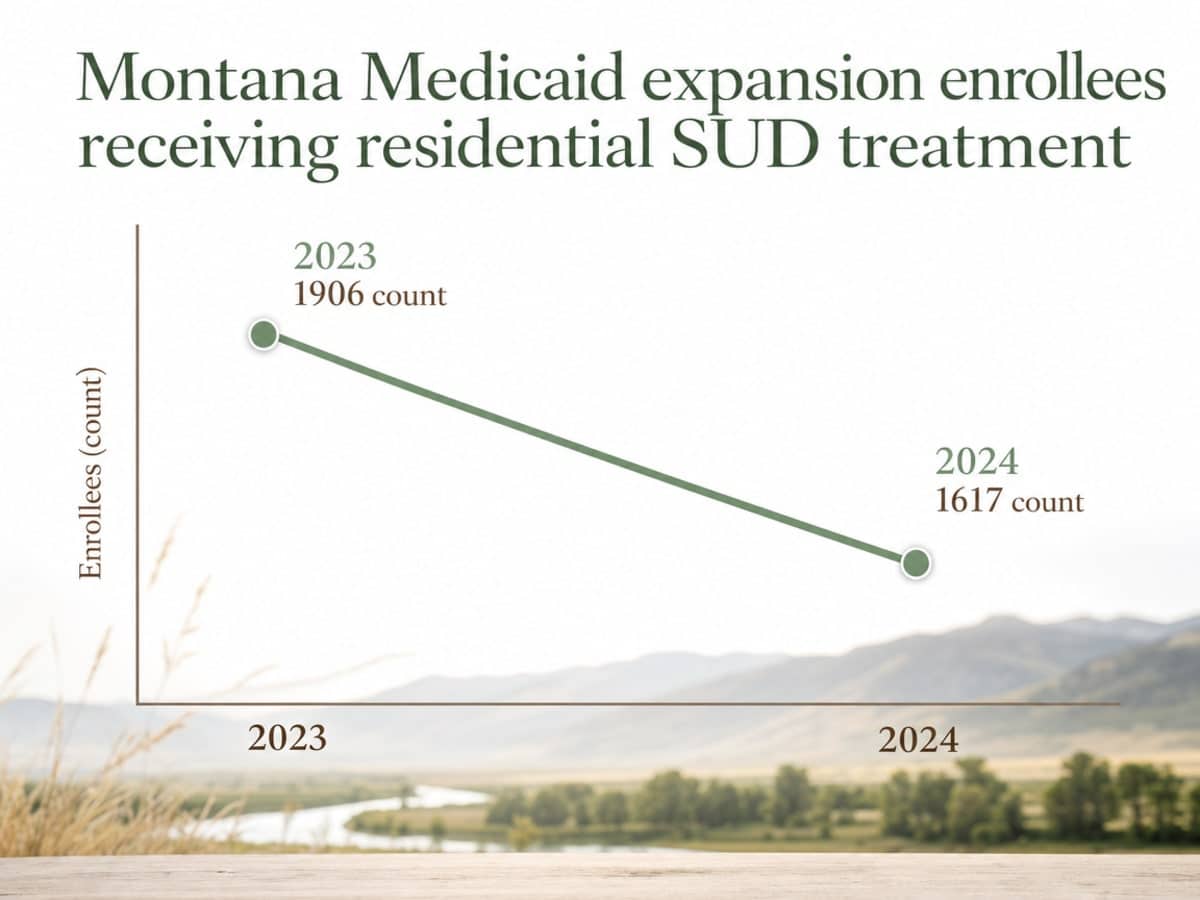
Montana has expanded access to residential SUD care. However, from a Butte case-management perspective, it’s less clear whether this expansion translates into increased bed utilization statewide.
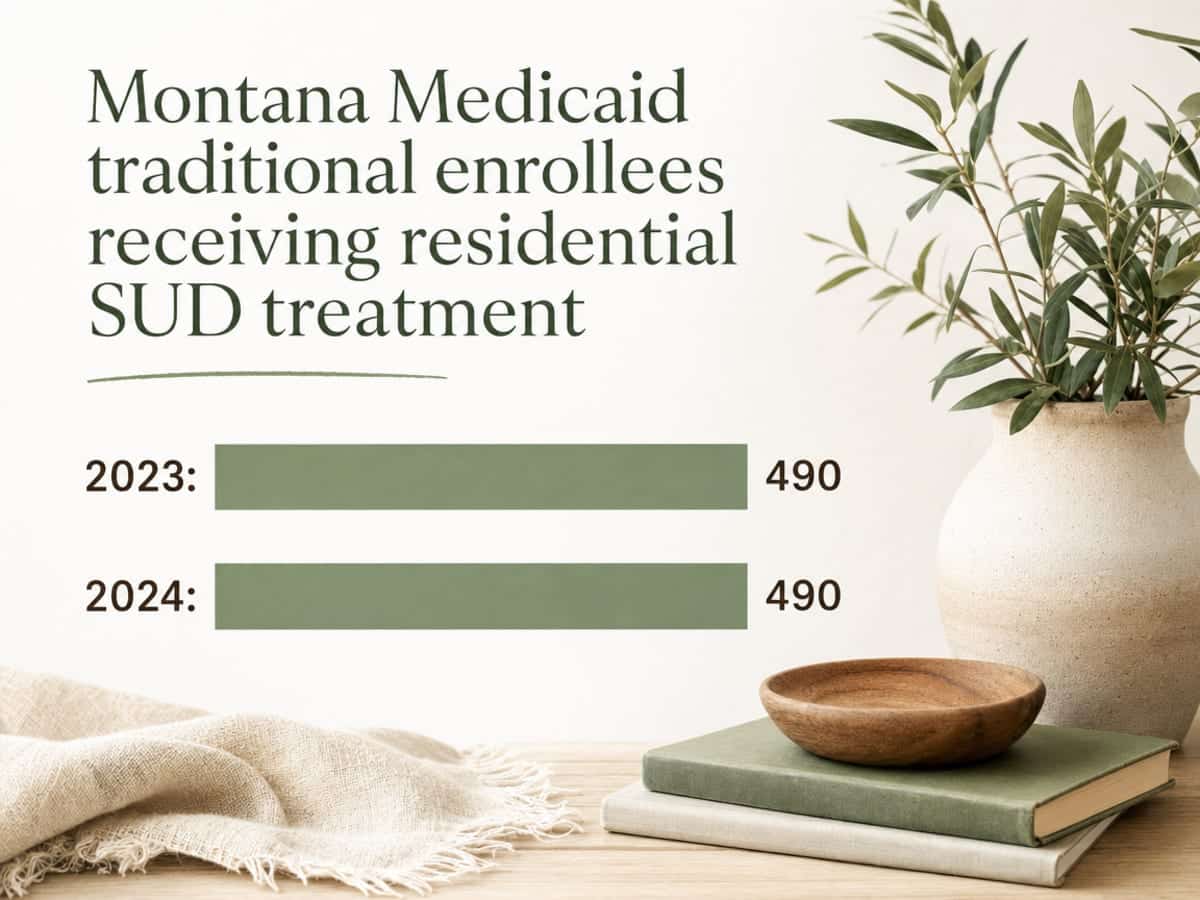
Data reveals a nuanced picture. Montana Medicaid Expansion residential SUD episodes decreased from 1,906 in 2023 to 1,617 in 2024, a reduction of approximately 15% year-over-year. Traditional Medicaid residential episodes remained stable at 490 for both years 10. This indicates that the population with the broadest access is utilizing less residential care, while the traditional population’s usage is unchanged.
For referrers, this doesn’t signify a failure of coverage, but rather uneven access not fully captured in policy documents. Factors such as workforce shortages, bed availability in rural areas, prior authorization challenges, and the reality that many clients who screen for 3.5 never reach admission all contribute. When you encounter “no beds until next week” or “not taking new admits this month” in Butte, you are experiencing the practical implications of this utilization data.
The implication is operational, not discouraging. Coverage exists, and approval is attainable. However, the assumption that an approved authorization guarantees same-week admission is often incorrect. Plan your referral timeline with an extra week and keep a secondary option in mind from the initial contact.
Butte-Silver Bow logistics: getting a client from intake to a bed
The I-15 and I-90 corridors and sober transport
Butte’s location at the intersection of I-15 and I-90 is advantageous for coordinating placements. Traveling north on I-15 provides access to Helena and Great Falls. West on I-90 leads to Missoula. East on I-90 connects to Bozeman and Billings. This geography often leads Butte referrers to place clients outside the county, not due to local capacity failure, but because driving to an available bed at the appropriate ASAM level is feasible.
However, the journey itself is a clinical consideration. A client in early withdrawal, ambivalent about admission, or recently discharged from an ER is not safe to drive themselves. A family member fatigued from a week of crisis is also not an ideal transport solution. Sober transport—involving a trained peer or recovery-focused driver who can support the client’s decision during transit—is often crucial for successful referrals.
Integrate the transport plan into the referral process, not as an afterthought. Clarify with the receiving facility whether they arrange transport or if it’s your responsibility. Confirm who covers fuel, mileage, or driver fees. Be aware of weather conditions on Homestake Pass or MacDonald Pass and have backup timing. Provide families with a realistic timeframe, such as “a driver will be at your house between 9 and 11 tomorrow,” to manage expectations and prevent last-minute cancellations.
Admission-day checklist for the person doing the coordinating
Admission day is when weeks of coordination either succeed smoothly or encounter problems. Keep this checklist readily available.
Before the driver leaves Butte:
- Confirm the prior authorization number is secured and on file with the receiving facility. This is mandatory for all residential ASAM levels 5.
- Verify the bed is still reserved, as beds can be reassigned if an admission is delayed.
- Pack identification, insurance or Medicaid card, a current medication list with bottles, ideally a two-week supply of any prescriptions, and a brief list of emergency contacts.
- Ensure the client has eaten and is hydrated. A client entering detox on an empty stomach after a long drive may be harder to stabilize.
In transit:
- Provide the driver with the facility’s intake number and a backup contact at your office.
- Text the family a check-in when the vehicle reaches the halfway point to alleviate anxiety.
At the door:
- Hand off the clinical packet: ASAM assessment, diagnosis, current medications, recent lab results (if available), and a one-paragraph summary of the client’s and family’s understanding of the admission.
- Ask the intake nurse to confirm the withdrawal protocol before ending the call. If your client, routed to a 3.5 bed, exhibits 3.2-WM symptoms upon arrival, it’s crucial to reassess immediately.
Your coordination work culminates in providing essential care at this moment.
Length of stay, IMD limits, and planning discharge from day one
The treatment clock begins the moment your Butte client is admitted. Under the HEART waiver, stays in IMD-qualifying residential or inpatient settings are generally limited to an average of 30 days 6. This is an average across the facility’s population, not a strict cap for any individual client, but it influences how the facility approaches each admission, including your client’s.
Consequently, discharge planning should commence on day one, not in the final week. During the intake call, inquire about the receiving team’s typical length of stay for the ASAM level your client is entering and what triggers a step-down decision. If the facility operates close to the 30-day average, they will likely prioritize step-down readiness earlier than anticipated.
From admission onward, document the client’s step-down destination (e.g., a 3.1 setting, a certified recovery residence, IOP back in Butte, or home with outpatient support), who is responsible for the next referral, and the client’s housing plan upon discharge. If they are returning to Butte, confirm availability at a recovery residence, a sober family member’s spare room, or a hotel voucher for the initial weekend.
Families will inquire about the duration of their loved one’s stay. Provide a realistic range—typically two to four weeks for many 3.5 stays, shorter for withdrawal-only admissions—and explain that the timeline can adjust based on clinical progress and utilization review. Vague answers can lead to disappointment; honest ranges allow families to plan for work, childcare, and pickup arrangements.
Discharge planning integrated into the admission process leads to more sustainable outcomes. The alternative is a client leaving treatment on day 28 without a clinically appropriate place to go, which often results in negative consequences.
What a compliant Montana residential program should look like on paper
When evaluating a facility for a Butte client, a full site visit is often impractical. Instead, verify that the program’s documented practices align with Montana’s regulatory requirements. Vague responses should prompt further inquiry.
Begin by reviewing client rights. A licensed Montana SUD facility must have a written client rights policy that safeguards constitutional, statutory, and civil rights, including clear procedures for privacy, grievances, and participation in treatment decisions 7. Ask how this policy is presented at admission, if the client receives a written copy, and how grievances are processed—who receives them, the response timeframe, and the process if the client is dissatisfied. A statement like “We have a policy” is insufficient; specific details such as “Here’s the form, here’s the officer, here’s the timeline” indicate compliance.
For programs accepting withdrawal admissions, staffing must correspond to the advertised ASAM level. An ASAM 3.2-WM bed requires sufficient staff on duty 24/7 to supervise clients in withdrawal; an ASAM 3.7-WM bed requires an RN on-site around the clock 8. If a facility markets itself as medically managed but cannot confirm 24/7 RN coverage, this discrepancy should be noted before referring your client.
Request the physician-approved withdrawal protocols, the emergency-transfer agreement with a local hospital, and confirmation of monitoring standards. Compliant programs typically provide this information promptly. This responsiveness reflects the level of care your client can expect once admitted.
Step-down and the handoff back to Butte
Completing a residential episode is a significant achievement, but it’s not the end of the journey. The period between discharge and the first outpatient appointment back home is critical for relapse prevention, and your coordination efforts remain vital.
Before your client leaves residential care, connect with the receiving side in Butte. If they are stepping down to IOP, confirm the intake slot in writing and provide the family with the date, time, and address. If a certified recovery residence is the plan, verify the bed is reserved for the discharge day, not the following week. Medication continuity is a common point of failure; ensure any MAT prescriptions have a local prescriber ready to continue them without interruption, and that the client leaves the facility with enough medication to last until their first appointment.
Transport back to Butte is as important as transport to treatment. A client returning alone on a bus after 25 days of structured care is at high risk. Re-establish the sober transport plan for the return journey, and if a family member is picking them up, brief them on what to expect in the first 48 hours—fatigue, mood swings, and cravings triggered by familiar environments.
Maintain an open case. A check-in call at 72 hours, followed by another at week two, can be crucial. Your established relationship increases the likelihood of the client responding to your calls compared to a stranger’s.
Connect Directly for Butte Residential Support
Speak with a local expert about available treatment and next steps for Butte-area residential care.
Frequently Asked Questions
Does Montana Medicaid cover residential SUD treatment for Butte residents?
Yes. Montana Medicaid reimburses residential SUD care across ASAM 3.1, 3.2-WM, 3.3, 3.5, and 3.7-WM under the current fee schedule 4. While coverage is available, all these levels require prior authorization before admission, meaning paperwork must be processed concurrently with transport and bed-hold arrangements 5.
How long does prior authorization take for ASAM 3.1 and above?
Turnaround times vary based on the case and reviewer workload, and Montana Medicaid does not specify a fixed timeline. Therefore, plan your referral timeline assuming a minimum of 48 to 72 hours 5. Submit the ASAM assessment, diagnosis, and level-of-care rationale simultaneously once available. Incomplete packets can lead to delays, potentially jeopardizing a previously secured bed.
What’s the difference between ASAM 3.2-WM and 3.7-WM withdrawal management?
The primary distinction lies in staffing requirements. ASAM 3.2-WM mandates sufficient staff on duty 24/7 to supervise and support clients in withdrawal, but these staff are not required to be RNs 8. In contrast, ASAM 3.7-WM requires an RN to be on-site 24/7 8. Clients with a history of seizures, complicated alcohol or benzodiazepine withdrawal, or unstable medical comorbidities are best suited for 3.7-WM.
How long can a client stay in residential treatment under the HEART waiver?
Stays in IMD-qualifying residential or inpatient settings are generally limited to an average length of 30 days under the HEART waiver 6. This is a facility-level average, not a rigid cap for any individual client. Individual stays may be shorter or longer depending on clinical progress and utilization review. Discharge planning should commence on the day of admission, not in the final week of treatment.
How do Butte clients get transported to a residential bed outside Butte-Silver Bow?
Butte’s location at the junction of I-15 and I-90 typically offers drivable options in multiple directions. However, a client in withdrawal or ambivalent about admission should not drive themselves. Inquire with the receiving facility if they arrange transport or if it’s your responsibility, confirm who covers mileage or driver’s time, and account for weather conditions on Homestake and MacDonald Pass. Sober transport is often a critical factor in successful referrals.
What rights and protections should a compliant Montana residential program provide?
A licensed Montana SUD facility must maintain a written client rights policy that protects constitutional, statutory, and civil rights, including clear procedures for privacy, grievance handling, and client participation in treatment decisions 7. Ask how the policy is presented at admission, if the client receives a written copy, who receives grievances, and what the response timeline is. Specific answers indicate a program that effectively implements its rules.
References
- MONTANA – National Survey on Drug Use and Health – SAMHSA. https://www.samhsa.gov/data/sites/default/files/reports/rpt56188/2023-nsduh-sae-state-tables_0/2023-nsduh-sae-state-tabs-montana.pdf
- Summary of Opioid Use in Montana. https://dphhs.mt.gov/assets/publichealth/EMSTS/Data/Opioid_Drug_Use_Summary.pdf
- Healing and Ending Addiction Through Recovery and Treatment (HEART). https://dphhs.mt.gov/assets/StatutorilyRequiredReports/MCA16-12-122HEARTReport9-1-25.pdf
- Substance Use Disorder Medicaid Provider Fee Schedule Effective July 1, 2025. https://medicaidprovider.mt.gov/docs/feeschedules/2025/SUD_Medicaid7.1.25.pdf
- Prior Authorization Required for ASAM Level 3.1 and Above. https://medicaidprovider.mt.gov/docs/providernotices/2025/PriorAuthorizationRequiredforASAMLevel3.1andAbove.pdf
- Clarification Regarding Institutions for Mental Disease Under the HEART Waiver. https://medicaidprovider.mt.gov/docs/providernotices/2023/ClarificationRegardingInstitutionsforMentalDiseaseUndertheHEARTWaiver.pdf
- Mont. Admin. r. 37.106.1450 – CLIENT RIGHTS. https://www.law.cornell.edu/regulations/montana/Mont-Admin-r-37.106.1450
- Mont. Admin. r. 37.106.1480 – WITHDRAWAL MANAGEMENT. https://www.law.cornell.edu/regulations/montana/Mont-Admin-r-37.106.1480
- Addressing Substance Use Disorders in Montana Strategic Plan. https://dphhs.mt.gov/assets/BHDD/SubstanceAbuse/SUDStrategicPlan.pdf
- Montana Substance Use Disorder Task Force Strategic Plan. https://dphhs.mt.gov/assets/publichealth/EMSTS/opioids/SUDsStrategicPlan2024.pdf
- Montana Substance Use Disorders Task Force Strategic Plan. https://dphhs.mt.gov/assets/publichealth/EMSTS/opioids/MontanaSubstanceUseDisordersTaskForceStrategicPlan.pdf