Key Takeaways
- Recovery runs on three overlapping clocks — motivational stages, clinical treatment phases, and neurobiological repair — and reading them together reveals why progress on one timeline can mask lag on another 2, 8, 9.
- The action-to-maintenance handoff after residential is the most common failure point, usually because late-stage transition work gets compressed and post-discharge scaffolding relies on willpower instead of structure 4.
- After a relapse, residential re-entry often fits when there’s functional impairment or untreated co-occurring conditions like depression, PTSD, or anxiety that the first stay didn’t fully address 12.
- Before leaving residential, book confirmed step-down appointments through PHP, IOP, and alumni supports, and treat any return to use as clinical data that reshapes the next plan rather than a verdict 7, 10, 11.
If You’ve Been Here Before: How to Read the Stages This Time
If you’ve relapsed, you already know the stages don’t move in a straight line. You’ve probably heard the list — precontemplation, contemplation, preparation, action, maintenance — read aloud in a group room or printed on a handout you took home from your last program 1. You don’t need it explained again. What you need is a way to read the map that accounts for the fact that you’ve walked parts of it before.
Here’s the shift worth making this time: the stages aren’t a ladder you climb once and finish. They’re overlapping cycles that most people move through more than once, and the current clinical literature treats a return to use as a learning event inside that cycle rather than a verdict on your character or your first stay 7. That reframe matters, because how you understand what happened last time shapes what you do next.
This article braids together three stage models — the motivational stages you already know 2, the early/middle/late arc of clinical treatment 8, and the neurobiological cycle happening underneath both 9 — because they move on different clocks. Reading them together is how you figure out where you actually are, and what kind of care fits the stage you’re in right now.
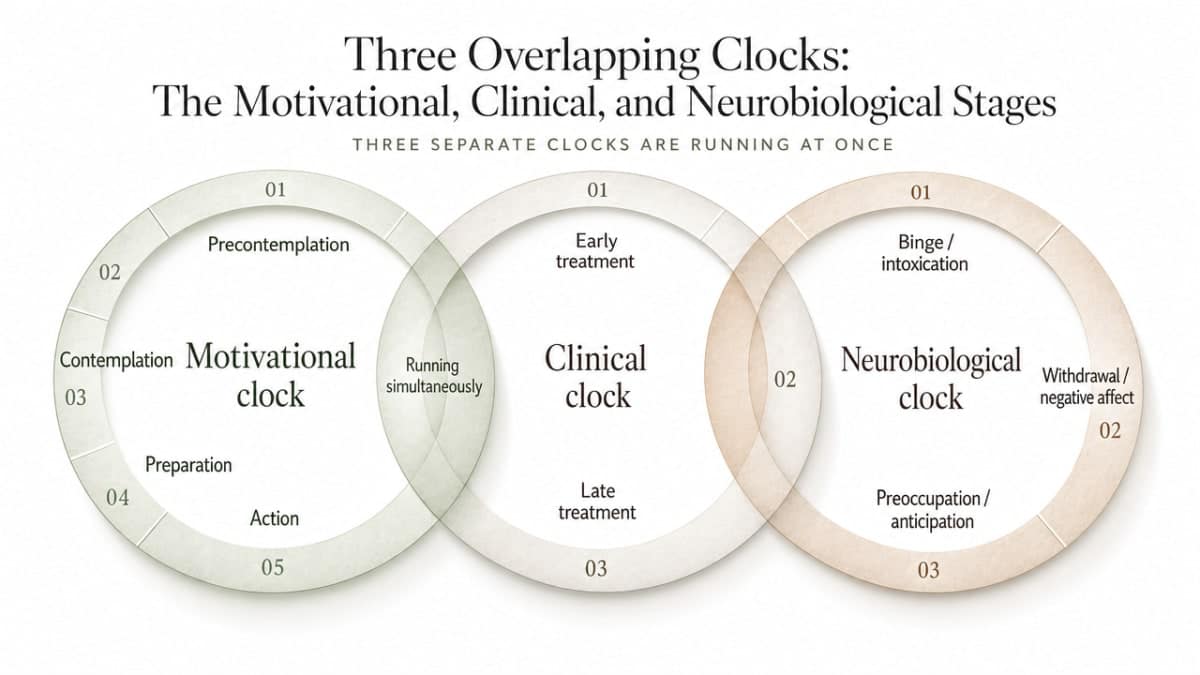
Three Overlapping Clocks: The Motivational, Clinical, and Neurobiological Stages
Why One Stage Model Isn’t Enough
Most handouts show you one list of stages and imply that if you can just identify which one you’re in, you’ll know what to do next. That’s not wrong, exactly — it’s just incomplete. The motivational stages describe what’s happening in your head. They don’t describe what’s happening in a treatment room, and they say nothing about what’s happening in your brain circuitry six weeks after your last use.
Three separate clocks are running at once. Your motivation moves through precontemplation to maintenance on one timeline 2. Your clinical work moves through early, middle, and late treatment tasks on another 8. And underneath both, your brain is cycling through binge/intoxication, withdrawal/negative affect, and preoccupation/anticipation on a third 9. When people say “I did everything right and still relapsed,” they usually mean the clocks were out of sync — the motivation was high, the treatment was stepping down, but the brain hadn’t caught up yet. Reading all three at once is how you stop being surprised by that gap.
The Five Motivational Stages, Defined for Someone Who Already Knows Them
You know the names. Here they are again, but written for someone asking a sharper question: which one am I actually in right now, and how do I tell?
- Precontemplation.
- You’re not considering change. In the stages-of-change model, this is the stage where the connection between substance use and the problems in your life hasn’t landed yet 1. If you’ve relapsed and you’re reading this, you’re almost certainly past this stage — but a partial precontemplation can sneak back in around specific behaviors (“the drinking is a problem, the weed isn’t”) even after you’ve done real work.
- Contemplation.
- You see the problem. You’re weighing change against staying the same, and the ambivalence is loud 3. This is the stage of two-column pro/con lists in your head at 2 a.m. The trap here is that contemplation can last months if nothing pushes it forward.
- Preparation.
- You’ve decided. You’re making calls, checking insurance, telling one person you trust. Preparation is where fear tends to spike — not because you don’t want change, but because the change is now real 3. Getting yourself to an assessment call is preparation-stage work. Count it.
- Action.
- You’re doing the thing — detoxing, in residential, in early outpatient. This is the most visible stage and the one people mistake for the whole of recovery. It’s also the shortest, clinically speaking.
- Maintenance.
- You’ve stabilized the behavior change and you’re working to keep it 4. The current literature defines maintenance as the stabilization stage, not the finished stage — the work is ongoing, and relapse risk lives inside it rather than after it 4.
Motivation is dynamic; it fluctuates, sometimes within the same week 3. The stages are not strictly linear. You can slip from action back to contemplation without landing in full precontemplation, and that partial regression is often what a relapse actually looks like on the motivation clock 7.
The Clinical Stages: What Early, Middle, and Late Treatment Actually Look Like
Clinically, treatment moves through three phases that don’t map cleanly onto the motivational stages — and that mismatch is worth paying attention to 8.
Early treatment is engagement and stabilization. In residential, this is the first week or two: getting through withdrawal safely, sleeping again, learning the schedule, meeting your primary counselor, and telling your story enough times that it stops feeling like performance. The clinical task is building enough trust and stability that real work becomes possible. You can be deep in action on the motivation clock and still be in early treatment on the clinical one.
Middle treatment is the actual therapeutic work. Trauma comes up here. Family patterns come up here. Co-occurring conditions — depression, anxiety, PTSD — get named and treated here instead of medicated around. This is where the reason you use, not just the fact that you use, becomes the subject of the sessions. Most of what people remember from a residential stay happens in the middle.
Late treatment is transition. Relapse prevention plans get written and rehearsed. You practice the specific conversations you’re going to have with your boss, your partner, your mother. You start attending outside meetings while still in the program. If the late-treatment phase is compressed or skipped — because insurance ends, because you feel ready, because a bed is needed — the drop-off between the structure of residential and the openness of the outside world gets steeper. That drop-off is where the action-to-maintenance transition tends to break 4.
The Brain on a Separate Clock: Why Cravings Outlast the Program
The neuroscience describes addiction as a three-stage brain cycle: binge/intoxication, withdrawal/negative affect, and preoccupation/anticipation 9. Repeated cycles change the circuits — the reward system, the stress system, and the parts of the prefrontal cortex that handle self-control and forward planning 9. Those changes don’t reverse on the schedule of a 30-day or 90-day program.
What this means, practically: months into abstinence, you can be doing everything right on the motivation clock — high commitment, good sponsor, showing up to IOP — and still get hit by a craving that feels like it came from nowhere. It didn’t come from nowhere. It came from a brain still cycling through the preoccupation/anticipation phase in response to a cue you may not have consciously registered — a song, a corner, a smell, a stretch of unstructured time on a Sunday afternoon.
Where Relapse Actually Shows Up in the Stages
Ambivalence in Contemplation, Fear in Preparation
The first two failure points are the quietest, which is part of why they get missed. In contemplation, the pressure is ambivalence — you can see the problem clearly and still not move. You hold both truths at once: the drinking is destroying your marriage, and it’s the only thing that gets you through the day. That’s not weakness. That’s the defining feature of the stage 3. The trap is that contemplation has no built-in ending. It can run for months, and each week you stay in it, the reasons to postpone the call feel a little more reasonable.
Preparation looks like progress from the outside, and often is — but the failure mode here isn’t backsliding. It’s the fear that shows up the moment change becomes concrete 3. You have the admission date. You told your boss. Now the actual leaving of your house feels impossible. What tends to break the plan in preparation isn’t a change of heart; it’s an unaddressed logistical or emotional gap — the kid’s schedule, the pet, the shame of the phone call to your mother — that no one asked you about at intake. Name those out loud with someone before the date, not on the drive there.
The Action-to-Maintenance Cliff
The single most common place for relapse to show up in someone with prior treatment experience is the handoff from action to maintenance 4. Inside residential, action is loud and structured — you have a schedule, meals, a counselor, a hallway of people who know why you’re there. Then you leave. The schedule loosens. The hallway is empty. The clinical task shifts from initiating change to stabilizing it, and stabilization is quieter, longer, and harder to feel good about 4.
The transition from action to maintenance is where residential graduates most often stumble, and it’s usually not because they stopped caring. It’s because the intensity of support dropped faster than the brain and the daily life could adjust. Two specific patterns show up over and over:
- First, the compression of late-stage clinical work — the transition planning, the rehearsed conversations, the outside meetings started while still in the program — because insurance ended or a bed was needed.
- Second, a maintenance stage designed around willpower instead of scaffolding, so the first hard week has nothing to catch it.
Both are addressable, but only if you plan for them before discharge, not after.
Relapse as a Data Point, Not a Verdict
The older framing treated relapse as evidence that treatment failed or that you weren’t serious enough. The current clinical literature treats it as a learning event inside the maintenance stage — information about which cues, which stretches of the week, and which unaddressed conditions the last plan didn’t account for 7. That reframe is not soft; it’s specific. It asks you to look at the return to use the way a clinician would look at a lab result: what does this tell us about what needs to change in the next plan?
Reading a relapse this way requires two things you may not have done last time:
- Get specific about the sequence — the day, the mood, the trigger, the thought, the action — not the guilt narrative.
- Treat what you learn as clinical data that reshapes the level of care you re-enter, the co-occurring conditions you treat, and the continuing-care scaffolding you build 5, 7.
A relapse handled this way doesn’t erase the work you’ve done. It updates it. That’s a different starting point than shame, and it’s the one the evidence actually supports.
Matching the Next Stage of Care to the Stage You’re Actually In
Why Residential Is Often the Right Re-Entry Point After a Relapse
If you’ve relapsed after a prior stay, the instinct to “just do outpatient this time” is understandable — you don’t want to disrupt your life again, and part of you may believe you already know the material. That instinct isn’t wrong, but it isn’t the whole picture either. The evidence base for adult substance use treatment points to residential-level care specifically when there’s significant functional impairment or a clear need for 24-hour support 12 — and a recent return to use, especially one that surfaced untreated co-occurring conditions, tends to meet that bar.
Here’s the stage-matching logic. On the motivation clock, you’re likely somewhere between preparation and action. On the clinical clock, you have to start over in early treatment — engagement and stabilization — regardless of how much you remember from last time 8. On the brain clock, the circuits are cycling again, and outpatient alone often can’t create enough distance from the cues that pulled you back 9. Residential compresses those three clocks into one setting so they can catch up to each other.
The other case for residential re-entry is co-occurring conditions. Depression, anxiety, PTSD, and trauma histories are commonly what the first stay didn’t fully treat — and untreated co-occurring conditions are one of the most reliable predictors of return to use 12. A 24/7 setting lets those diagnoses get named and worked on in parallel with the substance use, rather than treated as afterthoughts around an outpatient schedule. That parallel work is the piece most likely to change the outcome the second time.
Where MAT Fits Across the Stages
Medication-assisted treatment isn’t a separate stage — it’s a tool that runs alongside them. For opioid or alcohol use disorder, MAT is designed to move with you: induction happens in early treatment, stabilization carries through the action stage, and a maintenance phase supports the long stretch of behavioral maintenance that follows 13. The medication doesn’t replace the therapeutic work. It reduces the biological pressure so the therapeutic work can actually land.
If you’re relapse-experienced, the stage question worth asking is whether the last plan asked willpower to do a job that medication was better equipped to do. In an opioid or alcohol context, entering residential without a MAT conversation on the table is worth pushing back on. The clinical intent of a maintenance phase in MAT is to stabilize the patient and support recovery goals over the long term 13 — meaning it’s built for exactly the stretch where residential graduates most often stumble.
The stigma question is real. Some recovery communities frame MAT as not “true” recovery 13. That framing is worth naming so you can decide about it with clear eyes rather than absorb it by default.
Building the Continuing-Care Scaffolding Before You Leave
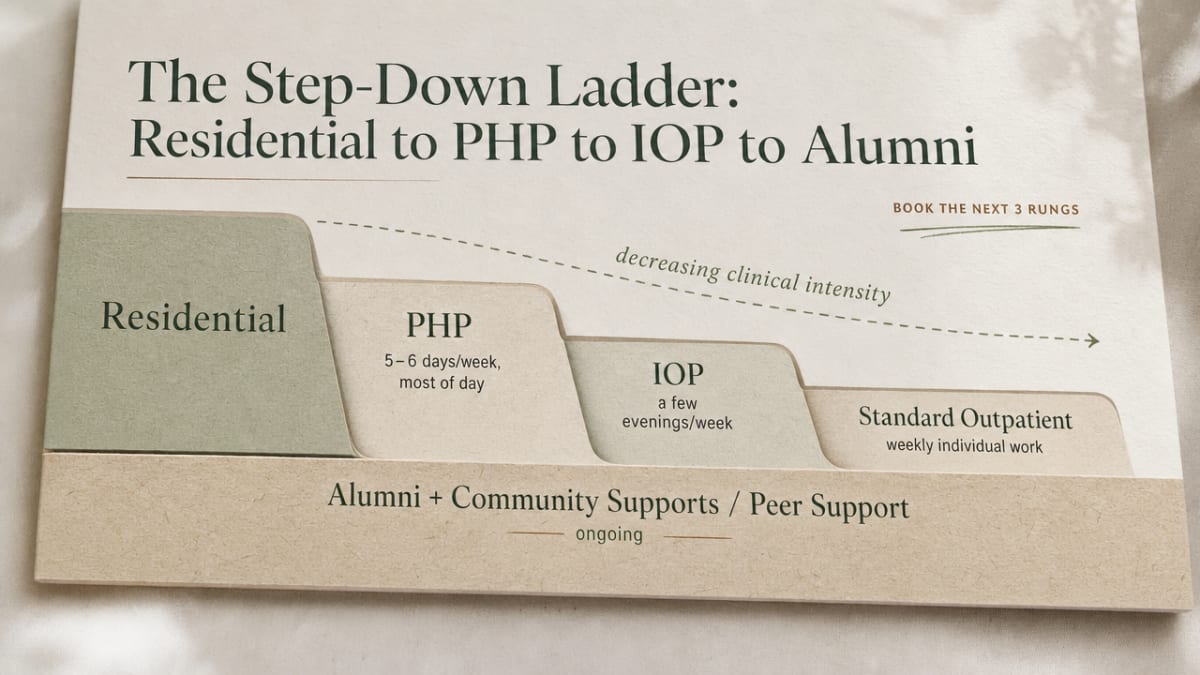
The Step-Down Ladder: Residential to PHP to IOP to Alumni
The single most useful thing you can do inside residential — after the trauma work, after the medication conversation, after the family session — is refuse to leave without the next three rungs of the ladder already booked. Not discussed. Booked.
The step-down ladder is not decorative. It goes residential → partial hospitalization (PHP) → intensive outpatient (IOP) → standard outpatient → alumni and community supports, and each rung is designed to lower the intensity of clinical structure gradually enough that your brain, your motivation, and your daily life can stay in rough sync. PHP typically runs five to six days a week with most of the day in programming; IOP drops to a few evenings a week; outpatient becomes weekly individual work. The alumni and peer-support layer runs alongside all of it and doesn’t end.
Recovery Management and ROSC: What Changes the Odds the Second Time
If the last stay treated recovery as an event — 30 or 90 days, then discharge, then hope — the shift worth making this time is toward recovery management as a long-run practice. The clinical model treats substance use disorders more like other chronic conditions: monitored over time, with scheduled check-ins that catch drift early rather than waiting for a full return to use to force another admission. Recovery management checkups are one version of that structure, and the continuing-care literature ties sustained involvement in them to better long-term outcomes 10.
The recovery-oriented systems of care framework goes further. It defines recovery as something held up by networks of formal and informal services — clinical care, peer support, recovery housing, employment help, family and community relationships — that support recovery over time rather than for the length of a program 11. Practically, that means the second-time plan looks less like “finish treatment and rejoin normal life” and more like a standing set of connections: a therapist, a MAT prescriber if that applies, a peer or sponsor, an alumni group, and one or two people who know your relapse-warning signs by name. Build that scaffolding before the residential door closes behind you, and you change the terrain the next hard week has to land on.
A Stage-Aware Plan for the Next 90 Days
If you take one thing from this, take the habit of reading your week against all three clocks at once. Motivation, clinical work, and brain repair each move at their own pace 2, 8, 9. A plan that respects that mismatch is more forgiving than one built on a single calendar.
For the next 90 days, try three concrete moves:
- Name the stage you’re actually in on the motivation clock this week, not the one you want to be in 3.
- Book the next two rungs of clinical care before the current one ends — a PHP or IOP seat, a therapist, a MAT check-in if that applies — so the step-down doesn’t become a step-off 4, 13.
- Put two people on standby who know your relapse-warning signs by name, and schedule the first recovery management check-in on the calendar now 10, 11.
If a return to use happens, treat it as data for the next plan, not a verdict on this one 7. That’s what the evidence supports, and it’s the starting point Elk Ridge Recovery works from.
Ready to Take the Next Step Forward?
Speak directly with a recovery professional about your path through the stages of addiction recovery.
Frequently Asked Questions
If I’ve relapsed, do I have to start over at precontemplation?
No. A return to use usually looks like a slip back from action to contemplation on the motivation clock, not a full reset to precontemplation 7. You still see the problem — that’s the definition of contemplation, and it’s already past denial 1. The clinical work restarts in early treatment, but your motivational starting point is further along than it was the first time 5.
How do I know if I need residential care again or if outpatient is enough?
Two questions matter most. First, is there significant functional impairment or a need for 24-hour support to interrupt the cycle? Second, are there untreated co-occurring conditions the last plan didn’t fully address? The evidence base points to residential-level care when either is true 12. If your recent use surfaced depression, PTSD, or anxiety you’d been managing around, that’s a signal residential re-entry fits the stage you’re in.
Why do cravings still hit hard months after I stopped using?
Because the brain runs on a slower clock than the calendar. Repeated substance use reshapes the reward and stress circuits and the prefrontal areas that handle self-control, and those changes cycle through preoccupation and anticipation long after abstinence begins 9. A craving at month four isn’t evidence that treatment failed or that you weren’t serious. It’s evidence the brain is still repairing on its own timeline.
Where in the stages does relapse most often happen?
The action-to-maintenance handoff is the tallest bar on the risk map. The clinical task shifts from initiating change to stabilizing it, and stabilization is quieter and longer than the visible work of early recovery 4. Isolation and complacency inside maintenance follow close behind. Earlier in the process, ambivalence stalls people in contemplation and fear disrupts preparation 3, but the post-residential drop-off is the most common failure point.
Does medication-assisted treatment fit if I’m trying to stay abstinent long-term?
Yes, and the stage logic supports it. MAT is designed to move with you — induction in early treatment, stabilization through action, and a maintenance phase built to stabilize the patient and support recovery goals over the long term 13. It reduces the biological pressure so the therapeutic work can land. Some abstinence-oriented communities question whether MAT counts as true recovery 13; that stigma is worth naming rather than absorbing.
What should continuing care actually look like after I leave residential?
Confirmed appointments, not phone numbers. A step-down ladder from residential to PHP to IOP to outpatient, with alumni and peer support running alongside — sustained involvement in continuing care and recovery management checkups is associated with improved long-term outcomes 10. The recovery-oriented systems of care framework adds the informal layer: peer support, housing, employment, and community ties that hold recovery up over time 11.
References
- Figure 2-1: The Stages of Change – Brief Interventions for Substance Use: A Manual for Use in Primary Care. https://www.ncbi.nlm.nih.gov/books/NBK64942/table/A61041/
- Stages of Change Theory – StatPearls. https://www.ncbi.nlm.nih.gov/books/NBK556005/
- Chapter 1—A New Look at Motivation – Enhancing Motivation for Change in Substance Use Disorder Treatment. https://www.ncbi.nlm.nih.gov/books/NBK571073/
- Chapter 7—From Action to Maintenance: Stabilizing Change – Enhancing Motivation for Change in Substance Use Disorder Treatment. https://www.ncbi.nlm.nih.gov/books/NBK571075/
- Stages of Change in the Recovery Process: Clinical Implications. https://pmc.ncbi.nlm.nih.gov/articles/PMC3968940/
- A stage of change approach to addiction in the medical setting. https://pubmed.ncbi.nlm.nih.gov/9788026/
- Relapse on the Road to Recovery: Learning the Lessons of Failure. https://pmc.ncbi.nlm.nih.gov/articles/PMC9014843/
- 5 Stages of Treatment – Substance Abuse Treatment: Group Therapy. https://www.ncbi.nlm.nih.gov/books/NBK64208/
- Neuroscience: The Brain in Addiction and Recovery. https://www.niaaa.nih.gov/health-professionals-communities/core-resource-on-alcohol/neuroscience-brain-addiction-and-recovery
- Continuing Care and Recovery Management for Substance Use Disorders. https://www.ncbi.nlm.nih.gov/books/NBK425757/
- Recovery-Oriented Systems of Care (ROSC). https://www.ncbi.nlm.nih.gov/books/NBK92054/
- Substance Use Treatment for Adults – Evidence-Based Practices. https://www.ncbi.nlm.nih.gov/books/NBK144075/
- Medication-Assisted Treatment and the Recovery Process. https://www.ncbi.nlm.nih.gov/books/NBK424857/