Wilderness Treatment Center in MT: A Complete Guide
Key Takeaways
- The Wilderness Treatment Center in Marion serves males ages 14 to 24 only, so adults searching for care in Montana need a different category of licensed residential program.
- Wilderness therapy research applies mostly to adolescents 15; adults with substance use disorder typically need nature-integrated residential SUD care with medical management and MAT access.
- Verify any Montana program by asking for its DPHHS OIG facility license 4, ASAM level, Medicaid approval under Rule 37.27.902 3, and how MAT is handled 6.
- Before calling, write down the license, ASAM level with prior authorization up to 90 days 6, and MAT logistics, then work through Montana programs until one clinically fits the adult you’re calling about.
What people actually mean when they search for a wilderness treatment center in Montana
If you typed “wilderness treatment center mt” into a search bar tonight, you’re probably not researching a therapeutic model. You’re trying to find help for someone you love, or for yourself, and you’ve heard the phrase from a friend, a counselor, or a late-night article. Take a breath. You’re doing something hard, and you’re doing it anyway.
Here’s what usually sits behind that search. Most people are looking for one of two things, and it helps to know which one. The first is the actual Wilderness Treatment Center in Marion, Montana, a specific 60-day inpatient program for males ages 14 to 24. It’s a real place with a long history, and we’ll walk through it honestly in the next section. The second thing people mean is broader: residential addiction treatment somewhere in Montana that uses the outdoors as part of healing, for an adult, close enough to home that visits are possible.
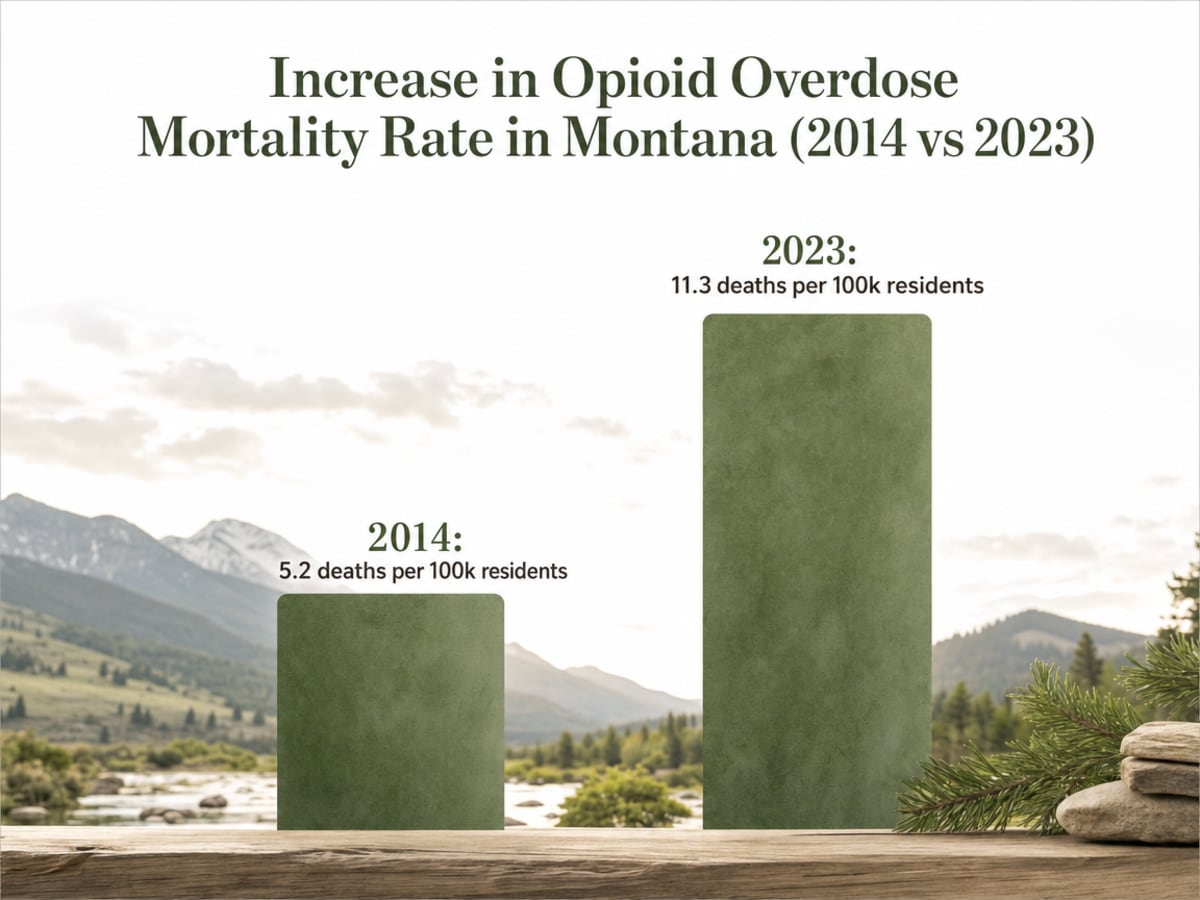
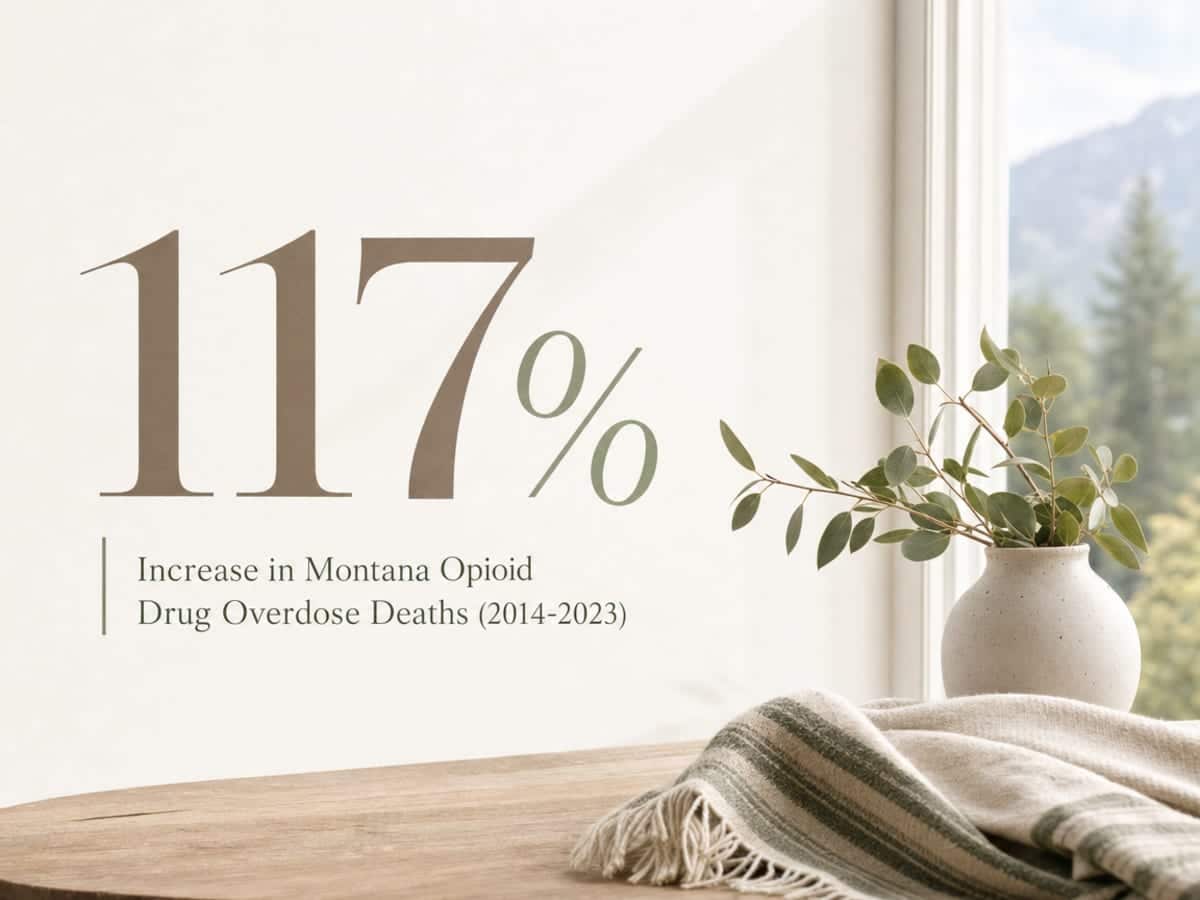
Those two things are not the same, and confusing them costs families weeks they don’t have. Montana’s opioid overdose mortality rate climbed from 5.2 deaths per 100,000 residents in 2014 to 11.3 in 2023, a 117% increase over that decade 8. That’s the reason the search feels urgent. That’s why you’re up reading this.
This guide does three things. It explains what the Marion program actually is and who it fits. It separates wilderness therapy (a specific intervention studied mostly in teenagers) from nature-integrated residential care for adults. And it walks you through what Montana law requires of any licensed residential facility, so you know what to ask before anyone signs a form.
The Wilderness Treatment Center in Marion: what it is, who it serves
Let’s clear this up early, because it matters. The Wilderness Treatment Center in Marion, Montana, is a residential chemical dependency program built specifically for adolescent and young adult males, ages 14 to 24. It runs about 60 days and pairs a traditional inpatient stay with a structured wilderness expedition in the backcountry. If you’re the parent of a 17-year-old son whose life has come off the rails, this is the program most people are pointing at when they say “send him to wilderness.”
That doesn’t mean the Marion program is doing anything wrong. It means it has a defined scope. Adolescent males, family involvement, extended time outdoors, sober-peer group dynamics, longer length of stay than most adult inpatient stays. It fits into what Montana’s Department of Public Health and Human Services calls its adult behavioral health continuum only tangentially, because most of its beds are, by design, not for adults 12.
So if you searched “wilderness treatment center mt” tonight and you’re looking for care for yourself or another adult, you have not failed. You’ve just landed on the name of one specific youth program. What you actually need is a different category of care, and the rest of this guide walks you into it.
Wilderness therapy vs. nature-integrated residential care: two different things
What the adolescent wilderness-therapy evidence actually shows
When you read about “wilderness therapy working,” almost every study behind that phrase looked at teenagers. That matters, and it’s worth slowing down on.
A 2016 evaluation of wilderness adventure therapy found a small but statistically significant short-term effect on youth mental health overall, with moderate improvements in psychological resilience and social self-esteem. Among youth who scored in clinical ranges before the program, researchers saw large reductions in depressive symptoms and behavioral and emotional problems, and those gains were largely retained at a three-month follow-up 15. A 2020 pilot study of trauma-informed wilderness therapy reported improvements in adolescents’ psychological and family functioning that caregivers still noticed after the program ended 14. A 2025 study added that when caregivers actually participated in the family portion of the program, their adolescent’s mental health outcomes were meaningfully better 13.
That’s genuinely encouraging if you’re a parent. It’s also important to say plainly what these studies did not measure. A 2022 mixed-methods systematic review pointed out that the evidence base on wilderness therapy for youth at risk is still emerging, uneven in quality, and thin on long-term outcomes 16. None of these studies followed adults with substance use disorder. None of them tested a 45-year-old walking through opioid withdrawal. If someone hands you an adolescent outcomes chart and implies it applies to your husband, that’s a stretch the researchers themselves would not make.
Why adults typically need nature-integrated residential SUD care instead
Adults come into residential treatment carrying a different weight. Fentanyl tolerance. Withdrawal that needs medical management. A job to protect. Kids at home. Chronic pain, maybe. A co-occurring mental health condition that has been showing up for twenty years. That clinical picture calls for something the wilderness-therapy model was never designed to deliver: licensed inpatient care with 24-hour medical support, medication access, structured therapy, and a discharge plan that lands you back in your actual life.
What the Montana landscape can honestly add for adults is environment, not intervention. Nature-integrated residential care means a licensed facility where hiking, fishing, group walks, and time outside are woven into a clinical week that still runs on individual therapy, group therapy, medication management, and case management. The outdoors becomes the setting where you sleep better, eat better, and start feeling like a person again. It is not the treatment itself.
Montana’s Department of Public Health and Human Services frames residential care as one rung on an adult behavioral health continuum, meant to place you in the least restrictive setting that actually meets your needs 12. For most adults with a substance use disorder, that rung is a licensed residential SUD facility, sometimes stepping down into partial hospitalization and outpatient care, not a backcountry expedition.
What Montana requires of a licensed residential SUD facility
Here’s where you get to stop guessing. Montana has actual rules for what counts as a licensed residential substance use disorder facility, and once you know them, you can tell the difference between a real program and a website with pretty photos in about ten minutes.
Two agencies are involved. The Department of Public Health and Human Services (DPHHS) Office of Inspector General handles the health care facility license itself, and any SUD facility in Montana has to obtain that OIG license before it can even apply for state program approval 4. From there, the facility has to meet the licensing standards for SUD facilities, which cover staffing, services, quality assurance, admissions, and safety planning 5. Those same rules require a licensed facility to admit only people it can actually serve, and to help refer you elsewhere when it cannot 5. If a program tells you it can treat anyone with anything, that’s not a green flag. That’s a red one.
If the facility bills Montana Medicaid, a second layer applies. The BHDD Medicaid Services Provider Manual is incorporated by reference into Montana Administrative Rule 37.27.902, which sets the authorization requirements for SUD services under Medicaid 2, 3. Residential care in that framework sits at ASAM Level 3.1, clinically managed low-intensity residential care. Prior authorization is required, and it can be issued for as many days as deemed medically necessary, up to 90 days 6. That number matters when you’re planning your leave from work or arranging childcare.
There’s a piece coming that changes the map for anyone with opioid use disorder. DPHHS has signaled that residential providers who do not offer medication-assisted treatment on site will be required to facilitate off-site access, with updated rulemaking and policies to follow 6. Translation: a Montana residential program cannot ethically hand you a bed and ignore that buprenorphine or methadone might be the thing keeping you alive. When you call, ask directly how MAT is handled. You have every right to that answer.
One more thing worth clearing up so you don’t get pointed toward the wrong door. A recovery residence, sometimes called a sober living home, is not the same as licensed inpatient treatment. Senate Bill 94 (2023) requires all alcohol and drug recovery homes in Montana to register with DPHHS, and the department recognizes certifications through the Recovery Residence Alliance of Montana and the National Sober Living Association 7. Those homes have their place, usually after treatment. They are not a substitute for a licensed SUD facility with 24-hour clinical staff.
Write these down before your next call: Is the program licensed by DPHHS OIG as a SUD facility? Is it approved to bill Montana Medicaid, and does it operate at ASAM Level 3.1 or higher? How is MAT provided or coordinated? Five questions. That’s the filter.
Who is actually walking into Montana residential care right now
If you picture the person most likely to sit across from an intake counselor at a Montana residential program this month, the image has changed. It is not the stereotype from a 1990s public service announcement. It is a 34-year-old ranch hand who started using opioids after a shoulder surgery. A 47-year-old mother whose drinking got quietly worse through the pandemic and never eased up. A 29-year-old veteran from a reservation community who has been white-knuckling fentanyl withdrawal alone in a truck cab.
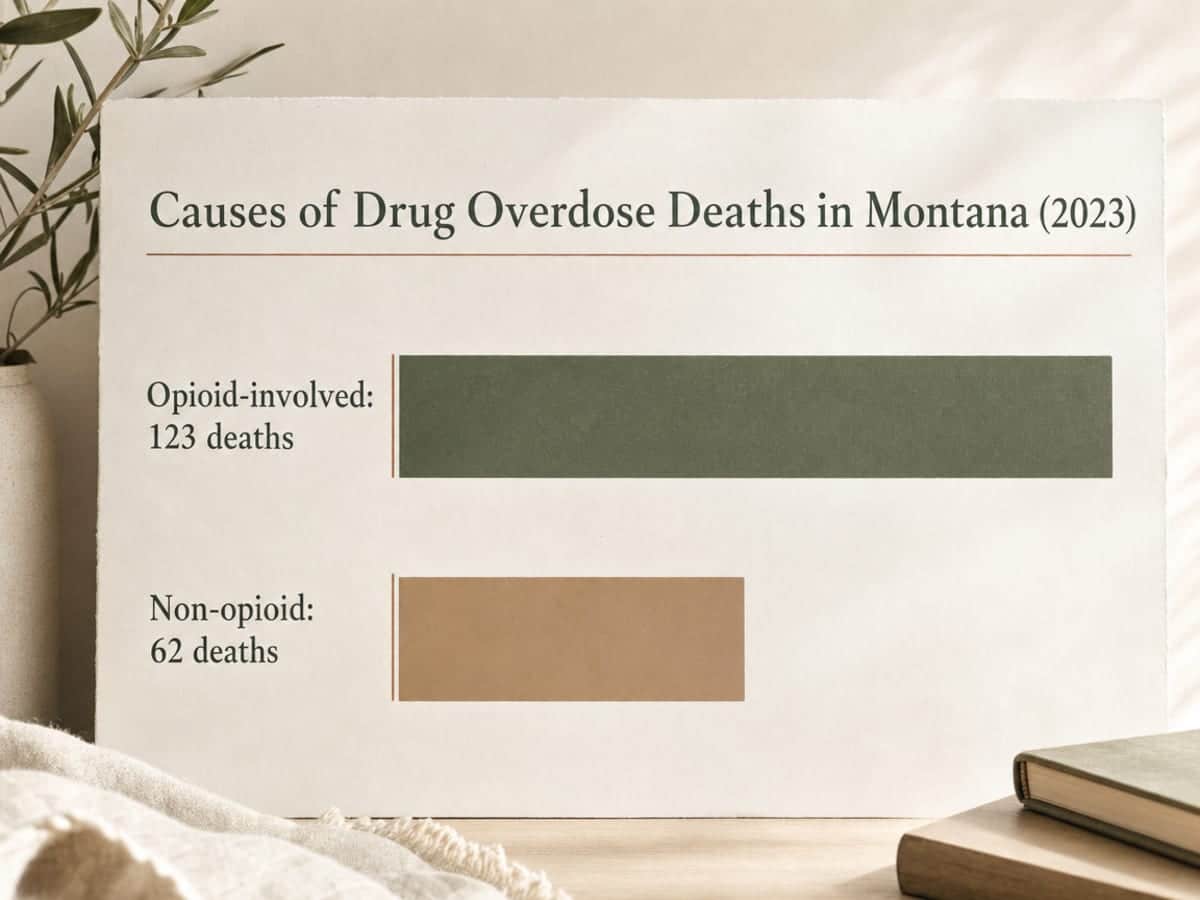
The numbers tell you where the pressure is. In 2023, 185 Montanans died from drug overdoses. Of those deaths, 123 involved opioids, and 62 did not 9. That two-to-one split matters when you are trying to understand who is walking through the door of a residential facility. Roughly two out of every three adult deaths involved an opioid, and across the longer 2020 to 2024 window, fentanyl was the drug most often behind those opioid deaths 10. Alcohol use disorder is still there. Methamphetamine is still there. But fentanyl has changed what medical staff have to be ready for on day one.
What that means practically for you or the person you love: the adult now most likely to benefit from residential care is someone who needs medical monitoring through withdrawal, honest access to medication-assisted treatment, dual-diagnosis support for anxiety or depression or trauma, and enough time in a stable setting to actually start sleeping again. If a program you are considering describes its typical client as a teenager acting out, or cannot tell you clearly how it manages a fentanyl withdrawal, you are looking at the wrong door. You deserve a program built for the person actually showing up in 2025.
System pressure: why residential capacity in Montana is stretched
Behind every open bed in a Montana residential program sits a much larger wave of people the system never gets to see in time. In 2023, Montana emergency medical services responded to 969 opioid overdose 911 calls, an average of 81 per month. That’s roughly one EMS overdose response every nine hours somewhere in the state, and the Governor’s office paired that number with a $400,000 investment specifically aimed at the fentanyl and opioid crisis 11. That funding is real, and it is small next to what the numbers are asking of the system.
What that pressure looks like on the ground, if you’re the one calling: waitlists in some parts of the state, intake coordinators who cannot pick up on the first try, and a shortage of licensed beds that can medically manage a fentanyl-era withdrawal. Montana is a big state with a small population spread across long distances, and the licensed residential facilities you can actually get into on short notice are not evenly distributed. If you live outside the Missoula, Billings, Great Falls, or Bozeman corridors, you may already know this.
None of that is your fault, and none of it means you should stop calling. It means two practical things. First, when a program says a bed is available, ask how soon and hold onto the slot while you sort logistics. Second, be ready to describe the person clearly on the first call: substances used, last use, withdrawal history, insurance, and whether children or work leave need coordinating. Clear information moves you up the list faster than a second call ever will.
The honest safety conversation most guides skip
Here’s the part most guides tiptoe around. You deserve it straight. Residential and wilderness programs for young people have a documented history of harm, and any adult program using the wilderness label sits in the shadow of that record. A U.S. Government Accountability Office review of youth residential programs, including wilderness therapy, boot camps, and therapeutic academies, found that in 2005 alone, 33 states reported 1,619 staff members involved in abuse incidents in these settings. Of ten closed cases GAO examined in depth, all involved the deaths of young people, and investigators tied those deaths to ineffective management, untrained staff, and reckless or negligent operating practices 17. That review covered 1990 through 2007 and focused on youth programs, not adult residential SUD care. But the pattern it exposed is the reason “wilderness” as a treatment word still needs scrutiny.
What that means for you, right now, is not that you should be afraid of every program with trees in the photos. It means you should ask specific questions and expect specific answers. Is the facility licensed by DPHHS OIG as a substance use disorder facility 4? Does it meet the state’s rules on staffing, admissions, and quality assurance 5? Are clinical staff actually credentialed, and is there 24-hour nursing coverage? Who is on call when someone in the program has a medical crisis at 2 a.m.? A program that answers those questions without hesitation is a program that has already done the work. One that gets defensive is telling you something too.
How to evaluate a Montana residential program before you commit
Questions that separate a licensed program from a marketing website
A polished website is not a license. Before you sign anything, get these answers, ideally in writing or in a follow-up email you can save.
Ask for the DPHHS OIG facility license number for the substance use disorder facility and confirm it is current 4. Ask which ASAM level of care the program operates at, and whether it is approved to bill Montana Medicaid under the BHDD Medicaid Services Provider Manual and Rule 37.27.902 2, 3. Ask how long prior authorization typically runs for ASAM Level 3.1 admissions, since Medicaid can authorize up to 90 days when medically necessary 6. That single number tells you whether the program is planning for a real stay or a short one.
Then get into the clinical detail. Who prescribes medication-assisted treatment, and if it isn’t on site, exactly how do they arrange it 6? What are the credentials of the counselors and nurses on shift overnight? How do admissions decisions actually work, given that state rules require a licensed facility to admit only those it can appropriately serve and to refer out when it cannot 5?
A program that answers plainly is a program that has already been audited on these points. A program that dodges is telling you what the next six weeks would feel like.
Rural access, transportation, and staying close to home
If you live in Libby, Lewistown, or a reservation community two hours from the nearest highway exit with a hospital, the phrase “close to home” carries real weight. It means your kids can visit on a Saturday. It means your spouse doesn’t have to fly. It means the case manager arranging your discharge understands the town you’re going back to.
When you call a program, ask how admissions handles transportation for someone coming from your county. Some facilities coordinate sober transport or help arrange a ride from a bus station or small regional airport. Ask whether family therapy can happen by video when a five-hour drive isn’t possible mid-week, and whether visiting hours actually work around ranch schedules or shift work.
Ask, too, about the discharge plan before admission. DPHHS frames residential care as one step on an adult continuum meant to land you in the least restrictive setting that meets your needs 12. That step-down only works if the program knows who in your county can pick up outpatient care, prescribe MAT, and support you at month three. If nobody at intake can name a provider near where you actually live, you have not found your program yet. Keep calling.
Making the next call
You’ve read a lot. That counts. If the person you love is still in the next room, or still not answering their phone, the work now is small and specific: pick up something to write with, and get three things on paper before you dial.
Write the name of the DPHHS Office of Inspector General SUD facility license you’re going to ask about 4. Write the ASAM level (3.1 or higher) and the words “prior authorization up to 90 days” so you don’t forget to ask 6. Write down how MAT is handled on site or arranged off site 6. That’s your call sheet.
You are not late. You are here. Programs like Elk Ridge Recovery exist in Montana for exactly the adult you are calling about. Make the call. Then make the next one if the first door doesn’t fit. That’s how this actually starts.
Talk With an Admissions Specialist About Next Steps
Get clear answers on admission, insurance, and starting care in Montana’s supportive recovery environment.
Frequently Asked Questions
Is the Wilderness Treatment Center in Marion, MT open to adults?
No. The Wilderness Treatment Center in Marion is a 60-day residential chemical dependency program for males ages 14 to 24. If you’re an adult, or you’re calling for one, that specific program is not built for you. What you’re actually looking for is a licensed adult residential SUD facility in Montana that meets the state’s admission standards for the person in front of you 5.
What’s the difference between wilderness therapy and nature-integrated residential SUD treatment?
Wilderness therapy is a specific intervention model, studied mostly in adolescents, where the backcountry experience itself is the treatment 15. Nature-integrated residential care is different: a licensed adult inpatient facility where hiking, fishing, and time outside are woven into a clinical week that still runs on individual therapy, group therapy, medication management, and case management. For adults with substance use disorder, the second category is almost always what fits.
How do I confirm a Montana residential program is actually licensed?
Ask for the DPHHS Office of Inspector General health care facility license for the substance use disorder facility, and confirm it’s current 4. If the program bills Medicaid, ask whether it’s approved under the BHDD Medicaid Services Provider Manual and Rule 37.27.902, and at which ASAM level of care 2, 3. A licensed program will answer these questions without hesitation. A defensive answer is your answer.
Will Montana Medicaid cover residential substance use treatment?
Yes, for approved facilities. ASAM Level 3.1 clinically managed low-intensity residential care requires prior authorization and can be issued for as many days as deemed medically necessary, up to 90 days 6. When you call, ask the intake coordinator to walk you through the prior authorization step and whether they’ll handle it directly with your Medicaid plan. That’s a normal, reasonable question.
Is a recovery residence the same as licensed inpatient treatment?
No, and this trips a lot of families up. Recovery residences, sometimes called sober living homes, are supportive housing environments. Since Senate Bill 94 passed in 2023, all Montana alcohol and drug recovery homes must register with DPHHS, and the department recognizes certifications through RRAM and the National Sober Living Association 7. They usually come after treatment, not instead of it. Licensed inpatient care has 24-hour clinical staff and medical support.
What safety questions should I ask before admitting a loved one?
Ask specifics. Federal reviewers have documented serious abuse and deaths in youth residential and wilderness programs, tied to poor management and untrained staff 17. That history is why detail matters. Confirm the DPHHS OIG license 4, ask who provides overnight nursing and clinical coverage, ask how medical emergencies at 2 a.m. are handled, and ask how the program admits only those it can appropriately serve 5. Clear answers mean prepared programs.
References
- Policy 002: Definitions. https://dphhs.mt.gov/assets/BHDD/SubstanceAbuse/002Definitions824.pdf
- Adult Behavioral Health and Substance Use Disorder Provider Manuals and Program Resources. https://dphhs.mt.gov/BHDD/SubstanceAbuse/ProviderManualsandProgramResources
- Mont. Admin. r. 37.27.902 – Substance Use Disorder Services: Authorization Requirements. https://www.law.cornell.edu/regulations/montana/Mont-Admin-r-37.27.902
- Substance Use Disorder Facility. https://dphhs.mt.gov/oig/licensure/healthcarefacilitylicensure/lbfacilityapplications/lbsubstanceusedisorderfacility
- Rules for Substance use Disorder Facility. https://dphhs.mt.gov/assets/oig/Rules_for_Substance_use_Disorder_Facility.pdf
- Montana HEART Demonstration – Community-Based Acute Care Services. https://www.medicaid.gov/sites/default/files/2022-07/mt-heart-demo-ca.pdf
- DPHHS Updates to Criminal Justice Oversight Committee (July 23, 2025). https://archive.legmt.gov/content/Committees/Interim/2025-2026/CJOC/July-2025/CJOC_DPHHS-Updates-7.23.2025.pdf
- Drug Overdose Deaths in Montana 2014–2023. https://dphhs.mt.gov/assets/publichealth/EMSTS/Data/DrugOverdoseDeaths_2014-2023.pdf
- Opioid Use in Montana. https://dphhs.mt.gov/assets/publichealth/EMSTS/Data/Opioids_1pager.pdf
- Summary of Opioid Use in Montana. https://dphhs.mt.gov/assets/publichealth/EMSTS/Data/Opioid_Drug_Use_Summary.pdf
- Governor Gianforte Announces $400,000 Investment in Response to Fentanyl, Opioid Crisis. https://news.mt.gov/Governors-Office/Governor_Gianforte_Announces_400000_Investment_in_Response_to_Fentanyl_Opioid_Crisis
- Adult Behavioral Health Continuum of Care. https://dphhs.mt.gov/assets/FutureGenerations/AdultBehavioralHealthCommissionDeck03-28-2024.pdf
- Does Caregiver Engagement Predict Outcomes of Adolescent Wilderness Therapy?. https://pmc.ncbi.nlm.nih.gov/articles/PMC11761905/
- The Effectiveness of Trauma-Informed Wilderness Therapy for Adolescents. https://pubmed.ncbi.nlm.nih.gov/32496098/
- Wilderness Adventure Therapy Effects on the Mental Health of Youth at Risk. https://pubmed.ncbi.nlm.nih.gov/27311098/
- The Effectiveness of Wilderness Therapy and Adventure Learning on Youth at Risk of Offending. https://pmc.ncbi.nlm.nih.gov/articles/PMC9428765/
- Residential Treatment Programs: Concerns Regarding Abuse and Death. https://www.ojp.gov/ncjrs/virtual-library/abstracts/residential-treatment-programs-concerns-regarding-abuse-and-death