Key Takeaways
- Gender composition alone does not reliably predict treatment outcomes; what matters is whether care is individualized, trauma-aware, and long enough to hold 1, 2.
- Women-only settings show clear advantages in trauma symptom reduction, treatment completion, and maintaining gains after discharge, especially when wraparound services are included 8, 12, 5.
- Arrest rates, employment, and one-year abstinence measures often come out comparable between women-only and mixed-gender programs when treatment quality is similar 4, 2.
- Women carrying active PTSD, high psychiatric symptom load, or a history of harm involving men should weight women-focused or heavily gender-responsive care more heavily 3, 7.
- Gender-responsive components like trauma-informed groups, parenting support, and integrated dual diagnosis care can live inside either co-ed or women-only programs, so evaluate components over labels 9, 11.
The question that actually matters
If you are reading this, you are already doing something hard. You are trying to make a serious decision about treatment while addiction is loud in your life or in your family’s life. That takes something. Give yourself credit for it.
Here is the honest truth about co-ed versus women’s-only rehab: the way most articles frame this choice is not the way clinicians actually think about it. The debate is often sold to you as a loyalty test. Women-only equals safe. Co-ed equals compromised. Or the reverse, depending on who is writing.
The research does not back that up. Large reviews of substance use treatment outcomes find that gender alone does not reliably predict how someone does in care 1. What predicts outcomes is whether the program is built around your actual needs, whether it treats trauma when trauma is present, and whether you stay long enough for the work to hold 2.
That means the better question is not which model wins. The better question is: does this specific program match what you are carrying in, and does it tailor care accordingly?
This guide walks you through what the evidence shows, where women-only settings genuinely pull ahead, where both models match, and how to read your own situation clearly enough to choose well.
What the research says when you strip away the marketing
Where outcomes match: substance use, arrests, employment
Start with the part that surprises people. When you compare women in women-only programs to women in mixed-gender programs, several of the biggest life-outcome measures come out roughly even.
A comparative study of women in women-only and mixed-gender substance abuse treatment found no significant differences between the two groups in arrest rates or employment status at follow-up 4. Both models moved women forward on those measures. Neither one had a clear edge.
The broader literature backs this up. Clinician guidance from SAMHSA’s TIP 51 reaches the same place: women and men have similar abstinence and quality-of-life outcomes one year after discharge when the treatment they receive is comparable 2.
That is a big deal for how you should read this decision. It means you are not choosing between a program that works and one that does not. You are choosing between two models that can both get someone to the other side of active addiction, especially on the outcomes most families care about long-term: staying alive, staying out of jail, getting back to work, holding a life together.
So when a marketing page tells you one model is objectively superior across the board, that is not what the research shows. The differences are real, but they live in specific places. That is where to look next.
Where women-only settings pull ahead: trauma, engagement, staying power
The differences are real. They just are not everywhere.
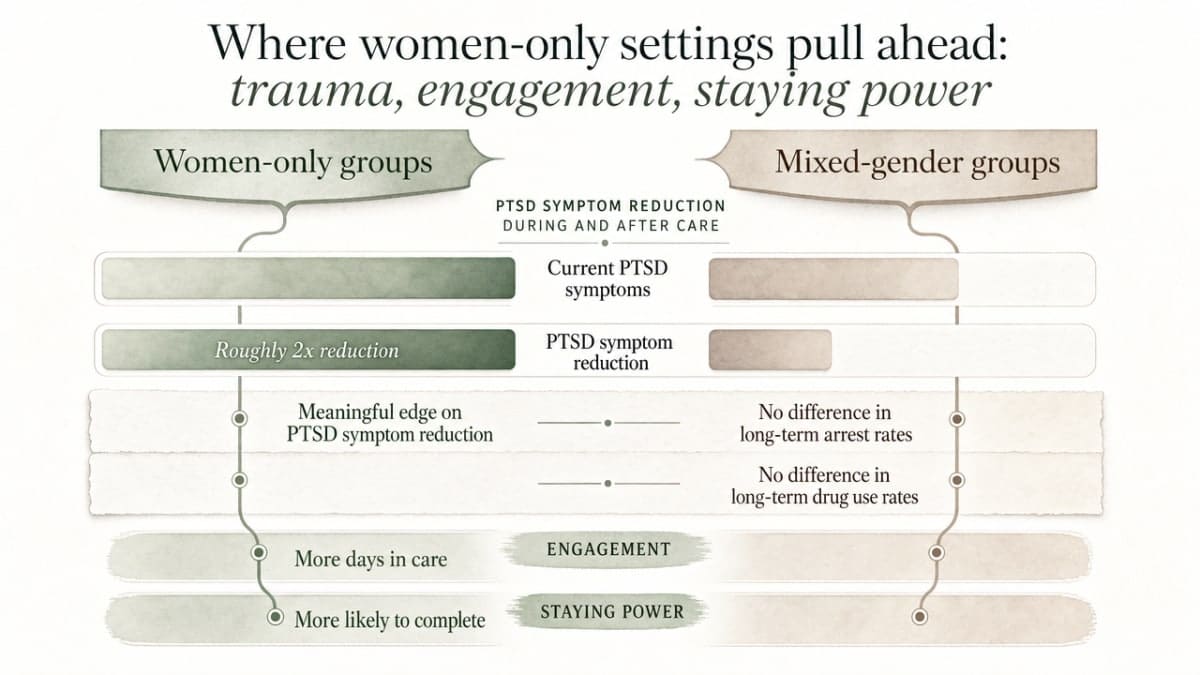
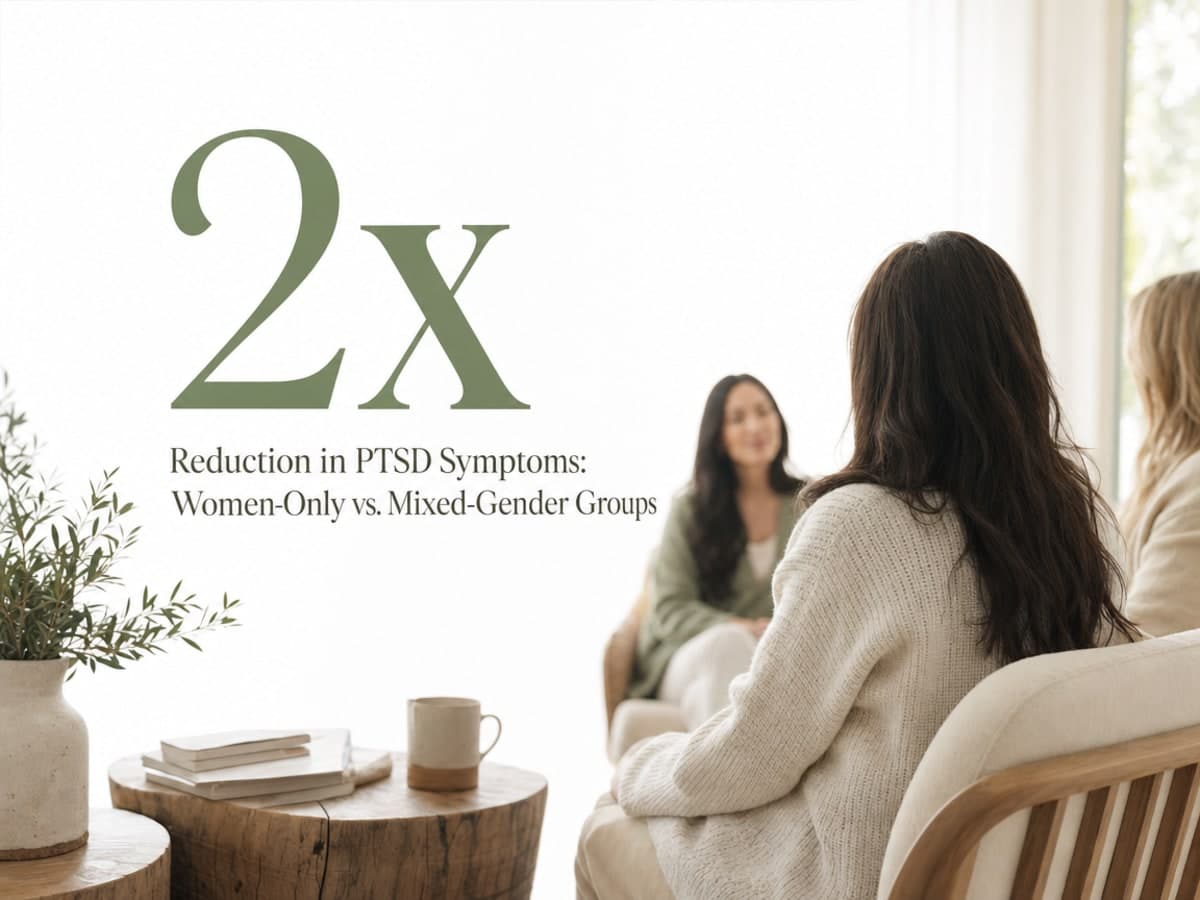
Trauma is where the gap shows up most clearly. A randomized controlled trial of women in drug court treatment compared women-only groups to mixed-gender groups and found that the women-only groups had roughly twice the reduction in current PTSD symptoms after the program 8. That study was done inside a drug court system, not the general treatment population, and long-term arrest and drug use rates did not differ between the arms 8. But on the specific measure of PTSD symptom reduction during and after care, women-only had a meaningful edge.
Engagement follows a similar pattern. The NIAAA’s 2017 national conference report summarized data showing women in women-only treatment averaged significantly more days in care, were more than twice as likely to complete treatment, and were more than two times less likely to report substance use at follow-up compared with women in mixed-gender programs, especially when the women-only programs offered wraparound services like childcare and parenting support 12. That last part matters. The advantage grew when the program built structure around a woman’s real life, not just her diagnosis.
Staying power after treatment is the third piece. The Women’s Recovery Group Stage I trial compared a women-focused single-gender group to a mixed-gender counseling group. During active treatment, both cut substance use by similar amounts. But in the six months after treatment ended, the women-focused group kept improving while the mixed-gender group drifted back toward baseline 5. In other words, both worked while people were in the room. Only one held the line after.
Read these findings together and a shape emerges. Women-only or women-focused care does not universally beat co-ed. It pulls ahead in specific, important places: trauma symptom reduction, treatment completion, and maintenance of gains after discharge. Those are not small things. If trauma is part of your story, or if you have started treatment before and watched the gains slip away, those advantages should carry weight in your decision.
What this does not mean is that co-ed programs cannot do this work. It means co-ed programs have to build in the gender-responsive elements deliberately, not assume they happen by default.
What women say about the room itself
Numbers only tell part of it. What the room feels like matters too, and researchers have asked women directly.
A qualitative study compared women’s experiences in a single-gender Women’s Recovery Group and a mixed-gender counseling group. Women in the single-gender groups were more likely to describe feeling safe, having their needs met, and experiencing intimacy, empathy, honesty, and cohesion with the other members 6. They talked about being able to focus on topics that felt too exposed to raise around men, and about the specific relief of not managing how they came across.
A long-term residential study of a women-only program found something similar. Women said the idea of a women-only setting increased their sense of security, motivation, and belief that they could actually finish treatment and stay drug free, especially compared with prior mixed-gender experiences 10.
That is worth sitting with. If you have tried treatment before and left feeling like you never fully showed up, the climate of the room may have been part of it.
Reading your own situation honestly
Trauma history and how it shows up around men
Trauma is not a checkbox. It is a nervous system that learned to protect you, and it does not always ask permission before it kicks on.
So when you think about walking into a treatment setting, pay attention to the honest answer to a few questions:
- Do you tense up in mixed groups?
- Have you had experiences with men, in childhood or adulthood, that you have not fully told anyone?
- Do you find yourself managing how you look, sound, or take up space when men are in the room, even when nothing is wrong?
Those are not weaknesses. Those are data points.
SAMHSA’s clinician guidance based on TIP 51 encourages providers to ask whether a woman is likely to benefit more from a same-sex versus mixed-gender program because of trauma history or patterns of withdrawal around men 3. That question exists because the answer changes what should happen next. If your protective responses activate hard around men, you may spend a real portion of your group time managing them instead of doing the work you came for.
That does not automatically mean women-only is the only option. It does mean that if you choose a co-ed setting, the program needs to offer women-only trauma groups, trauma-informed staff, and the kind of clinical structure that lets you do the deepest work in the safest possible room. Ask about that directly.
Psychiatric symptom load and co-occurring conditions
Now think about what else you are carrying.
Many women arriving at treatment are not just fighting substance use. They are also managing depression, anxiety, PTSD, eating disorder symptoms, or mood instability, often several at once. That combined weight is what clinicians call high psychiatric symptom severity, and it changes the calculation.
A study looking at exactly this question found that women with high psychiatric symptom severity may get added benefit from single-gender group treatment compared with mixed-gender treatment 7. That is a targeted finding. It does not say every woman needs a women-only program. It says that when the clinical picture is complex and layered, the single-gender room may do more of the work.
Be honest with yourself here. Not brave. Honest.
If you are entering treatment with active PTSD, a recent psychiatric hospitalization, self-harm history, or symptoms that feel like they run the show, that is a signal to weight women-focused or heavily gender-responsive care more heavily in your decision. In a co-ed program, that could mean asking whether women-only tracks exist for trauma and mental health, how integrated the dual diagnosis care actually is, and how psychiatric medication is managed alongside substance use treatment 11. What you need is a program built to hold all of it at the same time.
Caregiving, parenting, and what a program lets you bring with you
For a lot of women, the biggest barrier to treatment is not motivation. It is the child in the back seat, the aging parent down the hall, the household that does not run without you.
This is where program design matters more than the label over the door. The NIAAA’s national conference report noted that the advantages of women-only treatment were most pronounced when programs offered enriched wraparound services like childcare and parenting training 12. The setting mattered, but what really moved the numbers was whether the program was built around the reality of being a mother in recovery.
A co-ed program can offer parenting groups, family therapy, visitation structures, and case management for custody or child welfare involvement. A women-only program may or may not, depending on how it is resourced.
Ask the concrete questions:
- Can your kids visit, and how often?
- Is there family therapy that involves them at age-appropriate levels?
- Does the program help with parenting skills, custody navigation, or reunification planning?
- Is there case management for the practical wreckage that active addiction leaves in a household 9?
The right program is the one that lets you do the clinical work without pretending the rest of your life stopped when you walked in.
Prior treatment experience and what you learned from it
If you have been to treatment before, you already know things most people do not.
Go back to that experience without judgment. What worked? What did you check out of? Were there moments you felt truly seen, and moments you performed recovery instead of doing it? If you were in a mixed-gender setting, did the presence of men in group make it harder to speak, or did it barely register?
Women in a long-term women-only residential program described a real shift compared with their prior mixed-gender experiences, saying the setting increased their sense of security, motivation, and belief that they could actually finish and stay drug free 10. If that language matches something you have felt, take it seriously.
Also take the other possibility seriously. Maybe the co-ed setting was not the problem. Maybe the length of stay was too short, the aftercare was thin, or the trauma work never happened. Length of stay and program quality often matter more than gender composition 1.
Your history is not a verdict. It is information. Use it to ask sharper questions this time.
Gender-responsive care can live inside either model
The components that actually move outcomes
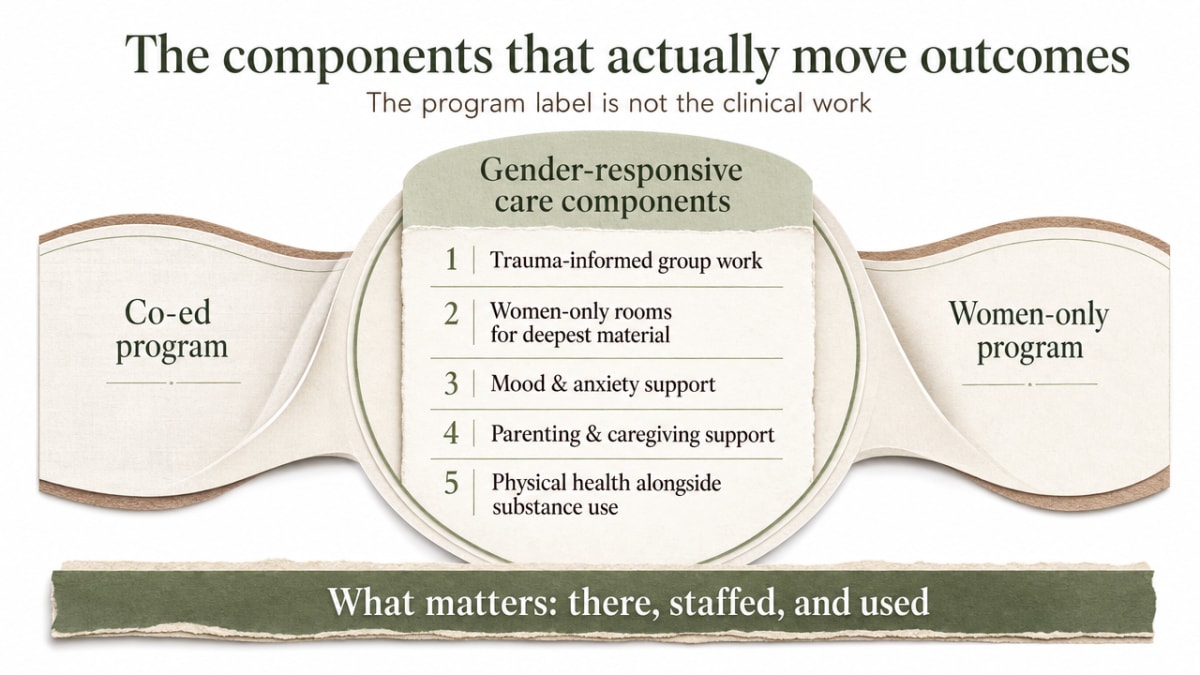
Here is the shift that changes everything about this decision. The label over the door is not what does the clinical work. The components inside the program are.
Researchers who study women-focused treatment describe it as care that accounts for the actual conditions women bring in: high rates of trauma exposure, mood and anxiety disorders, eating disorder symptoms, caregiving roles, and the physical health consequences that stack up alongside substance use 9. Those components can be built into a women-only setting. They can also be built into a co-ed setting. What matters is whether they are actually there, staffed, and used.
A few pieces do most of the lifting:
- Trauma-informed group work, ideally in women-only rooms for the deepest material, so protective responses do not eat the therapy 9.
- Parenting and caregiving support, because a mother in recovery is doing two jobs at once and the program should know that 12.
- Programming content written for women’s lives, not adapted from a men’s curriculum with the pronouns swapped.
- Staff trained specifically in gender-responsive care, including how trauma, shame, and caregiving load shape presentation in group.
- A physical environment that reads as safe, private, and dignified rather than institutional 13.
A systematic review of gender-responsive interventions like Seeking Safety, Helping Women Recover, Beyond Trauma, and the Women’s Recovery Group found significant improvements in both substance use and mental health outcomes, with several interventions outperforming their comparison conditions 11. Those protocols are portable. A well-run co-ed program can run them. A women-only program that skips them is not automatically doing gender-responsive care just because the men are elsewhere.
When you evaluate a program, look past the label. Look at the components.
Questions to ask any program before you say yes
You do not need to be a clinician to interview a treatment program well. You just need to ask specific questions and listen for specific answers.
Start with trauma. Ask whether there are women-only groups for trauma work, even if the broader program is co-ed. Ask what trauma-informed protocols the clinical team uses by name. If nobody can name one, that tells you something.
Move to co-occurring conditions. Ask how the program treats depression, anxiety, PTSD, and eating disorder symptoms alongside substance use, and whether psychiatric medication management is truly integrated with the substance use work or handled as a side conversation 11. Integrated is not the same as available.
Ask about your life outside the program. What does family therapy actually look like, and can your children participate at age-appropriate levels? Is there case management for custody, child welfare, employment, or housing? Does the program help with parenting skills or reunification planning 12?
Ask about staffing. How many women are on the clinical team? What gender-responsive training has staff completed? What is the staff-to-client ratio, and who runs the trauma groups?
Ask about length of stay and what happens after. Length of stay and program quality often predict outcomes more reliably than gender composition 1. A short stay in any setting, followed by thin aftercare, is a common failure pattern.
If you get vague answers, that is your answer.
How Elk Ridge Recovery approaches this in Montana
A quick note on scope here. This section is about one specific provider’s model, so you can compare it against the framework you have been building throughout this article.
Elk Ridge Recovery is a co-ed program in Montana, and it is honest about that. The reason to name it plainly is that the research does not support marketing co-ed as universally better. What the research supports is individualized, gender-responsive care built into whatever structure a program uses 9.
So the question to ask is not whether Elk Ridge is co-ed. The question is what the program actually does with that structure. The center runs a full continuum, from physician-led medical detox through residential, PHP, IOP, outpatient, and aftercare, which means length of stay can flex to match your clinical picture rather than a fixed calendar. Length of stay is one of the strongest predictors of outcome in the literature, often more predictive than gender composition 1.
On the gender-responsive side, ask directly. Ask about women-only trauma group options, dual diagnosis integration for co-occurring mental health conditions, family therapy that includes your kids, and case management for the practical wreckage waiting at home 11, 12. If the answers are specific, that is a program treating you as an individual. If your profile points more clearly toward a women-only setting, a good clinical team will tell you that too.
Making the call without waiting for certainty
You are not going to get certainty on this one. Nobody does. You are going to get a good-enough decision made with the information you have, and then you are going to let the treatment team adjust from there.
Here is what to hold onto. If trauma is central to your story, if your psychiatric symptom load is high, or if a prior mixed-gender experience left you unable to do the real work, weight women-focused care heavily 7, 8. If your situation is less about the room and more about needing a program that flexes around your kids, your co-occurring conditions, and a long enough stay to hold, look hardest at the components inside the program rather than the label 1, 9.
Either way, choosing today beats waiting for a perfect answer that is not coming. The research is clear that both models can move you forward when the care is individualized and you stay long enough for it to work 2.
You have already done the hardest part by looking honestly at this. Make the call. Adjust from there. That is how recovery actually starts.
Talk With Someone Who Gets Your Journey
Get real answers about co-ed and women’s only rehab options, tailored to your recovery needs.
Frequently Asked Questions
Is women-only rehab always better than co-ed rehab?
No. Large reviews of substance use treatment find that gender alone does not reliably predict retention, completion, or outcomes once someone is in care 1. Women-only settings show advantages in specific areas like trauma symptom reduction and treatment completion, but arrest rates and employment outcomes at follow-up often match between the two models 4. What matters more is whether the care is individualized and gender-responsive.
I have a trauma history involving men. Does that mean I should only consider a women-only program?
Not automatically, but take that history seriously. SAMHSA clinician guidance recommends assessing whether a woman is likely to benefit more from a same-sex program based on trauma history and patterns of withdrawal around men 3. If your protective responses activate hard in mixed groups, women-only or heavily gender-responsive care deserves real weight. If you choose a co-ed program, confirm it offers women-only trauma groups and trauma-informed clinicians who can hold that work safely.
Can a co-ed program still offer gender-responsive care for women?
Yes, when it is built to. Gender-responsive care is a set of components, not a building layout: trauma-informed groups, parenting and caregiving supports, women-specific programming content, trained staff, and a safe environment 9, 13. Evidence-based protocols like Seeking Safety, Helping Women Recover, and the Women’s Recovery Group can run inside a co-ed program 11. Ask which of these components exist by name. Vague answers usually mean they are not really there.
What questions should I ask a rehab program before I commit?
Ask whether women-only trauma groups exist inside the program, and what trauma-informed protocols the team uses by name 11. Ask how dual diagnosis care integrates psychiatric medication management with substance use treatment. Ask what family therapy looks like, whether children can participate, and whether case management covers custody, housing, or employment 12. Ask about staff-to-client ratio and length of stay flexibility, since length of stay often predicts outcomes more than gender composition 1.
My last treatment experience in a mixed-gender setting didn’t work. Should I switch to women-only?
Maybe, but do not assume the gender mix was the reason. Ask what actually broke down last time. Was the length of stay too short? Was the trauma work skipped? Was aftercare thin? Length of stay and program quality often matter more than composition 1. That said, if you consistently felt unsafe or unable to speak in mixed groups, women in long-term women-only programs describe a real shift in security and motivation 10. Both truths can coexist.
How do I decide between co-ed and women-only rehab for a loved one?
Focus on her clinical picture, not the label. If she carries active PTSD, high psychiatric symptom severity, or a history of harm involving men, weight women-focused care heavily 7, 8. If caregiving, co-occurring conditions, or length of stay flexibility are the bigger factors, evaluate program components rather than composition 9. Ask any program you consider the same specific questions about trauma groups, dual diagnosis integration, family involvement, and aftercare. Her honest input should drive the final call.
References
- Substance Abuse Treatment Entry, Retention, and Outcome in Women. https://pmc.ncbi.nlm.nih.gov/articles/PMC3532875/
- Quick Guide for Clinicians Based on TIP 51: Substance Abuse Treatment Addressing the Specific Needs of Women. https://library.samhsa.gov/sites/default/files/sma13-4789.pdf
- KAP Keys For Clinicians Based on TIP 51. https://library.samhsa.gov/sites/default/files/sma14-4844.pdf
- The Relative Effectiveness of Women-Only and Mixed-Gender Treatment for Substance-Abusing Women. https://pmc.ncbi.nlm.nih.gov/articles/PMC3081899/
- The Women’s Recovery Group Study: A Stage I Trial of Women-Focused Group Therapy for Substance Use Disorders. https://pmc.ncbi.nlm.nih.gov/articles/PMC3679366/
- A Qualitative Analysis of Women’s Experiences in Single-Gender Versus Mixed-Gender Group Therapy for Substance Use Disorders. https://pmc.ncbi.nlm.nih.gov/articles/PMC3711015/
- High Psychiatric Symptom Severity as a Moderator of Substance Abuse Treatment Outcomes Among Women in Single vs. Mixed Gender Group Treatment. https://pubmed.ncbi.nlm.nih.gov/18821452/
- Gender-Responsive Drug Court Treatment: A Randomized Controlled Trial. https://gap.hks.harvard.edu/gender-responsive-drug-court-treatment-randomized-controlled-trial
- What Is ‘Women-Focused’ Treatment for Substance Use Disorders?. https://pmc.ncbi.nlm.nih.gov/articles/PMC2753530/
- Long-Term Residential Substance Abuse Treatment for Women. https://pmc.ncbi.nlm.nih.gov/articles/PMC3889185/
- A Systematic Review of Gender-Responsive and Integrated Substance Use Disorder Treatments for Women. https://pubmed.ncbi.nlm.nih.gov/36283062/
- 2017 National Conference on Alcohol and Opioid Use in Women and Girls: Summary Report. https://www.niaaa.nih.gov/sites/default/files/2017_National_Conference_on_Alcohol_and_Opioid_Use_in_Women_and_Girls_Report.pdf
- Quick Guide for Administrators: Substance Abuse Treatment for Women. https://library.samhsa.gov/sites/default/files/sma13-4788.pdf
- Gender Dynamics in Substance Use and Treatment. https://pmc.ncbi.nlm.nih.gov/articles/PMC8881090/