Key Takeaways
- Montana Medicaid covers the full addiction treatment continuum, from screening and MAT to outpatient, IOP, PHP, withdrawal management, and residential care across ASAM levels.
- The HEART 1115 waiver expanded residential and withdrawal management access, with 1,461 members using expanded ASAM levels in state fiscal year 2025 3.
- Access hinges on three factors: medical necessity, prior authorization for higher-intensity care, and whether the program is both state-approved and Medicaid-enrolled.
- Before committing to a Montana program, verify Medicaid enrollment, ask about room-and-board costs for residential stays, and confirm current bed availability at your needed level of care.
The short answer for a Montana family in crisis
Yes. Montana Medicaid pays for drug and alcohol rehab, covering services from screening and assessment to medication-assisted treatment, outpatient counseling, intensive outpatient, partial hospitalization, withdrawal management, and residential care across all levels recommended by the American Society of Addiction Medicine 2, 13. If you or a loved one has a Montana Medicaid card, treatment is accessible.
However, whether Medicaid covers your specific rehab, at your specific program, on your specific start date, depends on three factors: medical necessity, prior authorization requirements for certain services, and the program’s state approval and enrollment with Montana Medicaid to bill for services 2, 6. Any of these can cause delays if not addressed upfront.
To navigate this, use this article to understand general Medicaid coverage in Montana, then contact a treatment program to confirm your exact benefits before committing. Coverage rules and provider participation can change, so direct confirmation is essential.
You can call Elk Ridge Recovery to discuss your situation and verify your Medicaid coverage for the level of care you need. Taking this step is crucial for accessing treatment.
What Montana Medicaid actually pays for in addiction treatment
The covered continuum: screening, MAT, outpatient, and beyond
Montana Medicaid’s substance use disorder benefit is comprehensive. The official Member Guide outlines coverage for:
- screening and assessment
- medication-assisted treatment
- recovery support
- case management
- clinically managed residential services
- medically monitored inpatient care
- partial hospitalization
- intensive outpatient
- standard outpatient therapy 2
If a doctor or licensed counselor determines a service is medically necessary and you meet the criteria, it is likely covered.
The benefit structure allows for a progression of care. It begins with a screening and biopsychosocial assessment to determine the appropriate level of care, which could range from weekly outpatient therapy to intensive outpatient programs, or even medical withdrawal management if needed 2. Each of these services has a corresponding Medicaid billing code.
Higher levels of care include partial hospitalization (day treatment without an overnight stay), various intensity levels of residential treatment, and inpatient care for withdrawal or co-occurring medical issues. Recovery support services and case management are integrated throughout, providing assistance with appointments, medication refills, and housing 2.
The state’s provider overview confirms that full Medicaid members are eligible for all covered services when medically necessary, with substance dependency services explicitly included 16. Behavioral health is part of the standard benefit package. A 2024 legislative commission report noted that Montana Medicaid reimburses “an array of mental health services, from community-based services to inpatient and residential levels of care,” which includes substance use disorder services 12. The coverage is robust, but certain aspects can be challenging to navigate, as discussed in the following sections.
How the HEART waiver expanded residential and withdrawal management
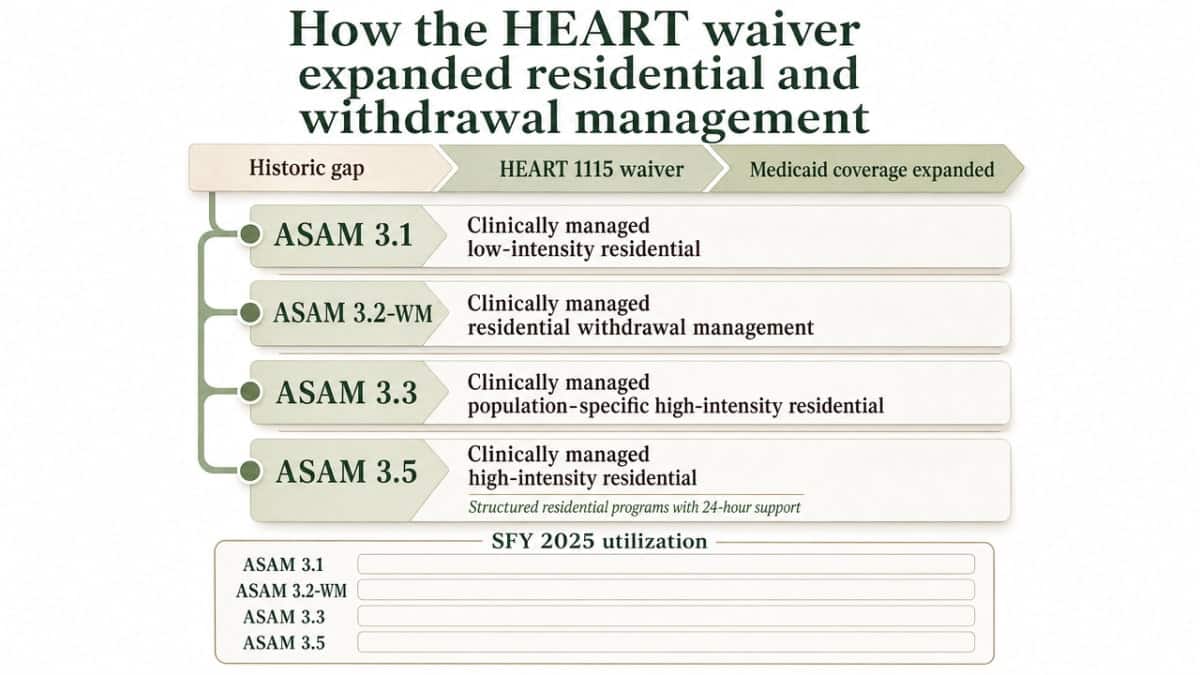
Historically, residential care was a significant gap in Montana’s rehab coverage. While outpatient counseling was often covered, the 30-day residential programs frequently recommended by clinicians were not always accessible through Medicaid. The HEART 1115 demonstration waiver addressed this.
Under the HEART waiver, Montana expanded Medicaid to cover the full spectrum of residential and withdrawal management levels recommended by the American Society of Addiction Medicine (ASAM). This includes:
- ASAM 3.1 (clinically managed low-intensity residential)
- ASAM 3.2-WM (clinically managed residential withdrawal management)
- ASAM 3.3 (clinically managed population-specific high-intensity residential)
- ASAM 3.5 (clinically managed high-intensity residential) 1, 15
ASAM 3.5 represents the structured residential programs with 24-hour staff, group and individual therapy, and extended stays. Previously, many such facilities could not be reimbursed by Medicaid due to the federal Institutions for Mental Diseases exclusion, but the waiver removed this barrier 13.
This expansion has had a tangible impact. In state fiscal year 2025, 1,461 Montana Medicaid members received treatment through these expanded ASAM levels, with 1,177 of them utilizing ASAM 3.5 residential care 3. This demonstrates that the policy changes have translated into real access to treatment for Montanans.
HEART also introduced three new services to support recovery:
- Contingency management for stimulant use disorder
- Tenancy supports for members with SUD or serious mental illness experiencing housing instability
- Justice-involved reentry services, which include up to 30 days of pre-release care and medication upon release 14, 1
Contingency management is particularly important for methamphetamine use, where evidence-based incentives are a highly effective approach given limited medication options 4.
While these changes have significantly broadened coverage, access to rehab is not automatic. The focus has shifted from whether Medicaid will pay for a bed to finding an available bed at a state-approved program when you are ready for treatment.
Medication-assisted treatment and the medical-necessity gate
Medication-assisted treatment (MAT), including buprenorphine (Suboxone), methadone, and injectable naltrexone (Vivitrol), is a critical component of Montana Medicaid’s rehab coverage. MAT is covered under the state plan for all Medicaid beneficiaries who meet medical necessity criteria 7. There are no additional waivers or special enrollment steps required. If you have a Montana Medicaid card and your prescriber determines MAT is clinically appropriate, both the medication and associated counseling are covered.
The concept of “medically necessary” is key. It means a licensed clinician must assess you, document your diagnosis, and explain why a specific level of care or medication is suitable for your condition. For MAT, this typically occurs during your initial appointment with a prescribing provider or through an addiction assessment at an approved program. For higher levels of care, such as residential treatment, the same principle applies, often with more extensive documentation 2.
Medicaid will not cover treatment that is not clinically needed or a level of care beyond what your assessment supports. If you feel the recommended treatment plan is inappropriate, it is best to discuss this during the assessment to ensure the plan aligns with your needs, as it is easier to adjust the plan early on than to appeal a coverage decision later.
The two friction points nobody warns you about
Medical necessity and prior authorization, translated
Two common phrases on Medicaid denial letters are “not medically necessary” and “prior authorization required.” These terms often sound more intimidating than they are.
“Medical necessity” means a licensed clinician must document that the treatment aligns with your diagnosis and current condition. This is determined during your intake assessment, where a counselor evaluates your use history, mental health, physical health, past treatments, and current safety to assign an ASAM level of care. If the assessment indicates residential care, Medicaid will consider it; if it suggests outpatient care with MAT, that will be authorized 2. The assessment is mandatory, and the chosen level of care must be clinically supported.
“Prior authorization” is a requirement for higher-intensity services. It involves the treatment program submitting paperwork to Medicaid before you begin treatment, detailing why this level of care is needed and the expected duration of your stay 2. A competent intake team typically handles this process. Your role is to provide accurate information during the assessment, including details about relapses, withdrawal history, and any mental health symptoms, to ensure the authorization matches your actual needs.
State-approved AND Medicaid-enrolled: the two-step provider rule
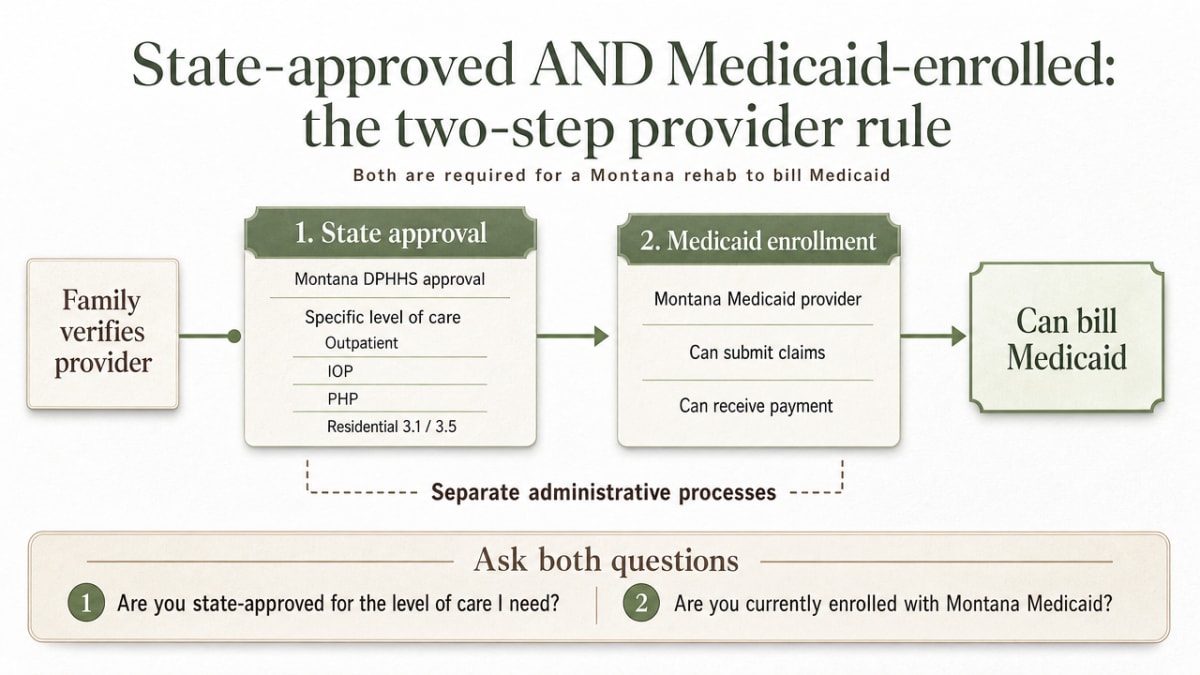
A crucial point that often surprises families is that a legitimate, licensed treatment center in Montana may still be unable to bill your Medicaid. Two distinct approvals are necessary.
First, the program must receive state approval from Montana’s Department of Public Health and Human Services to provide SUD services at a specific level of care, such as outpatient, IOP, PHP, or residential (e.g., 3.1, 3.5) 6. Second, the program must be enrolled as a Montana Medicaid provider to submit claims and receive payment. State approval does not automatically confer Medicaid enrollment; these are separate administrative processes 6, 5.
If an enrolled program lacks an open bed, inquire if they can recommend other Medicaid-enrolled programs. Montana’s SUD provider network is often interconnected, and intake teams may know of other facilities with availability.
The room-and-board line inside residential care
A common point of confusion is the coverage of residential rehab. While Medicaid covers the clinical services—therapy, medical oversight, medication, case management, and group work—it does not reimburse for room and board under Montana’s rehabilitative services rules 8. The cost of the bed and meals is not included in the benefit.
However, most Medicaid-enrolled residential programs in Montana have found ways to address this. Some integrate room and board costs into their overall financing, while others utilize state grants or HEART-related funding to cover the non-clinical aspects. The HEART 1115 waiver specifically expanded what residential facilities, including those previously affected by the Institutions for Mental Diseases exclusion, could bill Medicaid for clinical services, which altered the financial landscape for many programs 1, 15.
When contacting programs, do not assume residential care will be entirely free or prohibitively expensive. Directly ask the intake coordinator, “With my Montana Medicaid coverage, what will I actually owe for a residential stay at your program?” A clear answer indicates transparency and can help you make an informed decision.
Why Medicaid pays for more Montana rehab than most people realize
In Montana, Medicaid plays a significant role in funding substance use disorder treatment. Between 2016 and 2021, Medicaid funding for SUD treatment increased substantially, from $5.1 million to over $24 million 10. In 2021 alone, more than 5,700 Medicaid expansion enrollees received SUD services through the program 10. This indicates that Medicaid is a primary funding source for rehab in the state, not merely a last resort.
This shift is largely due to Montana’s Medicaid expansion, which provided coverage to many adults who previously paid out-of-pocket or went without treatment. Consequently, programs that once served primarily self-pay clients adapted their billing systems to accept Medicaid. County and tribal health systems also increased their participation. The HEART waiver further enhanced coverage by adding residential and withdrawal management services that were previously unavailable 1.
If you have hesitated to seek rehab due to concerns about Medicaid coverage, it is important to recognize that the landscape has changed. Coverage is extensive, spending is substantial, and thousands of Montanans are currently utilizing these benefits. While a 2024 legislative commission report highlighted that coverage is broader on paper than provider capacity on the ground, especially in rural areas, this should not deter you from seeking help 12. Your Medicaid card provides significant access to treatment.
Getting from a Medicaid card to an open bed in Montana
Kalispell, Missoula, Billings, and the rural access reality
Montana’s vast geography significantly influences rehab access. While Medicaid coverage is consistent statewide, finding an available bed at the required level of care can vary depending on your location.
Major urban centers like Billings, Missoula, Great Falls, Bozeman, Kalispell, Helena, and Butte host the majority of the state’s Medicaid-enrolled SUD programs. These areas offer the highest concentration of outpatient clinics, IOP slots, MAT prescribers, and residential beds. For individuals in rural areas, such as Libby, the Hi-Line, or reservation communities, the nearest Medicaid-enrolled program with an opening might be several hours away. The 2024 legislative commission acknowledged this disparity, noting that provider capacity in rural Montana lags behind the breadth of coverage 12.
To mitigate these challenges, some programs offer virtual outpatient and telehealth counseling, which Medicaid covers, reducing travel for follow-up care even if initial assessments or detox require in-person visits. Additionally, tribal health facilities in some communities provide their own SUD services and referral pathways. If a Medicaid-enrolled program has no immediate openings, inquire about other programs they might recommend, as the network is often small enough for intake teams to be aware of current availability.
What to have ready when you call to verify coverage
Preparing for a verification call can make the process smoother. Gather the following information before you dial:
- Your Montana Medicaid ID number (from your card or online account).
- Your date of birth and legal name as it appears on your card.
- The name and dosage of any medications you are taking, including illicit substances. This information is crucial for planning safe withdrawal.
- A general timeline of your substance use: what you use, how much, how often, and when you last used.
- Details of any past treatments, including program names, dates, and completion status.
- Any mental health diagnoses or medications, and whether you have thoughts of self-harm or harming others.
- Your ZIP code and your realistic travel radius.
In return, ask the program three key questions:
- Are you enrolled with Montana Medicaid and currently accepting new Medicaid patients?
- Based on what I’ve shared, what level of care do you recommend?
- What does the initial process entail, including assessment, prior authorization, and admission date?
Document their responses. A program that provides patient and specific answers is generally a good sign.
Where Elk Ridge Recovery fits — and what to ask them
Elk Ridge Recovery is a Montana treatment center offering a full continuum of care, including medical detox, residential inpatient, partial hospitalization, intensive outpatient, standard outpatient, and aftercare. Their services also encompass medication-assisted treatment, dual diagnosis care for co-occurring mental health conditions, family therapy, and case management. This comprehensive approach minimizes the need for transitions between multiple organizations as your level of care changes.
Given that Medicaid participation and network status can fluctuate, it is essential to confirm coverage directly. Contact Elk Ridge Recovery and ask specific questions:
- Are you currently enrolled with Montana Medicaid?
- Are you accepting new Medicaid patients at the level of care I need?
- What will be my out-of-pocket costs, including any room-and-board portion for a residential stay?
- How quickly can the assessment be completed and prior authorization initiated?
Obtaining clear answers to these questions is the primary goal of your call. You are not obligated to commit during the initial conversation; rather, you are gathering information to facilitate your next decision. Making the call is the crucial first step.
Get Real Answers About Medicaid and Recovery
Speak directly with an expert who can clarify your coverage and next steps for addiction treatment in Montana.
Frequently Asked Questions
Does Montana Medicaid cover inpatient drug and alcohol rehab?
Yes. Montana Medicaid covers medically monitored inpatient care and clinically managed residential treatment when deemed medically necessary and provided by a state-approved, Medicaid-enrolled program 2. The HEART 1115 waiver expanded coverage to include various ASAM residential levels, such as 3.5 high-intensity residential care 1. Your specific coverage depends on your plan and clinical assessment, so contact a program like Elk Ridge Recovery for confirmation.
Will Medicaid pay for medication-assisted treatment (MAT) like Suboxone or methadone in Montana?
Yes. MAT is covered under Montana’s Medicaid state plan for all beneficiaries who meet medical necessity criteria, without requiring a separate waiver 7. This includes buprenorphine, methadone, injectable naltrexone, and associated counseling. Your prescriber will document the diagnosis and clinical need during your first appointment. Coverage is provided, but the medication must be prescribed by a Medicaid-enrolled provider who can bill for the service.
Do I need prior authorization before starting rehab through Montana Medicaid?
For some services, particularly higher-intensity care like residential treatment and inpatient stays, prior authorization is required 2. This involves the treatment program submitting documentation to Medicaid before your admission, outlining the clinical justification for the chosen level of care and the anticipated duration of treatment. A proficient intake team will manage this process. Your role is to be transparent during the assessment to ensure the authorization aligns with your actual clinical needs.
What does Medicaid not pay for in residential treatment?
Medicaid does not cover room and board in residential treatment. Under Montana’s rehabilitative services rules, Medicaid reimburses for the clinical aspects of residential care—therapy, medical oversight, medication, and case management—but not for the accommodation itself or meals 8. Many Medicaid-enrolled residential programs use HEART funding, grants, or blended financing to cover these non-clinical costs. It is advisable to ask any program directly about your potential out-of-pocket expenses for a residential stay with your Medicaid coverage.
How do I find out if a specific rehab program takes Montana Medicaid?
To determine if a rehab program accepts Montana Medicaid, ask two specific questions: Is the program state-approved for the level of care I need, and is it currently enrolled with Montana Medicaid and accepting new Medicaid patients? These are distinct approval processes, and a program may have one without the other 6, 5. If a program meets both criteria but has no immediate openings, ask for recommendations of other Medicaid-enrolled programs.
Can I use Montana Medicaid for rehab if I live in a rural area or on a reservation?
Yes, your Montana Medicaid card is valid statewide. The challenge often lies in locating a Medicaid-enrolled program with an available bed at your required level of care nearby, as provider capacity in rural Montana can be limited compared to the breadth of coverage 12. Some services are accessible through Medicaid-covered telehealth, which can reduce travel for follow-up care. Additionally, tribal health facilities in certain communities offer their own SUD services and referral pathways worth exploring.
References
- Montana HEART Section 1115 Demonstration Amendment Approval. https://www.medicaid.gov/medicaid/section-1115-demonstrations/downloads/mt-heart-cms-amendment-approval-20240226.pdf
- Montana Medicaid Member Guide. https://prod-dphhs.mt.gov/assets/hrd/MedicaidMemberGuide.pdf
- Healing and Ending Addiction through Recovery and Treatment (HEART) Initiative – June 2025 Update. https://dphhs.mt.gov/assets/heartinitiative/June2025/HEARTUpdateJune2025.pdf
- Section 1115 HEART Demonstration Waiver Legislative Summary. https://archive.legmt.gov/content/Publications/services/2024-agency-reports/MCA_53-2-215_HEART_Waiver.pdf
- Substance Use Disorders – Medicaid Provider – Montana.gov. https://medicaidprovider.mt.gov/32
- State Approval Forms – dphhs. https://dphhs.mt.gov/BHDD/SubstanceAbuse/ProviderForms
- MT 21-0005 Approval Package. https://www.medicaid.gov/medicaid/spa/downloads/MT-21-0005.pdf
- Montana State Plan Amendment (SPA) #: 23-0023. https://www.medicaid.gov/medicaid/spa/downloads/MT-23-0023.pdf
- Clarification for Substance Use Disorder Intensive Outpatient Providers. https://medicaidprovider.mt.gov/docs/providernotices/2023/provnoticeClarificationforSubstanceUseDisorderIntensiveOutpatientProviders.pdf
- Medicaid Expansion in Montana & Nationwide. https://archive.legmt.gov/content/Publications/fiscal/2025-Biennium/MARA/Medicaid-in-Montana-ManattHealth-Jan2024.pdf
- Overdose Prevention Data Channel. https://www.cdc.gov/overdose-prevention/data-channel/index.html
- Behavioral Health System for Future Generations (Commission Report, June 2024). https://archive.legmt.gov/content/Publications/fiscal/2025-Biennium/Section-B/Interim/BHSFG-Commission-Report-June2024.pdf
- Healing and Ending Addiction Through Recovery and Treatment (HEART) Initiative Report – State Fiscal Year 2024. https://dphhs.mt.gov/assets/heartinitiative/HEARTInitiativeReport2024.pdf
- Governor Gianforte, DPHHS Announce New Behavioral Health Care Services for Montanans. https://dphhs.mt.gov/News/2024/February/DPHHSAnnounceNewBehavioralHealthCareServices
- Healing and Ending Addiction through Recovery and Treatment (HEART) Initiative Report. https://archive.legmt.gov/content/Committees/Interim/2023-2024/Children-Families/CFHHS_Meetings/2024_Sept_11/16-12-122-Healing-and-Ending-Addiction-Through-Recovery-and-Treatment-Report-FINAL.pdf
- General Information for Providers – Montana Healthcare Providers. https://dphhs.mt.gov/assets/BHDD/SubstanceAbuse/generalinformationmthealthcareproviders.pdf