Key Takeaways
- Cravings are a nervous system reflex tied to the stress response, and guided time in nature measurably lowers that response in ways a city walk or treadmill does not 8.
- SAMHSA now treats regular physical activity as a vital component of recovery, so structured movement should be written into the weekly schedule alongside therapy, not offered as an optional extra 2.
- The therapeutic dose that moves the needle is short sessions at least three times per week at low-to-moderate intensity, and guided activity outperforms passive time outdoors 15, 12.
- Outdoor recreation is an adjunct, not a replacement for medical detox, medication-assisted treatment, or dual diagnosis care, so evaluate programs on how the trail connects to the full clinical continuum 10.
What a Craving Actually Is, and Why a Morning on the Water Changes It
A craving is not weakness. It is your nervous system doing exactly what it learned to do. Somewhere along the way, your brain wired a fast, direct path between stress and relief, and the substance became the shortcut. Now, when the pressure builds, that path lights up before you even notice you’re thinking about it. Your heart rate climbs, your chest tightens, and a very old part of your brain starts pulling you toward the thing that made it stop before.
That is what you are up against. Not a character flaw. A reflex.
Here is why a morning on the Clark Fork or a slow walk up a trail near Kalispell matters. Cravings ride on the stress response, and the stress response can be interrupted. In one study cited in a 2024 review, patients with substance use disorder who took a one-hour walk in nature showed significantly reduced craving levels compared to patients who took a walk in the city 8. Same hour. Same movement. Different environment, different result.
Something about cold air, moving water, and open sky tells your body it is safe enough to stand down. Researchers describe outdoor, nature-based exposure as having a real effect on the emotional side of stress recovery 13. Federal guidance from SAMHSA now names regular physical activity as part of the recovery process itself, not a bonus around the edges 1.
That is the clinical reason outdoor recreation belongs in a treatment week. Not because nature is pretty. Because your nervous system listens to it.
Outdoor Recreation as a Clinical Tool, Not a Field Trip
The Federal Case for Movement in Recovery
For a long time, exercise sat in a strange corner of addiction treatment. Nice if you had time. Optional if you didn’t. Something the fitness-inclined patient did on their own between groups.
That framing is dated. SAMHSA now names physical activity a vital component of the recovery process for people managing substance use, mental health conditions, and the two together 2. Not a wellness perk. Not a lifestyle recommendation for later. Part of the work itself.
The federal brief goes further. Regular physical activity contributes to improved mental health, reduced rates of return to use, and better physical and psychological well-being over time 1. Read that sentence slowly. Reduced rates of return to use. That is the outcome every person in early recovery is trying to reach, and movement is one of the levers that shifts it.
What this changes for you, practically, is the question you ask about a program. It is not “do they offer some kind of exercise option.” It is whether structured physical activity is written into the treatment week the way group therapy is. If it isn’t, the program is running on an older model.
What the Nature-Based Evidence Actually Says
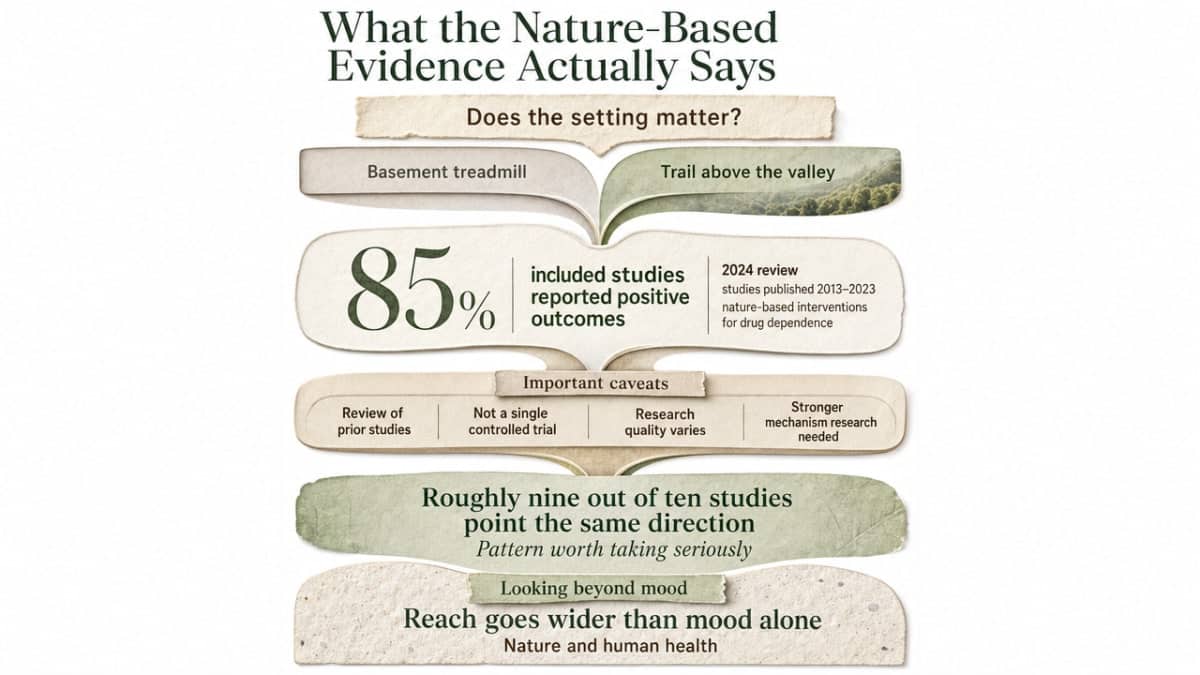
Once you accept that movement belongs in treatment, the next question is whether the setting matters. Would a treadmill in a basement do the same work as a trail above the Flathead Valley?
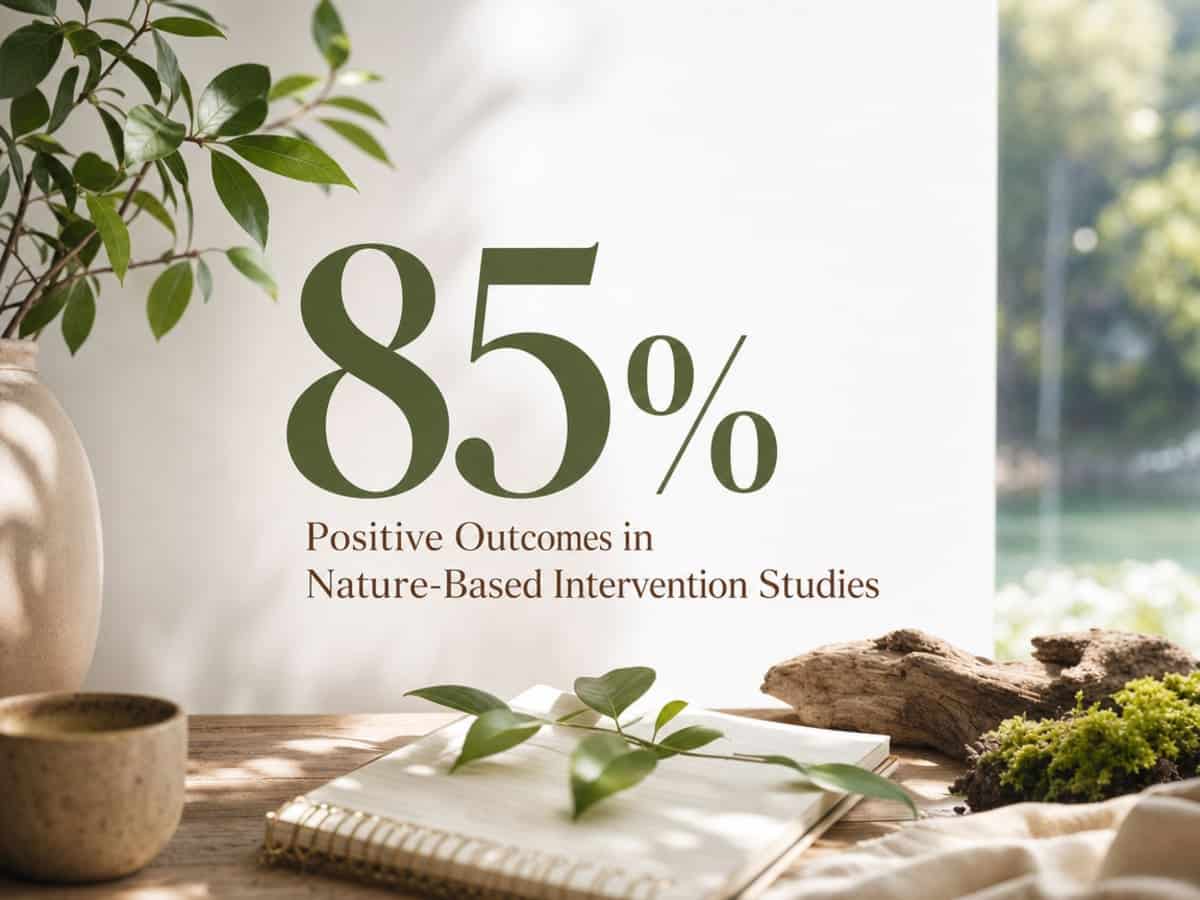
The research says no. A 2024 review of studies published between 2013 and 2023 on nature-based interventions for drug dependence found that 85% of the included studies reported positive outcomes 7. Important caveat in the same breath: this is a review of prior studies, not a single controlled trial, and the underlying research varies in quality. The authors themselves call for stronger work on the mechanisms. Still, when roughly nine out of ten studies point the same direction, that pattern is worth taking seriously.
The reach of nature exposure goes wider than mood alone. A scoping review of the literature on nature and human health found that:
- Mental health outcomes improved across 98% of studies
- Physical health outcomes improved across 83%
- Cognitive outcomes improved across 75% 14
Three different systems, three different response rates, all moving in the same direction.
That breakdown matters for someone in recovery. Substance use flattens all three. It dulls mood, wears down the body, and clouds thinking to the point that decisions you would never make sober start to feel reasonable. A treatment week built around trails, water, and open ground is not chasing one benefit. It is putting a slow, steady input into all three systems at once.
This is why calling weekly hiking or fishing a field trip misses the point. A field trip is a break from the work. A dosed, guided outdoor session is the work, in a form your body can actually receive after months or years of alarm.
The Honest Limits of the Research
You deserve the caveats too. This is your decision, and you should have the ceiling and the floor in front of you.
The largest government review of wilderness therapy programs identified 88 studies covering youth and adult behavioral health and substance use populations 10. That sounds like a robust evidence base until you read the fine print. Most of those studies lacked comparison groups, which means researchers could see people improve during and after the programs but could not cleanly say the program itself caused the improvement. The same review could not determine cost-benefit.
What the evidence supports is narrower and more useful: structured, guided outdoor recreation is a credible adjunct inside a real clinical program. That is the frame worth carrying into the rest of this article.
How Hiking, Fishing, and Floating Rewire the Stress Response
Stress as the Bridge Between Movement and Mood
If you have been using for any length of time, your stress system is not in a resting state. It is running hot. The cortisol keeps climbing, sleep keeps thinning, and your body starts treating ordinary moments the way it should treat actual danger. That baseline is where cravings breed.
This is the piece most people miss. Movement does not lift mood by magic. It lifts mood by working through stress first. A 2024 evidence synthesis on the pathways between physical activity and mental health found that stress mediates the relationship between the two, meaning exercise appears to improve mood in large part because it turns the stress dial down 5. You move, your stress response recalibrates, and your mood follows.
That matters for you specifically. Lower baseline stress means fewer of those sudden internal spikes that used to send you toward a drink or a pill before you had a chance to think. A separate review of exercise in mental health care describes this as acute mood enhancement paired with better emotional regulation during stressful life circumstances 6. Translation: not just feeling better in the moment, but handling the next hard moment with a little more room.
A hike on a Bitterroot trail is doing quiet work under the hood. Your legs are moving, your breath is deepening, and the alarm system that has been screaming for months is finally getting a signal that the fight is over for now. That is the bridge. Movement lowers stress, and lower stress gives your mood somewhere stable to land.
Cravings Drop After Time Outside
Here is the number worth sitting with. In a study cited in the Recovery Horizons review of nature-based adjunctive treatment, patients with substance use disorder who took a one-hour walk in nature showed significantly reduced craving levels compared to patients who took a one-hour walk in the city 8. Same duration. Same basic activity. The variable that changed was the environment.
Think about what that means for a treatment week. If sixty minutes on a trail near a river measurably lowers cravings compared to sixty minutes on a sidewalk, then the setting is not decoration. It is part of the dose. You are not just exercising your legs. You are giving your nervous system a different set of inputs, and those inputs are landing on the same circuit that produces the pull toward using.
This is the closest thing the research has to a clean answer for the question, why outdoors specifically. City walks still burn calories. Treadmills still move the heart rate. Neither delivered the same craving reduction in patients who were actively managing SUD. Cold air, tree cover, the sound of water, the absence of car horns and neon, the visual softness of a landscape that predates any of us. Your body reads all of it and settles.
None of this replaces medication, therapy, or a physician-led detox. It sits alongside them and does a job those tools cannot do on their own. When a program builds hiking, fishing, or floating into the weekly schedule, that is what is being dosed.
Mood, Sleep, and the Natural High
You have probably heard someone in recovery talk about a natural high. It sounds soft until you understand what is actually happening. When you move your body outside, you get a real, measurable lift in mood, and it does not carry the crash that substances do.
A meta-analysis across adult populations found that physical activity produced medium-sized effects on depression, anxiety, and psychological distress compared to usual care 3. A separate practice-oriented review calls physical activity a robust adjunct treatment strategy for depressive, anxiety, and stress-related disorders 4. These are the exact conditions that sit tangled up with substance use for most people in treatment.
Sleep is the quiet partner in all of this. When your stress response calms and your mood steadies, sleep starts to return. And when sleep returns, cravings shrink further, decisions get clearer, and the next day feels survivable instead of impossible.
A morning on the Clark Fork is not going to fix everything. What it can do is give you a small, honest lift, a body that is tired in the right way, and a nervous system that remembers how to feel good without being paid off in a substance. That memory is worth building back.
Dosing the Outdoors: Frequency, Duration, and Guided vs. Passive
What a Therapeutic Dose Looks Like
If outdoor recreation is a clinical tool, it needs a dose. That is the part most brochures skip.
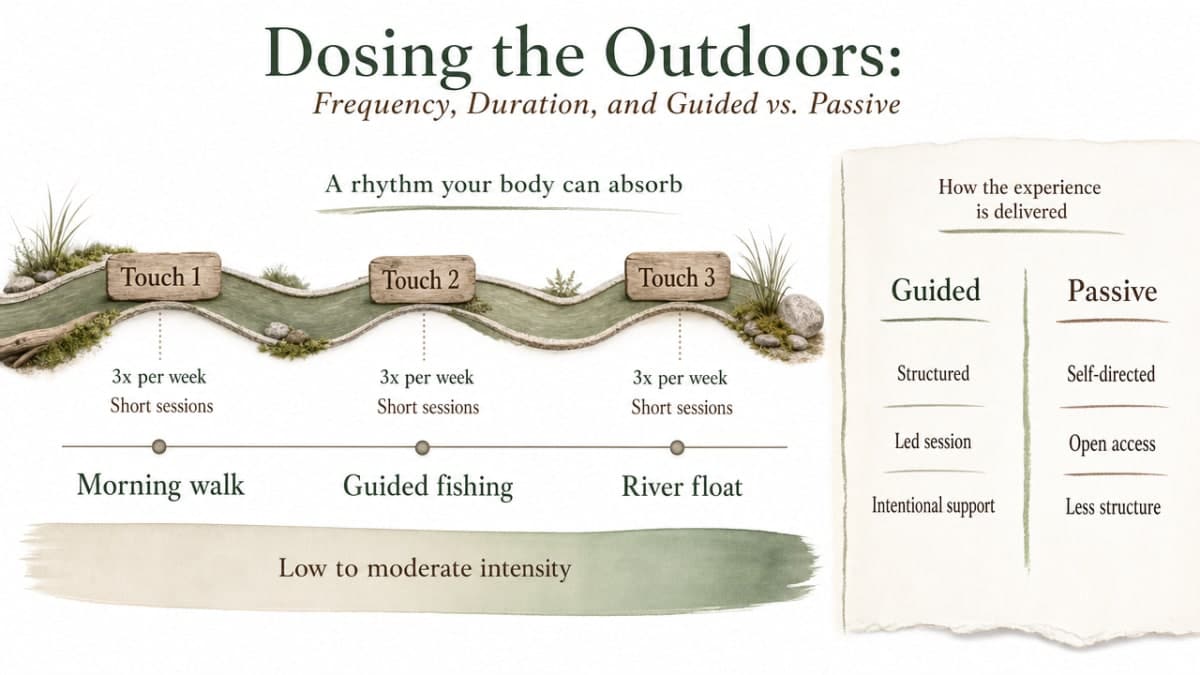
A 2025 review of green exercise and mental health looked at what actually moves the needle. The most pronounced benefits showed up with short-duration sessions, at least three times per week, at low-to-moderate intensity 15. Not marathon days. Not once-a-month wilderness expeditions. A rhythm your body can absorb without breaking down.
That pattern maps well onto what a residential week can hold. A morning walk on a Tuesday. A guided fishing session mid-week. A river float on Saturday. Three touches, none of them punishing, each one landing before the last one has fully faded from your nervous system.
Intensity matters too. Low-to-moderate does not mean easy. It means you are working, but you can still talk. Your heart rate is up, your breath is deeper, and you are not draining a body that is already trying to repair itself from months or years of use. A separate systematic review inside occupational therapy for SUD found moderate evidence for higher-intensity circuit work as well, so there is room to build 9. Start where you are. Add load as your body earns it. That is the dose.
Why Guided Activity Beats a Walk Alone
Here is a distinction almost no one makes, and it is the one that matters most for you.
Time in nature is not automatically protective. A 2025 scoping review looking at greenspace and substance use in adolescents and young adults found that guided activities in nature were associated with less substance use, while passive engagement in nature was associated with increased substance use 12. Same trees. Same trails. Different result depending on whether someone was leading the session or you were out there on your own.
Why does that gap exist? A walk alone in the woods can turn into a walk alone with your thoughts, and your thoughts, in early recovery, are not always your friend. Rumination climbs. Old memories surface. The trail becomes a place to hide rather than a place to heal.
Guided sessions change the equation. A trained staff member sets the pace, watches for distress, moves the group when someone is spiraling, and turns a hike into a shared experience instead of a solo one. Peers walking beside you rebuild the social muscle that using tore down. That is the difference between recreation and recreation therapy. Structure is the medicine.
A Week Inside a Montana Residential Program
Trails, Rivers, and Cold Water You Can Actually Reach
Geography matters more than most people give it credit for. If a program tells you it uses the outdoors, the next honest question is what outdoors, and how far you have to travel to get there.
Montana answers that question in a way most places cannot. From Kalispell, you are minutes from Flathead Valley trails that climb through pine and open onto lake views. From Missoula, the Clark Fork runs right through town, and the Bitterroot trailheads sit a short drive south. Bozeman puts you near the Gallatin. Great Falls sits along the Missouri. Cold rivers in July, snow-fed and clear enough to see the stones on the bottom. Trails that are groomed enough to be safe and wild enough to feel like actual country.
You do not need to be an outdoorsman to use any of it. That is the point. The land is close, the seasons are honest, and a guided group can be on a trail or in a drift boat within an hour of leaving the residence. When outdoor recreation is dosed at least three times a week at low-to-moderate intensity, as the strongest evidence suggests 15, the drive time to a trailhead becomes part of whether the model actually works. Here, it does.
How Elk Ridge Recovery Builds the Outdoors Into the Schedule
At Elk Ridge Recovery, hiking, fishing, and floating are written into the weekly schedule the same way group therapy and individual sessions are. Not offered when the weather cooperates. Not saved for the clients who ask. Scheduled.
That structure is deliberate. Guided nature activity is linked with less substance use in young people, while passive time in nature can trend the other way 12. So a staff member leads the walk. A guide sets the pace on the water. Peers move together. The trip has a start time, an end time, and someone watching for the client who goes quiet on the trail.
The outdoor block sits inside a full continuum. Physician-led medical detox handles the physical work of stopping. Residential inpatient holds the day. Medication-assisted treatment, dual diagnosis care for co-occurring depression, anxiety, or PTSD, individual and group therapy, family sessions, 12-step integration, and case management run alongside. The hike or float is not competing with any of that. It is one more dosed input, landing on the same nervous system the rest of the week is trying to steady.
Add sober transport for arrivals, a high staff-to-client ratio on outings, and an aftercare and alumni program that keeps the outdoor habit alive after discharge, and the model starts to look like what SAMHSA describes when it names physical activity a vital component of recovery 2. Built in. Not bolted on.
What Outdoor Recreation Cannot Do
It would be easier if a trail could carry all of it. It cannot.
Outdoor recreation does not manage the physical dependence that comes with alcohol, opioids, or benzodiazepines. Withdrawal from those substances can be dangerous, sometimes fatal, and it belongs in the hands of a physician-led medical detox. No amount of fresh air changes that.
It does not replace medication-assisted treatment for opioid use disorder. It does not replace the individual and group therapy that works through why the using started. It does not treat the depression, anxiety, PTSD, or bipolar disorder sitting underneath the substance use, all of which need dual diagnosis care to actually shift 6.
The largest government review of wilderness programs made the boundary plain. Most studies lacked comparison groups, so the field cannot yet claim that outdoor programming, on its own, causes recovery 10. Guided nature activity is a credible adjunct. It is not a stand-alone cure.
Hold both truths. A morning on the water can quiet your nervous system. It cannot detox your body or unpack your trauma. You need the trail and the clinical team.
Deciding Whether This Model Fits You or Someone You Love
You do not have to be certain to make a next call. You only have to be honest about where you are right now.
A program built around outdoor recreation as a real clinical input, not a weekend extra, tends to fit people who are tired of the noise, who feel their body has forgotten how to settle, and who want the treatment week to include something other than four walls. It fits people who need the physical piece of recovery worked on at the same time as the emotional piece, which is most people.
It is not the right fit if you or your loved one needs more than a program can safely provide outdoors. Active medical withdrawal comes first, in a physician-led detox. Untreated severe mental illness needs dual diagnosis stabilization alongside any trail time 6. Mobility limits, cardiac issues, or acute injury change what a guided hike can look like, and a good intake team will ask about all of it before scheduling a single outing.
Ask direct questions when you call any program:
- Is outdoor recreation on the written weekly schedule, or is it weather-permitting?
- Who leads the sessions, and what is the staff-to-client ratio on the water or the trail?
- How does the outdoor block connect to therapy, medication management, and aftercare?
Programs that treat guided activity as part of care will answer without hesitation, because structure is what makes it work 12.
You are allowed to want a treatment week that includes cold rivers and open sky. That instinct is not soft. It is your nervous system asking for a signal it can actually receive.
Talk to Someone Who Understands Recovery Challenges
Connect with a real person for support and immediate guidance on your recovery journey.
Frequently Asked Questions
Is outdoor recreation therapy a replacement for detox, medication, or counseling?
No. It sits alongside them. If your body has a physical dependence on alcohol, opioids, or benzodiazepines, you need a physician-led medical detox first. Medication-assisted treatment, individual and group therapy, and dual diagnosis care do work that a trail cannot do. Guided outdoor recreation is a credible adjunct inside a real clinical program, not a stand-alone cure 10.
How often do you need to be outside for it to actually help recovery?
The strongest current evidence points to short-duration sessions, at least three times per week, at low-to-moderate intensity 15. You do not need long, punishing days. A steady rhythm your body can absorb is what moves the needle. A residential week that schedules a hike, a fishing session, and a river float across the week fits that pattern well.
Does hiking or fishing really reduce cravings, or does it just distract you?
It does more than distract. Cravings ride on the stress response, and time in nature calms that system in ways a city walk does not 13. When your baseline stress drops, the internal spikes that drove you toward using come less often and with less force 5. Distraction fades in an hour. Nervous-system regulation lasts longer and builds with repetition.
What if you are not athletic or have never spent much time outdoors?
You are the person this model was built for. Low-to-moderate intensity means a pace where you can still talk. Guided sessions meet you where your body actually is, not where a marketing photo suggests it should be. A short walk on a groomed trail counts. A slow drift down a calm stretch of river counts. Start small. Your body will tell you when to add more.
Is a Montana-based program a good fit if you live out of state?
It can be, especially if you are in Idaho, North Dakota, South Dakota, or Wyoming, where travel is manageable. Distance from home can actually help early recovery by putting space between you and the people, places, and cues that trigger use. Ask about sober transport for arrivals and a clear aftercare and alumni plan for when you go home. Both matter more than the drive.
How is guided outdoor recreation different from just going for a walk on your own?
Big difference. A scoping review found that guided nature activity was linked with less substance use in young people, while passive time in nature was linked with more 12. A trained staff member sets the pace, watches for distress, and keeps the group moving when someone starts to spiral. Peers walk beside you. Structure turns the trail from a place to hide into a place that heals.
References
- The Intersection of Physical Activity, Wellness, and Recovery. https://library.samhsa.gov/sites/default/files/intersection-physical-activity-recovery-pep24-08-006.pdf
- The Intersection of Physical Activity, Wellness, and Recovery. https://library.samhsa.gov/product/intersection-physical-activity-wellness-and-recovery/pep24-08-006
- Effectiveness of physical activity interventions for improving symptoms of depression, anxiety and psychological distress in adult populations: a systematic review and meta-analysis. https://pubmed.ncbi.nlm.nih.gov/36796860/
- Promoting physical activity for mental health: an updated evidence review and practical guide. https://pubmed.ncbi.nlm.nih.gov/35674711/
- Physical activity and mental health: a systematic review and best evidence synthesis of mediation pathways. https://pmc.ncbi.nlm.nih.gov/articles/PMC11603721/
- The Role of Exercise in Management of Mental Health Disorders: Evidence, Gaps, and Future Directions. https://pmc.ncbi.nlm.nih.gov/articles/PMC8020774/
- Harnessing the healing power of nature: a review of natural interventions in substance abuse treatment and prevention. https://pmc.ncbi.nlm.nih.gov/articles/PMC11570648/
- Recovery Horizons: Nature-Based Activities as Adjunctive Treatments for Co-Occurring Post-Traumatic Stress Disorder and Substance Use Disorders. https://pmc.ncbi.nlm.nih.gov/articles/PMC11571177/
- Physical Activity Interventions Within Occupational Therapy for Substance Use Disorder: A Systematic Review. https://pmc.ncbi.nlm.nih.gov/articles/PMC12882691/
- Wilderness Therapy Programs: A Systematic Review of Research. https://www.wsipp.wa.gov/ReportFile/1748/Wsipp_Wilderness-Therapy-Programs-A-Systematic-Review-of-Research_Report.pdf
- Nature’s Role in Outdoor Therapies: An Umbrella Review. https://pmc.ncbi.nlm.nih.gov/articles/PMC8150931/
- Examining the Relationship Between Greenspace and Substance Use Among Adolescents and Young Adults: A Scoping Review. https://pmc.ncbi.nlm.nih.gov/articles/PMC12526326/
- Psycho-Physiological Stress Recovery in Outdoor Nature-Based Interventions: A Systematic Review of the Past Eight Years of Research. https://pubmed.ncbi.nlm.nih.gov/31100773/
- What is the impact of nature on human health? A scoping review of the literature. https://pmc.ncbi.nlm.nih.gov/articles/PMC9754067/
- Effects of urban green exercise on mental health. https://pmc.ncbi.nlm.nih.gov/articles/PMC12507887/