Key Takeaways
- Quality treatment rests on four verifiable pillars: accreditation with qualified staff, individualized planning built on the ASAM Criteria, a full continuum of care, and months-long aftercare 1.
- Accreditation from JCAHO or CARF sets a clinical floor, but SAMHSA’s five signs — including medication access, evidence-based therapy, and family involvement — tell you if care is real 1.
- Placement should follow ASAM’s six dimensions and allow movement up or down between detox, residential, PHP, IOP, and outpatient as your clinical picture changes, not as insurance days run out 3.
- Bring specific questions to the admissions call about accreditation, ASAM reassessment, medications for your substance, continuity of clinicians, and how long aftercare contact actually lasts 6.
The Four Things That Actually Separate Real Treatment From a Pretty Building
If you’re reading this at 2 a.m., or between shifts, or in a parking lot after another night that didn’t go the way you promised yourself it would — that already counts. You are doing the hardest part of research: looking honestly at what you need.
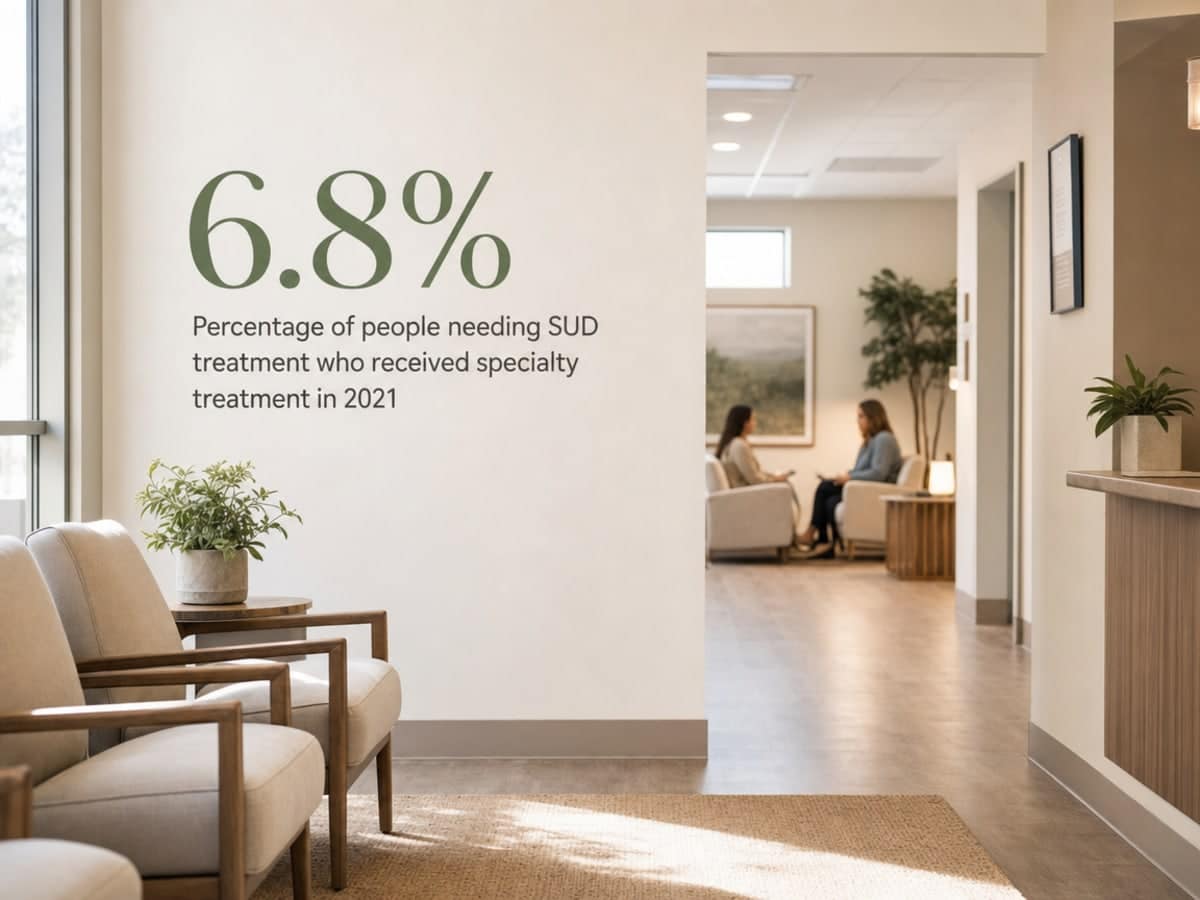
Here is the piece nobody says out loud. In 2021, roughly 43.7 million U.S. adults needed treatment for a substance use disorder, and only about 6.8% of them received care at a specialty facility 4. That is not a story about people not wanting help. It is a story about a system where quality care is uneven, hard to find, and easy to fake with a nice website and a mountain photo.
So how do you tell a real treatment program from a pretty building? Federal agencies and peer-reviewed research keep landing on the same four things:
- Accredited clinical care with qualified staff you can actually verify 1.
- An individualized plan built on a recognized placement standard — the ASAM Criteria — not a one-size 30-day script 3.
- A full continuum of care that moves you between detox, residential, PHP, IOP, and outpatient as your needs change, not as your calendar runs out 2.
- Structured aftercare that lasts months, not days, with real follow-up contact 6.
The rest of this guide walks each one, gives you the exact questions to ask on an admissions call, and shows what these standards look like in practice — including at programs like Elk Ridge Recovery in Montana, which is built around this same four-part spine. You do not need to become an expert. You just need four questions and the nerve to ask them. You already have the nerve, or you wouldn’t be here.
Criterion One: Accreditation and Clinical Staffing You Can Verify
What Accreditation Actually Buys You (and What It Doesn’t)
Accreditation is the first filter, not the whole answer. When a program is accredited by The Joint Commission (often called JCAHO) or CARF, an outside team has actually walked the halls, read the charts, checked how medications are stored, and looked at how the clinical staff is trained and supervised. That is not a marketing badge. It is a floor.
Here is the honest part. Peer-reviewed research on U.S. facilities found that accredited programs tend to offer more quality-linked services, but accreditation alone does not prove better patient outcomes 5. So use it the way a nurse uses a thermometer — as one important reading, not the whole diagnosis.
What accreditation buys you:
- a licensed medical director,
- defined protocols for detox and psychiatric emergencies,
- documented staff credentials,
- and a formal complaint process you can actually use.
What it does not buy you on its own: individualized planning, medication access, a real continuum, or aftercare.
Ask the admissions line two direct questions. Who is your accrediting body, and can you send me your current certificate? Any real program answers both in one email. Elk Ridge Recovery, for example, is JCAHO-accredited and will send that documentation without you having to push.
The Five Signs SAMHSA Says a Quality Program Should Show
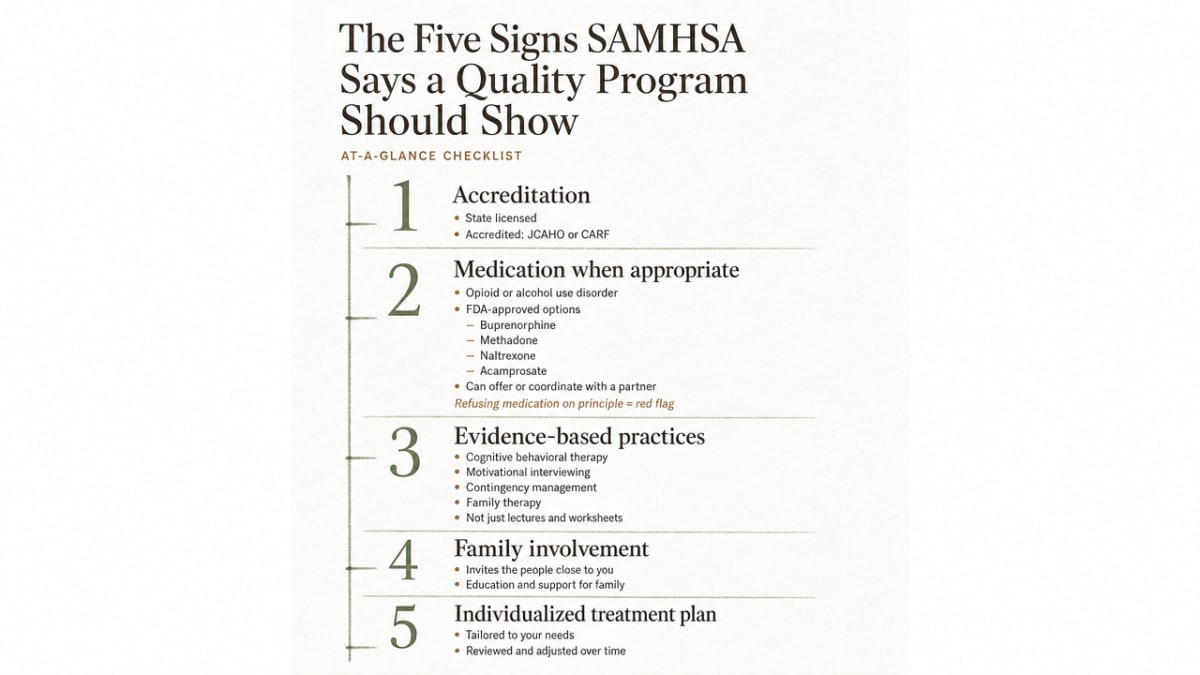
SAMHSA, the federal agency that oversees behavioral health, publishes a consumer guide with five plain-English signs of a quality treatment program 1. Print them. Screenshot them. Bring them to the phone call.
- Accreditation. The program is licensed by the state and accredited by a recognized body like JCAHO or CARF.
- Medication when appropriate. If you have an opioid or alcohol use disorder, the program can offer FDA-approved medication (buprenorphine, methadone, naltrexone, acamprosate) or coordinate it with a partner. Refusing medication on principle is a red flag.
- Evidence-based practices. The clinical work uses therapies with a research base — cognitive behavioral therapy, motivational interviewing, contingency management, family therapy — not just lectures and worksheets.
- Family involvement. The program invites the people who love you into education and therapy, with your consent. Addiction happens inside relationships, and recovery does too.
- Support beyond the acute phase. There is a real plan for after you leave — recovery coaching, sober housing help, employment supports, alumni connection — not just a discharge folder.
These five are the spine of every other criterion in this guide. If a program cannot clearly say yes to all five, you have your answer. If they can, you have a starting point worth exploring further. A well-built program, like Elk Ridge Recovery, is designed around these five on purpose — accreditation, medication-assisted treatment, evidence-based therapy, family programming, and an alumni network that keeps in contact after discharge — because the research keeps pointing to the same short list.
Criterion Two: An Individualized Plan Tied to the ASAM Placement Standard
Why ‘Everyone Gets 30 Days’ Is a Red Flag
Your body, your history, your substance, your mental health, your home life, your job, your safety when you leave — none of those fit a calendar. A person coming off high-dose fentanyl with untreated PTSD and no stable housing needs something very different from someone with a decade of alcohol use and a supportive spouse. The plan has to be built for the person in front of the clinician, not the slot on the schedule.
SAMHSA is clear about this. A quality program does a thorough assessment at intake and builds an individualized treatment plan around what that assessment finds, then updates the plan as you change 1. That means real questions about your medical history, your mental health, your trauma, your family, your legal situation, and what you actually want your life to look like six months from now.
Ask directly: “How do you decide how long I should stay, and who reassesses that?” A good program has a real answer. A program with one answer for everyone has already told you what it thinks of you.
How ASAM Levels of Care Should Move You Up and Down
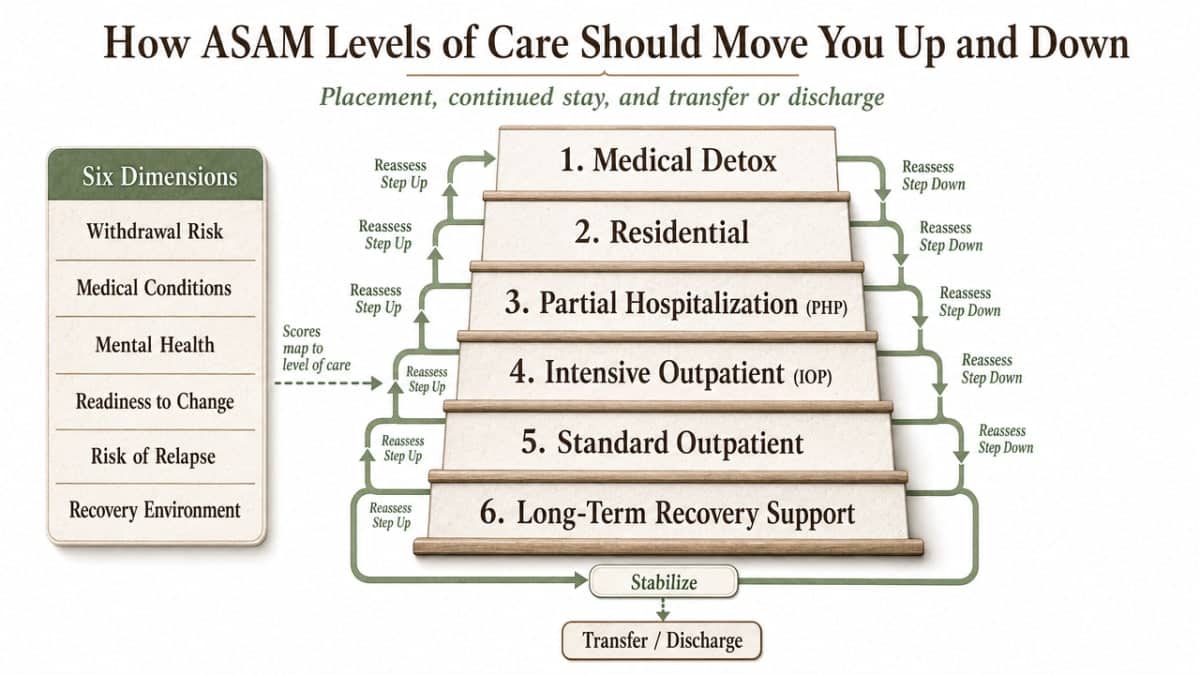
The tool most quality programs use to make placement honest is called the ASAM Criteria. SAMHSA describes it as the most widely used and comprehensive set of guidelines for placement, continued stay, and transfer or discharge in addiction treatment 3. It is not a marketing framework. It is the closest thing the field has to a shared clinical language.
ASAM looks at six dimensions of your life at once:
- withdrawal risk,
- medical conditions,
- mental health,
- your readiness to change,
- your risk of relapse,
- and your recovery environment.
Those six scores map you to a level of care — medical detox, residential, partial hospitalization (PHP), intensive outpatient (IOP), standard outpatient, or long-term recovery support.
Here is the part most brochures leave out. You are supposed to move. If you stabilize faster than expected, you should step down. If you struggle in outpatient, you should step back up. Movement is based on reassessment, not on how many days your policy authorized.
Ask the admissions team: “Do you use the ASAM Criteria for placement, and how often will my level of care be reassessed while I’m in your program?” A program like Elk Ridge Recovery is built around this exact ladder — detox to residential to PHP to IOP to outpatient to aftercare — so people can move up or down as their clinical picture actually changes, not when a countdown ends.
Modality Should Match the Substance: Contingency Management and MOUD
Individualization is not just about how long you stay. It is also about what happens inside the therapy room and the medication cabinet. The evidence base looks different for different substances, and a good program knows the difference.
If you are struggling with opioids, medications for opioid use disorder — buprenorphine, methadone, or naltrexone — are the standard of care, and SAMHSA tracks pharmacotherapy for OUD as one of its three national SUD quality measures 2. A program that flatly refuses to offer or coordinate these medications is out of step with the federal quality benchmark. That is not opinion; that is the measure.
If you are struggling with methamphetamine or cocaine, the picture is different. The ASAM/AAAP clinical practice guideline names contingency management — a structured behavioral approach that rewards verified periods of non-use — as the current standard of care for stimulant use disorder 9. If a program treats meth the same way it treats alcohol, that is a modality mismatch.
Ask two clean questions: “What medications do you offer for my specific substance?” and “What behavioral therapies do you use, and why those?” You are listening for specifics — CBT, motivational interviewing, contingency management, family therapy, trauma-focused work — not vague talk about “holistic healing.” Specific answers mean someone actually thought about you.
Criterion Three: A Full Continuum, Not a Single Front Door
Detox to Residential to PHP to IOP to Outpatient — as One Chain
A good program is not one door. It is a hallway with several doors, and the same clinical team walking you between them.
The chain looks like this: medical detox to stabilize your body, residential care while your nervous system is still raw, partial hospitalization (PHP) when you can hold structure but still need most of the day in treatment, intensive outpatient (IOP) when you are ready to sleep somewhere else and come in for sessions, standard outpatient as you rebuild a real week, and aftercare that keeps a hand on your shoulder for months. SAMHSA tracks continuity after withdrawal management and continuity after inpatient or residential as two of its three national SUD quality measures — meaning the handoff itself is what the federal government watches 2.
Here is why this matters. When detox happens at one facility, residential at a second, and outpatient at a third, information falls through the cracks. Medications get paused. Your history gets retold to strangers. The most fragile week of your recovery becomes a paperwork problem.
Ask: “If I start in detox with you, do the same clinicians follow me through residential, PHP, and IOP?” Programs built as one chain — Elk Ridge Recovery among them — keep your chart, your therapist, and your case manager consistent as you step down. That continuity is the point.
Dual Diagnosis and Medical Care Under One Roof
Most people with a substance use disorder are carrying something else too — depression, anxiety, PTSD, bipolar, ADHD, chronic pain, a traumatic brain injury, untreated diabetes. If a program treats the addiction and ignores the rest, it is treating half of you.
Dual diagnosis care means a psychiatric provider is on the team, not on a referral list. It means your medications for depression or PTSD are managed in the same building where you do group therapy. It means the trauma that has been driving the drinking gets named and worked with, not left for “after you get sober.”
The same logic applies to your body. Blood pressure, liver function, hepatitis and HIV screening, dental infections, wound care — these do not pause because you entered treatment. Peer-reviewed research on U.S. facilities found that in 2017, fewer than half offered HIV/STD testing on site 5. That gap tells you to ask.
Ask: “Do you have a psychiatrist and medical provider on staff, and how are my mental health medications and physical health managed while I’m here?” A program like Elk Ridge Recovery integrates dual diagnosis support and physician-led medical care into the same treatment plan, so you are one person to them, not two charts.
Criterion Four: Aftercare That Lasts Months, Not Days
Here is where most programs quietly fail you. The intake is warm, the residential stay is intense, and then the door opens and the follow-up is a photocopied list of AA meetings. That is not aftercare. That is a handoff to nobody.
The research is unusually clear on this one. A peer-reviewed review of continuing care concluded that aftercare should last at least three to six months, and ideally involve some form of contact across a full 12-month continuum before you can call the recovery robust 6. Not one call at week two. Months of lower-intensity contact — check-ins with a counselor, recovery coaching, alumni groups, medication management, family sessions — that keep a real person in your corner while the world tries to reabsorb you.
The federal quality measures now track the handoff directly. CMS uses initiation of treatment within 14 days of an SUD diagnosis and continued engagement within 34 days as core measures of whether a program actually gets you in and keeps you in 8. SAMHSA separately tracks continuity of care after withdrawal management and after inpatient or residential stays as national quality benchmarks — meaning the federal government is watching whether people fall off the cliff between levels of care 2.
Ask three things. How long will you stay in contact with me after I finish residential? Who specifically will call, and how often? Do you have an alumni program with real people in it, not a Facebook group nobody uses? A program built for the long haul — Elk Ridge Recovery structures aftercare, alumni connection, recovery coaching, and case management as part of the same plan, not a farewell packet — treats month four the way it treated week one. You deserve that kind of steadiness. The point of aftercare is that you are not doing this alone the moment it gets quiet.
The Honest Gap: Why These Criteria Matter So Much
You might be wondering if this level of scrutiny is really necessary. It is. Here is the piece of the picture the industry does not put on its billboards.
That is not a slam on the people working inside those facilities. Many are underfunded, understaffed, and trying. It is a warning about the field as a whole. When you call a program and ask about MAT, dual diagnosis screening, employment support, or how you will get to appointments after discharge, you are not being difficult. You are checking whether this specific program is in the half that actually offers what the research says works.
The four criteria in this guide — accreditation, individualized planning tied to ASAM, a full continuum, and real aftercare — exist because the average is not good enough. You are allowed to want above-average care. Asking the questions is how you find it.
The Exact Questions to Ask on the Admissions Call
When the phone rings and someone friendly picks up, your mind can go blank. That is normal. Save this list. Read it off the screen if you need to. You are not being rude — you are doing the work a good program will respect.
On accreditation and staffing: Who accredits you, and will you email me your current certificate? Who is your medical director, and is there a psychiatrist and nurse on staff?
On individualized planning: Do you use the ASAM Criteria for placement, and how often will my level of care be reassessed 3? What does your intake assessment cover — medical, mental health, trauma, family, housing, work?
On medication and modality: What FDA-approved medications do you offer for my specific substance 2? If I am here for stimulants, do you use contingency management 9? Which specific therapies do your counselors practice?
On the continuum: If I start in detox, do the same clinicians follow me through residential, PHP, and IOP? What happens if I need to step back up?
On aftercare: How long will you stay in contact after residential, and who calls? Do you have an active alumni program and recovery coaching 1?
On the practical stuff: Do you verify my insurance today, in writing? How do I get from home to your door if I cannot drive myself?
If any answer is vague, ask again. A program that treats these questions as welcome is a program that will treat you the same way.
What ‘Success’ Should Mean Beyond Just Staying Sober
Sobriety is the headline, but it is not the whole story. If the only question a program can answer is “did you use or not,” it is measuring one wall of a house.
Peer-reviewed research on SUD treatment outcomes recommends looking at three areas at once: substance use itself, the treatment process (did you start, did you stay, did you engage), and quality of life — how you are actually living 11. SAMHSA’s national treatment data tracks a similar spread: retention in treatment, abstinence, housing stability, employment status, criminal justice involvement, and social support 7. CMS has begun tracking improvement or maintenance in recovery and functioning as a behavioral health outcome measure, not just a checkbox for attendance 10.
What that means for you: a good program should be able to tell you, in plain language, how they define success and what they track. Are you sleeping? Working or in school? Housed? Back in touch with people who love you? Managing the depression or PTSD that was there under the using? Those count. Ask, “How will we know this is working three months and six months from now?” A program that has an answer is a program that is planning past the discharge date.
The Montana and Northern Rockies Reality: Distance, Access, and Sober Transport
If you live in Libby, or on a ranch outside Lewistown, or three hours from the nearest hospital in Wyoming, the treatment map looks different than it does in a brochure. The nearest program with medication for opioid use disorder might be a state away. The nearest psychiatrist who takes your insurance might be booked six weeks out. That is not a personal failing. It is geography.
Two practical questions matter more here than almost anywhere else. First, how will you physically get to treatment and back? Peer-reviewed facility data found fewer than half of U.S. programs offered transportation assistance in 2017 5, and the gap widens in rural counties. Ask whether the program provides sober transport from your town, coordinates flights, or partners with someone who does. Elk Ridge Recovery serves Montana, Idaho, and the Dakotas with sober transport built into intake for exactly this reason.
Second, distance from home can be a feature, not a bug. Enough space to detox without every trigger in arm’s reach, close enough that family can drive up for a weekend session. That balance is worth asking about out loud.
Speak With Someone Who Understands Addiction Recovery
Get real answers about your next steps toward safe, structured support.
Frequently Asked Questions
How can I tell if an addiction treatment program is accredited?
Ask two questions and expect fast answers. Who accredits you, and will you email me your current certificate? Recognized accrediting bodies include The Joint Commission (JCAHO) and CARF. You can also verify directly on the accreditor’s public search tool. State licensing is separate from accreditation, so ask for both. If the admissions team hesitates or sends marketing copy instead of documentation, that hesitation is the answer 1.
How long should a good addiction treatment program last?
Long enough to match your clinical picture, then longer than that in lower-intensity contact. There is no magic 30-day number. Peer-reviewed research on continuing care recommends at least three to six months of aftercare, ideally with some form of contact stretching across a full 12 months 6. The acute phase (detox, residential) is short. The follow-up should not be.
What questions should I ask on the first admissions call?
Six will get you most of the way. Who accredits you? Do you use the ASAM Criteria for placement, and how often is that reassessed 3? What FDA-approved medications do you offer for my substance? Do the same clinicians follow me through detox, residential, and outpatient? How long does aftercare contact last, and who calls? Will you verify my insurance in writing today?
Does a good program have to offer medication for addiction?
For opioid and alcohol use disorders, yes — or it should coordinate medication with a partner without friction. SAMHSA tracks pharmacotherapy for opioid use disorder as one of three national SUD quality measures 2. FDA-approved options include buprenorphine, methadone, and naltrexone for opioids, and naltrexone and acamprosate for alcohol. A program that refuses medication on principle is out of step with the federal quality benchmark.
What should aftercare actually look like after I leave treatment?
Real people, real contact, on a real schedule. That means a named counselor or recovery coach checking in, ongoing medication management if you need it, an active alumni community, family sessions when helpful, and a plan for housing and work. SAMHSA tracks continuity of care after withdrawal management and after residential treatment as national quality measures 2. A photocopied list of meetings is not aftercare.
Is it worth traveling out of state for treatment from Montana, Idaho, or the Dakotas?
Often, yes. In rural counties, the nearest program offering medication for opioid use disorder, dual diagnosis care, or a full continuum can be a state away — and peer-reviewed facility data found fewer than half of U.S. programs offered transportation assistance in 2017 5. Distance from your triggers can help stabilization, while a program with sober transport and family-weekend programming keeps you connected to home.
References
- FINDING QUALITY TREATMENT FOR SUBSTANCE USE DISORDERS. https://library.samhsa.gov/sites/default/files/pep18-treatment-loc.pdf
- Advancing Quality Measurement in Behavioral Health. https://www.samhsa.gov/substance-use/treatment/advancing-quality-measurement-behavioral-health
- ASAM Criteria for Patients with Addiction and Co-occurring Conditions. https://www.samhsa.gov/resource/ebp/asam-criteria-patients-addiction-co-occurring-conditions
- Addiction Treatment | National Institute on Drug Abuse (NIDA). https://nida.nih.gov/nidamed-medical-health-professionals/treatment/addiction-treatment
- Tracking the Quality of Addiction Treatment Over Time and Across States: Using the Federal Government’s “Signs” of Higher Quality. https://www.ncbi.nlm.nih.gov/books/NBK559647/
- The Continuing Care Model of Substance Use Treatment: What Works, and When Is “Enough,” “Enough?”. https://pmc.ncbi.nlm.nih.gov/articles/PMC4007701/
- Treatment Episode Data Set (TEDS) 2024: Admissions to and Discharges from Substance Use Treatment Services. https://www.samhsa.gov/data/report/treatment-episode-data-set-teds-2024-admissions-and-discharges-substance-use-treatment
- Overview of Substance Use Disorder Measures in the 2024 Child, Adult, and Health Home Core Sets. https://www.medicaid.gov/medicaid/quality-of-care/downloads/factsheet-sud-adult-core-set.pdf
- The ASAM/AAAP Clinical Practice Guideline on the Management of Stimulant Use Disorder. https://stacks.cdc.gov/view/cdc/156927
- CMS Quality Measure Development Plan – 2024 Annual Report. https://www.cms.gov/files/document/2024-quality-measure-development-plan-annual-report.pdf
- Substance Use Disorder Treatment Outcomes. https://pmc.ncbi.nlm.nih.gov/articles/PMC12180564/
- 2024 National Survey on Drug Use and Health (NSDUH) Releases. https://www.samhsa.gov/data/data-we-collect/nsduh-national-survey-drug-use-and-health/national-releases/2024