Key Takeaways
- Anxiety and substance use form a bidirectional loop where each condition worsens the other, making sequential ‘get sober first’ treatment measurably less effective than integrated care 5.
- Anxiety in active addiction shows up three ways: pre-existing disorder, substance-induced symptoms, and withdrawal-driven states — each requiring different clinical responses and repeated assessment over time 5.
- Integrated treatment screens for co-occurring conditions on day one, coordinates therapy and medication under one team, and handles benzodiazepine decisions with attention to misuse potential 1, 3.
- When evaluating a program, distinguish dual-diagnosis capable from dual-diagnosis enhanced, ask when anxiety assessment happens, and confirm how care shifts across detox, residential, PHP, IOP, and aftercare 4.
The 3 A.M. Loop: When Anxiety and Substance Use Feed Each Other
You know the loop before anyone names it for you. It’s 3 a.m. Your chest is tight, your jaw is set, and a conversation from six hours ago is playing on repeat. You get up. You pour the drink, or you take the pill, or you find the pipe. Within twenty minutes, the volume drops. You sleep for a few hours. And then you wake up shaky, sicker than yesterday, with the same anxiety waiting at the foot of the bed — only sharper now, because your nervous system has been through another round.
That loop is not a character flaw. It’s a pattern that clinicians recognize and researchers have mapped. Anxiety pushes you toward the substance. The substance quiets the anxiety for a few hours. Then withdrawal, rebound, and disrupted sleep hand the anxiety back to you with interest, and the next use has to be a little bigger to close the gap. Peer-reviewed reviews of anxiety and substance use describe exactly this bidirectional pull, where each condition shapes the course of the other over time 13. NIAAA’s work on anxiety and alcohol-use disorder tracks the same dynamic and links it to relapse vulnerability after treatment ends 5.
Here is the part worth sitting with: you are not treating one problem with a bad tool. You are living inside two conditions that have grown together. Pulling them apart is the work — and it is work that can actually be done.
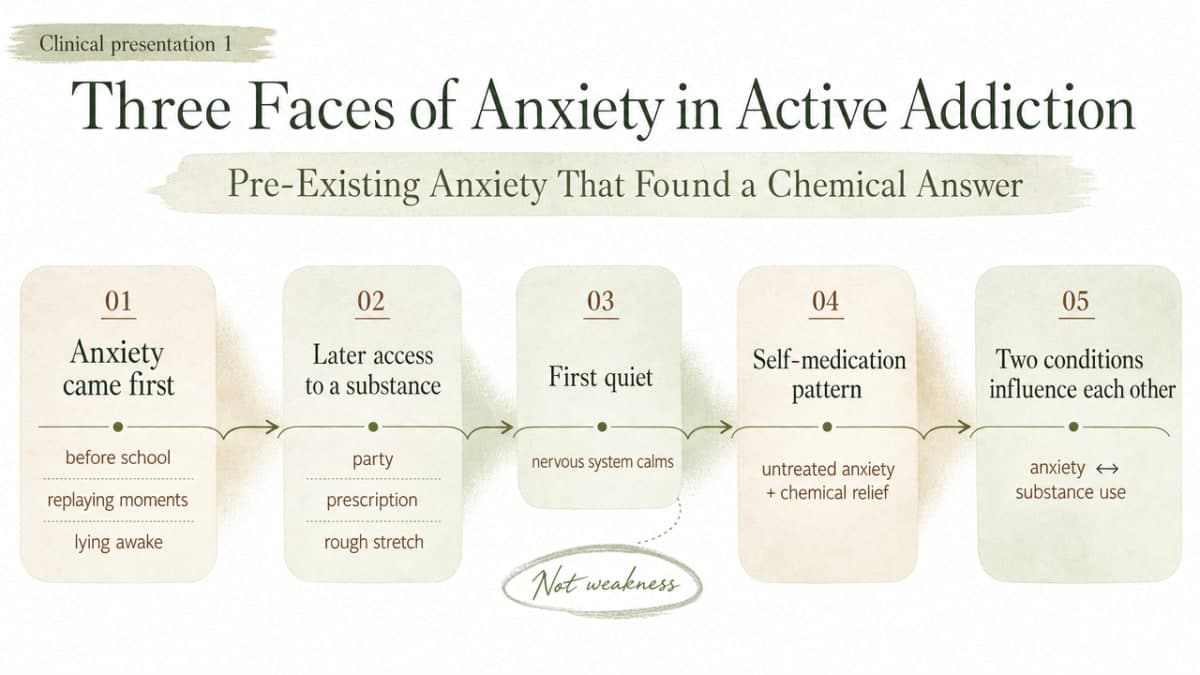
Three Faces of Anxiety in Active Addiction
Pre-Existing Anxiety That Found a Chemical Answer
For a lot of people, the anxiety came first. Maybe you were the kid who threw up before school on Sundays, or the teenager who couldn’t stop replaying every awkward moment, or the adult who lay awake calculating things that didn’t need calculating. Then, at some point — a party in high school, a prescription after surgery, a rough stretch in your twenties — you found something that worked. A drink. A pill. A line. And for the first time, your nervous system got quiet.
That is not weakness. That is a person with an untreated anxiety disorder discovering, by accident, a substance that acts on the same brain systems that anti-anxiety medications target. Researchers describe this as a self-medication pattern, and they note that when anxiety precedes substance use, the two conditions influence each other over time in ways that make either one harder to treat alone 13.
Substance-Induced Anxiety From Alcohol, Stimulants, and Chronic Use
Then there is the anxiety the substance built. Heavy alcohol use rewires the brain’s stress and reward circuits. Stimulants — cocaine, methamphetamine, high-dose prescription amphetamines — leave your sympathetic nervous system stuck in the on position, so the racing heart and the intrusive dread you feel at hour eighteen are not “just you.” Chronic opioid use flattens your ability to regulate mood, and the anxiety that emerges between doses can feel identical to a lifelong disorder even when it isn’t.
This is why clinicians are cautious about diagnosing an anxiety disorder in someone who is intoxicated or in acute withdrawal. NIAAA’s review of anxiety and alcohol-use disorder makes the point directly: anxiety symptoms can be substance-induced, independent, or both, and accurate diagnosis often requires repeated assessment during recovery rather than a single snapshot during a rough week 5. What looks like generalized anxiety on day three can look very different on day thirty.
Withdrawal-Driven Anxiety and the Danger Window
The third face is the one that shows up in the first days without the substance, and it is the most dangerous. Alcohol and benzodiazepine withdrawal produce anxiety that can climb into panic, tremor, and — in severe cases — seizures. Opioid withdrawal brings a specific kind of skin-crawling agitation that does not respond to reassurance. Stimulant crashes flatten mood and spike irrational fear. Every one of these states is a moment when the loop from the opening of this article tightens: your body is screaming for relief, and the relief you know how to deliver is the substance itself.
Why ‘Get Sober First, Then Handle the Anxiety’ Fails
For decades, the standard advice ran something like this: get clean, string together six months, and then — if the anxiety is still there — we’ll deal with it. That model made a certain kind of sense in a world where addiction programs and mental-health programs sat in separate buildings with separate paperwork. It also failed a lot of people. You were one of them, maybe. You finished a program, felt proud, went home to the same racing thoughts and the same 3 a.m. wake-ups, and reached for the same solution you’d always used, because nothing had changed about the underlying condition that started the loop.
The research on why this happens is direct. NIAAA’s review of anxiety and alcohol-use disorder reports that anxiety disorders are associated with elevated risk of relapse following alcohol treatment — meaning that people who leave residential care with an unaddressed anxiety disorder are measurably more likely to return to drinking than people who don’t 5. NIDA reinforces the mechanism from a different angle: stress is one of the most reliable triggers for relapse across substances, and an untreated anxiety disorder is, by definition, a chronic internal stressor that follows you home from treatment 7.
Federal guidance has moved accordingly. SAMHSA’s current advisory drawn from TIP 42 tells clinicians to screen for co-occurring conditions at intake and build a single coordinated treatment plan rather than sequencing them — addiction now, mental health later 1. NIAAA states plainly that the likelihood of recovery from both conditions is higher when both are treated, and that level of care should reflect the severity of each 3. Sequential treatment is not a more careful version of integrated treatment. It is a slower version that gives the loop time to reassemble.
What Integrated Treatment Actually Looks Like
Screening on Day One, Not Week Six
Integrated care starts with a question no one asked you the last time you tried to get sober: what does your anxiety look like when the substance is gone? SAMHSA’s advisory drawn from TIP 42 tells treatment programs to screen for co-occurring mental-health conditions at intake — not after detox, not after residential, not once you’ve “earned” the conversation by staying clean for a while 1. That screening is a real clinical assessment, with structured questions about panic, worry, avoidance, sleep, trauma history, and the timing of symptoms relative to your use.
Day-one screening does two things for you. It puts anxiety on the treatment plan from the beginning, so no one is surprised in week three when your sleep collapses or a panic attack hits during a group. It also creates a baseline the clinical team can compare against later, because anxiety symptoms shift as the substance leaves your system. SAMHSA frames co-occurring disorders broadly — no specific diagnostic combination is required — which means your clinicians should be looking at the whole picture from the first conversation, not waiting for a textbook presentation 2.
Coordinated Therapy: CBT, Exposure, and Stress-Reduction Skills
Once anxiety is on the plan, the therapy work has to actually address it. In an integrated program, the same clinician — or a tightly coordinated team sharing one treatment plan — uses cognitive-behavioral therapy to target both the thoughts that drive drinking and the thoughts that drive panic. Exposure work helps you sit with the sensations you’ve spent years drinking or using to escape: the racing heart, the tight chest, the certainty that something is about to go wrong. Stress-reduction skills, including mindfulness-based approaches, give your nervous system something to do besides reach for the substance. NIDA notes that mindfulness-based stress reduction has shown benefits for depression, anxiety, and substance use in relevant studies, and that stress-management skills are central to relapse prevention 6.
The outcome difference is not subtle. A peer-reviewed review of integrated treatment for co-occurring psychiatric and substance-use disorders reports that integrated care has been consistently superior to separate treatment plans, with integrated anxiety-and-SUD interventions increasing abstinent days, reducing symptoms, and improving retention in treatment 14. Three dimensions, one model — because the two conditions were never really separate to begin with.
The Benzodiazepine Question and Medication Decisions in SUD
You are probably wondering about medication, and you have every right to. If your anxiety is severe, the thought of white-knuckling it through detox and early recovery without something to take the edge off is genuinely frightening. Here is the honest answer: medication is often part of integrated care, but the calculus is different when addiction is in the picture.
NIAAA’s core resource on alcohol-use disorder and co-occurring conditions advises clinicians to avoid as-needed medications with misuse or overdose potential — a category that includes benzodiazepines like alprazolam, lorazepam, and clonazepam — when their use would be clinically inappropriate in someone with a substance-use disorder 3. That does not mean anxiety goes untreated. It means the medication conversation focuses on options without the same misuse profile: certain antidepressants used at therapeutic doses for anxiety disorders, non-addictive medications for sleep, and scheduled rather than as-needed dosing when a benzodiazepine is genuinely necessary for short-term stabilization.
The point is that a good clinical team explains the reasoning to you, involves you in the decision, and revisits it as your recovery stabilizes. You are not being punished. You are being kept alive.
When Anxiety Is Trauma-Shaped: Hyperarousal, Avoidance, and Concurrent Trauma-Focused Care
Sometimes what you’ve been calling anxiety has a specific origin. The hypervigilance that never turns off. The nightmares. The way certain sounds, places, or physical sensations send your body somewhere it does not want to go. The avoidance patterns that shrink your life down to a smaller and smaller circle. When anxiety is trauma-shaped, it needs trauma-informed treatment — and, for a long time, the field told people they had to be sober for a year before that work could begin.
The current evidence points the other direction. The VA National Center for PTSD is direct: patients with co-occurring trauma-related symptoms and substance-use disorders can tolerate and benefit from evidence-based trauma-focused treatment, and neither disorder should be a barrier to treating the other 8. Concurrent models — including COPE, which blends trauma-focused work with substance-use treatment in the same protocol — treat both at the same time and produce meaningful improvement in both 10. If your anxiety has trauma underneath it, an integrated program should be able to name that, offer a real therapeutic approach for it, and start the work while you’re still stabilizing — not years from now.
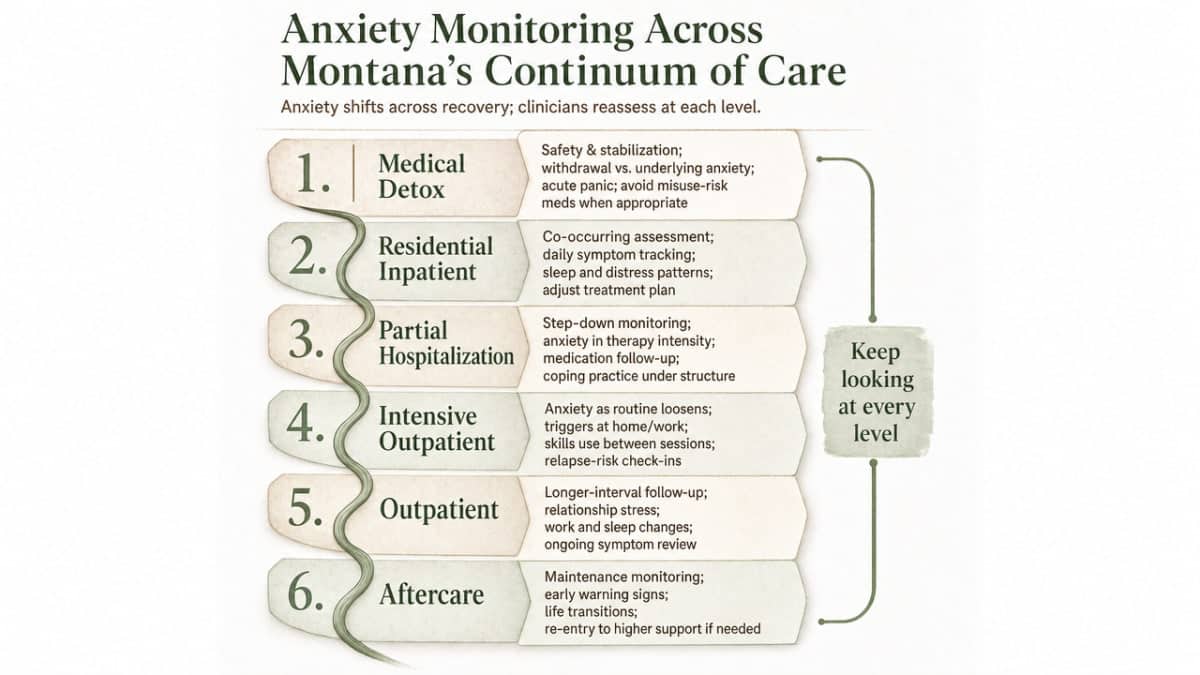
Anxiety Monitoring Across Montana’s Continuum of Care
Anxiety does not hold still while you get sober. It shifts as your body clears the substance, as sleep returns, as your relationships change, and as the structure of your day loosens. A program that treats anxiety once — during intake — and then moves on has already lost the plot. The whole point of a continuum of care is that clinicians keep looking, at each level, because what needs attention at day three is not what needs attention at day ninety.
Here is what that looks like in practice across the levels Elk Ridge Recovery offers in Montana.
- In medical detox, the focus is safety and stabilization: separating withdrawal-driven anxiety from an underlying disorder, managing acute panic, and avoiding medications with misuse potential where clinically appropriate 3.
- In residential inpatient, clinicians run a proper co-occurring assessment now that the acute noise has faded, build a single treatment plan that names anxiety alongside the substance-use diagnosis, and start CBT, exposure, and stress-reduction work. SAMHSA’s advisory drawn from TIP 42 anchors this coordinated planning as the standard, not the upgrade 1.
- In partial hospitalization (PHP), the day is still highly structured but you’re practicing skills in a more open environment — which is when anxiety often reemerges in new shapes. Clinicians reassess. Medication is reviewed. Sleep and appetite are tracked as leading indicators.
- In intensive outpatient (IOP) and standard outpatient, the check-ins get spaced further apart, but relapse-risk screening tightens: stress exposure is now real-world, and stress is one of the most reliable relapse triggers across substances 7.
- In aftercare and alumni programming, the work becomes longitudinal — clinicians and peer supports keep asking about anxiety, sleep, and avoidance long after the last group, because the VA’s whole-person guidance is clear that mental-health conditions co-occurring with SUD need ongoing assessment and treatment, not a one-time fix 17.
The through-line: your anxiety gets a fresh look at every level of care, and the plan changes when the picture changes.
How to Evaluate Any Program for Dual-Diagnosis Care
Dual-Diagnosis Capable vs. Dual-Diagnosis Enhanced: The Vocabulary That Matters
Almost every treatment center in the country will tell you they handle dual diagnosis. The word has become marketing furniture. What you actually need is the vocabulary that separates a program that can manage a co-occurring anxiety disorder from one that just tolerates one.
NIAAA’s treatment-navigation guidance uses two terms that are worth memorizing. A dual-diagnosis capable program can treat people whose psychiatric symptoms are stable and who mostly need addiction care with awareness of the mental-health condition in the background. A dual-diagnosis enhanced program is built for people whose anxiety, trauma, or other psychiatric symptoms are active and severe, with clinicians, medication management, and therapy protocols organized to treat both conditions at the same level of intensity 4.
The difference matters most when anxiety is loud. If your panic wakes you at night, if avoidance has shrunk your life, if trauma sits underneath the drinking, you probably need enhanced, not capable. NIAAA also flags one credential above the others: a board-certified addiction psychiatrist has the highest level of training across both addiction and mental-health care 4. Ask whether one is on staff, or on the consulting team, before you decide.
Questions to Ask Admissions Before You Commit
Admissions calls tend to be gentle. That’s fine — you’re often calling on a bad day. But a few direct questions will tell you more than any brochure.
- Ask when the anxiety assessment happens. If the answer is anything other than intake, keep looking; SAMHSA’s advisory drawn from TIP 42 makes day-one screening the standard 1.
- Ask whether one clinical team owns both the addiction and the anxiety treatment plan, or whether you’d be handed off between two departments.
- Ask how medication decisions get made when a substance-use disorder is in the picture, and listen for a real answer about misuse potential rather than a shrug 3.
- Ask what happens to your anxiety care when you step down from residential to PHP, and again to IOP.
Ask one more thing: what happens if you relapse. A program that treats that as a clinical event to respond to, not a reason to discharge you, is telling you something honest about how it understands the illness.
If Relapse Happens: Reading It as a Signal, Not a Verdict
If you’ve relapsed before — or if you relapse after this next round of treatment — you need to hear something clearly. It does not mean you failed. It does not mean treatment failed. It means the plan needs a look, because something in the picture has shifted.
That reframe matters, especially when anxiety is part of the picture. A drink after ninety days sober usually isn’t a random collapse. It’s often the visible edge of an anxiety pattern that got louder — a stretch of bad sleep, a panic episode you didn’t tell anyone about, a trigger that ambushed you.
Read backward, a relapse gives clinicians information: which anxiety symptoms crept back, when the loop retightened, and what part of the plan needs more weight. That is not a verdict. That is a next step.
What Elk Ridge Recovery Does Differently in Montana
Elk Ridge Recovery treats anxiety as part of the addiction picture from the first phone call, not as a footnote once you’ve completed detox. The clinical team screens for co-occurring conditions at intake, builds one treatment plan that names both diagnoses, and coordinates therapy and medication decisions under a single team rather than splitting you between departments — the practice SAMHSA’s advisory from TIP 42 identifies as the standard for co-occurring care 1.
The Montana setting does real clinical work here. Private grounds, low ambient stimulation, and structured outdoor time give a sensitized nervous system room to reset while cognitive-behavioral therapy, exposure work, trauma-informed care, and mindfulness-based stress reduction do the deeper repair. A high staff-to-client ratio means someone notices when your sleep slips or your avoidance widens.
The continuum — detox, residential, PHP, IOP, outpatient, aftercare, alumni — keeps anxiety on the chart long after the acute phase, in line with the VA’s whole-person guidance on treating mental-health conditions alongside SUD across the arc of care 17. If anxiety has been driving the loop, ask the admissions team directly how they’d treat both.
Start Addressing Anxiety and Addiction Together Now
Connect directly for guidance on treating both anxiety and substance use side by side.
Frequently Asked Questions
Can I be treated for anxiety while I’m still using or drinking?
Yes, with the right clinical setting. Medically supervised detox comes first when withdrawal is a safety issue, but anxiety assessment and support start at intake, not months later. SAMHSA’s advisory drawn from TIP 42 tells programs to screen for co-occurring conditions on day one and coordinate care from the start 1.
How do clinicians tell the difference between an anxiety disorder and substance-induced anxiety?
They watch the symptoms over time. Anxiety during intoxication or acute withdrawal often looks worse than what an underlying disorder actually looks like. NIAAA’s review notes that accurate diagnosis usually needs repeated assessment across recovery rather than a single snapshot, because symptoms can be substance-induced, independent, or both 5.
Will I be given medication for anxiety if I have a substance use disorder?
Often, yes — but the choices are made carefully. NIAAA advises avoiding as-needed medications with misuse or overdose potential, like benzodiazepines, when clinically inappropriate for someone with SUD 3. Antidepressants used at therapeutic doses for anxiety, non-addictive sleep options, and scheduled dosing when short-term stabilization is genuinely needed are typical alternatives.
What is the difference between a dual-diagnosis capable and dual-diagnosis enhanced program?
NIAAA’s navigation guidance draws the line here: capable programs treat people whose psychiatric symptoms are stable while addiction care leads. Enhanced programs are built for active, severe anxiety or trauma symptoms, with clinicians, therapy protocols, and medication management running both conditions at the same intensity 4. If your anxiety is loud, ask for enhanced.
What questions should I ask an admissions team about anxiety treatment?
Ask when the anxiety assessment happens (intake is the standard per SAMHSA’s TIP 42 advisory 1), whether one team owns both treatment plans, how medication decisions get made given your substance history, what changes when you step down from residential to PHP to IOP, and how a relapse is handled clinically rather than punitively.
If I relapse after treatment, does that mean integrated care didn’t work?
No. NIDA is direct: relapse doesn’t mean treatment failed, but it may signal that care needs to be renewed or adjusted, like symptom return in any chronic illness 7. When anxiety is part of the picture, a relapse often points to which symptoms crept back and where the plan needs more weight — not a verdict.
References
- Substance Use Disorder Treatment for People With Co-Occurring Disorders Based on TIP 42. https://www.samhsa.gov/resource/ebp/advisory-substance-use-disorder-treatment-people-co-occurring-disorders-based-tip-42
- Co-Occurring Disorders and Other Health Conditions. https://www.samhsa.gov/substance-use/treatment/co-occurring-disorders
- Mental Health Issues: Alcohol Use Disorder and Common Co-Occurring Conditions. https://www.niaaa.nih.gov/health-professionals-communities/core-resource-on-alcohol/mental-health-issues-alcohol-use-disorder-and-common-co-occurring-conditions
- Frequently Asked Questions. https://alcoholtreatment.niaaa.nih.gov/FAQs-searching-alcohol-treatment
- Anxiety and Alcohol Use Disorders. https://arcr.niaaa.nih.gov/media/1151/download
- Common Comorbidities with Substance Use Disorders. https://nida.nih.gov/sites/default/files/1155-common-comorbidities-with-substance-use-disorders.pdf
- Drugs, Brains, and Behavior: The Science of Addiction. https://nida.nih.gov/sites/default/files/soa_2014.pdf
- Treatment of Co-Occurring PTSD and Substance Use Disorder in Veterans. https://www.ptsd.va.gov/professional/treat/cooccurring/tx_sud_va.asp
- The Management of Posttraumatic Stress Disorder and Acute Stress Disorder: VA/DoD Clinical Practice Guideline. https://www.healthquality.va.gov/guidelines/MH/ptsd/PTSD-in-Annals-2024.pdf
- Substance Use and PTSD. https://www.ptsd.va.gov/understand/related/substance_misuse.asp
- A Clinician’s Guide to the 2023 VA/DoD Clinical Practice Guideline for Management of Posttraumatic Stress Disorder and Acute Stress Disorder. https://ptsd.va.gov/PTSD/professional/articles/article-pdf/id1629192.pdf
- Treating PTSD When Common Comorbidities Are Present. https://www.ptsd.va.gov/professional/continuing_ed/tx_ptsd_comorbidities.asp
- Anxiety and Substance Use Disorders: A Review. https://pmc.ncbi.nlm.nih.gov/articles/PMC2904966/
- Integrated Treatment of Substance Use and Psychiatric Disorders. https://pmc.ncbi.nlm.nih.gov/articles/PMC3753025/
- State of the Science: Treatment of Comorbid Posttraumatic Stress and Substance Use Disorders. https://www.ptsd.va.gov/professional/articles/article-pdf/id1635224.pdf
- VA/DoD Clinical Practice Guideline for the Management of Post-Traumatic Stress. https://www.ptsd.va.gov/professional/articles/article-pdf/id88356.pdf
- Substance Use Disorders. https://www.va.gov/WHOLEHEALTHLIBRARY/docs/Substance-Use-Disorders.pdf