Key Takeaways
- Alcohol drove roughly three out of four Montana treatment admissions in 2024, and alcohol-related deaths in the state nearly doubled between 2009–2013 and 2019–2023 1, 3.
- Care runs as a staircase — medical detox, residential, PHP, IOP, outpatient, and aftercare — and detox alone is not treatment for alcohol use disorder 7.
- Distance, small-town privacy, and provider shortages shape rural Montana decisions, but out-of-area residential stays, telehealth outpatient, and culturally responsive tribal options make care reachable 13.
- Montanans can ask admissions teams about FDA-approved medications like naltrexone, acamprosate, or disulfiram, co-occurring mental health care, and Medicaid HEART coverage before committing to a program 6, 14.
If you’re reading this at 2 a.m., start here
If you’re reading this in the middle of the night, or the middle of a hangover, or the middle of another promise to yourself that tomorrow will be different — take a breath. You’re not the only one awake right now, and you’re not the only one Googling this.
You probably came here with real questions. What actually happens in alcohol rehab? Will detox hurt? Do they give you medicine, or just make you sit in a circle and talk about your feelings? Can you keep your job? Your privacy? Your dignity? What happens after you leave?
This piece walks you through what alcohol treatment in Montana actually involves — medical detox, counseling, medication when it fits, and the long stretch of support that comes after. It uses plain language, real data, and the same words a doctor or counselor would use if they were sitting across from you at a kitchen table instead of behind a desk.
You don’t have to decide anything tonight. Reading is a step. Keep going.
Why alcohol is Montana’s quiet emergency
You already know something is wrong. You wouldn’t be here otherwise. What you might not know is how much company you have — and that matters, because shame gets quieter when you understand you’re looking at a public health pattern, not a personal defect.
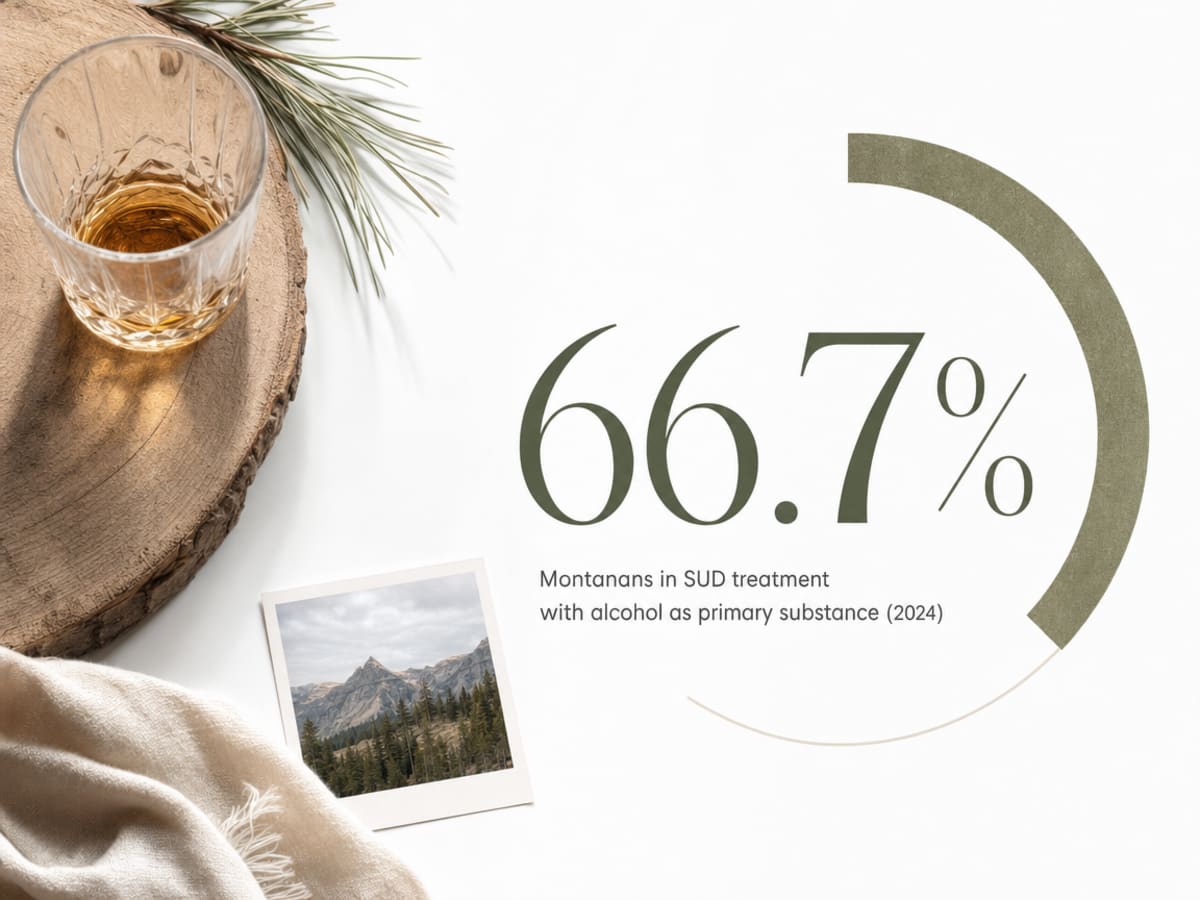
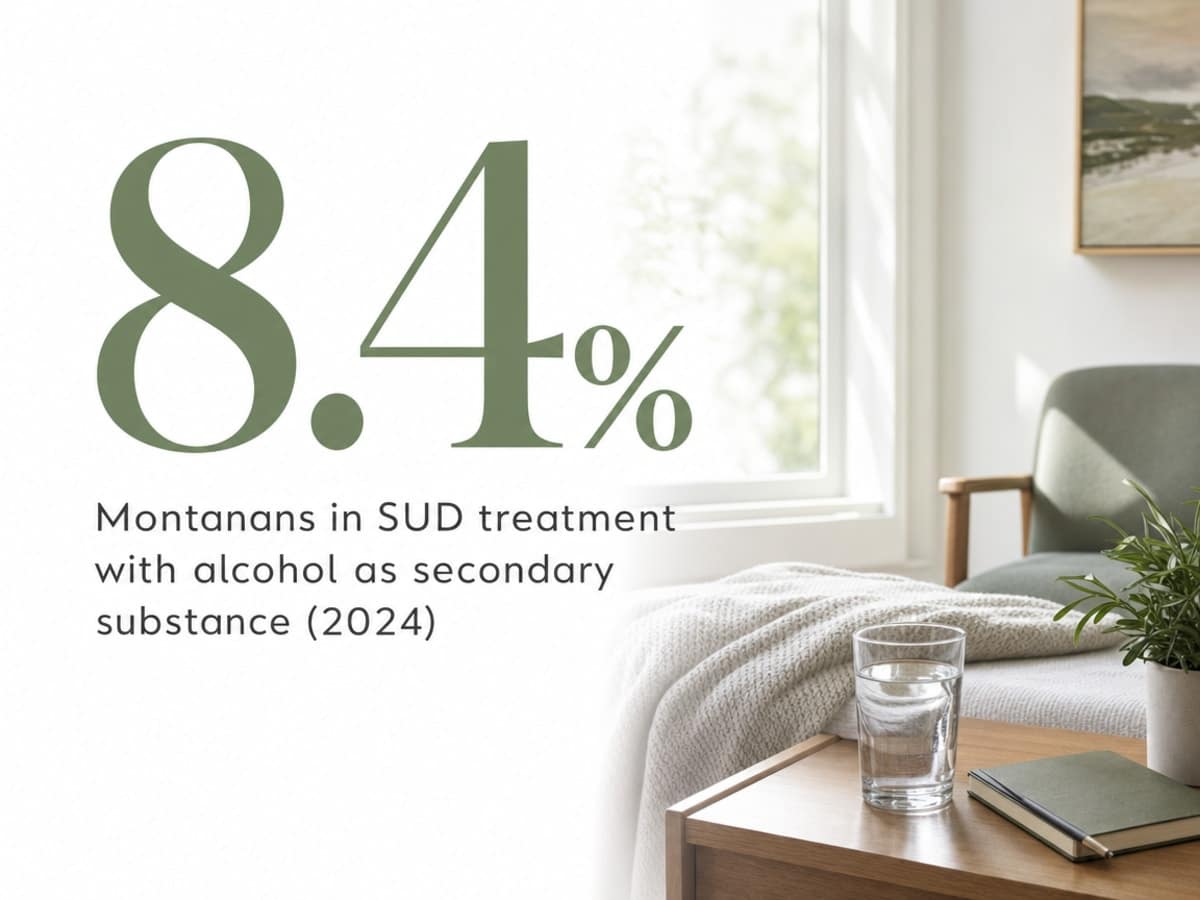
Here’s the number that gets under-reported in Montana: among Montanans who entered treatment for a substance use disorder in 2024, 66.7% named alcohol as their primary substance of misuse, and another 8.4% named it as a secondary substance 1. That’s roughly three out of every four people walking into treatment across this state. Not opioids. Not meth. Alcohol.
One caveat worth being straight about: that figure describes people who actually reached treatment, not every Montanan struggling with alcohol. The real picture — the people still drinking alone in Libby or Lewistown or a quiet apartment in Bozeman — is bigger than any dataset can show.
Alcohol is the substance most people don’t panic about until they should. It’s legal. It’s at every wedding, every tailgate, every dinner with your in-laws. It’s built into how a lot of Montana socializes. That’s exactly why it slips past everyone, including you, until the drinking is running your calendar instead of you running it.
None of this is meant to scare you. It’s meant to name something you may have been carrying alone. If your drinking has gotten louder in your own head lately — the morning after, the second glass, the promise you made yesterday — you’re inside a pattern that many other Montanans are already asking for help with. The next sections walk through what asking for help actually looks like.
The continuum, in plain language
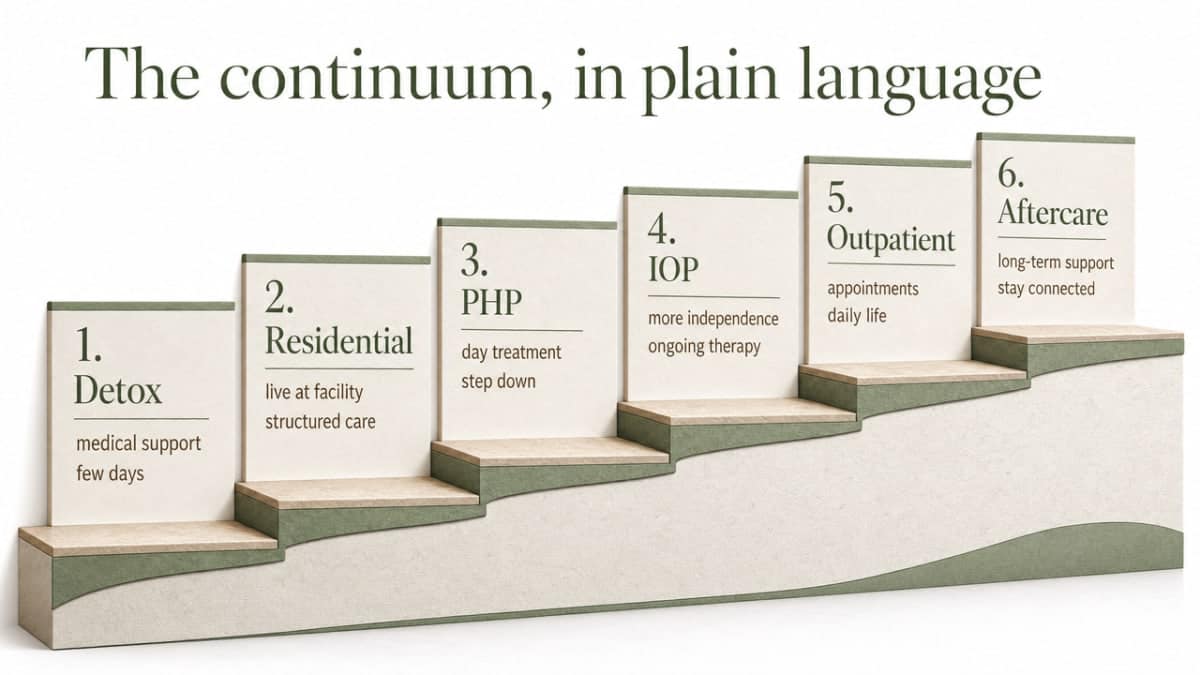
Alcohol rehab is not one room. It’s a series of rooms, and you don’t walk through all of them at once.
Here’s the sequence most people move through, without the acronyms getting in the way:
- First, if your body is physically dependent on alcohol, there’s medical detox — a short stretch, usually a few days, where a medical team helps you stop drinking safely. Withdrawal from alcohol can be dangerous, which is why doctors watch it instead of leaving you to tough it out alone 7.
- Then comes residential treatment, sometimes called inpatient. You live at the facility. You sleep there, eat there, do therapy there. It’s structured on purpose, because early recovery is not a great time to also be managing rent, bosses, and the liquor aisle at Town Pump.
- After residential, most people step down — not step out. Partial hospitalization (PHP) means treatment most of the day, but you sleep somewhere else.
- Intensive outpatient (IOP) is a few sessions a week.
- Standard outpatient is lighter still.
- Aftercare — alumni groups, recovery coaching, mutual-support meetings — is the long tail that runs for months or years.
Somewhere along that path, medication for alcohol use disorder may enter the picture. So might therapy for depression, trauma, or anxiety. Both are covered in later sections.
You don’t have to memorize this map. You just have to know that treatment is a staircase, not a cliff.
Medical detox: what withdrawal actually feels like and why doctors watch it
The first 72 hours and what the medical team is doing
If you’ve been drinking heavily every day, your body has quietly rewired itself around alcohol. When the alcohol stops, that rewiring shows up as withdrawal — and the first 72 hours are usually the loudest part.
Here’s what you might feel:
- Your hands shake.
- You sweat through your shirt.
- Your heart runs faster than it should.
- You can’t sleep, or you sleep in ten-minute pieces.
- You feel anxious in a way that has no story attached to it.
- Nausea comes and goes.
- Some people see or hear things that aren’t there.
- In the most serious cases, seizures or a condition called delirium tremens can develop, and both can kill you if no one is watching 7.
This is why doctors watch it. In a medical detox setting, a nurse checks your vital signs on a schedule. A physician orders medication — usually a benzodiazepine — to quiet the nervous system so withdrawal doesn’t spiral. Fluids, electrolytes, and often thiamine go in to catch what heavy drinking depletes. The clinical roadmap most Montana programs follow comes from ASAM’s alcohol withdrawal guideline, which spells out how to assess severity, monitor symptoms, and taper medication as you stabilize 5.
Detox is not treatment — and why that distinction matters
Here’s the part a lot of people miss, and a lot of programs don’t say out loud: getting through detox is not the same as being treated for alcohol use disorder. NIAAA is direct about this. Detoxification is a critical first step, but it is not, by itself, treatment 7.
Think of detox as putting out the fire. Treatment is figuring out why the house kept catching. If you leave a detox unit after five days and walk back into the same job stress, the same relationships, the same Tuesday night routine, the same untreated anxiety — without any counseling, medication plan, or continuing care in place — the odds are stacked against you. That’s not a character flaw. That’s how the brain and the calendar work.
This is why the sections that follow matter as much as this one. Counseling. Medication when it helps. Treatment for depression or trauma when those are riding along. A step-down into PHP, IOP, or outpatient. An aftercare plan that outlasts the discharge paperwork. Detox is the door. It’s not the room.
Medications for alcohol use disorder, demystified
Somewhere between detox and “figuring out the rest of your life,” a doctor may ask if you want to try medication for the drinking itself. If your first reaction is “wait, there’s a pill for this?” — you’re in good company. Most people have no idea these medications exist, because alcohol treatment has spent decades being talked about like it’s only willpower and meetings.
Here’s the short version. The FDA has approved three medications specifically for alcohol use disorder: naltrexone, acamprosate, and disulfiram 6. None of them are magic. None of them replace counseling. But for a lot of people, they make the difference between white-knuckling every evening and actually being able to think about something else.
Naltrexone comes as a daily pill or a monthly injection. It quiets the reward that alcohol used to give you, so a drink feels less like a reward and more like a shrug. A 2023 JAMA systematic review and meta-analysis found that oral naltrexone at 50 mg per day was associated with a lower return to heavy drinking than placebo, with a number needed to treat of 11 8. This means for every 11 people who take it, roughly one additional person avoids returning to heavy drinking who otherwise would have. This is a real effect, and it’s why naltrexone and acamprosate are considered first-line pharmacotherapies alongside counseling 8.
Acamprosate is a different tool. It’s taken three times a day and seems to help the brain settle after long-term drinking has scrambled it — less agitation, less of that low hum of “something is wrong” that drives a lot of people back to a drink. Disulfiram is the oldest of the three. It makes you sick if you drink on it. That sounds harsh, and it is, but for some people knowing the drink will physically punish them is exactly the guardrail they’ve been looking for.
An honest caveat, because you deserve one: AHRQ’s 2023 evidence review found that for certain populations and primary-care settings, the comparative evidence on these medications is thinner than we’d like 9. That doesn’t mean the medications don’t work. It means the right medication, the right dose, and the right fit still take a real conversation with a real prescriber. Liver function, kidney function, whether you also use opioids, whether you’re pregnant, what you can actually remember to take — all of it matters 6.
The point is this: if a program tells you medication isn’t an option, or doesn’t bring it up at all, that’s worth a follow-up question. Evidence-based alcohol treatment in Montana in 2025 includes the pills, not just the group room.
Counseling and residential care: the work that changes drinking
What therapy actually looks like in a Montana residential program
Forget the movie version. Nobody is going to make you cry on cue in front of strangers on day one. Residential therapy for alcohol use disorder is more ordinary than that, and more useful.
A typical week mixes a few kinds of work. You’ll meet one-on-one with a counselor, usually two or three times a week, to talk about your specific drinking history, what triggers it, and what you actually want your life to look like. You’ll sit in group sessions where other people — a rancher, a nurse, a college student, a retiree — say things you thought only you were thinking. You’ll do skills work: how to handle a craving that shows up at 4 p.m., how to tell your sister you’re not drinking at Thanksgiving, how to fall asleep without a nightcap.
The approaches used most often have real names — cognitive behavioral therapy, motivational enhancement, mindfulness-based treatment, family therapy, and mutual-support facilitation — and NIAAA lists them as evidence-based options for AUD 7. A 2024 systematic review of integrated behavioral interventions, covering 11 studies and 1,543 adults, found that combining these approaches was associated with reductions in heavy drinking and increased abstinence 10. The authors noted that superiority over usual care isn’t fully settled, but the evidence points to their effectiveness.
Translation: therapy works, but it’s not magic. It’s practice. You get better at not drinking the same way you’d get better at anything else — by doing it, badly at first, in a place where doing it badly is expected.
When depression, trauma, or anxiety are part of the picture
Here’s something a lot of people already suspect about themselves but don’t say out loud: the drinking isn’t only about the drinking. It’s also about the panic that starts around 3 p.m. It’s about a memory you don’t want to look at. It’s about a low, gray feeling that predates the first beer by about twenty years.
If that’s you, you’re not complicated — you’re common. NIAAA describes co-occurring mental health conditions as part of the recovery picture, not an add-on 7. Treating the drinking without treating the depression, anxiety, or trauma underneath it is like patching a roof and ignoring the hole in the wall.
Good Montana residential programs handle both under one roof. A 2023 systematic review of co-located mental health and substance-use treatment found provisional evidence of reduced substance use, fewer emergency visits, and fewer hospital admissions when the two services worked together 11. The authors flagged that many included studies had a real risk of bias, and physical co-location alone isn’t what does the work. What does the work is care coordination: your therapist, your prescriber, and your case manager actually talking to each other about you.
Ask directly whether a program treats co-occurring conditions. If the answer is vague, keep asking.
Rural Montana realities: distance, privacy, and getting to care
Let’s be honest about the map. Montana has about 1.1 million people spread across the fourth-largest state in the country 12. If you live in Libby, the nearest residential program might be a three-hour drive on winter roads. If you’re in Lewistown, it could be longer. HRSA’s Montana needs assessment names this plainly: services are concentrated in urban centers, and frontier and tribal residents shoulder the barriers of distance, transportation, and provider shortages that a Missoula or Billings resident doesn’t 13.
Then there’s the small-town problem you probably already thought about. In a town of 800, everyone knows whose truck is parked at the county building on Tuesday nights. The fear of being seen — by a coworker, a pastor, an ex, a neighbor — is a real reason people keep drinking instead of asking for help. Naming that out loud matters. It’s not weakness. It’s a rational response to living somewhere small.
A few things actually help:
- Residential treatment in a different part of the state can be a feature, not a bug — you’re away from the people who know your license plate.
- Telehealth counseling and virtual outpatient sessions let you keep working with a therapist after you go home, even from a cabin outside Ekalaka.
- Case managers can coordinate transportation, and many Montana programs are set up to accept clients from all corners of the state.
If you’re on a reservation or in a tribal community, ask specifically about culturally responsive care — smudging, Wellbriety, connection to tribal recovery networks. These are real options, not add-ons. Distance is a problem you can solve. Silence is the one that keeps costing.
After residential: PHP, IOP, outpatient, and the long tail of recovery
Leaving residential can feel like stepping off a dock. The structure that held you up for 30 or 60 days is gone, and Tuesday afternoon is suddenly a wide, empty room. This is exactly why treatment doesn’t end at the front door — it steps down.
Partial hospitalization, or PHP, usually means five or six hours of treatment a day, five days a week, while you sleep at home or in sober living. It’s residential-level clinical intensity without the overnight bed. Intensive outpatient — IOP — drops to about nine to twelve hours a week, often in evening groups so you can work. Standard outpatient is a therapy appointment or two a week, plus medication management if you’re on naltrexone, acamprosate, or disulfiram 6. Virtual outpatient does the same work through a screen, which matters if you live two hours from the nearest clinic.
Aftercare is the long tail. Alumni groups. A recovery coach who texts you back on a Sunday. AA, SMART Recovery, or Wellbriety if you’re connected to a tribal community. NIAAA is clear that recovery is a dynamic process, not a single event, and continuing care is what keeps the early wins from slipping 7. You don’t have to do the whole staircase perfectly. You just have to keep a foot on the next step.
Paying for it: Medicaid, HEART, and what to ask about insurance
Money is the reason a lot of people don’t call. Let’s take some of the fog off that.
If you have Montana Medicaid, alcohol treatment is a covered benefit, and the state has recently expanded what that coverage includes. Under the HEART demonstration, Montana Medicaid may cover contingency management, pre-tenancy and tenancy supports, and pre-release services for eligible beneficiaries 14. The 2025 amendment goes further, expanding residential treatment and withdrawal-management services and building out SUD provider capacity across the state 15. In plain terms: detox, residential, and the recovery supports that help you stay housed and stay out of jail are on the table in a way they weren’t a few years ago.
If you have private insurance, most plans cover some level of alcohol treatment, but the details matter — deductible, in-network status, prior authorization, length-of-stay limits. Don’t guess. Call the number on the back of the card, or ask the program’s admissions team to run a benefits check for you. That call is free and doesn’t commit you to anything.
How Elk Ridge Recovery fits into the Montana picture
Elk Ridge Recovery is one Montana-based option that runs the full staircase described in this piece — physician-led medical detox, residential inpatient, partial hospitalization, intensive outpatient, standard outpatient, virtual outpatient, and aftercare — under one program instead of scattered across four different providers. That matters because the handoffs between levels of care are where people fall through. When your detox nurse, your residential therapist, and your outpatient counselor all work for the same team, your story doesn’t have to be retold from scratch every three weeks.
The program treats co-occurring depression, anxiety, and trauma alongside the drinking, and it offers FDA-approved medications for alcohol use disorder — naltrexone, acamprosate, or disulfiram — when a prescriber and you decide together that one fits 6. Residential facilities in Montana operate under state SUD facility licensure, which is worth confirming with any program you consider 4.
You don’t have to be sure about anything to make a first call. Ask what a typical day looks like. Ask about medication. Ask what happens after you leave. The answers you get will tell you a lot.
Speak Now About Starting Alcohol Recovery Today
Get real answers about safe, supportive alcohol rehab options in Montana right when you need them.
Frequently Asked Questions
How long does alcohol detox usually take at a Montana rehab?
Most people spend three to seven days in medical detox, though it depends on how much and how long you’ve been drinking. A medical team monitors your vitals, uses medication to quiet withdrawal symptoms, and follows a clinical roadmap like the ASAM alcohol withdrawal guideline to decide when you’re stable enough to step into the next level of care 5.
Will I have to take medication for alcohol use disorder?
No, medication is never required. But it’s an option worth understanding. The FDA has approved three medications for alcohol use disorder — naltrexone, acamprosate, and disulfiram — and NIAAA lists them alongside counseling as evidence-based care 6. A prescriber will look at your health history and preferences with you and decide together whether any of them fit. Some people use them, some don’t.
What’s the difference between detox and actual alcohol treatment?
Detox handles the physical withdrawal — the shakes, the racing heart, the risk of seizures — usually over a few days. Treatment is everything that follows: counseling, medication when it helps, dual-diagnosis care, and continuing support. NIAAA says it directly: detox is a critical first step, but it is not, by itself, alcohol treatment 7. Skipping straight from detox back to your old life stacks the odds against you.
Does Montana Medicaid cover alcohol rehab?
Yes. Alcohol treatment is a covered Medicaid benefit, and Montana’s HEART demonstration has expanded what’s included — contingency management, pre-tenancy and tenancy supports, and pre-release services for eligible beneficiaries 14. A 2025 amendment further expanded residential treatment and withdrawal management 15. Coverage details depend on eligibility, so ask an admissions team to run your benefits before you assume anything is off the table.
What if I live hours away from the nearest residential program?
You’re not alone in that. HRSA’s Montana needs assessment names distance and provider shortages as real barriers, especially for frontier and tribal residents 13. Options exist: residential programs accept clients from across the state and can help coordinate transportation, and virtual outpatient counseling lets you keep working with a therapist after you go home. Distance is a logistics problem, not a disqualifier.
Can a Montana rehab help if I also have depression, anxiety, or trauma?
Yes, and you should ask directly about it. NIAAA treats co-occurring mental health conditions as part of recovery, not a side issue 7. A 2023 systematic review of co-located mental-health and substance-use care found provisional evidence of fewer emergency visits and hospital admissions when the two work together, though care coordination — not just shared walls — is what does the work 11.
References
- Alcohol Use in Montana. https://dphhs.mt.gov/assets/BHDD/PreventionResources/AlcoholUse2024Final.pdf
- Deaths: Final Data for 2022. https://www.cdc.gov/nchs/data/nvsr/nvsr74/nvsr74-04.pdf
- Alcohol Use in Montana. https://dphhs.mt.gov/assets/publichealth/EMSTS/Data/Alcohol_1pager.pdf
- Substance Use Disorder Facility. https://dphhs.mt.gov/oig/Licensure/HealthCareFacilityLicensure/lbfacilityapplications/lbsubstanceusedisorderfacility
- The ASAM Clinical Practice Guideline on Alcohol Withdrawal Management: Pocket Guide. https://www.samhsa.gov/resource/ebp/asam-clinical-practice-guideline-alcohol-withdrawal-management-pocket-guide
- Recommend Evidence-Based Treatment: Know the Options. https://www.niaaa.nih.gov/health-professionals-communities/core-resource-on-alcohol/recommend-evidence-based-treatment-know-options
- Alcohol Use Disorder: From Risk to Diagnosis to Recovery. https://www.niaaa.nih.gov/health-professionals-communities/core-resource-on-alcohol/alcohol-use-disorder-risk-diagnosis-recovery
- Pharmacotherapy for Alcohol Use Disorder: A Systematic Review and Meta-Analysis. https://pubmed.ncbi.nlm.nih.gov/37934220/
- Comparative Effectiveness Review No. 262: Pharmacotherapy for Adults With Alcohol Use Disorder in Outpatient Settings: Systematic Review. https://effectivehealthcare.ahrq.gov/sites/default/files/related_files/cer-262-pharmacotherapy-alcohol-summary.pdf
- Integrated behavioral interventions for adults with alcohol use disorder: A systematic review. https://pubmed.ncbi.nlm.nih.gov/39163680/
- Health outcomes and service use patterns associated with co-located outpatient mental health care and alcohol and other drug specialist treatment: A systematic review. https://pubmed.ncbi.nlm.nih.gov/37015828/
- FY 2025 – Montana. https://data.hrsa.gov/api/factsheet/3/30/2025
- III.C. Needs Assessment – Montana – 2022. https://mchb.tvisdata.hrsa.gov/Narratives/View/IIBFiveYearNeedsAssessmentSummary/MT/2022
- Montana Healing and Ending Addiction through Recovery and Treatment (HEART) Demonstration State Acceptance Letter. https://www.medicaid.gov/medicaid/section-1115-demonstrations/downloads/mt-heart-state-acceptance-letter-03192024.pdf
- Montana HEART Demonstration Amendment Approval Attachment. https://www.medicaid.gov/medicaid/section-1115-demonstrations/downloads/montan-heart-monitor-renty-invte-imptn-pln-aprvl-athmntH.pdf