Key Takeaways
- A quick benefits verification call with your member ID gives you plan-specific answers for detox, residential, PHP, IOP, and outpatient care in minutes.
- Cigna and Evernorth point to the same behavioral health benefits, so the phone number on the back of your card routes to substance use coverage.
- Roughly half of insured enrollees do not know their plan covers substance use treatment 4, and verifying closes that gap before assumptions delay care.
- Prepping your member ID, group number, plan type, and behavioral health phone number before calling lets the specialist quote real numbers instead of estimates.
- Ask level-of-care questions separately for detox, residential, PHP, IOP, and outpatient, because Cigna reviews each one against its own medical-necessity criteria.
- Writing answers into a benefits worksheet, including the call reference number and authorization IDs, prevents a second round of paperwork at admission.
- Prior authorization and medical necessity have defined rules, and under federal parity they cannot be applied more strictly to addiction care than medical care 16.
- A denial opens options including peer-to-peer review, internal appeal, and external review, with written criteria available on request 17.
Start Here: The Fastest Way to Know What Cigna Will Pay
Making this call is hard. You do not have to have it figured out before you dial.
Here is the short version: Elk Ridge Recovery works with Cigna and Evernorth plans, and the fastest way to know what your specific plan will pay for detox, residential, PHP, IOP, or outpatient care is a benefits verification. It takes minutes, not days. You can start it by phone or by submitting a verification form on the site, and a specialist will run your plan against the level of care you need.
You do not need to memorize insurance vocabulary first. You do not need to have a treatment plan. You do not need to know whether your card says Cigna or Evernorth on it (both point to the same behavioral health benefits, and we’ll cover that in the next section). You just need your member ID card nearby, or a photo of the front and back on your phone.
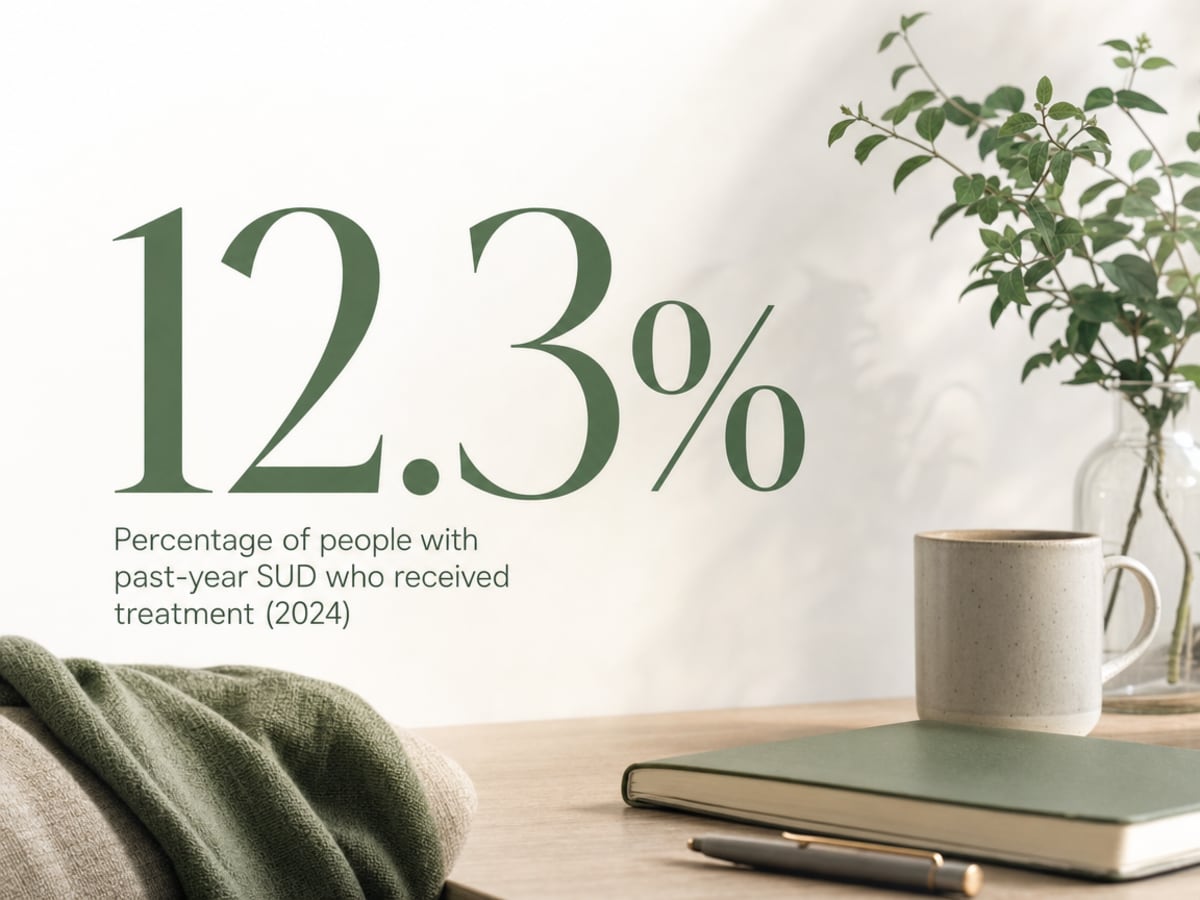
Two things worth knowing before you dial. First, in 2024, about 12.3% of the roughly 48.4 million people age 12 or older with a past-year substance use disorder actually received treatment, according to SAMHSA’s national self-reported survey 1. Coverage confusion is one reason. Verifying your benefits is how you take that variable off the table for yourself. Second, the answer you get will be specific to your plan, not a general Cigna answer, so write it down.
That’s the whole first step. One call, card in hand.
Cigna, Evernorth, and Elk Ridge Recovery: What the Relationship Actually Is
If your card says Cigna and you keep seeing Evernorth pop up when you Google your benefits, you are not confused. You are reading it correctly. Evernorth is the behavioral health arm that manages mental health and substance use benefits for most Cigna plans. So when you call about addiction treatment, the person on the other end may be an Evernorth care advocate even though your insurance is Cigna. Same family, different door.
Here is what that means for you at Elk Ridge Recovery. Elk Ridge works with Cigna and Evernorth plans, and benefits vary by the specific plan you carry. A verification specialist runs your member ID against the level of care being considered (medical detox, residential, PHP, IOP, or standard outpatient) and comes back with what your plan actually pays, what you owe, and whether prior authorization is required before you can be admitted.
A few things this relationship does not mean. It does not mean every Cigna plan treats Elk Ridge as in-network. It does not mean the first level of care requested is automatically the one approved, since medical necessity is reviewed at each step. And it does not mean you have to figure any of this out alone.
What it does mean is that your plan is generally required to treat substance use disorder benefits comparably to medical and surgical benefits under federal parity law, including how prior authorization and medical necessity are applied 14. That is a floor, not a promise about your specific admission. The verification call turns that floor into a real answer for your plan, on your card, for the care you need.
Why Verifying Beats Guessing
The Knowledge Gap Most People Don’t Know They Have
Here is something that might make you feel less alone: a lot of people with insurance have no idea what their insurance actually covers for addiction treatment.
A 2025 peer-reviewed study of an insured population found that only about half of enrollees knew their insurance covered substance use disorder treatment, and nearly 40% reported not knowing at all 4. That study looked at a specific insured group, not every Cigna member in the country, so treat it as a signal rather than a headline. But the signal is loud. If you have been sitting with your card in your hand wondering whether you are covered, you are in the majority, not the minority.
That gap matters because it changes behavior. People who are unsure often assume the worst. They assume residential care is not covered. They assume detox will cost more than they can pay. They put off calling because they think the answer will be no, and the not-knowing becomes its own reason to wait another week, another month.
A verification call closes that gap in minutes. You are not asking for permission. You are asking for information you are entitled to have. And once you have it written down, the next decision gets easier, whether the answer is generous, limited, or somewhere in the middle.
What Your Plan Is Required to Cover
Before you dial, it helps to know the floor your plan is standing on.
If you have a Marketplace plan, substance use disorder treatment is one of the essential health benefits your plan must cover, along with behavioral health inpatient services and outpatient behavioral treatment 15. That does not tell you your deductible, your coinsurance, or whether Elk Ridge is in-network for your specific plan. It tells you the category itself is not optional.
Federal parity law adds another layer. Under MHPAEA, qualifying plans have to treat mental health and substance use benefits comparably to medical and surgical benefits when it comes to copays, deductibles, visit limits, prior authorization, and medical-necessity standards 14. In plain terms, Cigna cannot make it harder to get approved for residential addiction treatment than it would be to get approved for a comparable medical admission. The 2024 final parity rules tightened this further around prior authorization, network composition, and out-of-network reimbursement, with group-plan requirements generally beginning with plan years on or after January 1, 2025 and additional provisions phasing in through 2026 12.
None of this guarantees your specific admission. What it does is give you real ground to stand on when you make the call, and real rights if something comes back looking wrong.
What to Have Ready Before You Call
Five minutes of prep will make this call feel a lot shorter. You do not need a folder. You just need a few things within reach so the specialist can pull up your plan and give you real answers instead of ballpark ones.
Grab your Cigna or Evernorth member ID card first. If you have the physical card, set it face up next to you. If you only have a photo on your phone, open both the front and the back before you dial. The back is where the behavioral health phone number usually lives, and it is often different from the number on the front for general medical questions. That is normal.
Here is what the specialist will ask for, and where to find each piece on the card:
- Member ID number — front of the card, sometimes labeled “ID” or “Member #.”
- Group number — front of the card, usually near the member ID.
- Plan type — front of the card. Look for PPO, HMO, EPO, POS, or Open Access.
- Behavioral health phone number — back of the card, often listed separately from medical claims.
- Policyholder name and date of birth — if the plan is through a spouse or parent, you need theirs, not just yours.
A few other things to have handy: the name of the person seeking treatment (if you are calling for someone else), a rough sense of what substances are involved and how recently they were used, and any current prescriptions. You do not need clinical details. A few sentences is enough for the specialist to identify the likely starting level of care.
Keep a pen and paper next to you, or open a blank note on your phone. You will want to write down the reference number for the call, the names of any levels of care that were quoted, and whether prior authorization is required. Section 6 has a worksheet you can print or copy first if that helps.
One last thing: give yourself somewhere quiet to sit. Not because the call is long, but because you deserve to hear the answers without background noise pulling at you. That counts as prep too.
The Questions to Ask, Level of Care by Level of Care
Detox and Residential
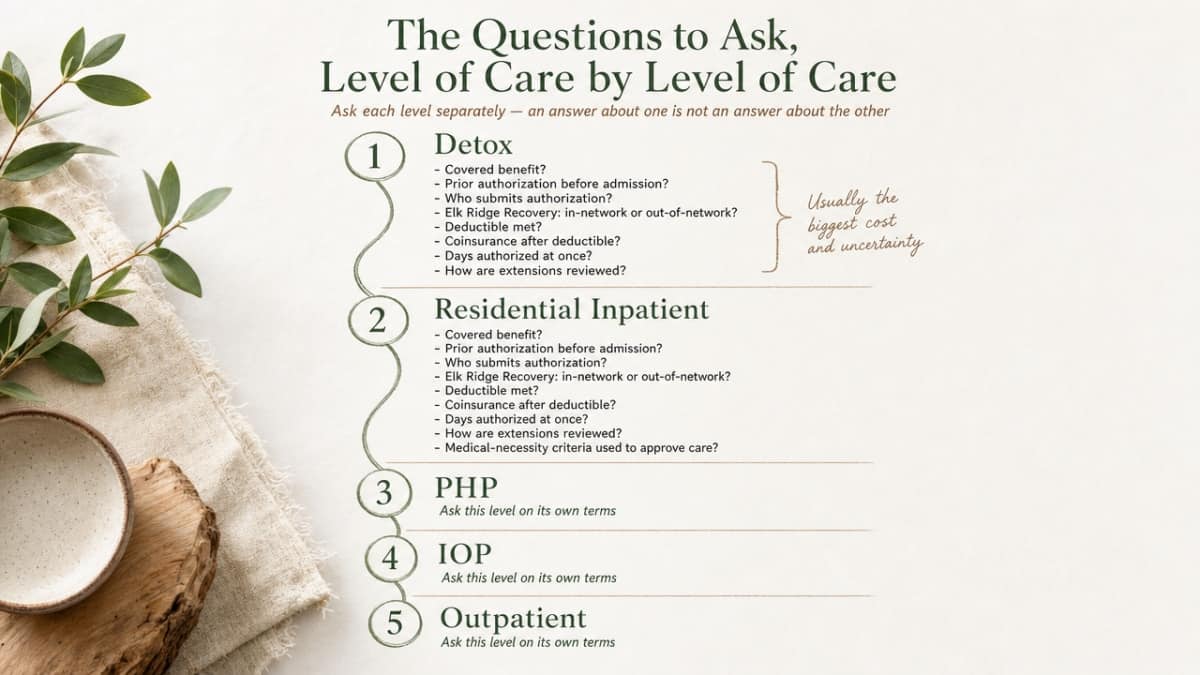
Detox and residential are usually the two levels of care people worry about most, because they cost the most and they feel the most uncertain. So ask about them separately. Cigna reviews each level of care on its own terms, and an answer about one is not an answer about the other.
For medical detox, ask: Is detox a covered benefit on this plan? Is prior authorization required before admission, and if so, who submits it? What is the in-network and out-of-network status for Elk Ridge Recovery specifically? What is my deductible, how much of it has been met, and what is my coinsurance once it is met? Is there a limit on the number of days that will be authorized at once, and how are extensions reviewed?
For residential inpatient, ask the same set again, and add: What medical-necessity criteria will Cigna use to approve residential rather than a lower level of care? If residential is denied, what level of care will Cigna authorize instead? Federal guidance says medical-necessity criteria and the reason for any denial must be made available on request, so you are entitled to see the rules being applied to your admission 17.
Write the answers down verbatim. If detox is authorized for a set number of days and residential is reviewed after that, you want that sequence in your notes before you arrive, not after.
PHP, IOP, and Outpatient
Step-down care matters just as much as the front door. Most people do not finish treatment in residential; they finish it in PHP, IOP, or standard outpatient, sometimes over months. Getting benefit answers for those levels while you are already on the call saves you from a second round of paperwork later.
Partial hospitalization (PHP) is the most intensive outpatient option, usually five to six hours a day, several days a week. Ask whether PHP is a covered benefit, whether prior authorization is required, and how many days or weeks are typically authorized at one time. Intensive outpatient (IOP) is lighter, often nine to twelve hours a week. Ask the same questions, plus what the per-session or per-week cost-share looks like once your deductible is met.
For standard outpatient, including individual therapy and medication management, ask how many visits are covered per year, whether telehealth visits are covered at the same rate as in-person visits, and whether medication-assisted treatment is a separate benefit or bundled in.
Your Benefits Worksheet: Fill This In During the Call
Print this, screenshot it, or copy it into a note on your phone before you dial. Filling in the blanks as you go turns a benefits call into something you can actually use later, when the person who needs treatment is checking in and someone at the front desk asks a question you already answered.
Leave the dollar amounts and percentages as blanks. Every plan is different, and the whole point is to capture your numbers, not someone else’s.
- Date of call / reference or call ID number: ___________
- Name of Cigna or Evernorth representative: _______
- Plan type (PPO, HMO, EPO, POS, Open Access): _______
- Deductible: $______ total / $______ remaining
- Coinsurance after deductible: ____% in-network / ____% out-of-network
- Out-of-pocket maximum: $______ total / $______ remaining
- Plan year reset date: _______
Now the level-of-care grid. Ask the same three questions for each row and write the answer in shorthand.
- Medical detox: In-network? Y / N · Prior auth required? Y / N · Auth reference #:
- Residential inpatient: In-network? Y / N · Prior auth required? Y / N · Auth reference #:
- Partial hospitalization (PHP): In-network? Y / N · Prior auth required? Y / N · Auth reference #:
- Intensive outpatient (IOP): In-network? Y / N · Prior auth required? Y / N · Auth reference #:
- Standard outpatient / MAT: In-network? Y / N · Prior auth required? Y / N · Auth reference #:
Two follow-up lines to save yourself a second call:
- Does authorization for one level carry over to the next step-down? Y / N · Notes: _________
- If out-of-network, is a single-case agreement possible? Y / N · Who to contact: ___________
One last field, and it matters more than it looks: the reference number for the call itself. If anything gets disputed later, that number is how Cigna finds the recording and the notes from your conversation. Circle it.
You do not have to fill every blank on the first try. Even three or four rows completed is real progress, and it gives the Elk Ridge admissions team a running start instead of a cold one.
Prior Authorization and Medical Necessity, in Plain Language
Two phrases will come up on your verification call, and both sound bigger than they are. Here is what they actually mean.
- Prior authorization
- Approval from Cigna before treatment starts. GAO describes it plainly: it is a requirement that the plan sign off on a service before you receive it, so the plan can confirm the care meets its coverage rules 6. For addiction treatment, that usually means Elk Ridge submits clinical information (what substances are involved, withdrawal risk, prior treatment history, co-occurring conditions) and Cigna reviews it against its criteria before authorizing the admission. You do not do this part. The facility does. Your job is to know whether it is required for the level of care you need, and to write down the authorization reference number once it is issued.
- Medical necessity
- The standard Cigna uses to decide whether a specific level of care is clinically appropriate for you right now. Not whether treatment is needed at all, but whether this level (residential vs. PHP, for example) is the right fit. Cigna publishes the criteria it uses, and under federal rules you are entitled to see them. CMS is explicit that medical-necessity criteria and the reason for any denial must be made available on request 17. If you ever want to know exactly what box a reviewer was checking, you can ask for the criteria in writing.
Parity law matters here too. Cigna generally cannot apply a prior-authorization requirement to all substance use disorder benefits when it applies no comparable requirement to medical or surgical benefits 16. The 2024 final parity rules go further, treating prior authorization as a nonquantitative treatment limitation that has to be applied comparably to how it is applied on the medical side 13. Translation: the rules for approving your residential stay cannot be stricter than the rules for approving a comparable medical admission.
None of this means every request sails through. It means the process has a shape, and you have the right to see it.
If You Get a Denial: Your Rights and Next Moves
A denial is not the end of the conversation. It is the start of a different one.
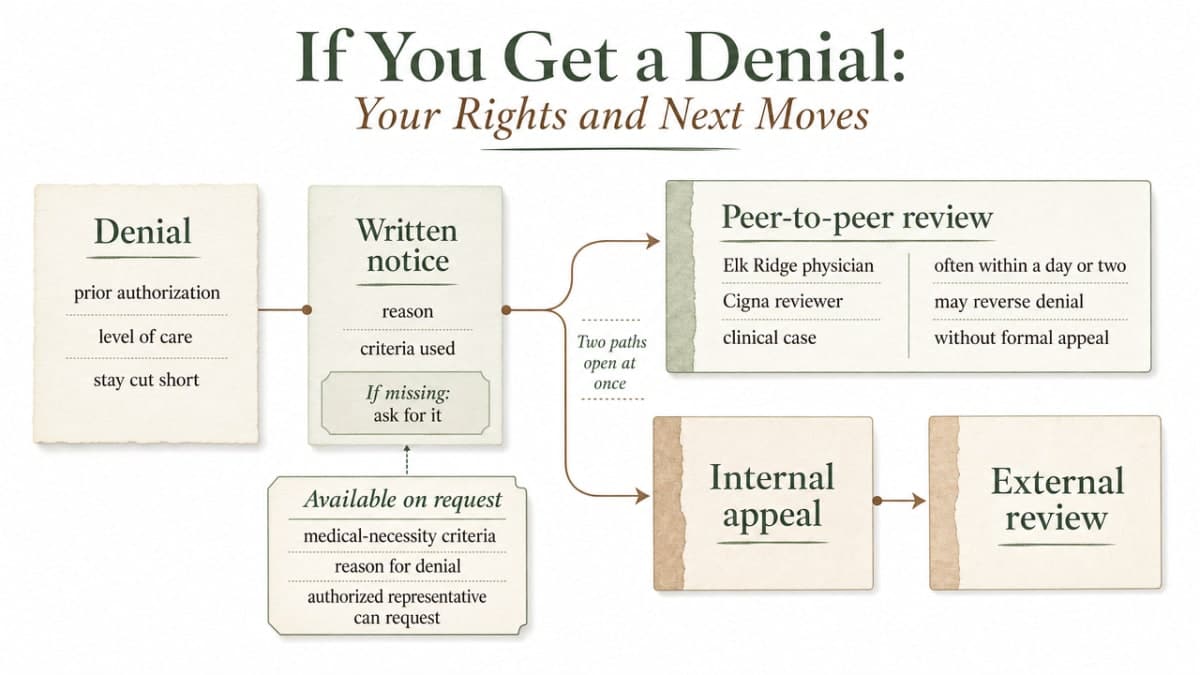
When Cigna denies a prior authorization, denies a level of care, or cuts a stay short, you should get a written notice that explains the reason and the criteria used. If you did not get one, ask for it. Under federal rules, the medical-necessity criteria and the reason for the denial have to be made available on request, and an authorized representative (a family member or the facility) can request them on your behalf 17. That written explanation is what an appeal is built on.
Two paths usually open up at once. The first is a peer-to-peer review, where a physician from Elk Ridge speaks directly with a Cigna reviewer to argue the clinical case. This often happens within a day or two and can reverse a denial without a formal appeal. The second is a formal internal appeal through Cigna, followed by an external review by an independent third party if the internal appeal is upheld. Your denial letter will spell out the deadlines. Missing them is the most common reason a strong appeal fails, so put the dates on a calendar the day the notice arrives.
If the denial pattern looks off, parity gives you another lever. Cigna generally cannot apply a stricter prior-authorization requirement to substance use disorder benefits than to comparable medical or surgical benefits 16. The Department of Labor publishes a self-compliance tool that walks through how nonquantitative limitations like utilization review are supposed to be applied evenhandedly 11. You do not have to run that analysis yourself. But knowing it exists is useful when you ask Cigna, in writing, to explain why a particular limit was applied to your care.
Why Montana Licensure and the Five-State Service Area Matter
Two practical facts about Elk Ridge Recovery shape how your Cigna plan pays: the facility is licensed in Montana, and it serves people from Montana, Idaho, North Dakota, South Dakota, and Wyoming. Both matter for verification.
Licensure is the first checkpoint most payers look at. Montana’s Department of Public Health and Human Services sets licensing rules for substance-use-disorder facilities and organizes services into ASAM-aligned levels, including clinically managed residential withdrawal management 9. When a Cigna reviewer looks at an admission request, that licensed level of care is what maps to a covered benefit. If the level does not match a recognized category, coverage gets shaky fast. It does not with Elk Ridge, which is one less thing to worry about.
The five-state piece shows up on your call in a different way. If you live in Idaho, Wyoming, or the Dakotas and your plan is written in that home state, Elk Ridge may sit in-network, out-of-network, or somewhere in between depending on how your specific plan builds its network. That is a plan-by-plan answer, not a general one. Ask the verification specialist to check network status for Elk Ridge under your home-state plan, and to explain whether an out-of-network admission could be handled with a single-case agreement. State licensure alone does not decide Cigna participation or reimbursement, so the call is where you get the real answer.
Start your confidential insurance verification now
Get clear answers about your Cigna coverage and next steps for entering treatment today.
Frequently Asked Questions
Does Elk Ridge Recovery accept Cigna or Evernorth insurance?
Yes. Elk Ridge Recovery works with Cigna and Evernorth plans across its full continuum of care, including medical detox, residential, PHP, IOP, and standard outpatient. What varies is your specific plan: deductible, coinsurance, in-network status, and whether prior authorization is required for the level of care being requested. A short benefits verification call turns those variables into real numbers for your card.
How long does it take to verify my Cigna benefits?
Usually minutes, not days. With your member ID card in hand, a verification specialist can pull your plan, check network status for Elk Ridge, and quote your deductible, coinsurance, and out-of-pocket maximum in a single call. Prior authorization, if required, may take longer because Cigna reviews clinical information before approving admission. That piece happens in the background while you get ready.
What is the difference between Cigna and Evernorth on my card?
Cigna is your health insurance. Evernorth is the behavioral health arm that manages mental health and substance use benefits for most Cigna plans. So your card may say Cigna on the front while the behavioral health phone number on the back routes you to an Evernorth care advocate. Same family, different door. Both point to the same benefits for your addiction treatment.
Will Cigna cover detox and residential treatment, or only outpatient?
Detox, residential, PHP, IOP, and outpatient are all potentially covered, but each level is reviewed separately against medical-necessity criteria. Marketplace plans must cover substance-use-disorder treatment as an essential health benefit, including inpatient behavioral health services 15. That does not guarantee your specific admission at any level. The verification call confirms what your plan pays and whether prior authorization is required for each step.
What happens if Cigna denies my prior authorization or a level of care?
A denial is not the end. You should get a written notice explaining the reason and the criteria used, and under federal rules the medical-necessity criteria must be made available on request 17. Elk Ridge can request a peer-to-peer review, where a physician argues the clinical case directly with a Cigna reviewer, often within a day or two. A formal internal appeal and external review remain available if needed.
I live in Idaho, Wyoming, North Dakota, or South Dakota. Can I still use my Cigna plan at a Montana facility?
Often, yes. Elk Ridge serves people from Montana, Idaho, North Dakota, South Dakota, and Wyoming. Whether your home-state Cigna plan treats Elk Ridge as in-network, out-of-network, or somewhere in between depends on how your specific plan builds its network. If out-of-network, ask the verification specialist whether a single-case agreement is possible. State licensure alone does not decide Cigna participation, so the call is where you get a real answer.
References
- Results from the 2024 National Survey on Drug Use and Health. https://www.samhsa.gov/data/sites/default/files/reports/rpt56287/2024-nsduh-annual-national-report.pdf
- SAMHSA Releases Annual National Survey on Drug Use and Health. https://www.samhsa.gov/newsroom/press-announcements/20250728/samhsa-releases-annual-national-survey-on-drug-use-and-health
- Results from the 2024 National Survey on Drug Use and Health. https://www.samhsa.gov/data/sites/default/files/reports/rpt56484/NSDUHDetailedTabs2024/NSDUHDetailedTabs2024/2024-nsduh-detailed-tables-appa.htm
- Changes in Access to Substance Use Disorder Treatment …. https://pubmed.ncbi.nlm.nih.gov/41024646/
- Payment-related barriers to medications for opioid use disorder. https://pubmed.ncbi.nlm.nih.gov/38906417/
- Behavioral Health: Patient Access, Provider Claims, and Federal Oversight. https://www.gao.gov/assets/720/713483.pdf
- MEDICARE ADVANTAGE. https://files.gao.gov/reports/GAO-25-107342/index.html
- DEPARTMENT OF HEALTH & HUMAN SERVICES. https://www.cms.gov/files/document/aetna-health-utah-inc-final-determination-letter-prior-authorization.pdf
- Rules for Substance use Disorder Facility. https://dphhs.mt.gov/assets/oig/Rules_for_Substance_use_Disorder_Facility.pdf
- Association of Medicaid expansion with health insurance coverage and unmet need for substance use disorder treatment. https://pubmed.ncbi.nlm.nih.gov/38053235/
- Self-Compliance Tool for the Mental Health Parity and Addiction Equity Act. https://www.dol.gov/agencies/ebsa/laws-and-regulations/laws/mental-health-parity/self-compliance-tool
- New Mental Health and Substance Use Disorder Parity Rules. https://www.dol.gov/agencies/ebsa/laws-and-regulations/laws/mental-health-parity/new-mhpaea-rules-what-they-mean-for-providers
- Fact Sheet: Final Rules under the Mental Health Parity and Addiction Equity Act. https://www.dol.gov/agencies/ebsa/about-ebsa/our-activities/resource-center/fact-sheets/final-rules-under-the-mental-health-parity-and-addiction-equity-act-mhpaea
- Mental Health and Substance Use Disorder Parity. https://www.dol.gov/agencies/ebsa/laws-and-regulations/laws/mental-health-and-substance-use-disorder-parity
- Mental health & substance abuse coverage. https://www.healthcare.gov/coverage/mental-health-substance-abuse-coverage/
- Affordable Care Act Implementation FAQs – Set 7. https://www.cms.gov/cciio/resources/fact-sheets-and-faqs/aca_implementation_faqs7
- Affordable Care Act Implementation FAQs – Set 17 – CMS. https://www.cms.gov/CCIIO/Resources/Fact-Sheets-and-FAQs/aca_implementation_faqs17