Key Takeaways
- Marijuana use disorder is a real, diagnosable condition, and believing cannabis can’t be a problem is a major reason people delay seeking care 1.
- The DSM-5 uses 11 criteria to identify cannabis use disorder, and recognizing two or three in your own year is enough reason to talk with a clinician 4.
- Reviewing the last seven days honestly, from how often you used to whether you tried to stop, turns vague worry into information you can act on 4.
- Cannabis withdrawal usually starts within 24 hours, peaks around days two and three, and eases over one to two weeks with supportive care rather than medical detox 9, 10.
- Levels of care run from standard outpatient through IOP, PHP, and residential, and matching intensity to your history and home environment matters more than picking the highest tier 13.
- No FDA-approved medication treats cannabis use disorder, but CBT, motivational enhancement, and contingency management have real evidence behind them 5, 7.
- Cannabis often sits alongside anxiety, depression, PTSD, ADHD, or other substances, and integrated care that treats both threads together produces more durable results 11, 12.
- Recovery unfolds in stages: surviving the first 72 hours, building skills by day 30, addressing underlying mental health at 90 days, and shaping a supported life by one year 9, 5, 11.
The Quiet Question Behind “Is Weed Really Addictive?”
You’ve probably heard some version of it: “Weed isn’t addictive.” Maybe you’ve said it yourself. Maybe you’re saying it right now, on your phone, in a parked car or a quiet room, while also wondering why you can’t seem to stop for more than a couple of days.
Both things can be true. Cannabis feels manageable to a lot of people, right up until it doesn’t. And the belief that it can’t be a real problem is one of the main reasons people wait years before looking up something like “marijuana addiction treatment near me.”
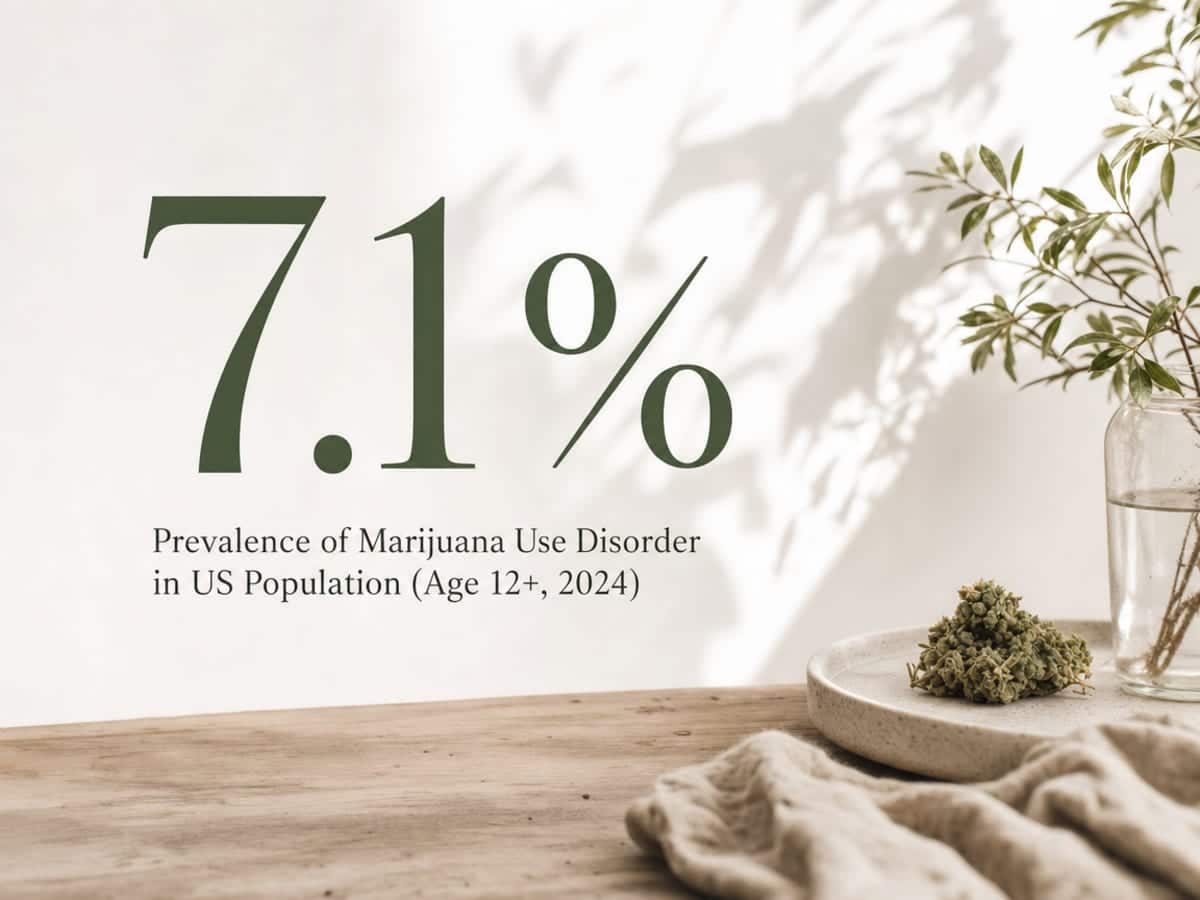
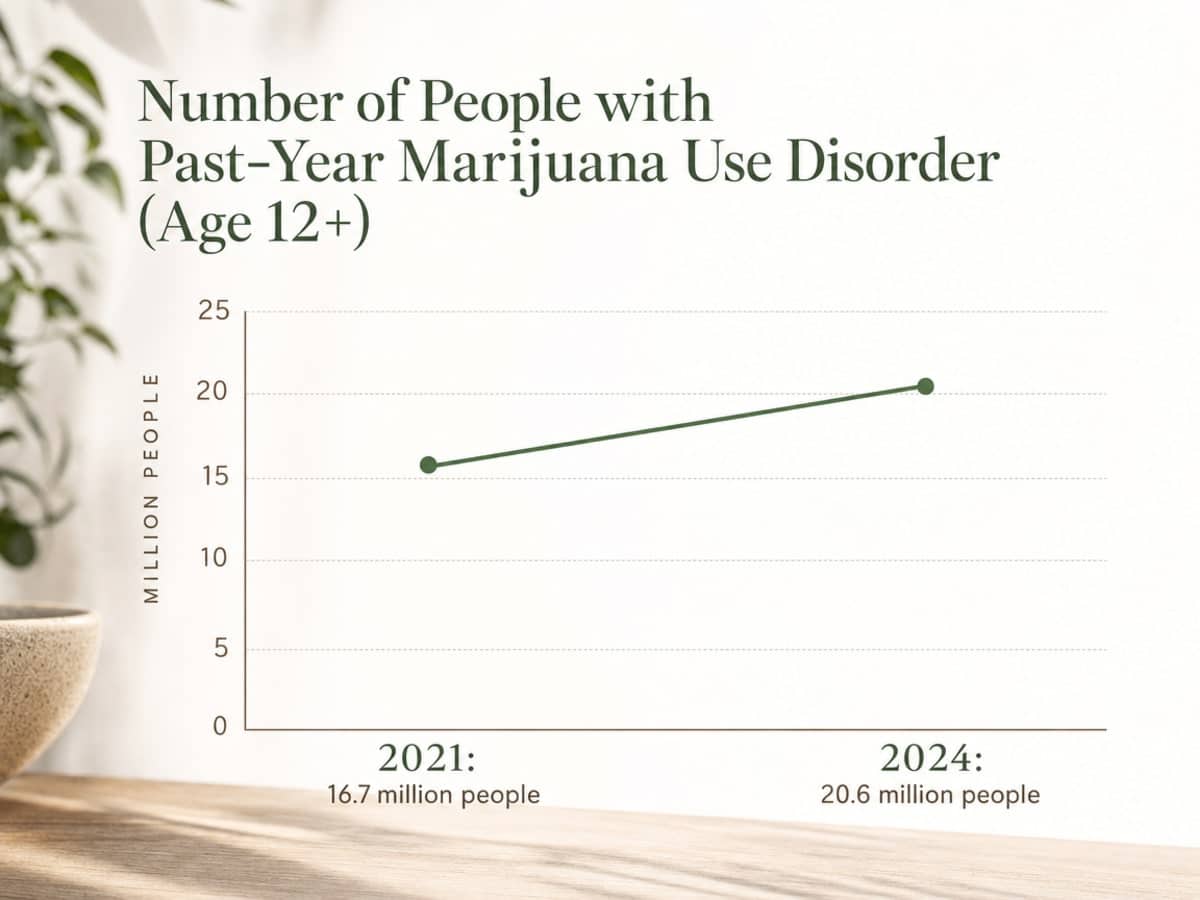
Here’s the honest picture. Marijuana use disorder is a real, diagnosable condition with clear clinical criteria. In 2024, about 20.6 million people in the U.S. aged 12 and older met criteria for a past-year marijuana use disorder, up from 16.7 million in 2021 1. That’s not a fringe experience. That’s your coworker, your cousin, the guy at the trailhead, and maybe you.
None of that means you’re weak. It doesn’t mean you’re an “addict” in the way movies frame it. It means your brain and your routine have wrapped themselves around a substance, and unwrapping takes support that goes beyond willpower.
This guide walks you through what actually counts as a problem, what withdrawal feels like, how to pick a level of care that fits your life, and what the first year of recovery can look like. No lectures. No scare tactics. Just a step-by-step path you can read at your own pace and come back to when you’re ready.
When Cannabis Use Crosses a Clinical Line
What the DSM-5 Actually Measures
Clinicians don’t diagnose marijuana use disorder by asking how much you smoke or how often. They look at how cannabis is shaping your life. The DSM-5 uses 11 criteria, and if two or more show up in the same 12-month stretch, that meets the threshold for a disorder. Two to three is mild. Four to five is moderate. Six or more is severe.
The criteria aren’t mysterious. They’re the quiet things you probably already notice. Using more than you meant to. Spending a lot of the day either high, coming down, or planning the next session. Craving that shows up when you’re bored, stressed, or trying to sleep. Trying to cut back and not being able to. Continuing even when it’s costing you at work, at home, or with your health. Withdrawal when you stop 4.
None of these by themselves make you “an addict.” They’re just data points. The CDC’s own list of warning signs mirrors the clinical criteria almost line for line, which is helpful because it means you can read them in plain language before you ever sit across from a counselor 4.
If two or three sound like the last year of your life, that’s worth a conversation with someone trained to sort it out. A self-check isn’t a diagnosis. But it is enough to justify picking up the phone.
Who This Tends to Affect, and Why Age Matters
Marijuana use disorder doesn’t hit every age group the same way, and that shapes what treatment should look like.
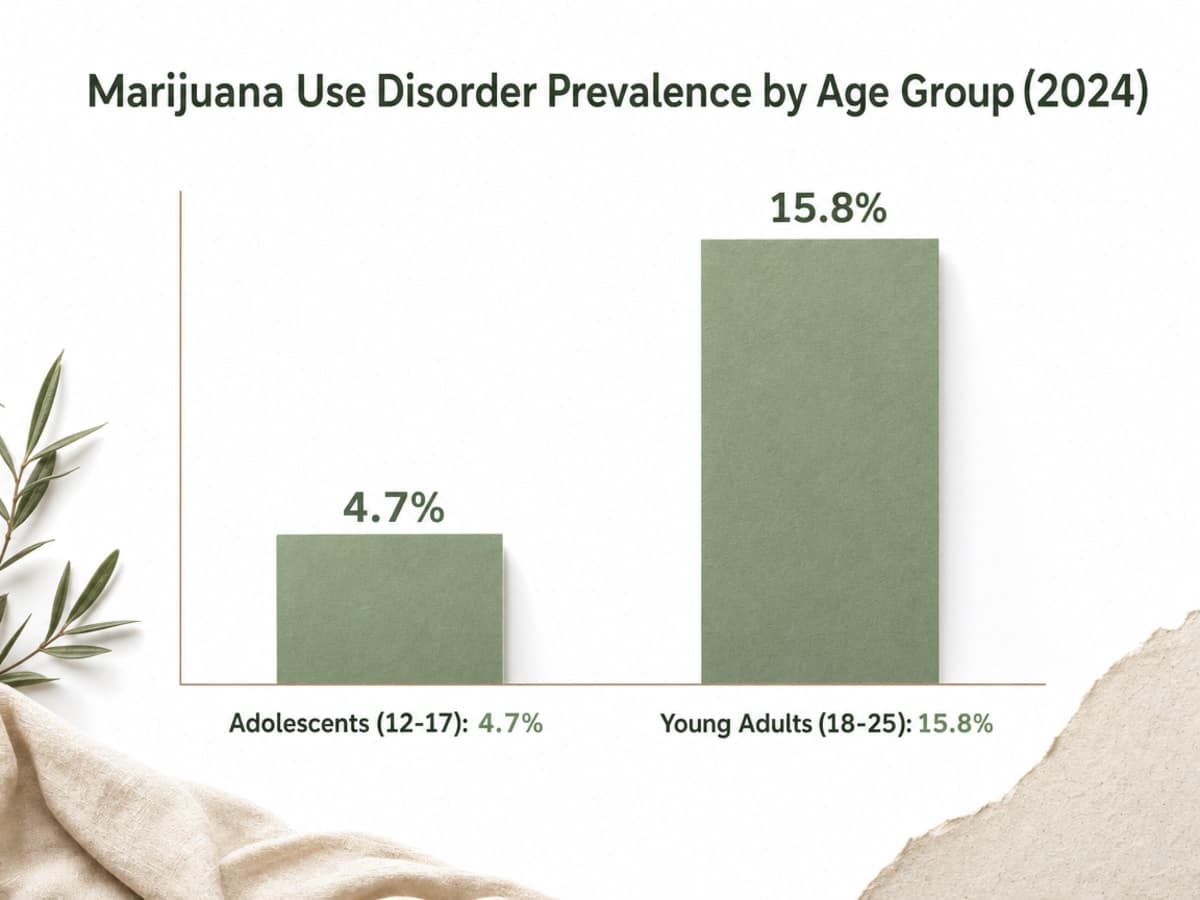
In 2024, about 4.7% of adolescents ages 12 to 17 met criteria for a past-year marijuana use disorder. Among young adults ages 18 to 25, that number climbed to 15.8% 2. That’s roughly one in six young adults, which lines up with what a lot of parents, partners, and roommates already suspect but hesitate to name.
The reasons behind that gradient aren’t a mystery either. Younger brains are still developing the circuits that govern reward, impulse, and stress regulation. Daily or near-daily use during that window tends to entrench faster. High-potency products, which barely resembled the flower older generations used, accelerate the process. The CDC notes that people who use frequently or use highly concentrated THC products are more likely to develop more severe symptoms 3.
If you’re in your 30s, 40s, or beyond and thinking, “But I’ve been using for years and I’m fine,” that’s worth taking seriously too. Long-term use can look stable on the outside and still meet criteria on the inside. The sleep you can’t get without it. The irritability on day two. The subtle shrinking of things you used to enjoy sober.
Age doesn’t decide whether you need help. It just changes what help should look like, and how quickly it’s worth acting.
Reading Your Own Pattern Honestly
Reading a list of criteria is one thing. Applying it to your own week is another. Most people who eventually get help spend months, sometimes years, negotiating with themselves in that gap.
Try this instead of the mental gymnastics. Pick the last seven days. Not a good week, not a bad one, just the most recent one you can actually remember. Then ask yourself a few specific questions:
- How many of those days did you use?
- How many times did you tell yourself you’d stop at one bowl, one gummy, one hit, and then keep going?
- Did you use before something that mattered, like driving, working, parenting, or a conversation you’d been putting off?
- Was there a morning you woke up irritable, sweaty, or unable to sleep the night before, and did that pull you back to using sooner than you planned?
Now widen the lens. In the last year:
- Have you tried to take a break and not made it as long as you wanted?
- Have you noticed you need more to get the same effect, or that the effect isn’t really what it used to be?
- Have people close to you said something, even gently, that you brushed off?
If a few of these are landing, that’s not a verdict. It’s information. The CDC’s own list of warning signs frames these same patterns, and they exist so you can name what you’re noticing without waiting for a crisis to force the conversation 4. A twenty-minute call with an intake counselor can turn that noticing into a plan.
What Withdrawal Actually Feels Like
One of the most common reasons people talk themselves out of quitting is what happens in the first week. If you’ve tried before, you already know the shape of it. The sleep goes first. You lie there at 2 a.m. with your brain running laps. Then the irritability, the sweating, the strange vivid dreams when you finally do doze off. Appetite drops. Little things at work feel bigger than they should.
That’s not weakness or a sign you “need” cannabis. That’s withdrawal. And it follows a pretty predictable arc. Symptoms usually start within about 24 hours of your last use, peak around days two and three, and taper off over roughly one to two weeks 9. The worst stretch is short. It just doesn’t feel short while you’re in it.
Having a clinician or a program in the loop during those first two weeks does two things. It gives you someone to check in with when the 3 a.m. version of you starts negotiating. And it catches the less common but real complications, like a spike in anxiety or a return of a mood problem that cannabis was quietly muffling. Getting through the peak is not the finish line. It’s the doorway.
Choosing a Level of Care Without Guesswork
Outpatient, IOP, PHP, and Residential in Plain Language
Level of care sounds like insurance jargon until you’re the one trying to figure out where you fit. Here’s the plain-language version, roughly in order of intensity.
Standard outpatient usually means one or two individual or group sessions a week, scheduled around your job or school. It works when your use is on the milder end, your home life is stable, and you have enough support around you that a weekly check-in can move the needle.
Intensive outpatient (IOP) is the next step up. Under the ASAM framework used across most of the country, Level 2.1 intensive outpatient runs about 9 to 19 hours of structured programming per week for adults 13. You still live at home, still sleep in your own bed, still keep some version of your regular life. But your evenings or mornings belong to group therapy, individual sessions, and skills work. It’s a real time commitment, and that’s the point.
Partial hospitalization (PHP) ratchets up further, typically to 20 or more structured hours a week during the day. You’re at the program most weekdays, then home at night. PHP fits when outpatient hasn’t held and you need more clinical contact, but you don’t need overnight supervision.
Residential care is Level 3 in ASAM language: structured housing with 24-hour staffing 13. You step out of your daily environment for a stretch of weeks, which matters when the environment itself is part of what keeps you using. At a program like Elk Ridge Recovery, residential care also folds in medical monitoring, dual-diagnosis psychiatric support, group and individual therapy, family work, and case management, so cannabis is treated inside a full plan rather than on its own.
None of these levels are permanent. Most people move down as they stabilize.
Signals That Point Toward a Higher Level of Care
A few honest signals should nudge you up the continuum rather than down:
- You’ve tried outpatient or self-directed quitting more than once and it hasn’t stuck past a couple of weeks.
- Your home, roommates, or routine make it almost impossible to go a day without using.
- You’re managing a mental health condition alongside cannabis, and the two are feeding each other.
- You use to fall asleep, to eat, to work, to be around people, and stopping any of those is a nonstarter without support.
If you’re in a stable spot and mostly need structure and accountability, IOP or standard outpatient is often plenty. If cannabis has quietly taken over the shape of your day, or if past attempts have collapsed the moment life got hard, residential care buys you something outpatient can’t: distance from the environment that keeps handing you the same choice. Neither is failure. They’re just different tools for different weeks of your life.
What Treatment Looks Like When There’s No Approved Medication
Here’s a sentence that trips a lot of people up: there is no FDA-approved medication to treat marijuana use disorder or to medically manage cannabis withdrawal 5. Read quickly, it sounds like a shrug. No pill, no treatment, nothing to do.
That’s not what it means. It means the strongest evidence for helping people stop or cut back on cannabis lives in behavioral care, not in a prescription bottle. And that evidence is real.
Three approaches keep showing up in the research. Cognitive behavioral therapy (CBT) helps you notice the specific thoughts, moods, and situations that pull you toward using, and then rehearse different moves. Motivational enhancement therapy (MET) is short, structured work with a counselor to sort through the mixed feelings almost everyone brings into treatment, so ambivalence stops running the show. Contingency management (CM) ties small, concrete rewards to specific goals, like attending sessions or turning in a cannabis-negative test 5. A 2024 systematic review of 16 studies found that contingency management likely improves abstinence and increases negative cannabis tests among adults and adolescents with CUD 7. A separate 2024 study reported a small but real reduction in use within the first three months of CM 16. Small and real still counts. Especially in the early weeks, when your own motivation is doing the wave.
In practice, these don’t run as separate lanes. At a program like Elk Ridge Recovery, cannabis treatment is built into an individualized plan that can include individual therapy, group work, family sessions, peer support, relapse prevention planning, and psychiatric care when the picture calls for it. Medication may still show up in that plan, but for what it’s actually approved to treat, like the depression, anxiety, ADHD, or sleep problems sitting underneath the use. Cannabis products themselves are not a treatment for cannabis use disorder, and prescription cannabinoid medications are approved for specific unrelated conditions, not CUD 6.
The takeaway is simpler than the science. No approved pill for cannabis doesn’t mean no path forward. It means the path is built out of skills, structure, and people, and those are things a good program can actually give you.
When Cannabis Isn’t the Only Thing Going On
For a lot of people, cannabis isn’t really flying solo. It’s tangled up with something else. Anxiety that quiets down after a few hits. Depression that gets a little more bearable. PTSD that finally lets you sleep. ADHD that feels less like static when you’re high. Alcohol on the weekends. A stimulant here and there.
This isn’t a character flaw. It’s the pattern most clinicians see. NIDA notes that people with marijuana use disorders often have psychiatric conditions or other substance use problems layered underneath 17. Treating one and ignoring the other tends to produce the same result: a stretch of sobriety, then a slide back, then confusion about why.
The federal answer to this is integrated care. SAMHSA recommends screening for and treating co-occurring mental health and substance use disorders together, not in separate buildings on separate calendars 11. Their TIP 42-based advisory describes integrated treatment as concurrent, individualized, and delivered through a mix of individual, group, family, peer, and psychiatric services rather than a single-format program 12. A 2024 systematic review of integrated management for cannabis use alongside common psychiatric disorders reached the same conclusion, though it flagged how limited the trial evidence still is for youth specifically 14.
Practically, that means the intake conversation should ask about more than how much you smoke. It should ask about sleep, mood, trauma history, other substances, and what cannabis is doing for you that nothing else has. A program built around dual diagnosis, like Elk Ridge Recovery’s model, treats the mental health thread and the cannabis thread in the same room, on the same plan, with a psychiatrist and a therapist who actually talk to each other. That’s the version worth asking for.
Finding Care Near You in Montana and the Northern Rockies
“Near me” means something different when you live in a place where the next town over is an hour of highway. If you’re reading this from Kalispell, Missoula, Helena, Bozeman, Billings, Great Falls, Butte, Libby, or Lewistown, or from across the line in Idaho, North Dakota, South Dakota, or Wyoming, the practical question isn’t just what treatment exists. It’s what treatment is close enough to actually use.
A few things are worth knowing before you start calling.
Distance matters less for residential care than it does for outpatient. If you’re stepping out of your daily environment for a stretch of weeks, a two-hour drive to a program in the Flathead Valley or outside Missoula is a one-time trip, not a weekly commute. Elk Ridge Recovery is set up for exactly that kind of regional reach, drawing clients from across Montana and the surrounding states into a private Montana setting with residential inpatient care, PHP, IOP, and outpatient follow-up on the same campus of services.
For outpatient and IOP, closeness matters more, because you’ll be showing up several times a week. Ask about virtual outpatient options if the drive from Sidney or Miles City doesn’t pencil out. Ask about case management and sober transport if getting there is part of the problem.
Whatever you find nearby, ask two questions on the first call:
- Do you treat co-occurring mental health conditions?
- Do you offer more than one level of care so you don’t have to switch programs as things change?
If the answer to both is yes, you’re in the right kind of conversation.
The First 72 Hours, and What Recovery Looks Like at 30, 90, and 365 Days
The first three days are the hardest, and knowing that in advance changes how you show up for them.
In the first 72 hours, your job is small: get through the peak. Symptoms typically kick in within about 24 hours, hit their loudest around days two and three, and start easing after that 9. Sleep will be rough. Appetite will be weird. You’ll feel more raw than the situation warrants. If you’re in a program, this is when supportive care, a calm setting, and symptomatic comfort measures earn their keep 10. If you’re doing it at home with clinical check-ins, this is when you actually use them. Text the counselor at 2 a.m. Call the intake line on day three. That’s what it’s there for.
By day 30, most of the acute noise is gone. Sleep is still uneven but recovering. You’ve probably had at least one moment where a craving came, sat with you, and left without winning. That’s a real skill, not luck. This is usually when CBT, motivational enhancement, or contingency management starts to feel less like homework and more like something you’re using 5.
At 90 days, the plan gets more honest. The mental health thread that cannabis was covering, whether that’s anxiety, depression, PTSD, or ADHD, is now visible and treatable in the same room where you’re doing the substance work 11. Life logistics come back online: work, family repair, a routine that doesn’t revolve around use.
By 365 days, recovery looks less like a program and more like a life with support built into it. Alumni check-ins. A weekly group you actually like. A relapse prevention plan you’ve revised twice because you’ve learned things. One year in, the question shifts from “can I stop” to “what am I building.” That’s the version worth showing up for.
Talk to Someone Who Understands Recovery Now
Get real answers and next steps for marijuana addiction treatment when you call.
Frequently Asked Questions
Does insurance usually cover marijuana addiction treatment?
Most private plans and Medicaid cover substance use disorder treatment, including care for cannabis. Coverage varies by plan, level of care, and state. Call the number on the back of your insurance card and ask about outpatient, IOP, PHP, and residential benefits, or let a program’s intake team run a verification for you. That call is free and doesn’t commit you to anything.
How do I talk to a family member about going to treatment for weed?
Pick a calm moment, not the middle of a fight. Lead with what you’ve noticed, not with a label. “I’ve seen you try to cut back and it’s been hard” lands better than “you’re an addict.” Offer to help with the first call or drive to intake. If the conversation stalls, a professional interventionist or a family therapist can sit with both of you and keep it moving.
What should I bring to residential treatment, and how long will I be away?
Stays usually run 30 to 90 days, depending on your plan and how you’re progressing. Bring comfortable clothes for a few days, weather-appropriate layers, toiletries without alcohol, insurance and ID, a list of medications, and something meaningful like a book or photos. Most programs send a specific packing list once you’re admitted. Skip anything with THC, CBD, or unlisted supplements. Ask about phone and laptop policies before you pack.
Is treatment for a teenager different from treatment for an adult?
Yes. Adolescent care leans heavily on family involvement, school coordination, and developmentally appropriate therapy. Individual and family-based psychotherapy, along with CBT, have the strongest evidence for teens with cannabis use disorder 15. An adult outpatient model dropped onto a 16-year-old often misses the peer, school, and home dynamics that keep use going. Ask any program whether they treat adolescents specifically or refer out.
Can I keep working or going to school while I get help?
Often yes. Standard outpatient and IOP are built around real schedules, with evening or morning groups so you don’t lose your job or fall behind in classes. Virtual outpatient adds even more flexibility if you’re driving in from somewhere like Sidney or Miles City. Residential care does mean stepping away for weeks, but FMLA, short-term disability, and school medical leave exist for exactly this. Ask your HR or dean.
What happens if I relapse after treatment?
Relapse isn’t the end of recovery. It’s information about what your plan didn’t yet cover. Call your counselor, your alumni contact, or the program’s aftercare line before the next use, if you can, or right after if you can’t. Most people step up a level of care briefly, revise the relapse prevention plan, and keep going. One slip doesn’t erase the skills you built. It sharpens them.
References
- Results from the 2024 National Survey on Drug Use and Health. https://www.samhsa.gov/data/sites/default/files/reports/rpt56287/2024-nsduh-annual-national-report.pdf
- Results from the 2024 National Survey on Drug Use and Health. https://www.samhsa.gov/data/sites/default/files/reports/rpt56287/2024-nsduh-annual-national/2024-nsduh-annual-national-html-071425-edited/2024-nsduh-annual-national.htm
- Cannabis Health Effects. https://www.cdc.gov/cannabis/health-effects/index.html
- Frequently Asked Questions. https://www.cdc.gov/marijuana/faqs.htm
- Cannabis (Marijuana). https://nida.nih.gov/research-topics/cannabis-marijuana
- About Cannabis. https://www.cdc.gov/cannabis/about/index.html
- Contingency management for cannabis use disorder: A systematic review and meta-analysis. https://pubmed.ncbi.nlm.nih.gov/39374591/
- Treatments for Cannabis Use Disorder across the Lifespan: A Systematic Review. https://pmc.ncbi.nlm.nih.gov/articles/PMC10968391/
- Cannabis Use Disorder – StatPearls. https://www.ncbi.nlm.nih.gov/books/NBK538131/
- Clinical Guidelines for Withdrawal Management and Treatment of Drug Dependence in Closed Settings. https://www.ncbi.nlm.nih.gov/books/NBK310652/
- Increasing Equitable Access to Care for Co-Occurring Mental Health and Substance Use Disorders. https://library.samhsa.gov/sites/default/files/tacc-increasing-equitable-access-pep24-01-025.pdf
- Substance Use Disorder Treatment for People with Co-Occurring Disorders. https://library.samhsa.gov/sites/default/files/pep20-06-04-006.pdf
- Overview of Substance Use Disorder (SUD) Care Clinical Guidelines: A Resource Guide for States. https://www.medicaid.gov/state-resource-center/innovation-accelerator-program/iap-downloads/reducing-substance-use-disorders/asam-resource-guide.pdf
- A systematic review of evidence on integrated management of common psychiatric disorders and cannabis use. https://pmc.ncbi.nlm.nih.gov/articles/PMC10823056/
- Treatment of Adolescent Cannabis Use Disorders. https://pmc.ncbi.nlm.nih.gov/articles/PMC10097012/
- Contingency Management is Associated with Positive Changes in Cannabis Use. https://pmc.ncbi.nlm.nih.gov/articles/PMC10923125/
- Marijuana. https://nida.nih.gov/sites/default/files/1380-marijuana.pdf