Key Takeaways
- Head-to-head research shows MI and CBT perform about equally for substance use; both beat minimal treatment, but neither reliably outperforms another evidence-based therapy 8, 24.
- MI does its best work early, resolving ambivalence and keeping people engaged, while CBT builds the functional analysis and coping skills that hold up after treatment ends 1, 23.
- Patient characteristics change the calculation: high-anger clients tend to respond better to MI-style approaches, while those with severe dependence benefit more from CBT’s structured skills work 13, 14.
- Fidelity is a serious weak spot — only 2 of 20 studied MI training programs got most clinicians to beginning proficiency, so a modality label alone reveals little 16.
- The decisive trade-off is not picking a modality but sequencing them, with clinicians moving between MI and CBT as motivation, severity, and life circumstances shift 25, 26.
The honest answer to “which therapy works better”
If you’re reading this at 2 a.m. with a browser full of treatment center tabs, you probably want a clean answer: MI or CBT, pick one, move on. That question is fair. It’s also the wrong one, and the research is pretty clear about why.
The most current Cochrane review of motivational interviewing pulled together 93 randomized trials and 22,776 participants. When MI was compared with another active, evidence-based therapy, the difference in substance use afterward was essentially zero 8. The largest meta-analysis on the other side of the aisle found the same story for CBT: it beats minimal treatment or no treatment, but it does not consistently beat another specific, evidence-based therapy 24. NIAAA’s own clinician resource lists both approaches as “about equally effective overall” for alcohol use disorder 4.
So no, one is not universally better than the other. That’s the honest answer, and it matters, because a program selling you “we use CBT” or “we do MI” as a differentiator is selling you a label, not a plan.
Here’s the more useful frame. What actually moves outcomes is which therapy is used, when it’s used, who delivers it, and how well they deliver it. MI is built to resolve ambivalence and get you engaged in the first place 1. CBT is built to give you the coping skills that hold up when a Tuesday afternoon craving hits 23. The rest of this piece walks through what each one actually does in a session, where the sequencing matters, and the questions worth asking any treatment team about how they put the two together.
What motivational interviewing actually does in a session
Picture your first real conversation with a counselor in the first week of treatment. You are tired, maybe a little defensive, and part of you is still weighing whether you actually want to stop. A clinician trained in motivational interviewing is not going to argue with that part of you. That is the whole point.
MI is a counseling style built to help you resolve the pull-you-both-ways feeling that keeps people stuck. SAMHSA’s federal treatment protocol describes it as a collaborative conversation that draws out your own reasons for change rather than installing someone else’s 1. It is not a lecture, it is not a confrontation, and it is not a checklist of consequences read back to you. It is a structured conversation with a specific job to do.
That job moves through four processes: engaging, focusing, evoking, and planning 1. Engaging is the trust-building opening. Focusing narrows in on what you actually want to work on, which may or may not be the thing that got you in the door. Evoking is where a skilled clinician listens for “change talk” — the small statements where you name your own reasons to change, your own worries, your own hopes — and gently amplifies them. Planning only comes when you are ready, not when the schedule says so.
Underneath those processes are four everyday skills clinicians call OARS: open questions, affirmations, reflective listening, and summaries 1. An open question sounds like “What worries you most about how things are going?” instead of “You know drinking is hurting your health, right?” A reflection sounds like “So part of you is exhausted and part of you is scared of what stopping would feel like.” That single sentence, done well, can do more than an hour of advice.
SAMHSA’s clinical advisory is blunt about what MI is not: it is not persuasion, and it is not confrontation dressed up in softer language 2. When you push back, a clinician using MI does not push harder. They roll with it, reflect it, and keep the door open. If you have ever left a doctor’s office feeling lectured, you already understand why that matters. People who feel heard tend to stay in the room. People who stay in the room have a chance to do the harder work that comes next.
What CBT actually does: functional analysis, coping, rehearsal
Now switch scenes. It’s week three. You’re in a group room with a whiteboard, and the clinician draws a simple diagram: what happened before you used, what you were thinking and feeling, what you did, and what happened after. That is a functional analysis, and it’s the opening move of cognitive behavioral therapy.
CBT treats addiction as a learned pattern that can be unlearned with practice. The 2023 review of CBT for alcohol and other drug use disorders describes it as a time-limited, targeted framework built on functional analysis, coping-skills training, craving management, refusal skills, mood management, lifestyle change, and relapse prevention 23. NIAAA puts it in plainer terms: CBT teaches you to spot the feelings and situations that lead to heavy use and gives you coping tools for the triggers you’re going to run into anyway 3.
Functional analysis is where it starts. You and your clinician take a specific use episode apart and look at the chain. What was the trigger — a person, a place, a paycheck, an argument, 10 p.m. on a Sunday? What thought showed up? What feeling? What did using actually do for you in that moment, and what did it cost you an hour or a day later? Naming that chain out loud, on paper, is not busywork. It’s how you stop being surprised by your own patterns.
From there, CBT moves into coping-skills work: what to do instead when the chain starts. That might mean learning to ride out a craving without acting on it, practicing a refusal script for the friend who always offers, or building a plan for the first hard hour after work. Skills rehearsal is exactly what it sounds like. You practice the conversation, the phone call, the walk out the door, in the room, so your body has done it once before you need it for real.
The final piece is relapse prevention: mapping high-risk situations, spotting early warning signs, and having a written plan for what you do if you slip. A Project MATCH analysis found that among clients with high dependence severity, improvements in coping skills by the end of treatment actually explained CBT’s better one-year drinking outcomes 14. That is the mechanism working as designed. You are not just talking about change. You are building the muscle memory that holds up on a Tuesday afternoon when nobody is watching.
What the head-to-head evidence really shows
Here is where the story gets uncomfortable for anyone selling a single-modality answer. When researchers put MI and CBT (and their close cousins) in the same trials and measure what happens, the winner is usually neither one.
The 2023 Cochrane review of motivational interviewing is the biggest and most current data set on the MI side. It pulled together 93 randomized controlled trials and 22,776 participants across a range of substances and settings 5. The headline finding is not that MI is powerful or weak in the abstract. It is that MI’s effect depends almost entirely on what you compare it to. Against no intervention at all, MI produced a small-to-moderate benefit right after treatment, with a standardized mean difference of 0.48 (95% CI 0.07–0.89) based on six studies and 471 participants 5. Against another active, evidence-based intervention — the kind of therapy a good treatment center would actually deliver — the difference in substance use afterward shrank to a standardized mean difference of 0.07 (95% CI −0.15 to 0.29), which is statistical language for “essentially nothing” 8.
The CBT side tells the same story from the other direction. The largest meta-analysis of CBT for substance use disorders found a moderate, significant effect compared with minimal treatment. When CBT was compared with another specific, evidence-based therapy, the effects were consistently not significant across outcomes and follow-up periods 24. A separate review of CBT for alcohol and drug use disorders reached the same conclusion: CBT has robust efficacy versus minimal or usual care, but no form of CBT reliably outperforms another empirically supported modality 23.
This matters for you in a very practical way. When a program tells you “we use CBT because the research says it’s the most effective,” the research does not actually say that. The research says CBT works better than nothing, better than a support group with no clinical structure, better than a waiting list. It does not say CBT beats MI, and it does not say MI beats CBT.
What the evidence does support is different, and honestly more useful. Both modalities work. Both have a real job to do. The question worth asking any clinician is not “which one is better” but “which one are you using with me right now, why this one at this moment, and what are we going to do next when the goal changes?” That is the question the next few sections will help you answer.
Why sequencing MI and CBT works better than picking one
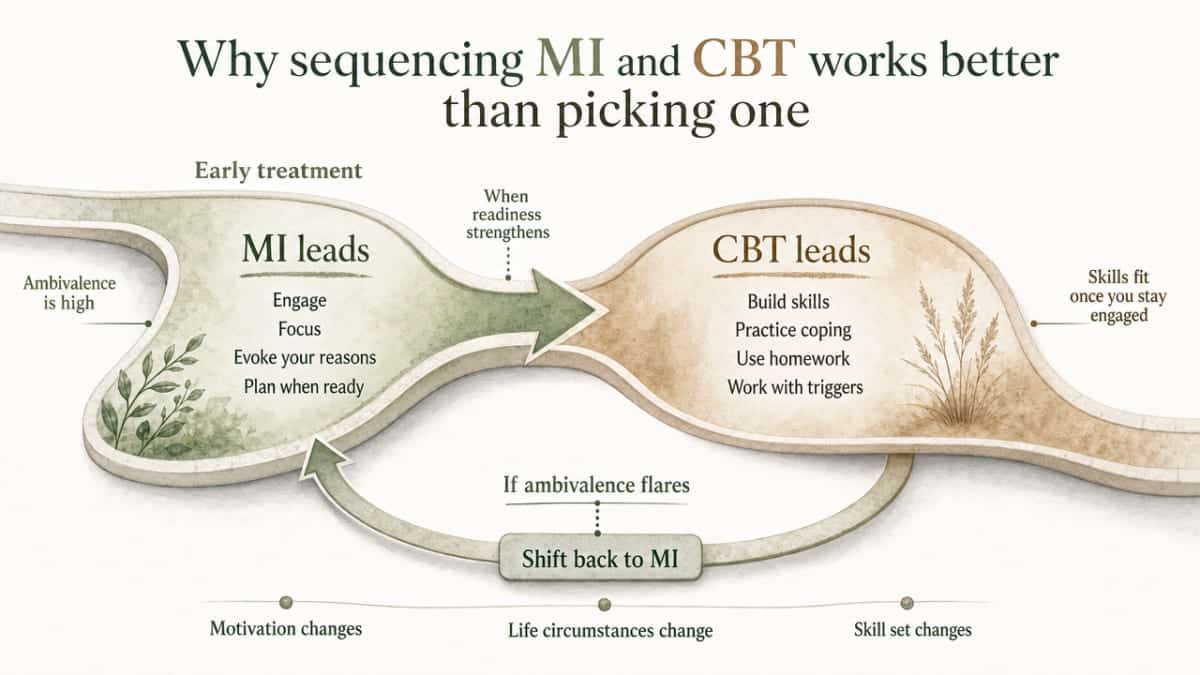
So if neither modality wins on average, what actually helps? The clinical answer is sequencing: using MI where MI does its best work, then handing off to CBT where CBT does its best work, and being willing to move back and forth as your motivation, life circumstances, and skill set change.
Think about it from the inside. In the first days of treatment, you probably do not need a whiteboard diagram of your trigger chain. You need a clinician who can sit with the part of you that is not sure this whole thing is a good idea. That is MI’s job description: engaging, focusing, evoking your own reasons, and only planning when you are ready 1. If a program hits you with refusal skills and homework in hour one, the risk is not that the skills are wrong. It is that you will not be in the room by week three to use them.
Once ambivalence loosens and you actually want the tools, CBT takes over the heavy lifting. This is where you build the coping architecture — functional analysis, craving management, refusal scripts, relapse prevention — that has to hold up long after your counselor is out of the picture 23. The NCBI Bookshelf clinical chapter on counseling approaches for harm reduction is explicit that MI can be effectively combined with CBT, with MI supporting engagement and CBT carrying the longer-term behavior-change work 26. An earlier CBT review makes the same point from the other side, noting that adding motivational enhancement at the start of CBT can improve motivation and retention 7.
Sequencing is not a one-way street, though. You are going to hit a rough weekend. A family visit will land badly. A medication change will scramble your sleep. When ambivalence flares back up mid-treatment, a good clinician steps out of skills mode and back into MI mode — reflecting what changed, evoking your own reasons again — before returning to the CBT work 1. That flexibility is what the VA/DoD substance use disorder guideline is describing when it recommends using an MI style throughout therapeutic encounters, alongside whatever specific evidence-based intervention fits your clinical picture and preferences 25.
One honest caveat: adding both modalities together is not a guaranteed upgrade. That is the next section’s question. For now, the operational point is this. When you ask a treatment team how they plan care, you want to hear a sequence and a set of decision rules, not a modality label. If someone answers “we do MI” or “we do CBT,” ask when they use each one, what signals prompt them to switch, and how a Tuesday setback would actually change your Wednesday schedule.
When patient characteristics change the calculation
Averages hide people. When you zoom in on subgroups, the picture gets more interesting, and more useful for you.
Project MATCH is still the biggest data set we have on this question. The three-year follow-up looked at whether specific patient characteristics predicted better outcomes with one modality over another. Most of the matching hypotheses did not hold up. A few did. Among clients in the highest third for anger, motivational enhancement therapy produced about 76.4% abstinent days, compared with roughly 66% for CBT and 12-step facilitation 13. If you walk into treatment carrying a lot of rage — at yourself, at family, at a system that failed you — a directive skills-first approach can land wrong. A clinician who reflects and evokes instead of prescribes is often the one who keeps you in the room.
High dependence severity flips the story. A secondary Project MATCH analysis found that among outpatients with severe alcohol dependence, improvements in coping skills by the end of treatment actually explained CBT’s better one-year drinking outcomes compared with MET and 12-step facilitation. The same mediation did not show up for people with low or moderate dependence 14. Translation: if your use is deeply entrenched and your day is full of triggers, the structured skills-building work is doing something specific for you that a shorter motivational intervention may not.
Readiness to change and self-efficacy — how prepared you feel and how much you believe you can actually do this — were among the strongest predictors of long-term outcomes regardless of which therapy people received 13. That is worth sitting with. Your starting point matters. A population-specific NIAAA study of Native American adults with alcohol use disorder found that MET produced significantly less drinking intensity at seven-to-12-month follow-up than CBT or 12-step facilitation, though the authors cautioned the sample was small 11.
None of this justifies rigid modality assignment. It does justify a clinician asking real questions about your anger, your severity, your readiness, and your history before writing your schedule.
The fidelity problem: a treatment center is only as good as its clinicians
Here is the part most articles skip. Both MI and CBT are skilled interventions, and a therapy label on a program’s website tells you almost nothing about how well that therapy is actually being delivered in the room where you’ll be sitting.
That is not a knock on individual counselors. It is a statement about how easy it is for a well-intentioned program to say “we use MI” when what is actually happening in the room is a friendlier version of persuasion. A separate fidelity review made the same point about motivational enhancement: MI is empirically supported, but it has to be delivered with fidelity and skill to produce the effects the research shows 17. Without that, the label on the brochure and the intervention in the chair are two different things.
So here is a concrete thing to do with this information. When you or a family member is calling programs, ask specific questions instead of accepting modality lists:
- How does your clinical team train new counselors in MI?
- Do you use an independent fidelity measure, and who reviews the recordings or transcripts?
- What does supervision look like for CBT — are counselors following a manual, and is someone checking that the functional analyses and coping-skills sessions are actually happening the way they are supposed to?
A program that has a real answer to those questions is doing the work. A program that gets vague is telling you something too.

How a Montana residential team sequences MI and CBT across levels of care
Here is what the sequencing model actually looks like when a full-continuum program has to put it into practice. Elk Ridge Recovery runs a JCAHO-accredited residential center in Montana that moves clients through medical detox, residential inpatient, partial hospitalization, intensive outpatient, and aftercare. Each of those levels asks a different clinical question, and the mix of MI and CBT shifts to answer it.
In detox, the immediate job is medical stability and staying in the building. This is not the moment for a functional analysis worksheet. It is the moment for a nurse and a counselor who can sit with you, use open questions and reflections, and evoke your own reasons for finishing the week — the MI processes SAMHSA outlines as engaging and focusing 1. If medication-assisted treatment is part of your plan, that conversation lives here too, because psychotherapy and medication interact rather than run on separate tracks 22.
Residential is where MI and CBT start braiding together. Group rooms introduce functional analysis and coping-skills work — the structured CBT scaffolding of trigger mapping, craving management, refusal scripts, and mood regulation described in the 2023 CBT review 23. Individual sessions keep an MI posture, so when ambivalence flares mid-week a clinician can step out of skills mode and reflect what changed before returning to the plan 1. This is what the VA/DoD substance use disorder guideline means when it recommends using an MI style throughout therapeutic encounters alongside whatever specific evidence-based intervention fits your clinical picture 25.
PHP and IOP are the skills-heavy stretch. By this point ambivalence has usually settled enough that the coping architecture becomes the daily work: rehearsing the hard phone call, walking through the first Friday night at home, writing a written relapse-prevention plan. A Project MATCH dose analysis found that participants who attended all 12 CBT sessions had fewer heavy-drinking days than those who dropped out early 15. Showing up to the skills work matters as much as the modality label.
Aftercare and the alumni program shift the weight back toward MI check-ins, relapse-prevention review, and case management that catches drift before it becomes a crisis. If you want the specifics of how the Montana clinical team builds a plan for your situation, that is a conversation worth having directly with them, not something to guess at from a website.
Talk Through MI and CBT Options Now
Connect with a clinician to discuss which therapy approach could fit your recovery path.
Frequently Asked Questions
Is CBT or motivational interviewing better for addiction?
Neither one wins on average. The largest current review of MI found essentially no difference in substance use when MI was compared with another active, evidence-based therapy 8. The largest CBT meta-analysis reached the same conclusion from the other side: CBT beats minimal treatment but does not consistently beat another specific therapy 24. NIAAA lists them as broadly comparable options for alcohol use disorder 4. The more useful question is which one you need first, and why.
Can motivational interviewing and CBT be used together?
Yes, and most good programs do. SAMHSA’s federal treatment protocol explicitly supports using MI before or between CBT sessions, and returning to MI whenever ambivalence flares up 1. Clinical guidance on counseling approaches notes MI can be effectively combined with CBT, with MI supporting engagement and CBT carrying the skills work 26. One caution: a large trial in people with psychosis found integrated MI-CBT reduced substance use per using day but did not improve broader outcomes 19.
How long does it take for MI or CBT to work in addiction treatment?
MI is often delivered in a shorter format — Project MATCH used a four-session motivational enhancement protocol — while CBT was studied as 12 sessions 15. Attendance mattered: people who finished all their assigned sessions had fewer heavy-drinking days than those who dropped out early 15. In a real residential stay, you’ll usually notice engagement shifts within the first week or two, and coping-skills changes over several weeks of practice. Progress is not linear, and honest setbacks do not erase the work.
What should I ask a treatment center about how they deliver MI and CBT?
Ask specific questions instead of accepting modality labels. How do counselors get trained in MI, and how does the team verify fidelity — do supervisors review recordings or transcripts? Only 2 of 20 studied MI training programs got even most clinicians to a beginning-proficiency benchmark 16. For CBT, ask whether counselors follow a manual, how functional analyses and coping-skills rehearsal are structured, and how the plan changes if you have a setback 23. Vague answers are themselves an answer.
Do MI and CBT work if I’m also taking medication for addiction?
Yes, and the two tracks interact rather than compete. A double-blind trial in alcohol-dependent adults found that combining a CBT-based broad-spectrum therapy with extended-release naltrexone produced longer time to first drink and first heavy-drinking day than other pairings 22. The VA/DoD substance use disorder guideline recommends coordinating psychosocial treatment with medication and using an MI style throughout therapeutic encounters 25. If MAT is part of your plan, the therapy conversation should include how the medication fits, not run beside it.
Which therapy is better if I have a co-occurring mental health condition?
Evidence is mixed and depends on the outcome you care about. A 2025 meta-analysis of 47 trials found cognitive-behavioral interventions benefited substance-use outcomes for people with co-occurring conditions, but effects on psychosocial outcomes were less consistent 10. The BMJ trial of integrated MI-CBT for psychosis reduced amount used per using day but did not improve hospitalization, symptoms, or functioning 28. Dual-diagnosis care usually needs coordinated treatment for both conditions, not a single modality expected to fix everything 25.
References
- SAMHSA TIP 35 Enhancing Motivation for Change in Substance Use Disorder Treatment. https://library.samhsa.gov/sites/default/files/tip-35-pep19-02-01-003.pdf
- USING MOTIVATIONAL INTERVIEWING IN SUBSTANCE USE DISORDER TREATMENT. https://library.samhsa.gov/sites/default/files/PEP20-02-02-014.pdf
- Frequently Asked Questions. https://alcoholtreatment.niaaa.nih.gov/FAQs-searching-alcohol-treatment
- Recommend Evidence-Based Treatment: Know the Options. https://www.niaaa.nih.gov/health-professionals-communities/core-resource-on-alcohol/recommend-evidence-based-treatment-know-options
- Motivational interviewing for substance use reduction. https://pubmed.ncbi.nlm.nih.gov/38084817/
- Motivational interviewing for substance abuse. https://pmc.ncbi.nlm.nih.gov/articles/PMC8939890/
- Cognitive Behavioral Interventions for Alcohol and Drug Use Disorders. https://pmc.ncbi.nlm.nih.gov/articles/PMC5714654/
- Motivational interviewing for substance use reduction – PMC – NIH. https://pmc.ncbi.nlm.nih.gov/articles/PMC10714668/
- Digitally-Delivered Cognitive-Behavioral Interventions for Alcohol and Other Drug Use: A Meta-Analysis across Consumption and Psychosocial Outcomes. https://pubmed.ncbi.nlm.nih.gov/41842924/
- Cognitive-behaviorally-based interventions for co-occurring alcohol and other drug use and mental health disorders: A meta-analysis. https://pubmed.ncbi.nlm.nih.gov/40543363/
- Motivational Enhancement Therapy (MET), Cognitive Behavioral Therapy (CBT), and Twelve-Step Facilitation (TSF) for Alcohol Use Disorder Among Native Americans. https://www.niaaa.nih.gov/health-professionals-communities/native-air/treatment-alcohol-use-disorder/motivational-enhancement-therapy-met-cognitive-behavioral-therapy-cbt-and
- Matching alcoholism treatments to client heterogeneity: treatment main effects and matching effects on drinking during treatment. Project MATCH Research Group. https://pubmed.ncbi.nlm.nih.gov/9811084/
- Matching alcoholism treatments to client heterogeneity. https://pubmed.ncbi.nlm.nih.gov/9756046/
- Coping mediates the effects of cognitive-behavioral therapy for alcohol use disorder among out-patient clients in Project MATCH when dependence severity is high. https://pubmed.ncbi.nlm.nih.gov/28388836/
- Dose of psychotherapy and long-term recovery outcomes: An examination of attendance patterns in alcohol use disorder treatment. https://pubmed.ncbi.nlm.nih.gov/35025543/
- After 30 years of dissemination, have we achieved our goals? A systematic review of motivational interviewing training and implementation. https://pubmed.ncbi.nlm.nih.gov/26216706/
- Measures of fidelity in motivational enhancement: a systematic review. https://pubmed.ncbi.nlm.nih.gov/16814012/
- Alcoholism treatment and medical care costs from Project MATCH. https://pubmed.ncbi.nlm.nih.gov/10962766/
- Integrated motivational interviewing and cognitive behavioural therapy for people with psychosis and comorbid substance misuse: randomised controlled trial. https://pubmed.ncbi.nlm.nih.gov/21106618/
- Randomized controlled trial of motivational interviewing, cognitive behavior therapy, and family intervention in people with comorbid schizophrenia and substance abuse. https://pubmed.ncbi.nlm.nih.gov/11579006/
- A randomized controlled trial of motivational enhancement therapy in primary care. https://pubmed.ncbi.nlm.nih.gov/11414349/
- Extended naltrexone and broad spectrum treatment or motivational enhancement therapy. https://pubmed.ncbi.nlm.nih.gov/19639303/
- Efficacy of Cognitive Behavioral Therapy for Alcohol and Other Drug Use Disorders: Is a One-Size-Fits-All Approach Appropriate?. https://pmc.ncbi.nlm.nih.gov/articles/PMC9948631/
- Cognitive Behavioral Therapy for Substance Use Disorders: A Meta-Analysis. https://pmc.ncbi.nlm.nih.gov/articles/PMC6856400/
- VA/DoD Clinical Practice Guideline for the Management of Substance Use Disorders. https://www.healthquality.va.gov/guidelines/MH/sud/VA-DoD-SUD-CPG_Final_for-508_v3.pdf
- Chapter 3—Counseling Approaches for Promoting Harm Reduction and Preventing Recurrence. https://www.ncbi.nlm.nih.gov/sites/books/NBK601490/?report=classic
- Evidence Based Psychosocial Interventions in Substance Use. https://pmc.ncbi.nlm.nih.gov/articles/PMC4031575/
- Integrated motivational interviewing and cognitive behavioural therapy for people with psychosis and comorbid substance misuse: randomised controlled trial. https://www.bmj.com/content/341/bmj.c6325