Key Takeaways
- PTSD is a specific DSM-5 diagnosis with four symptom clusters, not a catch-all for a hard life, and heavy substance use can mask it during rushed evaluations 12.
- The old sequential model of getting sober before addressing trauma has been replaced by integrated care, with a 2023 network meta-analysis showing trauma-focused therapy outperforms addiction-only approaches for PTSD symptoms 16.
- Montana’s long distances, thin provider network, and 15.3 per 100,000 overdose death rate make a single-team continuum — detox through alumni support — more critical than in dense metro areas 19.
- When evaluating a Montana program, verify licensed counselors 18, repeated PTSD screening at intake and after detox, clinicians trained in EMDR, CPT, or prolonged exposure, and coordinated step-down care.
When the drinking or using started making sense
There was probably a moment you can point to. Maybe the drink took the edge off the nightmares. Maybe the pills quieted the part of your brain that wouldn’t stop scanning the room. Maybe you didn’t connect it to anything at all — you just noticed that using made the day feel survivable, and then one day it didn’t work anymore, and you kept doing it anyway.
If that’s where you are right now, you’re not broken and you’re not alone in this. In 2024, the CDC estimated that about 21.2 million U.S. adults were living with both a mental-health condition and a substance use disorder 2. That number includes people who look nothing like the stereotype — veterans, nurses, ranch hands, teachers, parents, people in Kalispell and Billings and small towns nobody’s heard of. People who tried, more than once, to just stop.
Here’s what this article is going to do. It’s going to treat post-traumatic stress disorder as what it actually is — a specific diagnosis with real criteria, not a vague word for a rough life. It’s going to explain why PTSD and addiction so often travel together, and why the old advice to “get sober first and deal with the trauma later” doesn’t match what the current research shows. It’ll walk you through what integrated dual-diagnosis care looks like day to day, what EMDR and other trauma-focused therapies actually do, and what to look for in a Montana program that can hold both parts of what you’re carrying.
You don’t have to have this figured out before you keep reading. You just have to keep reading.
PTSD is a diagnosis, not a description of a hard life
You’ve probably heard people throw the word “trauma” around like it means everything and nothing. Bad day at work? Trauma. Rough breakup? Trauma. Your childhood? Trauma. The word has gotten so stretched out that when something real is happening inside your nervous system, it can be hard to tell whether you’ve earned the label — or whether you’re just being dramatic.
Post-traumatic stress disorder isn’t a mood. It isn’t a personality. It’s a clinical diagnosis with specific criteria a trained clinician uses to decide whether what you’re experiencing meets the definition.
The DSM-5, which is the manual clinicians use, lays out what PTSD actually requires. First, exposure to a traumatic event — directly, as a witness, by learning it happened to someone close to you, or through repeated professional exposure (think first responders, medics, investigators). Then symptoms fall into four clusters:
- Intrusion (nightmares, flashbacks, unwanted memories)
- Avoidance (steering clear of anything that reminds you of it)
- Negative changes in mood or thinking (numbness, shame, a persistent sense that the world is dangerous or that you’re to blame)
- Changes in arousal and reactivity (jumpiness, anger, trouble sleeping, scanning every room)
Those symptoms have to last longer than a month, they have to actually get in the way of your life or work or relationships, and they can’t be better explained by medication, substance use, or another medical condition — that last piece is called Criterion H 12.
Why does the distinction matter to you, sitting where you are right now? Because Criterion H is exactly the wall a lot of people run into. If you’re drinking heavily or using every day, a rushed evaluation might chalk your nightmares and hypervigilance up to withdrawal, or your emotional numbness up to depression, and never actually name the PTSD underneath. That’s not you being missed because you don’t matter. That’s why the assessment has to happen more than once, at more than one point in your care, by someone who knows how trauma and substances tangle together.
Reading a list of criteria and recognizing yourself in it isn’t a diagnosis. But it might be the first time you’ve had language for what’s been happening. That counts.
Why PTSD and addiction so often show up together
If your drinking or using got worse after something happened to you, there’s a reason for that. It isn’t weakness, and it isn’t a character flaw. Your nervous system was doing what it could with what it had.
Alcohol slows down a brain that won’t stop scanning. Opioids quiet a body that hurts in places you can’t point to. Stimulants push through the fog of not sleeping for weeks. Cannabis takes the edge off nightmares. Benzos turn the volume down on panic. None of that is mysterious. It’s what people reach for when they don’t have another way to get through the night.
The numbers back up what a lot of people already know from the inside. The VA’s National Center for PTSD reports a lifetime PTSD and alcohol- or drug-use-disorder comorbidity rate of about 44.6% among the veterans they’ve studied, along with elevated rates of alcohol, drug, and nicotine use in people with PTSD 13. That’s not a small overlap. That’s close to half of one group carrying both diagnoses at some point in their lives.
Veterans aren’t the only people this pattern shows up in. Survivors of assault, adults who grew up in violent or chaotic homes, first responders, nurses who worked through the worst years of the pandemic, people who lived through a bad accident or lost someone suddenly — the same loop keeps appearing. Something happens. The body doesn’t reset. Substances become the tool that works, until they don’t.
Here’s the piece that matters for treatment. When PTSD is driving the use, treating only the use leaves the engine running. You might get a few weeks of sobriety, maybe a few months, and then a bad night or a familiar smell or a car backfiring pulls the whole thing back down. That’s not you failing at recovery. That’s untreated PTSD doing exactly what untreated PTSD does — and it’s why the next section matters, because for a long time the standard advice was to wait on the trauma work, and that advice is changing.
The old advice was: get sober first. Here’s what changed.
For a long time, if you walked into a treatment center and mentioned trauma, someone would tell you to focus on staying sober and worry about the trauma later. Maybe in a year. Maybe after you had solid time. The reasoning sounded protective: opening up old wounds might destabilize you, spike cravings, put your sobriety at risk. So a lot of people did the work in that order. They got sober. They white-knuckled it. And then the PTSD came back to collect, and a lot of them relapsed.
That advice hasn’t held up. The VA now points to guidelines that support access to evidence-based treatment for both PTSD and SUD without one diagnosis excluding the other, and the field has moved away from the strict sequential model that dominated for decades 13. A peer-reviewed state-of-the-science review reaches the same conclusion: individual trauma-focused therapies are generally the most effective approaches for people with co-occurring PTSD and SUD, delivered alongside substance use treatment rather than after it 14.
The strongest recent evidence comes from Project Harmony, a 2023 network meta-analysis pooling 39 studies — 24 of them randomized trials — comparing different treatment approaches for co-occurring PTSD and alcohol or other drug use disorder. At the end of treatment, integrated trauma-focused therapy outperformed integrated non-trauma-focused therapy, addiction-focused psychotherapy on its own, and other control psychotherapies for reducing PTSD symptoms 16. The effects on substance use outcomes were less definitive, which is worth naming honestly — but for the PTSD side, treating both together, with the trauma actually addressed, worked better than the alternatives.
What integrated dual-diagnosis care actually looks like
“Integrated care” gets used a lot in treatment-center marketing, and it can start to sound like nothing. So here’s what it actually means in practice, and what it should feel like from the inside of the program.
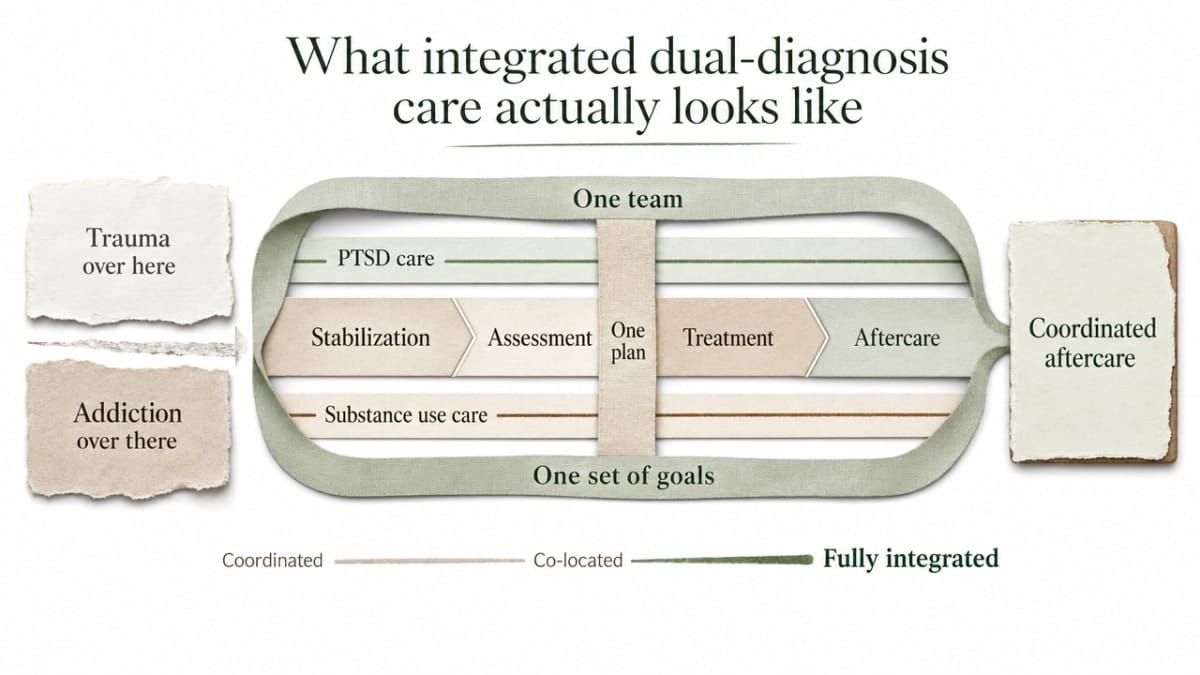
Integrated dual-diagnosis treatment means one team, one plan, and one set of goals that hold both your PTSD and your substance use at the same time. Not a therapist over here who does trauma and a counselor over there who does addiction, and neither one talking to the other. SAMHSA describes integrated care as coordinating mental-health and substance-use services through coordinated, co-located, or fully integrated models — with the fully integrated end of that spectrum meaning the same team is working on both conditions together 1. The SAMHSA evidence-based practices toolkit for co-occurring disorders lays out the same principle: assessment, medication decisions, counseling, discharge planning, and recovery supports should all be organized around the reality that both conditions are present 6.
What that looks like on the ground breaks into two pieces worth walking through: how you get assessed, and what the actual sequence of care feels like from week one to week twelve.
Screening in both directions, from day one
SAMHSA calls it “no wrong door.” It means if you come in through the addiction door, someone screens you for mental-health conditions like PTSD. If you come in through the mental-health door, someone screens you for substance use. Neither door sends you back out to figure the other side out on your own 1.
In practice, that looks like more than one conversation. A good program will screen you at intake, then screen you again once you’re through the worst of withdrawal, because symptoms shift as your body clears. Nightmares that looked like withdrawal in week one may still be there in week three — that’s information. Hypervigilance that a rushed evaluator would have chalked up to detox may turn out to be part of a PTSD picture that’s been there for years.
You shouldn’t have to advocate for this. But if you’re in a program and nobody has asked you about trauma by the end of your first week, it’s fair to say something. “I think there’s more going on than the drinking” is a full sentence. A team that’s actually set up for dual diagnosis will hear that and act on it.
A sequence you can actually picture: stabilization, assessment, paced trauma work, aftercare
The first stretch is stabilization. If you need medical detox, that comes first — physician-led, with medication support for withdrawal symptoms, monitoring for the complications that can turn dangerous fast (alcohol withdrawal, benzo withdrawal, opioid withdrawal each carry their own risks), and enough rest that your nervous system starts to remember what neutral feels like. Nobody is asking you to process the worst day of your life while you’re shaking. That would not be care. That would be harm.
Then comes the deeper assessment. This is where a clinician sits with you long enough to sort out what’s PTSD, what’s withdrawal echoing, what’s depression, what’s grief, what’s the way a body sleeps when it hasn’t slept safely in years. A treatment plan gets built around what’s actually there — not a template.
Trauma work starts when your body and your team agree you’re ready. For some people that’s in residential, once you have a few weeks of stability and skills for managing distress. For others it starts in partial hospitalization or intensive outpatient, when daily life has a rhythm again. Pacing matters. A good clinician will not push you into the memory before you have the tools to come back out of it. They will also not stall forever waiting for a perfect moment that never arrives.
Relapse prevention runs alongside all of it — coping skills, medication-assisted treatment when it fits, group work, family therapy where that’s possible. And then aftercare, because the twenty-eighth day or the ninetieth day is not the finish line. Aftercare means an alumni program, continued outpatient or virtual sessions, peer support, sober activities you actually want to do. Elk Ridge Recovery’s continuum in Montana is built this way on purpose: detox to residential to PHP to IOP to outpatient to alumni, so the handoffs happen inside one team instead of between strangers.
EMDR, CPT, and prolonged exposure, honestly explained
Three trauma-focused therapies come up over and over when clinicians talk about PTSD: EMDR, cognitive processing therapy (CPT), and prolonged exposure (PE). None of them are magic. All of them ask something of you. Here’s what they actually are.
EMDR stands for eye movement desensitization and reprocessing. In a session, you bring up a specific memory while a therapist guides your attention back and forth — usually by having your eyes follow their fingers, sometimes with taps or tones. The idea is that this bilateral stimulation helps your brain reprocess a stuck memory so it stops firing in the present. EMDR is among the highest-recommended PTSD treatments across the VA/DoD, ISTSS, NICE, and Australian clinical guidelines the VA cites 15. That’s a strong evidence base for PTSD symptom reduction.
Here’s the honest part: EMDR is not a treatment for addiction itself. A systematic review of EMDR studies in populations with comorbid conditions, including SUD, found that randomized trials were scarce and that available evidence pointed to improvement in trauma-related symptoms with smaller effects on the primary disorders like substance use 17. Translation: EMDR can help your PTSD, which can take pressure off the reasons you were using — but the addiction side still needs its own treatment.
CPT is talk-based. You work with a therapist on the beliefs the trauma installed — things like “it was my fault,” “I can’t trust anyone,” “the world is dangerous” — and learn to examine and rework them on paper and out loud. Sessions are structured. Homework is part of it.
Prolonged exposure asks you to approach the memory itself, in a controlled way, and to gradually stop avoiding the places, people, and situations you’ve been steering around. Avoidance keeps PTSD alive; PE interrupts that loop.
All three are supported by current guidance for co-occurring PTSD and SUD as part of integrated care 14. Which one fits you depends on what you can tolerate, what your clinician is trained in, and how your body responds. At Elk Ridge Recovery, EMDR is offered inside the dual-diagnosis pathway — not as a standalone fix for the drinking or using, but as a real treatment for the PTSD that’s often sitting underneath it.
Safety, overdose risk, and why continuity of care matters
There’s a hard truth worth putting on the table, because pretending it isn’t there doesn’t keep anyone safer. The stretch right after leaving treatment — or right after a relapse — is one of the most dangerous windows in a person’s recovery. Tolerance drops. The dose that used to work can stop your breathing. And if you’re carrying PTSD that never got fully treated, the emotional weight that pushed you to use in the first place is still sitting there.
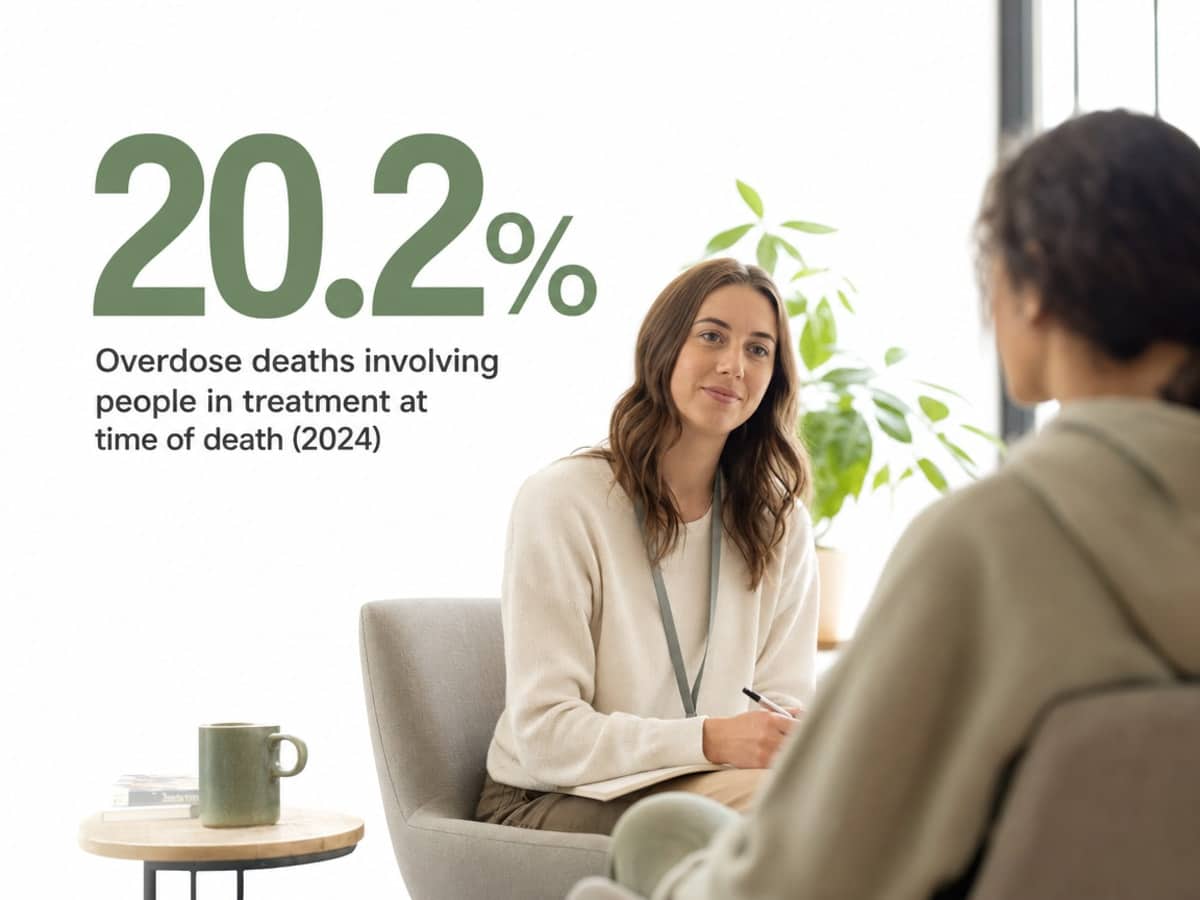
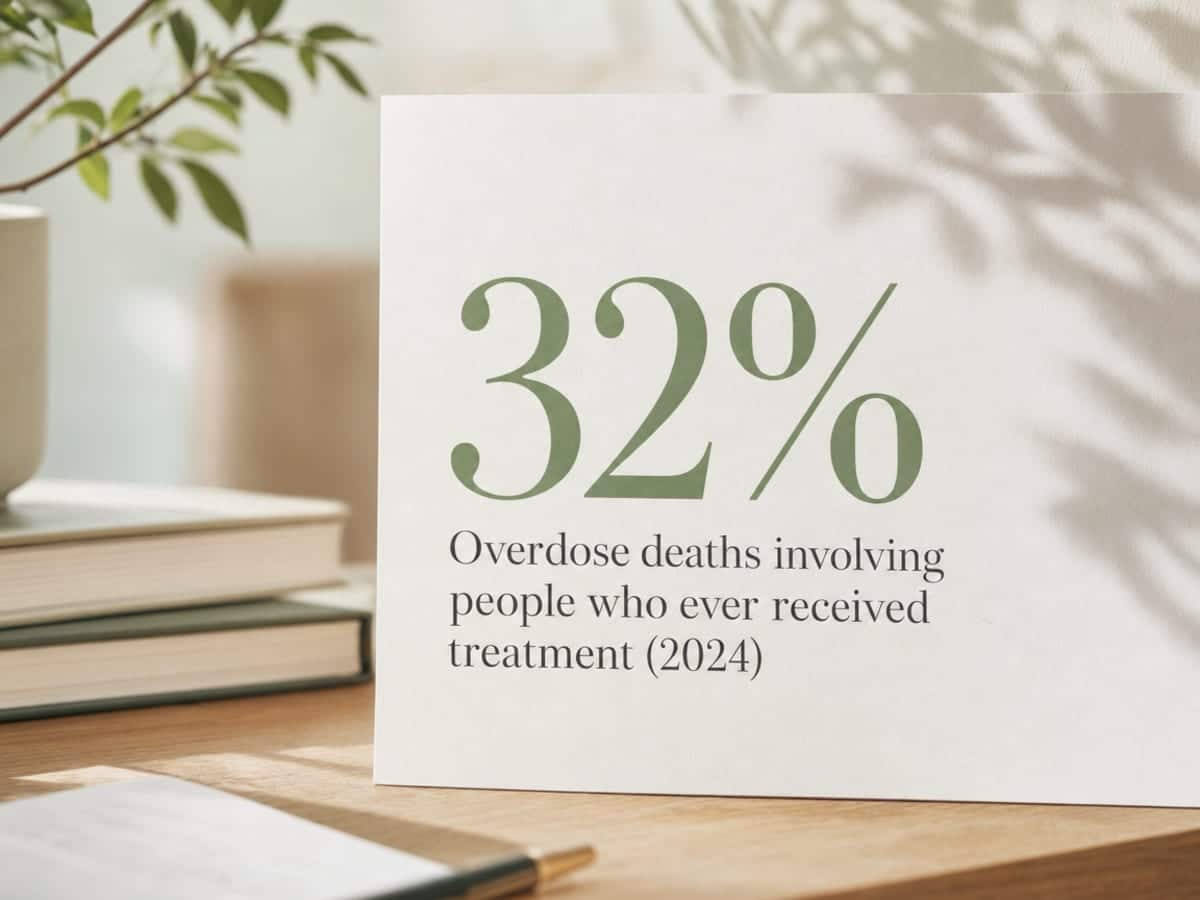
CDC data from 2024 puts the scope in plain terms: about 20.2% of U.S. overdose deaths that year involved people who were being treated for a mental-health or substance-use disorder at the time of death, and 32% involved people who had ever been treated for one 3. That doesn’t mean treatment caused those deaths. It means treatment contact happened, and something in the handoff, the follow-through, or the plan didn’t hold. The gaps between levels of care are where a lot of people get lost.
Continuity is what closes those gaps. It looks like naloxone in your bag before you leave residential, not as an afterthought. It looks like medication-assisted treatment continuing across the step-down, not restarting from zero every time you change providers. It looks like your outpatient therapist knowing what happened in your EMDR sessions upstairs, and your case manager knowing that this week is the anniversary of the thing you don’t talk about. One team. One plan. Fewer places to fall through.
Montana context: the state you’re getting treatment in
Where you get treatment matters. Not because Montana air is magic — it isn’t — but because the practical realities of the state shape what care looks like and how you get to it.
Start with the scale of what’s going on. Nationally, the CDC estimated about 21.2 million U.S. adults were living with both a mental-health condition and a substance use disorder in 2024 2. That’s the country you’re in. In Montana specifically, the CDC reported a drug-overdose death rate of 15.3 per 100,000 residents using 2024 data 19. That figure doesn’t tell you how many people are struggling — it captures fatal outcomes only — but it does say something honest about what happens when people don’t get the help they need in time.
Montana is also big and thin. Distances between towns are long, weather closes roads, and the nearest specialty provider can be hours away. If you live in Libby or Lewistown, driving to weekly outpatient in another town isn’t a small ask. That’s part of why a residential program that carries you through the whole continuum — detox, residential, PHP, IOP, outpatient, alumni support — matters more here than in a dense metro where you can string together separate providers. Elk Ridge Recovery serves people from across Montana, Idaho, North Dakota, South Dakota, and Wyoming for the same reason: the region is spread out, and the number of programs that hold both PTSD and substance use inside one team is smaller than the need.
SAMHSA’s 2024 state profile for Montana includes facility-level data on programs serving people with a PTSD diagnosis and points you toward FindTreatment.gov for verified provider information — a useful cross-check when you’re deciding where to go 5.
What to look for in a Montana program (and what to ask)
When you’re tired and scared, evaluating a treatment program can feel like one more thing you don’t have energy for. So here’s a shorter list of what actually matters, and the questions that get you real answers instead of brochure lines.
Start with licensing. Montana Code requires addiction counselors to be licensed, with specific education, supervised practice, and an approved examination behind that license 18. That’s the floor, not the ceiling. Ask who on the clinical team is licensed, and who is trained in trauma-focused therapies like EMDR, CPT, or prolonged exposure.
Ask how PTSD gets identified. “Do you screen for PTSD, and when — at intake, after detox, or both?” A program organized around integrated care will screen more than once, because symptoms shift as your body clears 1, 6.
Ask how trauma work and addiction work fit together. “Is my therapist the same person coordinating my substance use treatment, or a different team?” You’re listening for one plan, one set of goals, one team that talks to each other.
Ask about the whole arc. “What does the step-down look like from residential to PHP to IOP to outpatient — and who follows me?” Elk Ridge Recovery’s continuum in Montana is built to keep that handoff inside one team, which is the point of asking. If you want a direct conversation about PTSD and addiction treatment specifically, that’s a question worth putting on the table when you call.
Reach Out for Trauma and Addiction Support Today
Get immediate answers about trauma-related addiction care and start planning your path forward with guidance from real professionals.
Frequently Asked Questions
Do I have to get sober before I can start trauma therapy for PTSD?
No. Current guidance and recent evidence support treating PTSD and substance use at the same time, not in sequence. A 2023 network meta-analysis found integrated trauma-focused therapy outperformed addiction-only and non-trauma-focused approaches for PTSD symptoms 16. You still need medical stabilization first — but you don’t have to earn trauma care with sobriety time.
How do I know if what I’m dealing with is actually PTSD and not just a hard time?
PTSD has specific criteria: exposure to a traumatic event, symptoms in four clusters (intrusion, avoidance, negative mood/thinking, hyperarousal), duration longer than a month, real interference with your life, and symptoms not fully explained by substances or another condition 12. Only a trained clinician can diagnose you — but if that list sounds familiar, it’s worth an evaluation.
Does EMDR treat addiction, or just PTSD?
EMDR is an established PTSD treatment, recommended by major clinical guidelines 15. It’s not a treatment for addiction itself. A systematic review of EMDR in populations with comorbid conditions, including SUD, found improvement in trauma-related symptoms but smaller effects on the primary disorders 17. Inside dual-diagnosis care, EMDR treats the PTSD; your substance use needs its own coordinated treatment.
What should I look for in a Montana program that treats PTSD and addiction together?
Licensed addiction counselors — Montana Code requires it 18. Clinicians trained in trauma-focused therapies like EMDR, CPT, or prolonged exposure. Screening for PTSD at intake and again after detox 1. One team coordinating both your trauma and substance use care 6. And a real step-down: detox to residential to PHP to IOP to outpatient to alumni, without you having to rebuild the plan.
Is it safe to start trauma work during detox or early recovery?
Not during acute detox. Your body needs to stabilize first — withdrawal from alcohol, benzos, or opioids carries real medical risk, and processing traumatic memories while you’re shaking isn’t care. Once you’re medically stable and have some skills for managing distress, a trained clinician can begin paced trauma-focused work. Good programs match the timing to your nervous system, not a calendar 14.
What if I can’t afford treatment or don’t know what my insurance covers?
Call and ask. Most programs, including Elk Ridge Recovery, will verify your insurance benefits and walk you through what’s covered before you commit to anything. Case managers can also help you understand out-of-pocket costs and payment options. You don’t need to have the financial piece figured out before you make the first call — that conversation is part of what intake is for.
References
- Managing Life with Co-Occurring Disorders. https://www.samhsa.gov/mental-health/serious-mental-illness/co-occurring-disorders
- About Behavioral Health. https://www.cdc.gov/mental-health/about/about-behavioral-health.html
- Substance Use & Mental Health. https://www.cdc.gov/mental-health/about-data/substance-use-mental-health.html
- MMWR, Volume 73, Issue 34 — August 29, 2024. https://www.cdc.gov/mmwr/volumes/73/wr/pdfs/mm7334-H.pdf
- National Substance Use and Mental Health Services Survey (N-SUMHSS) State Profile 2024. https://www.samhsa.gov/data/system/files/media-quick-stats/nsumhss-id24.pdf
- Integrated Treatment for Co-Occurring Disorders: Evidence-Based Practices (EBP) KIT. https://www.samhsa.gov/resource/ebp/integrated-treatment-co-occurring-disorders-evidence-based-practices-ebp-kit
- Mental Health Conditions & Care. https://www.cdc.gov/mental-health/about-data/conditions-care.html
- Mental & Physical Health Status. https://www.cdc.gov/mental-health/about-data/mental-physical-health-status.html
- SUDORS Dashboard: Fatal Drug Overdose Data. https://www.cdc.gov/overdose-prevention/data-research/facts-stats/sudors-dashboard-fatal-overdose-data.html
- FastStats – Mental Health. https://www.cdc.gov/nchs/fastats/mental-health.htm
- Post-Traumatic Stress Disorder. https://www.nimh.nih.gov/health/publications/post-traumatic-stress-disorder-ptsd
- PTSD and DSM-5 – PTSD: National Center for PTSD. https://www.ptsd.va.gov/professional/treat/essentials/dsm5_ptsd.asp
- Treatment of Co-Occurring PTSD and Substance Use Disorder in Veterans. https://www.ptsd.va.gov/professional/treat/cooccurring/tx_sud_va.asp
- State of the Science: Treatment of comorbid posttraumatic stress disorder and substance use disorder. https://www.ptsd.va.gov/professional/articles/article-pdf/id1635224.pdf
- Eye Movement Desensitization and Reprocessing (EMDR) for PTSD. https://www.ptsd.va.gov/professional/treat/txessentials/emdr_pro.asp
- Project Harmony: A systematic review and network meta-analysis of psychosocial and pharmacological treatments for co-occurring PTSD and alcohol or other drug use disorder. https://pmc.ncbi.nlm.nih.gov/articles/PMC10939977/
- EMDR beyond PTSD: A Systematic Literature Review. https://pmc.ncbi.nlm.nih.gov/articles/PMC5623122/
- 37-39-310. Addiction counseling license required — qualifications. https://mca.legmt.gov/bills/mca/title_0370/chapter_0390/part_0030/section_0100/0370-0390-0030-0100.html
- Montana | Stats of the States. https://www.cdc.gov/nchs/state-stats/states/mt.html