Key Takeaways
- Recovery after discharge means taking over the structure your treatment team once provided, using the same categories — triggers, cravings, warning signs, contacts, and a lapse plan — in your own handwriting.
- Map triggers specifically across people, places, feelings, and times, then layer a H.A.L.T. check on top so predictable high-risk moments get a written plan instead of willpower.
- Rehearse the eight-step craving response and a five-step lapse protocol before you need them, so voice contact, distraction, and safety moves are automatic when an urge hits.
- Match aftercare intensity to your actual life, keep MAT and naloxone in the plan if opioids are involved 13, and treat depression and low self-efficacy as modifiable relapse risks 20.
What Changes the Morning After Discharge
The first morning back in your own bed is quieter than you expected. No shift change, no group at 9 a.m., no one knocking to see if you’re up. That silence is the shift. In residential care, the walls did some of the work for you. Now the walls are yours, and the plan has to move from a binder into your Tuesday.
Here is the honest part: recovery is a long-term change process, and the first year tends to be the hardest. NIAAA describes it as a marathon, not a sprint, and specifically flags the value of ongoing support during that first stretch 1. That is not a warning meant to scare you. It is permission to treat this like the multi-year project it is, instead of a test you already passed at discharge.
What actually changes on day one is who runs the schedule. In treatment, someone else structured your meals, your groups, your sleep, your accountability. Starting today, you decide when the alarm goes off, who you call before a Friday shift, what you do with a Sunday afternoon that used to be a drinking afternoon. The good news is that the same categories your clinicians used, triggers, cravings, warning signs, support contacts, and a lapse plan, still work. You just become the person holding the pen.
The rest of this guide walks through each piece so you can write it down this week, in your own words, for your own life in Montana or wherever you woke up this morning.
Mapping Your Triggers Before They Map You
A trigger is anything that reliably points your brain toward using. SAMHSA’s Matrix handbook is blunt about the categories: people, places, objects, feelings, and times can all set off cravings, and they usually do it before you consciously notice 7. If you don’t name them, they still run. You just don’t get a vote.
Start with four columns in a notebook this week. Label them People, Places, Feelings, Times. Then fill them in with the specifics from your actual life, not a generic list.
- People: The cousin who always shows up with a twelve-pack. The coworker on the framing crew who drinks through lunch. The ex who texts at 11 p.m.
- Places: The bar off Highway 93. Your uncle’s garage. The gas station where you used to buy singles. The stretch of road that runs past your old dealer’s house.
- Feelings: Boredom on a Sunday. The tight-chest feeling after a fight. Payday relief. Shame after a missed call from your kid.
- Times: Friday at 5. Hunting season. The anniversary of your dad’s death. The first snow. Any night the house is empty.
Now add a fifth check that sits on top of the whole map: H.A.L.T. — Hungry, Angry, Lonely, Tired. SAMHSA’s recovery handbook names these four states as reliable amplifiers, the kind that turn a manageable Tuesday into a risky one 10. When any two of them stack up, your trigger list gets sharper teeth. A Friday afternoon alone in a cold cabin after a missed meal is not the same Friday as one where you ate, slept, and called someone.
The point of the map isn’t to avoid your whole life. It’s to know, in advance, which Tuesdays need a plan.
The Craving Response Sequence: An Eight-Step Playbook
A craving is not a decision. It’s a wave that shows up, peaks, and passes, usually inside twenty minutes if you don’t feed it. NIAAA’s patient tool describes urges exactly this way: temporary experiences that crest and fade 6. The problem isn’t that you get cravings. The problem is that in the moment, your brain skips the whole middle of the movie and jumps straight to the ending. A rehearsed sequence puts the middle back.
Here is the eight-step playbook, drawn from the NIAAA CBT manual and the Rethinking Drinking worksheet 5, 6. Learn it in order, then practice it before you need it. The point isn’t to run every step every time. The point is that when a craving hits at 6:42 on a Thursday, you already know what step two is.
- Track. Write the urge down. Time, place, intensity from 1 to 10, what happened right before. This sounds like homework, and it is. Tracking makes an invisible pattern visible within a week or two.
- Avoid. When the trigger is predictable, reduce exposure first. The CBT manual is direct: cutting preventable cues comes before coping with them 5. Take the long way home. Delete the number. Ask your partner to keep alcohol out of the house for now.
- Remember. Read your own reasons. Keep a short list in your wallet or on your phone lock screen: your kid’s name, the job you want to keep, the way you felt on day three of detox. Cravings work by amnesia. You fight amnesia with a note.
- Contact. Call a person. Not text, if you can help it — voice. Your sponsor, your counselor, the friend from group who actually picks up. Have three names lined up so one unanswered call doesn’t end the play.
- Distract. Do something that occupies your hands and your attention for at least fifteen minutes. NIAAA recommends preparing short, medium, and long options in advance 6. Short: cold water on your face, a walk to the mailbox. Medium: a shower, a chore, a drive with music. Long: a hike, a gym session, dinner with someone sober.
- Challenge. Say the craving thought out loud, then argue with it. “One won’t hurt” gets answered with “one has never been one for me.” “I’ve earned it” gets answered with “I’ve earned staying sober tonight.” Writing these rebuttals in advance beats trying to invent them mid-urge.
- Surf. If it’s still there, ride it. Sit down, breathe, and watch the sensation without acting. The CBT manual calls this observing the physical experience of craving without responding 5. Notice where it lives in your body. Notice it changing. Most urges soften noticeably within twenty to thirty minutes when you stop feeding them with argument.
- Exit. If you’re still in the high-risk situation and the wave isn’t passing, leave. Keys, jacket, door. You don’t owe anyone an explanation on the way out. You can send a text from the car.
Rehearse this on small urges — the 3-out-of-10 ones — so the sequence is automatic when a 9 shows up. That’s the whole trick. You’re not trying to out-willpower a craving in real time. You’re running a play you already practiced.
Structuring the Week So Sobriety Has Somewhere to Live
Willpower is a bad calendar. If your week has no shape, cravings will fill the gaps for you. SAMHSA’s Matrix handbook is straightforward about this: structuring free time with exercise, mutual-help meetings, volunteering, and non-using friends is one of the main jobs of early recovery, not a nice-to-have 7. A written week is a set of walls where the old ones used to be.
Build the week around three anchors and one flag.
- A morning anchor. Same wake time, seven days. Coffee, ten minutes of reading or prayer or journaling, a short walk if the driveway isn’t iced over. The point isn’t the ritual, it’s that your day starts before your feelings do.
- A midday check-in. A two-minute pulse on H.A.L.T. and a scan of your trigger map. If you’re hungry, eat. If you’re lonely, text someone before the shift ends. This is the cheapest relapse prevention you’ll ever run.
- An evening wind-down. A hard stop on screens and stimulants, a consistent bedtime, and something that signals the day is over. Sleep is not optional here. NIAAA’s neuroscience resource is clear that disrupted sleep and unmanaged stress erode the cognitive control you need to ride out an urge 21.
Then flag your one predictable high-risk block on the calendar — Friday at 5, Sunday afternoon, the drive home after a long shift — and pre-load it. A meeting, a gym slot, dinner with your sister, a phone call already on the schedule. You are not white-knuckling that block. You are booking over it.
Two more moves make the week hold. Put your recovery appointments — therapy, IOP, MAT check-ins, mutual-help meetings — on the same calendar as your work shifts, in the same color. They are not extras. And schedule at least one thing each week you actually look forward to that has nothing to do with using: a hike, a fishing trip, a Sunday breakfast with a friend. Substance-free activities are part of the plan, not a reward for finishing it 1.
Warning Signs Worth Writing Down
Relapse rarely starts with a drink or a pill. It starts weeks earlier, in small drifts you might not clock as a big deal. SAMHSA’s illness management training describes relapse as a gradual process with early warning signs that show up before the full return to use, which means you have a window if you’re paying attention 11.
The trick is to write your own list, from your own last relapse or your own last close call. Generic checklists don’t fit as well as a page in your handwriting. Pull from what actually happened last time: What did the week before look like? Who did you stop calling? What did you tell yourself?
SAMHSA’s practitioner handout names the usual suspects, and they’re worth putting on your list until you know your own better: sleep disruption, appetite changes, isolation, irritability, missed medications, poor concentration, and overconfidence — the quiet belief that you’ve got this handled and don’t need the meeting this week 12. The SAMHSA recovery handbook adds two more that hit hard in early recovery: romanticizing past use (“it wasn’t always that bad”) and testing the idea that you could use in a controlled way this time 10.
Pick your top five. Write them on the same page as your trigger map. Then name one person who gets to hear you say, “Three of these are true this week” — before the fourth one is a drink.
When Depression and Low Self-Efficacy Are the Real Trigger
Sometimes the trigger isn’t a person or a place. It’s the voice in your head that says you’re not going to make it anyway, so why bother tonight. That voice has a name in the research. A recent systematic review of relapse after residential SUD treatment found that greater depressive burden and lower self-efficacy — the belief that you can actually pull this off — were both linked to higher relapse risk, while peer support, longer treatment engagement, and adherence-focused care were linked to better outcomes 20.
Read that again, because it matters: depression and self-doubt are not character flaws. They are modifiable risk factors. Treating them is relapse prevention, not a separate project you’ll get to later.
Two practical moves this week. First, if your mood has been sliding — sleeping too much or too little, no appetite, no interest in things you used to like, a heaviness that doesn’t lift — tell your prescriber or therapist now, not at the next scheduled visit. Co-occurring depression responds to treatment, and untreated symptoms can look exactly like relapse warning signs 9. Second, build evidence against the self-doubt. Keep a running list of days you handled a craving without using, calls you made when it was hard, mornings you got up on time. Self-efficacy grows from proof, not pep talks.
If Opioids Are Part of Your Story: Medication and Naloxone
If opioids are the substance you’re trying to stay away from, the rules of this plan shift in one important way: the cost of a slip is higher, and the medication piece is not optional the way it might be with other substances.
Buprenorphine, methadone, and naltrexone are the three FDA-approved options. They work by normalizing brain chemistry, relieving cravings, and, in some cases, preventing withdrawal, which is exactly the load your willpower shouldn’t have to carry in month two 14. If you started one in treatment, staying on it is part of your relapse-prevention plan, not a separate medical errand. Put your prescriber follow-ups on the same calendar as your therapy and meetings, in the same color, and treat a missed refill as a warning sign worth calling your counselor about.
Two more items belong on the plan, in writing. First, keep naloxone in the house and in the truck, and make sure at least one person you live with or see often knows how to use it 13. Second, if you slip, tell your prescriber the same day, not next week. Reduced tolerance is what turns a lapse into a funeral, and it is preventable.
Daily Support Tools: Phones, Apps, and Human Voices
Between therapy appointments, most of your recovery happens in the small moments — the drive home, the empty Saturday, the 10 p.m. urge that shows up when no one’s around. The tools that help most in those moments are the ones already in your pocket or on your call list.
Start with the human voices. A short contact tree beats a long one: three people you can actually reach, in the order you’ll call them. Sponsor first, therapist or counselor second, sober friend third. Test the list this week by calling one of them when nothing is wrong. If the call feels awkward on a Tuesday, it will feel impossible on a Friday.
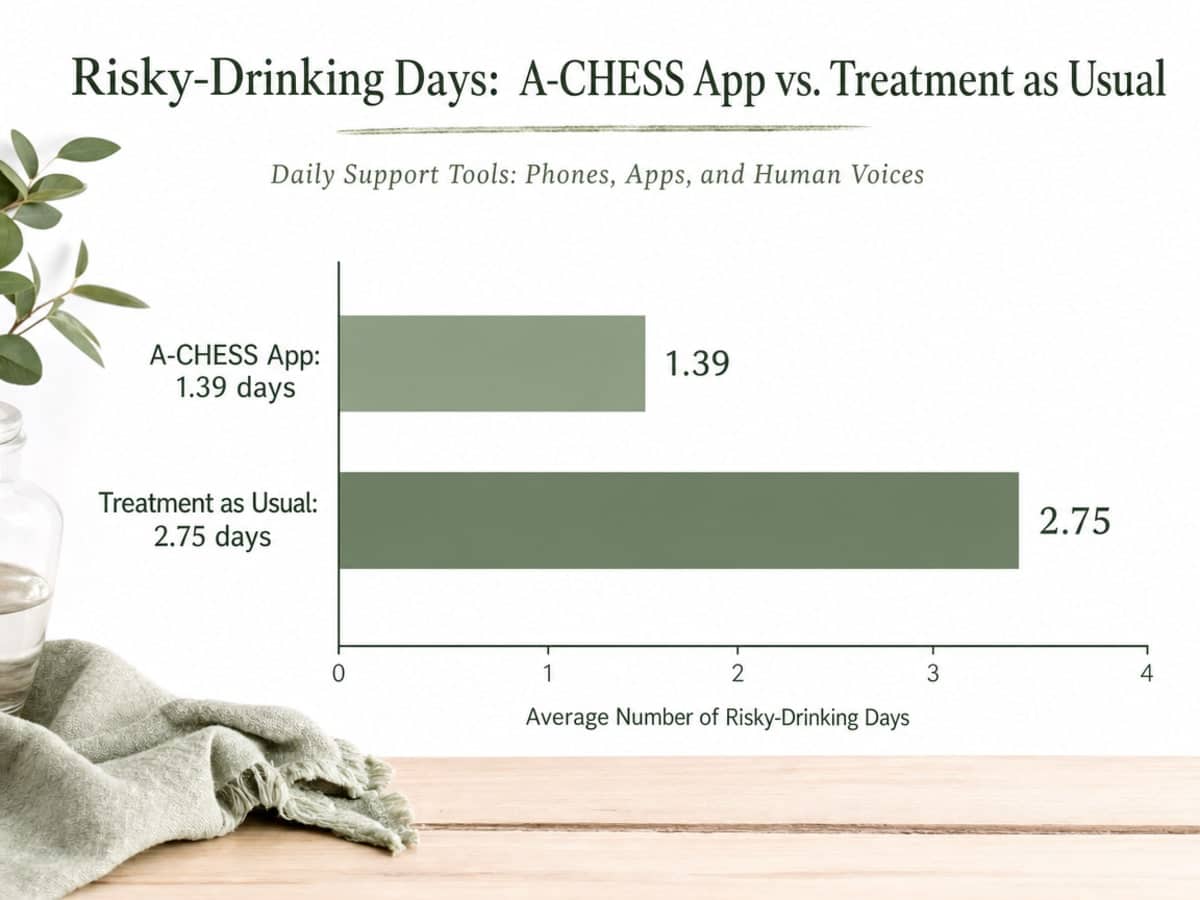
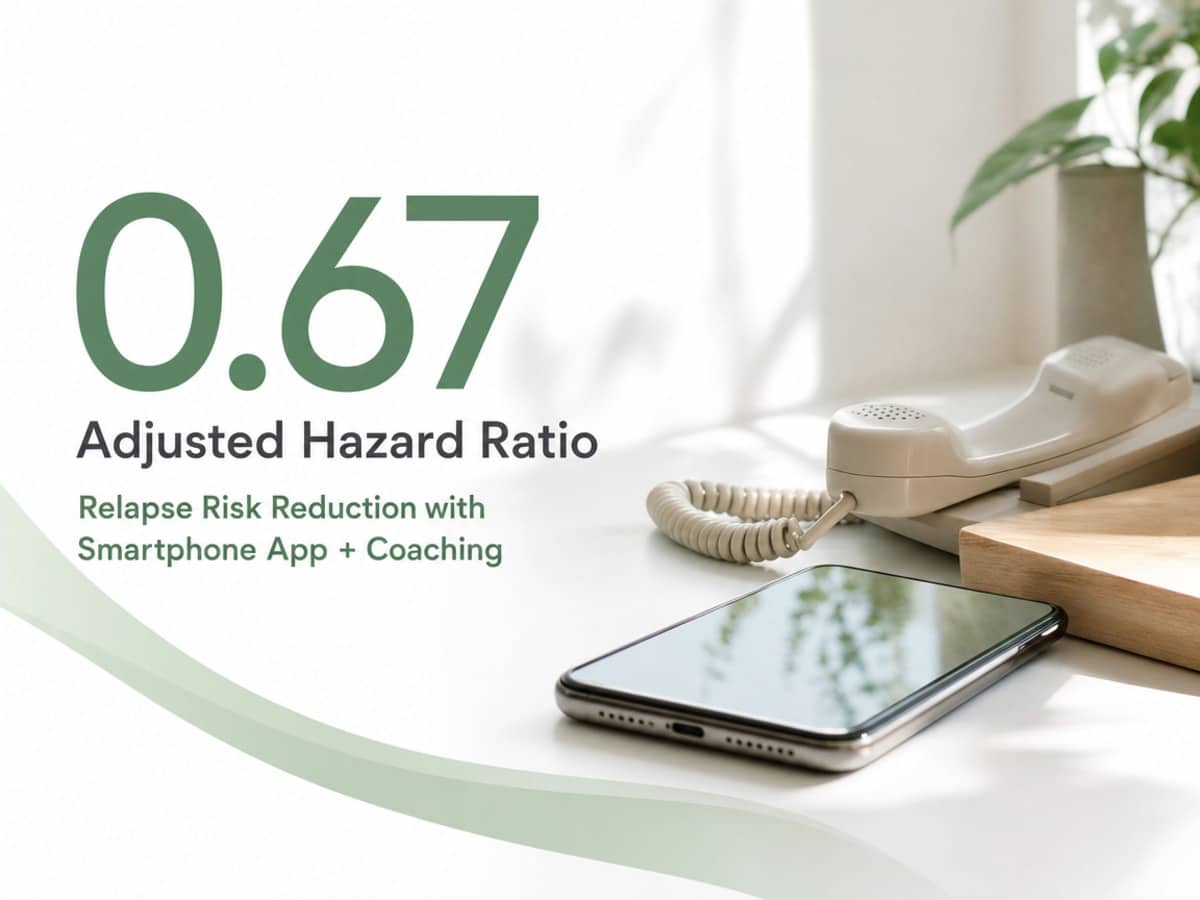
Then layer in the phone itself. Digital tools built for recovery aren’t a gimmick — the evidence is real, if narrower than the marketing suggests. In the A-CHESS randomized trial of 349 adults leaving residential treatment for alcohol dependence, participants using the smartphone app reported an average of 1.39 risky-drinking days versus 2.75 for treatment as usual over the study period 17. That’s roughly half. A more recent 2025 trial pairing a smartphone app with telephone coaching after inpatient AUD treatment found an adjusted hazard ratio of 0.67 for relapse within six months, meaning about a third lower risk in the app-plus-coaching group 16.
Two honest caveats. Both studies tested app-plus-support, not apps alone. And no app replaces the person on the other end of the line. Use technology for what it’s good at — reminders, mood tracking, a coping menu at 2 a.m., a one-tap call button — and use humans for what they’re good at, which is hearing your voice shake and knowing what that means.
Choosing an Aftercare Intensity That Fits Your Life
Aftercare is not a moral test. It’s a dosing question. How much clinical contact do you need, in what format, at what cost, to actually keep going? The honest answer changes with distance, work schedule, insurance, and how stable your first weeks feel. What matters is that the intensity you pick is one you’ll actually show up for in February, not the one that sounds most virtuous in the discharge meeting.
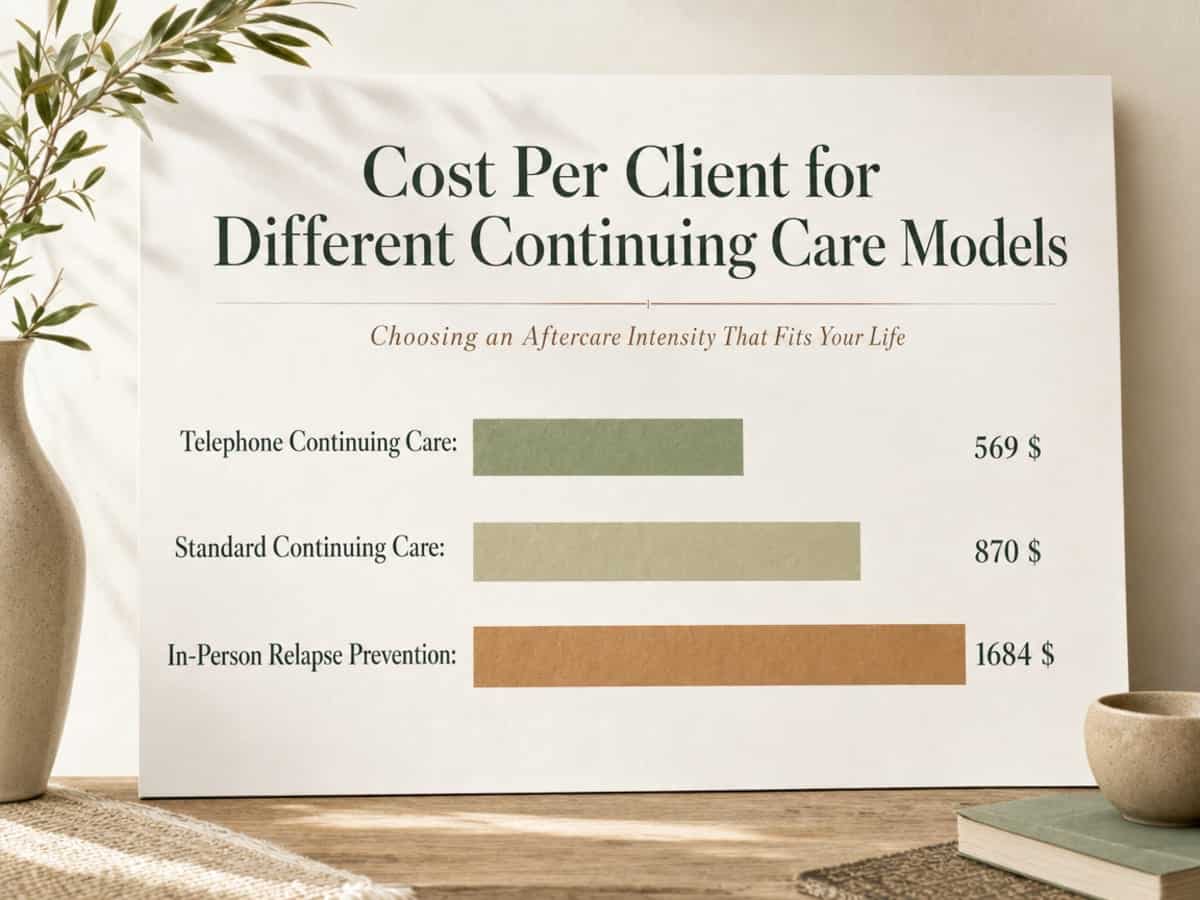
There’s useful cost and outcome data here. In a study comparing three continuing-care models after intensive outpatient treatment for alcohol and cocaine dependence, telephone-based continuing care cost $569 per client, standard continuing care cost $870, and in-person relapse prevention cost $1,684. Reported abstinence was 57.1% for telephone care versus 46.7% for standard care 18. Cheaper wasn’t worse. For some people, it was better, likely because a scheduled call is easier to keep than a ninety-minute drive across a Montana county in January.
Two cautions before you decide. First, cost data doesn’t tell you which format matches your clinical risk. If your first thirty days out have been rocky, or you’re managing depression alongside your SUD, higher-touch care is not a luxury 20. Second, telephone continuing care isn’t automatically effective either. A 2025 randomized trial of different telephone schedules after residential treatment found no significant six-month difference in abstinence between calling arms and the control group 15. All groups improved from baseline. The lesson isn’t that phone care doesn’t work; it’s that the format matters less than whether you actually engage with it.
Pick the intensity you’ll keep. Then tell your treatment team the truth about whether it’s holding. Ask Elk Ridge Recovery about relapse prevention planning if you need help sizing that decision to your life, your drive time, and your first-year risk.
If You Slip: A Lapse-Response Protocol
A slip is not the end of your recovery. It is data. Painful, scary data, but data. SAMHSA’s co-occurring disorders guidance is clear on this point: a lapse should be treated as information about what triggered the slip and what your plan missed, not as proof that you have failed 9. The people who stay in recovery long-term are usually not the ones who never slipped. They are the ones who had a protocol for what to do next.
Write these five steps down before you need them, on the same page as your trigger map.
- Stop the situation now. Pour it out. Leave the house, the bar, the truck. Physical distance from the substance is the first move, before you try to think your way through anything.
- Call one person from your contact tree within the hour. Sponsor, counselor, sober friend. Not to confess and be judged. To be heard and to have a witness. Silence is what turns a slip into a stretch.
- Call your prescriber or treatment team the same day if you’re on MAT or managing co-occurring conditions. If opioids are involved, this step is not optional. Tolerance drops fast after abstinence, and the next dose is the dangerous one 13.
- Get to safety for the night. A friend’s couch, a family member’s spare room, a meeting followed by coffee with someone. Do not sleep alone in the place where it happened if you can avoid it.
- Investigate it within 48 hours. With your counselor or on paper: What was the trigger? Which warning signs showed up in the week before? Which step of the craving response did you skip? Update your plan based on what you learned 11.
One more thing. Shame is the fuel that turns one drink into a week of them. Name the slip, tell the truth, and get back to your Tuesday. That is not weakness. That is the plan working.
Write the Plan This Week
Close this tab in a minute and open a notebook. The plan doesn’t count until it exists on paper you can see from the kitchen table.
One page, five blocks: your trigger map (people, places, feelings, times, with a H.A.L.T. check), your eight-step craving response, your three-name contact tree with phone numbers, your top five warning signs, and your lapse-response protocol. Add prescriber and naloxone info if opioids are in the picture. Put it somewhere you’ll actually see it — inside a cabinet, on the fridge, in the truck.
Then rehearse it out loud with one person this week. If you want help sizing the plan to your life, ask Elk Ridge Recovery about relapse prevention planning. Tomorrow morning, run the morning anchor. That’s the whole start.
Talk With Someone About Real-Life Relapse Risks
Get immediate support for building your day-to-day relapse prevention plan with someone who understands your challenges.
Frequently Asked Questions
How long do cravings last after residential treatment?
A single craving usually crests and passes within about twenty to thirty minutes if you don’t feed it with argument or exposure. The bigger pattern is longer: urges can reappear months after treatment, then fade again when you handle them without using 10. NIAAA’s neuroscience resource explains why — the brain systems tied to craving and stress take time to settle 21. Persistent cravings are not a sign you’re failing.
Is one slip the same as a full relapse?
No. SAMHSA’s co-occurring disorders guidance treats a lapse as information about what your plan missed, not as proof of failure 9. The difference between a slip and a stretch is usually what you do in the next twenty-four hours: stop the situation, call one person from your contact tree, and get to safety. Investigate the trigger with your counselor within forty-eight hours and update your plan 11.
Do I need medication if I finished detox and feel stable?
If opioids are your substance, yes — CDC is direct that detox without medications for opioid use disorder raises the risk of renewed use and overdose death, because your tolerance drops fast 13. Buprenorphine, methadone, or naltrexone relieve cravings and, in some cases, prevent withdrawal 14. For alcohol, FDA-approved options include acamprosate, naltrexone, and disulfiram 21. Feeling stable at week three is not the same as being protected at week twelve.
What if I live in a rural area and can’t get to meetings or an IOP?
Distance is a real constraint in Montana, not an excuse. Telephone-based continuing care produced higher reported abstinence than standard care in one study (57.1% vs. 46.7%) at a lower per-client cost 18, and proactive high-frequency phone contact was linked to significantly better six-month abstinence in a multicenter trial 19. Pair scheduled calls with a smartphone recovery app and one weekly video session with your counselor. Ask your treatment team to build that mix.
Does mindfulness actually prevent relapse?
It helps some people, some of the time. A randomized trial of 286 adults found both mindfulness-based and standard cognitive-behavioral relapse prevention beat treatment as usual at six months, with mindfulness showing added benefit on substance-use days at twelve months 2. But a pooled meta-analysis of seven trials found no statistically significant difference versus comparators (OR 0.72, 95% CI 0.46–1.13) 4. Treat it as one useful tool, not the answer.
When should I call someone versus handle a craving on my own?
Call sooner than you think. The contact step sits at position four in the eight-step sequence for a reason — voice contact interrupts the amnesia that makes cravings dangerous 5, 6. A good rule: if the urge is a 6 or higher, if two H.A.L.T. states are stacked, or if you’re inside a high-risk block on your calendar, dial before you try to think your way out. Calling early is the plan, not weakness.
References
- Support Recovery: It’s a Marathon, Not a Sprint. https://www.niaaa.nih.gov/health-professionals-communities/core-resource-on-alcohol/support-recovery-its-marathon-not-sprint
- Relative efficacy of mindfulness-based relapse prevention, standard relapse prevention, and treatment as usual for substance use disorders: a randomized clinical trial. https://pubmed.ncbi.nlm.nih.gov/24647726/
- Effectiveness of Mindfulness-Based Relapse Prevention in Individuals with Substance Use Disorders: A Systematic Review. https://pubmed.ncbi.nlm.nih.gov/34677226/
- Mindfulness-Based Relapse Prevention for Substance Use Disorders. https://pmc.ncbi.nlm.nih.gov/articles/PMC5636047/
- Cognitive-Behavioral Coping Skills Therapy Manual. https://www.niaaa.nih.gov/sites/default/files/match03.pdf
- How to Stop Alcohol Cravings | Rethinking Drinking. https://rethinkingdrinking.niaaa.nih.gov/tools/worksheets-more/how-stop-alcohol-cravings
- Client’s Handbook: Matrix Intensive Outpatient Treatment for People with Stimulant Use Disorders. https://library.samhsa.gov/sites/default/files/sma15-4154.pdf
- What is substance abuse treatment?. https://library.samhsa.gov/sites/default/files/sma14-4126.pdf
- Quick Guide: For Mental Health Professionals-Based on TIP 42. https://library.samhsa.gov/sites/default/files/sma10-4531.pdf
- The Next Steps…Towards A Better Life. https://library.samhsa.gov/sites/default/files/sma14-4474.pdf
- Training Frontline Staff – Illness Management and Recovery. https://library.samhsa.gov/sites/default/files/trainingfrontlinestaff-imr_0.pdf
- Illness Management and Recovery – Practitioners Guides and Handouts. https://library.samhsa.gov/sites/default/files/practitionerguidesandhandouts_0.pdf
- Opioid Use Disorder: Treating. https://www.cdc.gov/overdose-prevention/hcp/clinical-care/opioid-use-disorder-treating.html
- Treatment of Opioid Use Disorder | Overdose Prevention. https://www.cdc.gov/overdose-prevention/treatment/opioid-use-disorder.html
- The continuing care project: A multi-arm randomised controlled trial of a continuing care telephone intervention following residential substance use treatment. https://pubmed.ncbi.nlm.nih.gov/40288058/
- Evaluation of a Smartphone App Intervention with Telephone Guidance as Transitional Support from Inpatient Treatment to Continuing Care for Individuals with Alcohol Use Disorder: Results from a Randomized Controlled Trial. https://pubmed.ncbi.nlm.nih.gov/40414214/
- A smartphone application to support recovery from alcoholism. https://pubmed.ncbi.nlm.nih.gov/24671165/
- Telephone-based continuing care counseling in substance abuse treatment: a cost-effectiveness analysis. https://pubmed.ncbi.nlm.nih.gov/26718395/
- Telephone- and Text Message-Based Continuing Care After Residential Treatment for Alcohol Use Disorder: A Randomized Clinical Multicenter Study. https://pubmed.ncbi.nlm.nih.gov/33245589/
- Risk and protective factors for relapse after residential substance use disorder treatment: a systematic review and meta-analysis. https://pubmed.ncbi.nlm.nih.gov/42661178/
- Neuroscience: The Brain in Addiction and Recovery. https://www.niaaa.nih.gov/health-professionals-communities/core-resource-on-alcohol/neuroscience-brain-addiction-and-recovery
- Recommend Evidence-Based Treatment: Know the Options. https://www.niaaa.nih.gov/health-professionals-communities/core-resource-on-alcohol/recommend-evidence-based-treatment-know-options