Key Takeaways
- A case manager is the treatment team member responsible for your outside life — housing, benefits, court dates, healthcare, transportation, childcare, income, and employment — while you focus on recovery 1.
- The role varies by program and credential, so ask directly what your case manager handles themselves versus what they refer out, from landlord calls to court appearances 2, 12.
- Evidence is strongest for engagement, retention, and provider linkage; effects on substance use and long-term employment are mixed and depend on the wider treatment plan 3, 9.
- Discharge planning should start on day one, with housing, MAT prescriptions, outpatient appointments, and peer support arranged before you leave, not scrambled together at the end 1, 5, 6.
The Person on Your Treatment Team Whose Job Is Your Outside Life
Here is the thing nobody explains clearly before you walk into treatment: your therapist is going to focus on you. Your counselor is going to focus on you. Your doctor is going to focus on your body. But somebody has to focus on the pile of things waiting for you outside — the landlord who wants next month’s rent, the boss who needs an answer by Friday, the Medicaid card that expired, the probation check-in on the 15th, the kids’ school pickup, the truck payment, the pharmacy that won’t refill without a new prescription.
That somebody is your case manager.
A case manager is the person on your treatment team whose entire job is the practical scaffolding of your life while you get well. SAMHSA describes case management as a coordinated, individualized approach that links you with the services you need — housing, food, childcare, transportation, income, healthcare, employment — and keeps that web from collapsing while you focus on recovery 1. It is not therapy. It is not a lecture. It is a person making phone calls, filling out forms, and following up so the outside world does not swallow the work you are doing inside.
You do not have to hold all of this alone. That is the whole point of the role.
What a Case Manager Actually Does, Defined Plainly
The SAMHSA Definition, Translated
SAMHSA calls case management a coordinated, individualized approach that links you with the specific services you need to hit your recovery goals 1. That is the official version. Here is what it actually looks like on a Tuesday afternoon.
Your case manager sits down with you and asks a lot of questions. Where are you sleeping? Do you have insurance? Who is watching your kids? What does your day look like when you leave here? Then they write it down and start making calls. They are your single point of contact — one person coordinating the primary care doctor, the pharmacy, the housing lead, the benefits office, the probation officer, and the therapist inside the building — so those pieces stop working against each other 1.
The role covers seven areas SAMHSA names directly:
- housing
- food
- childcare
- transportation
- income
- healthcare
- employment 1
Any one of these can pull you out of treatment if it goes sideways. Your case manager’s job is to see the whole picture, notice which piece is about to break, and pick up the phone before it does.
Why ‘Case Manager’ Isn’t One Standardized Job
Here is something that will save you confusion: two case managers at two different treatment centers may not do the same work. The title covers a range of models, and SAMHSA’s practice guide names four common ones:
- the broker or generalist who mostly makes referrals
- the strengths-based case manager who builds on what is already working in your life
- assertive community treatment teams that show up where you are
- clinical or rehabilitation models where the case manager also delivers some direct services 2
What this means for you is simple. Ask. When you meet your case manager, ask what they handle themselves versus what they hand off. Ask if they will drive to a court appearance with you or just help you schedule it. Ask if they will call your landlord or coach you through the call.
Scope also depends on credential and employer. A licensed social worker, a counselor, and a dedicated case manager may all touch case management tasks, but the depth varies 12, 13. You are not being difficult by asking. You are figuring out who does what on your team.
A Week in the Life: What Your Case Manager Handles by Tuesday
Picture your first week in residential treatment. You are exhausted. You are finally sleeping. Your body is doing hard work. Meanwhile, your case manager is quietly working through a list that would have crushed you a week ago.
By Monday morning, they have pulled your intake paperwork and flagged the urgent stuff: Is your Medicaid active? Is there a court date on the calendar? Who is holding your apartment? Is anyone feeding your dog? SAMHSA’s advisory names seven practical domains that case managers cover — housing, food, childcare, transportation, income, healthcare, and employment — and any one of them can pull you out of treatment if it goes sideways 1. So your case manager triages. What is on fire, what is smoldering, what can wait until week two.
By Tuesday, the calls start. A voicemail to your landlord explaining you are in treatment and asking about a payment plan. A message to your probation officer confirming you are here and requesting a rescheduled check-in. A call to the county benefits office to reinstate your Medicaid card so your prescriptions do not lapse. A note to the pharmacy about a Suboxone bridge. A conversation with your employer, if you want one, using language that protects your job without saying more than you are ready to share.
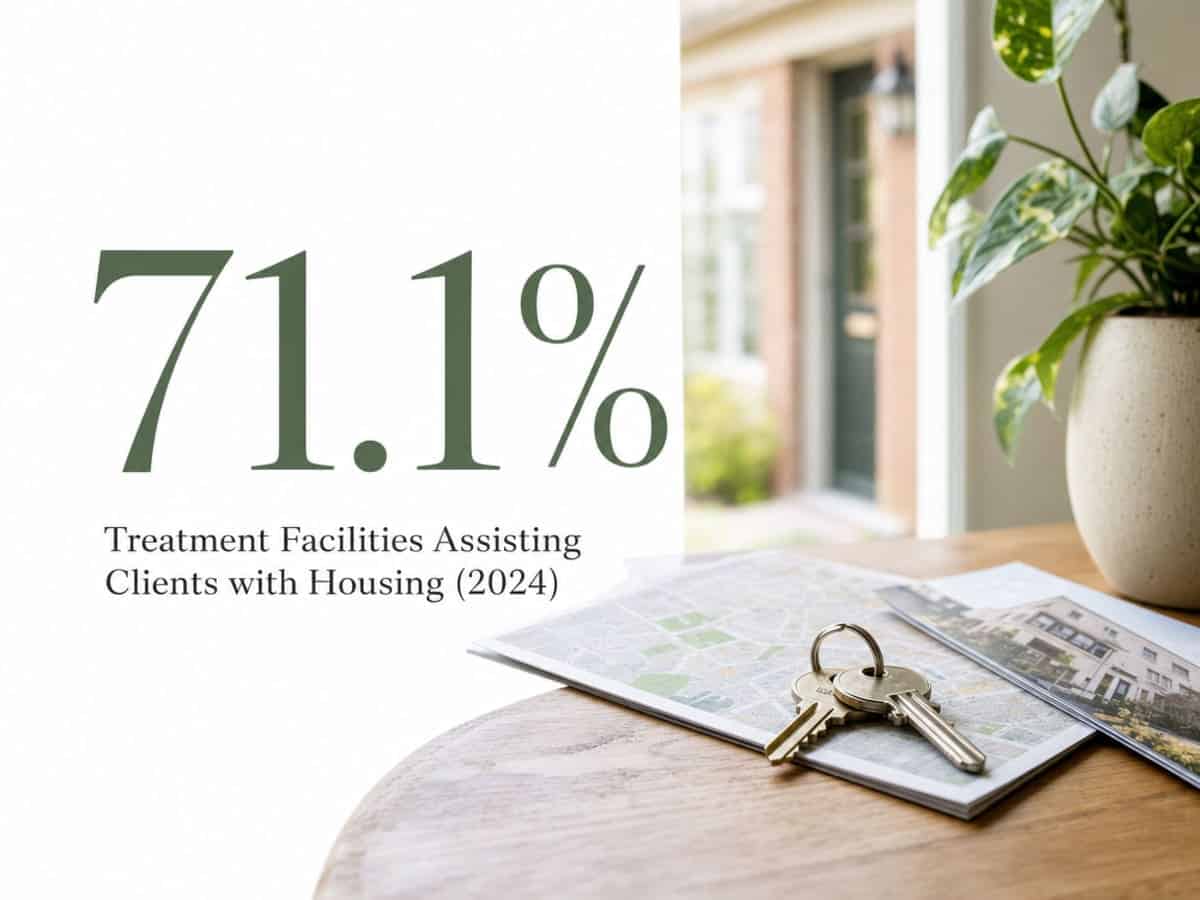
By Wednesday, they are looking further out. Where will you sleep the night you discharge? Do you need recovery housing, or is your apartment safe to go back to? Housing coordination is not a niche service anymore — 71.1% of U.S. substance use and mental health treatment facilities reported assisting clients in locating housing in 2024, according to SAMHSA’s national survey 14. It is standard treatment infrastructure now, and for good reason: a bed at discharge is often the difference between the plan holding and the plan collapsing.
By Thursday, they are sitting down with you. Not to lecture. To ask what you want. What matters to you when you leave. What you are scared of. Then they write it into your plan. That is the week. Quiet, unglamorous, and holding your life together while you do yours.
Case Manager vs. Counselor vs. Therapist vs. Peer Coach vs. Sponsor
Five people may show up in your recovery, and their jobs blur together fast. Here is how to tell them apart so you know who to call for what.
Your therapist works on the inside — trauma, grief, depression, anxiety, the reasons the drinking or using started and kept going. Sessions are private, structured, and clinical. Your counselor often runs the addiction-specific work: relapse prevention, group process, coping skills, the daily curriculum of treatment. The Bureau of Labor Statistics describes counselors as assessing addiction needs, setting treatment goals, and preparing you for discharge — but the deep coordination of outside services is usually not their primary lane 12.
Your case manager handles the outside. Housing, benefits, court, healthcare appointments, employer conversations, the ride to the pharmacy. Some case managers are licensed social workers who also do crisis intervention and advocacy 13. Others are dedicated coordinators. Either way, they are your logistics person.
Your peer recovery coach is someone who has walked this road. They are not clinical staff. They meet you for coffee, text you on a hard Tuesday, and help you stay engaged with your plan after treatment ends. Evidence suggests peer support improves engagement and retention when added to your care continuum 5.
Your sponsor is not part of the treatment team at all. A sponsor comes from a mutual-help fellowship like AA or NA, works a program with you, and is free. Different job, different accountability, no clinical record.
Housing, Court, and the Practical Mess Waiting Outside
Recovery Housing and the Rural Reality in Montana, Idaho, and the Dakotas
Where you sleep the night you leave treatment matters as much as anything you learned inside. A 2025 systematic review of recovery-housing interventions found that recovery housing outperformed usual care or no intervention on abstinence, income, employment, and criminal charges, though effects varied by study design 6. Translation: a stable, sober bed after discharge is one of the few things researchers can point to that consistently moves the needle.
The rural piece is real and your case manager knows it. In much of Montana, Idaho, the Dakotas, and Wyoming, recovery housing is thin on the ground. The nearest sober-living home may be two hours from your kids’ school. The county with the most beds may not be the county where your job is. If you are coming from a reservation community, the closest culturally grounded option may require a specific referral. None of this is your fault, and none of it is a reason to skip planning.
Your case manager works the map. They call the housing leads, ask about openings, ask about house rules on MAT (medication-assisted treatment, meaning prescribed medicines like Suboxone or Vivitrol), and ask whether the house takes people on probation. If beds are scarce, they help you weigh going home to an apartment that is safe, staying with family who supports your recovery, or waiting a week for a spot to open. For people without stable housing at intake, intensive case management has been shown to reduce days spent homeless, with a small but real effect size in a meta-analysis of 56 studies 4. That is the piece worth holding onto: someone is working the phone for you.
Probation, Child Welfare, and Keeping Legal Obligations From Derailing Treatment
If you have a probation officer, a court date, or an open child-welfare case, treatment is not a pause button. Those clocks keep running. Miss a check-in and the warrant is real. Miss a hearing and custody can shift.
Your case manager gets ahead of it. They call your probation officer with your permission, confirm your admission dates, and ask about rescheduling or remote check-ins. They draft the letter your attorney needs. They coordinate with your child-welfare caseworker so visitation and case-plan requirements line up with your treatment schedule instead of colliding with it. Advocacy on your behalf is part of the SAMHSA-defined role, not an extra favor 1, 13.
You are allowed to ask for this. Bring the names, dates, and phone numbers to your first meeting. The sooner your case manager has the list, the sooner the legal noise gets quieter and you can focus on the work in front of you.
Healthcare, Medicaid, and the Prescription Bridge
Addiction is rarely the only thing happening in your body. Blood pressure, diabetes, a bad tooth, a knee that never healed right, hepatitis screening you have been avoiding, mental health prescriptions that ran out three months ago — all of it is still there when you walk into treatment. Your case manager treats your medical life as part of your recovery, not a separate errand list.
The first job is usually insurance. If your Medicaid lapsed, they help you reinstate it. If you never enrolled, they walk you through the application. Without that card, prescriptions stall and appointments get canceled. With it, doors open.
Then comes the coordination piece. AHRQ’s evidence on integrating behavioral health with primary care describes exactly what your case manager is doing behind the scenes: connecting your prescriber, your primary care doctor, and your behavioral health team through referral, follow-up, and shared information so decisions get made together instead of in silos 10, 11. If you are on MAT — medication-assisted treatment, meaning prescribed medicines like Suboxone, methadone, or Vivitrol that reduce cravings and withdrawal — your case manager builds the prescription bridge. That means confirming your current prescriber, arranging a hand-off to a provider who can continue the medication after discharge, and making sure the pharmacy has the script the day you need it. No gap. No missed dose that turns into a missed week.
You will not remember every phone number or refill date. You do not have to. That is the job.
What the Evidence Actually Says About Case Management
Where It Reliably Helps: Engagement, Retention, and Linkage
You deserve an honest answer about what case management can actually do for you, not a sales pitch. So here it is: the strongest evidence for case management is not that it makes you sober or gets you a job. It is that it keeps you connected to the care that does.
A systematic review of case-management interventions for people with substance-use disorders found that treatment adherence improved in most studies, and linkage between healthcare providers improved in most studies as well 3. In plain English, people who had a case manager showed up to more appointments and their providers actually talked to each other. That is not a small thing. That is often the difference between a plan that works and a plan that dies in a voicemail.
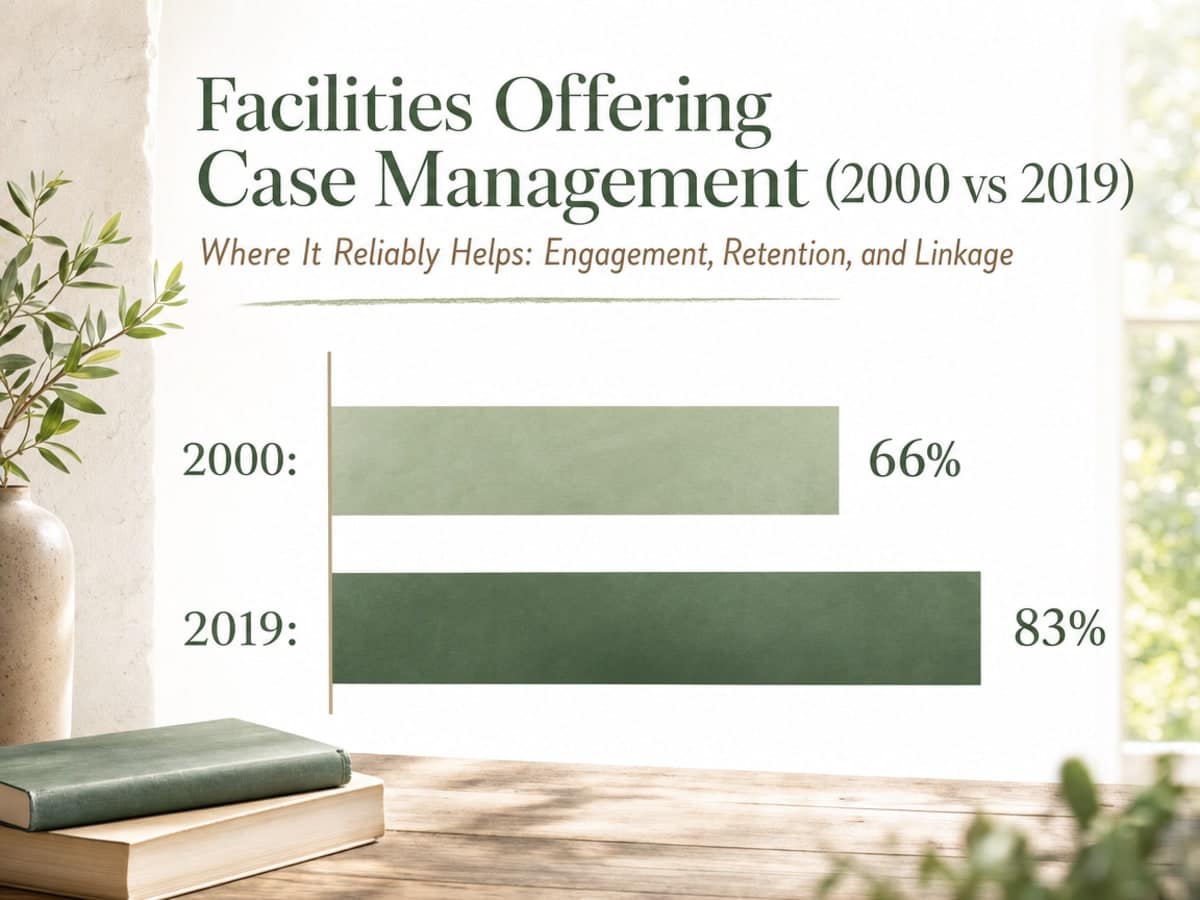
The system has caught on. The share of U.S. substance-use treatment facilities offering case management rose from 66% in 2000 to 83% in 2019, according to SAMHSA’s advisory on the role 1. It moved from optional to close to universal because programs kept seeing the same pattern: when someone owns the coordination piece, people stay in treatment longer and get more of the care they were supposed to get in the first place.
Where Results Are Mixed: Substance Use and Employment
Now the harder part. If someone tells you a case manager will make you stop using or land you a job, they are stretching what the research actually shows.
That same systematic review of case management for substance-use disorders found substance use decreased in only about one-third of the studies reviewed 3. Coordination and adherence went up. Actual reductions in drinking or using were less consistent. This makes sense when you think about it — the case manager is not the person doing therapy with you, and staying sober is not a paperwork problem. It is a whole-life problem that treatment, community, medication, and time have to work on together.
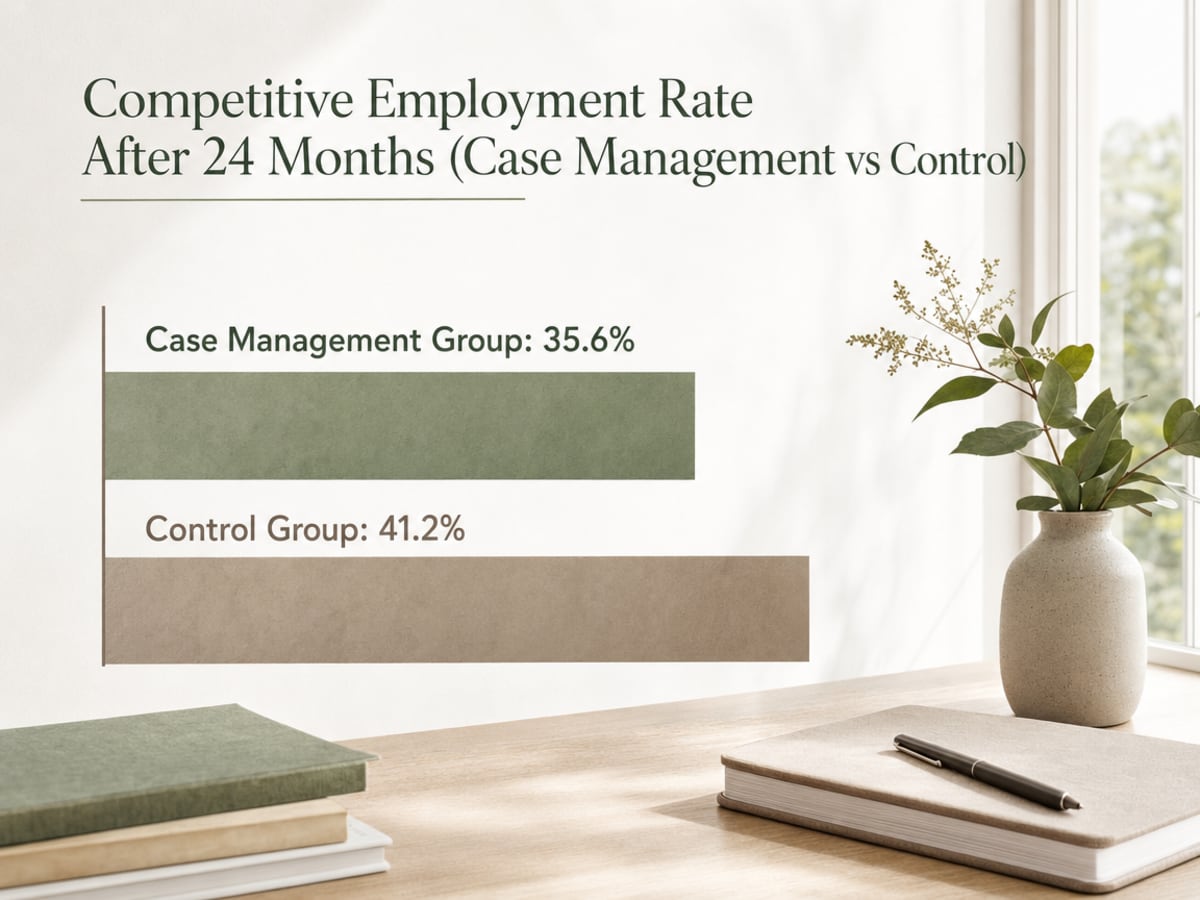
Employment is similar. A controlled multi-site trial in Germany followed people for two years after inpatient rehab and compared employment-focused case management to standard care. At 24 months, competitive employment was 35.6% in the case-management group and 41.2% in the control group — a difference that was not statistically significant 9. The case-management group did connect faster with employment-agency and job-center services. They just did not end up more likely to be working two years later.
Here is what to take from this. A case manager is powerful at the thing case managers actually do: connecting you, keeping you in treatment, and holding the outside pieces together. The rest — sobriety, a steady paycheck, a life you like — comes from you plus the whole treatment team plus time. Nobody hands that to you in a folder. But the folder matters, because without it, the rest is much harder to reach.
Employment and Vocational Rehab: What Works, What Doesn’t
Work is complicated in early recovery. A paycheck brings dignity, structure, and a reason to be somewhere at 8 a.m. It also brings stress, schedules that clash with therapy, and sometimes coworkers who drink after every shift. SAMHSA’s employment-in-recovery guide treats a job as part of recovery planning rather than a reward you earn after everything else is fixed 7. Your case manager takes the same view — job readiness is on the table from the start, not saved for month six.
The models with the most positive evidence are Individual Placement and Support and Customized Employment Supports, which pair rapid job search with ongoing coaching rather than months of pre-employment classes 8. If your case manager mentions IPS-style help, that is what they mean: real jobs, real support, adjusted to what you can actually do this week.
Be careful of promises. The honest picture from the research is that referral to job services goes up, while long-term employment rates do not always follow 8, 9. Ask your case manager what they can actually do — resume help, disclosure coaching, coordinating your shift around IOP, talking to HR about accommodations — and use it. The paycheck you keep is the one that fits the life you are building.
Discharge Planning Starts on Day One
That means the first assessment is not only about what got you here. It is also about what you are walking back into. Where will you sleep on discharge night? Who will drive you to your first outpatient appointment? Is your MAT prescription written and filled? Is your primary care follow-up on the calendar? Is your peer recovery coach introduced before you leave, not after?
SAMHSA frames case management as coordinated support through transitions between services, not a service that stops at the front door 1. The evidence backs this up. Peer recovery support and continuing-care handoffs are associated with better engagement and retention when they are woven into the plan early 5. Recovery housing lined up in advance beats a scramble on discharge day 6.
Ask your case manager in week one what your day-31 looks like. If they can sketch it, you are in good hands. If they cannot yet, ask again in week two. Keep asking. It is your life, and the plan for it starts now.
How Elk Ridge Recovery Structures Case Management
At Elk Ridge Recovery, case management is not an afterthought bolted onto residential care. It runs alongside your medical detox, inpatient stay, PHP, IOP, and outpatient work as a continuous thread, so the person coordinating your outside life on day one is still coordinating it on day sixty.
Your case manager works with the clinical team on housing, benefits, court, medical appointments, and the MAT hand-off, using the coordinated approach SAMHSA describes as central to the role 1. Because Elk Ridge serves people across Montana, Idaho, North Dakota, South Dakota, and Wyoming, that coordination is built around your county, your prescriber, and your recovery-housing options, not a generic template. Vocational rehab, peer support, and family therapy get folded into the same plan.
Discharge planning starts the week you arrive. By the time you leave, the appointments, prescriptions, and follow-ups are on the calendar. You do the recovery work. Someone else holds the phone list.
Talk with an expert about case management now
Get real answers on how case management supports your next steps in recovery.
Frequently Asked Questions
What is the difference between a case manager and a therapist or counselor in addiction treatment?
Your therapist works on what’s inside — trauma, depression, the reasons you started using. Your counselor runs the addiction-specific work like relapse prevention and group sessions 12. Your case manager handles the outside — housing, benefits, court, healthcare appointments, employer conversations, and transitions between services 1. Different jobs, same team, all working for you.
Will my case manager help me keep my housing while I’m in residential treatment?
Yes. Housing is one of the seven practical needs SAMHSA names as central to the case-management role 1. Your case manager can call your landlord, help you set up a payment plan, or line up recovery housing for discharge day. Housing coordination is now standard — 71.1% of U.S. treatment facilities reported assisting clients with housing in 2024 14.
Can a case manager help me deal with probation, court dates, or child welfare while I’m in treatment?
Yes. Advocacy on your behalf with courts, probation officers, and child-welfare caseworkers is part of the SAMHSA-defined role 1. With your permission, your case manager confirms your admission dates, requests rescheduled check-ins, drafts letters for your attorney, and coordinates so treatment and legal obligations line up instead of colliding. Bring names, dates, and phone numbers to your first meeting.
Does case management actually help people stay sober or get a job after treatment?
Honest answer: it reliably improves treatment adherence and provider linkage, but substance use decreased in only about one-third of studies reviewed 3. Employment results are similar — one controlled trial found 35.6% competitive employment at 24 months in the case-management group vs. 41.2% in controls, a non-significant difference 9. Case management connects you; recovery still takes the whole plan.
When does discharge planning start, and what happens the day I leave residential treatment?
Good discharge planning starts on day one, not week four. SAMHSA frames case management as coordinated support through transitions, not a service that stops at the door 1. By discharge, your housing, MAT prescription, first outpatient appointment, and peer recovery coach handoff should be scheduled. Peer support woven in early is linked to better engagement and retention 5.
Will my case manager help me with Medicaid, medical appointments, and medication like Suboxone?
Yes. Your case manager helps reinstate or apply for Medicaid, coordinates your prescriber, primary care doctor, and behavioral health team, and builds the MAT prescription bridge so medications like Suboxone or Vivitrol don’t lapse at discharge. This behind-the-scenes coordination — referral, follow-up, shared information — is exactly what integrated behavioral and primary care requires 10, 11.
References
- Comprehensive Case Management for Substance Use Disorder Treatment. https://library.samhsa.gov/sites/default/files/PEP20-02-02-013.pdf
- TIP 27: Comprehensive Case Management for Substance Abuse Treatment. https://library.samhsa.gov/sites/default/files/sma15-4215.pdf
- Effect of Case Management Interventions for Patients with Substance Use Disorders: A Systematic Review. https://pmc.ncbi.nlm.nih.gov/articles/PMC5382199/
- The effectiveness of case management interventions for patients with substance use disorders: a systematic review and meta-analysis. https://pubmed.ncbi.nlm.nih.gov/32271769/
- Peer Recovery Support Services and Recovery Coaching for Substance Use Disorder: A Systematic Review. https://pmc.ncbi.nlm.nih.gov/articles/PMC12811009/
- Recovery housing for substance use disorder: a systematic review. https://pmc.ncbi.nlm.nih.gov/articles/PMC11922849/
- Substance Use Disorders Recovery with a Focus on Employment. https://library.samhsa.gov/sites/default/files/SAMHSA_Digital_Download/pep21-pl-guide-6.pdf
- The Effectiveness of Interventions Intended to Improve Employment Outcomes for Persons with Substance Use Disorder: A Systematic Review. https://pubmed.ncbi.nlm.nih.gov/32781876/
- Is employment-focused case management effective for patients with substance use disorders? Results from a controlled multi-site trial in Germany covering a 2-years-period after inpatient rehabilitation. https://pubmed.ncbi.nlm.nih.gov/27496255/
- Integration of Mental Health/Substance Abuse and Primary Care. https://www.ahrq.gov/downloads/pub/evidence/pdf/mhsapc/mhsapc.pdf
- Strategies for Integrating Behavioral Health and Primary Care. https://effectivehealthcare.ahrq.gov/sites/default/files/product/pdf/strategies-integrating-behavioral-health-protocol.pdf
- Substance Abuse, Behavioral Disorder, and Mental Health Counselors. https://www.bls.gov/ooh/community-and-social-service/substance-abuse-behavioral-disorder-and-mental-health-counselors.htm
- Mental Health and Substance Abuse Social Workers. https://www.bls.gov/oes/2023/may/oes211023.htm
- Data on Substance Use and Mental Health Treatment Facilities: 2024 National Substance Use and Mental Health Services Survey. https://www.samhsa.gov/data/sites/default/files/reports/rpt56696/2024-nsumhss-annual-report.pdf