Key Takeaways
- The dense residential schedule isn’t about control — it removes daily decisions, builds predictability, and delivers seven categories of care in parallel 1, 4.
- Mornings handle medical stabilization and therapy blocks like CBT, while afternoons shift toward skills practice and case management that shapes life after discharge 13, 14.
- Residential care isn’t automatically the right fit; for opioid use disorder, medication reduces overdose risk more than the setting itself 7, 15.
- Progress is tracked through evolving treatment plans and outcomes like retention, mental health, and quality of life — not just abstinence 11, 15.
The First Morning Is the Hardest Hour
The first morning is honest with you in a way the night before wasn’t. You wake up somewhere new. Your body remembers what it’s been through. Your brain, still catching up, asks the question you’ve been dodging for months or years: what now?
Here’s what’s true. That first hour — the disorientation, the second-guessing, the urge to walk out — is the hardest single hour of the whole stay for most people. And it passes. Not because you talk yourself out of it, but because a nurse knocks, someone hands you coffee, and the day starts moving whether you feel ready or not.
That movement is the point. Residential treatment is a live-in, full-time supportive environment, and it’s built to carry you through the moments willpower can’t 2. You’re not expected to arrive motivated. You’re expected to arrive, and let the structure do some of the lifting while your nervous system settles.
If you’re still in withdrawal when you wake up, staff already know. Medical check-ins and medications to ease cravings and symptoms are part of the morning, not something you have to ask for 2. The rhythm you’re about to learn — meds, meals, therapy, movement, rest — is the same rhythm thousands of people before you have used to get through day one, and then day two, and then a week.
Why the Schedule Exists in the First Place
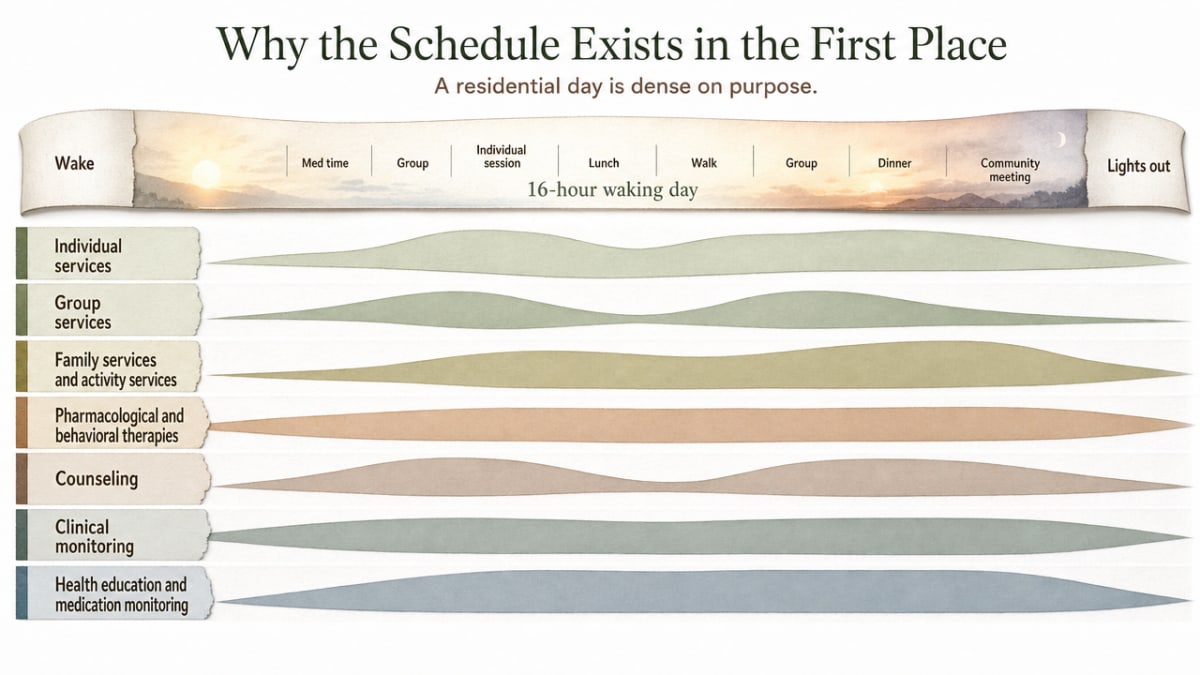
You might look at a printed schedule taped to a wall and think: this is a lot. Wake time, med time, group, individual session, lunch, another group, a walk, dinner, community meeting, lights out. It can feel like being back in school, or worse, like being managed. That reaction is fair. It’s also worth knowing what the density is actually doing.
A residential day is dense on purpose. The ASAM/Medicaid clinical guide lays out seven distinct service categories a residential program can deliver in a single stretch of care:
- individual services, group services, family services, and activity services;
- pharmacological and behavioral therapies;
- counseling;
- clinical monitoring;
- health education;
- and medication monitoring 1.
When you stack those against a sixteen-hour waking day, the schedule stops looking crowded and starts looking like what it is — a working delivery system for seven different kinds of care, running in parallel.
There’s a second reason the hours are held tightly, and it has less to do with services and more to do with your nervous system. Trauma-informed care, the framework most reputable residential programs are built on, treats predictability as a form of safety. When you know what’s coming next — the same wake time, the same faces at breakfast, the same 10 a.m. group — your body gets to stop scanning for threats. SAMHSA’s trauma-informed care manual is explicit that safety, choice, and routine are not extras; they are the ground floor of behavioral-health treatment 4.
The third thing the schedule does is quieter. It removes decisions. In active addiction, an enormous amount of your daily energy went to deciding when, how, whether, and with whom. Take those decisions away for a few weeks and the mental space that opens up is where the actual recovery work happens. You’re not being managed. You’re being given a container.
6:30 a.m. to 9:00 a.m. — Wake-Up, Meds, and Breakfast
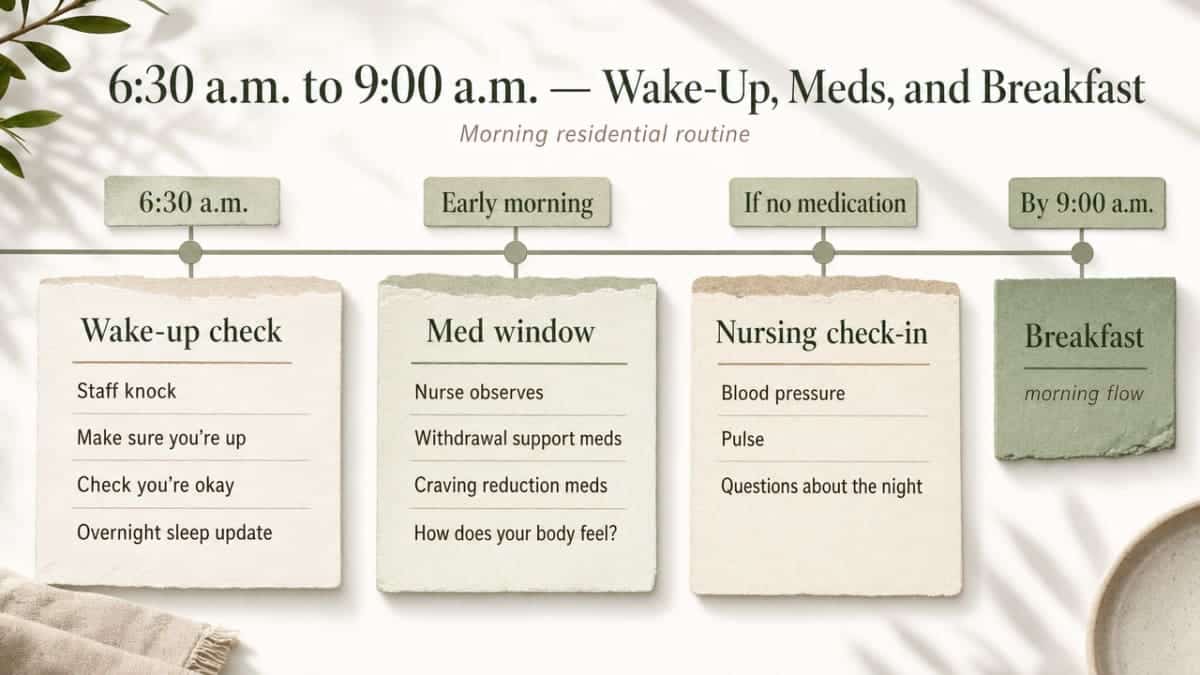
Wake-up in residential is early, and it’s early on purpose. Around 6:30 a.m., someone knocks. Not a shout, not an alarm you can silence — a person, checking that you’re up and that you’re okay. If you slept badly, they already know; overnight staff pass that along. Sleep disturbance is one of the things trauma-informed programs are trained to watch for, not judge you about 4.
The first stop is usually the med window. If you’re on medication to ease withdrawal or reduce cravings, this is when you take it, with a nurse watching and asking how you’re feeling in your body. The CDC frames this plainly: medications can help with cravings and withdrawal while therapy handles the rest 2. If you’re not on a medication, the check-in still happens — blood pressure, a few questions, a pulse read on how the night went. Nursing availability and medication monitoring are built into the residential level of care, not an add-on you have to request 1.
Then breakfast. It sounds small. It isn’t. For a lot of people, this is the first meal in a long time that arrives at the same hour, in the same room, with the same faces starting to become familiar. You don’t have to talk. You don’t have to be cheerful. You just have to eat something and let your body register that food shows up here.
By 8:30 or so, you’re expected to be dressed, medicated, fed, and heading toward the first group of the day. If that sounds like a lot before 9 a.m. — yes. And by the end of the first week, most people find they’re doing it half on autopilot, which is exactly what the morning is designed to build.
9:00 a.m. to Noon — The Therapy Block, and What It’s Actually Doing
By 9 a.m. you’re in a chair, in a room, in a group. This is the block that scares people most before they arrive, and the one they usually rank as the most useful once they’re a week in. It helps to know what’s actually happening in those three hours, because a therapy block isn’t one thing — it’s a stack of separate, researched interventions running back to back, each doing a different job.
The first hour is often a process group or a skills-based group, and if it’s skills-based it’s very likely built on cognitive behavioral therapy. CBT is a talk therapy that helps you spot the situations, feelings, and people that push you toward using — and then practice something else in their place. NIDA’s plain-language version is that CBT teaches you to “recognize, avoid, and cope” with the moments you’re most likely to use 14. In practice, that looks like naming a trigger out loud, mapping what usually happens next, and rehearsing a different response with a room full of people doing the same work. A systematic review of retention interventions found CBT — and CBT combined with opioid-agonist medication for opioid use disorder — showed promise for keeping people engaged in treatment 8. That matters because the therapy that keeps you in the room is the therapy that has a chance to work.
Mid-morning you may move into an individual session with your primary counselor. This is the hour where the general becomes specific. Your treatment plan gets reviewed, adjusted, argued with. NIDA’s foundational principles are direct that no single treatment fits everyone and that plans should be reassessed as your needs change 15. If something isn’t working — a medication making you foggy, a group that feels unsafe, a family issue surfacing sooner than expected — this is where you say so.
Somewhere inside the block, quieter mechanics are also at work. Contingency management, another evidence-based approach the CDC and NIDA both describe, reinforces treatment participation and drug-free behavior — the small acknowledgments for showing up, staying, and doing the assignment 3, 14. And the room itself is a peer intervention. A 2024 systematic review of peer recovery support drew on 28 studies and 12,601 participants and found evidence that peer support improves treatment engagement and retention, even as evidence for substance-use outcomes remains preliminary 9. Translation: sitting with people who understand the specific shape of what you’re carrying is doing work, even in the hours it feels like nothing is happening.
By noon your brain is tired. That’s normal, and it’s why lunch comes next instead of another group.
Noon to 1:30 p.m. — Lunch, Fresh Air, and the Quiet Middle
Lunch is not a therapy session, and that’s exactly what makes it useful. After three hours of naming triggers and rehearsing responses, your brain needs a room where nobody is asking it to do anything. You sit down. You eat. You listen to someone at the next table complain about the weather, or laugh about a card game from the night before. That is the treatment happening, too.
Most programs build a real break into the middle of the day — thirty or forty minutes to eat, then another chunk of time to go outside, walk a loop, sit on a porch, journal, or do nothing at all. At a Montana setting like Elk Ridge, that outside time usually means actual sky and actual quiet. You don’t have to hike. You can just stand there.
The quiet middle matters for reasons the trauma-informed care framework spells out plainly: safety, choice, and autonomy are the ground floor of behavioral-health treatment, and choice includes the choice to be alone for twenty minutes without a plan 4. It also matters because recreation and self-care show up in the research as meaningful parts of residential programming, not filler between the real work 10. Rest is part of the schedule for the same reason meds are.
1:30 p.m. to 4:30 p.m. — Afternoons of Skills, Case Management, and the Unseen Work
Afternoons feel different from mornings. The therapy block asked your brain to face things. The afternoon asks it to build things. The pace shifts from processing to practicing, and from what happened to what happens next.
A typical afternoon opens with a skills or psychoeducation group — relapse prevention, emotion regulation, sleep hygiene, sometimes a session on how substances actually change the brain. It’s less confessional than a process group and more like a workshop. You take notes. You try something. You get feedback. This is where the abstract idea of “coping skills” turns into a specific plan for a specific Tuesday afternoon three months from now when you’re back home and someone offers you a drink.
Somewhere in the middle of the afternoon, you’ll likely have a one-on-one with your case manager. This is the part of residential most people don’t picture from the outside, and it’s often the part that quietly determines whether the gains you make in therapy actually survive discharge. SAMHSA’s case-management guidance describes this work as coordinating treatment, recovery, and social services — the practical scaffolding of housing, benefits, employment, family services, transportation, and referrals that a person in early recovery needs to walk into on day one out 13. If you don’t have stable housing lined up, your case manager is on the phone about it. If your job is in limbo, if your kids need a call scheduled, if your insurance needs a new authorization, if you owe a court date documentation — this is where it gets handled.
It’s worth naming how much of a residential day is spent on things that don’t look like therapy at all. A 2024 study of 8,109 therapeutic-community records found that fewer than half of participants received at least one activity from each of the recreational, spiritual, educational, and self-care domains — and that offering the full range of those domains was associated with higher odds of social rehabilitation outcomes at discharge 10. In plain terms: the programs that treated recreation, education, and self-care as real programming — not as breaks between the real work — tended to send people out in better shape. That’s the argument for the afternoon looking the way it does. A skills class, a case-management meeting, twenty minutes on a discharge worksheet, a wellness activity, a check-in with the nurse about a medication adjustment — none of it is glamorous, and all of it is the work.
By 4:30, you’ve done more decision-making than you probably realize. What you’ll do about housing. What you’ll say to your family on Sunday. What you’ll practice the next time you feel the urge. The afternoon is where the residential day earns its keep.
4:30 p.m. to 7:00 p.m. — Movement, Dinner, and the Montana Setting
Late afternoon is when your body finally asks for something the morning couldn’t give it. Movement. Sky. A change of room. Most programs put a wellness or activity block right here, and it’s not a bonus feature — it’s programming.
At a Montana setting like Elk Ridge, that block often means going outside. A walk on a loop trail, an easy hike, a stretch class on the grass, a game of something with people you were sitting across from in group two hours ago. You don’t have to be an athlete. You have to be willing to move your body in daylight for forty-five minutes. The 2024 therapeutic-communities study of 8,109 records found that recreational and self-care activities, offered alongside clinical care, were associated with better social rehabilitation outcomes at discharge — evidence that the walk counts, even when it doesn’t feel like treatment 10.
Dinner follows, and it holds the same weight breakfast did: same time, same room, same faces, no performance required. By 7 p.m. you’ve eaten three meals, taken your medications, done real therapeutic work, moved your body, and put in some quiet time. That’s a full day by any honest measure, and your body knows it.
7:00 p.m. to 10:00 p.m. — Evening Community and Lights-Out
Evenings are softer than the rest of the day, and that softness is deliberate. The heavy clinical work is behind you. What’s left is the part of recovery that happens when people are just in a room together.
Most programs run an evening community meeting or a mutual-support group somewhere in this window — twelve-step, SMART, Wellbriety, or an in-house peer meeting. NIDA lists mutual-support groups as a standard component of residential care alongside counseling and medications, not as an afterthought 16. You are not required to believe anything in particular. You are asked to sit down and listen to people a few days, weeks, or months ahead of you describe what today looked like. The 2024 peer-support review of 28 studies and 12,601 participants found evidence that peer connection helps with engagement and staying in treatment, and the evening meeting is where a lot of that connection actually forms 9.
After the meeting, the night loosens. A card game. A phone call home during the allotted window. A book. A shower that isn’t rushed. This is protected quiet, and it’s protected on purpose — SAMHSA’s trauma-informed care manual names sleep and downtime as things staff should actively support, not tolerate 4.
Lights-out is early, usually around 10 p.m. Your body will thank you before your brain does. Tomorrow starts at 6:30, and by the end of the first week, you’ll notice you’re already tired at the right time. That’s the schedule working.
The Honest Part: Residential Is Not the Right Fit for Everyone
Here’s something most treatment center websites won’t tell you plainly: residential care is not automatically the best choice for every person or every substance. It’s the right level of care for a lot of people, and the wrong one for some, and it’s worth knowing that before you sign anything.
NIDA’s foundational principle is the same idea, said differently: no single treatment is appropriate for everyone, and the right plan depends on your substance, your medical needs, your mental health, and your life circumstances 15. Residential is a container. It’s a good container for many people, especially early on, especially when home isn’t safe or stable. It’s not a guarantee, and it’s not a moral upgrade over outpatient. Knowing that going in is part of what makes the choice yours.
How Progress Gets Measured While You’re There
Progress in residential treatment doesn’t announce itself. You don’t get a grade at the end of the week. But something is being tracked, and it helps to know what.
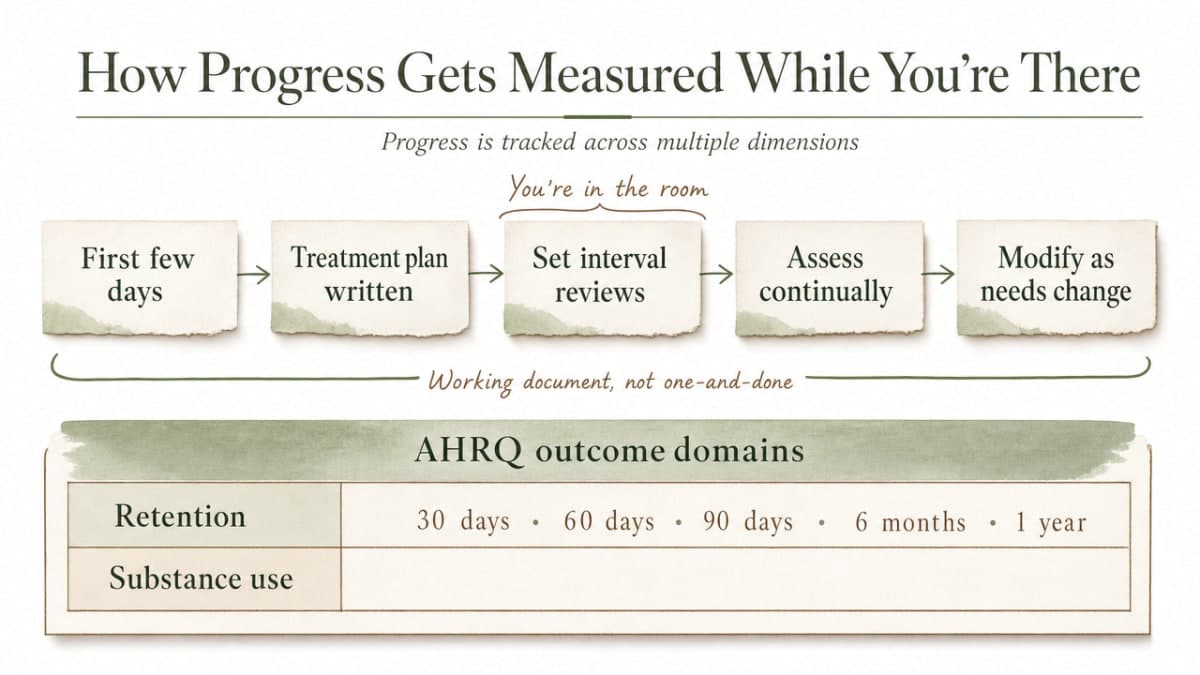
Your treatment plan is the working document. It gets written in the first few days, and it gets revisited — with you in the room — at set intervals during your stay. NIDA’s foundational guidance is direct that plans should be assessed continually and modified as your needs change, not treated as a form you sign once and forget 15. If a medication isn’t working, if a group is making things worse, if a family issue is louder than the substance issue this week, that’s what those reviews are for.
AHRQ, which sets outcome-measurement guidance for behavioral health, points to a specific set of things worth watching:
- retention at 30, 60, 90 days, six months, and a year;
- substance use itself;
- progress on the goals you named;
- mental-health symptoms;
- quality of life;
- your satisfaction with care;
- medication continuity;
- and whether you’re actually participating in counseling and recovery supports 11.
That’s a longer list than “did you stay clean,” and it’s a more honest one. Recovery is measured in how your days are working, not just in what you’re not using.
Some programs will ask you to fill out surveys — a mood scale, a cravings check-in, a satisfaction form. AHRQ notes that patient-experience tools like the ECHO survey exist precisely so your read on your own care counts as data 12. If you’re asked, answer honestly. It’s one of the few places your voice is the measurement.
What the Last Day Looks Like — and the Day After
The last day feels different from the first. You know the wake-up knock. You know which chair in the group room is yours. You know the nurse’s name. And somewhere in the middle of packing a bag, it hits you that the container you resented in week one is the thing you’re now nervous to leave.
Most of the last day is spent on the handoff. You’ll sit with your case manager and go through the discharge plan one more time — where you’re sleeping the first night, who’s picking you up, what medications you leave with and who’s prescribing the refill, which outpatient program or IOP you’re stepping down into, when your first appointment is, and who to call if the day goes sideways. SAMHSA’s case-management guidance is direct that this coordination — medical care, housing, benefits, family, transportation, referrals — is the bridge between residential and whatever comes next 13. If it feels like a lot of paperwork, that’s because the paperwork is what makes the plan real.
The day after isn’t a finish line. NIDA describes residential as extended care lasting weeks to months, with continuing-care referrals built in for a reason 16. Your progress will keep being tracked — retention at 30, 60, 90 days, six months, a year, along with mental health, quality of life, and medication continuity 11. You leave with a plan, a phone list, and a next appointment. That’s not the end of treatment. It’s the shape it takes now.
Talk to Someone Who Understands Your Struggle
Get real answers about daily life in structured, supportive residential care.
Frequently Asked Questions
How long does a typical residential treatment stay last?
NIDA describes residential care as extended, live-in programming that usually runs “a few weeks to a few months,” with the exact length shaped by your substance, medical needs, mental health, and life situation 16. Some people stay 28 days, others 60 or 90. Your treatment team should reassess the plan as you go, not lock you into a number picked on day one 15.
Will I be able to use my phone or contact my family?
Yes, in almost all programs — with limits. Phone use is usually restricted to specific windows so it doesn’t cut into therapy, sleep, or the routine that’s helping your nervous system settle. Family contact is protected, not blocked. Family services are a recognized part of residential care 1, and case management coordinates family calls, visits, and scheduled sessions as part of your plan 13.
What happens if I’m still going through withdrawal when I arrive?
Staff expect it. Nursing availability and medication monitoring are built into the residential level of care, not services you have to request 1. The CDC is direct that medications can ease cravings and withdrawal while therapy handles the rest of the work 2. You’ll be checked on more often at first, and your schedule the first day or two will bend around what your body needs, not the other way around.
Do I have any free time, or is every hour scheduled?
You have real free time — usually in the middle of the day, after dinner, and in protected quiet before lights-out. That space isn’t a gap in the program; it’s part of it. SAMHSA’s trauma-informed care framework treats choice, autonomy, and rest as ground-floor requirements for behavioral-health treatment, not extras 4. You can journal, walk, call home during the window, read, or sit outside and do nothing at all.
What if I don’t want to share in group therapy?
You don’t have to. Showing up and listening counts, especially early on. A 2024 systematic review drawing on 28 studies and 12,601 participants found evidence that peer connection improves treatment engagement and retention — and a lot of that happens just from being in the room 9. Trauma-informed groups are trained to give you choice about when and how you speak, not to force disclosure before you’re ready 4.
How is residential treatment different from outpatient care?
Residential is live-in, 24-hour programming for weeks to months; outpatient is scheduled sessions while you live at home 16. Neither is universally better. A 2022 Medicaid study of adults with opioid use disorder found residential was linked to greater six-month retention but not one-year retention, and medication for opioid use disorder reduced overdose risk in both settings 7. The right level depends on your substance, medical needs, and home situation 15.
References
- Overview of Substance Use Disorder Care Clinical Guidelines and Resource Guide. https://www.medicaid.gov/state-resource-center/innovation-accelerator-program/iap-downloads/reducing-substance-use-disorders/asam-resource-guide.pdf
- Treatment of Substance Use Disorders. https://www.cdc.gov/overdose-prevention/treatment/index.html
- Understanding Addiction to Support Recovery. https://www.cdc.gov/stop-overdose/stigma-reduction/understanding-addiction.html
- Trauma-Informed Care in Behavioral Health Services. https://library.samhsa.gov/sites/default/files/sma15-4912.pdf
- Substance Use Disorder Treatment Outcomes. https://pmc.ncbi.nlm.nih.gov/articles/PMC12180564/
- The effectiveness of residential treatment services for substance use disorders: a systematic review. https://pubmed.ncbi.nlm.nih.gov/31254749/
- Association between treatment setting and outcomes among Medicaid-enrolled adults with opioid use disorder. https://pmc.ncbi.nlm.nih.gov/articles/PMC9389731/
- Investigating interventions that lead to the highest treatment retention in substance use disorder treatment: a systematic review. https://pubmed.ncbi.nlm.nih.gov/34119856/
- Peer Recovery Support Services and Recovery Coaching for Substance Use Disorder: A Systematic Review. https://pubmed.ncbi.nlm.nih.gov/41551498/
- Intervention diversity predicts social rehabilitation indicators at discharge in Therapeutic Communities. https://pubmed.ncbi.nlm.nih.gov/38641054/
- Monitor Patient Outcomes. https://integrationacademy.ahrq.gov/products/playbooks/moud-playbook/implement-moud-treatment/monitor-patient-outcomes
- Mental Health Quality Measures. https://www.ahrq.gov/patient-safety/quality-resources/tools/chtoolbx/measures/measure-9.html
- Comprehensive Case Management for Substance Use Disorders. https://library.samhsa.gov/sites/default/files/PEP20-02-02-013.pdf
- Treatment and Recovery. https://nida.nih.gov/publications/drugs-brains-behavior-science-addiction/treatment-recovery
- Principles of Drug Addiction Treatment: A Research-Based Guide. https://nida.nih.gov/sites/default/files/podat-3rdEd-508.pdf
- Treatment. https://nida.nih.gov/research-topics/treatment