Key Takeaways
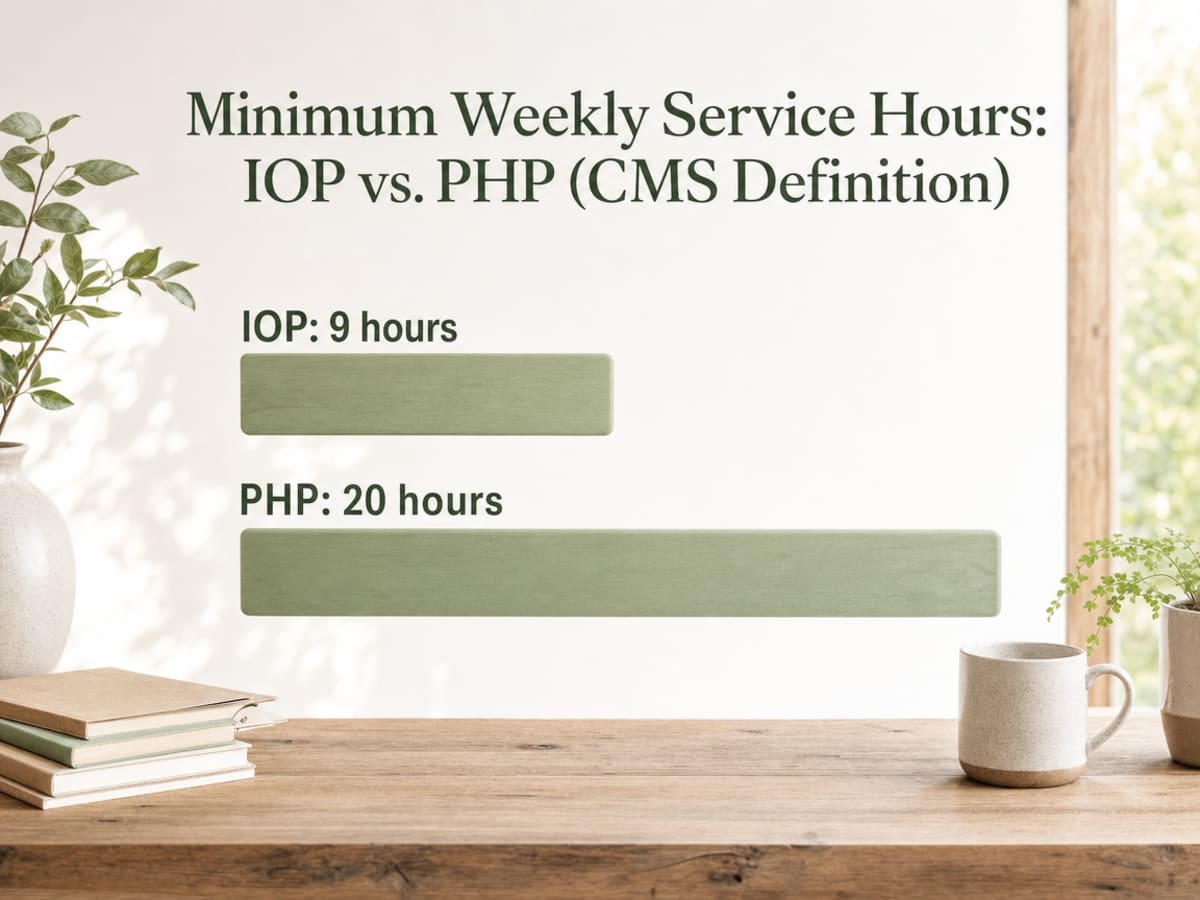
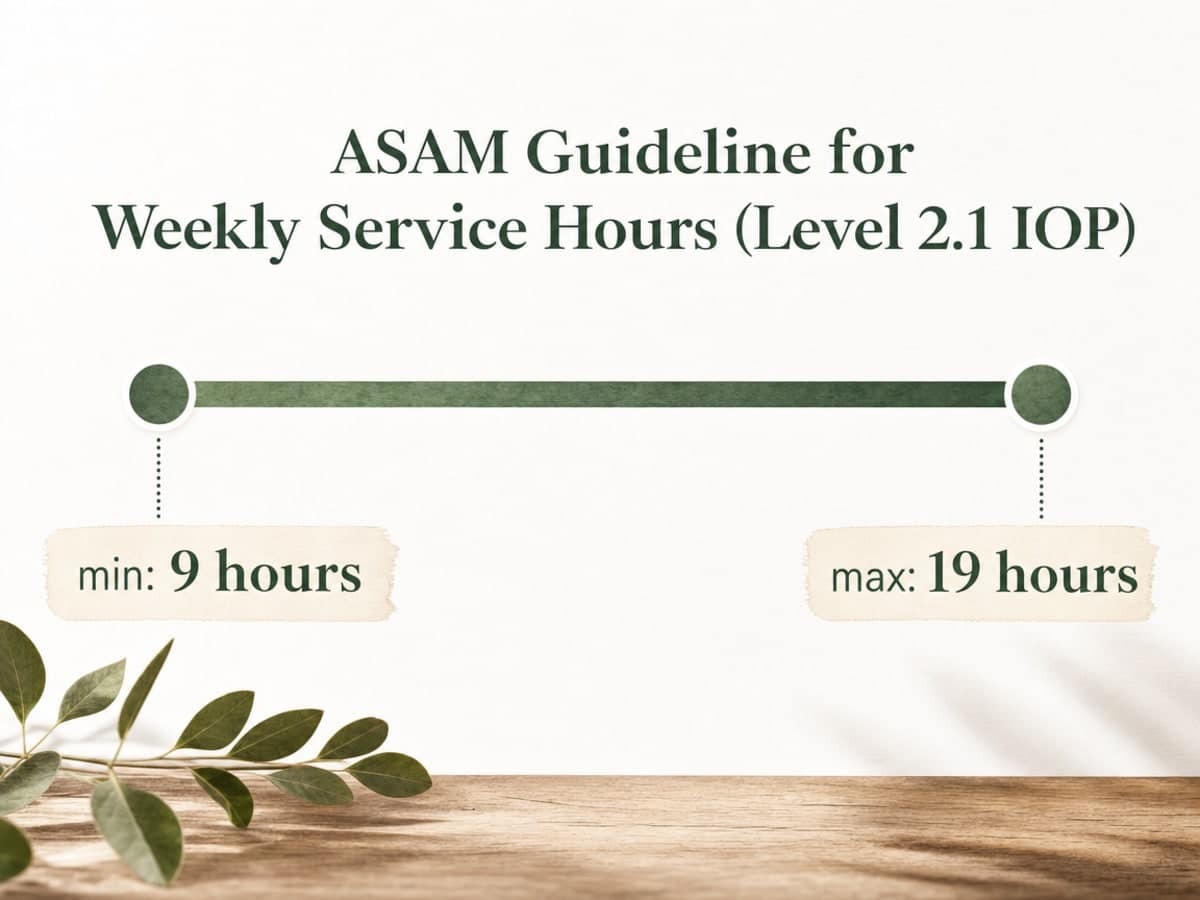
- PHP and IOP are both outpatient care, separated mainly by weekly hours: PHP requires at least 20 structured hours, IOP runs 9 to 19 4.
- The right fit depends on four honest variables: withdrawal stability, current mental health, whether home supports recovery, and what your weekly schedule can realistically hold.
- PHP suits unstable medical or psychiatric pictures needing near-daily psychiatry and nursing contact; IOP fits when your baseline is holding and work, school, or family need room 2.
- Research shows more hours does not automatically mean better recovery—IOP outcomes often match residential care for appropriately matched patients, with 50 to 70 percent abstinent at follow-up 12.
- PHP and IOP work best as a continuum rather than competing options, with step-downs and step-ups reflecting the plan working, not failure or graduation.
You’re standing at a real fork in the road
If you’ve made it this far—actually reading about the difference between two treatment programs instead of scrolling past—you’re already doing something hard. Choosing a level of care while you or someone you love is still hurting is not a small ask. It’s decision fatigue on top of everything else.
Here’s what you don’t need right now: another page telling you that PHP is “more serious” and IOP is “a step down.” That framing is misleading, and it makes people second-guess a choice that might actually fit their life.
PHP and IOP are two calibrated intensities of outpatient care 5. One isn’t a trophy and the other isn’t a consolation prize. The right fit depends on how your body is handling withdrawal today, how steady your mental health feels this week, whether home is safe enough for recovery to take root, and what your Tuesday afternoon already has to hold.
The rest of this guide walks you through those questions honestly, with the clinical thresholds behind each program and a straight look at what the research does—and doesn’t—say.
What PHP and IOP actually are, in plain terms
Both PHP and IOP are outpatient care. That word matters. Outpatient means you receive treatment during the day and go home—or somewhere safe you can sleep and eat and be a person—when the day’s programming ends 5. Neither one includes 24-hour nursing or overnight supervision. If you need that, you’re looking at detox or residential, not either of these programs.
- Partial Hospitalization Program (PHP)
- The more intensive of the two. Think of it as a full clinical day: therapy groups, individual sessions, psychiatric check-ins, medical monitoring, and skills work, typically five days a week. It’s built for people who need a lot of structure and closer eyes on their mental health or medication, but who don’t require a hospital bed 2.
- Intensive Outpatient Program (IOP)
- Compresses core recovery work—group therapy, individual counseling, coping-skills education, relapse prevention—into a smaller weekly footprint. You still show up several times a week, but the schedule leaves room for a job, classes, childcare, or the daily rhythm of home life 5.
That’s the shape. The next section gets into the actual hours, who’s in the room with you, and how much medical oversight comes with each.
The core difference: hours, oversight, and who’s watching
Here’s where the two programs actually part ways.
Under the Medicare payment framework updated for 2025, an intensive outpatient program has to deliver at least 9 hours per week of structured treatment. A partial hospitalization program has to deliver at least 20 hours per week 4. That gap—roughly double—is not marketing. It’s a clinical threshold that shapes almost everything else about your week.
What fills those PHP hours is more than just extra group time. At the 20-hour level, you get closer access to the medical and psychiatric side of the house: psychiatry appointments happen more often, medication changes get watched in something closer to real time, and lab work or nursing check-ins are built into the schedule rather than tacked on 2. If your body is still finding its footing after detox, or your psychiatric medications are being adjusted, that density of oversight matters.
IOP holds the same clinical DNA—group therapy, individual counseling, relapse-prevention work, coping skills—but it’s compressed. Nine to nineteen hours a week, usually spread across three or four days 1. You might do a 3-hour evening group Monday, Wednesday, and Friday, plus a weekly individual session. The rest of your time is yours: work shifts, kids’ pickup, a class, a sponsor meeting, dinner at your own table.
The staffing picture changes with the hours. In PHP, you’re typically seen by the psychiatrist, the primary therapist, the nurse, and the case manager within the same week—sometimes the same day. In IOP, that team still exists, but contact points are fewer and spaced out. Psychiatry might be every two or three weeks instead of weekly. Nursing may only come in if something specific triggers it.
Neither setup includes someone checking on you overnight. That’s the outpatient line both programs share. What differs is how much of your daytime the clinical team holds—and how quickly they’d notice if something started to slip.
If you’re reading this and thinking, “I need eyes on me most days,” that’s a PHP signal. If you’re thinking, “I can hold the week together as long as I have a strong anchor a few times a week,” that’s IOP territory. The four questions in the next section help you pressure-test which one you’re actually describing.
Four honest questions that point you toward the right level
How stable is your withdrawal risk right now?
Start here, because it’s the question that changes everything else. If your body is still in the acute stretch of withdrawal—shaking, sweating through sheets, unable to keep water down, cravings that feel like a physical event—you’re not really choosing between PHP and IOP yet. You’re a detox conversation first.
SAMHSA’s clinical guidance for intensive outpatient treatment is direct on this point: people appropriate for IOP generally have little risk of acute intoxication or withdrawal, with physical health conditions that can be managed on an outpatient schedule 3. That’s the floor. Below it, neither program is safe as a stand-alone.
Above the floor, the question becomes how close the medical team needs to be. If your last drink or use was recent, if your withdrawal history includes seizures or DTs, or if you’re stabilizing on new medication, PHP’s near-daily nursing and psychiatric contact does real work. If withdrawal is behind you and your body has settled, IOP’s lighter medical footprint is often enough.
How steady is your mental health this week?
Not “in general.” This week. The last seven days.
Depression, anxiety, PTSD, bipolar disorder, and trauma responses don’t sit quietly while you get sober—they often get louder. That’s not a character flaw. It’s what happens when the substance you were using to manage them isn’t there anymore.
PHP is built for the weeks when your mental health needs a closer clinical eye. The Medicaid.gov summary of ASAM Level 2.5 describes PHP as appropriate for people living with unstable medical or psychiatric conditions who can still be treated without 24-hour care 2. That phrase—unstable but not requiring a hospital bed—is the window PHP was designed to fill. Psychiatry appointments come in tighter cycles. Medication changes get watched. A rough Tuesday doesn’t have to wait until next week’s group.
IOP fits better when your baseline is holding. You’re sleeping most nights. Suicidal thoughts, if they’re there, are passive and manageable with your outpatient prescriber. You can name what you’re feeling and use a coping skill before it swallows the day.
Is home a place where recovery can breathe?
This one is uncomfortable. It’s also one of the most predictive.
Both PHP and IOP send you home at the end of the day. That’s the whole design. So the question isn’t really about the program—it’s about what’s waiting for you when programming ends.
A home that supports recovery doesn’t have to be perfect. It needs to be sober enough that you’re not walking past a bottle on the counter, safe enough that you’re not being screamed at or hit, and stable enough that you have a bed, a door, and food in the fridge. If someone you live with is actively using, or if the relationship there is violent, that’s not a moral failing on your part—it’s a clinical variable that pushes toward PHP’s longer daytime containment, or toward a sober-living arrangement running alongside IOP.
If home is quiet, if the people there are on your side, if evenings feel more like rest than risk, IOP can hold. If home is where relapse lives, PHP buys you more hours away from it while you build other footing.
What do your days already have to hold?
Now the practical part. PHP typically runs Monday through Friday for something close to a full workday. IOP usually asks for three evenings a week, roughly three hours each. Those are very different demands on a life.
If you’re a parent with school pickup at 3, a shift worker whose paycheck vanishes the moment you stop showing up, or a rural resident staring at a two-hour round trip to Kalispell or Missoula, PHP’s schedule may not be something you can physically execute right now—even if it’s the level of care your clinical picture suggests. That tension is real, and it’s worth naming out loud with an admissions counselor rather than choosing the lighter program by default and hoping.
SAMHSA’s IOP guidance calls for a full multidimensional assessment—withdrawal, medical, psychiatric, home environment, readiness, and relapse potential all weighed together—precisely because no single dimension makes the decision 3. The four questions in this section are that assessment in plainer clothes. Bring your honest answers to the intake call, and the level of care usually chooses itself.
What the research actually says about outcomes
Here’s the part most treatment center websites won’t tell you: more hours in a chair does not automatically mean a better recovery. That’s not a soft opinion. It’s what the research keeps finding when someone actually looks.
A review published in Psychiatric Services pulled together the randomized and quasi-experimental studies comparing intensive outpatient and day-treatment programs to residential or inpatient care. Across the studies it examined, IOP produced consistent reductions in problem severity, more abstinent days, and follow-up outcomes that were often equivalent to higher-intensity settings—with roughly 50 to 70 percent of participants reporting abstinence at follow-up 12. That’s a wide range, and the review is careful about it: certain subgroups, including people with heavy alcohol involvement, sometimes did better inpatient. But the headline is honest. For appropriately matched patients, IOP is not a compromise.
PHP has its own real-world evidence. In one observational study of adults discharged from an alcohol-focused partial hospitalization program, 69.7 percent of the 89 participants who completed follow-up were abstinent during the assessment period, and continued contact with mental-health providers and 12-step meetings tracked with better outcomes 13. Small sample. Single program. Worth taking as encouraging rather than definitive.
A separate study looking at quality of life and emotional health after inpatient and PHP treatment found improvements that went beyond whether someone stayed sober—people felt better, functioned better, and those gains were themselves associated with a lower risk of relapse 14.
The Montana access problem no one talks about
Pull up a map of Montana. Now put a treatment center in Kalispell, Missoula, or Billings and draw a line from someone’s house in Libby, Sidney, or Wolf Point. That line is often two hours. Sometimes three. In February, with the pass conditions being what they are, it’s a decision about whether you’re driving at all.
This is the part of the PHP-versus-IOP conversation that gets skipped on most treatment center websites. PHP, by design, expects you five days a week for something close to a full workday. If you’re 90 minutes from the building, PHP isn’t just a clinical commitment—it’s a ten-hour day with the commute added. For a lot of people in this part of the country, that math doesn’t work, even when the clinical picture would otherwise point there. The honest answer is often sober-housing near the program during PHP, then a step down to IOP once you’re back home.
IOP is where the geography starts to bend in your favor, especially in hybrid form. A 2024 study of group therapy for substance use disorders found that people in a hybrid model—part in-person, part virtual—were 1.88 times more likely to complete treatment than people in a virtual-only group (95% confidence interval 1.50 to 2.41) 10. The lesson isn’t that virtual alone is broken. It’s that the mix works better than either extreme for the people it was studied in.
Larger telehealth IOP cohorts have shown solid short-term engagement and abstinence numbers 11, but the researchers who ran those studies are careful: virtual care isn’t the right container for everyone, particularly people with unstable withdrawal or heavier medical needs 8. Talk to admissions honestly about the drive, the weather, and your bandwidth. The schedule should bend to your life, not the other way around.
Cost, framed as an investment rather than a sticker price
The cost question deserves a real answer, not a dodge. What you’ll actually pay for PHP or IOP at any given facility depends on your insurance, your deductible, whether the program is in-network, and the length of the episode your clinical team recommends. An admissions counselor can price your specific situation in a phone call. A blog post cannot.
What a blog post can do is reframe the math.
An economic review of substance use disorder treatment summarized one outpatient study where the average cost of treatment came out to $1,658 per client, while the measured economic benefits—reduced healthcare use, fewer criminal-justice costs, restored productivity—totaled $17,899 per client. Net benefit: $16,242 17. That’s one study, one population, one follow-up window, and it doesn’t guarantee anything for you personally. But it points at something the sticker price hides: treatment is being weighed against the real cost of not treating, which shows up in emergency rooms, missed paychecks, and relationships that don’t survive another year of active use.
PHP will cost more than IOP in a given week because it delivers more clinical hours. That’s arithmetic, not a value judgment. The better question is which level of care actually matches your clinical picture—because a program that’s too light will cost you a relapse, and a program that’s more than you need will cost you a job you couldn’t afford to lose.
PHP and IOP as a continuum, not a competition
Somewhere along the way, the treatment world started talking about PHP and IOP like rival products. They aren’t. They’re two points on the same road, and most people who do well long-term move through both.
The usual arc looks like this:
- Detox first, if withdrawal risk demands it.
- Then residential, if home isn’t safe or the clinical picture needs 24-hour containment.
- Then PHP, where the days are still full but you sleep in your own bed.
- Then IOP, where the schedule loosens and life starts fitting back around treatment instead of the other way around.
- Then standard outpatient.
- Then aftercare and alumni connection, which quietly does more work than most people expect.
What matters isn’t which program you enter first. It’s whether the step between them feels like continuity or a hard stop. Every handoff—residential to PHP, PHP to IOP, IOP to outpatient—is a moment where people fall through the cracks if the clinical team, the medication plan, and the therapist relationship don’t travel with them.
What neither program can fix on its own
Here’s the honest part. PHP and IOP are strong tools, but there are a few things no outpatient program—no matter how many hours a week it runs—can carry alone.
Acute withdrawal is the first one. If your body is still in the dangerous window, especially with alcohol or benzodiazepines, you need medical detox before either program can hold you safely. SAMHSA’s IOP guidance is explicit that suitable outpatient patients have little risk of acute intoxication or withdrawal to begin with 3. Skipping detox to jump into PHP isn’t grit. It’s a medical risk.
Unsafe housing is the second. If the place you’re sleeping has people actively using, violence, or nowhere to actually rest, going home each night undoes what the day built. Sober living alongside IOP, or PHP paired with transitional housing, is often the honest fix.
The third is isolation. Neither program replaces the sponsor, the alumni group, the friend who picks up at 11 p.m. The PHP outcomes study found continued mental-health contact and 12-step attendance tracked with staying sober 13. The scaffolding matters as much as the program.
How Elk Ridge Recovery structures the step between levels
The place where people most often lose ground isn’t inside a program. It’s in the gap between them. A new therapist who hasn’t read the file. A prescription that lapses because the psychiatrist changed. A group where you have to introduce yourself all over again on the day you needed to talk about something hard.
Elk Ridge Recovery is built as a continuum for exactly this reason. Detox, residential, PHP, IOP, standard outpatient, and aftercare sit under one clinical roof in Montana, which means the same treatment team follows you as the hours narrow. Your primary therapist in PHP is often the same person you see in IOP. Your medication plan carries forward without a rewrite. Case management holds the paperwork so you don’t have to.
Practically, that continuity matters most at two moments: the step from residential into PHP, when your days are still full but your evenings are suddenly your own, and the step from PHP into IOP, when the schedule opens up for work, family, or the drive back to Libby or Lewistown. If you’re weighing which program to start in, a straight conversation with admissions—about withdrawal history, mental health, home, and what your week already holds—will usually settle it in one call.
Talk Through PHP vs. IOP With a Specialist
Get real-time guidance on which level of care supports your next step toward recovery.
Frequently Asked Questions
What is the main difference between PHP and IOP?
Weekly hours and clinical oversight. PHP delivers at least 20 structured hours a week with closer access to psychiatry, medical monitoring, and lab services, while IOP runs 9 to 19 hours a week with a lighter medical footprint 4, 2. Both send you home at night. PHP fits when your medical or psychiatric picture is less stable; IOP fits when your baseline is holding.
Can I work or go to school while in PHP or IOP?
IOP is designed for it. Three evenings a week of roughly three hours each leaves most of your workday and school schedule intact. PHP is much harder to pair with full-time work or class because it typically runs Monday through Friday for something close to a full workday. Some people take short-term leave for PHP, then return to work as they step down to IOP.
Do I need to complete detox or residential treatment before starting PHP or IOP?
Not always, but sometimes yes. SAMHSA guidance says people appropriate for IOP have little risk of acute intoxication or withdrawal 3. If your body is still in the dangerous window—especially with alcohol or benzodiazepines—detox comes first. Residential is called for when home isn’t safe or your clinical picture needs 24-hour containment. An honest admissions assessment sorts this out before you commit to a level.
Is IOP less effective than PHP because it has fewer hours?
No—not for appropriately matched patients. A Psychiatric Services review of intensive outpatient and day-treatment studies found outcomes often equivalent to residential or inpatient care, with roughly 50 to 70 percent of participants abstinent at follow-up 12. A separate review of young-adult treatment matching notes that higher intensity does not automatically improve outcomes compared with outpatient care 15. Intensity should match your clinical picture, not exceed it.
Can PHP or IOP be delivered virtually if I live far from Kalispell, Missoula, or Billings?
IOP often can, in hybrid form. A 2024 study found hybrid group therapy participants were 1.88 times more likely to complete treatment than virtual-only participants 10. Telehealth IOP cohorts show strong short-term engagement 11, but researchers caution that virtual care isn’t right for people with unstable withdrawal or heavier medical needs 8. PHP’s density of medical oversight makes it much harder to deliver fully virtually.
How do I know when it’s time to step down from PHP to IOP?
Your clinical team decides with you, but the signals are usually consistent: withdrawal is settled, psychiatric medications are stable, you’re using coping skills between sessions, and your home environment is holding. Stepping down isn’t graduation and it isn’t failure—it’s the level of care adjusting to where you actually are. If a rough month shows up in IOP, stepping back up to PHP is part of the plan working.
References
- Factors Associated With Use of ASAM Criteria and Service Provision in Substance Abuse Treatment Programs. https://pmc.ncbi.nlm.nih.gov/articles/PMC3584172/
- Overview of Substance Use Disorder Care Clinical Guidelines and Resources. https://www.medicaid.gov/state-resource-center/innovation-accelerator-program/iap-downloads/reducing-substance-use-disorders/asam-resource-guide.pdf
- CLINICAL ISSUES IN INTENSIVE OUTPATIENT TREATMENT FOR SUBSTANCE USE DISORDERS. https://library.samhsa.gov/sites/default/files/pep20-02-01-021.pdf
- CY 2025 Medicare Hospital Outpatient Prospective Payment System and Ambulatory Surgical Center Payment System Final Rule. https://www.cms.gov/newsroom/fact-sheets/cy-2025-medicare-hospital-outpatient-prospective-payment-system-ambulatory-surgical-center-payment
- Treatment Types for Mental Health, Drugs and Alcohol. https://www.samhsa.gov/find-support/learn-about-treatment/types-of-treatment
- Data on Substance Use and Mental Health Treatment Facilities, 2024. https://www.samhsa.gov/data/sites/default/files/reports/rpt56696/2024-nsumhss-annual-report.pdf
- 2024 National Substance Use and Mental Health Services Survey: Detailed Tables. https://www.samhsa.gov/data/report/2024-n-sumhss-detailed-tables
- Telehealth Services for Substance Use Disorders During the COVID-19 Pandemic: Longitudinal Assessment of Intensive Outpatient Programming and Data Collection Practices. https://pmc.ncbi.nlm.nih.gov/articles/PMC8923149/
- In-Person Versus Telehealth Setting for the Delivery of Substance Use Disorder Treatment: A Prospective Longitudinal Cohort Study. https://pmc.ncbi.nlm.nih.gov/articles/PMC9016509/
- Transitioning Virtual-Only Group Therapy for Substance Use Disorders to a Hybrid Model. https://pmc.ncbi.nlm.nih.gov/articles/PMC11055515/
- Patient Engagement in Providing Telehealth SUD IOP Treatment: A Retrospective Cohort Study. https://pubmed.ncbi.nlm.nih.gov/39765981/
- Substance Abuse Intensive Outpatient Programs: Assessing the Evidence. https://pmc.ncbi.nlm.nih.gov/articles/PMC4152944/
- Alcohol Treatment Outcomes Following Discharge from a Partial Hospitalization Program. https://pmc.ncbi.nlm.nih.gov/articles/PMC6419972/
- Quality of Life and Well-being Following Inpatient and Partial Hospitalization Treatment for Substance Use Disorders. https://pmc.ncbi.nlm.nih.gov/articles/PMC5968820/
- Evidence-Based Treatment for Young Adults with Substance Use Disorders. https://pmc.ncbi.nlm.nih.gov/articles/PMC7879425/
- The Economic Costs of Substance Abuse Treatment. https://pmc.ncbi.nlm.nih.gov/articles/PMC2614666/
- Economic Benefits of Substance Use Disorder Treatment. https://pmc.ncbi.nlm.nih.gov/articles/PMC10530001/