Key Takeaways
- Trauma-informed addiction care is an organization-wide philosophy shaping leadership, policy, and daily practice so getting help does not feel like being hurt again 1.
- It is distinct from PTSD treatment: everyone receives trauma-informed operations, while diagnosis-specific therapies like EMDR or Seeking Safety are offered separately by trained clinicians 10, 13.
- Real implementation changes concrete procedures — intake calls, urine screens, physical exams, nighttime vitals checks, and seclusion policies — so required care is delivered with dignity and pacing 6.
- Evidence is promising but uneven: a 2025 review of 15 studies showed reduced substance use and better retention, though only 6 studies were high quality 2.
Why the Word ‘Trauma-Informed’ Should Mean Something Specific
If you’re reading this while scared, hungover, sick, or holding a phone for someone you love, start here: trauma-informed addiction care is not a therapy session where a stranger asks you to describe the worst thing that ever happened to you. It is a way of running an entire treatment program so that getting help does not feel like being hurt again.
That distinction matters because the phrase gets used loosely. Some centers slap it on a brochure after a single afternoon of staff training. Real trauma-informed care is an organization-wide commitment that shapes leadership, policy, physical space, clinical practice, and how a night-shift tech knocks on your door at 2 a.m. SAMHSA describes it as an approach that realizes how common trauma is, recognizes its signs, integrates that knowledge into every practice, and actively works to prevent retraumatization 1.
You deserve specifics, not vibes. Over the next few sections, you’ll see how a trauma-informed program handles the first phone call, medical detox, urine screens, physical exams, room assignments, and staff supervision differently than a program that just says the words. You’ll also see where the evidence is strong, where it is still uneven 2, and how to spot the difference between real practice and a marketing label.
You do not have to relive anything to get better. That is the whole point.
Trauma-Informed Care Is a Philosophy, Not a Diagnosis
The SAMHSA Definition in Plain Language
Here is the short version. SAMHSA describes trauma-informed care as an approach that does four things at once:
- It realizes how widespread trauma is
- It recognizes how trauma shows up in clients and staff
- It integrates that knowledge into every policy and practice
- It actively resists doing anything that would retraumatize the people it serves 1
Read that again with your own life in mind. It does not say the program will diagnose you. It does not say you will be assigned homework about your worst memories. It says the program is built on the assumption that a lot of people walking through the door have been hurt in ways that shape how they respond to authority, touch, closed doors, uniforms, urine cups, and the word “no.”
That assumption changes small things and big things. Small: a nurse tells you what she is about to do before she does it. Big: leadership rewrites the seclusion policy so a client in crisis is not restrained the same way that once caused harm 6.
You are not being asked to prove you have trauma. The program is choosing, as a whole organization, to act as if you might — because that is safer for everyone, including the people who do not carry a diagnosis but still deserve to be treated like a full human being.
How It Differs From PTSD Treatment
This is where a lot of programs, and a lot of families, get tangled up. Trauma-informed care and PTSD treatment are not the same thing, and confusing them can either scare you away from treatment or set you up to expect something the program was never designed to deliver.
PTSD treatment is a clinical protocol for a specific diagnosis. It involves trained therapists using named approaches — prolonged exposure, cognitive processing therapy, EMDR, Seeking Safety, integrated CBT — with someone who has been screened, assessed, and diagnosed with post-traumatic stress disorder 10. It often asks you to go toward difficult memories in a structured way, at a pace you help set, with a clinician who knows how to keep you safe while you do it.
Trauma-informed care is the environment that surrounds all of that. It applies whether you have PTSD or not. It shapes how the front-desk staff greets you, how the night tech handles a panic attack at 3 a.m., how the group therapist responds when someone starts crying, how the physician explains a medication side effect. Everyone gets it. Nobody has to earn it with a diagnosis.
The overlap is real and worth naming. A peer-reviewed review found that nearly half of people with PTSD in one national survey also met criteria for a substance use disorder, and people with PTSD were two to four times more likely to meet SUD criteria than people without it 14. That is why residential addiction programs need genuine dual-diagnosis capability. It is also why they need trauma-informed care as a baseline — because the other half of clients, and the many people who have trauma histories without a formal PTSD diagnosis, deserve safe care too.
A good program offers both layers. Trauma-informed operations for everyone. Diagnosis-specific PTSD treatment, delivered by properly trained clinicians, for the people who need it and want it 13. You should never be forced into trauma-focused therapy as a condition of getting sober.
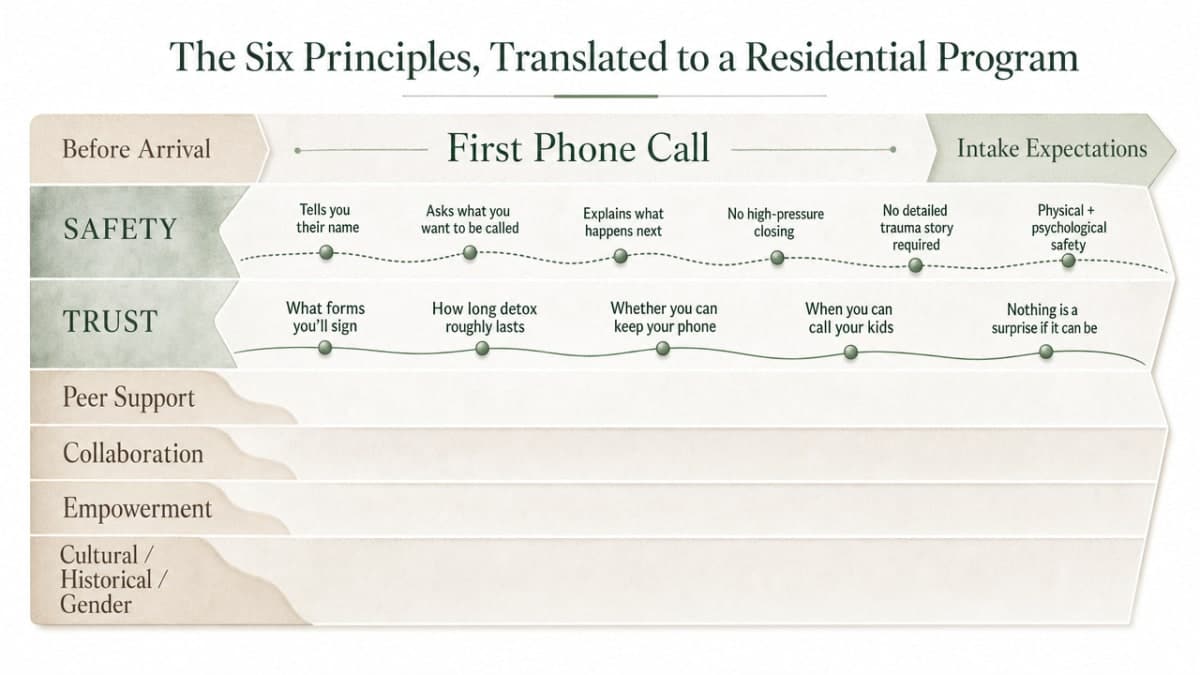
The Six Principles, Translated to a Residential Program
Safety, Trust, and the First Phone Call
Safety is the first principle, and it starts before you ever set foot on the property. When you call, the person on the other end should tell you their name, ask what you want to be called, and explain what happens if you decide to come in. No high-pressure closing. No stranger demanding your worst story to “qualify” you for a bed.
SAMHSA is direct about this: trauma-informed programs establish physical and psychological safety and avoid requiring clients to describe overwhelming traumatic events in detail 1. You should not have to trade your history for a phone number.
Trust is built in small, boring moments. The intake coordinator tells you what forms you’ll sign, roughly how long detox lasts, whether you can keep your phone, when you can call your kids. Nothing is a surprise if it can be avoided. When something has to be a surprise — a room change, a new roommate, a schedule shift — someone explains why.
Massachusetts BSAS guidance frames this as reviewing every routine procedure for trauma sensitivity: drug screens, examinations, safety checks, even how a bed is assigned 6. The goal is not to remove rules. It is to make sure the rules do not accidentally reproduce the dynamics of coercion or humiliation that a lot of people in active addiction already know too well.
If the first call feels like a sales pitch, that is data. If it feels like a nurse triaging a scared human being, that is also data.
Choice and Collaboration Inside a Structured Setting
Residential treatment has structure. Wake-ups, meals, groups, meds, curfews. Structure is part of what makes early recovery possible — your brain and body need a container while they stabilize. Trauma-informed care does not throw that container out. It changes how choice lives inside it.
- Choice sounds like:
- “We recommend you attend the 10 a.m. group. Here is why. If you can’t today, here is what we’d ask you to do instead.”
- Collaboration sounds like:
- “Your treatment plan is a draft. Read it. Cross out what feels wrong. Tell us what’s missing.”
- Empowerment sounds like:
- “You can decline this medication. Here is what that means for your withdrawal, and here is what we’d suggest instead.”
SAMHSA lists control, autonomy, collaboration, and empowerment as core principles for a reason 1. People who have been hurt often lost some version of choice in the moment they were hurt. A program that returns choice — in small, real ways, every day — is doing clinical work, not being permissive.
BSAS guidance is blunt that coercion should be avoided where possible, and that when a procedure like a drug screen is clinically required, it should still be explained, paced, and handled with as much dignity as the situation allows 6. “Required” and “trauma-informed” are not opposites. They coexist when the person doing the required thing treats you like a partner instead of a suspect.
Peer Support and Cultural Responsiveness
Peer support is the fifth principle, and for a lot of clients it is the one that finally makes recovery feel possible. Hearing from someone who has been where you are — not a lecture, not a slogan, just a person — lowers the shame that keeps people using. SAMHSA names peer support as a core element of trauma-informed practice, and organizational guidance places peer roles alongside supervision and debriefing as structural features, not decoration 1, 4.
Cultural responsiveness is the sixth. Trauma does not present the same way in every person, and the meaning of a symptom — hypervigilance, silence, distrust of authority, avoidance of eye contact — shifts with culture, gender, and history. A trauma-informed program adapts to that instead of forcing everyone through the same intake script. NCBI’s sociocultural chapter is explicit that overly standardized screening and programming can conflict with the very principles of choice, collaboration, and humility that define the model 8.
In the region a Montana program serves — Montana, Idaho, and the Dakotas — that means taking Indigenous historical trauma seriously, recognizing rural isolation as a real clinical factor, and offering practices like smudging or Wellbriety where they fit a client’s identity, not as tokens.
You get to bring your whole self. That is the point of the principle.
What Changes in Detox, Screens, and Physical Exams
Detox is where trauma-informed care stops being an abstraction. Your body is sick, your defenses are down, and you are surrounded by strangers who need access to your veins, your urine, and your skin. This is exactly the setting where a program either honors the philosophy or quietly abandons it.
Start with the physical exam. A trauma-informed clinician tells you what they need to check before they touch you, asks whether you’d prefer a same-gender provider, offers a gown that actually covers you, and lets you keep a support person in the room if one is available. If you flinch, they stop. If you say no to a specific part of the exam, they document it and figure out what is still clinically possible. Massachusetts BSAS guidance names exactly this kind of procedure review — physical exams, drug screens, and safety checks — as a core operational test of whether a program is genuinely trauma-informed 6.
Urine screens are the moment programs most often slip. A same-sex observer is often required for clinical validity. That does not mean the process has to feel like a search. Trauma-informed practice means the staff member explains why observation is needed, describes what they will and will not watch, gives you a moment to prepare, and does not stand between you and the door. Coercion should be avoided where clinically possible, and when a procedure is required, it is still delivered with dignity and pacing 6.
Medical detox itself changes too. Nurses knock before entering. Vital-signs checks at 2 a.m. come with a soft voice and a name, not a flashlight in your face. Medication-assisted treatment options are explained in plain language, including what happens if you decline. Restraint and seclusion policies are written to be last resorts, not first tools — a point SAMHSA implementation guidance treats as a structural marker of a real trauma-informed program, not a nice-to-have 1, 4.
None of this slows care down. It is care.
The Workforce Side Most Programs Underplay
Here is the part of trauma-informed care that rarely makes it onto a website: the people caring for you are also carrying something. A tech who sits with someone through withdrawal at 4 a.m., a counselor who hears three trauma histories before lunch, a nurse who has watched too many clients cycle back — none of them are immune to what the field calls secondary traumatic stress.
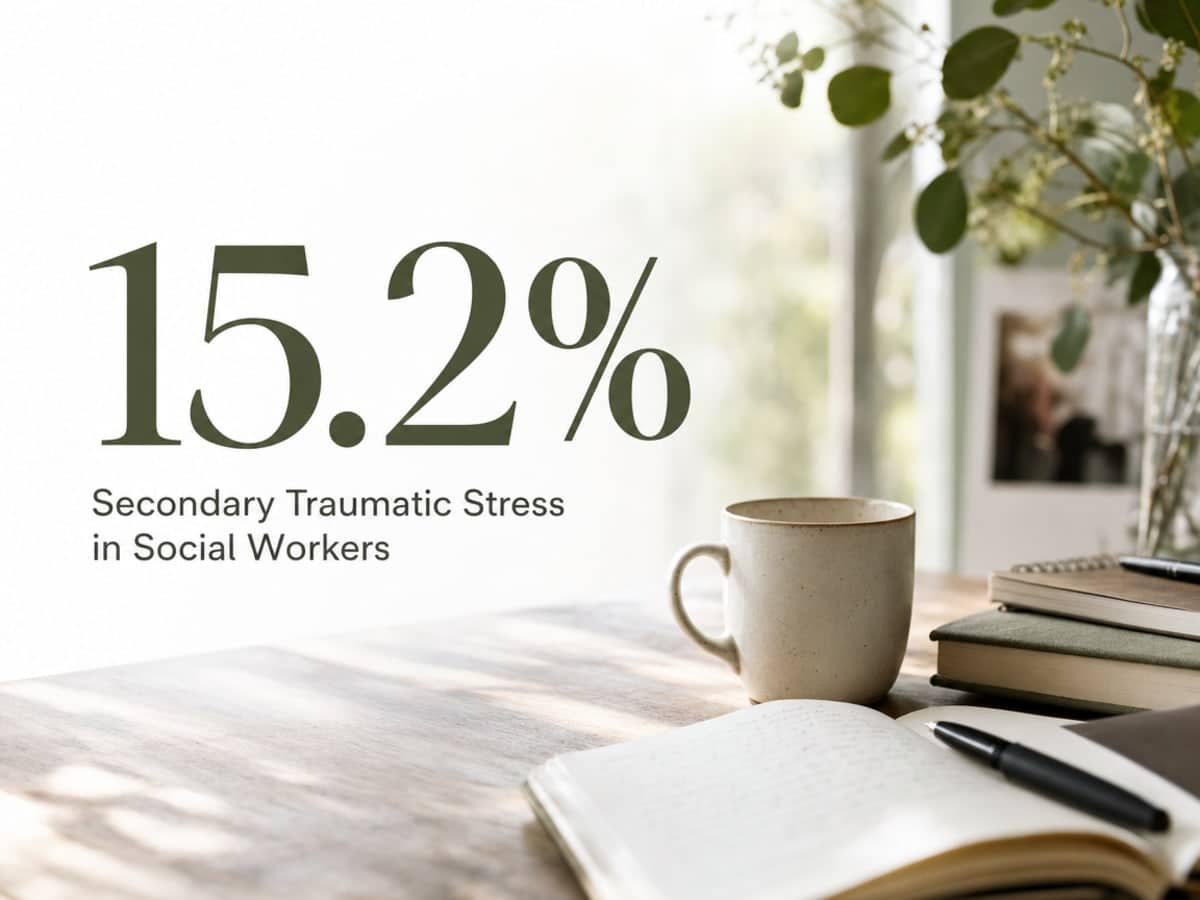
The numbers are sobering, and they are worth stating carefully. In one professional sample, 15.2% of surveyed licensed social workers experienced secondary traumatic stress at a level meeting diagnostic criteria for PTSD 9. That figure comes from a specific workforce study, not a census of every addiction-treatment employee, so it should be read as a signal rather than a universal rate. The signal is loud enough: staff who work closely with trauma get hurt too, and programs that ignore that fact cannot deliver trauma-informed care for long.
What structural support actually looks like:
- Reasonable caseloads so a counselor is not carrying forty stories at once
- Regular clinical supervision that is not just chart review
- Peer consultation groups
- Debriefing after critical incidents
- Manageable schedules that let people sleep
SAMHSA implementation guidance treats these as core organizational features, not perks 9, 1. Individual self-care — a yoga class, a bubble bath — cannot substitute for a reasonable job.
Ask the question when you tour. How often do staff meet with a supervisor? What happens after a hard shift? Programs that answer clearly are protecting your care by protecting the people who deliver it.
What the Evidence Actually Shows — and Where It Falls Short
You deserve an honest read on the research, not a sales pitch. The strongest recent synthesis is a 2025 systematic review in Community Mental Health Journal that looked at 15 studies of trauma-informed care in substance-use settings and mapped them to SAMHSA’s implementation domains 2. The direction of the findings is encouraging:
- Reductions in substance use
- Drops in trauma and mental-health symptoms
- Better retention in treatment
- Higher satisfaction reported by both clients and staff 2
Broader reviews outside addiction settings point the same direction. A 2024 review of reviews across healthcare found potential improvements in staff understanding, patient satisfaction, staff retention, and reductions in burnout and compassion fatigue, but flagged the same heterogeneity problem: different definitions, different measures, different settings, hard to compare cleanly 3. A 2024 scoping review counted 23 systematic reviews on implementation alone and concluded the field still lacks a single standardized measure of whether an organization is truly trauma-informed 4.
What this means for you, practically: trauma-informed care is a well-reasoned, promising framework with real early evidence and honest gaps. A program using the phrase should be able to describe how it measures its own work, not just claim it does. Ask what they track, and how they know it is working.

How to Tell Real Trauma-Informed Care From a Marketing Label
You do not need a clinical degree to tell the difference. You need a short list of questions and permission to trust what you hear back.
- Ask who trained the staff, and who counts as staff. In a real trauma-informed program, training reaches the front-desk person, the housekeepers, the transport driver, and the night-shift techs — not just the therapists. SAMHSA implementation guidance treats workforce development as one of several linked domains, alongside leadership commitment, policy alignment, and physical environment 1, 5. If the answer is “our clinicians did a webinar last year,” that is a label, not a practice.
- Ask what changed. A program that has genuinely done this work can name specific policies it rewrote — how urine screens are observed, when seclusion is used, how a client can request a different provider, what happens after a difficult incident on the unit. Becoming trauma-informed is an iterative organizational process, not a one-time announcement 7. A program that cannot describe a single policy it changed has probably not changed one.
- Ask how they know it is working. Real implementation includes measurement — client feedback, staff well-being data, incident tracking, retention numbers. The field still lacks a single standardized measure, so no program will have a perfect scorecard 4. But they should track something, and be willing to tell you what.
- Ask who is at the table. Guidance across the literature consistently names patient and family voice as a core implementation factor 5. If clients and alumni have no role in shaping policy, the philosophy is stuck on paper.
Finally, notice how the conversation feels. If asking these questions gets you defensiveness or a pivot to pricing, you have your answer.
What This Looks Like Across a Stay at Elk Ridge Recovery
To make this concrete, walk through a stay the way a client actually experiences it. The first call is triage, not sales — someone finds out if you are medically safe right now, tells you what a bed looks like, and answers whether you can bring your phone, when you’ll see your family, and what happens if you change your mind on day three.
Detox happens in a physician-led medical setting. Nurses knock. Vitals get taken with a name and a warning, not a flashlight. Medication-assisted treatment is offered with the tradeoffs explained in plain language, and declining a specific medication does not end the conversation 6. Same-gender providers are offered where possible for physical exams and observed screens.
Residential days have structure — groups, meals, meds, curfews — but your treatment plan is a draft you help edit. If a group format is not safe for you today, staff work with you on an alternative rather than logging a refusal. Culturally responsive options like smudging, Wellbriety, and outdoor therapy are available where they fit your identity, not assigned as tokens 8.
If you carry a PTSD diagnosis, integrated trauma-focused treatment is offered by trained clinicians alongside addiction care — not required, not withheld until you are “sober enough” 11, 13. If you do not, the same trauma-informed operations still apply. Aftercare, alumni support, and case management extend the same principles past discharge. That is what the philosophy looks like on a Tuesday.
Talk with someone who truly understands trauma
Get immediate support and discuss trauma-informed treatment options with a compassionate professional.
Frequently Asked Questions
Do I have to talk about my trauma to get addiction treatment in a trauma-informed program?
No. A trauma-informed program does not require you to describe overwhelming events in detail as a condition of getting help. SAMHSA guidance is explicit that safety comes first and that clients should not be pushed into disclosure they are not ready for 1. You may be asked screening questions, but what you share and when is your call.
What’s the difference between trauma-informed care and PTSD treatment?
Trauma-informed care is an organization-wide philosophy that shapes how every client is treated, whether or not they have a diagnosis 1. PTSD treatment is a specific clinical protocol — approaches like Seeking Safety, integrated CBT, or exposure-based therapy — delivered by trained clinicians to someone diagnosed with PTSD 10. A good program offers both layers, but they are not the same thing.
How is a trauma-informed detox different from a standard detox?
The medical care itself follows the same standards, but delivery changes. Nurses explain procedures before touching you, offer same-gender providers where possible, and describe medication options in plain language, including what happens if you decline 6. Nighttime vitals checks come with a soft voice, not a flashlight. Restraint and seclusion are treated as genuine last resorts, not routine tools 1.
How can I tell if a program is actually trauma-informed or just using the label?
Ask specific questions. Who was trained — only clinicians, or also front-desk, housekeeping, and night staff? Which policies were rewritten, and when? How do they measure client experience and staff well-being? Do clients or alumni help shape policy 5? Real programs can name changed policies and tracked outcomes. Programs that pivot to pricing or get defensive have answered you already 7.
Does trauma-informed care mean the program has no rules or structure?
No. Structure is part of what makes early recovery possible — meals, groups, meds, curfews all stay. What changes is how choice lives inside that structure. You get explanations, options, and a voice in your treatment plan. When a procedure like a urine screen is clinically required, it is still explained and paced with dignity rather than handled as a search 6.
Do I need a PTSD diagnosis to benefit from trauma-informed addiction care?
Not at all. The whole point of trauma-informed care is that it applies to everyone walking through the door, because the program assumes trauma histories are common and designs around that reality 1. If you do carry a PTSD diagnosis, integrated trauma-focused treatment is available from trained clinicians 13. If you don’t, the same safe, choice-preserving operations still apply to your care.
References
- TIP 57: Trauma-Informed Care in Behavioral Health Services. https://library.samhsa.gov/sites/default/files/sma14-4816.pdf
- A Systematic Review of Trauma Informed Care in Substance Use Settings. https://pubmed.ncbi.nlm.nih.gov/39641885/
- Effectiveness of Trauma-Informed Care Implementation in Health Care Settings: Systematic Review of Reviews and Realist Synthesis. https://pmc.ncbi.nlm.nih.gov/articles/PMC10940237/
- Implementing Trauma-Informed Care—Settings, Definitions, Interventions, Measures, and Implementation across Settings: A Scoping Review. https://pmc.ncbi.nlm.nih.gov/articles/PMC11083630/
- What are effective strategies for implementing trauma-informed care in healthcare settings? A systematic review of the evidence. https://pmc.ncbi.nlm.nih.gov/articles/PMC5425975/
- BSAS Practice Guidance: Trauma Informed Care as a Prevention and Treatment Framework for Substance Use Disorders. https://www.mass.gov/doc/trauma-informed-care-practice-guidance-2023/download
- Trauma-Informed Organizations. https://www.ncbi.nlm.nih.gov/books/NBK207204/
- Trauma-Informed Care: A Sociocultural Perspective. https://www.ncbi.nlm.nih.gov/books/NBK207195/
- Building a Trauma-Informed Workforce. https://www.ncbi.nlm.nih.gov/books/NBK207194/
- Treatment of post-traumatic stress disorder and substance use disorder: A systematic review and meta-analysis. https://pmc.ncbi.nlm.nih.gov/articles/PMC9948894/
- Concurrent Treatment of Posttraumatic Stress Disorder and Alcohol Use Disorder in Women: A Randomized Clinical Trial. https://pmc.ncbi.nlm.nih.gov/articles/PMC12371515/
- Multi-site randomized trial of behavioral interventions for women with co-occurring PTSD and substance use disorders. https://pmc.ncbi.nlm.nih.gov/articles/PMC2795638/
- Treatment of Co-Occurring PTSD and Substance Use Disorder in Veterans and Military Members. https://www.ptsd.va.gov/professional/treat/cooccurring/tx_sud_va.asp
- Posttraumatic Stress Disorder and Co-Occurring Substance Use Disorders: Advances in Assessment and Treatment. https://pmc.ncbi.nlm.nih.gov/articles/PMC3811127/