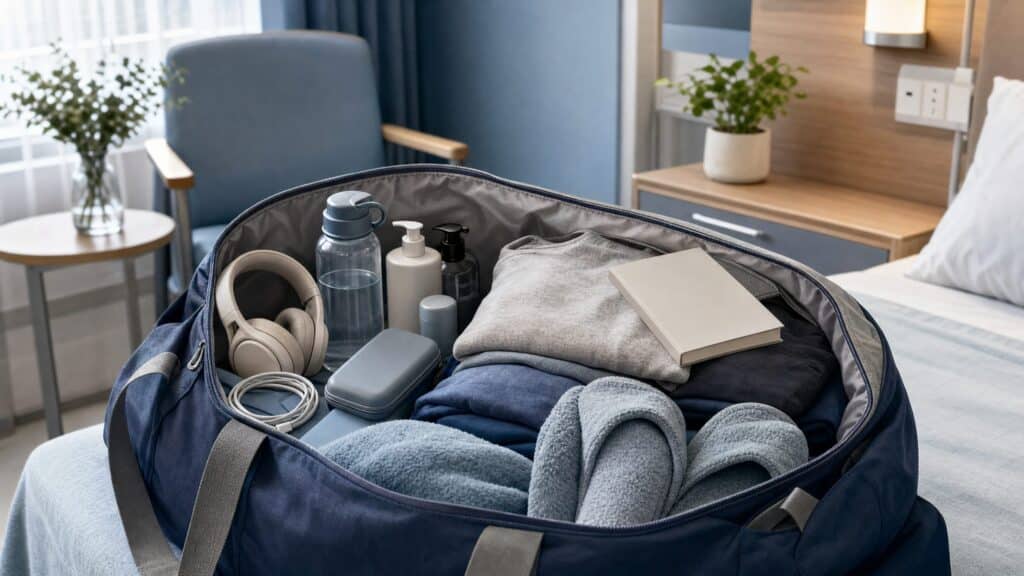
Key Takeaways
- Sort belongings into three piles before packing: items to bring, items to confirm with Elk Ridge Recovery admissions, and items to deliberately leave at home.
- Bring what nearly every residential program accepts, including photo ID, insurance cards, a written medication list, layered Montana-appropriate clothing, basic toiletries, and a few quiet comfort items.
- Confirm sensitive items with Elk Ridge before you zip the bag, especially a full written medication record, last-use and prior-treatment history, and a signed list of who staff may contact under 42 CFR Part 2 7.
- Deliberately leave behind substances, alcohol-containing toiletries, weapons, valuables, unapproved electronics, outside food, and any clothing with drug, alcohol, or violent imagery.
- Treat anxiety as part of the packing list by naming your specific fears in writing and preparing a short intake script so honesty is easier when you walk in.
- Expect the first 24 hours to include a bag inventory, medication handoff to nursing for reconciliation 3, and a clinical assessment that starts at or just before admission 2.
- Family members packing for someone else should hand over labeled bottles and a written medication and last-use record 3, 10, then accept that federal privacy law limits what staff can share back.
The night before you leave for Montana
The bag is half-packed on the floor and you keep circling it. Maybe you fold the same shirt twice. Maybe you pour a glass of water and forget to drink it. If your chest feels tight tonight, that’s not a sign you’re doing this wrong. It’s a sign you’re actually going.
Here’s the thing worth knowing before you overthink another item: there is no single national packing list for residential treatment. Federal guidance from SAMHSA tells you to bring identification, insurance information, and details about your medications, and then to confirm the rest of the specifics with the program you’re entering 1. That includes questions about phones, food, tobacco, and how family will contact you. Facilities set their own rules for good clinical reasons, and those rules vary 18.
So call Elk Ridge Recovery before you zip anything shut. Write down what admissions tells you. Then let this checklist do the rest of the work.
You’ll see three simple buckets ahead: what almost every residential program accepts, what to confirm with Elk Ridge directly, and what to deliberately leave at home. There’s also a short section on the fear you probably haven’t said out loud yet. Pack that too. You’re allowed to bring it with you.
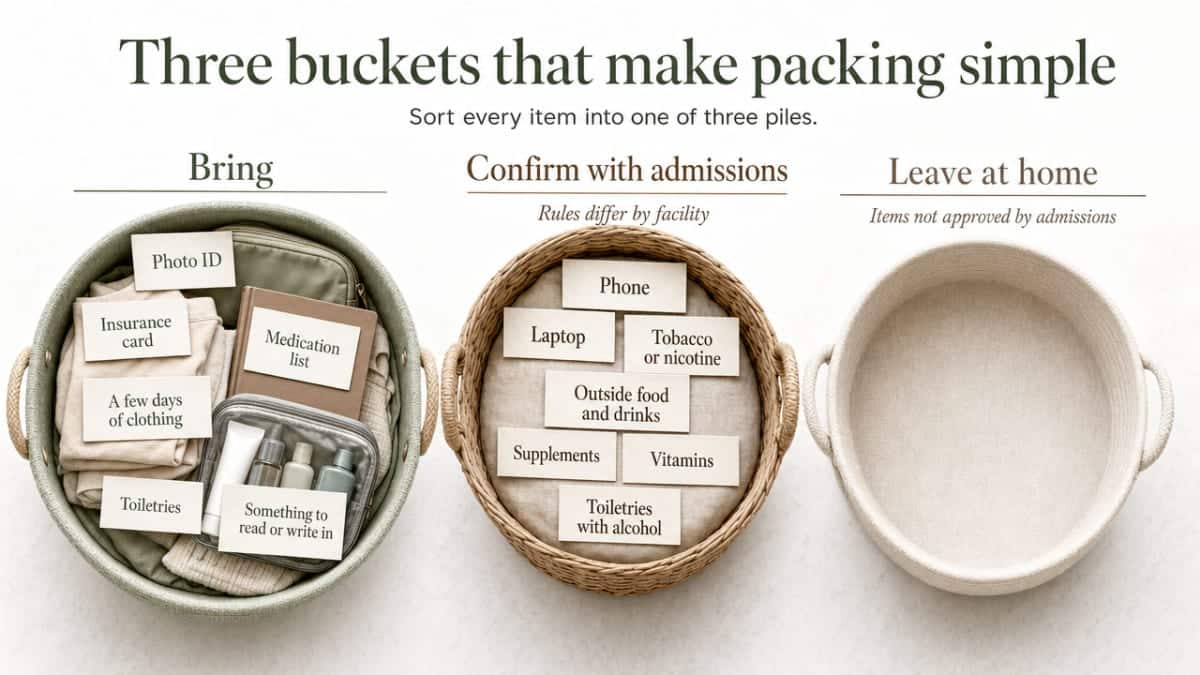
Three buckets that make packing simple
Sort every item you’re staring at into one of three piles. That’s the whole system.
- Bring.
- These are the things you can pack tonight without a phone call: a photo ID, your insurance card, a written medication list, a few days of season-appropriate clothing, basic toiletries, and something to read or write in. SAMHSA points to ID, insurance, and medication details as the non-negotiables for any inpatient admission 1.
- Confirm with Elk Ridge Recovery.
- Phones, laptops, tobacco or nicotine products, outside food and drinks, over-the-counter supplements, vitamins, and even certain toiletries with alcohol content sit in this pile. Residential programs write their own rules for real clinical reasons, and those rules genuinely differ from one facility to the next 18. One call to admissions turns this whole pile into a yes or a no.
- Leave at home.
- Anything you’d have to hide, explain, or apologize for at the door. We’ll get specific about that pile in a minute.
Three piles. That’s it. The rest of this checklist just fills them in.
What almost every residential program accepts
Identification, insurance, and admission paperwork
Start here because everything else waits on it. SAMHSA is direct: bring a photo ID and your insurance information to inpatient admission 1. That’s the floor. Everything else on this page is scaffolding around those two cards.
Pull together a small folder tonight. You want:
- A driver’s license, state ID, passport, or tribal ID. Any current government photo ID works.
- Your insurance card, front and back, plus a member portal login if you have one.
- A secondary card if you carry Medicaid, Medicare, VA benefits, or an employer EAP referral.
- Emergency contact names and phone numbers written on paper. Your phone may not stay with you the first day.
- Any prior treatment records, discharge summaries, or a short written history of past programs you’ve attended 2.
If you don’t have a physical insurance card, call the number on your benefits portal and ask for a printout or a screenshot you can email to yourself before you leave. Elk Ridge Recovery’s admissions team can verify coverage in advance, which shaves real time off the front-door process.
One more thing worth writing down: the name and number of the admissions coordinator you’ve been talking to. When you walk in tired and scared, having that name on a slip of paper in your pocket is worth more than you’d guess.
Clothes that work for Montana weather and daily programming
Montana doesn’t care what month your suitcase thinks it is. Mornings can be cold enough to see your breath in September, and afternoons can climb into the seventies the same day. Pack in layers or you’ll spend two weeks either shivering or sweating.
Aim for about seven days of clothing. Programs typically have laundry access, so more than that just crowds the closet. SAMHSA’s preparation guidance points to bringing practical belongings suited to the program’s daily activities and confirming what’s permitted before you pack 1. For a Montana residential stay, practical means:
- Three to five casual tops and a couple of long-sleeve options.
- Two to three pairs of pants or jeans and a pair of comfortable joggers or sweats.
- A warm hoodie or fleece and a lightweight jacket. If you’re arriving in winter, add a heavier coat, gloves, and a hat.
- One pair of closed-toe athletic shoes for outdoor and adventure therapy. One pair of everyday shoes. Slip-ons or shower sandals for the bathroom.
- A week of underwear and socks. Add a couple of extra pairs of thick socks if you’ll be outside a lot.
- Pajamas or something you can comfortably sleep in around other people.
- A modest swimsuit if the program includes hydrotherapy or lake outings, and a workout shirt if you plan to use a gym space.
Skip the resort-wear instinct. Elevated accommodations don’t mean cocktail attire. Skip anything with drug, alcohol, or violent imagery on it, and skip clothing with drawstrings if you’re coming in for detox first, since some detox units restrict them. Not sure about a specific item? Set it aside and ask admissions. Facility clothing rules vary more than people expect 18.
Toiletries, comfort items, and a paperback or two
Toiletries are where a lot of people overpack. Bring a two-week supply of the basics and let the rest wait:
- Toothbrush, toothpaste, floss, and deodorant.
- Shampoo, conditioner, body wash, and a comb or brush.
- Any prescription skincare, contact lens supplies, glasses, and a glasses case.
- Feminine hygiene products if you need them.
- A basic hair tie or two, a razor if permitted, and lip balm for dry Montana air.
Here’s the catch: many residential programs restrict toiletries that contain alcohol, including some mouthwashes, aftershaves, hairsprays, and hand sanitizers. Call admissions and ask which brands or ingredients are fine to bring. It’s a two-minute conversation that keeps your favorite shampoo out of the trash bin at check-in.
For comfort, keep it small and meaningful. A paperback or two. A journal and a couple of pens. A few printed photos of people who matter to you. A stuffed animal or a small blanket if that’s part of how you rest. Nothing valuable, nothing you’d be crushed to lose, and nothing electronic until you’ve confirmed it with the program. What you’re building is a quiet corner in an unfamiliar room. That doesn’t take much.
What to confirm with Elk Ridge Recovery before you zip the bag
Build a written medication record before you pack the bottles
The bottles matter less than the piece of paper that goes with them. Before you drop anything into a ziplock bag, sit down and write out a full medication record. AHRQ’s guidance for hospital admissions is clear: obtain a complete list of everything you take, then compare it against what gets ordered on arrival 3. That comparison is how a care team catches the interaction that could hurt you.
For each medication, write down eight things: the name (both brand and generic if you know them), the dose, the schedule, why you take it, who prescribes it, any allergies or past reactions, when you last took a dose, and any recent changes in the last thirty days 3. Don’t forget vitamins, supplements, and herbal products. MedlinePlus is direct that these count and should be disclosed, because they interact with prescribed medicines more often than people realize 5, 6.
Bring the actual bottles too, with the labels intact 4, 6. But don’t take anything from home once you’re admitted unless the medical team specifically authorizes it 5. That rule exists because dosing, timing, and drug interactions get managed by the clinicians now, not by you and your memory.
Call Elk Ridge Recovery ahead of time and ask how they want controlled substances, injectables, and continuous medications handled at the door. That single question prevents a lot of first-day confusion.
Document last use, prior treatment, and withdrawal concerns
This is the part of the paperwork that keeps you safe in the first seventy-two hours. The medical team needs to know what you’ve been using, how much, how often, how you’ve been taking it, and when you last did. SAMHSA’s clinical guidance on opioid-use disorder specifically calls out documenting frequency, quantity, type, route, and recency of use, including the last day and use in the previous thirty days 10. Even if opioids aren’t your primary substance, that same framework applies to alcohol, benzodiazepines, stimulants, and anything else in the mix.
Write it down before you arrive. It’s harder to think clearly at intake than you’d expect, and shame has a way of shrinking the truth by half. A written note in your folder means you don’t have to summon the details from memory while a stranger types.
Privacy paperwork and who you want the team to contact
Substance-use treatment records get stronger federal protection than most other health information. Under 42 CFR Part 2, the program generally can’t share records that identify you as someone with a substance-use disorder unless you consent, an exception applies, or there’s a court order 7. That means the default is quiet. If you want your sister, your spouse, your employer’s EAP, or your outpatient therapist looped in, you have to sign a release of information that names them specifically.
HHS’s model Part 2 notice spells out what you’re entitled to: you can consent to most disclosures, ask for limits on what gets shared, receive the facility’s privacy notice, request an accounting of who your information was disclosed to, and file a complaint if your rights get violated 9. Under the current final rule, you can also request restrictions on certain disclosures and get that accounting of disclosures 8.
Pack a written list before you go. Include:
- People you want the team allowed to speak with by name, relationship, and phone number.
- People you specifically do not want contacted, even in a general update.
- Whether you want mail, packages, or messages passed through.
- Your outpatient providers, prescribing psychiatrist, primary care doctor, or therapist, if you want continuity of care.
- Questions you want answered about emergency disclosures and what happens if a family member calls asking about you.
Ask Elk Ridge Recovery for a copy of their privacy notice and read it before you sign anything. Releases can be limited in scope and duration. You don’t have to consent to everything at once, and you can change your mind later.
What to deliberately leave at home
Some things belong in a drawer at home, not in your bag. Leaving them behind isn’t punishment. It’s how you protect the version of yourself who’s showing up to do this work.
Leave the substances. All of them. Alcohol, prescription pills that aren’t yours, anything you’ve been using, and anything you’ve been hiding in a shoe or a jacket pocket. If you’re not sure whether you’d try to use it, that’s your answer. Elk Ridge Recovery’s medical team will handle withdrawal safely once you’ve documented what you’ve been taking 10. You don’t need a stash for the drive.
Leave anything with alcohol in the ingredients unless you’ve cleared it with admissions: mouthwash, hand sanitizer, some perfumes and colognes, certain hairsprays. Leave weapons of any kind, including pocket knives and multi-tools. Leave lighters and matches unless you’ve confirmed the facility’s tobacco policy 1.
Leave valuables. Expensive jewelry, watches, large amounts of cash, and anything irreplaceable. Bring a small amount of cash for incidentals only if admissions says it’s useful. Your grandmother’s ring should stay in a drawer.
Leave electronics you haven’t confirmed. Laptops, tablets, smart watches, gaming devices, and even e-readers sit in a gray zone that differs by facility 18. Same with headphones, chargers, and portable speakers.
Leave outside food and drinks, energy drinks, and any over-the-counter medications or supplements that haven’t been approved 5. Leave clothing with drug, alcohol, or violent imagery, and leave anything revealing enough to make a stranger uncomfortable in a shared living space.
One more thing worth leaving: the pressure to arrive as a finished person. You’re not supposed to have this figured out yet. That’s the whole point of going.
Anxiety is part of the packing list
The pre-admission fear no one names out loud
Here’s the part most packing lists skip: the fear. Not the practical fear of forgetting a phone charger. The other one. The fear of walking into a room full of strangers who will know why you’re there. The fear of group therapy when talking about yourself already feels like standing on a stage. The fear that withdrawal will be worse than you can handle. The fear that you’ll fail again.
Name it. Say the specific version out loud, even just to yourself in the car. Researchers studying residential retention have proposed that social anxiety, in particular, may affect whether people enter and stay in residential treatment, though that specific study is a protocol testing an intervention rather than proof it works 16. What matters for you tonight is simpler: your fear is not evidence you shouldn’t go. It’s evidence you’re a person doing a hard thing.
CDC guidance to clinicians is explicit that trust and empathy shape whether people disclose what’s really going on 14. That guidance is written for the team you’re about to meet. They expect you to be scared. They’re trained to meet that with steadiness, not judgment.
Pack the fear in a sentence. Write down the two or three things you’re most afraid to say. You don’t have to lead with them. You just have to have them somewhere you can find them.
A short script for the intake conversation
Intake is not an interrogation. It’s a clinical conversation that starts at or just before admission and keeps going 2. Still, having a few sentences ready takes the pressure off.
Try something like this:
- “I’m nervous. I want to be honest, but I might need a minute on some questions.”
- “Here’s my written medication list and my last-use timeline. I wrote it down because I was worried I’d forget details.”
- “I’ve been most afraid of ___. Can you tell me how that usually gets handled here?”
- “Who can you talk to about my care, and who do you need my written permission to contact?”
- “What does the first 24 hours look like for me?”
You’re allowed to ask questions back. SAMHSA’s case-management guidance frames prepared questions about schedule, rules, rights, and what happens next as a normal, expected part of admission 12. And if a question lands hard, you can say, “I need a second.” That’s a full sentence.
The team at Elk Ridge Recovery has heard versions of your story before. Not your exact one. But close enough that they won’t flinch. Your job tonight is to bring the truth, not to perform it.
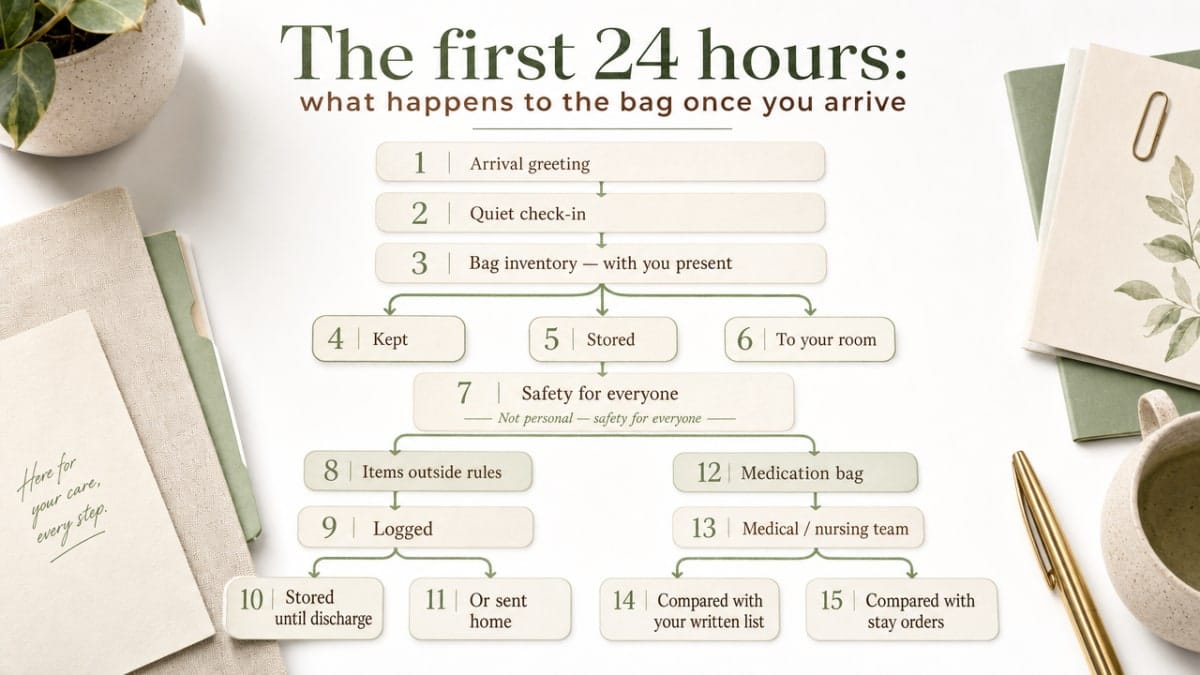
The first 24 hours: what happens to the bag once you arrive
Knowing what happens to the bag makes the front door less scary. Here’s a reasonable picture of your first day, keeping in mind that Elk Ridge Recovery will walk you through their exact process when you arrive.
- Expect a staff member to greet you and take you somewhere quiet to check in. Your bag gets inventoried, usually with you present, so you can see what’s being kept, what’s being stored, and what you can take to your room. This isn’t personal. It’s how the program keeps everyone in the building safe, including you. Anything that doesn’t meet the facility’s rules gets logged and either stored until discharge or sent home with whoever dropped you off.
- The medication bag goes to the medical or nursing team. They’ll compare what you brought against your written list and against what gets ordered for your stay 3. If something doesn’t match, they’ll ask. That’s the whole point of medication reconciliation, and it’s protective, not accusatory. From that moment on, medications get administered by staff, not by you 5.
- Clinical intake usually starts the same day, sometimes within the first few hours. Assessment begins at or just before admission and keeps going through your stay 2. Expect questions about your substance use history, last use, medical conditions, mental health, and what brought you in. Your written notes are your friend here.
- Then a room assignment, probably a meal, and a first night in an unfamiliar bed. That night is often the hardest one. It also passes.
A short note for family members packing on someone else’s behalf
If you’re the one folding a brother’s shirts or double-checking a partner’s insurance card, take a breath. You’re doing something loving and hard at the same time.
A few things worth knowing. You can call Elk Ridge Recovery’s admissions team yourself to confirm what’s permitted, but the release-of-information paperwork controls what the clinical team can tell you once your person is inside 7. Under 42 CFR Part 2, the default is that no one confirms your family member is even there unless they’ve signed a release naming you 9. That’s not a rejection. It’s federal privacy law working the way it’s supposed to.
Bring the medication bottles and the written list, even if you had to piece it together from cabinets and pharmacy printouts 3, 4. Write down what you observed: last use if you know it, recent changes, anything that scared you 10. Then let the professionals take it from there. Your job now is to hand off the bag, say what you need to say, and go home to rest. You’ve done the packing. That’s enough for today.
Talk to Someone Who Gets It—Start Now
Get real answers about prepping for admission and make your first day less stressful.
Frequently Asked Questions
Can I bring my phone and laptop to inpatient rehab?
Maybe, maybe not. Residential programs set their own electronics rules, and those rules genuinely vary from one facility to the next 18. Some allow phones during limited hours. Some hold them until a later phase. Some restrict laptops to specific spaces. Call Elk Ridge Recovery’s admissions team before you pack either one, and ask about chargers, headphones, and smart watches while you’re on the line 1.
What should I do with my prescription medications before admission?
Write a full list first, then pack the labeled bottles. For each medication, note the name, dose, schedule, purpose, prescriber, allergies, last dose, and any recent changes 3, 4. Include vitamins, supplements, and herbs 5. Bring the bottles with labels intact, but don’t take anything from home once you’re admitted unless the medical team specifically authorizes it 5, 6. Ask admissions how they handle controlled substances and injectables at the door.
Who will the treatment team be allowed to talk to about my care?
By default, almost no one. Under 42 CFR Part 2, records identifying you as a person with a substance-use disorder generally can’t be shared without your written consent 7. If you want your spouse, sibling, outpatient therapist, or employer’s EAP updated, you sign a release naming each person. You can also request restrictions and an accounting of who your information was shared with 8. Bring a written list of authorized contacts.
How much clothing should I actually pack for a Montana residential stay?
About seven days’ worth. Programs typically have laundry access, so overpacking just crowds your closet. Focus on layers: casual tops, long sleeves, jeans or joggers, a fleece or hoodie, and a jacket suited to the season. Add closed-toe athletic shoes for outdoor and adventure therapy days, plus everyday shoes and shower sandals 1. Skip anything with drug or alcohol imagery, and ask admissions before packing borderline items like drawstring hoodies.
What happens to my bag during the first few hours after I arrive?
A staff member greets you and takes you somewhere quiet. Your bag gets inventoried, usually with you present, so you see what’s kept, what’s stored, and what goes to your room. Medications go to the nursing team, who compare them against your written list and admission orders 3. Clinical intake often begins the same day, sometimes within a few hours, because assessment starts at or just before admission 2.
What if I am too anxious or ashamed to answer intake questions honestly?
Say that out loud. “I’m nervous and I need a minute” is a complete answer. CDC guidance trains clinicians to lead with empathy and person-first language precisely because shame silences the details that keep you safe 14, 15. Research has explored how social anxiety may affect residential treatment entry and retention, though that work is an investigational protocol rather than proof 16. Write your hardest truths down beforehand so you don’t have to summon them.
References
- Starting Treatment: Mental Health, Drugs and Alcohol Use. https://www.samhsa.gov/find-support/learn-about-treatment/get-ready-to-start-treatment
- What is substance abuse treatment?. https://library.samhsa.gov/sites/default/files/sma14-4126.pdf
- Appendix, Medication Reconciliation – MATCH Toolkit. https://www.ahrq.gov/patient-safety/settings/hospital/match/appendix/app-7.html
- Chapter 5. Education and Training. https://www.ahrq.gov/patient-safety/settings/hospital/match/chapter-5.html
- Help prevent hospital errors. https://medlineplus.gov/ency/patientinstructions/000618.htm
- Medicine safety during your hospital stay. https://medlineplus.gov/ency/patientinstructions/000501.htm
- Understanding Confidentiality of Substance Use Disorder (SUD) Patient Records. https://www.hhs.gov/hipaa/part-2/index.html
- Fact Sheet 42 CFR Part 2 Final Rule. https://www.hhs.gov/hipaa/for-professionals/regulatory-initiatives/fact-sheet-42-cfr-part-2-final-rule/index.html
- Model Part 2 Patient Notice. https://www.hhs.gov/hipaa/for-professionals/privacy/guidance/privacy-practices-part-2/index.html
- TIP 63: Medications for Opioid Use Disorder. https://www.samhsa.gov/sites/default/files/pep21-02-01-002.pdf
- Substance Use Disorder Treatment for People with Co-Occurring Disorders. https://library.samhsa.gov/sites/default/files/pep20-06-04-006.pdf
- TIP 27: Comprehensive Case Management for Substance Abuse Treatment. https://library.samhsa.gov/sites/default/files/sma15-4215.pdf
- Advisory: Low Barrier Models of Care for Substance Use Disorders. https://library.samhsa.gov/sites/default/files/advisory-low-barrier-models-of-care-pep23-02-00-005.pdf
- Addiction Medicine Primer. https://www.cdc.gov/overdose-prevention/media/pdfs/2024/07/Addiction-Medicine-Primer.pdf
- Remove Stigma: Talk with Your Patients About Substance Use Disorder. https://www.cdc.gov/overdose-prevention/media/pdfs/2024/04/Conversation-Starter-Remove-Stigma.pdf
- Improving the retention rate for residential treatment for substance use disorders: a protocol for a randomised controlled trial of a social anxiety intervention. https://pmc.ncbi.nlm.nih.gov/articles/PMC3936994/
- Substance Use – Alcohol & Drug Addiction Treatment for Veterans. https://www.mentalhealth.va.gov/substance-use/treatment.asp
- Domiciliary Programs. https://www.va.gov/salem-health-care/programs/domiciliary-programs/