Key Takeaways
- Roughly 42.8% of American Indians in one Montana survey population were uninsured 9, so admissions teams serving this region are used to starting the conversation without a coverage card.
- Four funding pathways run in parallel for uninsured Native families in Montana: Medicaid through the HEART initiative, IHS Purchased/Referred Care, HEART tribal grant gap funds, and structured self-pay.
- Tribal enrollment and the county you live in determine PRC eligibility, since Purchased/Referred Care is tied to designated delivery areas and is not an entitlement program 5, 10.
- Call admissions the day you decide, even with incomplete paperwork, because Medicaid screening, PRC prior authorization windows, and tribal health coordination all take time to move 7.
What Happens When You Call Without Insurance
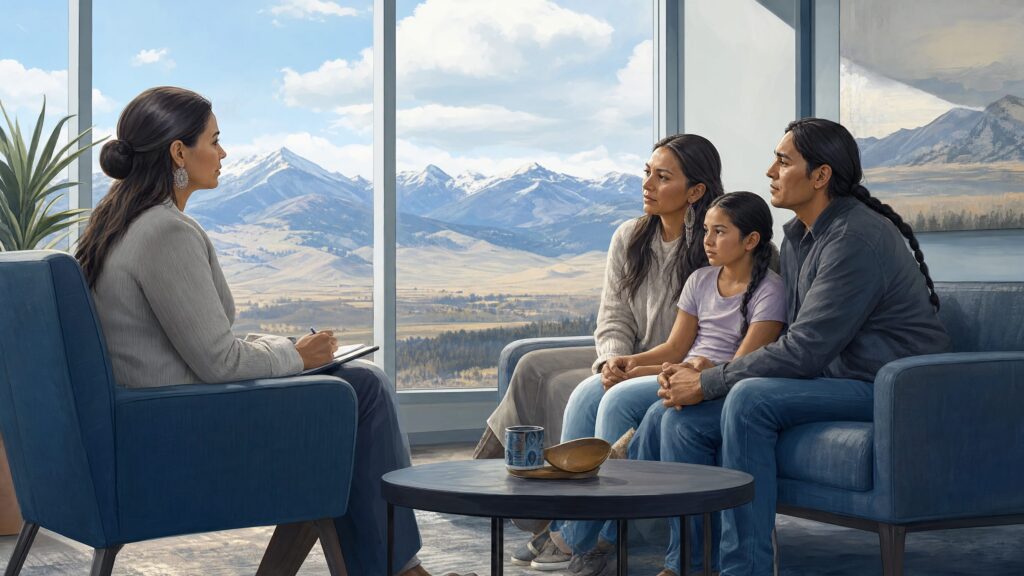
You might be sitting with the phone in your hand, already writing the rejection in your head. No insurance card. No savings. Maybe no clear answer about whether Medicaid ever went through, or whether the clinic back home has records on file. If you are Native, uninsured, and living in Montana, you are not making this call from a position of paperwork strength. That does not mean the call ends the way you fear.
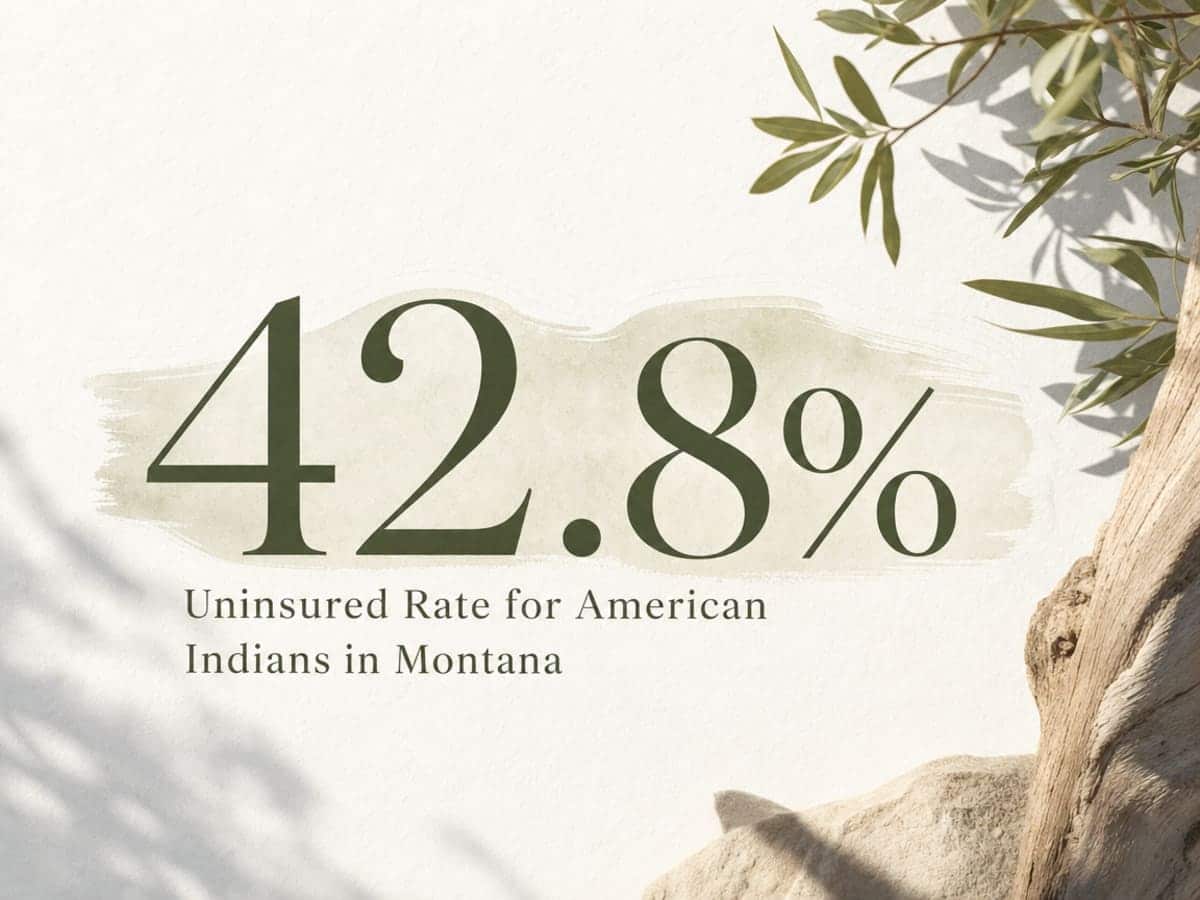
Here is the honest picture. In one University of Montana analysis, roughly 42.8% of American Indians in the studied Montana population were uninsured, give or take about 3.7 percentage points 9. That is a state-specific estimate from one survey window, not a universal number, but it tells you something important: you are not an unusual case, and admissions teams that serve this region should know how to talk to you.
When you call Elk Ridge Recovery without insurance, the first questions are not about money. They are about what is happening with you or your relative right now, what tribe you are enrolled with or affiliated with, what county you live in, and whether Medicaid has ever been screened or applied for. Each of those answers opens a different door: Montana Medicaid through the HEART initiative, Indian Health Service Purchased/Referred Care, HEART tribal grant gap funding, or a structured self-pay conversation.
No insurance is not the end of the conversation. It is the start of a different one.
The Admissions Call, Question by Question
Clinical Picture First, Coverage Second
The first few minutes of the call are about the person, not the paperwork. Expect an admissions counselor to ask what is happening right now: what you or your relative is using, how much, how often, when the last use was, and whether there are withdrawal symptoms already showing up. If alcohol or benzodiazepines are in the picture, they will listen for shakes, seizures, or a history of complicated withdrawal, because that changes whether medical detox needs to happen first.
You will also be asked about mental health. Depression, anxiety, trauma responses, suicidal thoughts, past hospitalizations, current prescriptions. This is not a test you can fail. It is how the clinical team figures out whether residential care is the right level, whether a co-occurring diagnosis needs attention alongside the substance use, and whether the intake needs to be same-day.
Only after that picture is clear does the conversation shift to coverage. That order matters. It means the plan is built around what you actually need, and then funding is matched to the plan, rather than the other way around. If you are worried about saying the wrong thing, say what is true. The counselor has heard it.
Tribal Enrollment, Residency, and Which County You Live In
Next comes a set of questions that can feel bureaucratic but open real doors. Which tribe are you enrolled with, or which tribe are you affiliated with if enrollment paperwork is complicated? Where do you live right now, and where have you lived for the last several months? What is your mailing address, and what county is that in?
These questions matter because Indian Health Service Purchased/Referred Care is tied to both tribal eligibility and geography. In general, IHS explains that a person must be from a federally recognized tribe and reside on or near a reservation within a designated Purchased/Referred Care Delivery Area, or PRCDA 10. The county line is not a formality. It is the eligibility line.
Montana has eight federally recognized tribes plus the Little Shell Tribe of Chippewa Indians, and each has its own PRC delivery area. The Little Shell PRCDA, for example, covers Blaine, Cascade, Glacier, and Hill counties 8. If you live inside your tribe’s delivery area, PRC becomes a pathway worth screening. If you live outside it, the answer is not automatically no, but the route changes.
Bring your tribal enrollment card or number if you have it. If you do not, the admissions counselor can still work the conversation forward while you request documentation from your tribal enrollment office. Do not let a missing card stop you from calling today.
Medicaid Screening Before Anyone Talks Cost
Before any conversation about self-pay, the admissions team should screen you for Montana Medicaid. This is not a stall tactic. It is the single most important door to open, because Medicaid through the HEART initiative now covers a real continuum of substance use treatment, including residential care at ASAM level 3.5 2.
You may have applied before and been denied. You may have had coverage that lapsed. You may assume you earn too much, or too little, or that your immigration or household situation disqualifies you. Say all of that out loud on the call. Eligibility rules have shifted, and a screening today is not the same as the answer you got two years ago. If you are potentially eligible, admissions can connect you with someone who helps with the application while treatment planning continues.
If Medicaid is a clear no, you have not wasted the step. You have ruled out a pathway on paper, which strengthens any later request through IHS Purchased/Referred Care or HEART tribal grant gap funds, both of which look at whether other payers are available before authorizing help 5. Every no you document moves you closer to a yes somewhere else.
The Four Funding Pathways an Uninsured Native Family Should Know
Medicaid Through Montana’s HEART Expansion
If there is one pathway to screen first, it is Montana Medicaid through the HEART initiative. This is not a promise that you will qualify. It is a recognition that the coverage landscape has shifted in a way that matters for you.
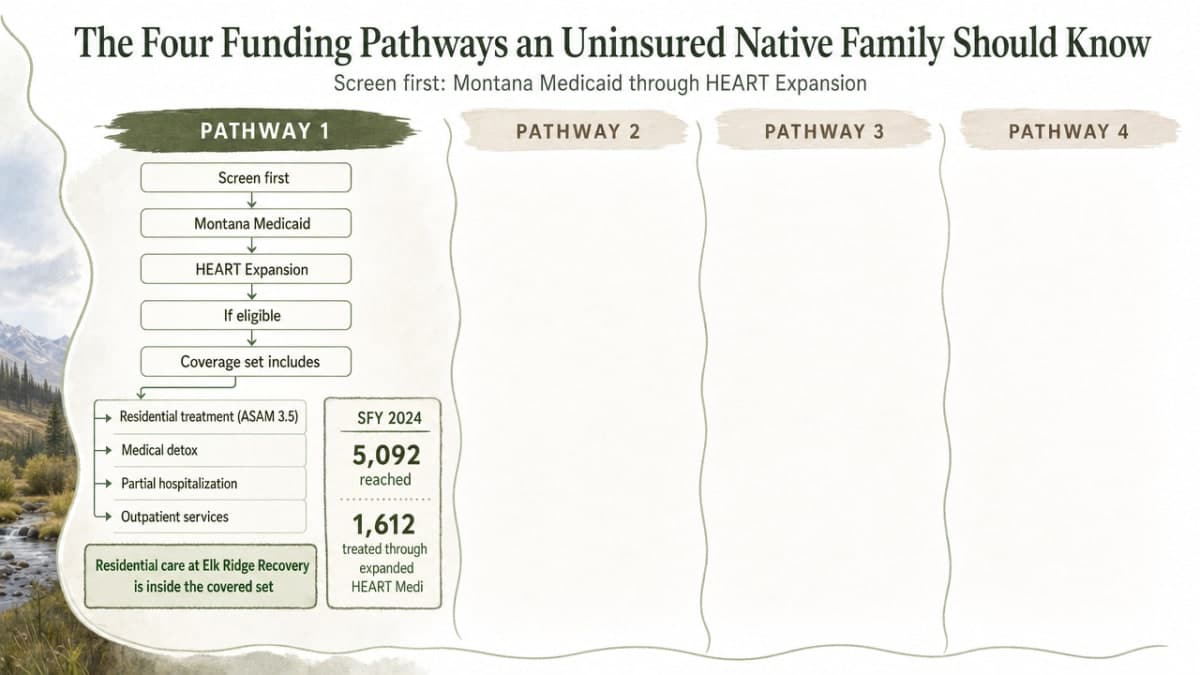
Under HEART, Medicaid now reimburses a real continuum of substance use disorder care, including residential treatment at ASAM level 3.5, medical detox, partial hospitalization, and outpatient services 2. That means if you enroll, residential care at a program like Elk Ridge Recovery is inside the covered set of services, not a luxury sitting outside of it.
The numbers show a live, working pathway. In SFY 2024, HEART Medicaid and grant services together reached 5,092 Montanans, with 1,612 members receiving treatment specifically through expanded HEART Medicaid SUD services 2. In SFY 2025, another 1,499 Montanans were newly approved for SUD treatment through the initiative 1. Those are people who, in many cases, started exactly where you are: unsure whether the phone call would end in a yes.
Admissions can walk you through Medicaid screening on the same call, and if you look potentially eligible, connect you to help completing the application while clinical planning moves forward. You do not have to solve enrollment before you ask for help.
IHS Purchased/Referred Care: What It Actually Screens For
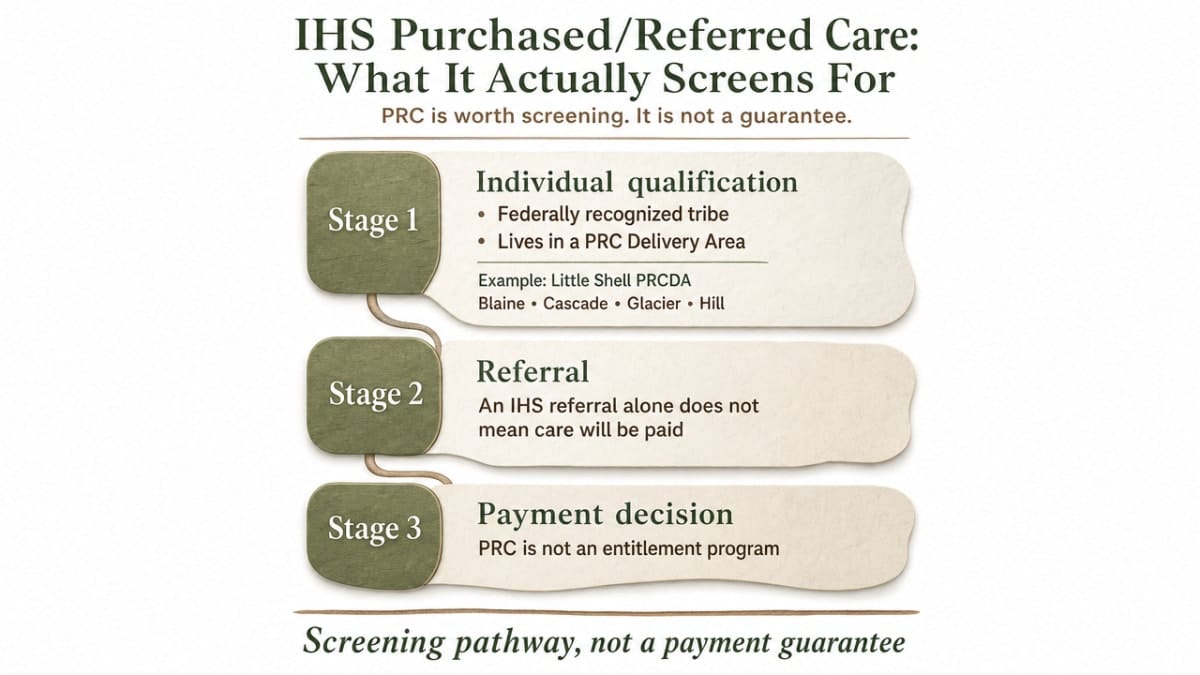
Purchased/Referred Care, or PRC, is the pathway most families have heard about and the one most often misunderstood. It is worth screening. It is not a guarantee.
PRC screens in three stages, and it helps to picture them in order 7.
- The first stage is individual qualification: are you from a federally recognized tribe, and do you live within a designated Purchased/Referred Care Delivery Area? If you live in the Little Shell PRCDA, for example, that means Blaine, Cascade, Glacier, or Hill county 8. If your tribe is one of the other Montana tribes, the delivery area is different, and your tribal PRC office is the right place to confirm.
- The second stage is medical necessity and facility availability. Is the care you need clinically necessary, and is it something the local IHS or tribal facility cannot provide? Behavioral health services, including substance use treatment, are inside the PRC priority-of-care framework 6. Documentation of clinical urgency and medical necessity strengthens this stage of the review.
- The third stage is payment priority and available funds. Even when you qualify on paper and the care is necessary, PRC funding is finite, and other payers must be reviewed first 5. This is why Medicaid screening happens before, not after, a PRC request. Every alternate resource you rule out builds a cleaner case.
Call your tribe’s PRC office early. Prior authorization, or emergency notification within the required window, is often the difference between an approved and denied request 7.
HEART Tribal Grants as Gap Funding
The third pathway is one many families have never heard about. Under HEART, each of Montana’s eight federally recognized tribes receives an annual tribal grant, reported at $62,500 per tribe in recent state fiscal years, for prevention, crisis response, treatment, treatment supports, and recovery services 1, 3.
These dollars are meaningful, and they are also specific. HEART tribal grants are gap funding. They are designed to help when a needed service is not reimbursable through Medicaid or another payer, or when the person needing care is not Medicaid-eligible 3. That fits the exact situation many uninsured Native families find themselves in.
What this looks like on the ground: your tribal health department decides how its grant is spent within HEART’s allowed categories. That may include transportation to residential care, a bridge for services that fall outside Medicaid, or recovery supports after discharge. The way to find out is to call your tribal health or behavioral health department directly and ask what the current year’s HEART grant is funding.
Admissions at Elk Ridge Recovery can coordinate with your tribal contact once you name them.
Self-Pay Structuring and Scholarship Assistance
The fourth pathway is the one families brace hardest against: paying out of pocket. Hear this clearly. Self-pay in this context rarely means writing one large check. It means structuring what the family can contribute, if anything, alongside whatever other pathways come through.
On the call, admissions can talk through what a partial contribution looks like, whether payments can be spread over time, and whether scholarship or philanthropic assistance is available for the current admission window. None of this is a fixed menu. It is a conversation shaped by your clinical needs, the length of stay recommended, and what Medicaid, PRC, or HEART tribal grants may cover in parallel.
Two honest points. Self-pay is often the last piece added to a mixed funding plan, not the first. And if the answer at the end is that a full self-pay arrangement is not workable for your family, admissions should help you identify the next best option rather than end the call.
Funding Pathway Matrix at a Glance
You have now heard about four pathways in separate pieces. Here they are side by side, so you can see at a glance what each one asks of you and what it can realistically do.
| Pathway | What triggers eligibility | What to bring | What it typically covers | What it does not |
|---|---|---|---|---|
| Montana Medicaid via HEART | Meeting current Montana Medicaid income and household rules | ID, income information, household details, tribal enrollment if applicable | Residential SUD care at ASAM 3.5, detox, PHP, IOP, outpatient once enrolled 2 | Care received before enrollment is active; services outside the covered benefit set |
| IHS Purchased/Referred Care | Enrollment in a federally recognized tribe plus residence in a designated PRCDA 10 | Tribal enrollment, proof of residence, referral, prior authorization or emergency notification 7 | Discretionary payment for outside care when medical necessity and priority are met 6 | Any guarantee of payment; PRC is not an entitlement and funds are finite 5 |
| HEART tribal grants | Determined by your tribal health department within HEART categories 3 | Contact with your tribal health or behavioral health office | Gap funding at roughly $62,500 per tribe annually for prevention, treatment supports, recovery 1 | Services another payer should cover 3 |
| Self-pay structuring | Family decision, discussed on the admissions call | Honest picture of what the family can contribute | Partial contributions, payment plans, scholarship review when available | A fixed rate card; this is a conversation, not a menu |
Read across the row that fits you first. Then call, and let admissions help you screen the others in parallel.
Why the Timing of the Call Matters
You may be telling yourself you will call next week, once things settle. Hear this gently: the day you call is the day the clock starts on every pathway that could help you. Medicaid screening takes days, not minutes. A tribal PRC review requires prior authorization or timely emergency notification to be considered 7. HEART tribal grant coordination depends on whoever is in the tribal health office that week. None of these move faster because you waited.
The stakes behind that clock are real. The CDC reports that the age-adjusted overdose death rate for non-Hispanic American Indian and Alaska Native people was 65.0 per 100,000 in 2023 and 51.6 per 100,000 in 2024, the highest among the racial and ethnic groups shown 12. Those are national figures, not Montana-specific, and the drop is meaningful. It is also still the highest rate on the chart.
You are not making a permanent decision by calling. You are starting the paperwork that any of these pathways will need. Call today, even if you are not ready to admit today.
Cultural Care as Clinical Design, Not Decoration
You have probably seen programs where a smudge bowl sits on a shelf like a photograph prop. That is not what SAMHSA means when it recommends culturally responsive care, and it is not what should show up in a program that says it serves Native families. SAMHSA’s Treatment Improvement Protocol 61 asks providers to weave American Indian and Alaska Native beliefs and heritage into program design, the care environment, and staff development, so that services are engaging, holistic, and trauma-informed rather than translated from a template 11.
What that looks like in practice is quieter than a brochure suggests. Smudging happens when a client asks for it, in a space where the smoke does not set off alarms, with someone who understands what is being offered. Wellbriety, family therapy, and outdoor time in Montana country are folded into the clinical week, not added as extras once the real work is done. Group content acknowledges historical trauma without turning it into a lecture.
TIP 61 also warns against treating Native identity as one thing 11. A Blackfeet client, a Crow client, a Little Shell client, and an urban Native client from Billings do not walk in with the same story. A program worth your time asks which practices matter to you, then adjusts, rather than assuming.
A Respectful Conversation About Medication
Somewhere in the admissions call, medication for opioid use disorder may come up. Buprenorphine, methadone, naltrexone. If you or your relative has strong feelings about these, say so. A 2025 qualitative analysis of American Indian community members documented real, careful concerns about MOUD, alongside systemic barriers like scarcity of prescribers, transportation, housing instability, and long waits 13. Those concerns deserve to be heard, not overridden.
Here is what a respectful conversation sounds like. The clinical team explains what each medication does, what the evidence shows, what the side effects are, and what stopping looks like. You are asked what you want, not told what you will accept. If medication is right for your care, it is offered. If it is not the path you choose, other clinical options are built around that decision. Medication is a tool on the table, not a condition of getting through the door.
Before You Pick Up the Phone: What to Have Ready
You do not need a folder of documents to make the first call. You do need a few things nearby, so the conversation moves without stalling. Missing pieces are not a reason to wait. They are a reason to start.
Have this within reach if you can:
- Your tribal enrollment card or number, or the name of your tribe if the card is not on hand.
- Your current mailing address and the county you live in, since Purchased/Referred Care eligibility is tied to your PRC delivery area 10.
- The name and phone number of your IHS or tribal health clinic, and your tribal PRC office if you know it.
- Any Medicaid history: past application, denial letter, case number, or the month coverage ended.
- A short list of current medications, prescribing providers, and any prior treatment episodes.
- An emergency contact and, if the call is about your relative, their permission to share information.
If half of this list is blank, call anyway. Admissions can work forward with what you have and help you request the rest.
How to Vet Any Residential Program You Consider
Wherever you end up calling, ask the same questions. In Montana, any residential treatment center must be state-licensed, and the licensing statute requires rules on staff-to-patient ratios, staff qualifications and training, treatment services, insurance, background checks, suicide-prevention policies, abuse reporting, and accreditation 14. That list is a fair checklist for you, too.
On the call, ask whether the program is licensed and accredited, what the staff-to-client ratio looks like, how detox and co-occurring mental health are handled, and how cultural practices are actually built into the week rather than displayed on a wall. Ask what happens if PRC denies the referral or Medicaid takes longer than expected. A program that answers plainly, in that order, is a program worth your time.
Speak Privately Now About Montana Recovery Options
Connect with an admissions specialist who understands your family’s unique needs and next steps for treatment.
Frequently Asked Questions
Can I really get addiction treatment in Montana if I have no insurance and no money to put down?
Yes, calling is worth it. Admissions screens several pathways in parallel: Montana Medicaid through the HEART initiative, which now covers residential SUD care 2, IHS Purchased/Referred Care if you qualify by tribe and residence 10, and HEART tribal grant gap funding through your tribal health office 3. You are not expected to solve payment before you ask.
Do I have to be enrolled in a federally recognized tribe to get help through IHS Purchased/Referred Care?
Generally, yes. IHS requires that a person be from a federally recognized tribe and reside on or near a reservation within a designated Purchased/Referred Care Delivery Area 10. If your enrollment paperwork is incomplete, call your tribal enrollment office to request documentation while admissions works forward with what you have. PRC is also not an entitlement, so eligibility alone does not guarantee payment 5.
What documents should I have ready before I call admissions?
Have your tribal enrollment card or number, mailing address and county, the name and number of your IHS or tribal health clinic, any Medicaid history (application, denial, or case number), a short list of current medications and prescribers, and an emergency contact. County matters because PRC eligibility is tied to your delivery area 10. If half the list is blank, call anyway.
If I qualify for Montana Medicaid through HEART, will it cover residential treatment?
Once your Medicaid is active, residential SUD care at ASAM level 3.5 is inside the covered continuum under the HEART 1115 demonstration, along with detox, PHP, IOP, and outpatient services 2. In SFY 2025, another 1,499 Montanans were newly approved for SUD treatment through HEART 1. Care received before your enrollment is active is generally not retroactively covered, so start the application early.
Will I be pressured to take medication like Suboxone or methadone as part of treatment?
No. A 2025 qualitative analysis documented real concerns among American Indian community members about medications for opioid use disorder, and those concerns deserve to be heard 13. The clinical team explains what each medication does, the evidence, and the side effects. You choose. If medication is not your path, other clinical options are built around that decision. It is a tool, not a condition.
What happens if IHS Purchased/Referred Care denies my referral?
A denial is not the end. PRC is discretionary and priority-based, and funding is finite 5. If PRC cannot authorize payment, admissions should pivot to the remaining pathways: continuing Medicaid screening if not yet enrolled, coordinating with your tribal health department about HEART grant gap funding 3, and discussing structured self-pay or scholarship review. Ask your tribal PRC office whether an appeal or reconsideration is available.
References
- Healing and Ending Addiction through Recovery and Treatment (HEART) Initiative Report. https://dphhs.mt.gov/assets/StatutorilyRequiredReports/MCA16-12-122HEARTReport9-1-25.pdf
- DPHHS MCA 16-12-122: HEART Initiative Report. https://dphhs.mt.gov/assets/heartinitiative/HEARTInitiativeReport2024.pdf
- HEART Tribal Grants Summary Report. https://dphhs.mt.gov/assets/MedicaidTribalConsultation/FINALHEARTTribalGrantsSummaryReport2-7-23.pdf
- February 26, 2024 HEART Waiver Approval, Part II. https://dphhs.mt.gov/assets/heartinitiative/MTHEARTAmendmentApproval02262024.pdf
- Purchased/Referred Care (PRC) | for Patients. https://www.ihs.gov/forpatients/prc/
- Requirements: Priorities of Care. https://www.ihs.gov/prc/eligibility/requirements-priorities-of-care/
- Can PRC pay for your referral medical care? Find out in 3 stages.. https://www.ihs.gov/sites/prc/themes/responsive2017/display_objects/documents/CHSProcessHandout1.pdf
- Billings Area Report Q4. https://www.ihs.gov/sites/odsct/themes/responsive2017/display_objects/documents/dst-area-reports/q4/2020/DSTAC-BillingsAreaReport_2020_Q4.pdf
- The Status of Montana’s Health Insurance Population. https://www.bber.umt.edu/pubs/health/CSI_HealthInsurancePopulation.pdf
- Purchased/Referred Care Delivery Areas | Eligibility. https://www.ihs.gov/prc/eligibility/requirements-purchased-referred-care-prc-delivery-areas/
- TIP 61: Behavioral Health Services for American Indian and Alaska Native Communities. https://library.samhsa.gov/sites/default/files/tip_61_aian_exec_summary_020419_0.pdf
- Drug Overdose Deaths in the United States, 2023–2024. https://www.cdc.gov/nchs/products/databriefs/db549.htm
- Concerns About Medications for Opioid Use Disorder Among American Indian Community Members: A Qualitative Secondary Analysis. https://pmc.ncbi.nlm.nih.gov/articles/PMC12411911/
- 50-5-248 Licensing of residential treatment centers — rulemaking. https://mca.legmt.gov/bills/mca/title_0500/chapter_0050/part_0020/section_0480/0500-0050-0020-0480.html