Key Takeaways
- Affordable rehab on Montana reservations rarely comes from one source — most people layer IHS, PRC, Medicaid, Marketplace plans, TOR/SOR grants, and sliding-scale health centers together 1, 5, 15.
- Purchased/Referred Care can pay outside providers for residential treatment, but only after enrollment, PRC-area residency, prior referral, medical necessity, and available funds are confirmed 1, 2.
- Montana Medicaid covers SUD care across levels under parity rules, and the HEART demonstration adds telehealth case management and transportation coordination that matter for reservation distance 7, 8.
- Start by calling your local IHS or tribal service unit for screening and referral paperwork, then run a benefits check with an admissions team to map your full funding stack 3, 1.
Paying for Rehab When You Live on a Montana Reservation
If you’re reading this, you’ve probably already done the hardest part: you’ve admitted that something needs to change, and you’ve started looking. What’s stopping you now isn’t willingness. It’s the money question. How does someone on the Blackfeet, Northern Cheyenne, Flathead, Fort Belknap, Fort Peck, Rocky Boy’s, or Crow reservation actually pay for treatment when the checking account is thin and the nearest inpatient bed is a three-hour drive away?
Here’s the honest answer: affordable rehab almost never comes from one place. It comes from stacking what you already qualify for. That might mean the Indian Health Service and Purchased/Referred Care, Montana Medicaid, a Marketplace plan, SAMHSA-funded tribal grants, a sliding-scale health center, and a provider’s own financial assistance — layered together until the cost drops to something workable 1, 5, 15.
This article walks through each pathway honestly. It tells you where each one stops, what to ask, and what to do if the first answer is no. You don’t have to figure it out alone, and you don’t have to have the answers before you make the first call. That’s what an admissions team is for.
IHS and Purchased/Referred Care: What They Actually Cover
Starting With Your Service Unit
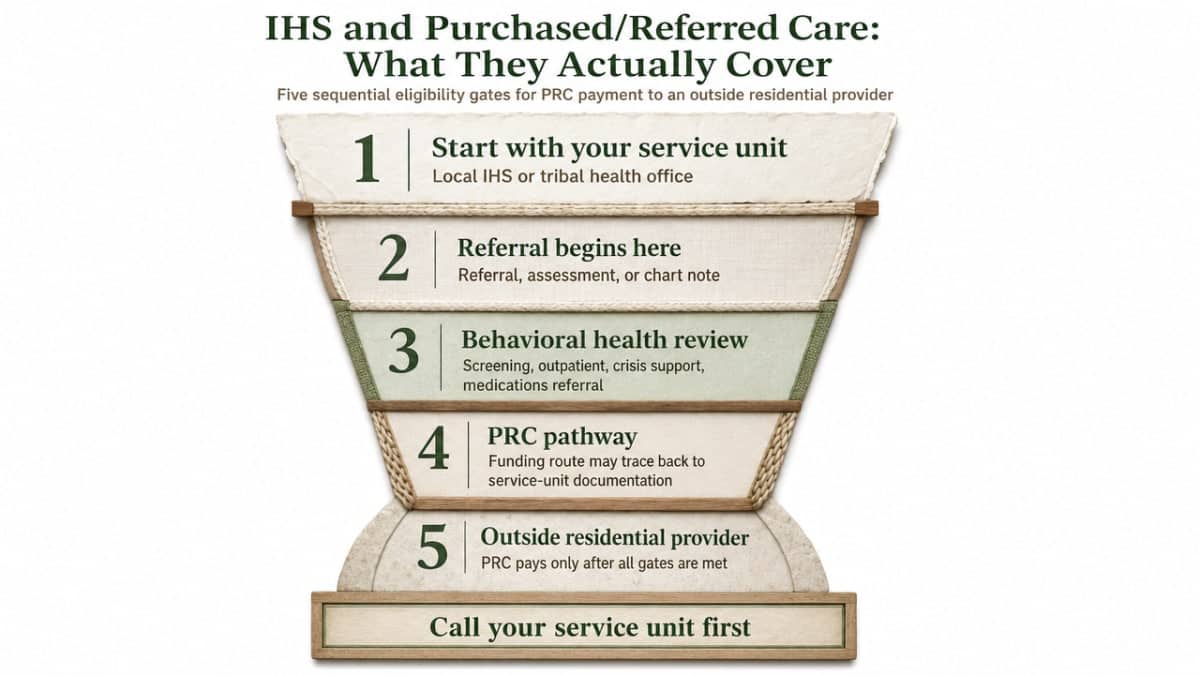
Before you call a residential program, call your service unit. That’s the local Indian Health Service or tribal health office that serves your reservation — Blackfeet, Northern Cheyenne, and other Montana communities have behavioral-health contacts listed directly through IHS 3. The reason to start there isn’t loyalty. It’s paperwork. Almost every other funding pathway you might use later — Purchased/Referred Care, some grant-funded slots, transportation help — traces back to a referral, an assessment, or a chart note that begins at your service unit.
What can your service unit actually do on that first call? Depending on the location, you may get behavioral-health screening, outpatient counseling, crisis support, connections to medications for opioid or alcohol use disorder, and a referral coordinator who knows which outside programs the tribe or IHS has worked with before 3. Not every service unit offers the same hours or the same depth of substance-use services, so ask specifically what’s available today and what has to be scheduled.
You do not need to have your insurance figured out to make this call. You do not need a diagnosis. You just need to say you’re looking for help with substance use and want to know what your service unit offers and what it can refer you to.
How PRC Works — and Where It Stops
Purchased/Referred Care, or PRC, is the piece of IHS most people misunderstand. PRC is the mechanism that can pay a non-IHS, non-tribal provider — like a private residential rehab — when the care you need isn’t available through direct IHS or tribal services 1. So yes, PRC is real, and yes, it has paid for outside treatment. But PRC is not insurance, and it does not activate automatically because you’re enrolled in a tribe.
There are five gates PRC funding has to pass through before it will pay for an outside stay 1, 2, 4:
- Tribal enrollment in a federally recognized tribe, or another accepted basis for IHS eligibility.
- Residence on or near your reservation, inside the applicable PRC delivery area.
- Referral authorization from IHS or your tribal health program before the service happens, in most non-emergency situations.
- Medical necessity — a clinical determination that the level of care you’re seeking is needed and that IHS or tribal direct care can’t provide it.
- Available PRC funds in that budget year, which are finite.
Here’s what this means for you practically. If you live on the reservation, are enrolled, and your service unit agrees residential treatment is medically necessary, PRC is worth pursuing — but treat it as one possible funding source, not a guarantee. The Indian Health Manual is clear that eligibility for direct IHS care and eligibility for PRC-funded outside care are two different tests 4. That’s why Elk Ridge Recovery’s admissions team will ask about your PRC status and your service unit contact when you call. They’re not gatekeeping — they’re trying to layer PRC with Medicaid, Marketplace, or grant funding so nothing gets left on the table.
If You Have Medicaid or Can Get It
Montana Medicaid is often the strongest single card in your funding stack. If you already have it, that’s a real head start. If you don’t, applying is worth the hour it takes — and you can apply while you’re figuring out treatment, not before. Medicaid isn’t means-tested against your intentions; it’s tested against your income and household size right now.
Here’s what matters for rehab specifically. Medicaid and CHIP plans have to cover mental-health and substance-use-disorder services under federal parity rules, and they have to disclose the medical-necessity criteria they use to approve or deny that care 7. That second part is bigger than it sounds. If a plan turns you down for residential treatment, you can ask — in writing — why, and what standard they used. That’s the beginning of an appeal, not the end of the road.
Montana’s Medicaid program also has a set of provisions under the HEART demonstration that speak directly to reservation life: telehealth-supported case management, warm handoffs between providers, and transportation coordination for eligible transitions 8. If the closest residential program is three hours away and you don’t have a working vehicle, those aren’t luxuries — they’re the difference between getting to a bed and losing the referral.
A few honest notes. Being on Medicaid doesn’t mean every facility is in-network for you, and it doesn’t mean every level of care is automatically approved. Some programs need prior authorization. Some require an assessment that scores you against ASAM criteria before residential is covered. And if you’re PRC-eligible, Medicaid usually pays first, with PRC filling gaps — not the other way around 1. That order matters, because it changes which application goes in first.
What you can do today, without leaving the house: call the Montana Medicaid enrollment line or apply online, and call Elk Ridge Recovery’s admissions team with whatever coverage information you have — even if that’s just “I think I qualify but haven’t applied.” They can run a verification, tell you what your plan covers at each level of care, and flag whether prior authorization is needed before you pack a bag. The paperwork is the part someone else can help you carry.
If You’re Uninsured: Marketplace, Grants, and Sliding Scale
Marketplace Plans and What SUD Coverage Really Means
If you don’t have insurance and you don’t qualify for Medicaid, the Health Insurance Marketplace is the next door to try. Every Marketplace plan is required to cover mental-health and substance-use-disorder treatment as an essential health benefit — outpatient, inpatient behavioral-health, and SUD services are all in that bucket 5. A plan also cannot deny you or charge you more because you already have a substance-use disorder, and it cannot put an annual or lifetime dollar cap on those essential benefits 6. That’s a real floor of protection, and it’s worth knowing before anyone tells you a rehab stay is off the table.
Here’s the honest part. “Covered” is not the same as “free.” Marketplace plans still have deductibles, coinsurance, copays, and network rules, and residential treatment often needs prior authorization before the plan will pay 5, 6. A plan with a low monthly premium may have a high deductible you have to hit before benefits kick in. A plan with a wider network may cost more each month but cover more facilities.
If you’re outside open enrollment, ask whether a life event — a job loss, a move, losing other coverage — opens a Special Enrollment Period for you. Elk Ridge Recovery’s admissions team can run a benefits check on any Marketplace plan you’re considering and tell you what your out-of-pocket would look like at each level of care before you commit.
TOR and SOR: Grant-Funded Care Through Tribes and the State
Grant money is the piece of the funding puzzle most people never hear about, and it can be the one that closes the gap when insurance falls short. Two federal grant streams matter most for Montana reservations: the State Opioid Response (SOR) grant, which flows through the state, and the Tribal Opioid Response (TOR) grant, which SAMHSA awards directly to federally recognized tribes and tribal organizations 9, 10.
These grants are not theoretical. Between September 30, 2021 and September 29, 2022, 626 individuals received opioid-use-disorder services in Montana through SOR-funded programs — 42% self-identified as American Indian, and nearly 30% reported criminal-justice involvement 9. That’s a lot of Montana neighbors already using this pathway. Grant dollars typically pay for medications for opioid-use disorder (buprenorphine, methadone, naltrexone), counseling, recovery-support services, and, in the 2026 TOR notice, stimulant-use-disorder treatment as well 10.
Two caveats worth stating plainly. First, grants flow to tribes and organizations, not to individuals — you don’t apply for TOR yourself; you find a participating provider or ask your tribe’s health program which grants they hold 10. Second, grant-funded slots can be capped, geographically limited, or tied to specific services (often outpatient MAT rather than residential) 9. So when you call your service unit or Elk Ridge’s admissions team, ask specifically whether TOR- or SOR-funded services are available and whether they can be layered on top of Medicaid, PRC, or a Marketplace plan to reduce what you’d owe.
HRSA Sliding-Scale Health Centers as a First Step
Before you assume you need a residential bed, know that Montana has a network of Health Center Program grantees — federally funded community health centers that provide primary and behavioral-health care on a sliding fee scale based on your income 15. If you’re uninsured or between coverage, that sliding scale can drop a first appointment to something you can actually pay.
Why start here? A community health center visit can get you screened for substance use, connected to medications for opioid or alcohol use disorder, treated for co-occurring depression or anxiety, and — importantly — documented. That documentation becomes the medical-necessity record that a Medicaid application, a PRC referral, or a residential admission will lean on later. It’s the paperwork that turns “I need help” into a chart note someone can act on.
Not every Health Center site provides residential rehab, and not every site accepts every plan 15. Call ahead and ask two questions: what behavioral-health services do you offer, and what does the sliding scale look like at my income level? If the answer is yes to a screening and an MAT prescription, you’ve just started treatment while you figure out the bigger pieces. Small steps count.
The Funding Stack: One Table, Six Pathways
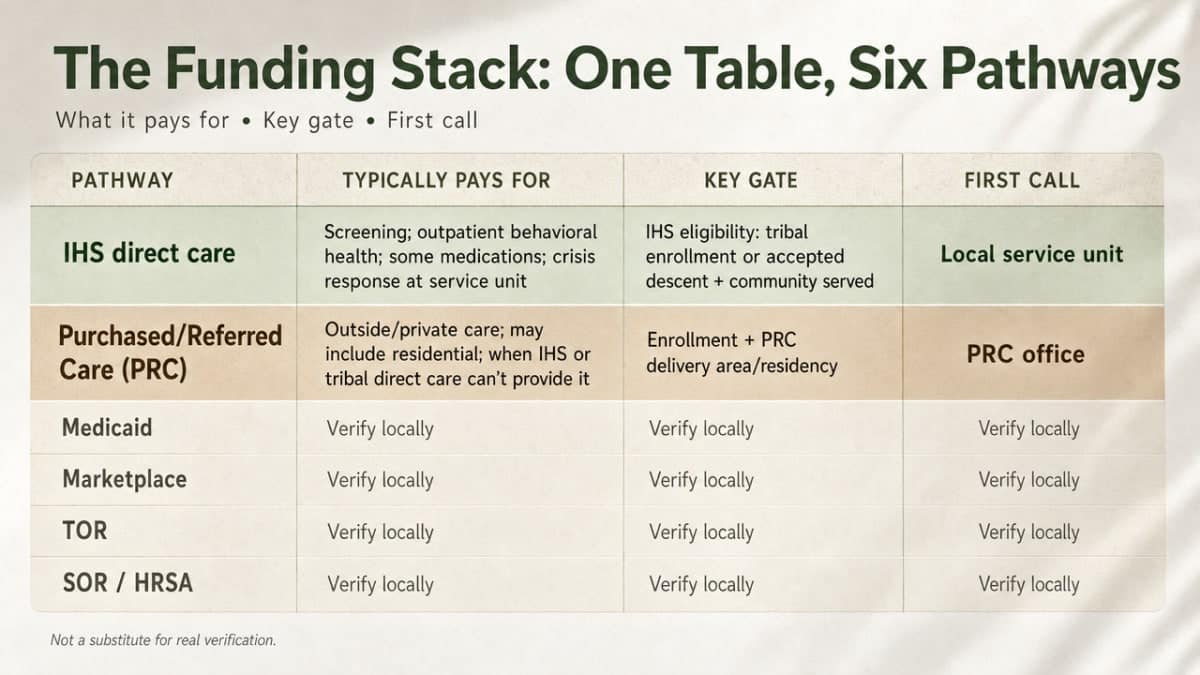
You’ve read a lot of names in this article — IHS, PRC, Medicaid, Marketplace, TOR, SOR, HRSA. Here’s one table that puts them side by side, so you can see what each pathway typically pays for, the main gate you have to pass through, and who to call first. Nothing here replaces a real verification, but it should stop the pathways from blurring together.
| Pathway | What it typically pays for | Key eligibility gate | First call to make |
|---|---|---|---|
| IHS direct care | Screening, outpatient behavioral health, some medications, crisis response at the service unit 3 | IHS eligibility (tribal enrollment or accepted descent + community served) 4 | Your local service unit (Blackfeet, Northern Cheyenne, etc.) 3 |
| Purchased/Referred Care (PRC) | Outside/private care — including residential — when IHS or tribal direct care can’t provide it 1 | Enrollment + PRC delivery-area residency + prior referral + medical necessity + available funds 1, 2 | Your service unit’s PRC or referral coordinator 1 |
| Montana Medicaid | Outpatient, IOP, PHP, residential SUD care, MAT — under parity rules 7 | Income and household-size eligibility; some services need prior authorization 7 | Montana Medicaid enrollment line or a treatment center’s admissions team |
| Marketplace plan | Mental-health and SUD services as essential benefits, including inpatient behavioral health 5 | Open or Special Enrollment; deductible and network still apply 5, 6 | HealthCare.gov or an admissions team that runs benefits checks |
| TOR / SOR grants | MOUD (buprenorphine, methadone, naltrexone), counseling, recovery support, stimulant-use services 9, 10 | Grants flow to tribes/organizations; you access services through a participating provider 10 | Your tribe’s health program or a provider that holds TOR/SOR funding 9 |
| HRSA sliding-scale health center | Primary care, behavioral-health screening, MAT, co-occurring mental-health treatment 15 | Sliding fee based on income; site services vary 15 | The nearest Montana Health Center site 15 |
Read the table sideways, not top-to-bottom. Most people who get to treatment affordably are using two or three of these at once — a Medicaid card for the residential stay, PRC filling a gap, a grant-funded MAT start at the local clinic before admission. Elk Ridge Recovery’s admissions team can look at your situation and tell you which rows apply to you before you commit to anything.
Five Questions to Ask on Your First Call
Calling an admissions line when you’re not sure you can afford treatment is one of the harder phone calls a person makes. You don’t have to sound polished. You just need five questions in your pocket, and you can read them off a piece of paper.
- “Can you run a benefits check on my coverage today?” Give them whatever you have — Medicaid card, Marketplace plan name, IHS status, or nothing at all. A good admissions team will verify what your plan pays at detox, residential, PHP, and IOP, and tell you what prior authorization is needed 5, 7.
- “Do you work with Purchased/Referred Care, and what do I need from my service unit?” This tells you whether the facility has taken PRC referrals before and what documentation the referral coordinator will need on their end 1.
- “Do you have any TOR- or SOR-funded slots, or grant-supported services I could use?” Some providers hold grant funding that covers medications, counseling, or specific beds. If they don’t, ask who in Montana does 9, 10.
- “If my insurance doesn’t cover the full stay, what does your financial assistance or sliding scale look like?” Ask for a real number, not a range. Ask whether they’ll bill remaining balances or require payment up front.
- “If I get denied, will you help me appeal?” Under parity rules, you have the right to the plan’s medical-necessity criteria and the reason for any denial — and admissions teams that do this often already know how to write the appeal 7.
Write the answers down. If the person on the phone can’t answer a question, that’s information too. Elk Ridge Recovery’s admissions team is set up to work through all five in one conversation, so you don’t have to make the same call to six different places. Making the call is the hard part. The rest is paperwork someone else helps you carry.
When the Answer Is No: Your Right to Appeal
A denial letter is not the end of the conversation. It’s the start of a different one. Under federal parity rules, your Medicaid or CHIP plan has to give you the medical-necessity criteria it used and the specific reason it said no — and you have the right to ask for both in writing 7. Marketplace plans carry similar disclosure and appeal obligations for substance-use-disorder benefits 6.
Here’s what to do the day the denial arrives. Request the plan’s medical-necessity criteria and the written reason for denial. Ask your assessing clinician — at your service unit, community health center, or admissions team — to document why the level of care you were denied is medically necessary using the plan’s own language. Then file the appeal within the plan’s deadline, usually printed on the letter.
Most denials for residential care come down to a gap between what the plan wants documented and what the initial submission included. That gap is fixable. Elk Ridge Recovery’s admissions team has written these appeals before and can help you assemble the clinical record that matches the plan’s criteria. A no today is often a yes in two weeks.
Travel, Telehealth, and the Distance Problem
Distance is not a small barrier. It’s often the reason a first appointment gets missed, a bed gets given to someone else, or a medication script runs out on a Sunday with no way to refill it. NIDA experts describe transportation and the sheer distance between tribal communities and treatment facilities as one of the biggest reasons people don’t start or don’t finish care 14. If you live on Fort Peck or Rocky Boy’s and the nearest residential program is a three-hour drive with patchy cell service, that’s a real logistics problem — not a motivation problem.
There are two ways to shrink it. First, Montana Medicaid’s HEART demonstration includes telehealth-supported case management, warm-handoff meetings between providers, and transportation coordination for eligible transitions between levels of care 8. That means a Medicaid case manager may be able to arrange the ride, or a virtual check-in can replace a drive for parts of your care plan. Telehealth doesn’t replace medically necessary in-person detox, physical exams, or residential supervision — but it can carry a lot of the follow-up 8.
Second, ask about sober transport when you call admissions. Elk Ridge Recovery coordinates transportation for clients coming from reservation communities, so getting from your driveway to the front door isn’t your problem to solve alone.
How Elk Ridge Recovery’s Admissions Team Verifies Coverage
You don’t have to sort this out alone, and you don’t have to know your plan details before you pick up the phone. When you call Elk Ridge Recovery’s admissions team, they’ll ask for whatever you have — a Medicaid ID, a Marketplace plan name, your service unit contact, or nothing at all — and start working the phones on your behalf.
In one conversation, they can run a benefits check across detox, residential, PHP, and IOP; coordinate with your service unit’s PRC referral coordinator 1; ask about TOR- or SOR-funded services in your area 9; and flag whether prior authorization is needed before you arrive 7. If a payer says no, they’ve written the appeals before and know what medical-necessity language the plan wants to see 7.
Ask about coverage options. The verification is free, the conversation is confidential, and you get a real answer about what your stack looks like — not a maybe.
Talk With Someone About Low-Cost Recovery Options
Connect directly to discuss affordable treatment and insurance coverage for Montana reservation communities.
Frequently Asked Questions
Does IHS pay for residential rehab automatically if I’m an enrolled tribal member?
No. Enrollment alone doesn’t trigger payment for an outside residential program. Purchased/Referred Care (PRC) can pay a non-IHS provider, but only when you meet enrollment, PRC delivery-area residency, prior referral, medical necessity, and available-funds requirements 1, 2. Treat PRC as one possible funding source you stack with Medicaid or a Marketplace plan, not as automatic coverage.
What if I don’t have any insurance and can’t afford a Marketplace plan?
You still have options. Start with a HRSA-funded community health center, which uses a sliding fee scale based on your income 15. Ask your tribe’s health program about TOR- or SOR-funded services that cover medications and counseling 9, 10. Apply for Montana Medicaid at the same time. And ask any admissions team about financial assistance. Layering these often gets the out-of-pocket cost close to zero.
Will Montana Medicaid cover residential treatment, or only outpatient?
Medicaid covers substance-use-disorder care across levels, including residential, under federal parity rules — but coverage isn’t automatic 7. Some residential stays need prior authorization and an assessment showing medical necessity. If a plan denies you, you have the right to the medical-necessity criteria it used and the written reason 7. That’s the start of an appeal, not a final no.
What should I do if my insurance denies coverage for rehab?
Don’t stop there. Request the plan’s medical-necessity criteria and the written reason for denial — you’re entitled to both under parity rules 7. Ask your assessing clinician to document why the level of care you were denied is medically necessary using the plan’s own language. File the appeal within the deadline on the letter. Elk Ridge Recovery’s admissions team writes these appeals often and can help.
I live hours from the nearest treatment center. Are there options that don’t require me to travel?
Distance is a real barrier, not a personal failing 14. Montana Medicaid’s HEART demonstration includes telehealth-supported case management and transportation coordination for eligible transitions between levels of care 8. Telehealth can’t replace in-person detox or residential supervision, but it can carry follow-up visits and check-ins. Ask admissions about sober transport too — many programs coordinate the ride from your driveway.
What’s the first phone call I should make?
Call your local IHS or tribal service unit first — Blackfeet, Northern Cheyenne, or whichever serves your reservation 3. They can screen you, start a referral, and begin the paperwork that other funding sources will need later 1. Then call Elk Ridge Recovery’s admissions team to run a benefits check and map your full funding stack in one conversation. You don’t need answers first — just the willingness to call.
References
- Purchased/Referred Care (PRC) | Fact Sheets. https://www.ihs.gov/newsroom/factsheets/purchasedreferredcare/
- Purchased/Referred Care [PRC] Delivery Areas | Eligibility. https://www.ihs.gov/prc/eligibility/requirements-purchased-referred-care-prc-delivery-areas/
- IHS Mental Health Programs. https://www.ihs.gov/mentalhealth/mhprograms/
- Chapter 1 – Eligibility for Services | Part 2. https://www.ihs.gov/ihm/pc/part-2/chapter-1-eligibility-for-services/
- Mental health and substance abuse health coverage options. https://www.healthcare.gov/coverage/mental-health-substance-abuse-coverage/
- Health Coverage Options for Consumers with Mental Health and Substance Use Disorders. https://www.cms.gov/marketplace/technical-assistance-resources/coverage-mental-health-substance-use-disorders.pdf
- CMS finalizes mental health and substance use disorder parity rule …. https://www.cms.gov/newsroom/press-releases/cms-finalizes-mental-health-and-substance-use-disorder-parity-rule-medicaid-and-chip
- April 20, 2026 Rebecca de Camara State Medicaid Director …. https://www.medicaid.gov/medicaid/section-1115-demonstrations/downloads/montan-heart-monitor-reentry-reinvestment-plan-approval.pdf
- 2023 Report to Congress on the State Opioid Response Grants. https://www.samhsa.gov/sites/default/files/fy23-sor-grants-rtc.pdf
- Award Information. https://www.samhsa.gov/grants/grant-announcements/ti-26-012
- Drug Overdose Prevention and Tribal Communities. https://www.cdc.gov/overdose-prevention/health-equity/tribal-communities.html
- Trends in Suspected Fentanyl-Involved Nonfatal Overdose Emergency Department Visits …. https://www.cdc.gov/mmwr/volumes/74/wr/mm7416a2.htm
- Drug Overdose Deaths in the United States, 2003–2023. https://www.cdc.gov/nchs/products/databriefs/db522.htm
- A Conversation About Drug Use and Addiction for American Indians and Alaska Natives. https://nida.nih.gov/videos/conversation-about-drug-use-addiction-american-indians-alaska-natives
- FY 2025 – Montana – HRSA Data Warehouse. https://data.hrsa.gov/api/factsheet/3/30/2025