Key Takeaways
- Getting from a Montana reservation to a residential bed requires four same-day approvals: clinical acceptance, ASAM prior authorization, transportation authorization, and an arrival handoff at the facility.
- Admissions plans fall apart at the seams between agencies, not at the destination, and structural support from an admissions coordinator is what actually moves people from wanting care to receiving it 6.
- Four separate parties own the trip: your tribal I/T/U clinic holds records, the admissions team coordinates, Mountain-Pacific Quality Health approves the clinical level, and the Transportation Center authorizes the ride.
- Work backward from admission day with a two- to three-week window, sequencing records, ASAM 3.1 approval 13, and transportation authorization before travel 12so nothing arrives too late.
- The Transportation Center picks the closest appropriate site 11, but ‘appropriate’ isn’t ‘nearest’ — ask admissions to document clinical reasons your chosen program fits.
- When calling admissions, hand off five tasks: pulling tribal clinic records, ASAM authorization, transportation coordination, bed-hold plans for delays, and sober transport for your route.
- If the ride falls through, call admissions first so they can move all the pieces at once, then call the Transportation Center 12to find an alternate approved mode.
- Pack light with ID, Medicaid card, and medications in original bottles, and tell one family member the date, pickup time, and admissions number as backup.
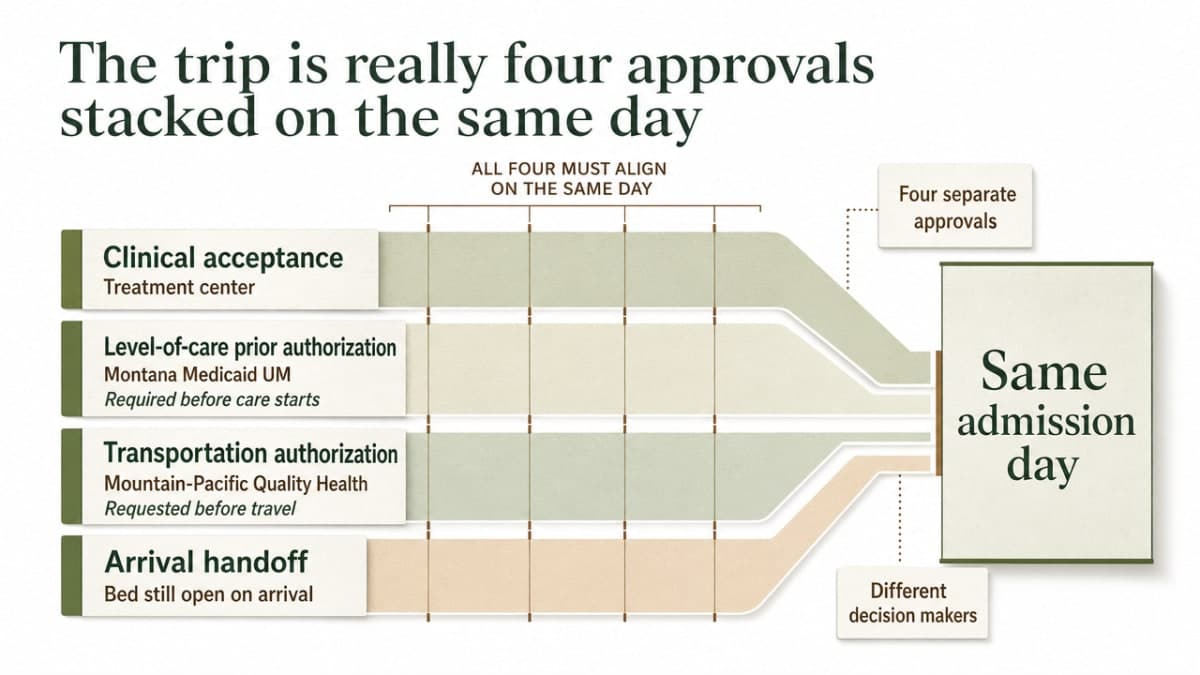
The trip is really four approvals stacked on the same day
Here is the thing nobody tells you before you make the call: getting from your community to a residential bed in Kalispell or Missoula is not one arrangement. It is four separate approvals that all have to land on the same day, held by four different people who mostly do not talk to each other unless someone makes them.
You need clinical acceptance from the treatment center. You need a prior authorization for the level of care itself, because ASAM Level 3.1 and everything above it — that is where residential lives — requires utilization-management approval through Montana Medicaid before care starts 13. You need a separate transportation authorization, which runs through Mountain-Pacific Quality Health and has to be requested before you travel, not the morning of 12. And you need the arrival handoff: someone at the front door expecting you, records in hand, bed made.
Miss any one of those and the day falls apart. The bed gets released. The ride shows up with no destination on file. The Transportation Center calls back to say the appointment could not be verified 1. You sit at the kitchen table and wonder if the door just closed.
It did not close. But it does mean the plan you are building right now has four moving parts, not one. You do not have to carry all four yourself. That is what the admissions team on the receiving end is for — to hold the seams between the tribal clinic, the payer, the ride, and the front door so the pieces line up on the same morning.
You made the decision to go. That is the hard part. The rest is scheduling.
Why so many people almost make it and then don’t
You have probably seen this happen. Someone in your family, or someone down the road, decided to go. They picked a date. They packed a bag. And then something in the chain of arrangements broke — the ride did not come, the paperwork was not ready, the person on the other end of the phone said to call back Monday — and by Monday, the decision had cooled.
That is not a failure of wanting it enough. That is a system problem, and it is a documented one. CDC has named the barriers directly for AI/AN communities: travel time to IHS facilities, limited transportation, long wait times, and a shortage of providers who understand the culture you are coming from 8. A qualitative study of eighteen treatment programs serving AI/AN communities found that some clients traveled several hours to reach care, and in some cases made the trip by foot or bicycle 5. Read that again. People have walked to get where you are trying to go.
Which brings us back to why the trip falls apart at the seams and not at the destination. The person deciding to go is usually not the person who knows the Transportation Center workflow, the ASAM authorization rule, or which fax number the tribal clinic uses. That is the gap. And that is exactly the gap a good admissions coordinator on the receiving end is built to close.
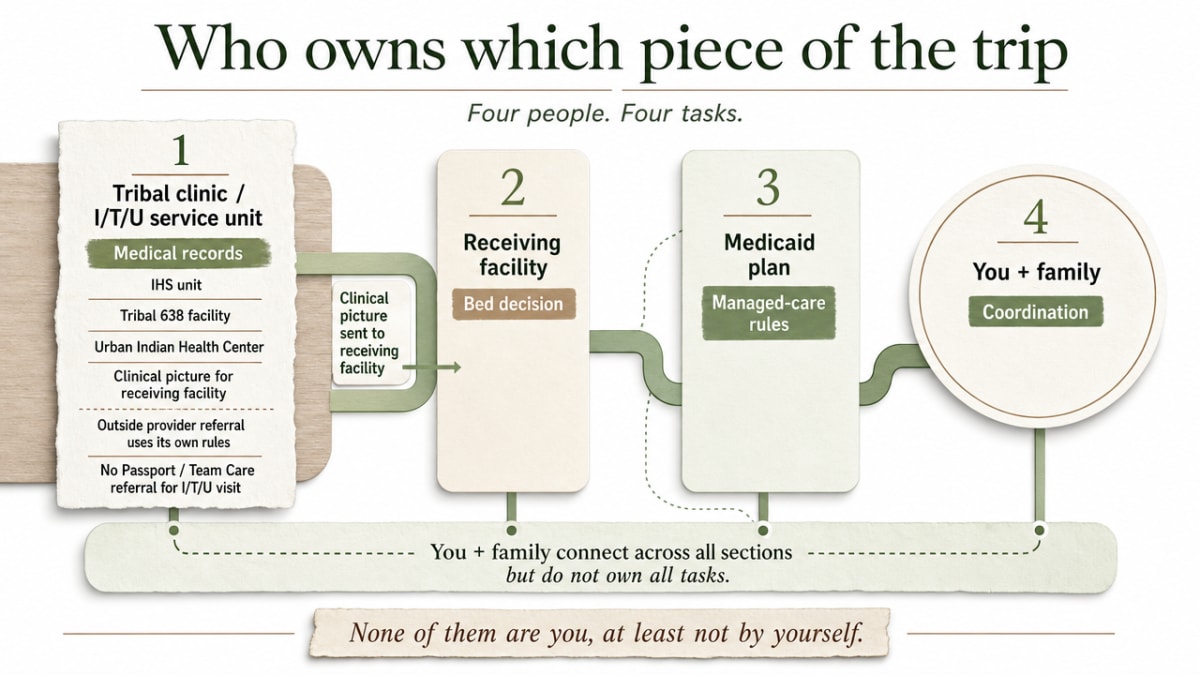
Who owns which piece of the trip
Four people. Four tasks. None of them are you, at least not by yourself. Here is who holds each piece and what you should expect them to do.
The tribal clinic or I/T/U service unit
Your tribal clinic — whether that is an IHS unit, a Tribal 638 facility, or an Urban Indian Health Center — is usually where your medical records live. That matters, because the receiving facility will want a clinical picture before they say yes to a bed.
Here is a piece of good news: as an AI/AN Medicaid member, you generally do not need a Passport or Team Care referral to be seen at your I/T/U facility, and when the clinic refers you to an outside provider, that referral is handled under its own set of rules rather than the standard managed-care referral path 10. Montana Medicaid also lists the specific IHS and Tribal 638 service units across the state, so you or a family member can identify exactly which unit is yours — Fort Peck, Fort Belknap, Rocky Boy’s, Blackfeet, Flathead, Crow, Northern Cheyenne, or Little Shell 9.
What to ask the clinic: release your records to the receiving facility, and note that you are working on a residential admission.
Elk Ridge Recovery’s admissions team
This is the phone call that turns four separate problems into one coordinated plan. When you call Elk Ridge Recovery’s admissions team, you are not just asking whether there is a bed. You are asking someone to hold the seams for you.
A good admissions coordinator can request your records from the tribal clinic, run the clinical intake by phone, work with the payer on the ASAM 3.1 prior authorization for residential care 13, and stay in touch with the Transportation Center about your arrival window. They also know what to do when the date slips, because dates slip. Rides run late. Weather closes a pass. Someone in the family needs one more conversation before you go.
CDC has been direct that structural support — transportation assistance, linkage through trusted people, peer navigators — is what actually moves someone from wanting care to receiving it 6. The admissions team is your structural support on the receiving end. Ask them to act like it.
Mountain-Pacific Quality Health (the clinical prior auth)
Mountain-Pacific Quality Health is the name you will hear again and again. They are the utilization-management partner Montana Medicaid uses to approve residential care before you show up. Anything at ASAM Level 3.1 or above — that is 3.1, 3.2-WM, 3.3, 3.5, and 3.7 — requires prior authorization, and that includes both withdrawal management and residential levels of care 13.
You do not call Mountain-Pacific yourself. The treatment facility submits the clinical documentation and asks for the approval. This is where the tribal clinic’s records matter, because the request has to show medical necessity for the level of care being requested.
Two things to remember. First, this authorization is separate from the transportation authorization. Different phone tree, different reviewer, different paperwork. Second, an approval covers a specific level and a specific date range — if your admit date moves, someone has to update the dates. Ask your admissions coordinator to confirm both pieces are current.
The Montana Medicaid Transportation Center (the ride)
The Transportation Center is the piece most people underestimate. This is the office that decides how you actually get from your community to the front door. You reach them at 1-800-292-7114 or 406-443-6100, and — this part is important — the request has to happen before you travel, not the morning of 12.
Here is what the Transportation Center does when you call:
- They verify your Medicaid eligibility.
- They confirm the appointment or admission at the receiving facility.
- They check that Medicaid covers the service you are traveling to.
- They determine the closest appropriate service site.
- They select the least costly appropriate travel mode — which might be mileage reimbursement to a family driver, a commercial ride, or specialized transport, depending on your situation 11.
Five checks, one call.
You or a designee can make the request, which is why the admissions team on the receiving end can act on your behalf if you ask them to. If your date changes, the authorization has to be updated. Do not assume yesterday’s approval covers tomorrow’s ride.
A timeline you can actually work backward from
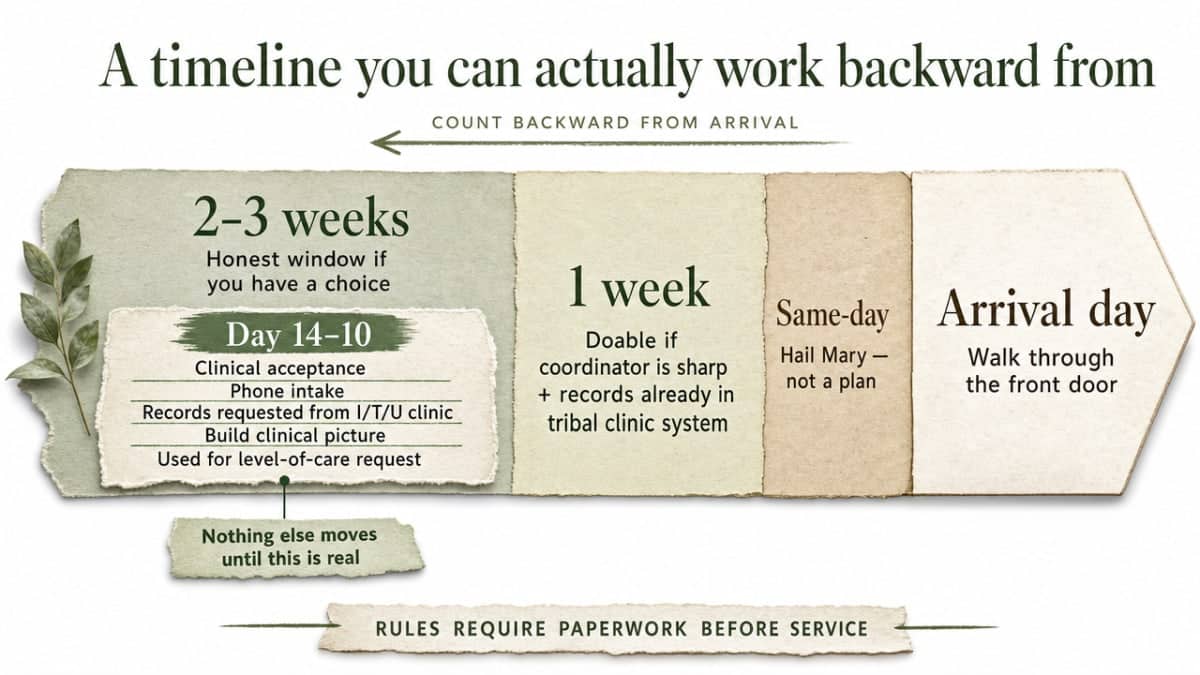
Start from the day you want to be walking through the front door. Then count backward. That is the only way this works.
Two to three weeks out is the honest window if you have a choice. One week is doable when the coordinator on the other end is sharp and your records are already in the tribal clinic’s system. Same-day is not a plan; it is a Hail Mary. Not because anyone is trying to make it hard, but because the rules that govern each approval require the paperwork to exist before the service does.
Here is what has to happen, and roughly when.
Day 14 to 10 out — clinical acceptance and records. You call Elk Ridge’s admissions team. They run a phone intake, request records from your I/T/U clinic, and start building the clinical picture that will be used for the level-of-care request. Nothing else moves until this piece is real.
Day 10 to 5 out — ASAM 3.1 prior authorization. The facility submits the clinical documentation to Mountain-Pacific Quality Health. Residential care sits at ASAM Level 3.1 and above, and Montana Medicaid requires prior authorization for 3.1, 3.2-WM, 3.3, 3.5, and 3.7 before care begins 13. Approval comes back with a specific level and a specific date range. Write both down.
Day 5 to 2 out — transportation authorization. The Transportation Center request goes in through Mountain-Pacific Quality Health, because Medicaid transportation must be approved before you travel 12. The Center verifies eligibility, confirms your appointment, confirms Medicaid covers the service, picks the closest appropriate site, and selects the least costly appropriate mode 11. The rule is not new — non-emergency transportation must be requested before services are provided 1.
Day 1 and admission day — the handoff. Someone at Elk Ridge confirms the arrival window with the ride, has your bed ready, and expects your records at the door.
If your admit date moves, three of these four pieces have to move with it. That is the seam. Ask your admissions coordinator to update the dates on the ASAM approval and the transportation authorization the same day the calendar changes — not the next morning.
The ‘closest appropriate site’ rule and what to do about it
Here is the part most people find out too late. When the Transportation Center picks your ride, one of the checks they run is which service site is closest to you 11. That rule exists for good reason — Medicaid is supposed to spend public money carefully — but it can complicate things when the residential program that fits you is not the one nearest your community.
You are allowed to have a preference. You are also allowed to name the reasons:
- continuity with a specific clinician,
- a program that integrates cultural practice,
- a bed that is actually open this week,
- a level of care the closer facility does not offer.
Those are real clinical reasons, not luxuries.
If the ride is denied to the site you chose, ask why in writing. Then ask your admissions coordinator to help you respond. Do not walk away from the plan on the first no.
The phone call: what to ask Elk Ridge’s admissions team to do for you
You do not have to know the right words. You just have to know what to hand off. Here are the five specific things to ask the admissions team to take off your plate when you call. Write them on a piece of paper before you dial if that helps.
Pull records from your tribal clinic
Start here. The clinical picture that gets built for your admission — and later for the ASAM level-of-care request — leans on what your I/T/U clinic already knows about you.
Ask the admissions team to contact your tribal clinic directly and request your records. Give them the name of the clinic, your date of birth, and your Medicaid ID if you have it in front of you. If you do not, tell them that too — they can work with what you have.
As an AI/AN Medicaid member, an I/T/U referral to an outside provider runs on its own set of rules, not the standard managed-care path 10. The admissions team knows how that works. Let them handle the fax.
Handle the ASAM 3.1 prior authorization on the clinical side
This is the piece you cannot do yourself, and you should not try. Montana Medicaid requires prior authorization for ASAM Level 3.1 and every level above it — 3.2-WM, 3.3, 3.5, and 3.7 — before residential care begins 13. The facility submits the clinical documentation. The reviewer at Mountain-Pacific Quality Health reads it and approves a specific level for a specific date range.
Ask the admissions team, out loud:“Will you handle the ASAM 3.1 prior authorization with Mountain-Pacific, and will you tell me the approved level and the approved dates when it comes back?”Both numbers matter. If your admit date moves later, the dates on the authorization have to move with it. Ask them to keep you posted the day it changes.
Coordinate the Transportation Center request and the arrival window
The transportation authorization is a separate call from the clinical one, and it has to happen before you travel 12. You or a designee can make the request — which is exactly why you can ask the admissions team to act as your designee and coordinate with the Transportation Center on your behalf.
Ask for three things specifically:
- Submit the transportation request with your admit details so the Center can verify eligibility, confirm the appointment, and select an appropriate travel mode 1.
- Give the ride an arrival window at the front door, not just a drop-off address.
- Text or call you the day before with the pickup time, the driver’s contact, and the plan if weather closes a pass.
Three details, one conversation. Write them down as they answer.
Hold the bed if travel slips by a day
Dates slip. A truck breaks down. A child gets sick. Someone you love asks for one more night. This is not failure — this is what travel from a reservation to Kalispell actually looks like, and any admissions team that has done this work knows it.
Ask directly:“If my ride is delayed by a day, what happens to the bed?”A good coordinator will tell you what they can and cannot promise, and what they will do to protect the plan — including updating the ASAM authorization dates and the transportation authorization the same day the calendar moves, not the next morning.
You are allowed to ask this before you leave. Ask it.
Ask about sober transport for your specific route
Elk Ridge lists sober transport among its services. That does not automatically mean a car from your driveway to the front door — it means it is worth asking about for your specific route.
Say the words out loud:“Can sober transport be arranged from my community, and if not, what is the closest pickup point that works?”If the answer is yes, ask who the driver is, when they will call you, and what to do if you cannot reach them. If the answer is no or partial, ask them to help you build the trip out of the pieces that are available.
If the ride falls through the day of
Ride does not show. Driver calls at 6 a.m. and says the truck will not start. Snow closes Marias Pass. Any of these is normal. None of them is the end of the plan.
Do this first: call Elk Ridge’s admissions team before you call anyone else. They are the one person on your list who can move all the other pieces at once. Tell them the ride is not happening and ask them to update the arrival window on their side while you work on a new ride.
Then call the Transportation Center at 1-800-292-7114 or 406-443-6100 12. Tell them the authorized ride fell through and ask what other approved mode is available for today. Because the Center selects the least costly appropriate travel mode from what is available 11, a different option — mileage reimbursement to a family driver, a different commercial provider — may exist.
If today truly cannot happen, ask Elk Ridge to hold the bed for tomorrow and to move the ASAM authorization dates and the transportation authorization to the new date the same afternoon. Do not wait until morning. One missed ride is a scheduling problem. Silence for twenty-four hours is how the decision cools.
You are still going. Just not today.
What to bring, what to leave, what to tell your family
Pack light. A week of clothes, comfortable shoes, toiletries without alcohol in them, your Medicaid card, a photo ID if you have one, and any current medication in its original bottle. If you have paperwork from your tribal clinic — a med list, a recent visit summary — bring it. Ask the admissions team what else they need. They will tell you plainly.
Leave the phone charger where you can find it at 5 a.m. Leave anything sharp, anything that could be mistaken for a weapon, and anything that could get someone else in trouble. If you are not sure, ask before you pack it.
Now the harder conversation. Tell one person in your family the date, the pickup time, and the number for Elk Ridge’s admissions team. One person. They do not need to fix anything. They need to know where you are so they can answer the door if the ride comes early, and so they can call the admissions team if you cannot. That is enough.
Get Support Navigating Admission And Transportation
Talk with someone who understands reservation-to-treatment logistics and can guide your next step right now.
Frequently Asked Questions
Does Montana Medicaid pay for the ride from a reservation to residential treatment?
It can, but only when you request prior approval before you travel and only when the Transportation Center confirms your eligibility, the appointment, that Medicaid covers the service, the closest appropriate site, and the least costly appropriate travel mode 11, 12. Ask your admissions coordinator to submit the request on your behalf and to reauthorize it if your admit date moves.
How far in advance should I start the admissions process?
Two to three weeks is the honest window. You need clinical acceptance, an ASAM 3.1 prior authorization through Mountain-Pacific Quality Health 13, and a separate transportation authorization that has to be approved before you travel 12. One week is doable if your tribal clinic records are current. Same-day rarely works, because each approval requires paperwork to exist before the service does.
What happens if the treatment center I want isn’t the ‘closest appropriate site’?
The Transportation Center checks the closest appropriate site as part of its review 11. “Appropriate” is not the same as “nearest” — a program that offers the level of care you need or has an open bed can qualify. Ask Elk Ridge’s admissions team to document why their program fits your clinical needs and to send that documentation with the transportation request.
Do I need a referral from my tribal clinic before Elk Ridge can admit me?
As an AI/AN Medicaid member, you generally do not need a Passport or Team Care referral for I/T/U services, and when your clinic refers you to an outside provider, that referral follows its own billing and referral rules 10. You still need clinical records and a prior authorization for residential care 13. Ask admissions to request records from your clinic directly.
What if I can’t reach anyone at the Transportation Center or my phone service is unreliable?
Give Elk Ridge’s admissions team permission to act as your designee. Members or a designee can request non-emergency transportation on your behalf 1, and admissions can reach the Transportation Center at 1-800-292-7114 or 406-443-6100 for you 12. Leave one family member’s number as a backup contact so someone can be reached if your phone drops.
Can Elk Ridge hold my bed if my ride gets delayed by a day?
Ask directly when you call — bed-hold decisions depend on current census and clinical circumstances, and no one can promise this in the abstract. What a good coordinator will do is update the ASAM authorization dates and reauthorize the transportation request the same day the calendar moves 12, 13. Call admissions before you call anyone else when a ride falls through.
References
- Personal Transportation Services Manual – Medicaid Provider. https://medicaidprovider.mt.gov/manuals/personaltransportationservicesmanual
- GAO-24-106847, NONEMERGENCY MEDICAL TRANSPORTATION: Leading Practices Would Help the Federal Transit Administration Evaluate Its Pilot Program. https://www.gao.gov/assets/gao-24-106847.pdf
- GAO-15-110, TRANSPORTATION DISADVANTAGED POPULATIONS: Nonemergency Medical Transportation Not Well Coordinated, and Additional Federal Leadership Needed. https://www.gao.gov/assets/gao-15-110.pdf
- BHSFG Commission Report. https://dphhs.mt.gov/assets/FutureGenerations/BHSFGCommissionReport-05-20-2024.pdf
- Challenges to providing quality substance abuse treatment services for American Indian and Alaska native communities: perspectives of staff from 18 treatment centers. https://pmc.ncbi.nlm.nih.gov/articles/PMC4080609/
- Achieving Health Equity Around Overdoses. https://www.cdc.gov/overdose-prevention/health-equity/achieving-health-equity-around-overdoses.html
- Drug Overdose Deaths Rise, Disparities Widen. https://www.cdc.gov/vitalsigns/overdose-death-disparities/index.html
- Health Disparities Among American Indians/Alaska Natives. https://www.cdc.gov/mmwr/volumes/67/wr/mm6747a4.htm
- Indian Health Service – Medicaid Provider – Montana.gov. https://medicaidprovider.mt.gov/manuals/indianhealthservicetribal638
- passporttohealthmanual. https://medicaidprovider.mt.gov/manuals/passporttohealthmanual
- Commercial and Specialized Non-Emergency Transportation Services Manual. https://medicaidprovider.mt.gov/manuals/commercialandspecializednonemergencytransportationservicesmanual
- Medicaid Transportation Services. https://dphhs.mt.gov/MontanaHealthcarePrograms/Medicaid/montanahealthcaretransportation
- Prior Authorization Required for ASAM Level 3.1 and Above. https://medicaidprovider.mt.gov/docs/providernotices/2025/PriorAuthorizationRequiredforASAMLevel3.1andAbove.pdf