Key Takeaways
- Wellbriety is a recovery-support framework from White Bison built on the Medicine Wheel’s four quadrants — emotional, mental, physical, spiritual — and sits alongside clinical care rather than replacing it.
- Medication for opioid or alcohol use disorder, detox, and behavioral therapy remain the backbone of treatment; ceremony gives that clinical work personal meaning but does not treat physical dependency 2.
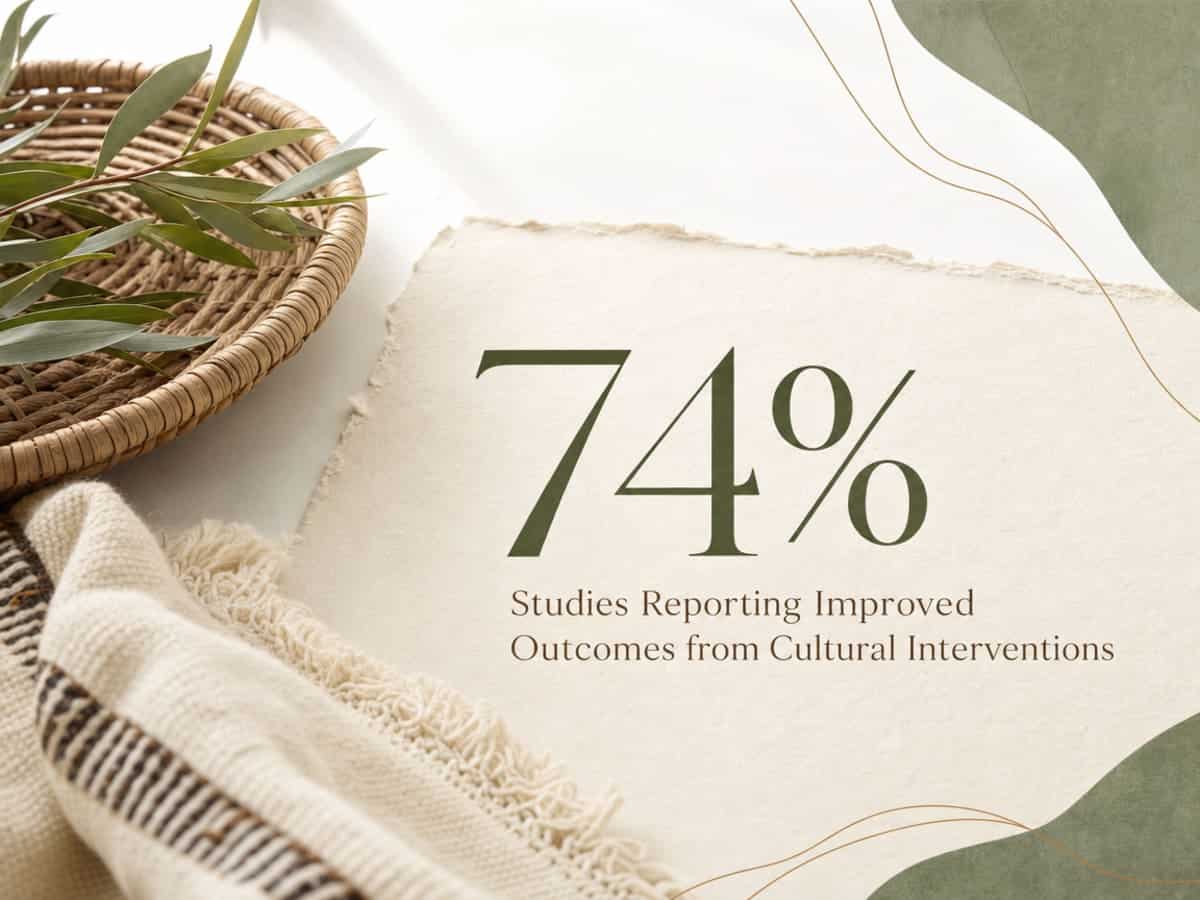
- Roughly 74% of studied Indigenous cultural interventions reported improved functioning or reduced substance use, though the evidence base is still emerging and varies too much for meta-analysis 5, 4.
- When evaluating a program, ask who runs the ceremonies, which Elders and communities are partners, and whether practices are adapted rather than transplanted — that answer reveals cultural safety 14, 10.
Why a Recovery Framework Built on the Medicine Wheel Matters Right Now
If you have already tried a program that treated your addiction like a chemistry problem and nothing else, you know what was missing. The craving got a name. The withdrawal got a medication. But the part of you that felt hollow after the substances left? That part often walked out of treatment the same way it walked in.
Wellbriety was built to answer that. It is a recovery-support framework developed by White Bison that treats sobriety as balance across four parts of you — emotional, mental, physical, and spiritual — held together by community and by your own history. It does not replace detox. It does not replace medication for opioid or alcohol use disorder. It does not replace therapy. It sits alongside them and gives them meaning.
Federal guidance points in the same direction. SAMHSA’s Treatment Improvement Protocol 61 recommends combining culturally adapted, evidence-based treatment with attention to identity, community, and traditional healing when a client wants that.1 In plain terms: the science works better when the person receiving it feels like a person.
You are reading this because something has to change, and you want to know what a program that includes smudging, Talking Circles, and Elder involvement actually looks like on a Tuesday morning in Montana. The rest of this article is that answer.
What Wellbriety Actually Is (and Where It Came From)
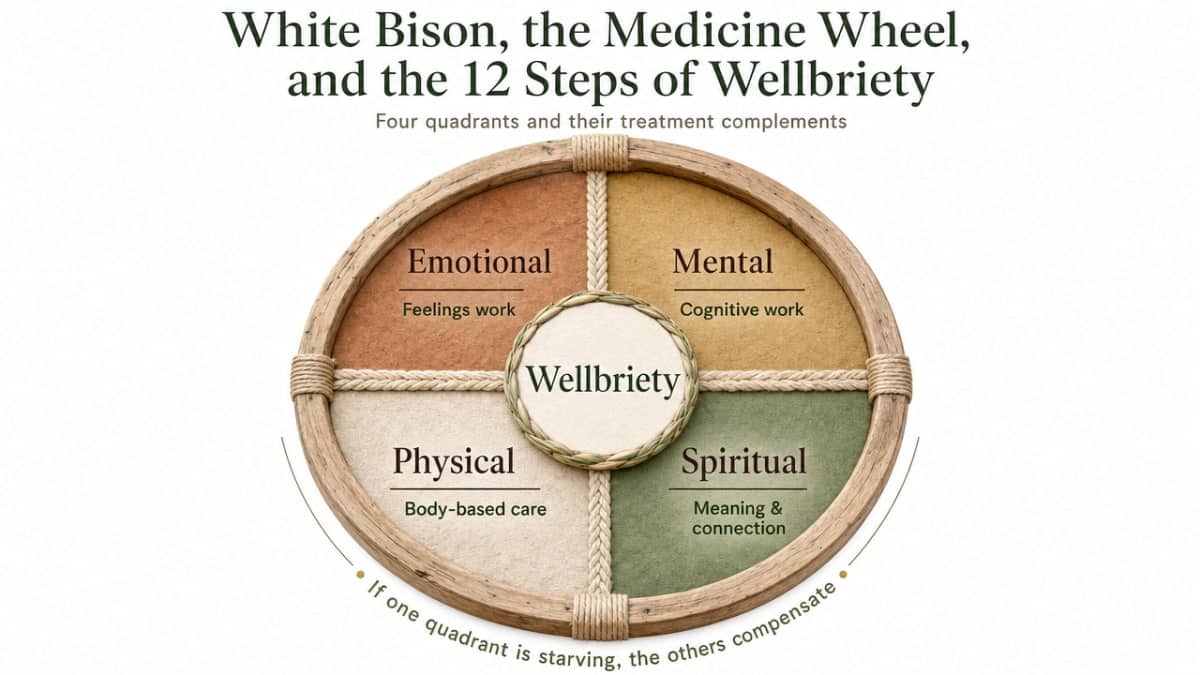
White Bison, the Medicine Wheel, and the 12 Steps of Wellbriety
Wellbriety came out of a Colorado-based nonprofit called White Bison, founded by Don Coyhis of the Mohican Nation in 1988. The word itself is deliberate: well plus sobriety. Not just staying away from the substance, but becoming well enough that you do not need it to hold your life together.
The structure rests on the Medicine Wheel, a teaching found in many (though not all) Native traditions. The wheel is divided into four quadrants — emotional, mental, physical, and spiritual — and the idea is simple to say and hard to live: if any one quadrant is starving, the others start to compensate. Addiction is one of the shapes that compensation takes.
Wellbriety also carries its own 12 Steps, adapted from the AA Twelve Steps but rewritten through a Native lens. Where AA speaks of powerlessness and a Higher Power in fairly Christian-inflected language, the Wellbriety steps speak of the Creator, the community, and the responsibilities that come with sobriety — to your family, your ancestors, and the people who will come after you. Recovery is not just a personal project. It is intergenerational.
None of this replaces clinical care. SAMHSA’s Treatment Improvement Protocol 61 is direct on this point: culturally adapted, evidence-based treatment should be combined with attention to identity, community, and traditional healing when the client wants it.1 Each quadrant of the Medicine Wheel has a clinical partner at a residential program:
- Emotional — trauma therapy
- Mental — CBT and relapse-prevention work
- Physical — medical detox and MAT
- Spiritual — Wellbriety practices
Complements, not substitutes.
You do not have to memorize the four quadrants on day one. You just have to know the map exists.
How Wellbriety Differs From 12-Step, in Plain Terms
If you have been to an AA or NA meeting, some of Wellbriety will feel familiar. Steps. Sponsorship. Sharing a story out loud in front of people who will not flinch. That bones-of-the-thing overlap is real, and it is intentional.
The differences are in what the frame is built out of.
AA leans on a linear path — admit, believe, turn over, make amends. Wellbriety leans on a circle. You return to the same four quadrants again and again because life keeps knocking one of them out of balance. There is no graduation from the Medicine Wheel.
The language changes, too. AA’s Higher Power becomes the Creator. Character defects become the parts of you that got wounded and learned to survive with a substance. The individual moral inventory sits inside a larger inventory: what happened to your family, your community, the generations before you. Historical trauma is named, not skirted around.
Sponsorship also looks different. Wellbriety often leans on Elders — people with lived recovery and community standing — rather than a one-to-one sponsor model alone. The Talking Circle replaces the round-robin share.
You do not have to choose between the two. Many people in a residential program in Montana work Wellbriety steps in the morning and sit in an AA meeting at night. Both traditions want the same thing for you. They just carry you there on different roads.
The Practices You Will Actually Encounter
Smudging With Sage, Cedar, and Sweetgrass: What It Is and Isn’t
Walking into a smudge ceremony when you have never done one can feel strange. That is okay. Nobody expects you to know what to do on the first morning.
Here is what actually happens. A facilitator — often an Elder or a trained cultural staff member — gathers a small bundle of dried plants, most commonly sage, cedar, or sweetgrass, in an abalone shell or a fireproof bowl.13 The plants are lit, then gently extinguished so they smolder rather than burn. The smoke is what matters. You may be invited to draw the smoke over your hands, your head, your chest, sometimes your feet. Or you may just sit and let the smoke pass. Both are fine.
The clinical strategies literature describes smudging as a practice that can support mindfulness, grounding, a sense of connection, and the release of negative thoughts.13 It is not a purge, a detox, or a substitute for anything happening in your medication schedule.
What smudging is not matters just as much. It is not a magic trick. It is not a New Age wellness product. It is not something a facility can hand out like a hotel amenity. Smudging is a ceremony that belongs to specific communities and is offered under specific protocols.14 When a residential program includes it, that inclusion should come through relationships with Elders and cultural teachers — not through a checklist someone printed off the internet.
If you are not sure whether you want to take part on any given morning, you do not have to. Consent is part of the practice.
Talking Circles, Drum, and Elder Involvement
A Talking Circle is exactly what it sounds like. Chairs arranged in a ring. An object — often a stone, a feather, or a small carved piece — passed from person to person. Whoever holds it speaks. Whoever does not, listens. No cross-talk. No advice. No one jumping in to fix you.
If you have sat in group therapy, you already know how hard it is to actually be heard. The circle is designed around that difficulty. The physical shape says something the words do not have to: nobody is at the head of the table, because there is no head.
The drum shows up in some circles and in standalone gatherings. A hand drum, sometimes a larger community drum with several people around it. Scoping and systematic reviews of Indigenous cultural interventions in addiction treatment describe drum circles, ceremony, and community gatherings as recurring practices that sit alongside counseling.5, 6 The beat is slow. Your breathing tends to follow it before you notice.
Elders are the connective tissue. In Wellbriety-informed programming, an Elder is not a chaplain or a life coach. Their role is to carry teachings, hold the ceremony’s protocol, and offer guidance from lived experience — often including their own recovery.9 Sitting through one Talking Circle without leaving the room is a real thing. So is asking an Elder a question you have carried for twenty years and hearing an answer that does not rush you.
One Practice, Many Nations: Why Protocols Vary
Smudging is used by many, but not all, Indigenous communities. The plants, the protocols, and the meanings vary by community.14 Sage in one nation is not sage in another. A ceremony that opens a meeting on the Blackfeet reservation is not the same ceremony that opens a meeting for a Salish or Crow or Northern Cheyenne family, even when the vocabulary overlaps. SAMHSA’s federal guidance on behavioral health for American Indian and Alaska Native clients names this directly: there is substantial diversity across Native nations, and no one set of beliefs or practices applies to all of them.1
Why does this matter for you, sitting in a Montana treatment center weighing your options? Because a facility that treats “Indigenous healing” as a single package is missing the point of the practice it says it is offering. A program doing this well names its partners, defers to Elders on protocol, and tells you honestly when a practice is being adapted rather than transplanted. That honesty is a sign the ceremony is being held with care, not dressed up as a feature.
Where Wellbriety Ends and Clinical Treatment Begins
Detox, MAT, and Psychotherapy Remain the Backbone
Here is the line that has to be clear before anything else in this article makes sense: Wellbriety is not what treats the physical dependency in your body. It is not what keeps your blood pressure from spiking during alcohol withdrawal. It is not what blocks the opioid receptors that have been running your life.
Medicine does that. Doctors do that. And they do it first.
NIDA is direct about this. For opioid use disorder, medication is the first-line treatment and is usually combined with behavioral therapy or counseling.2 Buprenorphine, methadone, and naltrexone are not optional add-ons — they are the standard of care. For alcohol use disorder, medications like naltrexone and acamprosate sit alongside behavioral treatment in the same way. NIDA’s broader treatment guide names behavioral therapy, medication, case management, continuing care, monitoring, and relapse prevention as the core elements of effective addiction treatment.3
None of those elements are ceremonies. All of them are measurable.
Where Wellbriety fits is on top of that backbone, not inside of it. A Talking Circle does not lower your withdrawal severity score. A smudge does not treat your co-occurring depression. What they do is give the clinical work a reason to matter to you when the medication starts working and you have to figure out who you are going to be now.
You should walk into any program asking two separate questions: What is the medical plan? And what is the meaning plan? A good residential program has an answer to both, and can tell you which one is doing which job.
What the Evidence on Cultural Interventions Actually Shows
You deserve the numbers straight, with their edges showing.
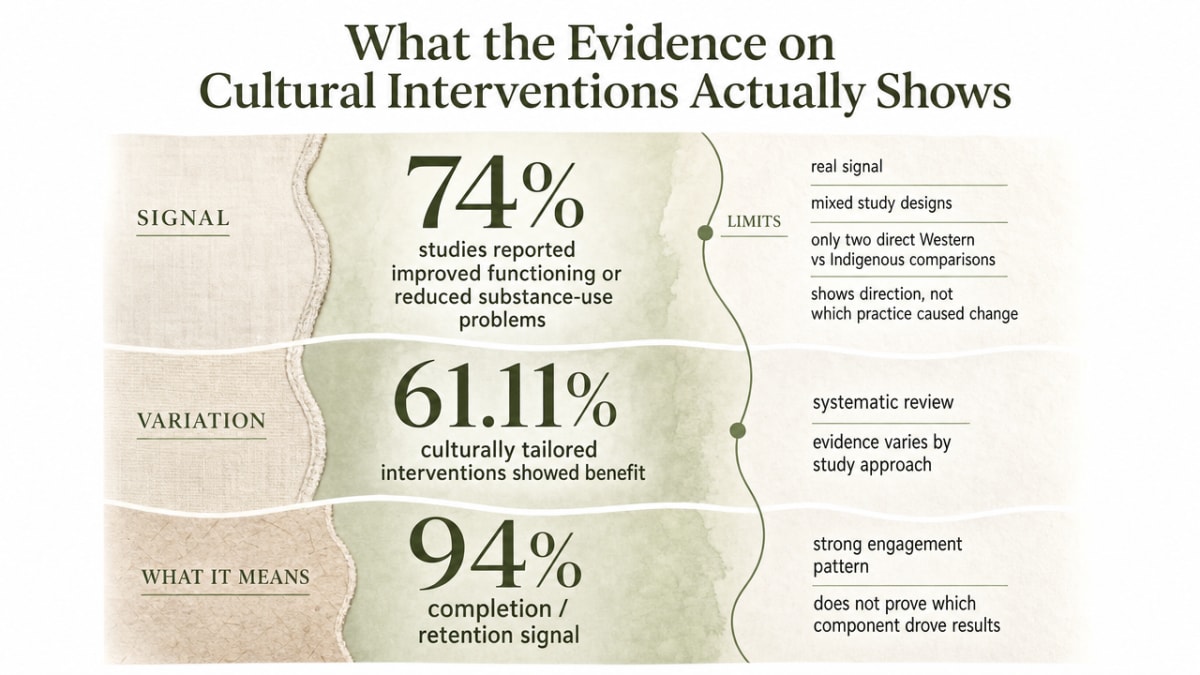
A scoping review of Indigenous cultural interventions delivered in residential and outpatient addiction-treatment settings found that roughly 74% of the included studies reported improved functioning or reduced substance-use problems after the intervention.5 That is a real signal. It is also a mixed bag of study designs — cohort studies, evaluations, pilots, cross-sectional work — with only two studies directly comparing Western and Indigenous components. So the 74% tells you that culturally grounded programs tend to move the needle in the direction you want. It does not tell you which specific practice moved it, or by how much compared with a purely clinical program.
A separate systematic review of culturally tailored substance-use interventions for Indigenous adults in North America looked at 18 programs and found that 11 of them — 61.11% — integrated practices like drum circles, sweat lodges, or ceremony into the intervention rather than delivering culture and clinical care on separate tracks.6 That figure tells you something different: when programs describe themselves as culturally tailored, most of them are actually weaving ceremony into the treatment week, not offering it as an optional side event.
The 2023 systematic review focused specifically on traditional ceremonial practices found ten studies that met inclusion criteria. All ten reported some reduction in substance use associated with the practices. The authors also said, plainly, that the literature is still emerging and too varied for meta-analysis.4
Put those three findings next to each other and the honest read is this: culturally grounded recovery support has a growing, promising evidence base, and it is not yet the same evidence base that medication for opioid use disorder or established behavioral therapies have. That is not a reason to skip Wellbriety. It is a reason to keep the medical spine of your treatment intact while you build the rest.
How Elk Ridge Recovery Layers Wellbriety on Top of Clinical Care in Montana
A Day That Includes Both a Buprenorphine Dose and a Talking Circle
A regular Tuesday at a residential program that takes both sides of this seriously does not look mystical. It looks scheduled.
You wake up in a clinical facility. If you are on medication for opioid use disorder, your buprenorphine or methadone dose is handled by nursing on the same schedule it would be at any other JCAHO-accredited program. That piece is not moved to make room for ceremony. It runs first, because it has to.2 Vitals, medication pass, breakfast.
After breakfast, you might sit in a smudge to open the day with the group. Ten or fifteen minutes. Then group therapy — CBT, relapse-prevention work, sometimes a trauma-focused session on a different day of the week. NIDA’s principles guide describes exactly this kind of stacked structure: medication, behavioral therapy, case management, monitoring, all coordinated in a single plan.3
Afternoons at Elk Ridge fold in the Wellbriety practices the pillar mentioned in passing — a Talking Circle two or three times a week, time outside on the property, family therapy or vocational work when it is scheduled. Evenings often include a 12-Step meeting for people who want one. You can work Wellbriety steps in the morning and sit in AA that night. Nobody makes you choose.
The point is not that any single hour of the day is magic. The point is that the medical spine holds, the therapy runs on time, and the ceremony gives you a reason to come back to it tomorrow.
The Operational Side: Ceremony Space, Ventilation, and Oxygen Safety
Most articles about culturally grounded treatment skip the part where somebody has to think about the smoke detector. That is where a lot of well-meaning programs quietly fall apart.
The clearest operational playbook comes from Alberta Health Services, which enacted a Patient Access to Indigenous Spiritual Ceremony policy in June 2023. Its working group concluded that smudging had minimal impact on air quality under ordinary conditions when appropriate safeguards were used.11 That finding matters because it means a residential facility does not have to choose between fire safety and ceremony. It has to plan for both.
Here is what planning looks like in practice, drawn from the Alberta policy and a qualitative study of Indigenous medicine access in hospitals:11, 12
- A designated ceremony space with adequate ventilation, or a bedside option for clients who cannot leave their room, with precautions.
- Coordination with clinical staff so smoke detectors are handled correctly — not disabled, but managed through facility protocol.
- Exclusion of oxygen-enriched areas. If a client is on supplemental oxygen for withdrawal complications, smudging happens somewhere else or is deferred.
- An Elder or trained cultural facilitator running the ceremony, not a staff member improvising.
- Patient consent every time. Participation is never assumed because a client is in the building.
Fire-safety rules in institutional settings have historically shut smudging down entirely in some hospitals.12 The workable answer is not to ignore those rules. It is to build a policy that lets ceremony happen safely, in the right room, with the right people. When you tour a facility, that is a fair thing to ask about directly.
Cultural Safety Is a System Property, Not a Checkbox
You can put sage in a bowl and still get this wrong.
Cultural safety, as defined in the equity-oriented care literature, is not about whether a facility offers a cultural activity. It is about the client’s experience and the power relationships inside the health system that surrounds them.10 A program can hold a smudge every morning and still feel unsafe if the staff outside that ceremony treat Native identity as a novelty, or if the ceremony was designed without Elders from the region actually being at the table.
For a Montana facility serving people from the Blackfeet, Salish, Kootenai, Crow, and Northern Cheyenne communities — and non-Native clients drawn to the framework — that means a few concrete things. Cultural programming is built with Elders, not imported from a manual. Protocols vary by community, and staff know when a practice is being adapted rather than transplanted.14 Non-Native clients are welcomed into the shared parts and told plainly when something is not theirs to take home.
The 2016 community-engaged pilot with a Southwest Tribe reported 94% retention at eight months after the intervention was adapted to the local community rather than delivered to it.8 Retention is not the same as cure. But it tells you that when people feel the program was built with their world in mind, they stay long enough for the medicine and the therapy to work.
Who Wellbriety-Informed Care Fits, and Who Should Ask Different Questions
Wellbriety-informed residential care tends to fit you if the clinical-only route has already let you down once, and you can name what was missing. Meaning. Community. A sense that recovery is bigger than your file number. If the words emotional, mental, physical, spiritual made you nod when you read them earlier, the framework is probably worth a serious look — whether you are Native and coming home to a tradition, or non-Native and drawn to a way of getting well that treats you as a whole person.
It also fits if you are open to sitting in a Talking Circle, taking part in a smudge when it is offered, and letting Elders have a real role in your week. You do not have to arrive believing in any of it. You just have to be willing to show up.
Ask different questions if your first need is stabilization. If you are in active opioid or alcohol withdrawal, the first call is about medical detox and whether the program starts buprenorphine, methadone, or naltrexone on day one.2 Ceremony comes after your body is safe, not instead of it.
Ask different questions, too, if you are looking for something specific a Wellbriety-informed program may not center — for example, a strictly secular CBT track, or a program built around a faith tradition other than the Creator-centered language Wellbriety uses. Both are legitimate needs. Name them out loud on the intake call.
And if you are Native and want ceremony held by teachers from your own nation, ask directly which Elders and communities a facility partners with, and whether protocols are being adapted rather than transplanted.14 That answer will tell you more than any brochure.
Speak With Someone Who Understands Your Journey
Connect right now to discuss how Wellbriety and clinical support can work for your recovery path.
Frequently Asked Questions
Is Wellbriety a replacement for medical detox or medication for opioid use disorder?
No. Wellbriety is a recovery-support framework, not a medical treatment. For opioid use disorder, medication like buprenorphine, methadone, or naltrexone is the first-line treatment and is usually combined with behavioral therapy.2 Ceremony sits on top of that clinical spine and gives it meaning. It does not lower withdrawal severity or block opioid receptors.
Do I have to be Native American to take part in Wellbriety practices at a treatment center?
No. Wellbriety welcomes non-Native clients, and many residential programs include shared practices in the daily schedule. A program doing this well will tell you plainly which parts are open to everyone and which belong to specific communities and are not yours to take home.14 You do not have to arrive believing in any of it — just be willing to sit down.
How is Wellbriety different from AA or a standard 12-Step program?
Wellbriety keeps the 12-Step structure but rewrites it through a Native lens. Higher Power becomes the Creator. Character defects become wounds that learned to survive. The individual inventory sits inside a family and community inventory, and historical trauma is named directly. Elders and Talking Circles often stand in for the one-to-one sponsor model. Many people work both traditions at once.1
What actually happens during a smudge ceremony, and is it safe indoors?
A facilitator lights a small bundle of sage, cedar, or sweetgrass in a shell or fireproof bowl, then lets it smolder.13 You may draw the smoke over yourself or just sit with it. Alberta Health Services’ 2023 policy work found smudging had minimal impact on air quality under ordinary conditions with appropriate safeguards — designated space, ventilation, and exclusion of oxygen areas.11
What should I do if I have never sat in a Talking Circle before and feel nervous?
Show up and sit down. You do not have to speak the first time. The object passes around the ring, and when it reaches you, you can hold it quietly and pass it on. Nobody will push. Sitting through one Talking Circle without leaving the room is a real thing, and most people find the second one easier than the first.
How do I know if a facility is offering Wellbriety respectfully rather than as a marketing add-on?
Ask who runs the ceremonies. A respectful program names its Elders and community partners, tells you when a practice is adapted rather than transplanted, and does not treat Indigenous healing as one uniform package.14 Ask how cultural programming was built — with local Elders at the table, or from a manual? That answer, and how directly it is given, tells you more than any brochure.10
References
- Behavioral Health Services for American Indians and Alaska Natives. https://library.samhsa.gov/sites/default/files/tip_61_aian_exec_summary_020419_0.pdf
- Treatment and Recovery. https://nida.nih.gov/publications/drugs-brains-behavior-science-addiction/treatment-recovery
- Principles of Drug Addiction Treatment: A Research-Based Guide. https://nida.nih.gov/sites/default/files/podat-3rdEd-508.pdf
- Traditional Ceremonial Practices as a Strategy to Reduce Problem Substance Use in American Indian Communities: A Systematic Review. https://pmc.ncbi.nlm.nih.gov/articles/PMC10280199/
- Cultural interventions to treat addictions in Indigenous populations: findings from a scoping study. https://pmc.ncbi.nlm.nih.gov/articles/PMC4158387/
- Culturally tailored substance use interventions for Indigenous adults in North America: a systematic review. https://pmc.ncbi.nlm.nih.gov/articles/PMC10248734/
- Pilot outcome results of culturally adapted evidence-based substance use disorder treatment with a Southwest Tribe. https://pmc.ncbi.nlm.nih.gov/articles/PMC4778727/
- Aligning Three Substance Use Disorder Interventions among a Tribe: A Community-Engaged Approach. https://pmc.ncbi.nlm.nih.gov/articles/PMC8095342/
- Blending Aboriginal and Western healing methods to treat Aboriginal people with substance use disorders. https://pmc.ncbi.nlm.nih.gov/articles/PMC4445297/
- Enhancing health care equity with Indigenous populations. https://pmc.ncbi.nlm.nih.gov/articles/PMC5050637/
- Smudging the barriers away: crafting the Patient Access to Spiritual Ceremony policy. https://pmc.ncbi.nlm.nih.gov/articles/PMC12636535/
- Improving access to Indigenous medicine for patients in hospital: a qualitative study. https://pmc.ncbi.nlm.nih.gov/articles/PMC6507818/
- Clinical Strategies to Develop Connections, Promote Health, and Prevent Suicide among Indigenous Peoples. https://pmc.ncbi.nlm.nih.gov/articles/PMC9137308/
- 3. Results. https://pmc.ncbi.nlm.nih.gov/articles/PMC10606678/