Key Takeaways
- Addiction treatment records receive stronger federal privacy protection than most medical records through 42 CFR Part 2, which generally blocks disclosure without written consent or a qualifying court order 1.
- Employers, spouses, parents, licensing boards, police, and immigration authorities cannot confirm you are a patient or access your records without your written consent or a qualifying court order 1.
- The 2024 final rule simplified consent forms, aligned breach notification with HIPAA, and gave the HHS Office for Civil Rights civil enforcement authority over Part 2 violations 2.
- Narrow exceptions exist for medical emergencies, qualifying court orders, mandated child abuse reporting, audits, qualified research, and crimes on program premises, but everyday inquiries still require your consent 16.
The Fear That Keeps People From Making the Call
You’ve probably rehearsed the phone call in your head more times than you can count. You picture dialing the number. Then you picture your boss finding out. Your kids’ school. Your ex-spouse’s attorney. The licensing board. The neighbor who somehow knows everything. And so you put the phone down again.
That fear is not paranoia. It’s the reason a lot of people wait years to ask for help, even when the drinking or the pills or the powder has already cost them sleep, money, relationships, and self-respect. If you’re reading this at 2 a.m. with a browser window you plan to close before anyone sees it, you are not alone in that habit either.
Here is what you deserve to know before you decide anything: addiction treatment records get stronger federal privacy protection than almost any other kind of medical record in the United States. A specific rule called 42 CFR Part 2 was written for exactly this fear 1. It doesn’t make confidentiality absolute. Nothing in medicine is. But it comes closer than most people realize, and the details matter.
The Specific Law That Protects You: 42 CFR Part 2
Most people have heard of HIPAA. Far fewer have heard of the rule that sits on top of it when addiction is involved. It’s called 42 CFR Part 2, and it exists because Congress decided decades ago that being identified as someone who has, or ever had, a substance use disorder carries a different kind of risk than being identified as someone with high blood pressure 17.
Here is the short version. Part 2 applies to federally assisted programs that hold themselves out as providing substance use disorder diagnosis, treatment, or referral. It covers your intake paperwork, your diagnosis, your treatment notes, and anything else that would identify you as a person receiving SUD care 4. If a facility is a Part 2 program, it generally cannot share those records without your written consent or a qualifying court order. There are a few narrow exceptions, and we’ll get to those honestly in a later section 1.
HIPAA also protects your health information, but it works differently. HIPAA lets providers share records for treatment, payment, and health care operations without asking you first. Part 2 does not. Where both rules apply, the treatment center has to follow both, and the stricter one wins. HHS states this plainly: Part 2 generally provides more stringent privacy protections than HIPAA, and providers subject to both must comply with both sets of requirements 5.
What does that mean for you in practice? A hospital emergency room can share your broken-ankle records with a follow-up orthopedist under HIPAA alone. A Part 2 program cannot share your addiction records with an outside provider the same way. Your written consent, or a specific legal order, is the door. Nobody walks through it without one.
Part 2 also limits what happens after records leave the facility. Whoever receives them gets a notice that restricts what they can do with them next, so information doesn’t quietly travel from one office to another without your knowledge 1. That redisclosure limit is one of the biggest gaps between plain HIPAA and the addiction-specific rule, and it’s a big reason the law exists in the first place.
What Changed in 2024 (and Why the February 2026 Date Matters)
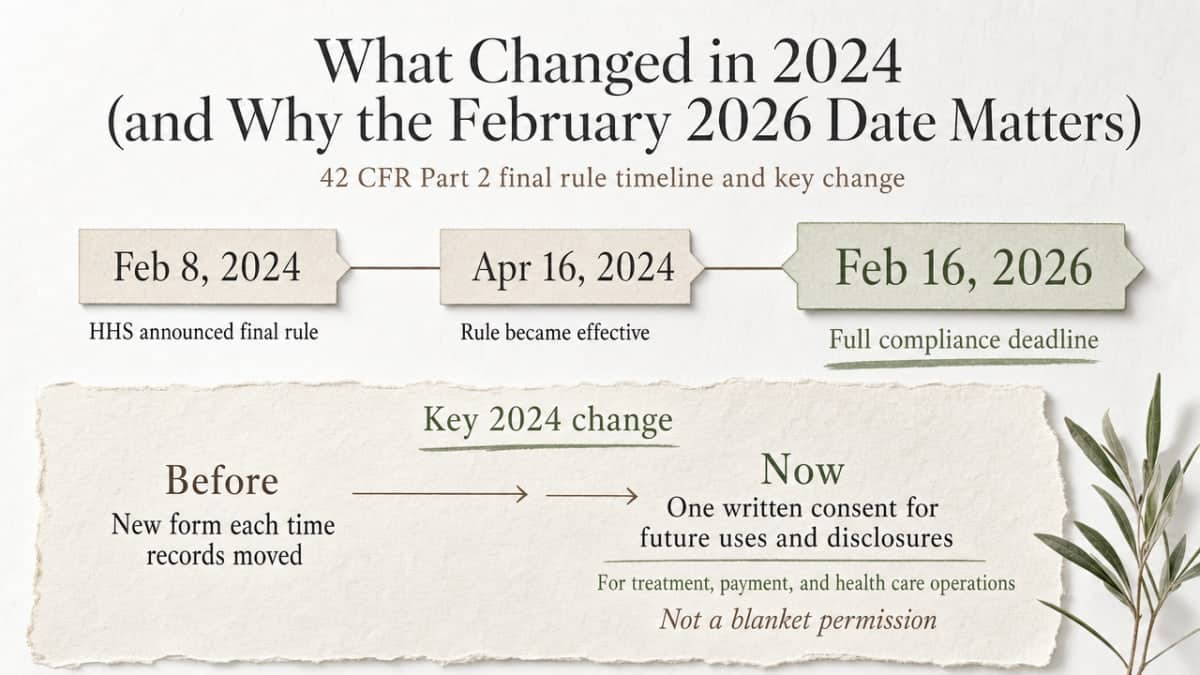
If you searched this topic a few years ago, you probably read something that felt half-true. That’s because the rules just got rewritten. On February 8, 2024, HHS announced a final rule updating 42 CFR Part 2 to implement the confidentiality provisions of the CARES Act. The rule became effective on April 16, 2024, and treatment programs had until February 16, 2026 to fully comply 2.
Three changes matter most for someone weighing that first phone call.
First, the consent form got simpler in one specific way. You can now sign a single written consent covering future uses and disclosures for treatment, payment, and health care operations, rather than signing a new form every time your records need to move between providers who are helping coordinate your care 2. That does not mean your consent becomes a blanket permission slip forever. You can still revoke it, and Part 2’s core rule stays intact: without your written consent or a qualifying court order, your addiction records generally do not leave the program 1.
Second, the rule aligned Part 2’s breach notification requirements with HIPAA’s. If something goes wrong and your records are accessed without permission, the program has to tell you 2.
Third, and this is the part that changes the enforcement landscape: the HHS Office for Civil Rights now has civil enforcement authority for Part 2 violations. The 2024 final rule gave OCR the same kind of teeth for addiction records that it has long had for HIPAA violations 2. HHS formally announced the civil enforcement program to strengthen confidentiality protections and align Part 2 with HIPAA’s privacy and breach-notification rules 13.
Why does the February 2026 compliance date matter to you specifically? Because any facility you call today is expected to be operating under the updated rule, with updated consent forms, updated breach procedures, updated patient notices, and a federal enforcement agency actively watching. When you ask an admissions specialist how your information will be handled, that answer should sound current, not vague.
Who Can Actually Find Out You’re in Treatment
Your Employer, Spouse, Parents, and Community
This is the question underneath all the other questions. So let’s take it directly.
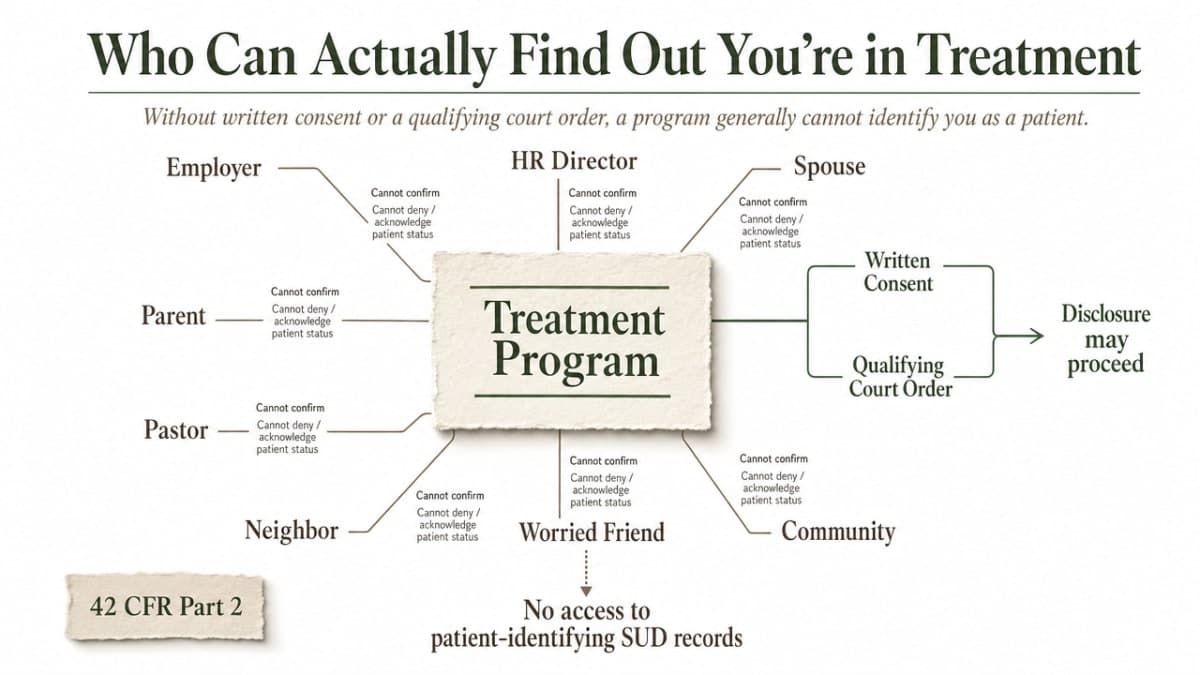
Your employer cannot call a treatment center and get confirmation that you are a patient there. Under 42 CFR Part 2, a program generally cannot disclose any information that would identify you as someone who has or has had a substance use disorder without your written consent or a qualifying court order 1. If your HR director calls the front desk and asks whether you’re checked in, staff cannot say yes. They also cannot say no in a way that confirms you by process of elimination. The program is not allowed to acknowledge that you exist as a patient.
Your spouse is in the same position. So is your adult child, your parent, your pastor, your neighbor, and the friend who is genuinely worried about you. None of them can call and be told you’re there. If you want your husband to be able to check in on your progress, or your sister to sit in a family session, you sign a specific written consent naming that person and what information they can receive. You control that form. You can also revoke it.
Parents of an adult patient do not have automatic access either. Being the person paying the bill, being listed as an emergency contact, or being biologically related does not create a right to your records. The consent has to come from you.
Insurers, Licensing Boards, and Courts
Insurance is where the picture gets more practical. If you use your health insurance to pay for treatment, your insurer will receive the minimum information needed to process the claim. That’s how billing works in every corner of medicine. Under the 2024 final rule, a single written consent can now cover future uses and disclosures for treatment, payment, and health care operations, which is what allows the program and the insurer to communicate about your care without you signing a fresh form every week 2. What your insurer does with that information after receiving it is limited: Part 2 attaches redisclosure restrictions to records that leave the program 1.
Your insurer does not, as a matter of course, tell your employer that you filed an SUD claim. They also do not call your spouse. The Explanation of Benefits document, however, is a real consideration if you’re on a family plan where the policyholder is someone other than you. That’s a conversation worth having with admissions before you decide how to pay.
Licensing boards — nursing, medical, legal, commercial driving — cannot pull your treatment records directly from a Part 2 program. They need your written consent or a qualifying court order, same as anyone else 1. Many professionals with monitoring agreements sign consents voluntarily because the alternative is worse. That’s your decision, not the program’s.
Courts do not get automatic access either. A subpoena alone is not enough for Part 2 records; the court has to issue an order that meets specific findings 4.
Law Enforcement, Immigration, and Legal Proceedings
Police cannot walk into a treatment facility, ask the front desk if you’re a patient, and get an answer. Part 2 was written, in part, because Congress and clinicians were worried about exactly this — that people would avoid treatment if their records could quietly move to police and other authorities 17. That concern is still baked into the rule. A federally assisted SUD program generally cannot confirm your presence or disclose your records to law enforcement without your written consent or a court order that meets Part 2’s specific requirements 1.
Immigration authorities, including ICE, sit under the same restriction. A Part 2 program cannot hand over records identifying you as an SUD patient without your consent or a qualifying court order 1. The consent form you sign at intake does not include a checkbox that quietly authorizes immigration disclosure.
Legal proceedings — a custody dispute, a criminal case, a civil lawsuit — cannot use your Part 2 records against you without either your consent or a court order that meets Part 2’s specific findings. A regular subpoena, even one signed by a judge, does not automatically clear that bar 4. This is one of the sharpest differences between addiction records and other medical records, and it exists on purpose.
None of this means the exceptions don’t exist. They do, and the next section names them honestly.
The Narrow Exceptions Nobody Wants to Talk About
Confidentiality is strong. It is not absolute. Pretending otherwise would be a disservice, and the exceptions are worth naming plainly so you know exactly what you’re deciding.
Medical emergency. If you are unconscious, seizing, or otherwise unable to consent during a bona fide medical emergency, information can be shared with the medical personnel responding to that emergency. HHS’s model patient notice states this directly 7. The disclosure is limited to what those responders need to keep you alive. It is not a general permission to update your family or your employer.
A qualifying court order. A regular subpoena is not enough. A court has to issue an order that meets Part 2’s specific findings before your records can be produced or used against you in a proceeding 4. That higher bar is one of the sharpest differences between addiction records and other medical records.
Mandated child abuse or neglect reporting. Part 2 does not shield a clinician from state laws requiring reports of suspected child abuse or neglect 16. If, in the course of treatment, information surfaces that triggers a mandatory report, that report is made.
Audits and evaluations. Auditors, accreditors, and payers may review records under defined conditions to verify that the program is operating properly. These reviews are structured so that the information stays inside the audit process rather than leaking into the wider world 16.
Qualified research. Researchers can access Part 2 records only under strict conditions designed to protect your identity 16. You are not being enrolled in a study by walking through the door.
A crime on program premises or against program staff. If a crime is committed at the facility or against a staff member, limited information can be shared with law enforcement about that specific incident 16. This is a narrow exception tied to the event itself, not a back door into your treatment history.
Overdose and Family Notification: A Careful Carve-Out
Overdose situations sit in one of the trickiest corners of the whole confidentiality picture, and it’s worth being honest about how it actually works.
Under HIPAA alone, a provider treating someone who has overdosed may share necessary information with family, close friends, or caregivers when the patient agrees, is incapacitated and the disclosure is in their best interest, or when there is a serious and imminent threat that others could help prevent or lessen 11. That is the rule most emergency-room physicians operate under.
Part 2 is stricter. HHS specifically warns that HIPAA’s permission to disclose does not automatically authorize sharing records protected by Part 2, and that a Part 2 program may face tighter requirements even in the same emergency 10. What Part 2 does allow is disclosure during a bona fide medical emergency to the medical personnel responding to it, even when you cannot consent 7. That’s the carve-out. It is designed to keep you alive, not to update your family on your treatment.
The practical result: if you overdose and paramedics need clinical information to treat you, that information can move. Notifying your spouse that you are a patient is a separate decision that generally still requires your consent.
How Records Are Handled Inside the Facility
Confidentiality isn’t only about who calls asking. It’s also about who inside the building can open your chart.
Under HIPAA, providers are required to reasonably limit access and disclosures for payment and health care operations to the minimum necessary, and to use role-based access so that staff see only what their job requires 9. In practice, that means the intake nurse, your primary therapist, the physician managing your detox medications, the case manager coordinating your discharge, and the billing specialist processing your claim each see a different slice of your record. The kitchen staff, the maintenance team, and the therapist working with a different patient down the hall do not open your chart at all.
Part 2 layers on top of this. Because the records identifying you as an SUD patient are covered by both rule sets where they apply, the program has to comply with both, and the stricter one governs any given decision 5. If someone accesses your information without authorization, the 2024 final rule requires the program to notify you, aligning Part 2’s breach obligations with HIPAA’s 2. You will hear about it, not read about it later by accident.
What Patients Actually Fear: Stigma More Than Leaks
Here is something worth sitting with before you decide anything. A 2025 qualitative study published in a peer-reviewed journal asked people in SUD treatment what actually worried them about their records being shared. The privacy protections themselves were not the main deterrent. Stigma was. Participants generally viewed appropriate information sharing with health professionals as helpful, but several women described being treated differently by clinicians after their substance-use history became known 14.
A second 2025 study, this one focused on how patients weigh privacy, trust, and equity, found that willingness to share SUD information depended heavily on who was receiving it and why. Patients were more comfortable with sharing tied to direct treatment than with sharing for administrative or research purposes, and stigma was significantly linked to greater sensitivity about SUD information reaching providers outside their primary facility 15.
Both studies are qualitative or survey-based and reflect the people who participated, not every patient everywhere. Still, the pattern points somewhere useful. The fear that keeps you awake may not be about a document leaking. It may be about how someone will look at you across a desk once they know. That is a real fear, and it deserves a real answer from whoever you call. Ask how staff are trained. Ask how they talk about patients. The law protects the record. The people on the other end of the phone are what shape the rest.
What the First Call to Elk Ridge Recovery Looks Like
Picking up the phone is the hardest part. Here is what actually happens after you do.
When you call Elk Ridge Recovery, an admissions specialist answers. They do not need your legal name to talk with you. You can start the conversation with a first name, a nickname, or nothing at all, and ask whatever you need to ask. The call itself is not a medical record. Nothing about you enters a Part 2 record until you decide to move toward admission and share identifying information.
Once you are ready, the specialist asks the clinical questions needed to figure out whether medical detox, residential care, PHP, or IOP fits your situation. They ask about substances, amounts, medical history, mental health, and any medications you take. They ask about insurance if you plan to use it. What they do not do is call your employer, your spouse, or anyone else to verify what you say. Those calls only happen if you sign a written consent naming that person and what may be shared 1.
You control the consent form. You decide whether your partner can call for updates, whether a family session is on the table, and whether your outside physician gets a discharge summary. You can revoke any of it later. If someone tries to reach you at the facility without being on your consent, staff cannot confirm you are there 1.
Montana adds a quieter layer. The physical distance from your daily life — the drive, the mountains, a phone that does not ring with your usual name on the screen — is not a legal protection. It is a practical one. Ask admissions what they can and cannot say if a specific person calls looking for you. A clear answer is a good sign.
If You Believe Your Privacy Was Violated
You have a route, and it is not complicated. If you believe a Part 2 program or a HIPAA covered entity shared your information without your consent or outside the narrow exceptions, you can file a written complaint with the HHS Office for Civil Rights. The complaint needs to name the entity involved and describe what you think happened. OCR generally expects the complaint within 180 days of when you knew or should have known about the disclosure, though OCR may extend that deadline for good cause 12.
The teeth behind that process are newer than they sound. The 2024 final rule gave HHS civil enforcement authority for Part 2 violations, and OCR has formally launched a civil-enforcement program specifically for addiction records 13. That is a real change from the past, when Part 2 violations often had no clear enforcement path.
Write down what you can remember: dates, who said what, who received the information, how you learned about it. Keep a copy of any document that shows the disclosure. You do not need a lawyer to file, though you can bring one if you want.
Speak Privately With an Admissions Specialist Now
Get confidential answers about your treatment options in a safe, judgment-free conversation.
Frequently Asked Questions
Can my employer find out I’m in addiction treatment?
Not without your written consent. If your employer calls a Part 2 program asking whether you are a patient, staff cannot confirm or deny that you exist there. They cannot share your diagnosis, your schedule, or your treatment plan. The program needs your written consent naming your employer as an authorized recipient, or a qualifying court order, before any of that information moves 1.
Will my insurance company tell my family or employer that I used my benefits for rehab?
Your insurer receives claim information to process payment, and Part 2 attaches redisclosure limits to what leaves the program 1. Insurers do not routinely notify employers about SUD claims. The real concern is the Explanation of Benefits on a shared family plan, where the policyholder may see procedure descriptions. Ask admissions about billing options before you decide how to pay, especially if you are not the policyholder 2.
Can a court order my treatment records to be released?
Only under specific conditions. A regular subpoena is not enough for Part 2 records. A court has to issue an order that meets Part 2’s particular findings before your records can be produced or used against you in a proceeding 4. That higher bar exists on purpose. Your attorney can challenge a request that does not meet the standard, and the program itself is generally required to resist non-qualifying demands 1.
If I call a treatment center just to ask questions, is that call confidential?
Yes. You can call with a first name, a nickname, or no name at all, and ask whatever you need to ask. Nothing enters a Part 2 record until you share identifying information and move toward admission. Once you do become a patient, the program generally cannot disclose that fact without your written consent or a qualifying court order 1. Ask the admissions specialist what they can and cannot confirm.
Can my treatment records be used against me in a custody case or criminal case?
Not without your consent or a court order that meets Part 2’s specific findings 4. A judge’s regular signature on a subpoena does not clear that bar. This protection is one of the sharpest differences between addiction records and other medical records, and it applies in family court, criminal court, and civil litigation. Tell your attorney early that your records are Part 2 protected so they can respond to any request correctly 1.
What can I do if I think my confidentiality was violated?
File a written complaint with the HHS Office for Civil Rights. Name the program or entity, describe what happened, and file generally within 180 days of when you knew or should have known about the disclosure; OCR may extend that deadline for good cause 12. The 2024 final rule gave OCR civil enforcement authority for Part 2 violations, and a formal enforcement program is now in place 13. You do not need a lawyer to file.
References
- Understanding Confidentiality of Substance Use Disorder (SUD) Patient Records. https://www.hhs.gov/hipaa/part-2/index.html
- Fact Sheet 42 CFR Part 2 Final Rule. https://www.hhs.gov/hipaa/for-professionals/regulatory-initiatives/fact-sheet-42-cfr-part-2-final-rule/index.html
- 89 FR 12472 – Confidentiality of Substance Use Disorder (SUD) Patient Records. https://www.govinfo.gov/app/details/FR-2024-02-16/2024-02544
- 42 CFR § 2.12 – Applicability. https://www.law.cornell.edu/cfr/text/42/2.12
- Additional FAQs on Sharing Information Related to Treatment for Mental Health or Substance Use Disorder. https://www.hhs.gov/sites/default/files/new-faqs-on-sharing-information.pdf
- Model Notices of Privacy Practices. https://www.hhs.gov/hipaa/for-professionals/privacy/guidance/model-notices-privacy-practices/index.html
- Model Part 2 Patient Notice. https://www.hhs.gov/hipaa/for-professionals/privacy/guidance/privacy-practices-part-2/index.html
- Summary of the HIPAA Privacy Rule. https://www.hhs.gov/hipaa/for-professionals/privacy/laws-regulations/index.html
- Uses and Disclosures for Treatment, Payment, and Health Care Operations. https://www.hhs.gov/hipaa/for-professionals/privacy/guidance/disclosures-treatment-payment-health-care-operations/index.html
- HIPAA Privacy Rule and Sharing Information Related to Mental Health. https://www.hhs.gov/sites/default/files/hipaa-privacy-rule-and-sharing-info-related-to-mental-health.pdf
- When does HIPAA allow a doctor to notify an individual’s family, friends, or caregivers if the patient has overdosed?. https://www.hhs.gov/hipaa/for-professionals/faq/when-does-hipaa-allow-doctor-notify-individuals-family-friends-caregivers-patient-has-overdosed/index.html
- How to File a Health Information Privacy or Security Complaint. https://www.hhs.gov/hipaa/filing-a-complaint/complaint-process/index.html
- Office for Civil Rights Announces Civil Enforcement Program for 42 CFR Part 2. https://www.hhs.gov/press-room/hhs-announce-civil-enforcement-program-sud-patient-records.html
- Privacy, Care-seeking, and Stigma: A Qualitative Investigation of Patient Perspectives on Sharing Substance Use Disorder Treatment Records. https://pubmed.ncbi.nlm.nih.gov/39976343/
- Balancing Privacy, Trust, and Equity: Patient Perspectives on Substance Use Disorder Data Sharing. https://pubmed.ncbi.nlm.nih.gov/40283841/
- Privacy protection for patients with substance use problems. https://pmc.ncbi.nlm.nih.gov/articles/PMC3846317/
- Interpretation and Integration of the Federal Substance Use Privacy Regulation. https://pmc.ncbi.nlm.nih.gov/articles/PMC6310476/
- Health Information Privacy and Health Information Technology in the United States: A Review. https://pmc.ncbi.nlm.nih.gov/articles/PMC3987588/