Key Takeaways
- Tolerance and withdrawal on prescribed opioids are expected biological adaptations and do not, by themselves, indicate opioid use disorder, which requires meeting at least two of eleven diagnostic criteria within a year 1, 11, 18.
- Stopping abruptly is a medical event, not willpower; the FDA and CDC describe gradual tapers of roughly 5% to 25% every two to four weeks or slower, with pain care built in alongside 3, 12.
- Medications like buprenorphine, methadone, and naltrexone are legitimate clinical tools, and buprenorphine or methadone cut mortality risk roughly in half compared with no medication treatment 13, 14.
- The next practical step is one confidential call for an assessment, plus naloxone at home and person-first language that treats this as continued medical care, not a character verdict 5, 8, 15.
You Followed the Instructions. Something Still Shifted.
You did what you were told to do. The surgery went well, or the back pain finally got taken seriously, or the dentist wrote a script after the extraction. You took the pills on schedule. You didn’t double up. You didn’t crush anything. You didn’t buy anything off anyone. And somewhere along the way, the medication stopped feeling like a temporary bridge and started feeling like something your body plans its day around.
Maybe you noticed it when a refill was late and your skin went clammy by the afternoon. Maybe you noticed it when a normal dose stopped touching the pain the way it used to. Maybe you noticed it when you found yourself counting pills on a Sunday night and doing the math backward from your next appointment.
That noticing is not a character flaw. It’s information.
Here’s the part almost no one says out loud: on prescribed opioids, tolerance and withdrawal are expected physiological responses. They are not, by themselves, a diagnosis of addiction 1, 18. Your body adapted to a medication a licensed clinician gave you for a real reason. That is biology doing exactly what biology does.
What comes next is a conversation, not a verdict. The rest of this article walks you through how to tell physical dependence apart from opioid use disorder, why you should not stop cold, and what a private, individualized next step actually looks like.
Is This Actually Addiction, or Something Else?
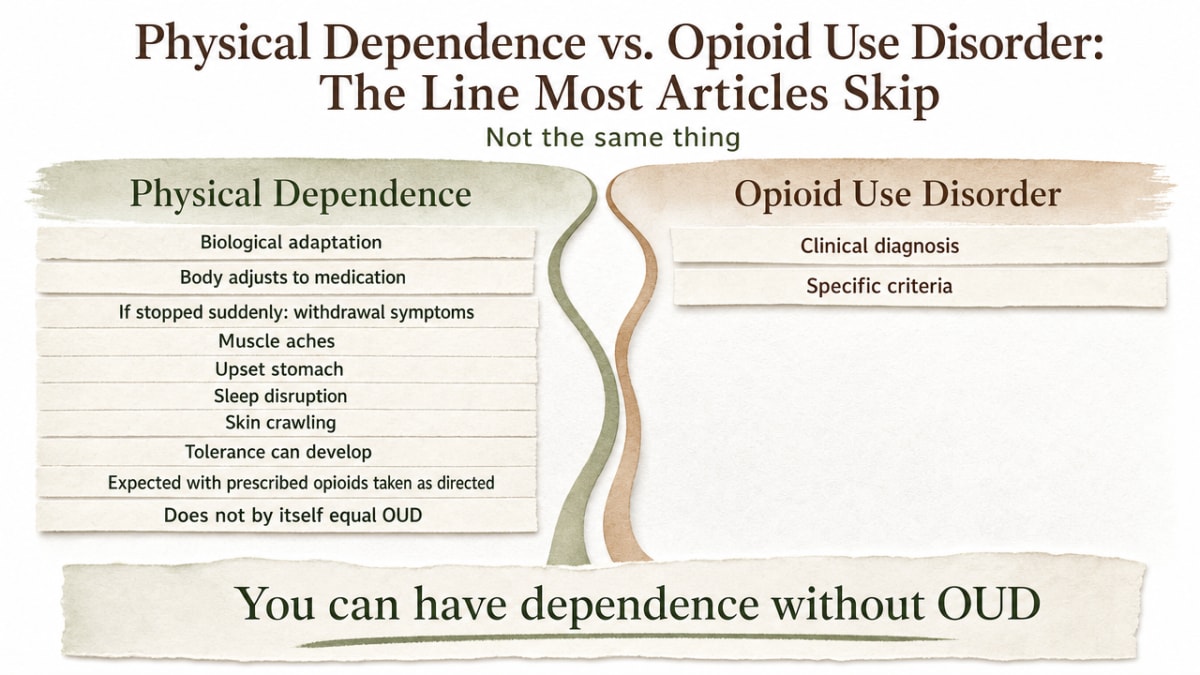
Physical Dependence vs. Opioid Use Disorder: The Line Most Articles Skip
Here’s the distinction that almost every article about opioids gets wrong, or skips entirely: physical dependence and opioid use disorder are not the same thing. One is a predictable biological adaptation. The other is a clinical diagnosis with specific criteria. You can have the first without the second. Many people do.
Physical dependence means your body has adjusted to a medication. If you stop suddenly, you feel sick. Your muscles ache, your stomach turns, your sleep falls apart, your skin crawls. Tolerance is the sibling of dependence — the dose that worked in week two doesn’t quite land the same way in month three. Both of these are expected on prescribed opioids taken as directed, and neither, on its own, counts toward a diagnosis of opioid use disorder 1, 18.
Opioid use disorder is different. The CDC guideline defines it as meeting at least two of eleven criteria within a twelve-month period 11. Those criteria include things like taking the medication in larger amounts or for longer than intended, wanting to cut down but not being able to, spending significant time obtaining or using the drug, craving, failing to meet obligations at work or home, continued use despite problems it’s causing, giving up activities you used to enjoy, using in physically hazardous situations, and continuing despite physical or psychological harm 11, 18.
So where does that leave you? Possibly in one of three places. You may be physically dependent on a medication working as intended, with no disorder present. You may be somewhere on a spectrum — mild, moderate, or severe OUD depending on how many criteria apply. Or you may be somewhere in between, where a clinician’s eyes are more useful than your own. None of these locations makes you a bad person. All of them are worth naming honestly, because the plan that helps you depends on which one you’re actually in.
An Honest Self-Check You Can Do in Five Minutes
Grab a piece of paper. Set a timer if you want. This isn’t a diagnosis — only a clinician can give you that — but it’s a way to look at your last twelve months clearly, and to bring something honest to the appointment you’re going to make 11, 18.
Go through these questions and mark yes or no:
- Have you taken more of your medication than prescribed, or taken it for longer than your doctor intended?
- Have you tried to cut back and found you couldn’t, even when you wanted to?
- Do you spend real time thinking about the next dose — planning around it, worrying about running out, calculating refills?
- Have you felt cravings that show up even when your pain is manageable?
- Has your use of the medication started to interfere with work, family, or the things you’re supposed to be doing?
- Are you continuing to take it despite problems it’s causing at home, at your job, or in your relationships?
- Have you given up activities you used to care about because of the medication or the way it makes you feel?
- Have you taken it in situations where it wasn’t safe — driving, caring for a child, operating equipment?
- Are you continuing even though it’s making a physical or emotional problem worse?
Those nine questions cover most of the eleven diagnostic criteria in plain language. Tolerance and withdrawal are the other two, and as noted above, they don’t count if you’re taking your prescription as directed 1, 18.
Two or more “yes” answers within the past year suggests a professional assessment is worth scheduling — not a panic response, not a decision to stop your medication tonight 11. It’s information. Bring the paper with you. A good clinician will thank you for showing up prepared, and the answers will help shape whatever comes next.
Why You Can’t Just Stop (And Shouldn’t Try To)
What Abrupt Discontinuation Actually Does to a Dependent Body
You may have already thought about it. Flush the bottle. Skip tomorrow’s dose. Just power through and be done.
Please don’t.
When your body has adapted to a daily opioid, cutting it off suddenly is not willpower — it’s a medical event. The FDA issued a formal safety communication after receiving reports of serious harm from patients who stopped abruptly or had their prescriptions cut off quickly, including uncontrolled pain, psychological distress, suicidal thoughts, and cases where people sought relief in unregulated ways 3. That’s the agency responsible for approving these medications telling prescribers, in writing, that abrupt discontinuation causes harm.
What you’d feel in the first 24 to 72 hours isn’t just discomfort. Your muscles ache like the flu but sharper. Your gut turns inside out. You don’t sleep. Your heart races. Your skin is wet, then cold, then wet again. And underneath all of it, the pain your medication was treating comes back louder because your nervous system has been sensitized by the medication itself.
Here’s the part that matters most: none of this makes you weak. It makes you physically dependent, which is exactly what the medication was doing to your body while it was helping you 3. The plan out of this is gradual, supported, and built with a clinician — not a weekend of white-knuckling alone.
What a Real Taper Looks Like: 5% to 25%, Not All at Once
A real taper is slower than most people expect. It’s also more forgiving than most people fear.
The FDA’s general example for physically dependent patients is a dose reduction of no more than 10% to 25% every two to four weeks, adjusted to how your body is actually responding 3. The VA/DoD chronic pain guideline describes an even gentler pace — roughly 5% to 20% every four weeks or longer — with the freedom to pause or slow down when withdrawal, pain, or emotional distress flares up 4. The CDC’s tapering resource adds another frame: if you’ve been on opioids for a year or more, cuts of about 10% per month or slower are often better tolerated than anything faster 12.
Notice what all three of those sources share. Ranges, not rules. Weeks or months, not days. Permission to pause.
A good taper builds in the rest of your life. Nonopioid pain treatment — physical therapy, targeted injections, non-opioid medications — gets stacked in as the dose comes down 12. Sleep, mental health support, and honest check-ins about withdrawal symptoms belong in the plan, not as afterthoughts. If a week is bad, the taper holds. If a week is fine, the next reduction is discussed, not assumed.
Here’s what a taper is not: a punishment for having taken the medication in the first place. It is not a test of your resolve. It’s a clinical process designed around the specific dose you’re on, how long you’ve been on it, why you started, and what your body and mind are telling you as the numbers shift.
And if the taper stalls, or the pain won’t settle, or the cravings are louder than the calendar — that’s information too. It doesn’t mean you failed the taper. It means the plan needs a different shape, and there are options for that shape 2.
What About the Pain That Started All of This?
Almost no one asks you this part. They talk about the medication, the dose, the taper — and they forget that you started taking opioids because something hurt. It probably still does.
That pain is not a footnote. It’s the whole reason you’re here, and any plan that ignores it isn’t really a plan.
Here’s what current guidelines actually say. The VA/DoD chronic pain guideline suggests that for patients on daily opioids for chronic pain, clinicians consider buprenorphine instead of a full opioid agonist, because it carries a lower risk of overdose and misuse while still treating pain 4. That’s a meaningful option, not a demotion. Buprenorphine is a medication, not a punishment, and it can hold pain while giving your nervous system room to recalibrate.
The CDC’s tapering guidance points in the same direction from another angle: as the opioid dose comes down, nonopioid pain care needs to come up. That means physical therapy, targeted procedures, non-opioid medications, sleep support, and behavioral health woven into the same treatment plan, not offered as consolation prizes after the taper is over 12.
So the honest answer to “what about my pain?” is this: it stays on the table. A good clinician plans the taper, the medication decision, and the pain treatment together — not in that order, at the same time. If someone tells you to stop the opioid and figure the pain out later, that’s not the person to build this plan with.
Medication Options That Fit a Prescription-Origin Story
Buprenorphine, Methadone, and Naltrexone in Plain Language
If someone tells you that medication for opioid use disorder is “trading one addiction for another,” they are repeating a line that the science stopped supporting a long time ago. These medications treat a medical condition. They don’t create a new one.
There are three FDA-approved options, and each one works differently 8, 14.
- Buprenorphine
- A partial opioid agonist. In plain language, it settles onto the same receptors your prescription opioid was working on, but only partially — enough to quiet withdrawal and cravings, not enough to produce the escalating effects that made your last dose feel less useful than the one before it. It can be prescribed by qualified clinicians in an office setting, which for many people who started on a prescription feels like a continuation of medical care rather than a departure from it 14, 16.
- Methadone
- A full agonist, taken daily at a specialized clinic. It has decades of evidence behind it and remains a strong option, especially for people on higher doses or with longer histories 14, 16.
- Naltrexone
- Blocks opioid receptors entirely. It’s not a substitute — it’s a shield. You have to be fully through withdrawal before starting it, which makes timing important 14.
Here is the outcome data that matters most. A meta-analysis of 36 observational studies found that patients receiving buprenorphine or methadone had approximately half the mortality risk of people with opioid use disorder who received no medication treatment 13. Roughly 50%. That is a survival difference, not a comfort difference. Any honest conversation about your options should include that number.
Why Maintenance Often Outlasts a Fast Taper
There’s a quiet expectation baked into most opioid conversations: that the goal is zero medication, as fast as safely possible, and any other outcome is somehow second best. For people whose story started with a prescription, that expectation can feel like the only respectable option.
The evidence tells a different story.
A 2024 systematic review of adults on long-term prescribed opioids compared what happens when people taper after rotating to buprenorphine versus what happens when they stay on maintenance treatment. The dropout rate for the tapering group was 91%. For the maintenance group, it was 34% 2.
Sit with those two numbers for a second. Nine out of ten people in the taper-after-rotation group did not complete the study. About one in three did not stay in the maintenance group. Neither is perfect. One is dramatically more sustainable than the other.
What that means for you is not that maintenance is required, or that tapering is doomed. It means that if your first attempt at coming off the medication entirely doesn’t hold, you are not the exception — you are closer to the rule, and the plan can shift without shame. Staying on buprenorphine or methadone for months, years, or indefinitely is a legitimate clinical choice, backed by mortality and retention data 2, 13. The finish line is your life working, not the pill bottle being empty on a specific date.

A Safety Note for You and the People You Live With
Before the plan comes together, one practical thing belongs in your home this week: naloxone.
This is not an accusation. It’s a smoke detector.
Keep naloxone somewhere visible, not tucked in a drawer. Show your spouse, your adult child, or a roommate where it is and how to use it — the nasal spray takes seconds. Pharmacists in all 50 states can dispense it without a separate prescription 6. If you’re partway through a taper, your tolerance is dropping, which actually raises overdose risk if you take your usual dose on a hard day 6. Have the conversation once. Then get back to the plan.
How to Talk About This Without the Word ‘Addict’
You’ve been reading a page about prescription opioids for a while now. That already puts you ahead of most people in your situation. Give yourself a second for that.
The word “addict” is doing damage in this conversation, and it’s damage you don’t have to accept. Stigma keeps people quiet, and quiet keeps people sick. Peer-reviewed research on treatment barriers puts shame and stigma alongside cost, wait times, and access as reasons people who need help don’t ask for it 9. A 2024 peer-recovery study measured what happens when someone is met with compassion instead of judgment — perceived stigma went down, and so did substance-related problems 10. Language changes outcomes.
NIDA’s guidance is direct: use “person with a substance use disorder,” not “addict” 15. In your kitchen, that can sound plainer. “I’ve been on this medication longer than we planned, and I want to talk to someone about a safer next step.” That sentence is true, medical, and honest. It doesn’t require you to accept a label you don’t feel fits.
With your doctor, try: “I think I’ve become physically dependent, and I’d like an assessment to understand what that means for me.” With your spouse: “I need help with the prescription, and I’d like you in the room for the appointment.” With yourself, when the shame gets loud: you took a medication a licensed clinician prescribed for a real reason. Asking for help now is the same medical care, continued.
What a First Phone Call Actually Sounds Like
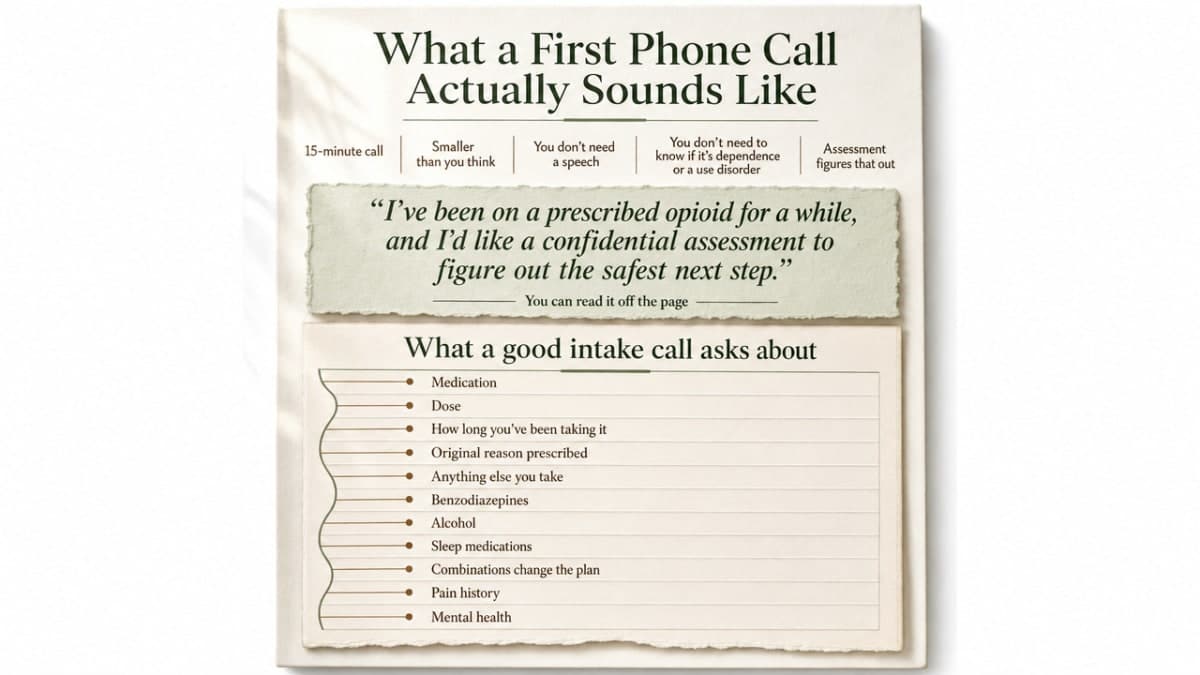
You’ve read this far. That already counts. The next thing that helps is a fifteen-minute call, and it’s smaller than you think.
You don’t need a speech. You don’t need to know whether what you have is dependence or a use disorder — that’s what the assessment is for 1. A workable opener sounds like this: “I’ve been on a prescribed opioid for a while, and I’d like a confidential assessment to figure out the safest next step.” That’s it. You can read it off the page if it helps.
Here’s what a good intake call will ask about, so nothing catches you off guard:
- What medication you’re on, the dose, how long you’ve been taking it, and what it was originally prescribed for.
- Whether you take anything else — especially benzodiazepines, alcohol, or sleep medications, because combinations change the plan 16.
- Your pain history.
- Your mental health history.
- Whether anyone at home knows you’re calling, and whether you want them involved.
What a good intake call will not do: pressure you to stop your medication that day, demand you commit to a specific level of care before an assessment, or make you feel like a case number. If any of that happens, hang up and try somewhere else.
One call. That’s the whole ask right now 8.
If Outpatient Isn’t Enough: A Montana-Based Option
Sometimes an outpatient taper, a primary care prescriber, and a good therapist are the right fit. Sometimes they aren’t. If your dose is high, if benzodiazepines or alcohol are in the mix, if a previous taper stalled, or if home is not a place where you can safely focus on this, a higher level of care exists precisely because outpatient can’t hold every situation 8, 16.
Elk Ridge Recovery is a JCAHO-accredited program in Montana that offers physician-led medical detox, residential treatment, PHP, IOP, and standard outpatient — meaning the same team can plan the taper, start medication for OUD if appropriate, address the pain that started this, and treat co-occurring anxiety or depression alongside it 8, 14. CDC guidance is clear that detoxification alone is not recommended for OUD; whatever detox happens should connect directly to ongoing care 8. That continuity is the point.
The regional footprint spans Kalispell, Missoula, Billings, Bozeman, Helena, Great Falls, Butte, Lewistown, and Libby, with clients arriving from Idaho, the Dakotas, and Wyoming. If outpatient hasn’t been enough, one confidential call can tell you whether a higher level of care fits your situation.
Talk to Someone Who Understands Prescription Struggles
Get support from people who know how prescription use can spiral and what real recovery feels like.
Frequently Asked Questions
If I took my opioid medication exactly as prescribed, does that mean I’m addicted?
Not automatically. Tolerance and withdrawal on a prescribed dose are expected physiological responses and do not, by themselves, count toward a diagnosis of opioid use disorder 1, 18. OUD requires meeting at least two of eleven specific criteria within a year, such as loss of control or continued use despite harm 11. A confidential assessment is the only way to know where you actually land.
Can I just stop taking my prescription opioid on my own?
Please don’t. The FDA issued a formal safety communication after reports of serious harm from abrupt discontinuation, including uncontrolled pain, psychological distress, and suicidal thoughts 3. A physically dependent body needs a gradual, individualized taper planned with a clinician, often reducing 10% to 25% every two to four weeks or slower 3, 12. Stopping cold turkey is a medical event, not a display of willpower.
What happens to my chronic pain if I taper or switch to a medication like buprenorphine?
Your pain stays part of the plan. The VA/DoD chronic pain guideline suggests considering buprenorphine for patients on daily opioids because it treats pain with lower overdose and misuse risk 4. CDC tapering guidance also stacks in nonopioid pain care, physical therapy, and behavioral health as the dose comes down 12. A good clinician plans the medication decision and the pain treatment together, not sequentially.
Should I have naloxone at home even though my opioids are prescribed?
Yes. CDC recommends offering naloxone to all patients prescribed opioids, with extra attention if you’re on a higher dose, take a benzodiazepine, have sleep apnea, or have overdosed before 5. Anyone who takes opioids can overdose, including people taking exactly what their doctor prescribed 6. Pharmacists in every state can dispense it without a separate prescription. Keep it visible and show someone in your home how to use it.
How do I talk to my doctor or my family about this without being labeled an addict?
Use medical language. NIDA recommends person-first terminology like “person with a substance use disorder” rather than “addict” 15. With your doctor, try: “I think I’ve become physically dependent, and I’d like an assessment to understand what that means.” Stigma keeps people quiet, and quiet keeps people sick 9. Compassionate framing measurably reduces perceived stigma and improves engagement in care 10. Asking for help is continued medical care.
When is residential treatment the right step instead of an outpatient taper?
Consider a higher level of care if your dose is high, if benzodiazepines or alcohol are also in the picture, if a previous taper stalled, or if home isn’t a safe environment to focus on this 16. CDC guidance is explicit that detoxification alone is not recommended for OUD; whatever detox happens must connect to ongoing medication treatment and therapy 8. One confidential assessment can clarify the fit.
References
- Screening and Diagnosis. https://integrationacademy.ahrq.gov/products/playbooks/moud-playbook/engage-patients/screening-and-diagnosis
- Pharmacological Strategies to Decrease Long-Term Prescription Opioid Use: A Systematic Review. https://pmc.ncbi.nlm.nih.gov/articles/PMC11728354/
- FDA identifies harm reported from sudden discontinuation of opioid pain medicines and requires label changes to guide prescribers on gradual, individualized tapering. https://www.hhs.gov/guidance/sites/default/files/hhs-guidance-documents/CMS/Opioid-Tapering-DSC-Final2019.pdf
- The Use of Opioids in the Management of Chronic Pain: VA/DoD Clinical Practice Guideline. https://www.healthquality.va.gov/guidelines/Pain/cot/VADoDOpioidsCPGProviderSummary.pdf
- When to Offer Naloxone to Patients. https://www.cdc.gov/overdose-prevention/media/pdfs/2024/07/Fact-Sheet-When-to-Offer-Naloxone-to-Patients.pdf
- Naloxone: How to Save a Life With Naloxone. https://www.cdc.gov/overdose-prevention/media/pdfs/2024/04/4Conversation-Starter_Naloxone-Family-Caregiver_FINAL_4_11_2024.pdf
- Initiating Opioid Therapy. https://www.cdc.gov/overdose-prevention/hcp/clinical-care/initiating-opioid-therapy.html
- Guideline Recommendations and Guiding Principles. https://www.cdc.gov/overdose-prevention/hcp/clinical-guidance/recommendations-and-principles.html
- Addressing Stigmas That Hinder Addiction Treatment and Recovery. https://pmc.ncbi.nlm.nih.gov/articles/PMC11571192/
- Reduction in substance use stigma following a peer-recovery intervention. https://pmc.ncbi.nlm.nih.gov/articles/PMC11347115/
- CDC Clinical Practice Guideline for Prescribing Opioids for Pain — United States, 2022. https://www.cdc.gov/mmwr/volumes/71/rr/rr7103a1.htm
- Strategies to Support Tapering. https://www.cdc.gov/overdose-prevention/hcp/training-modules/guideline/page1451766.html
- Management of opioid use disorder: 2024 update to the national clinical practice guideline. https://pmc.ncbi.nlm.nih.gov/articles/PMC11573384/
- How can prescription drug addiction be treated?. https://nida.nih.gov/publications/research-reports/misuse-prescription-drugs/how-can-prescription-drug-addiction-be-treated
- Words Matter – Terms to Use and Avoid When Talking About Addiction. https://nida.nih.gov/nidamed-medical-health-professionals/health-professions-education/words-matter-terms-to-use-avoid-when-talking-about-addiction
- TIP 63: Medications for Opioid Use Disorder. https://library.samhsa.gov/sites/default/files/pep21-02-01-003.pdf
- Montana Prescription Drug Registry Requirements and FAQ. https://boards.bsd.dli.mt.gov/_docs/pha/MPDR_Requirements_FAQ.pdf
- Opioid Use Disorder: Diagnosis. https://www.cdc.gov/overdose-prevention/hcp/clinical-care/opioid-use-disorder-diagnosis.html