Key Takeaways
- Montana Medicaid rules let eligible American Indian members reach nontribal residential rehab without a Passport referral, and Tribal 638 referrals to outside providers skip that extra layer too 2.
- IHS, Tribal 638 programs, and Purchased/Referred Care each play a defined role in coordinating admission, with PRC contacts at every Billings Area service unit handling outside-care logistics 9.
- 42 CFR Part 2 keeps substance-use records tightly controlled, and the 2024 update allows a single TPO consent to cover treatment, payment, and operations across providers 3, 4.
- The next step is one honest phone call — to a Billings Area IHS service unit, a Tribal 638 behavioral-health line, or a residential admissions team that coordinates the rest 8.
What Actually Happens After You Make the Call
You picked up the phone. That’s the hardest part, and you already did it. What comes next is not a maze — it’s a sequence, and other people carry most of the weight.
Here is the honest shape of it. Someone answers. They ask you a few questions about what you’re using, how you’re feeling right now, whether you’re safe, and where you’re calling from in Montana. That first conversation is a clinical screening, not an interrogation. If residential care is the right fit, the admissions team starts coordinating with your tribal health services — your IHS clinic, your Tribal 638 program, or your Purchased/Referred Care contact — while you rest 1.
From there, a small stack of things happens in the background: a medical screening, a records request, a consent form that puts you in charge of who sees what 5, and a Medicaid or funding check 2. Transport gets arranged. You arrive. You get oriented.
This guide walks through each piece in plain language. It is separate from the cost article and the access article in this hub — this one is about the pathway itself. What paperwork. What order. Who calls whom. What you actually have to do, and what someone else will do for you.
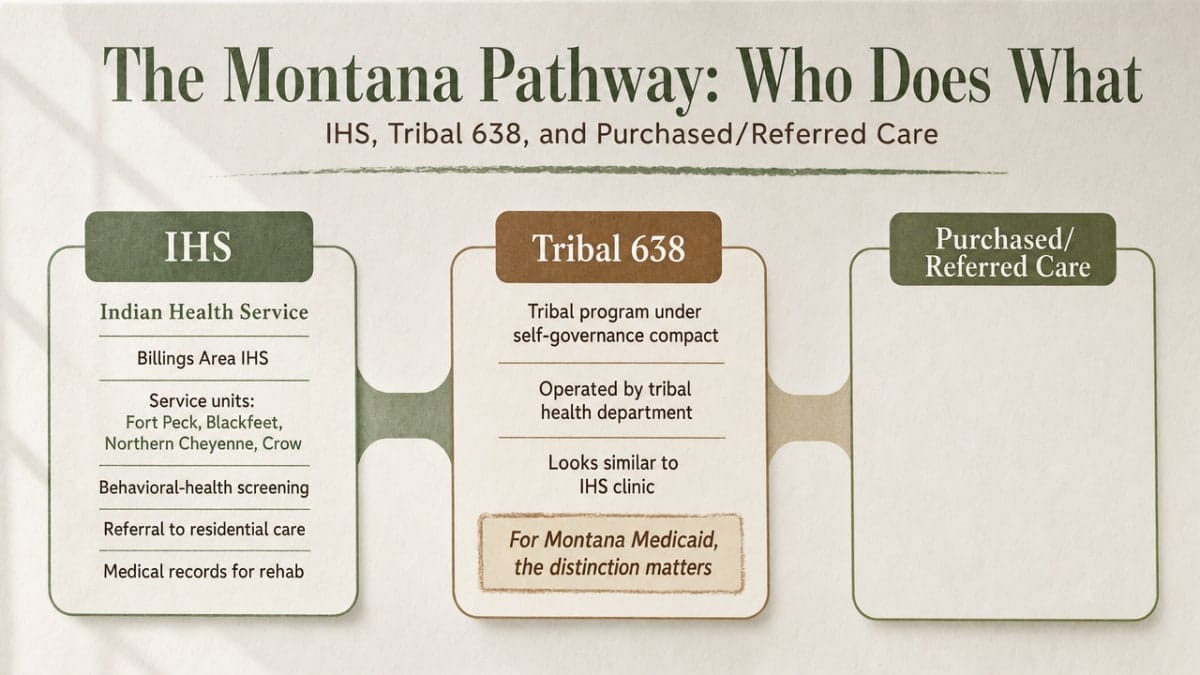
The Montana Pathway: Who Does What
IHS, Tribal 638, and Purchased/Referred Care Explained Plainly
Three names come up over and over when you start looking into treatment. They sound bureaucratic. They are not, once you see what each one actually does for you.
- IHS
- The Indian Health Service. In Montana, most tribal members touch the Billings Area IHS system through service units like Fort Peck, Blackfeet, Northern Cheyenne, or Crow 8. IHS clinics can start a behavioral-health screening, refer you out for residential care, and hold your medical records that a rehab may need to see.
- Tribal 638
- Programs your tribe runs directly under a self-governance compact with the federal government. A 638 clinic looks a lot like an IHS clinic from the outside, but it is operated by your tribal health department. For Montana Medicaid, that distinction matters — 638 facilities have their own referral rules that make it easier, not harder, to reach a nontribal rehab 2.
- Purchased/Referred Care (PRC)
- How IHS pays for services you receive outside the IHS system when the care you need is not available in-house. Every Montana service unit has a PRC contact who handles this coordination 9. If residential addiction treatment is not offered at your local clinic — and it usually isn’t — PRC is often part of how the outside stay gets paid for and authorized.
Where Elk Ridge Recovery Fits in the Coordination
You are not the person who has to chase down PRC contacts, request records from your IHS clinic, and confirm Medicaid eligibility all in the same week. That is a lot to ask of anyone, and it is more than anyone should have to carry while they are trying to get sober.
Elk Ridge Recovery’s admissions team already knows the Montana map. They know who to call at Fort Peck, at Blackfeet, at Northern Cheyenne. They know what a Tribal 638 referral looks like and what the T-HIP care coordinators need on their end 6. When you call, they start the coordination on your behalf — reaching out to your tribal health contact, requesting the medical records the residential program needs before admission 1, and lining up the consent paperwork so information can move legally between your clinic and the facility.
Your job is smaller than you think. Answer the screening questions honestly. Sign what needs signing. Pack a bag. Everything else, the admissions team is on the phone about while you rest.
How the Montana Medicaid Referral Rule Helps You
Here is a piece of good news that almost nobody explains up front: Montana Medicaid’s rules for tribal members are built to make outside referrals easier, not harder.
If you are an eligible American Indian Medicaid member, you can receive services at IHS or Tribal 638 facilities without a Passport referral. And when a Tribal 638 program refers you to a nontribal provider or specialist — including a residential addiction treatment facility off the reservation — that referral does not require a separate Passport or Team Care referral either 2. One less layer. One fewer signature to hunt down.
The takeaway is simple. The referral itself is lighter than most people expect. The paperwork most tribal members fear — the layered approvals, the multiple gatekeepers — mostly does not exist for you. What remains is a manageable set of records, one solid consent form, and a clinical decision about the right level of care 1.
Your First 72 Hours, Step by Step
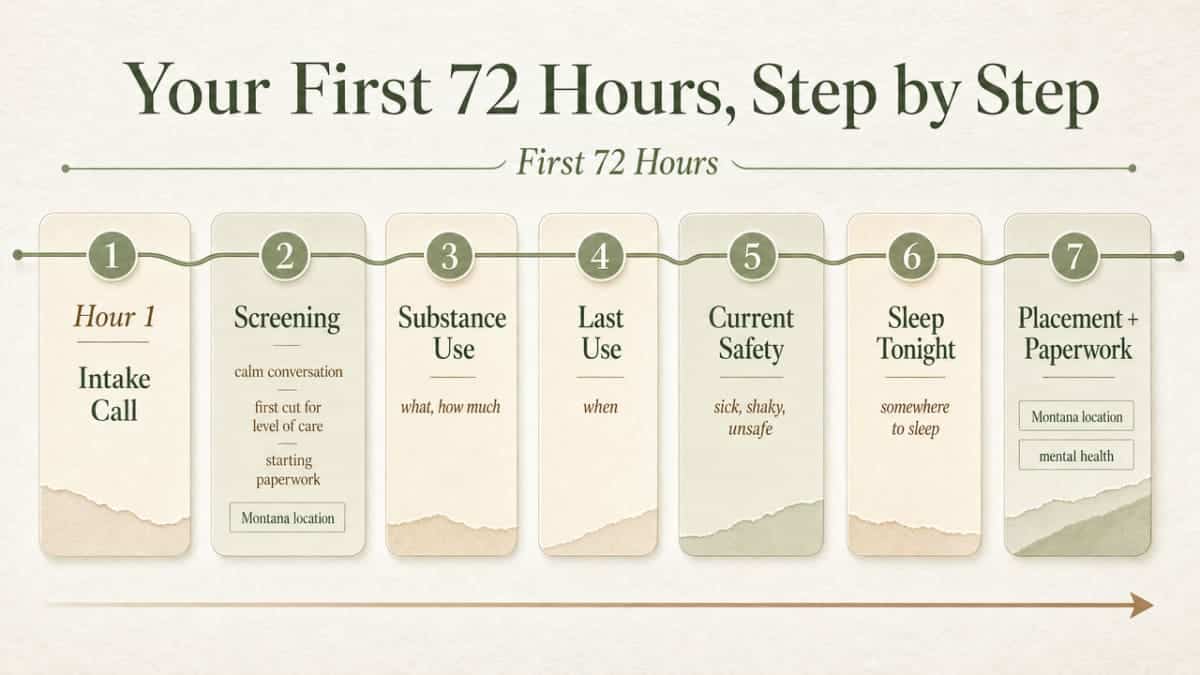
Hour 1: The Intake Call and Screening
The first hour is quieter than you might expect. No forms shoved at you. No lecture. Just a conversation with someone whose whole job is to listen carefully and figure out what you need.
The person on the other end of the line asks about a few things. What you’ve been using and how much. When you last used. Whether you’re feeling sick, shaky, or unsafe right now. Whether you have somewhere to sleep tonight. Where in Montana you’re calling from — Poplar, Browning, Lame Deer, Box Elder, Ronan, wherever. They ask about mental health too, because most people carrying an addiction are also carrying something else, and that matters for placement 10.
This screening is not the whole intake. It is the first cut — enough clinical information to decide whether residential care is the right level, and to start the paperwork on their end. IHS standards call for written eligibility and intake criteria, standardized intake forms, referral procedures, and orientation before residential admission 1. Your first call kicks off that whole sequence:
- Intake call
- Clinical screening
- Medical clearance and records request
- 42 CFR Part 2 consent
- Medicaid or PRC verification
- Transport
- Arrival and orientation
That is the shape of your next 72 hours.
You do not have to have your answers polished. Honesty is what moves this forward fastest.
Day 1-2: Medical Clearance and Records
Somewhere in the first day or two, the medical side comes together. This is the piece people sometimes worry about most, and it is usually the least dramatic part of the whole process.
Residential programs need a recent medical picture before they can admit you safely. IHS standards call for a recent medical examination, medical history, physical exam, and appropriate lab information before residential admission 1. That sounds like a lot. In practice, most of it already exists in your chart at your IHS clinic, your Tribal 638 program, or wherever you last received care. The admissions team requests those records directly from your tribal health contact once you have signed the consent that lets them do it.
If something is missing — labs are too old, a physical has not been done recently, withdrawal symptoms need a closer look — a local clinic visit or a brief medical evaluation gets scheduled. Fort Peck and other Billings Area service units have appointment contacts who help with exactly this kind of pre-admission need 9.
What you actually do during Day 1 and Day 2 is smaller than the list suggests. Rest if you can. Eat something. Answer the phone when the admissions team calls with a follow-up question. The records are moving whether you feel them moving or not.
Day 2-3: Funding Verification, Transport, and Arrival
By the second or third day, the money and the miles get sorted.
Funding verification happens between the admissions team, Montana Medicaid, and — if it applies to you — the Purchased/Referred Care contact at your service unit 9. For eligible American Indian Medicaid members, the referral piece is lighter than for most patients: a Tribal 638 referral to a nontribal provider does not require a separate Passport or Team Care referral 2. If a specific service on your plan requires prior authorization, the facility handles that submission. You do not personally fill anything out for it.
Transport gets arranged next. Montana is a big state, and the distance from your community to a residential facility in Kalispell, Missoula, or Helena is real. The admissions team coordinates the ride — sometimes through PRC, sometimes directly, sometimes with help from your tribal health department. You do not drive yourself if that is not safe or realistic.
Then you arrive. Someone meets you at the door. You get shown where you’ll sleep. You meet the person who will check on you overnight. Orientation covers program rules, your rights, what tomorrow looks like 1. You do not have to remember all of it — most of it repeats over the first week.
You made it. That is not a small thing.
Paperwork You Can Actually Understand
What Goes on a Montana Tribal Referral
The tribal referral form is smaller than the fear around it. When people picture paperwork, they picture stacks. The actual Montana form is one page of the kind of information you already know by heart.
Here is what a Montana T-HIP provider referral asks for 7:
- Your name
- Your date of birth
- Your address
- A phone number where someone can reach you
- Your Medicaid ID if you have one
- The condition or risk that brought you here
- The care goals you and the referring provider talked about
- The referring provider’s signature
That is the whole finite list.
Most of those fields your IHS or Tribal 638 clinic already has on file. The condition-and-goals piece is a short clinical summary the referring provider writes — you do not draft it yourself. The signature comes from the clinician on the tribal side who is making the referral.
What you actually gather before the first call is even smaller:
- Your tribal ID or enrollment information
- Your Medicaid card if you have one
- A phone number where the admissions team can reach you
- The name of the IHS or Tribal 638 clinic where you were last seen
That is enough to start.
42 CFR Part 2: You Control Who Sees What
The name sounds cold. What it actually does for you is warm. 42 CFR Part 2 is the federal rule that protects substance-use records more tightly than almost any other health information you have. It exists because Congress decided a long time ago that people should not have to choose between getting help and keeping their story private.
Here is how it works in plain terms. Nobody at your IHS clinic, your Tribal 638 program, or a residential facility can share your substance-use records with anyone else without your written consent — and you decide the scope. A valid Part 2 consent names 5:
- The program disclosing the information
- The person or organization receiving it
- You as the patient
- The purpose of the disclosure
- Exactly what information is being shared
- An expiration date
- Your signature
- The date you signed
Eight pieces. You read them. You sign only what you agree to.
The 2024 update to the rule made one thing easier: you can now give a single consent that covers treatment, payment, and health-care operations, rather than signing a fresh form every time information needs to move between providers involved in your care 3. That is often called a TPO consent, and it is what most residential programs use to keep records flowing between your tribal health team and their clinical staff without asking you to sign something new each week 4.
What Part 2 does not do is give the receiving facility a free pass. They still have to honor the limits you set on the form. If you want your records shared with your IHS clinician but not with a family member, you write that in. If you want the consent to expire when you complete treatment, you write that in too. Your name. Your scope. Your call.
What a Complete Intake Looks Like
A good intake asks about more than what you drank or used. That surprises people. The substance-use questions are there, of course — what, how much, how long, last use, withdrawal history. But those questions alone do not tell a clinician enough to build a treatment plan that actually holds.
A more complete intake covers the ground around the addiction, too:
- Trauma history
- Family dynamics — who raised you, who you lost, who you are still trying to protect
- Cultural experiences, including boarding-school history in your family and your own connection to ceremony or community
- Mental-health symptoms and any past treatment for them
- Family history of addiction or mental illness
The peer-reviewed research on American Indian substance-use treatment specifically recommends this kind of comprehensive intake rather than a substance-only checklist 10.
You do not have to prepare for these questions. You do not have to have the words ready. A skilled intake clinician asks gently, gives you room to pause, and does not push into territory you are not ready for on day one. Some of what comes up in intake gets revisited weeks later in therapy, when trust has had time to build.
What the intake gives you, in return, is a treatment plan that fits the whole person who called — not just the diagnosis on the form.
Fears People Name Out Loud (and What to Do With Them)
Leaving the Reservation, Community, and Family
This is the fear most people do not say first. They talk about paperwork, or cost, or whether they’ll get sick during detox. Underneath, the harder thing is often this: leaving. Leaving the place your grandparents are buried. Leaving kids, elders, a partner, a job that barely holds together. Leaving the people who know your name.
You are not disappearing. Residential treatment in Kalispell, Missoula, or Helena is a stay, not a move. Most programs run weeks, not years. Family therapy and family education are part of the treatment itself, which means the people you love get looped in on their own timeline, not cut off. Aftercare planning starts early and links back to your tribal community — your IHS or Tribal 638 clinic stays part of the picture through discharge and beyond 1.
Going away for a stretch is not the same as going away for good. A lot of people find that the distance is what finally lets them come home whole.
Confidentiality on a Small Reservation
On a small reservation, news moves faster than the road. That fear is real, and it is not paranoia. It is one of the biggest reasons people wait years to ask for help.
Here is what actually protects you. Your substance-use records are covered by 42 CFR Part 2, which is stricter than regular medical privacy. Nobody at your IHS clinic, your Tribal 638 program, or a residential facility can share those records without your written consent — and the consent has to name the specific recipient, the specific purpose, and the specific scope of what gets shared 5. A cousin who works front desk somewhere cannot pull your file. A neighbor who happens to work in billing cannot look. You decide who is on that consent, and you can leave people off.
Culturally Responsive Care Inside Residential Treatment
The other fear that gets named — sometimes quietly, sometimes not — is walking into a room where nobody understands where you come from. Where the counselor has never heard of Wellbriety. Where ceremony gets treated like a hobby instead of medicine.
You are allowed to ask about this before you go. What does culturally responsive care actually look like inside the program?
- Is smudging permitted on the grounds?
- Is there space for prayer?
- Are Wellbriety principles part of group work?
- Does the clinical team have experience working with tribal members from Fort Peck, Blackfeet, Crow, Northern Cheyenne?
Research on American Indian substance-use treatment underscores that intake and treatment should include cultural experiences and family history as core clinical information, not as an afterthought 10.
Ask these questions on the intake call. A program that answers them clearly, without getting defensive, is telling you something important about how the next few weeks will feel.
Starting the Call: Local Contacts and Next Steps
You do not need every piece of this figured out before you dial. You need a phone, a few minutes, and a willingness to answer honest questions.
If you want to start on the tribal side first, your Billings Area IHS service unit is a real place with a real phone number. Behavioral-health contacts are listed for Blackfeet, Northern Cheyenne, and other Montana service units through the IHS directory 8. Fort Peck lists separate contacts for general appointments and for Purchased/Referred Care, so you can reach the person whose job it is to help coordinate outside care 9. Your Tribal 638 program has its own behavioral-health line too — the front desk can point you to it.
If you want the residential side to start the coordination for you, that works the same way. Elk Ridge Recovery’s admissions team places the calls to your IHS or Tribal 638 contact, requests the records the program needs 1, and walks you through the consent that lets information move between them and your tribal health team 5.
One call. That is the next step. You have already done harder things than this.
Start Your Tribal Rehab Admission Conversation Now
Connect directly for step-by-step support through the tribal rehab admission process in Montana.
Frequently Asked Questions
Do I need a Passport referral from Montana Medicaid to go to a nontribal rehab?
If you are an eligible American Indian Medicaid member, no. You can use IHS or Tribal 638 facilities without a Passport referral, and a Tribal 638 referral to a nontribal provider — including a residential rehab off the reservation — does not require a separate Passport or Team Care referral 2. Some specific services may still need prior authorization, which the facility handles on your behalf.
Who sees my treatment records once I sign a 42 CFR Part 2 consent?
Only the people and organizations you name on the form, for the purpose you name, within the scope you set. A valid Part 2 consent lists the disclosing program, the recipient, you as the patient, the purpose, the exact information covered, an expiration date, your signature, and the date 5. If you leave someone off, they do not get access. You control the scope.
What information do I need to gather before I make the first call?
Less than you think. Your tribal ID or enrollment information. Your Medicaid card if you have one. A phone number where the admissions team can reach you. The name of the IHS or Tribal 638 clinic where you were last seen. Most of the demographic and clinical fields on a Montana referral form already live in your chart at that clinic 7. You do not need to draft anything yourself.
Can I still access culturally responsive care if I leave the reservation for residential treatment?
Yes, and you should ask about it directly on the intake call. Research on American Indian substance-use treatment recommends including cultural experiences and family history as core clinical information, not add-ons 10. Ask whether smudging is permitted, whether Wellbriety principles show up in group work, and whether the clinical team has experience with tribal members from Fort Peck, Blackfeet, Crow, or Northern Cheyenne communities.
What happens if I do not have Medicaid or my IHS Purchased/Referred Care is uncertain?
The admissions team works the funding question in parallel with your clinical screening. If Medicaid is not active, they help you check eligibility. If Purchased/Referred Care status is unclear, they contact your service unit’s PRC coordinator directly — every Montana Billings Area service unit lists one 9. You do not have to have the funding piece figured out before you call. That is part of what gets sorted.
Who arranges transportation from my community to the residential facility?
The admissions team does, working with your tribal health contact and — when it applies — your Purchased/Referred Care coordinator at the local service unit 9. Montana is a big state, and the ride from Poplar, Browning, Lame Deer, or Box Elder to Kalispell, Missoula, or Helena is real distance. You do not drive yourself if that is not safe. The ride gets coordinated for you.
References
- Chapter 18 – Alcohol/Substance Abuse | Part 3. https://www.ihs.gov/IHM/pc/part-3/p3c18/
- Tribal 638 Provider Manual – MT Medicaid – Montana.gov. https://securemedicaidprovider.mt.gov/manuals/tribal638providermanual
- Fact Sheet 42 CFR Part 2 Final Rule. https://www.hhs.gov/hipaa/for-professionals/regulatory-initiatives/fact-sheet-42-cfr-part-2-final-rule/index.html
- Understanding Confidentiality of Substance Use Disorder (SUD) Patient Records. https://www.hhs.gov/hipaa/part-2/index.html
- 42 CFR Part2 Confidentiality. https://www.ihs.gov/rpms/training/course-materials/?p=rpmsTraining%5CRPMS+General%5C42-CFR-Part-2-Confidentiality.pdf&flname=42-CFR-Part-2-Confidentiality.pdf&download=1
- Tribal Health Improvement Program (T-HIP) Manual. https://medicaidprovider.mt.gov/manuals/THIP
- THIP Provider Referral Form. https://medicaidprovider.mt.gov/docs/ihs/thip/THIPProviderReferralForm02142019.pdf
- IHS Mental Health Programs. https://www.ihs.gov/mentalhealth/mhprograms/
- Fort Peck Service Unit | Healthcare Facilities. https://www.ihs.gov/billings/healthcarefacilities/ftpeck/
- American Indians with Substance Use Disorders: Treatment Needs and Challenges. https://pmc.ncbi.nlm.nih.gov/articles/PMC3622709/