Key Takeaways
- A first call to a rehab admissions line is a 15-to-30-minute conversation, not a commitment, and you can hang up or stay anonymous at any point.
- Expect a predictable flow: greeting, your reason for calling, clinical questions about substance use and health, insurance logistics, and a specific next step.
- Federal 42 CFR Part 2 rules generally prevent a covered program from sharing information identifying you as having a substance use disorder without written consent 21.
- A good call ends with something concrete — a scheduled assessment, warm handoff, or named alternative — not a vague suggestion to call back later 19.
If you’ve picked up the phone three times today, read this first
If you’ve picked up the phone three times today and put it back down, you’re not weak. You’re normal. The people who answer admissions lines hear this exact hesitation every shift, and the fear that makes your thumb hover over the call button is one of the most documented reasons people delay treatment they already know they need 10.
Here’s what to expect calling a rehab center for the first time: have a conversation. Not sign paperwork. Not pack a bag. Not commit to anything. A first call is somewhere between 15 and 30 minutes of questions and answers with one person whose job is to figure out whether the center can help you and, if not, who can.
You can hang up at any point. You can say “I’m not ready to answer that” and they’ll move on. You can call from a parking lot, a bathroom, or your car at 2 a.m. Federal rules limit what a covered program can do with what you share 21, and you don’t have to give your real name to ask a question.
The rest of this guide walks you through the call, minute by minute, so the next time you pick up the phone, you already know what’s coming.
Before you dial: what the next 20 minutes actually looks like
Most first calls run 15 to 30 minutes. That’s it. Not an interview, not an intake exam, not a legal process. One person on the other end asks questions in a fairly predictable order, listens, and figures out what to do next with you.
Here’s the rough shape of the conversation, so nothing surprises you.
The first 1 to 2 minutes are just the greeting. Name of the center, name of the person answering, a soft question like “What’s going on?” or “How can I help?” You don’t have to have a speech ready.
The next 2 to 3 minutes are yours. You say why you’re calling, in whatever words you have. Some people cry. Some people make a joke to stay calm. Some people say, “I don’t even know if I need this.” All of that is fine.
The middle 8 to 12 minutes are the clinical questions. This is the longest chunk of the call. A good admissions counselor asks open-ended questions and pays attention to your goals and any barriers you name, like a ride or a job you can’t leave 26. The questions cover what you’re using and how recently, your medical and mental-health history, current medications, and your support system at home 20, 24.
The next 3 to 5 minutes are logistics. Insurance, location, when you could start, who else needs to know.
The final 2 to 3 minutes are the next step. A scheduled assessment, a warm handoff to a clinician, or a specific alternative if the center isn’t the right fit 19. Not just a phone number to try later.
That’s the whole call. You can now read the rest of this guide knowing exactly which part you’re in.
The first 60 seconds: what the person on the other end will say
The phone rings once, maybe twice. Someone picks up and says something close to: “Thanks for calling, this is [name] — how can I help?” That’s it. No sirens, no forms, no demand that you explain yourself in a full sentence.
You don’t need an opening line. “I don’t really know what to say” is a fine start. So is “I think I need help” or “I’m calling for my brother” or a long pause while you try to breathe. Admissions staff are trained to hold that silence and ask a soft, open question — something like “What’s going on tonight?” or “Are you calling for yourself?” 26.
In the first minute, they are not writing anything down that identifies you. They’re listening for two things: whether you’re safe right now, and whether the center is even the right kind of place for what you’re describing. If you’re in a medical emergency — actively overdosing, bleeding, or unable to stay awake — they’ll route you to 911 instead of running an intake 14.
You will not be asked for your full name, date of birth, or insurance in the first 60 seconds. That comes later, and only if you want to keep going. Right now, you’re just talking to a person.
The questions you’ll actually hear, and why each one matters
Substance use: how much, how recently, and why they ask
This part usually comes first because it decides a lot of what happens next. The person on the phone will ask what you’re using, how much, and when you last used. If you’re not sure of exact numbers, estimates are fine. “Most days,” “a fifth a night,” “a couple of grams on the weekends,” “I lost track around Thursday” — all of that is useful.
Here’s the part nobody tells you: these are safety questions, not judgment questions. If you’ve been drinking heavily every day and you stop suddenly, withdrawal can be dangerous — sometimes life-threatening — which is why NIAAA notes that up to half of people with alcohol use disorder experience some withdrawal, and severe cases need medical monitoring 23. The counselor needs to know how much and how recently so they can figure out whether you need medical detox, whether you can wait a day or two for an assessment, or whether they should keep you on the phone while someone else makes arrangements.
You’ll also be asked about past attempts to stop — what happened, whether you had seizures, shakes, or seizures near withdrawal — and about other substances in the mix, including things you might not think of as drugs, like kratom, gabapentin, or your prescribed benzos 20. Answer as honestly as you can. Nothing you say gets you in trouble here, and getting the level of care wrong is what actually hurts people.
Medical history, mental health, and current medications
The next block of questions is about your body and your head. Any current diagnoses — diabetes, high blood pressure, seizure history, pregnancy, chronic pain? Any surgeries or hospital stays in the last year? Anything you’re allergic to? 20
Then mental health. Depression, anxiety, bipolar, PTSD, trauma history, thoughts of hurting yourself. If you have a psychiatric diagnosis or you’ve been in the ER for a mental health reason, say so. Roughly one in every two or three people entering substance use treatment has a co-occurring mental health condition, and NIAAA specifically flags mental-health comorbidity as a reason someone needs specialty care rather than a lighter-touch referral 25. Naming it upfront doesn’t disqualify you from anywhere good — it helps them route you to a program that treats both.
Then medications. Every pill, patch, and injection, including psychiatric meds, pain meds, anything for a chronic condition, and anything a friend gave you. If you can, grab the bottles before you call. If you can’t, do your best. Admissions staff aren’t going to quiz you like a pharmacist — they just need enough to know whether anything you take could interact with detox meds or with the medications used in treatment.
You will not be diagnosed on this call. This is a screening conversation to guide the next step, not a final treatment plan 25.
Your support system, transportation, and logistics
The last chunk of questions is the practical stuff, and it matters more than people expect. Who’s at home with you? Does anyone know you’re making this call? Do you have kids or someone else you care for? Do you have a job you need to tell — or not tell — and roughly what does your week look like? 24
Then the boring-but-important questions: Do you have a way to get somewhere if you’re admitted? A driver’s license, a car, someone who can drop you off? Any pending court dates or probation requirements the treatment team should know about? Any housing concerns after you leave? 24 CDC specifically calls out transportation, housing, and childcare as the practical barriers that decide whether people actually make it into care, which is why a decent admissions counselor will ask instead of assuming 18.
A good counselor here is also listening for what would make you not show up — an unreliable ride, a shift you can’t miss, a phone that dies at night — and problem-solving with you 26. If they don’t ask, you can volunteer it. “I don’t have a car” or “I can’t leave my dog for 30 days” is a real thing to solve, not a reason to hang up.
The insurance portion: what they need and what parity means for you
Somewhere around minute 12 or 13, the conversation shifts. The clinical questions ease up, and the person on the phone asks something like, “Do you have insurance you’d like to use?” This is where a lot of callers freeze. You don’t have to.
Here’s what they actually need:
- the name of your insurance company,
- the member ID number on your card,
- the group number if there is one, and
- the date of birth of whoever’s name is on the policy.
That’s it. If you don’t have the card in front of you, they can often look up your plan with just your name and date of birth. If you’re on a parent’s or spouse’s plan, they’ll ask for that person’s info too. You are not signing anything by giving them these numbers — you’re letting them run a benefits check so they can tell you what your plan actually covers before you make any decision.
The reason they ask so early is that coverage shapes the next step. Federal parity rules say your plan generally can’t put stricter financial limits or treatment limits on substance-use care than it does on other medical care 8. The 2024 final rules went further, tightening how insurers can use prior authorization, step therapy, and network standards for mental-health and substance-use benefits 9. In plain English: your plan probably covers more than you think, but you may still need pre-authorization, and the counselor is trying to figure that out for you, not against you.
If you don’t have insurance, say so. It’s not a trick question and it’s not the end of the call. Ask about self-pay rates, sliding scale, scholarship beds, or state-funded options — cost is one of the most-cited reasons people never make it into care, and a decent admissions team knows this and has answers ready 2.
Is this really confidential? A straight answer about Part 2 and HIPAA
Short version: yes, mostly — and the details matter enough that you deserve the real answer, not a marketing one.
When you call a treatment center that qualifies as a covered program under federal law, what you say is protected by 42 CFR Part 2, a specific set of rules for substance-use records. Part 2 generally stops that program from sharing information that identifies you as someone with a substance use disorder unless you give written consent or a narrow exception applies 21. The program is also required to tell you these protections exist — that’s not a favor, it’s part of the rule 21.
HHS is direct about why this rule exists at all: fear of discrimination, job loss, and prosecution keeps people out of treatment, and Part 2 is meant to lower that fear 10. In plain terms, records from a covered program generally can’t be used against you in a criminal case, and they can’t be handed to your employer, your landlord, or a family member just because someone asks nicely 21.
What this means for the call you’re about to make: the person on the other end can’t legally call your boss tomorrow to say you rang. They can’t post your name anywhere. They can’t tip off police that you admitted to using. Before you share sensitive information, you’re allowed to ask three simple questions — and a good admissions counselor will answer them without flinching:
- Are you a Part 2 covered program?
- Can I get a copy of your privacy notice?
- Can I ask questions anonymously first? 13, 22
Confidential is not the same as invisible. But for the ordinary fears — will my ex find out, will this cost me my job, will this show up in court — the law is squarely on your side 10.
What a good call ends with, and why the next step matters more than the pitch
Here’s the part of the call that decides everything: the last three minutes. Not the questions before it, not the sales language somewhere in the middle. The end.
A good admissions call ends with something specific:
- A scheduled assessment on a real date.
- A warm handoff — meaning the person on the phone introduces you directly to a clinician, a nurse, or the next department, sometimes right there on the line.
- A callback window with a name and a time (“I’ll call you back tomorrow between 10 and noon”).
- Or, if the center isn’t the right fit for what you described, a specific alternative — a program name, a number, a person to ask for — not a shrug and a Google suggestion 19.
What you don’t want: “Just call us back when you’re ready.” That’s not a next step. That’s a door closing softly.
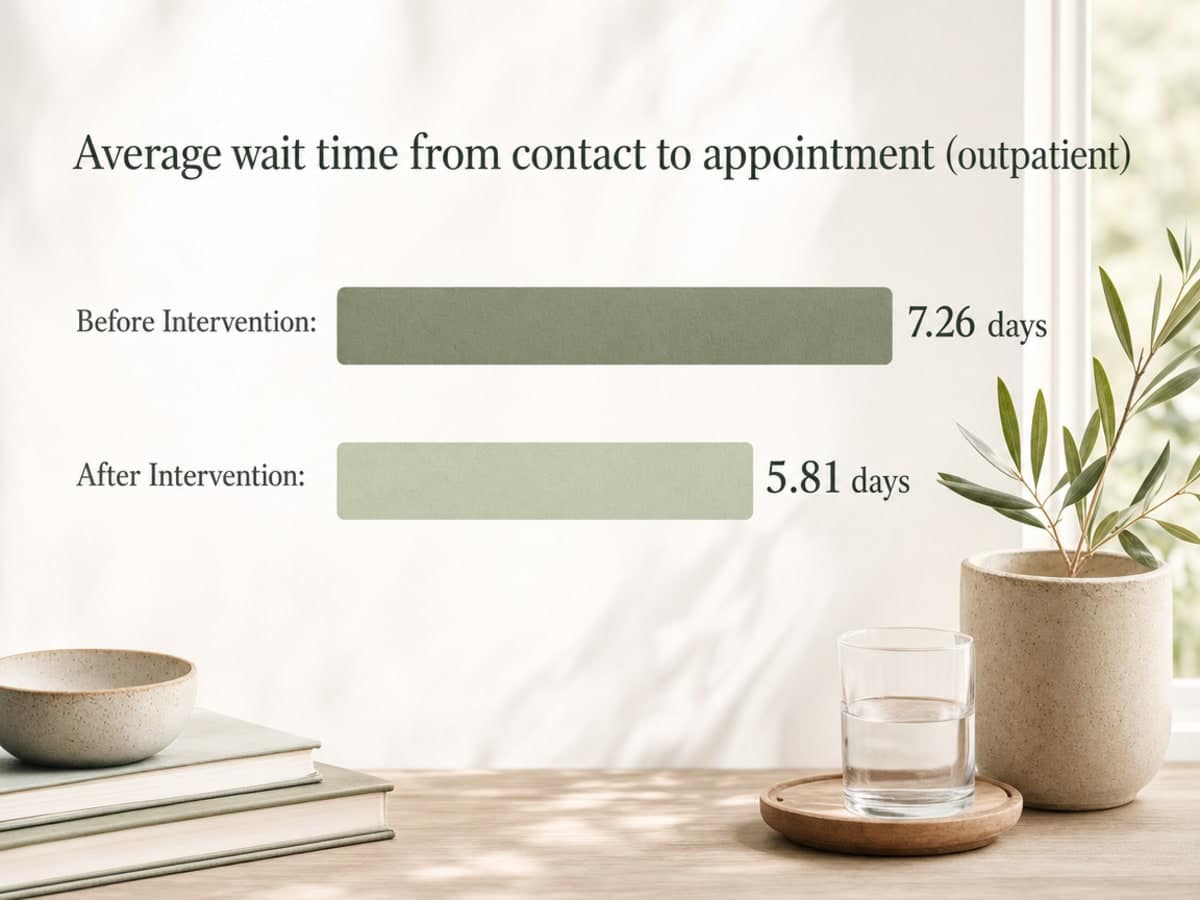
The reason to insist on more is boring and quantitative. One outpatient quality-improvement study found that when a program tightened its scheduling process, the average wait from first contact to first appointment dropped from 7.26 days to 5.81 days, and it took an average of only 0.47 callbacks to lock in the appointment 6. That’s a single outpatient setting, not a national benchmark — but it tells you what “reasonable” looks like from the caller’s side. Under a week to an appointment. Roughly one callback, not five. If the person on the phone can’t give you a rough timeframe, that’s information about the center.
Before you hang up, it’s fair to ask three things out loud:
- What exactly happens next?
- When will I hear from someone, and from whom?
- What do I do in the meantime if things get worse?
A counselor who has real answers is a counselor whose center has real capacity. A counselor who dodges is telling you something too.
You can hang up. You can call back. You can text instead.
Nothing about this call is a contract. If the conversation gets too heavy, you can say “I need to stop” and hang up. You can call the same number tomorrow and get a different person. You can call twice from the parking lot and once from your bed and nobody keeps a scoreboard.
If you can’t find a private spot, that’s real, not weakness. The most-reported barriers to phone-based substance-use care are lack of privacy, unreliable phone or internet, and preferring an in-person visit 1. Ask if you can call back from somewhere quieter, request a scheduled callback, or ask whether the center offers a text or chat option. Telephone visits are a legitimate way into care, not a lesser one 17 — but so is walking in the door when you’re ready.
Someone else can also call for you. A parent, a partner, a friend, a coworker who noticed. You don’t have to be the one holding the phone the first time.
After you hang up: what happens next, and what you should do
Take a breath. Whatever just happened on that call, the hardest part is already behind you. You dialed a number most people never dial.
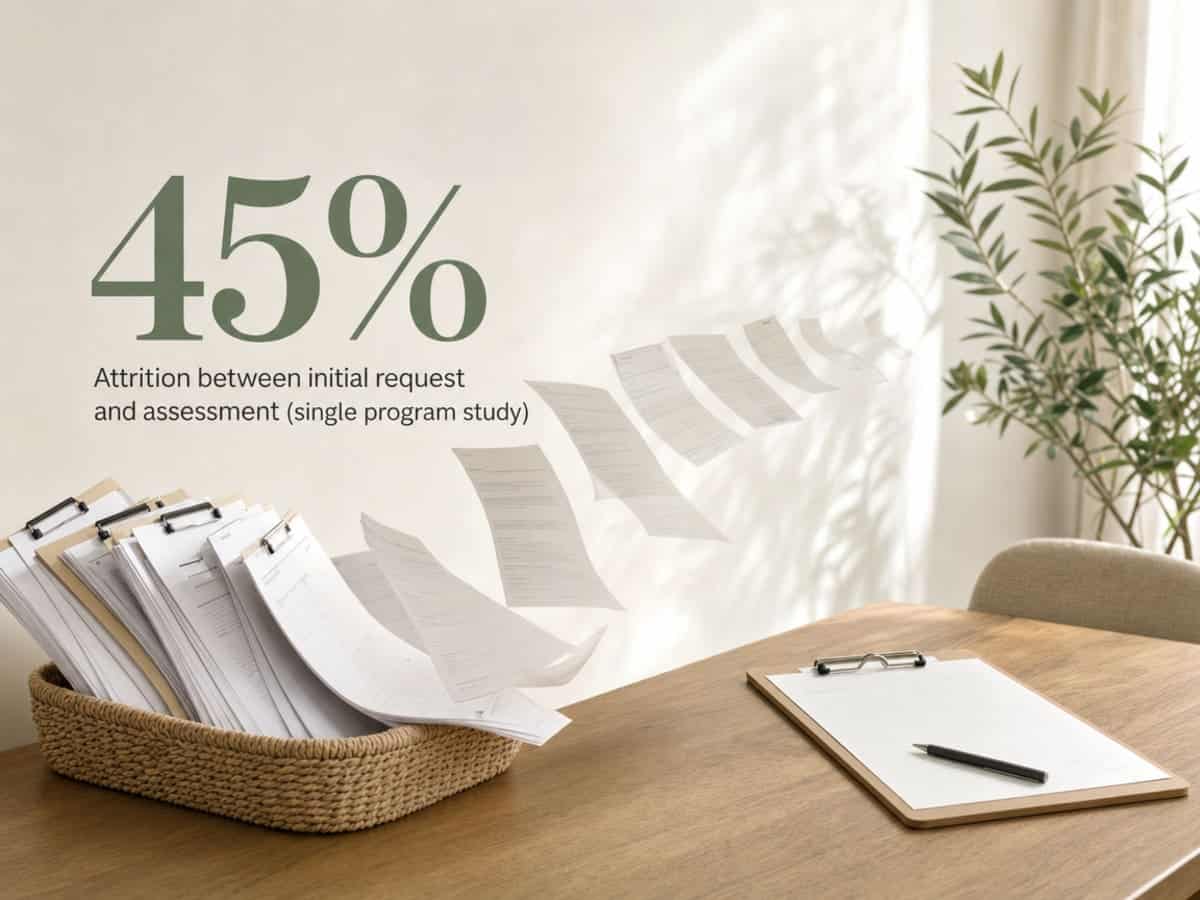
If the call ended with a scheduled assessment or a warm handoff, put the date, time, and the name of the person who called you on something you’ll actually see — a sticky note on your bathroom mirror, a phone alarm, a text to yourself. The path from first contact to enrollment is where most people quietly fall off. One observational study at a single specialty addiction program found that 45% of people were lost between the initial request and the assessment, and another 32% between the assessment and enrollment 7. That’s one program, not a national average — but the pattern shows up enough that your future self will thank you for writing things down.
If the call ended without a clear next step, call back tomorrow or try somewhere else. Ask again: What day? What time? Who’s calling whom? You’re allowed to be that direct.
In the meantime, if things get worse — heavier withdrawal, thoughts of hurting yourself, a slip — dial or text 988 15. Making the call once means you can make it again. You already know how.
Calling Elk Ridge in Montana: what’s different, what’s the same
Everything above applies whether you call Elk Ridge Recovery or a center in a different state. The 15-to-30-minute shape, the questions, the Part 2 protections, the right to hang up — none of that changes because the number has a Montana area code.
What’s specific to Elk Ridge: the admissions line is staffed by people who expect the nervous call, not the ready-to-admit one. If you’re in Montana, Idaho, North Dakota, South Dakota, or Wyoming, they can talk through medical detox, residential, PHP, IOP, or outpatient — and figure out with you which one actually fits, including travel, work, and family logistics 18.
If it turns out Elk Ridge isn’t the right fit, you should still leave the call with a specific alternative and a next step, not a shrug 19. That standard applies to any center you call. Elk Ridge just happens to be one number you can dial when you’re ready to test it.
Connect Directly With Someone Who Understands Recovery
Speak privately with an admissions specialist ready to guide your first step toward safe, structured recovery.
Frequently Asked Questions
How long does the first call to a rehab center usually take?
Most first calls run 15 to 30 minutes. The greeting takes a minute or two, you get a few minutes to say why you’re calling, the clinical questions take the biggest chunk, and insurance and next steps wrap it up. If you’re short on time, say so at the start — the counselor can shorten the call and schedule a longer one when you have privacy.
Am I committing to treatment if I call?
No. A first call is a conversation, not a contract. You’re not signing anything, not booking a bed, and not agreeing to show up anywhere. You can ask questions, get a benefits check, hear what the counselor recommends, and then hang up and think about it. You can also call back the next day, or the next week, and start over with someone new.
Is the call really confidential?
Mostly, yes. When you call a program covered by 42 CFR Part 2, federal rules generally stop that program from sharing information that identifies you as someone with a substance use disorder without your written consent 21. HHS notes these protections exist specifically because fear of discrimination and prosecution keeps people out of treatment 10. There are narrow exceptions — medical emergencies, certain court orders, suspected child abuse — so it’s honest to say confidential, not invisible 11.
What if I don’t have insurance or can’t afford treatment?
Say so at the start of the insurance portion. Cost is one of the most-cited reasons people never enter care 2, and a decent admissions team expects the question. Ask about self-pay rates, sliding-scale options, scholarship or grant beds, state-funded programs, and payment plans. If the center you called can’t work with your budget, they should still hand you a specific alternative — a program name and number — not a shrug 19.
Can someone else call for me?
Yes. A parent, partner, adult child, friend, or coworker can dial the admissions line and ask questions on your behalf. There are limits on what the counselor can share back about you specifically without your consent, but they can explain how the program works, run a general benefits check, and describe next steps. When you’re ready, you or the caller can loop you into the conversation.
What if I’m not ready to talk to a rehab center yet?
That’s okay. Dial or text 988 instead. It’s free, confidential, available 24/7, and you don’t have to give payment or insurance information to talk to someone about mental-health or substance-use concerns 15. If someone is overdosing, unresponsive, or in immediate medical danger, call 911 14. When you’re ready for a facility-specific call, the admissions line will still be there — tomorrow, next week, or at 2 a.m.
References
- Barriers and Poor Telephone Counseling Experiences among Patients Receiving Medication for Opioid Use Disorders. https://pmc.ncbi.nlm.nih.gov/articles/PMC9203915/
- Service-level barriers to and facilitators of accessibility to treatment for problem alcohol use: a systematic review. https://pmc.ncbi.nlm.nih.gov/articles/PMC10722420/
- Assessing public behavioral health services data: a mixed method analysis. https://pmc.ncbi.nlm.nih.gov/articles/PMC7661157/
- Telephonic Outreach to Engage Patients with Substance Use Disorders in Care during the COVID-19 Pandemic. https://pmc.ncbi.nlm.nih.gov/articles/PMC10139664/
- Gaps in the Substance Use Disorder Treatment Referral Process. https://pmc.ncbi.nlm.nih.gov/articles/PMC6066414/
- Examining access to addiction treatment: Scheduling processes and wait times among outpatient substance abuse treatment organizations. https://pmc.ncbi.nlm.nih.gov/articles/PMC3616751/
- Examining attrition rates at one specialty addiction treatment program. https://pmc.ncbi.nlm.nih.gov/articles/PMC4189207/
- FAQs about Affordable Care Act Implementation Part 34. https://www.cms.gov/cciio/resources/fact-sheets-and-faqs/downloads/faq-part-34_10-26-16_final.pdf
- Departments of Labor, Health and Human Services, and Treasury Issue Final Rules Strengthening Access to Mental Health and Substance Use Disorder Care. https://www.cms.gov/newsroom/press-releases/departments-labor-health-and-human-services-treasury-issue-final-rules-strengthening-access-mental
- Fact Sheet 42 CFR Part 2 Final Rule. https://www.hhs.gov/hipaa/for-professionals/regulatory-initiatives/fact-sheet-42-cfr-part-2-final-rule/index.html
- Understanding Confidentiality of Substance Use Disorder Patient Records. https://www.hhs.gov/hipaa/part-2/index.html
- Additional FAQs on Sharing Information Related to Treatment for Mental Health or Substance Use Disorders. https://www.hhs.gov/sites/default/files/new-faqs-on-sharing-information.pdf
- Model Notice of Privacy Practices for HIPAA Covered Health Care Providers. https://www.hhs.gov/hipaa/for-professionals/privacy/guidance/privacy-practices-health-care-provider/index.html
- Advising People on Using 988 Versus 911: Practical Approaches for Healthcare Providers. https://library.samhsa.gov/sites/default/files/988-vs-911-practical-guide-pep24-06-009.pdf
- 988 Key Messages. https://www.samhsa.gov/mental-health/988/key-messages
- Telemedicine-delivered treatment for substance use disorder. https://pmc.ncbi.nlm.nih.gov/articles/PMC11444076/
- Old tech but not low tech: telephone-based treatment provision for substance use. https://pmc.ncbi.nlm.nih.gov/articles/PMC10985352/
- Achieving Health Equity Around Overdoses. https://www.cdc.gov/overdose-prevention/health-equity/achieving-health-equity-around-overdoses.html
- Care Coordination and Patient Referral Sources. https://integrationacademy.ahrq.gov/products/playbooks/moud-playbook/coordinate-care/care-coordination-and-patient-referral-sources
- Screening and Diagnosis | Integration Academy. https://integrationacademy.ahrq.gov/products/playbooks/moud-playbook/engage-patients/screening-and-diagnosis
- 42 CFR Part 2 — Confidentiality of Substance Use Disorder Patient Records. https://www.ecfr.gov/current/title-42/chapter-I/subchapter-A/part-2
- Model Part 2 Patient Notice. https://www.hhs.gov/hipaa/for-professionals/privacy/guidance/privacy-practices-part-2/index.html
- Alcohol Use Disorder: From Risk to Diagnosis to Recovery. https://www.niaaa.nih.gov/health-professionals-communities/core-resource-on-alcohol/alcohol-use-disorder-risk-diagnosis-recovery
- Different People, Different Options. https://alcoholtreatment.niaaa.nih.gov/what-to-know/different-people-different-options
- Screen and Assess: Use Quick, Effective Methods. https://www.niaaa.nih.gov/health-professionals-communities/core-resource-on-alcohol/screen-and-assess-use-quick-effective-methods
- Engaging Patients in Treatment for OUD. https://integrationacademy.ahrq.gov/products/playbooks/moud-playbook/engage-patients/engaging-patients-in-treatment