Key Takeaways
- Detox without ongoing medication is not treatment; leaving opioid-free after a short stay raises the risk of return to use and overdose death, so ask how long medication will continue 18.
- Fentanyl changes induction because it lingers in the body and can trigger precipitated withdrawal; choose a program with a written protocol, withdrawal scoring, and on-site monitoring 11.
- Three medications are FDA-approved for opioid use disorder, and a program offering only one is choosing for you; insist on an assessment-based recommendation 19.
- Medication alone is half the care; federal guidance pairs it with counseling, behavioral therapy, and coordinated primary and mental health services, so ask what counseling actually looks like 2.
- Retention drops sharply after the first month, so ask how a program keeps you on medication for at least 180 days without a gap longer than seven days 13.
- Before discharge you should have a naloxone kit you know how to use and a scheduled follow-up appointment on the calendar, not a photocopied list of referrals 7.
The call you’re about to make is harder than the search bar makes it look
You typed “medication assisted treatment near me” into a search bar, and now you’re staring at a list of names, phone numbers, and stock photos of smiling people on couches. None of it tells you what you actually need to know: which of these places will keep you alive, and which will send you home in five days with a handshake and a prayer.
If you’ve tried to stop before and it didn’t hold, that wasn’t a character failure. It was often a plan failure. Federal clinical guidance is blunt about this: detoxification alone, without ongoing medication for opioid use disorder, is not recommended, because it raises the risk of returning to use and of overdose death 18.
So before you dial, give yourself one honest moment. Making this call is hard. Asking strangers hard questions when you’re already exhausted is harder. The rest of this guide gives you the specific mistakes to avoid, the words to say on the phone, and the red flags that mean you should quietly thank them and keep looking.
Why ‘near me’ is the wrong first question
Proximity feels like safety when you’re scared. A clinic ten minutes away sounds easier than one across the county, and easier sounds survivable. But distance is a weak filter for a decision this big. A program three blocks from your apartment that hands you a tapered dose and sends you home is more dangerous than one forty minutes away that keeps you on medication for months.
The right first question is not where. It’s what. What medication will they offer, out of the three the FDA has approved? Will they continue it past the first month, or treat your admission like a short service call? Do they combine medication with counseling and behavioral health support, which federal guidance describes as the whole-patient model 2? Can they coordinate what happens after you walk out the door, including primary care and mental health treatment 4?
Once you have good answers to those questions, then proximity matters. A nearby program you can actually get to for follow-up appointments beats a distant one you’ll skip in week six. But proximity without a real plan is just a shorter drive to the same bad outcome. Start with the plan, then measure the miles.
Mistake #1: Confusing detox with treatment
What detox actually does (and doesn’t do)
Detox is a doorway. It is not the house. A medical detox gets you through the acute phase of withdrawal safely, with staff who can manage your blood pressure, your vomiting, your sleep, and your pain. That matters, and if you need it, you should have it. But the medicine stops when you walk out, and your body is still an opioid-dependent body on day six, day sixteen, and day sixty.
Medication-assisted treatment is different. It uses one of the three FDA-approved medications for opioid use disorder as an ongoing part of your care, often for months or longer, alongside counseling and medical follow-up 1. Federal clinical guidance is clear that detoxification alone, without medication for opioid use disorder, is not recommended, because stopping all opioids and then leaving raises the risk of returning to use and of overdose death 18.
If a program sells you detox and calls it treatment, they are naming the doorway after the house.
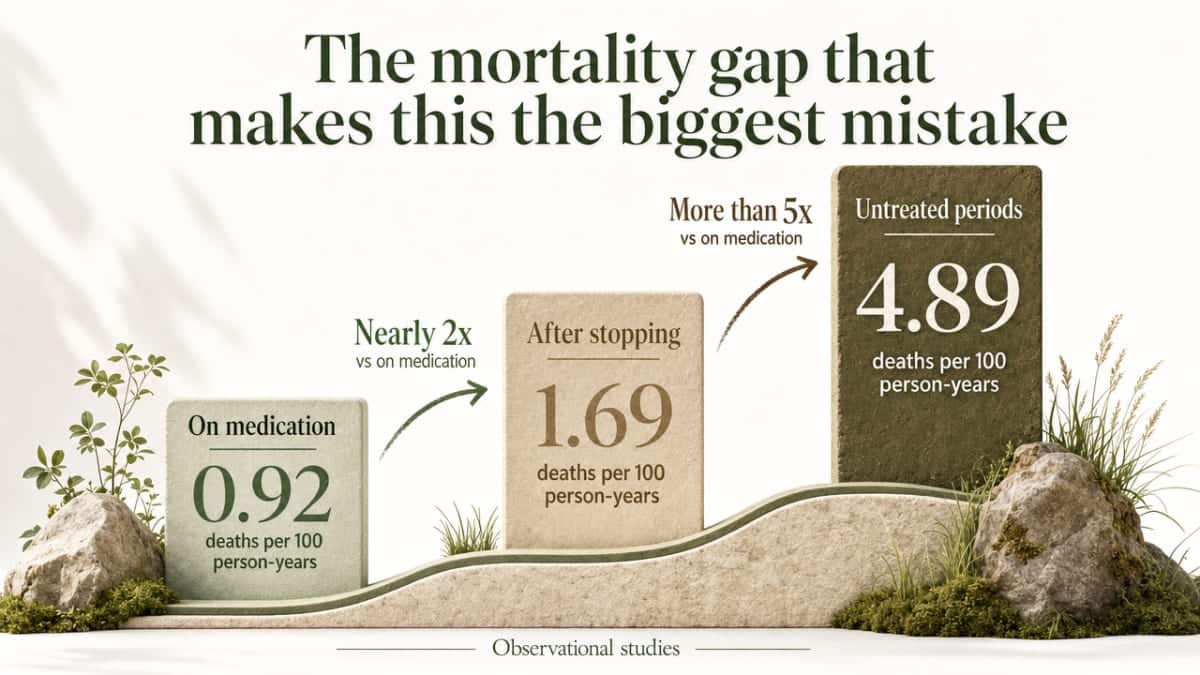
The mortality gap that makes this the biggest mistake
Here is the hard part, and you deserve to see the numbers before you make a decision this big. A systematic review and meta-analysis pulled together 21 studies that tracked what happened to people during three different periods: while they were receiving medication-assisted treatment, after they stopped, and during stretches when they were not in treatment at all. Pooled all-cause mortality was 0.92 deaths per 100 person-years while people were on medication, 1.69 after they came off it, and 4.89 during untreated periods 20.
What this means for your phone call is simple. A program that frames success as finishing a five- or ten-day detox and walking out medication-free is not describing treatment. It is describing the window with the highest risk. The question to ask instead is how long they plan to keep you on medication, how they will transition you to outpatient care, and what happens if you miss a dose. If they cannot answer those questions clearly, the number of days they offer is not the number that matters.
Mistake #2: Picking a program without a fentanyl-era induction plan
Why fentanyl changed the first 72 hours
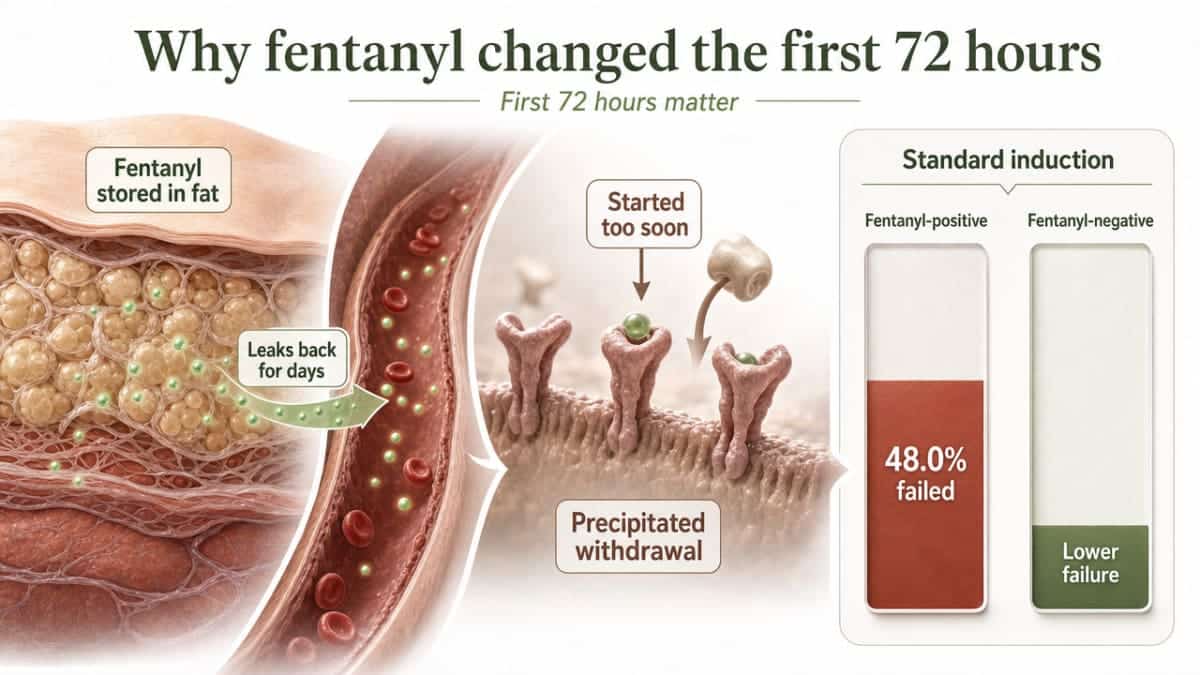
If the opioid in your life right now is fentanyl, or anything you bought on the street in the last few years, the first three days of medication matter in a way they didn’t a decade ago. Fentanyl sits in your body differently than heroin or pills. It lingers in fat tissue and keeps leaking back into your bloodstream for days. If buprenorphine is started before enough of that fentanyl has cleared, it can shove the remaining opioid off your receptors and throw you into sudden, violent withdrawal. The clinical name is precipitated withdrawal. The lived name is one of the worst nights of your life.
A randomized trial of 729 people compared standard induction to injectable extended-release buprenorphine between fentanyl-positive and fentanyl-negative patients. In the standard-induction group, induction failed for 48.0% of fentanyl-positive participants, compared with 16.9% of fentanyl-negative participants 11. Nearly half. That is not a problem you solve with a closer drive. It is a problem you solve with a program that has a written induction plan built for the drug you are actually using.
Questions that tell you a program has thought about this
You don’t need to speak clinical to screen for this. You need to ask a few plain questions and listen for whether the person on the phone has answers ready or is improvising.
Try these, one at a time:
- “If I’ve been using fentanyl, how do you decide when to start the medication?” A good answer mentions waiting for clear withdrawal signs, using a scoring tool, or offering a low-dose or rapid-induction option under supervision 12.
- “What happens if I go into precipitated withdrawal during induction?” You want to hear about on-site monitoring, comfort medications, and a nurse or physician who can adjust the plan in real time, not “that rarely happens.”
- “Do you offer the shot, the daily film, or both?” Both are FDA-approved formulations, and a program that only offers one is making the choice for you 19.
- “Have you successfully started people who were using fentanyl this week?” If the voice on the other end hesitates, that is your answer.
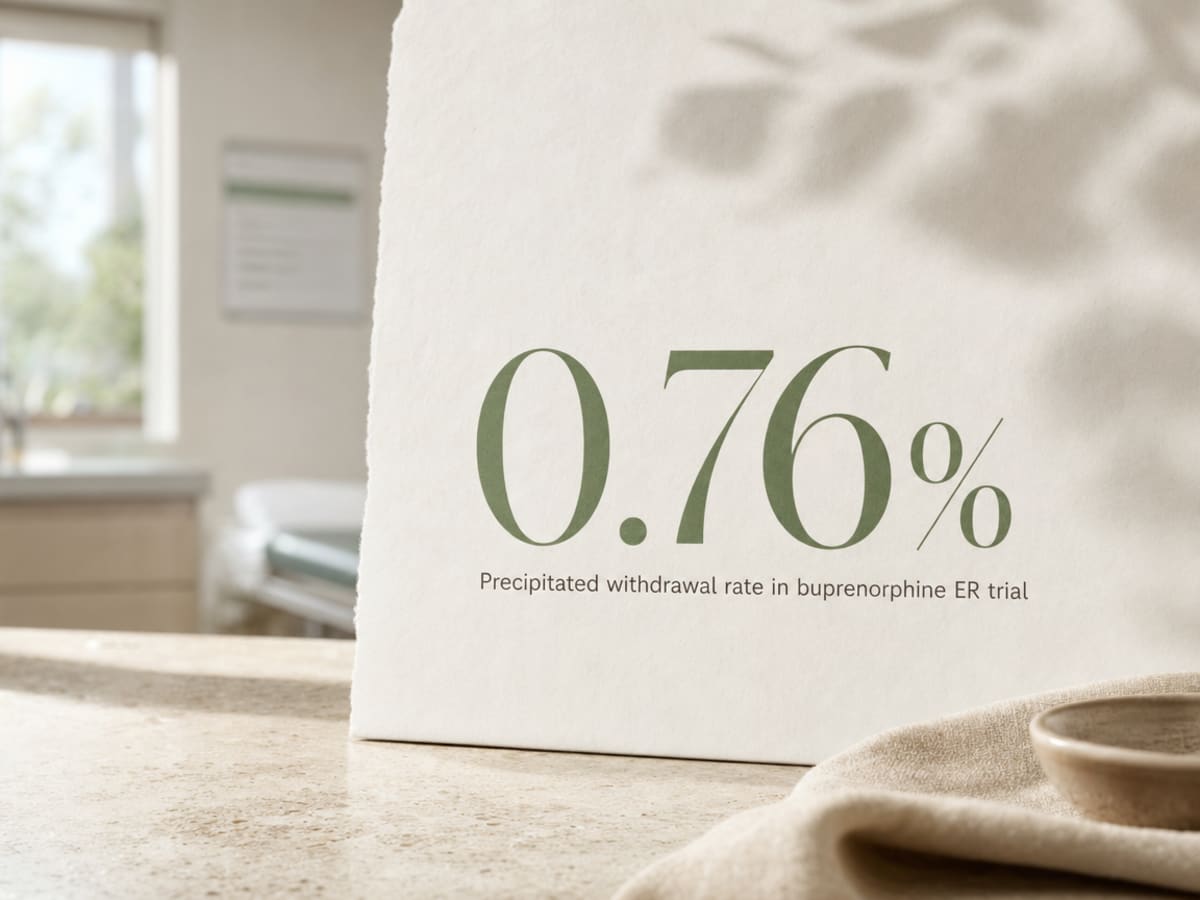
Supervised buprenorphine starts, even for people using fentanyl, have been studied carefully. In a multisite trial of about 1,200 patients, precipitated withdrawal occurred in less than 1% when induction was properly managed 8. The risk is real, but it is manageable in the right hands. Your job on the phone is to find out whose hands those are.
Mistake #3: Taking whatever medication they happen to offer
The three FDA-approved medications in plain language
There are three medications the FDA has approved for opioid use disorder, and a good program should be able to explain all three to you without reading from a brochure 19.
- Methadone
- A long-acting opioid medication that steadies your brain’s receptors so cravings and withdrawal quiet down. You take it as a liquid, usually once a day, and in the United States you can only get it through a federally certified opioid treatment program, which means daily visits at first 2. It has decades of evidence behind it and is especially useful if you have been using heavily for a long time.
- Buprenorphine
- A partial opioid medication that calms the same receptors but has a ceiling on its effects, which makes overdose less likely. It comes as a daily film or tablet you dissolve under your tongue, and also as a monthly injection you get in a clinic 19. Because it does not require an OTP, you can often get it from a regular doctor’s office after induction.
- Naltrexone
- Different. It is not an opioid at all. It blocks opioid receptors so using doesn’t produce the usual effect. The extended-release version is a monthly shot. The catch is that you have to be fully off opioids for seven to ten days before you can start it, which is a hard window for most people to clear 1.
A program that only offers one option is making the choice for you
Pay attention to this on the phone. If the intake coordinator describes only one medication, or steers you toward a specific one before anyone has heard your story, you are not getting a medical decision. You are getting a product line.
The right medication depends on how long you’ve been using, what you’ve been using, your other health conditions, whether you’re pregnant, whether you can get to a clinic every morning, and what you want your life to look like in six months. That is a conversation with a clinician, not a scripted answer from a call center. Federal clinical guidance supports all three medications and leaves the choice to assessment and patient preference 6.
Ask directly: “Which of the three FDA-approved medications do you offer, and how do you decide which one is right for me?” If the answer is “we only do one,” that is useful information. It may still be the right program for you, but now you know the choice was made before you walked in.
Mistake #4: Treating counseling as optional
Here is something a lot of programs will not tell you plainly: the medication is doing medical work, but it is not doing all the work. Buprenorphine, methadone, and naltrexone quiet the biology. They do not sit with you at 9 p.m. when a text from an old number pulls your attention sideways. They do not help you figure out how to tell your boss, your partner, or your kid what the last two years were really like.
Federal guidance is specific about this. SAMHSA describes effective care as a whole-patient model: medication combined with counseling and behavioral therapies, plus medical and social services 2. The agency also urges programs to integrate medication treatment with primary care, mental-health treatment, and coordinated social support rather than running the medication piece in isolation 4.
So when you call, ask what counseling actually looks like at that program. Is it one group a week in a conference room, or is there individual therapy, behavioral-health support for anxiety or depression, and a case manager who can help with housing, work, or transportation? A program that offers you a prescription and nothing else is handing you half the care. You deserve the other half, especially in the first months when so much is being rebuilt at once.
Mistake #5: Ignoring what happens after day 30
The retention cliff you’re trying to beat
Here’s a number worth sitting with before you commit to any program. A 2026 peer-reviewed study followed 261,025 Medicaid beneficiaries receiving care through 1,138 Opioid Treatment Programs in 2023. Median retention was 61.2% at 30 days, 41.5% at 90 days, and 27.5% at 180 days 14. By the six-month mark, roughly three out of four people were no longer in care.
That is the national baseline. It is not your personal forecast, and it is not a verdict on anyone who fell off along the way. People leave for reasons that have little to do with willpower: a car breaking down, a job shift changing, a prescription that didn’t get refilled on time, insurance paperwork that stalled, a counselor who left. The study authors are clear that retention varies by program and that lower numbers often reflect transportation, housing, insurance, and medication-access barriers rather than clinical failure.
What this means for your call is this. A nearby program should be able to tell you what their 90-day and 180-day retention looks like, and what they do differently to keep people connected past the first month. If they have no answer, you are looking at a program that measures success in admissions, not in months.
The 180-day question to ask every intake coordinator
CMS, the federal agency that sets quality measures for a huge share of American healthcare, defines continuity of pharmacotherapy for opioid use disorder as at least 180 days of treatment without a gap longer than seven days 13. That is the yardstick regulators use. You can use it too.
Try this on the phone, word for word: “How do you make sure I stay on medication for at least six months without a gap longer than a week?” Listen for specifics. A real answer sounds like scheduled follow-up appointments, pharmacy coordination, a case manager who flags missed refills, a plan for insurance changes, and a backup prescriber if your main one is out. A weak answer sounds like “we’ll help you with that when the time comes.”
Six months is not an arbitrary finish line. It is the point where a program’s work shifts from starting you to keeping you. If no one at intake can describe how they’ll bridge day 31, day 60, day 120, that bridge probably isn’t built.
Mistake #6: Leaving without naloxone and a next-week appointment
Picture the moment you walk out the front door of a program. If what’s in your hand is a discharge summary and a photocopied list of hotline numbers, something important got skipped. Two things should go with you: a naloxone kit you know how to use, and a confirmed appointment on a specific day, with a specific person, in the next week.
CDC’s clinical guidance for linking people with opioid use disorder to medication treatment is specific on this. Programs should identify patients at higher overdose risk, train them to respond to an overdose, and provide naloxone before discharge 7. Overdose-reversal medication is treated by federal guidance as a routine part of discharge, not an extra 5. If no one at the program has walked you or a family member through how to use naloxone, that is a gap you can name on the phone before you ever admit.
The next-week appointment matters just as much. The risk window after you leave structured care is real, and a referral printed on a sheet is weaker than a scheduled visit on a calendar. Ask the intake coordinator directly: “Before I’m discharged, will I have a naloxone kit in my hand and an appointment already booked with my outpatient prescriber?” A yes with specifics means the bridge is built. A vague “we’ll give you resources” means you’ll be building it yourself, at the hardest possible time.
A phone script for your first call
You do not have to sound like a clinician to get real answers. You just need a few questions ready so the voice on the other end does not steer the call. Here is a script you can keep next to you. Take notes while they talk, and if anything is vague, ask again.
Open with this: “Hi. I’m calling because I need help with opioid use. Can you tell me what your program looks like?” Let them talk for a minute. Then work through the questions that matter.
- “Which of the three FDA-approved medications do you offer, and how do you decide which one is right for me?” You want to hear methadone, buprenorphine, or naltrexone named by a person who can explain the differences 19.
- “If I’ve been using fentanyl, what is your induction plan?” Listen for withdrawal scoring, on-site monitoring, and a written protocol 12.
- “How soon can I be seen?” Timely admission matters, and federal quality measures track initiation within 14 days of the episode 16.
- “What does counseling look like alongside the medication?” 2
- “How will you keep me on medication for at least six months without a gap longer than a week?” 13
- “Will I leave with a naloxone kit and a scheduled follow-up appointment?” 7
Making this call is already doing the work. If the answers come back clear and specific, you have found something worth a second conversation.
Walk away if you hear any of this
Some answers on an intake call are soft, and some are warnings. If any of the following come out of the person’s mouth, it’s okay to say thank you and keep looking. Trusting that instinct is part of the work.
- “We’ll get you off everything in a week.” Detoxification alone, without ongoing medication for opioid use disorder, is not recommended by federal clinical guidance because it raises the risk of returning to use and of overdose death 18.
- “We don’t really do counseling here, just the medication.” Effective care is described as a whole-patient model: medication combined with counseling and behavioral therapies, plus medical and social services 2.
- “We only offer one medication.” There are three FDA-approved options, and the right one depends on your assessment, not their inventory 19.
- “We’ll figure out follow-up after you’re discharged.” Linkage to a next appointment and naloxone should be arranged before you walk out, not after 7.
- “Fentanyl? We start everyone the same way.” That’s not an induction plan. That’s a shrug.
Hearing any of these is not your failure to find the right place. It’s the place telling you the truth about itself. Listen.
What a good ‘near me’ answer actually sounds like
After enough calls, you’ll start to hear the difference. A good answer is specific, unhurried, and names things by their proper names. It sounds something like this:
“We offer buprenorphine and naltrexone here, and we refer to a certified opioid treatment program if methadone is a better fit for you 19. If you’ve been using fentanyl, we wait for clear withdrawal signs, use a scoring tool, and have a nurse on-site during induction 12. We can usually see you within a week 16. You’ll meet with a counselor individually, not just in group, and we coordinate with a primary care provider and a mental-health clinician 4. Our plan is to keep you on medication for at least six months with no gap longer than a week 13, and before you leave, you’ll have a naloxone kit, know how to use it, and a scheduled follow-up visit on the calendar 7.”
If that’s close to what you hear, you’ve found a real program. If this is the kind of care you want in Montana or the surrounding states, Elk Ridge Recovery is one place worth a call. Either way, the fact that you got this far in the article means you’re already asking better questions than most. Keep going.
Talk With Someone Who Understands Next Steps
Connect directly for guidance on starting MAT and stabilizing your recovery journey today.
Frequently Asked Questions
Is medication assisted treatment the same as detox?
No, and this is the mix-up that costs people the most. Detox manages the few days of withdrawal when you stop opioids. Medication assisted treatment uses an FDA-approved medication as ongoing care, often for many months, alongside counseling. Federal guidance is explicit that detoxification alone, without medication for opioid use disorder, is not recommended 18.
How long should I expect to stay on medication for opioid use disorder?
There is no universal finish line, and that’s okay. A useful floor comes from CMS, which defines continuity of pharmacotherapy as at least 180 days of treatment without a gap longer than seven days 13. Many people stay on medication longer. The right length is a conversation with your prescriber based on how you’re doing, not a countdown clock 1.
Which of the three FDA-approved medications is right for me?
That depends on your history, your health, your access to a clinic, and what you want your days to look like. The FDA has approved methadone, buprenorphine, and naltrexone 19. A good program assesses you first, then recommends. If an intake coordinator picks one before hearing your story, you’re being matched to inventory, not to a plan.
What should I ask when I call a program for the first time?
Ask which of the three FDA-approved medications they offer and how they choose 19. Ask how they handle induction if you’ve been using fentanyl 12. Ask how soon they can see you; federal quality measures track initiation within 14 days 16. Ask how counseling fits in 2. Ask whether you’ll leave with a naloxone kit and a scheduled follow-up 7.
Why does fentanyl use change how a program should start my medication?
Fentanyl lingers in your body longer than other opioids. If buprenorphine starts too early, it can trigger sudden, severe withdrawal called precipitated withdrawal. A program should wait for clear withdrawal signs, use a scoring tool, and consider low-dose or rapid-induction options under supervision 12. In supervised emergency-department starts, precipitated withdrawal was rare when induction was managed carefully 8.
Should I leave treatment with naloxone and a follow-up appointment?
Yes, both. CDC guidance tells programs to identify patients at higher overdose risk, train them to respond to an overdose, and provide naloxone before discharge 7. Overdose-reversal medication is treated as a routine part of leaving care, not an extra 5. A scheduled next-week visit with a named prescriber matters just as much as the kit in your hand.
References
- Medications for Opioid Use Disorder. https://nida.nih.gov/research-topics/medications-opioid-use-disorder
- Treatment Options for Substance Use Disorder. https://www.samhsa.gov/substance-use/treatment/options
- Substance Use Disorders: Statutes, Regulations, and Guidelines. https://www.samhsa.gov/substance-use/treatment/statutes-regulations-guidelines
- Integrating Substance Use Disorder Services into Primary and Other Health Care Settings. https://www.samhsa.gov/substance-use/treatment/integrating-sud-services
- Opioid Overdose Reversal Medications (OORM). https://www.samhsa.gov/substance-use/treatment/overdose-prevention/opioid-overdose-reversal
- Guideline Recommendations and Guiding Principles. https://www.cdc.gov/overdose-prevention/hcp/clinical-guidance/recommendations-and-principles.html
- Linking People with Opioid Use Disorder to Medication Treatment. https://www.cdc.gov/overdose-prevention/hcp/clinical-guidance/linkage-to-care.html
- Buprenorphine initiation in the ER found safe and effective for individuals with opioid use disorder who use fentanyl. https://www.nih.gov/news-events/news-releases/buprenorphine-initiation-er-found-safe-effective-individuals-opioid-use-disorder-who-use-fentanyl
- Emergency Department-Initiated Buprenorphine for Opioid Use Disorder. https://pubmed.ncbi.nlm.nih.gov/41670966/
- Initiation and Dosing of Extended-Release Buprenorphine. https://pmc.ncbi.nlm.nih.gov/articles/PMC11954470/
- Rapid vs Standard Induction to Injectable Extended-Release Buprenorphine. https://pmc.ncbi.nlm.nih.gov/articles/PMC12522003/
- Treatment of Opioid Use Disorder. https://www.ncbi.nlm.nih.gov/books/NBK558319/
- Continuity of Pharmacotherapy for Opioid Use Disorder (OUD). https://qpp.cms.gov/docs/QPP_quality_measure_specifications/CQM-Measures/2025_Measure_468_MIPSCQM.pdf
- Opioid Treatment Programs’ Medicaid Patient Retention Rates. https://pubmed.ncbi.nlm.nih.gov/41575747/
- Management of opioid use disorder: 2024 update to the national clinical practice guideline. https://pmc.ncbi.nlm.nih.gov/articles/PMC11573384/
- 2025 Quality Rating System Measure Technical Specifications. https://www.cms.gov/files/document/2025-quality-rating-system-measure-technical-specifications.pdf
- Billing for substance use disorder (SUD) via telehealth. https://telehealth.hhs.gov/providers/best-practice-guides/telehealth-substance-use-disorder/billing-telehealth-substance-use
- Opioid Use Disorder: Treating | Overdose Prevention | CDC. https://www.cdc.gov/overdose-prevention/hcp/clinical-care/opioid-use-disorder-treating.html
- Information about Medications for Opioid Use Disorder (MOUD) – FDA. https://www.fda.gov/drugs/food-and-drug-administration-overdose-prevention-framework/information-about-medications-opioid-use-disorder-moud
- Effects of medication-assisted treatment on mortality among opioids users: a systematic review and meta-analysis. https://www.ncbi.nlm.nih.gov/pubmed/29934549
- Federal Guidelines for Opioid Treatment Programs. https://library.samhsa.gov/sites/default/files/federal-guidelines-opioid-treatment-pep24-02-011.pdf