Key Takeaways
- Tricare directories frequently list wrong locations and phone numbers, so a direct call to Humana Military and the facility is the only reliable way to confirm current coverage 1.
- Montana has 85 SAMHSA-reporting SUD facilities, with 55.3% self-reporting acceptance of federal military insurance and over 80% supporting medication-assisted treatment for opioid and alcohol use disorder 7, 8.
- Nonemergency residential, detox, and PHP care generally require pre-authorization from Humana Military, and Tricare Prime beneficiaries also need a referral from their primary care manager before admission 3.
- Verify plan and eligibility through milConnect, request a Prime referral if applicable, secure the Humana Military authorization number, and call Elk Ridge Recovery to confirm current Tricare East acceptance for the level of care needed.
Why a Phone Call Beats the Tricare Directory
If you are reading this while someone you love is struggling, or while you are trying to hold your own life together long enough to get help, take a breath. You are doing the hard part right now. The next practical step is smaller than it feels: you need to confirm what Tricare will actually pay for, at which facility, and starting when. That is a phone-call problem, not a search-engine problem.
Here is why that distinction matters. In 2024, the U.S. Government Accountability Office reviewed Tricare’s behavioral-health provider directories and found that most sampled listings contained at least one error, including wrong practice locations and incorrect phone numbers 1. That is not a knock on you if you have already spent an hour clicking through a directory and getting nowhere. The directory itself is unreliable. GAO recommended that the Department of Defense monitor accuracy more closely, but for you, tonight, the fix is simpler. Trust a live voice, not a listing.
What a phone call confirms that a directory cannot: whether the facility is currently authorized under Tricare East, whether it is accepting new patients this week, which levels of care are covered for an adult, and what Humana Military will need before admission. That is the sequence you will walk through in the sections below. When you are ready, call Elk Ridge Recovery directly to confirm current Tricare East acceptance for the level of care you need. One call moves you further than a full afternoon of scrolling.
What Tricare Actually Pays For in Addiction Treatment
The Levels of Care Covered Under Tricare East
The good news is that Tricare’s addiction benefit is broader than many families assume. A 2016 federal final rule reshaped the benefit to eliminate unnecessary limits, align cost sharing with medical and surgical care, expand intensive outpatient coverage, add opioid-use-disorder treatment, and streamline how institutional providers get authorized 5. This rule ensures that the current menu of covered care reflects modern addiction medicine.
For an adult with Tricare East, the levels of care you will hear about most often are these:
- Medical detox to safely manage withdrawal
- Residential treatment for round-the-clock structured care
- Partial hospitalization (PHP) as a step down that still occupies most of your day
- Intensive outpatient (IOP) for treatment several days a week while you sleep at home
- Standard outpatient therapy
- Medication-assisted treatment for opioid or alcohol use disorder
Dual-diagnosis care for depression, PTSD, anxiety, or other co-occurring conditions falls under the same behavioral-health umbrella.
One clarifying note: you may see the term “psychiatric residential treatment facility,” or PRTF, in Tricare documents. That specific benefit is limited to people under age 21 3. If you are an adult, or helping an adult loved one, PRTF is not your path. Adult residential substance-use treatment is a different, covered category. When you call, use the words “residential substance-use disorder treatment” to ensure you receive accurate benefit information.
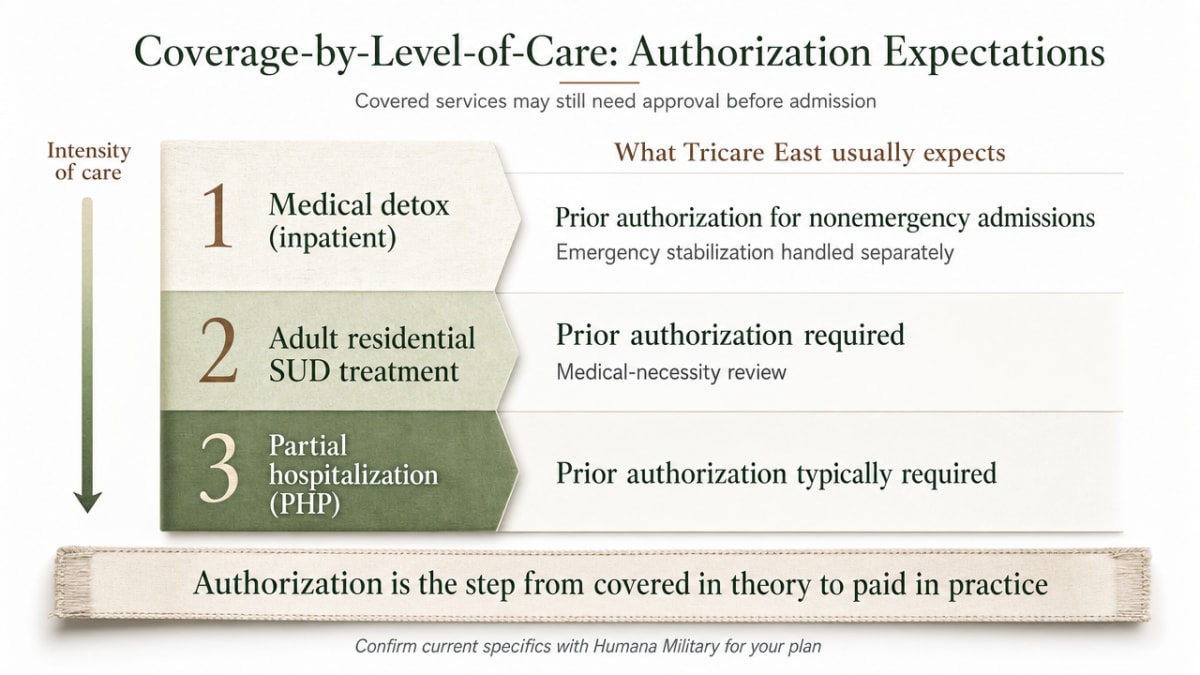
Coverage-by-Level-of-Care: Authorization Expectations
Tricare covers these services, but nonemergency inpatient and residential behavioral-health care generally require authorization before admission 3. This is the paperwork step that turns “covered in theory” into “paid in practice.” Missing it can result in a bill Humana Military never agreed to pay.
Use the compact view below to match the level of care your loved one needs to what Tricare East usually expects. Confirm the current specifics with Humana Military for your plan.
| Level of Care | Typical Tricare East Authorization Expectation |
|---|---|
| Medical detox (inpatient) | Prior authorization for nonemergency admissions; emergency stabilization handled separately 3 |
| Adult residential SUD treatment | Prior authorization required; medical-necessity review 3 |
| Partial hospitalization (PHP) | Prior authorization typically required 3 |
| Intensive outpatient (IOP) | Covered under the 2016 rule expansion; authorization expectations vary 5 |
| Standard outpatient therapy | Generally covered; referral may apply under Prime |
| Medication-assisted treatment (MAT) | Covered for opioid and alcohol use disorder 5 |
Tricare Prime vs. Tricare Select: What Changes for You
The Prime versus Select distinction can be confusing. The two plans use different rules for how you reach a specialist, and addiction treatment is a specialty. Here is the short version that actually matters for rehab.
Under Tricare Prime, you have a primary care manager, and most nonemergency specialty care, including residential SUD treatment, runs through a referral from that PCM and then a Humana Military authorization. Skipping the referral step is the most common way Prime beneficiaries end up with an unexpected bill for an otherwise covered service.
Under Tricare Select, you have more freedom to schedule directly with a Tricare-authorized provider, but pre-authorization for higher levels of care still applies 3. Select tends to feel more flexible on the front end and then can lead to issues at the authorization step if you skip it.
Either way, the sequence is the same: verify your plan, secure the referral if you are on Prime, get the pre-authorization from Humana Military, and confirm the facility is currently accepting Tricare East for the specific level of care you need. Do not guess which plan you have. Log into milConnect or check the sponsor’s benefit summary before you make the first outbound call. Knowing that answer changes everything you say next.
The Montana Reality: Capacity, Geography, and Who Takes Tricare
How Many Montana Facilities Actually Accept Military Insurance
You are not imagining the shortage. Montana is a big state with a small provider bench, and when you start dialing around, the same handful of names come up again and again. It helps to know the actual size of the field before you feel like you have failed to find the right door.
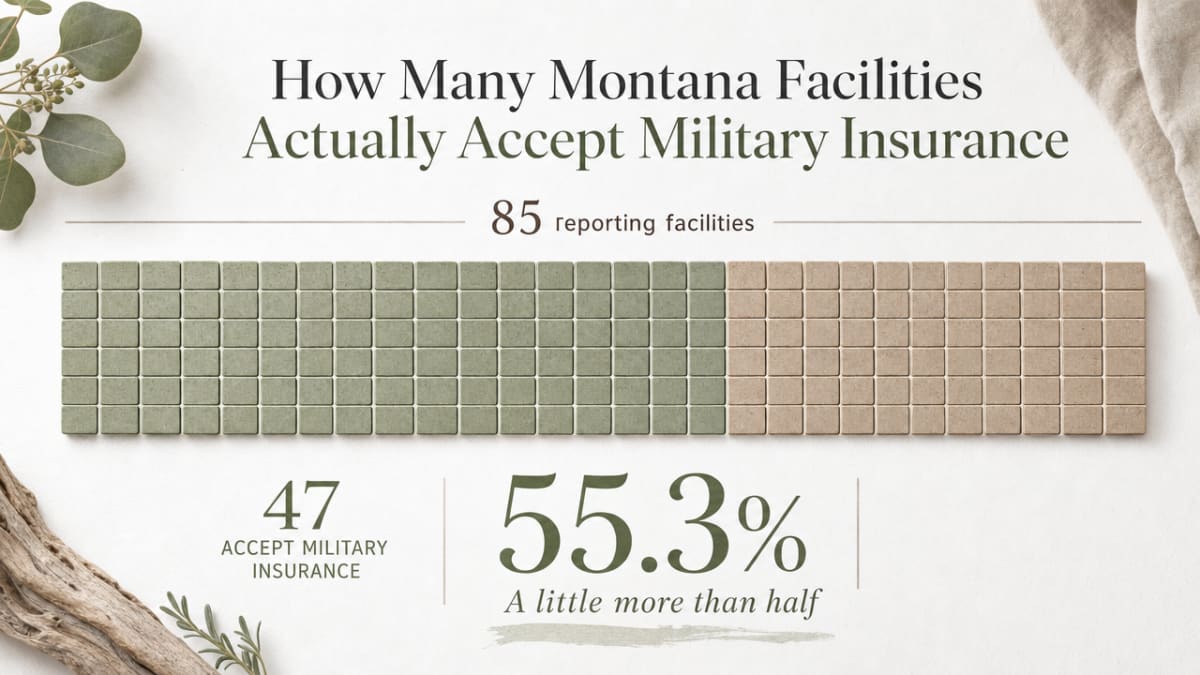
SAMHSA’s most recent Montana state profile counted 85 reporting substance-use-disorder facilities across the state, with 3,803 clients in treatment on a single March 2023 reference date. Of those 85 facilities, 47, or 55.3%, reported that they accept federal military insurance such as Tricare 7. So a little more than half the field is theoretically open to you. That is more than you might feel right now at 11 p.m. with a browser full of tabs. It is also less than the whole state, which is exactly why the search feels narrow.
Two things to hold in mind as you work through that list. First, the 55.3% number is self-reported facility acceptance, not confirmation that a specific place is currently in-network with Tricare East for a specific level of care 7. Second, the GAO directory-accuracy problem still applies: a listing that says “accepts Tricare” is a starting point, not a promise 1. Your job is not to find the perfect facility from a dropdown. Your job is to shorten the list to two or three real options, then call. When you are ready to make Elk Ridge Recovery one of those calls, do it. Confirming current Tricare East acceptance takes minutes, not days.
Medication-Assisted Treatment Is More Available Than You Think
If your loved one is struggling with opioids or alcohol, medication is part of modern care, not a workaround. Buprenorphine, methadone, naltrexone, and acamprosate exist because willpower and group therapy alone leave too many people to relapse. You deserve to know these medications are within reach in Montana, not concentrated in a coastal city.
SAMHSA’s 2024 facility survey found that 83.8% of Montana SUD facilities accepted clients using medications for opioid use disorder, and 81.8% accepted clients using medications for alcohol use disorder 8. The vast majority of Montana facilities are set up to work with people on MAT, not against them. That is a real change from a decade ago, when families were often told to choose between medication and “real” recovery.
What this means for you: if a facility hesitates when you ask about buprenorphine or naltrexone, that is a signal to keep dialing. Ask directly whether MAT is offered on-site, whether prescribers are in-house, and how the medication plan continues after residential care ends. Tricare’s 2016 rule expressly expanded opioid-use-disorder treatment as a covered benefit 5, so the payer side is not the obstacle here.
Rural Distance and the Five-State Catchment
Montana geography is honest about what it asks of you. A four-hour drive to treatment is not unusual here, and if you live in Libby or Lewistown, the map is part of the problem. The draft 2024 Montana AHEC behavioral-health needs assessment flags workforce and access gaps across rural communities, which is the polite way of saying that the right specialist is often not in your county 6.
Two practical reframes can help. First, distance is not disqualifying for residential care. Once your loved one is admitted, they are not driving anywhere for 30 or 60 or 90 days. The one-way trip becomes a single logistics problem, not a daily one. Second, Elk Ridge Recovery serves families from Montana, Idaho, North Dakota, South Dakota, and Wyoming, so if you are calling from Sheridan or Coeur d’Alene or Bismarck, you are not off the map. Ask when you call how they handle transportation, admissions coordination, and family visits from your specific town. The distance question has answers. It just needs to be part of the first conversation, not the last.
Your Tricare East Verification Path, Step by Step
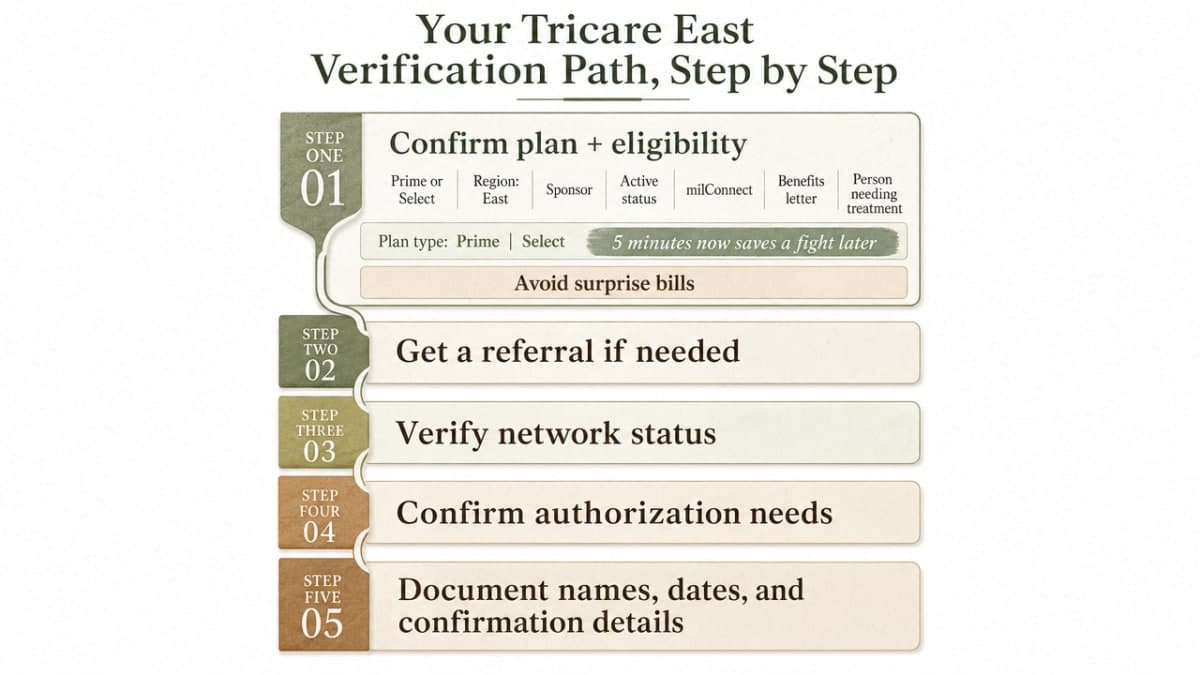
Step One: Confirm Your Plan and Eligibility
Before you dial anyone, get two pieces of information in front of you: the sponsor’s plan type (Prime or Select) and current eligibility status. The sponsor is whoever’s service earned the benefit, whether that is you, a spouse, a parent, or an adult child. Log into milConnect, or pull the most recent benefits letter, and confirm the plan is active for the person who needs treatment.
This step sounds boring next to the emotional weight of what you are actually doing. It is not. Half the surprise bills that hit military families after treatment start here, with a lapsed enrollment or an outdated dependent status nobody caught. Five minutes now saves a fight later. Once you can name the plan, name the region (East), and name the sponsor, you are ready for the next call.
Step Two: Get a Referral if You Have Tricare Prime
If the plan is Tricare Prime, your primary care manager is the gate. Call the PCM’s office and say plainly: your family member needs a referral for substance-use-disorder treatment, and you are looking at residential or PHP-level care. You do not need to explain the whole story. “Referral for SUD residential treatment” is the phrase that opens the right door.
Ask the PCM’s office to send the referral to Humana Military the same day, and get the referral number in writing before you hang up. If the plan is Tricare Select, you can skip this step and go directly to Humana Military for authorization. Prime beneficiaries who skip the PCM step are the ones who get stuck. Do not let that be you.
Step Three: Request Pre-Authorization for the Level of Care
Nonemergency inpatient and residential behavioral-health services generally require authorization from Humana Military before admission 3. This is the step that turns coverage on paper into coverage that pays. Call the Humana Military behavioral-health line printed on the back of the Tricare card and ask for a pre-authorization for the specific level of care you need: medical detox, adult residential SUD treatment, PHP, or IOP.
Humana Military will run a medical-necessity review, which usually involves a clinical assessment from the admitting facility. This is why the facility and the payer end up talking to each other directly. Your job is to make sure both sides know your name, the sponsor’s information, and the referral number if you are on Prime. Ask for the authorization reference number and the effective dates. Write both down. If you take one thing away from this whole process, take that number. It is the receipt that says Humana Military agreed to pay.
Step Four: What to Say When You Call Humana Military
A phone script sounds silly until you are on hold at 8 a.m. trying not to cry. Write these lines on a sticky note before you dial. You do not have to say them perfectly.
“My name is . I am calling about Tricare East benefits for [sponsor name], sponsor SSN or DoD ID . I need pre-authorization for substance-use-disorder treatment for [patient name and relationship]. We are looking at [level of care: medical detox, adult residential, PHP, IOP]. Can you confirm the authorization requirements, whether a referral is on file, and which in-network facilities are currently accepting Tricare East for this level of care in Montana?”
Then ask three things:
- What is the authorization reference number?
- What is the effective date range?
- What documentation does the admitting facility need to submit?
Get the representative’s name and the call reference number too. If you are told the wait for a first appointment is longer than you can safely manage, ask about urgent-referral options directly 2. That phrase, “urgent referral,” opens a different track. Use it if the situation calls for it.
Step Five: What to Ask Elk Ridge Recovery
Now the other call. When you reach Elk Ridge Recovery, do not open with insurance jargon. Say who is struggling and what has been happening. The admissions team is trained to hear that and respond like people, not like a call center. Once they know the situation, ask the practical questions:
- Do you currently accept Tricare East for the level of care we need (detox, residential, PHP, or IOP)?
- How do you coordinate pre-authorization with Humana Military, and what do you need from us?
- What is your current admission timeline for someone in our situation?
- Is medication-assisted treatment available on-site, and who prescribes it?
- How do you handle transportation from [your Montana town or neighboring state], and can family visit?
- What does the step-down from residential to PHP, IOP, and aftercare look like?
You are not being pushy by asking these. You are doing the exact verification the GAO report says families should do 1. If the answers land right, you have found your door. Call Elk Ridge Recovery to confirm current Tricare East acceptance and start the conversation.
When Speed Matters: Urgent Referrals and Wait Times
Sometimes the situation cannot wait 28 days. Your husband is drinking through the night. Your daughter overdosed last week and swears it will not happen again. Your own hands shake when you try to pour the coffee. If any version of that is your reality right now, you need to know that Tricare has a faster track, and you have to ask for it by name.
The Defense Health Agency’s routine access standard for specialty behavioral-health care, including SUD treatment, is that wait times should not exceed 28 days 10. That is the routine standard. It is not what happens when someone is actively unsafe. Even so, GAO found that service members with urgent referrals to civilian behavioral-health providers waited an average of more than two to three weeks for a first appointment 2. That gap is exactly why you cannot assume the system will move at the pace your family needs. You have to push.
If Something Goes Sideways: Denials, Billing, and Second Opinions
Sometimes the process does not go clean. The authorization gets denied. The claim comes back as the patient’s responsibility. The facility says one thing and Humana Military says another. If that happens to you, it is not proof that you did something wrong. Behavioral-health claims processing is its own beast, and a 2025 GAO review found that how DOD processes TRICARE claims from civilian behavioral-health providers can affect whether providers are paid cleanly for the care they deliver 4. Eligibility and payment are two different rooms, and sometimes the doors do not line up.
If an authorization is denied, ask for the specific reason in writing and the appeal deadline. Medical-necessity denials can usually be reconsidered when the admitting facility submits fuller clinical documentation. If a bill shows up that you were told would be covered, do not pay it before you call. Read the reference number back to Humana Military, ask which claim it corresponds to, and request a review. If you feel stuck, ask for a case manager assigned to your family, and consider a second clinical opinion from another Tricare-authorized provider before you accept a denial as final. You are allowed to push back. Do it in writing, keep every reference number, and keep going.
Confirm Tricare coverage and plan your next step
Get clear answers about Tricare rehab coverage and guidance on starting your recovery journey in Montana.
Frequently Asked Questions
Does Tricare East cover residential addiction treatment in Montana?
Yes, adult residential substance-use-disorder treatment is a covered Tricare benefit when it is medically necessary, delivered by a Tricare-authorized provider, and pre-authorized by Humana Military before admission 3. “Covered” and “paid without a fight” are not the same sentence, though. Confirm the facility’s current Tricare East status, get your authorization reference number in writing, and keep it.
Do I need pre-authorization before entering rehab with Tricare?
For nonemergency inpatient and residential behavioral-health care, yes. Tricare generally requires authorization before admission for these higher levels of care 3. PHP typically requires it too. Emergency stabilization does not. If your loved one is in acute danger, get them safe first through 911, 988, or the nearest ER, then work the residential authorization in parallel. Skipping this step is how covered care becomes a bill.
Is Elk Ridge Recovery in-network with Tricare East?
Network status changes, and directory listings are not reliable proof either way; GAO found most sampled Tricare behavioral-health listings contained at least one error 1. The honest answer is to call Elk Ridge Recovery directly and ask whether they currently accept Tricare East for the specific level of care you need, whether that is detox, adult residential, PHP, or IOP. A five-minute call settles what a search cannot.
What is the difference between Tricare Prime and Tricare Select for rehab coverage?
Prime routes specialty care through your primary care manager, so residential SUD treatment usually needs a PCM referral before Humana Military authorization. Select lets you schedule directly with Tricare-authorized providers, but pre-authorization for higher levels of care still applies 3. Either way, the sequence is the same: verify your plan, get the referral if you have Prime, secure the authorization, and confirm the facility is currently accepting Tricare East.
Does Tricare cover medication-assisted treatment (MAT) in Montana?
Yes. Tricare’s 2016 final rule expressly expanded opioid-use-disorder treatment as a covered benefit, and MAT for both opioid and alcohol use disorder falls under the current SUD benefit 5. Availability in Montana is also strong: 83.8% of SUD facilities in the state accepted clients using medications for opioid use disorder in SAMHSA’s 2024 survey 8. Ask any facility whether prescribers are on-site and how MAT continues after discharge.
What should I do if Tricare denies my rehab authorization?
Ask for the specific denial reason in writing and the appeal deadline. Medical-necessity denials can often be reconsidered when the admitting facility submits fuller clinical documentation. Claims processing is a separate track from eligibility and can create its own snags 4. Request a case manager, keep every reference number, and consider a second clinical opinion from another Tricare-authorized provider before you accept a denial as final. Push back in writing.
References
- Defense Health Care: DOD Should Improve Accuracy of Behavioral Health Provider Information in TRICARE Directories. https://www.gao.gov/products/gao-24-106588
- Defense Health Care: DOD Should Monitor Urgent Referrals to Civilian Behavioral Health Providers to Ensure Timely Care. https://www.gao.gov/products/gao-24-106267
- Defense Health Care: DOD Assessment Needed to Ensure TRICARE Behavioral Health Coverage Goals Are Being Met. https://www.gao.gov/products/gao-24-106597
- Information on DOD’s Processing of TRICARE Claims from Behavioral Health Providers. https://files.gao.gov/reports/GAO-25-107484/index.html
- TRICARE; Mental Health and Substance Use Disorder Treatment. Final rule. https://pubmed.ncbi.nlm.nih.gov/27592499/
- Draft – 2024 AHEC BH Needs Assessment. https://healthinfo.montana.edu/reports/2024%20AHEC%20BH%20Needs%20Assessment.pdf
- 2023 Substance Use Treatment Services State Profile—Montana. https://www.samhsa.gov/data/system/files/media-quick-stats/nsumhss-mt23.pdf
- Data on Substance Use and Mental Health Treatment Facilities. https://www.samhsa.gov/data/sites/default/files/reports/rpt56696/2024-nsumhss-annual-report.pdf
- Treatment Episode Data Set (TEDS) 2024. https://www.samhsa.gov/data/sites/default/files/reports/rpt57179/2024-teds-annual-report.pdf
- DEFENSE HEALTH CARE DOD Should Monitor Urgent …. https://www.gao.gov/assets/870/868038.pdf
- Rules for Substance use Disorder Facility. https://dphhs.mt.gov/assets/oig/Rules_for_Substance_use_Disorder_Facility.pdf
- OIG-Letter. https://dphhs.mt.gov/assets/oig/LicensureBureau/SUDFLetterUpdated_20251.pdf