Key Takeaways
- Polysubstance care starts with screening every substance, including xylazine and fentanyl exposure, so the treatment plan reflects your full reality rather than the most obvious drug.
- Managing withdrawal from two substances at once, such as alcohol and opioids, often demands inpatient care with physician-led monitoring to prevent seizures and dangerous relapse.
- Medications must be chosen to work together across substances, since options like naltrexone for alcohol can conflict with opioid treatment and require careful prescribing.
- Overdose risk should shape the treatment design itself, including naloxone training, discharge planning, and awareness that xylazine will not respond to naloxone 4.
- Contingency management is the strongest evidence-based option when stimulants are involved, since no FDA-approved medication exists for stimulant use disorder 11.
- Mental health conditions should be treated concurrently with substance use, not after sobriety, because integrated care produces better psychiatric outcomes 8.
- Progress in polysubstance recovery is rarely linear, so a good program adjusts the plan when use continues rather than discharging you for relapse.
- A real continuum of care spans detox, residential, PHP, IOP, outpatient, and aftercare with the same team, avoiding disruptive handoffs between levels.
- A single intake call can reveal program quality through specific answers about screening, withdrawal management, medications, contingency management, and aftercare details.
When One Diagnosis Can’t Hold What’s Actually Happening
If you’re using more than one substance, you know a single diagnosis doesn’t capture your reality. You might be managing an opioid habit, using alcohol to cope, relying on a stimulant for work, and taking benzodiazepines for panic. This is polysubstance use, a complex clinical picture that a single-diagnosis program cannot adequately address.
The Agency for Healthcare Research and Quality (AHRQ) emphasizes that effective care for polysubstance use involves screening for every substance, monitoring use over time, providing concurrent treatment, considering medication for each applicable disorder, offering psychosocial support, addressing overdose risk, and treating co-occurring mental health conditions through one integrated team1. This comprehensive approach is the standard you deserve.
There is no single FDA-approved medication for polysubstance use disorder as a unified condition11. Therefore, treatment must consider all aspects of your situation—the substances, withdrawal risks, mental health, medical history, and life circumstances—to build a personalized plan that evolves with your progress.
This article outlines what effective polysubstance use treatment looks like in practice, helping you identify programs that can address your full story rather than offering partial solutions.
It Screens for Every Substance, Not Just the Loudest One
The substance that initially brings you to treatment is often not the only one in play. While opioids might be your primary concern, alcohol could be a nightly habit, stimulants might enable work, and benzodiazepines might manage withdrawal symptoms from other substances. If an assessment focuses only on the most apparent substance, the resulting treatment plan will be incomplete.
A program equipped to help begins with a thorough screening. AHRQ identifies this as a crucial first step in polysubstance care: screening for every substance, monitoring use over time, and developing a plan that addresses each one rather than treating them in isolation1. This involves detailed questions about opioids, alcohol, benzodiazepines, stimulants, cannabis, sleep aids, and any substances obtained from illicit sources or old prescriptions. It also includes inquiries about xylazine, fentanyl exposure, and other adulterants you may have unknowingly encountered.
You don’t need perfect answers, just honesty about what you remember. A truthful intake conversation is a significant step forward, allowing the team to see the complete picture and avoid treating you as a single-diagnosis case with complications.
It Can Medically Manage Two Withdrawals at Once
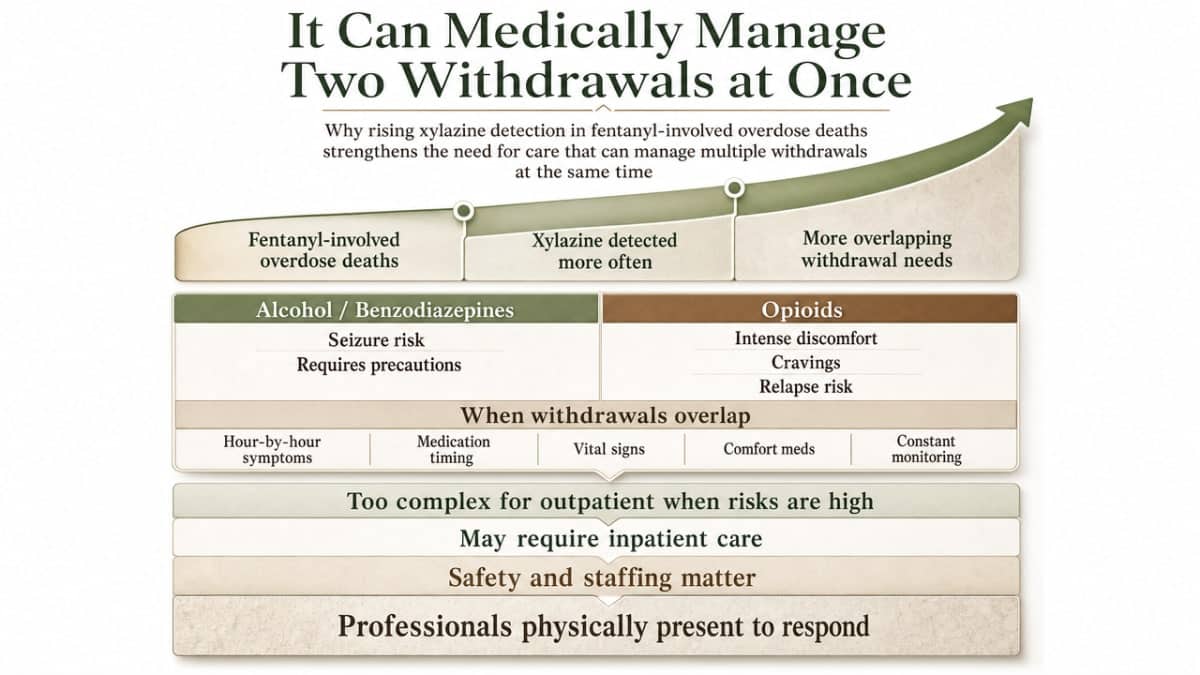
Managing withdrawal from two substances simultaneously is medically challenging and requires expert care. Alcohol and benzodiazepine withdrawal can lead to seizures, while opioid withdrawal, though rarely fatal, causes intense discomfort and cravings that can trigger relapse, especially with the unpredictable supply of illicit drugs. Combining these withdrawals necessitates constant monitoring, appropriate medication, and a team skilled in managing complex symptoms hour by hour.
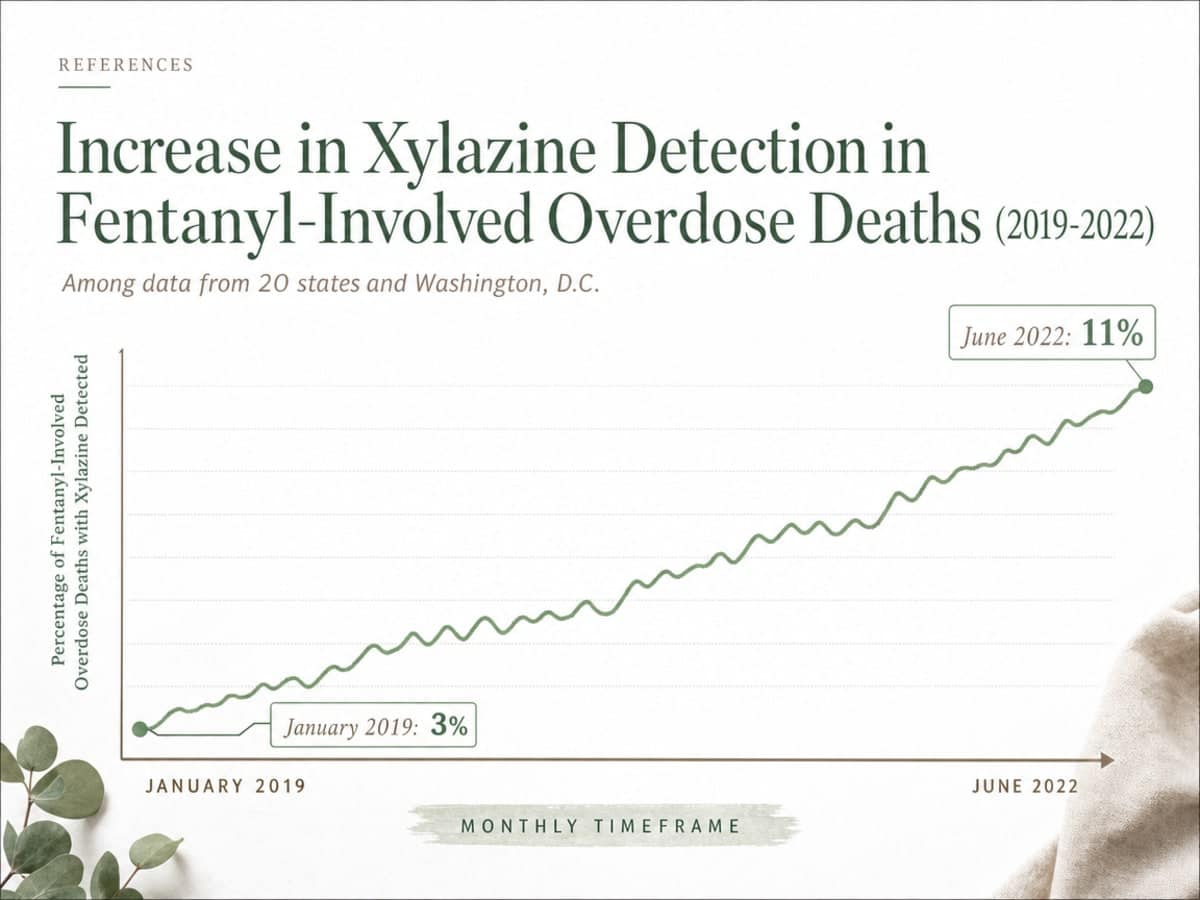
The urgency of this is underscored by the rise of adulterants. The CDC found that the monthly share of illegally manufactured fentanyl-involved overdose deaths also involving xylazine increased from 3% in January 2019 to 11% by June 2022 across 20 states and Washington, D.C.2. Xylazine is a sedative, not an opioid, meaning individuals seeking help for an “opioid problem” might unknowingly be withdrawing from two different drug classes. A program capable of managing multiple withdrawals simultaneously is not a luxury but a fundamental requirement for your safety.
It Picks Medications That Don’t Fight Each Other
Medication selection in polysubstance care is a complex process, not a simple choice. A medication effective for alcohol use might be dangerous if you are also using opioids. Similarly, a medication for opioid cravings could interact negatively with a benzodiazepine you are tapering. An effective program considers every substance you use, your liver and kidney function, and any mental health medications to create a safe and synergistic combination.
Consider alcohol use disorder. SAMHSA lists four FDA-approved medications: acamprosate, disulfiram, oral naltrexone, and extended-release injectable naltrexone15. While naltrexone is a common choice, it blocks opioid receptors. If you are actively using opioids, might need opioid pain medication, or are considering buprenorphine for opioid use disorder, naltrexone would be contraindicated. Liver function also plays a critical role. This single decision—which of the four options to use—integrates your opioid use, medical history, and treatment goals.
The National Institute on Drug Abuse (NIDA) confirms that no FDA-approved medication treats polysubstance use disorder as a single condition, and none exists for stimulant or cannabis use disorder11. Therefore, prescribers must combine substance-specific medications, monitor for interactions, and adjust as your body responds. The VA/DoD guideline emphasizes this as an ongoing process: monitoring response, adverse effects, adherence, and connection to recovery support, and adapting the plan as circumstances change5.
When evaluating a program, ask about the prescribing process, how often medications are reassessed, and what happens if a medication combination becomes ineffective. Clear answers indicating a physician-led process, a regular schedule, and a defined adjustment protocol signify care designed for individuals managing multiple substances.
It Treats Overdose Risk as a Design Question
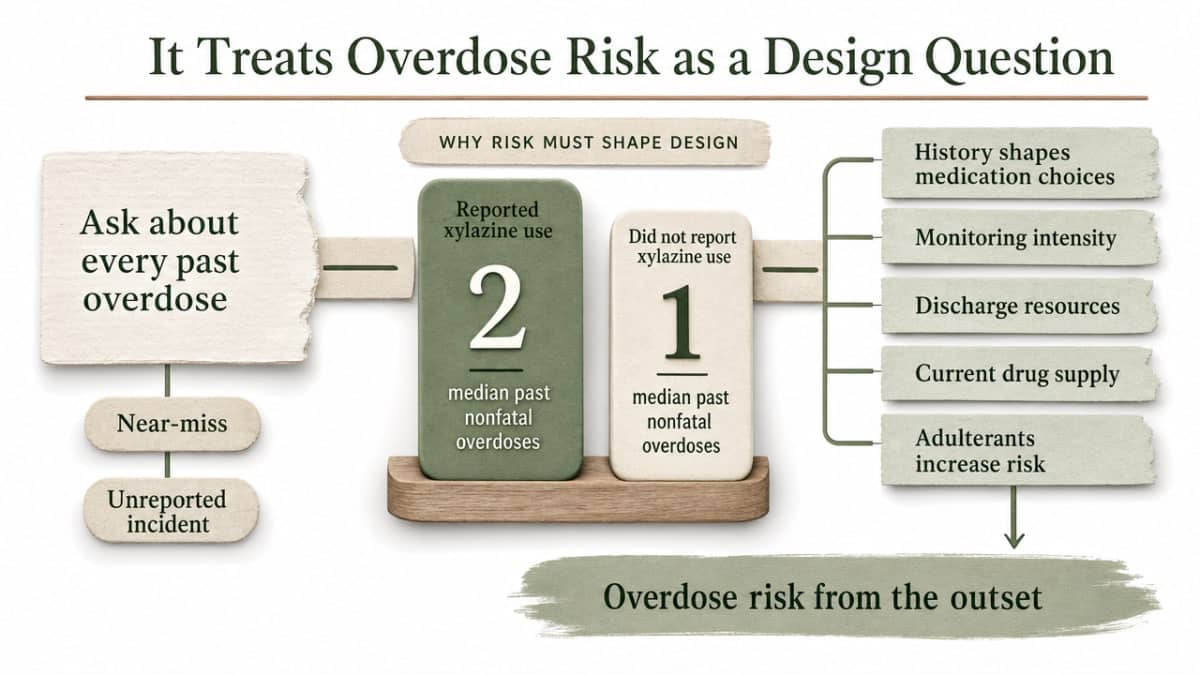
Overdose risk should be a foundational element of your treatment plan, much like a heart condition would influence a hospital stay. It’s not an afterthought but a primary consideration from the outset. A program that takes this seriously will inquire about every past overdose, near-miss, and unreported incident. This history directly impacts medication choices, monitoring intensity, and the resources you receive upon discharge.
The current drug supply, often contaminated with adulterants, makes this even more critical. Individuals using illicit substances frequently have a more extensive overdose history than a single-substance profile might suggest. In a CDC study, adults reporting xylazine use had a median of two past nonfatal overdoses, compared to one among those who did not report xylazine use3. This disparity highlights the importance of a thorough overdose risk assessment.
Effective overdose prevention is integrated into the treatment design. SAMHSA’s overdose toolkit outlines response steps:
- checking for a response,
- administering opioid-overdose reversal medication,
- calling for emergency help,
- supporting breathing, and
- giving additional doses if needed6.
This training should be part of your treatment, not just a pamphlet. It must also account for xylazine, which naloxone does not reverse. SAMHSA advises administering naloxone during a suspected opioid overdose, even with potential xylazine involvement, as breathing support and emergency care remain vital4.
Ask programs directly: Who teaches you and your family how to use naloxone? Will you receive naloxone upon discharge? What is the plan if you relapse in the vulnerable period after residential treatment when tolerance has decreased? Specific, detailed answers indicate a program prioritizing your safety.
It Uses Contingency Management When Stimulants Are in the Mix
If stimulants—such as methamphetamine, cocaine, or misused prescription stimulants—are part of your substance use, it’s important to know that there is currently no FDA-approved medication for stimulant use disorder11. This is a limitation of current science, not a program’s failing. However, contingency management is an evidence-based intervention strongly supported by research.
Contingency management involves providing tangible rewards, often gift cards or vouchers, for achieving specific goals, such as negative drug tests or consistent attendance at sessions. A systematic review of reviews found strong evidence for contingency management in stimulant use disorder, with additional benefits when combined with other interventions7. SAMHSA reinforced this in a 2025 advisory, highlighting its effectiveness for stimulant use disorders and its suitability for integration with other psychosocial and medical interventions for individuals with multiple substance use disorders14.
Inquire whether a program offers contingency management, how the incentive structure works, and how it integrates with your opioid or alcohol treatment. If the program dismisses this approach or refers to it as “bribery,” seek other options. When stimulants are involved, contingency management is a crucial component of the treatment plan.
It Treats the Mental Health Diagnosis at the Same Time
If you’ve been advised to achieve sobriety before addressing mental health conditions like depression, anxiety, PTSD, or bipolar disorder, you’ve received guidance that contradicts current evidence. Mental health conditions and substance use disorders are interconnected and often exacerbate each other. The panic that leads to benzodiazepine use will persist even after the substance is gone unless it is actively treated.
SAMHSA’s guidance on co-occurring disorders advocates for integrated care as the preferred model. Assessment should comprehensively cover symptoms, level of care, functional impairment, strengths, supports, cultural needs, and stage of change simultaneously10. AHRQ concurs, stating that mental health and substance use should be treated concurrently rather than sequentially1. A recent umbrella review of 28 systematic reviews found that integrated treatment generally yielded better outcomes than treating conditions in isolation, and sometimes surpassed parallel but uncoordinated services8.
While integration is not a panacea, a 2023 systematic review of randomized trials indicated that integrated treatment consistently improved psychiatric symptoms, though its impact on substance use outcomes or treatment retention was less consistent16. Nevertheless, improved mental well-being often provides the stability needed for overall recovery.
In practice, this means your therapist and prescriber communicate and coordinate. Trauma work is intentionally integrated with substance use groups. Psychiatric medications are selected in consideration of your opioid, alcohol, and stimulant use. If a program requires you to be “clean” for a certain period before addressing your PTSD, it signals a model not designed for the complexities of polysubstance use and co-occurring mental health conditions.
It Redefines Progress and Adjusts When Use Continues
Many programs may not openly acknowledge that recovery from polysubstance use is rarely a linear path to complete abstinence within 30 days. A program that discharges you for any continued use is failing to address the clinical reality it should be prepared to manage.
Data supports a more nuanced view of progress. A peer-reviewed follow-up of patients receiving opioid-maintenance treatment revealed that approximately two-thirds continued using other drugs to varying degrees after one year, while about one-third achieved abstinence from non-agonist medications9. This doesn’t signify treatment failure; rather, it indicates that individuals with multiple substance use disorders often reduce use gradually. Medication-assisted treatment for one substance can provide significant stability even when other substance use persists.
An effective program responds to continued use by adjusting the plan, not by discharging the patient. If you are stable on buprenorphine but still drinking, the response should be to add alcohol-focused care, not to discontinue buprenorphine. If contingency management for stimulant use becomes ineffective, the solution is to modify the reinforcement structure or introduce a new therapy, not to abandon treatment. NIDA’s principles emphasize that treatment must address the full spectrum of medical, psychological, social, and vocational needs, and that ongoing monitoring and continuing care are integral to its success13.
In this context, progress can manifest as fewer overdoses, reduced emergency room visits, stable employment, improved sleep, or choosing to seek help instead of using. Ask a program how they define a “good month.” If the only metric is a clean urine screen, they are measuring one aspect of a multifaceted life. If they discuss improvements in function, safety, and gradual change, they are equipped for the realities of polysubstance recovery.
It Runs a Continuum, Not a Single Level of Care
No single level of care is sufficient for sustained recovery from polysubstance use. Detox alone is not treatment, a 30-day residential stay is not a cure, and weekly outpatient groups are insufficient when your body is recovering from multiple withdrawals and your brain is adapting to life without substances. A continuum of care—a series of interconnected steps that provide seamless transitions—is essential, preventing abrupt disengagement when insurance benefits expire.
NIDA’s principles clearly state that treatment must be of adequate duration, and continuing care is vital for maintaining recovery13. This is why a continuum is so important. Your body first needs medical stabilization. Then, a structured environment where daily needs are met and external pressures are reduced. Following this, you need opportunities to practice recovery skills in real-world situations, managing responsibilities, family dynamics, cravings, and boredom. Each step down in intensity should maintain consistent medication management, therapeutic relationships, and mental health care, avoiding the need to restart these crucial elements.
A true continuum encompasses detox, residential inpatient, partial hospitalization (PHP), intensive outpatient (IOP), standard outpatient, and aftercare, with the same team overseeing your plan throughout each phase. Elk Ridge Recovery in Montana exemplifies this structure, offering physician-led detox, residential, PHP, IOP, outpatient, medication-assisted treatment, dual-diagnosis support, case management, and alumni programming within a single, private setting. This integrated approach, away from usual triggers, provides the necessary space for the treatment plan to be effective.
When considering a program, ask about the transition process between levels of care. Does the same prescriber follow you from residential to IOP, or do you start with someone new? Is aftercare a concrete schedule with identified contacts, or merely a document in your discharge folder? A program that can articulate a step-by-step continuum demonstrates a commitment to ongoing reassessment and adaptive care, which is crucial for polysubstance recovery.
How to Judge a Program in One Intake Call
You don’t need a clinical degree to distinguish an effective program from a partial one. A concise list of questions and trust in your intuition during the intake call can provide most of the information you need. A single 20-minute phone call can be highly informative.
Ask these questions, in an order that feels natural:
- “Do you screen for every substance at intake, including xylazine and fentanyl exposure?” A specific “yes” aligns with AHRQ’s standard for comprehensive care1.
- “Can you medically manage more than one withdrawal simultaneously, and who is on-site overnight?” Look for a physician-led answer, not just reassurance.
- “How do you select medications when I use both opioids and alcohol?” Listen for a detailed prescribing process, not a generic response.
- “Do you offer contingency management if stimulants are part of my use?” Evidence strongly supports this for stimulants14.
- “Will my mental health be treated concurrently, or do I need to achieve sobriety first?” Concurrent treatment is consistent with current guidelines10.
- “What is your policy if I use during treatment?” The ideal response involves adjustment, not immediate discharge.
- “Will I receive naloxone and training for my family upon discharge?” The answer should be a clear “yes,” with specifics about provision6.
- “What does aftercare specifically entail, including names and schedules?”
Vague answers are also informative. Continue calling programs until you receive specific and comprehensive responses.
A Realistic Path Forward
You don’t need to have everything figured out today. Your immediate goal is to connect with a program that can address every aspect of your situation—the substances, withdrawals, mental health, medical history, and the life you aspire to reclaim. The standard for effective care involves screening for all substances, concurrent treatment, individualized medication plans, integrated mental health care, and continuous adjustment as you progress1.
In practice, this means a team that consistently reassesses your needs. Your initial plan is not static. Medications that work in week one may need adjustment by week six. Therapy approaches effective in residential care might require modification for an intensive outpatient setting. NIDA’s principles emphasize that ongoing care and monitoring are integral to treatment success, not optional add-ons13. A program designed for polysubstance recovery views the treatment plan as a dynamic, evolving entity.
Elk Ridge Recovery in Montana offers this comprehensive continuum of care—from detox through aftercare, including medication-assisted treatment, dual-diagnosis support, and case management, all under one integrated team. Ask Elk Ridge Recovery about treatment for polysubstance use. An honest conversation is the starting point for your path forward. You don’t have to navigate it alone.
Talk to a Team Member About Your Options
Get answers now about comprehensive support for polysubstance use and next steps tailored to your needs.
Frequently Asked Questions
How is polysubstance abuse treatment different from regular rehab?
Regular rehab often focuses on a single primary substance. Polysubstance care, however, begins with screening for every substance used and then treats them concurrently rather than sequentially. AHRQ defines this standard as comprehensive screening, medication for each applicable disorder, psychosocial support, overdose-risk planning, and integrated mental health care delivered by a unified team1. The treatment plan is also continuously reassessed and adapted as your physical and life circumstances change.
Can a program safely manage withdrawal from more than one substance at the same time?
Yes, but often this requires an inpatient setting due to the complexities and risks involved. AHRQ notes that managing multiple withdrawals can be challenging outside of inpatient facilities when significant risks are present1. For example, alcohol and benzodiazepine withdrawal can induce seizures, while opioid withdrawal causes intense cravings. When evaluating a program, ask about overnight staffing, physician involvement in detox, and how vital signs, symptom scales, and comfort medications are managed hourly. Specific answers indicate a program equipped for this level of care.
What happens if I continue using one substance while being treated for another?
An effective program will adjust the treatment plan rather than discharge you. A one-year follow-up study of patients in opioid-maintenance treatment showed that approximately two-thirds continued some other drug use, while about one-third achieved abstinence from non-agonist substances9. This outcome is not considered a failure but rather an indication to enhance treatment, perhaps by adding alcohol-focused care, modifying contingency management strategies, or increasing support. Continued use should prompt more treatment, not less.
How does a program handle mental health conditions alongside multiple substances?
Integrated care is the preferred model. SAMHSA recommends treating mental health and substance use disorders simultaneously, using a coordinated assessment that covers symptoms, functional impairment, strengths, support systems, and stage of change10. An umbrella review found that integrated treatment generally yielded better outcomes than treating conditions separately8, although a 2023 review indicated that psychiatric symptom improvement was more consistently observed than gains in substance use outcomes or treatment retention16. Ideally, your therapist and prescriber should be in regular communication.
What questions should I ask on an intake call to judge a program?
Inquire if they screen for every substance, including xylazine and fentanyl exposure. Ask how they medically manage multiple withdrawals and who provides overnight supervision. Ask about their process for selecting medications when both opioids and alcohol are involved. Determine if contingency management is offered for stimulant use14. Confirm if mental health is treated concurrently. Ask about their policy if you use during treatment, and whether you will receive naloxone and family training upon discharge6.
Is there a single medication that treats polysubstance use disorder?
No. NIDA explicitly states that no FDA-approved medication treats polysubstance use disorder as a unified condition, nor are there specific medications for stimulant or cannabis use disorder11. Prescribers instead combine substance-specific medications while carefully monitoring for interactions. For alcohol use disorder, SAMHSA lists four approved options: acamprosate, disulfiram, oral naltrexone, and extended-release injectable naltrexone15. Naltrexone, however, can conflict with opioid treatment, underscoring the need for medication selection to reflect your complete clinical picture.
References
- Polysubstance Use & Integrated Behavioral Health | AHRQ. https://integrationacademy.ahrq.gov/products/topic-briefs/polysubstance-use
- Polysubstance Overdose | Overdose Prevention | CDC. https://www.cdc.gov/overdose-prevention/about/polysubstance-overdose.html
- MMWR, Volume 73, Issue 26 — July 4, 2024. https://www.cdc.gov/mmwr/volumes/73/wr/pdfs/mm7326-H.pdf
- Xylazine and Drug Mixtures. https://library.samhsa.gov/sites/default/files/xylazine-drug-mixtures-pep24-02-015.pdf
- VA/DoD Clinical Practice Guideline for the Management of Substance Use Disorders. https://www.healthquality.va.gov/guidelines/MH/sud/VA-DoD-SUD-CPG_Final_for-508_v3.pdf
- Overdose Prevention and Response Toolkit. https://library.samhsa.gov/product/overdose-prevention-response-toolkit/pep23-03-00-001
- Treatment of stimulant use disorder: A systematic review of reviews. https://pmc.ncbi.nlm.nih.gov/articles/PMC7302911/
- Effectiveness of Psychosocial Interventions for Adults With Substance Use and Co-Occurring Mental Health Disorders: An Overview of Systematic Reviews. https://pmc.ncbi.nlm.nih.gov/articles/PMC12682421/
- Harm Reduction Journal 2024;21:101. https://pmc.ncbi.nlm.nih.gov/articles/PMC11127449/pdf/12954_2024_Article_1005.pdf
- Substance Use Disorder Treatment for People with Co-Occurring Disorders. https://library.samhsa.gov/sites/default/files/pep20-06-04-006.pdf
- Priority Scientific Area #2: Develop and Test Novel Prevention and Treatment Strategies. https://nida.nih.gov/about-nida/2022-2026-strategic-plan/priority-area-2
- Drug Overdose Deaths in the United States, 2023–2024. https://www.cdc.gov/nchs/products/databriefs/db549.htm
- Principles of Drug Addiction Treatment: A Research-Based Guide. https://nida.nih.gov/sites/default/files/podat-3rdEd-508.pdf
- Using SAMHSA Funds To Implement Evidence-Based Contingency Management Services. https://library.samhsa.gov/sites/default/files/contingency-management-advisory-pep24-06-001.pdf
- Prescribing Pharmacotherapies for Patients With Alcohol Use Disorder. https://library.samhsa.gov/sites/default/files/PEP20-02-02-015.pdf
- Integrated vs non-integrated treatment outcomes in dual diagnosis disorders: A systematic review. https://pmc.ncbi.nlm.nih.gov/articles/PMC10157410/