Key Takeaways
- Dual diagnosis care treats substance use and mental health conditions together from day one, since decades of evidence show sequential or siloed treatment leaves too much untouched 1.
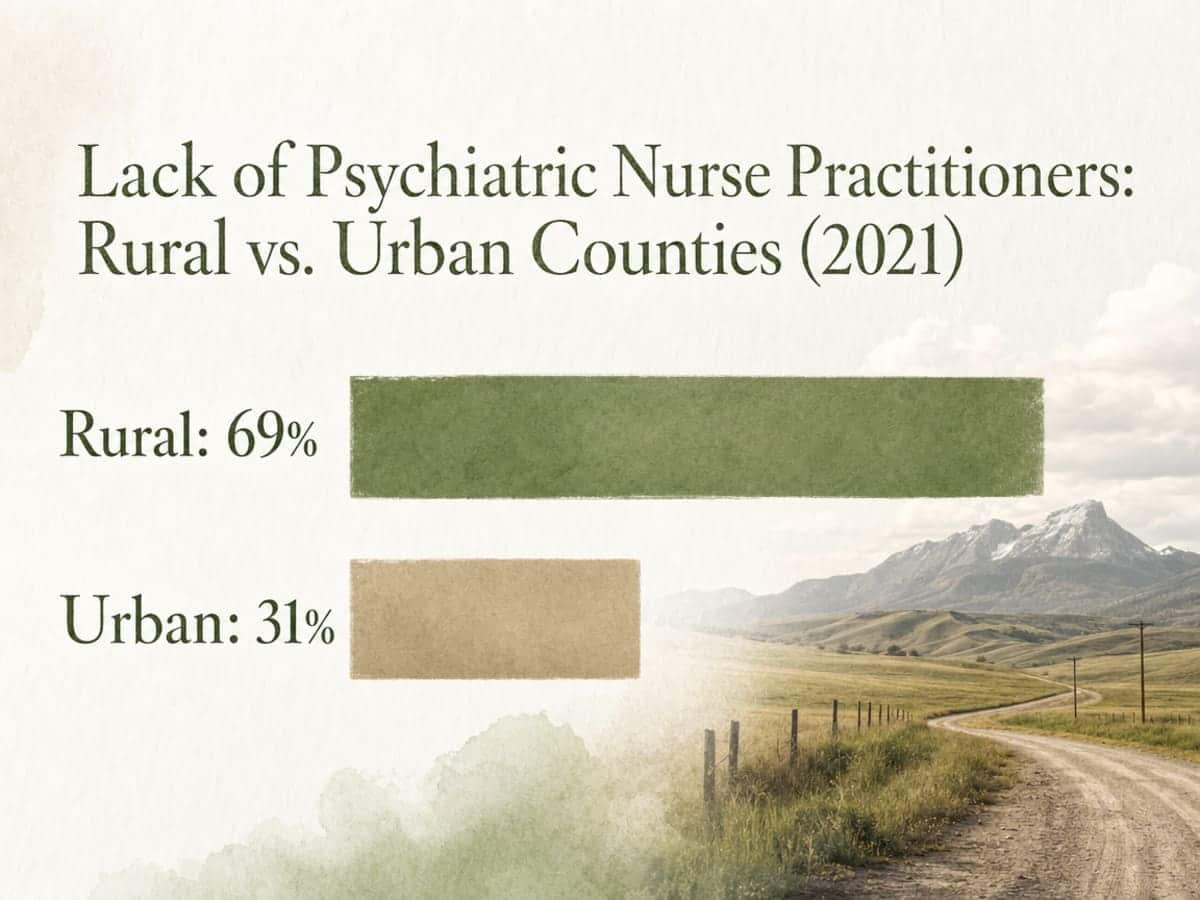
- Montana’s rural geography and workforce shortages make coordinated care hard to piece together locally, with 69% of rural U.S. counties lacking psychiatric mental-health nurse practitioners in 2021 7.
- Coverage options exist, including the HEART Section 1115 waiver that reimbursed residential services for 1,350 Montanans in state fiscal year 2024, alongside commercial insurance shaped by federal parity law 4.
- When vetting a Montana provider, confirm licensing and accreditation, in-house psychiatric prescribing, shared charts between therapy and psychiatry, and a clear step-down and aftercare path 10.
The 3 A.M. Question: Which One Came First?
You know the hour. The house is quiet, the phone screen is too bright, and the question shows up again: was it the drinking that made you feel this way, or did you start drinking because you already felt this way? Was it the pills that flattened everything, or were you reaching for the pills because everything already felt flat?
If you’ve been turning that question over for months or years, you’re not broken for not having an answer. Most people can’t untangle it on their own. The anxiety and the drinking braid together. The trauma and the pills feed each other. By the time you’re awake at 3 a.m. trying to sort out which one came first, they’ve been shaping each other for a long time.
Here’s what matters more than the origin story: you don’t have to figure it out alone, and you don’t have to fix one before you get help with the other. That old idea — get sober first, then deal with your mental health, or stabilize your mental health first, then deal with the substances — has fallen apart under decades of evidence. Care that treats both together tends to work better than care that treats them one at a time 1.
This guide walks through what dual diagnosis actually means, what integrated treatment looks like in Montana, and how a residential program like Elk Ridge Recovery approaches both sides of the picture. No sales pitch. No promises that recovery is simple. Just what you need to decide whether reaching out is the next right step.
What Dual Diagnosis Actually Means
Dual diagnosis is a two-word way of saying something pretty simple: you’re living with a substance use disorder and a mental health condition at the same time. Depression and alcohol. Anxiety and stimulants. PTSD and opioids. Bipolar disorder and just about anything you can reach for on a bad night. Clinicians also call it co-occurring disorders. Same idea.
It’s not a rare diagnosis or an unusual complication. It’s how addiction shows up for a large share of people who walk into treatment. The two conditions get tangled because they feed each other — a drink softens the panic, then the hangover deepens the panic, then you need another drink. Over months and years, that loop rewires how you sleep, how you eat, how you handle a hard Tuesday. Your brain adapts to both the substance and the mental health symptoms, which is why willpower alone rarely undoes what took years to build.
The National Institute on Drug Abuse is clear on the treatment piece: co-occurring conditions are usually better addressed together rather than one at a time, and care often combines therapy with medication when it’s clinically appropriate 1. That doesn’t mean every person needs the same plan. Someone with alcohol use disorder and long-standing depression will need something different than someone with methamphetamine use and unprocessed trauma.
What matters is that you don’t have to pick which condition to treat first. You don’t have to be sober for 90 days before someone will take your anxiety seriously. You don’t have to have your mental health perfectly stable before someone will help you stop using. A program built around dual diagnosis assumes both are on the table from day one.
Why Treating Both at Once Matters
For a long time, the treatment world ran on a stubborn idea: get clean first, then we’ll look at the depression. Stabilize the bipolar first, then we’ll deal with the drinking. If you’ve ever been bounced between a substance use program and a mental health clinic that couldn’t quite talk to each other, you know how that plays out. You get partial help for one thing, partial help for the other, and neither side sees the whole person sitting in the chair.
The evidence has caught up with what a lot of people already suspected from lived experience. A 2025 umbrella review that pulled together 28 systematic reviews on psychosocial care for co-occurring substance use and mental health conditions found that integrated or coordinated treatment generally did better than treating one condition alone or shuttling people between parallel, uncoordinated services 2. The researchers were honest about the mess in the data — the studies varied in quality and design — but the direction was clear enough to matter for how care gets built.
Practically, integrated care means the psychiatrist knows what the addiction counselor is seeing, the therapist knows what medication you started this week, and the plan on the wall accounts for both. When those pieces are separated by different buildings, different records, and different waiting lists, the gaps are where people fall through. When they’re in the same room, the gaps get smaller. That’s the whole argument for doing this together — not that it’s easier, but that it holds.
Montana Makes This Harder Than It Should Be
Let’s be honest about the map. Montana is big, the roads are long, and the nearest psychiatrist might live three hours from your kitchen table. If you’ve ever called around trying to find someone who takes your insurance, understands both addiction and mental health, and has an opening before next spring — you already know this isn’t just a scheduling problem. It’s a geography problem, a workforce problem, and a weather problem all stacked on top of each other.
The numbers back up what you’ve been living. HRSA’s 2025 behavioral health workforce brief found that 69% of rural U.S. counties lacked psychiatric mental-health nurse practitioners in 2021, compared with 31% of urban counties 7. Montana is mostly rural counties. That gap is why the same handful of prescribers get booked out for months, and why some people give up before they ever get a first appointment. It’s also why care that’s coordinated inside one program — instead of scattered across three towns — matters so much here.
There is federal money moving toward the problem. HRSA reported roughly $6.4 million in FY 2025 rural-health funding for Montana, including work aimed at substance-use-related morbidity and mortality 8. That helps. It doesn’t rebuild a workforce overnight, and it doesn’t shorten the drive from Glasgow to a psychiatrist. But it’s a signal that the access gap is being taken seriously at the state and federal level.
What this means for you, practically: waiting for the perfect local option to appear may cost you more time than you have. The 2024 CDC provisional count recorded 171 Montana drug overdose deaths, a number that will be revised as final data lands but that already says something about the cost of delay 5. A residential program inside the state — where you live and sleep and eat in one place with clinicians who work as one team — solves several of these problems at once. You’re not driving between appointments. You’re not stitching together three providers who’ve never met. You’re not depending on a single overbooked prescriber to hold your whole care plan.
None of this is your fault. You didn’t design the workforce shortage or the county lines. You’re just trying to get well in a state that makes getting well complicated. Knowing what you’re up against is part of making a plan that actually works.
What Integrated Care Looks Like on a Real Day
Integrated care sounds like a policy word until you actually walk through a Tuesday inside it. So here’s a Tuesday.
You wake up in the same building where your treatment happens. Breakfast isn’t a separate errand — it’s part of the day. Before mid-morning, you meet with a therapist who already knows what your psychiatrist prescribed on Monday, because they share the same chart and sat in the same team meeting about you that week. There’s no faxing records. No repeating your trauma history to a new intake coordinator. The person across from you already knows the outline.
Group happens next. It might be a relapse-prevention group, or one focused on how anxiety shows up when you’re sober, or a skills group on tolerating hard feelings without a substance to blunt them. The group leader isn’t guessing about which topics land for you — they’ve read the same notes your therapist wrote.
Somewhere in the afternoon, if medication is part of your plan, you see the prescriber. This might be a psychiatric provider who can adjust an antidepressant, or a medical clinician managing medication-assisted treatment for opioid or alcohol use disorder, or both working from one plan. Decisions about what to add, taper, or leave alone happen with your input and with the rest of the team looped in — not in a separate clinic three weeks from now.
Family fits in too, when it’s safe and useful. A family therapy session or a family education call can happen the same week, so the people who will drive you home in a month understand what you’ve been building.
The day ends with something that doesn’t feel like a clinical intervention — a walk, a meal, a conversation with someone on staff who has been where you are. That’s not filler. Time between sessions is where the nervous system starts to reset.
What makes this integrated isn’t the schedule. It’s that one team, one chart, and one plan sit underneath every part of the day. When the psychiatrist changes a dose, your therapist knows by the next morning. When you tell your counselor that group made your chest tight, that shows up in the psychiatry visit. The evidence for doing it this way is imperfect but consistent — the 2025 umbrella review of 28 systematic reviews on co-occurring care found integrated approaches generally outperformed parallel, uncoordinated ones, even as the researchers flagged wide variation in study quality 2. What you feel from the inside is smaller: fewer people to update, fewer stories to repeat, fewer gaps where something important gets lost between appointments.
When Stimulants, Opioids, and Mental Health Overlap
Addiction doesn’t always stay in its lane. A lot of people show up to treatment using more than one substance, and the pattern often maps onto whatever mental health symptom they’re trying to outrun. Meth to get through a shift when depression has flattened your energy. A benzo to bring down the panic that meth kicked up. An opioid on top of both because sleep stopped happening weeks ago. If any of that sounds familiar, you’re not an unusual case.
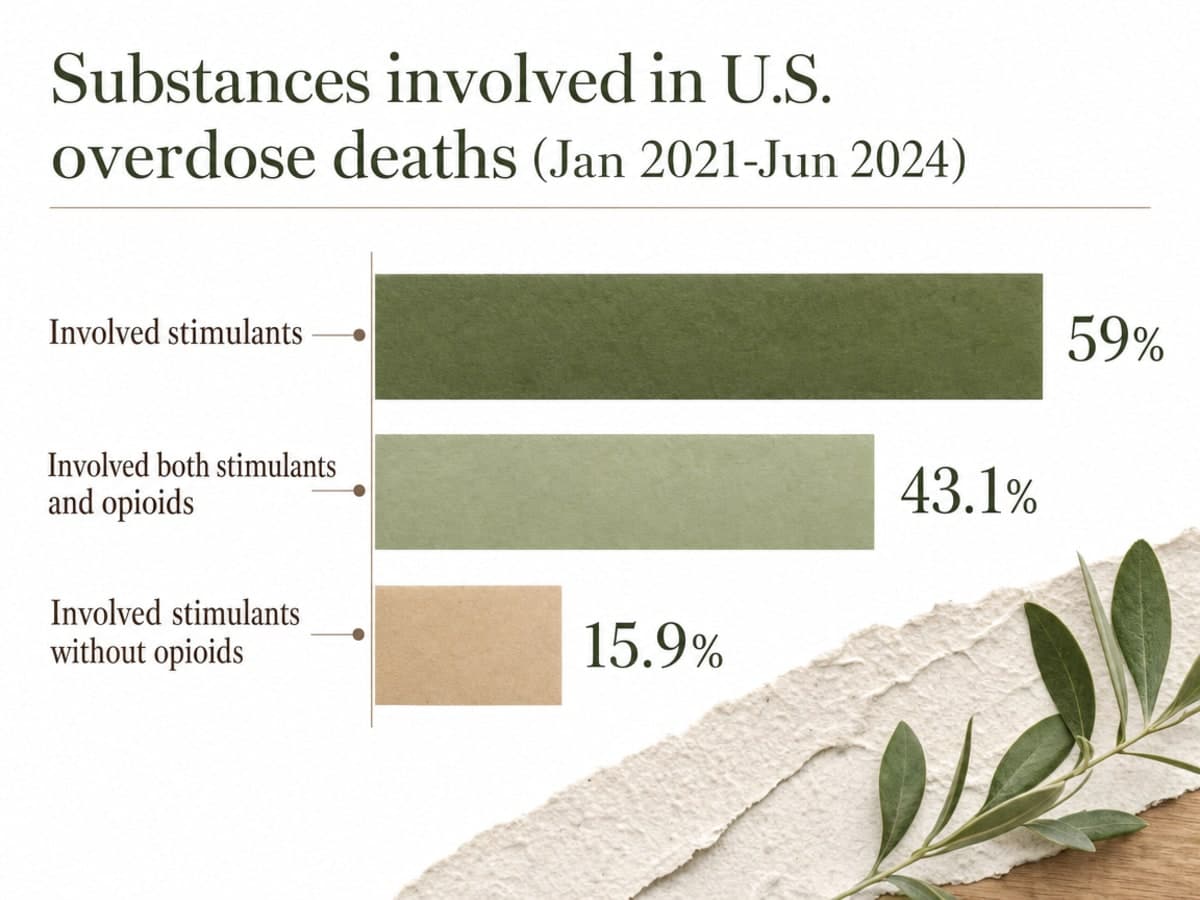
The national picture makes the point. In a CDC MMWR report covering January 2021 through June 2024, 59.0% of U.S. overdose deaths involved stimulants, 43.1% involved both stimulants and opioids, and 15.9% involved stimulants without opioids 11. Those are national numbers, not Montana-specific ones, and they count deaths — not the much larger group of people using these combinations who are still alive and looking for a way out. But the shape of it tells you something important: polysubstance use is closer to the norm than the exception, and stimulant-opioid combinations are doing a lot of the damage.
Here’s where mental health slides in. Stimulants can mimic and worsen anxiety, paranoia, and mania. Opioids can flatten emotion and deepen depression, especially in the crash after a dose wears off. Alcohol pulls in both directions depending on the hour. When you’re using two or three of these together, symptoms stop having clean sources. Is the racing heart withdrawal, or an anxiety disorder that was there before the meth? Is the numbness the opioid, or depression the opioid was covering? A single-substance treatment plan can’t answer those questions, because it isn’t looking at the whole picture.
Integrated dual diagnosis care handles this by starting with a full assessment — every substance you’ve been using, every mental health symptom, and the timeline of how they’ve shaped each other. Medication decisions get made in the same room as therapy decisions, not in separate clinics that never talk. If you’re using stimulants and opioids and living with untreated PTSD, the plan has to account for all three, or one of them will pull the others back.
Paying for Care: HEART, Insurance, and What to Ask
Money is often the reason people don’t call. You think you can’t afford it, so you don’t ask, so you never find out what you actually could afford. Let’s put some real ground under this.
Montana has a Medicaid pathway called the HEART waiver — a Section 1115 demonstration that covers adults ages 18 to 64 with substance use disorders and/or serious mental illness, including reimbursement for short-term residential treatment in facilities that would otherwise be excluded under old Medicaid rules. In state fiscal year 2024, 1,350 Montanans received Medicaid-reimbursable clinically managed residential services through the waiver 4. That’s not a promise you’ll qualify — eligibility and covered services are narrower than the full range of care someone might need, and every case has to be checked individually. But it means residential dual diagnosis treatment isn’t automatically off the table just because you’re on Medicaid or think you might qualify.
If you have commercial insurance through a job or a spouse, most plans cover some level of substance use and mental health treatment because federal parity law requires it. What’s covered, for how long, and at which facilities varies a lot. Deductibles, prior authorization, and in-network status all shape what you actually pay.
When you call a program, a few direct questions save days of confusion:
- Do you accept Montana Medicaid or the HEART waiver?
- Are you in-network with my specific insurance plan?
- What will I owe out of pocket, and can someone verify my benefits before I commit?
- If insurance denies part of the stay, what happens next?
You don’t have to have the answers before you pick up the phone. The admissions team is supposed to help you find them.
How Elk Ridge Recovery’s Montana Program Fits In
Elk Ridge Recovery sits inside the state, not three flights and a rental car away. That matters more than it sounds. When you’re deciding whether to leave home to get well, staying in Montana means your family can drive to a family session, your discharge plan can point to real Montana resources, and the culture around you isn’t a jarring change on top of everything else you’re already carrying.
The program runs a full continuum — physician-led medical detox, residential inpatient, partial hospitalization, intensive outpatient, standard outpatient, and aftercare — which means you’re not handed off to a stranger every time your level of care changes. Dual diagnosis support is built into that continuum rather than bolted on. Psychiatric involvement, medication-assisted treatment when it fits, individual and group therapy, family therapy, peer support, and case management all sit under one roof and one plan. That’s what makes it integrated in the operational sense the earlier sections described: one team, one chart, one plan, from detox through the first months of independent living.
A few pieces are worth naming specifically for a Montana reader. The clinical team includes people with lived recovery experience, which changes how conversations sound in group and in the hallway. Montana licensed addiction counselors are required to complete 30 hours of coursework specifically in co-occurring disorders as part of their 330 hours of addiction training 9 — a baseline that shapes how in-state programs think about the mental health side of the picture. Elk Ridge Recovery is JCAHO-accredited, which is an external check on how the program handles safety, records, and clinical processes.
The setting is deliberate. A private Montana property gives you space to sleep, eat, walk outside, and let a nervous system that’s been running on cortisol for years start to slow down. Wellness programming, adventure and outdoor therapy, and structured community time aren’t garnish — they’re where a lot of the between-session work happens. For adults across Montana, Idaho, North Dakota, South Dakota, and Wyoming, that combination — clinical care, dual diagnosis integration, and a place that doesn’t feel like a hospital hallway — is what the program is built to offer. If you want the specifics of how the dual diagnosis piece is structured, or how a particular condition like anxiety, depression, or trauma gets addressed inside the program, the condition-specific pages go deeper than a state hub reasonably can.
What to Look for in a Montana Dual Diagnosis Provider
Once you decide to call somewhere, the next question is which somewhere. Not every program that puts “dual diagnosis” on the website actually treats both conditions together. A few markers help you tell the difference without needing a clinical background.
Start with the basics. Montana law defines a substance-use-disorder facility as one whose function includes treatment, rehabilitation, and prevention of chemical-substance use that creates behavioral or health problems 10. That’s the legal floor. On top of it, look for an accreditation like JCAHO or CARF — an outside body checking how the program handles safety, records, and clinical processes. Ask directly.
Then ask about the team. A real dual diagnosis program has psychiatric prescribing available inside the program, not through a referral to a clinic across town. Ask whether medication-assisted treatment is offered when it’s clinically appropriate for opioid or alcohol use disorder. Ask how often the therapy team and the psychiatric team actually meet about your case. Montana licensed addiction counselors are required to complete 30 hours of coursework specifically in co-occurring disorders as part of their 330 hours of addiction training 9 — so a Montana-licensed counselor should be comfortable talking with you about the mental health side, not just the substance use.
A few more questions worth asking before you commit:
- How is my treatment plan built, and who’s on the team that writes it?
- Do therapy and psychiatry share one chart, or are they separate systems?
- What happens when I step down from residential — do I stay with the same program for outpatient, or get handed off?
- How is family involved, and how soon?
- What does aftercare actually look like six months from now?
Trust what the answers sound like. A program that treats both conditions together can explain how, in plain language, without dodging.
The Honest Limits of Dual Diagnosis Treatment
The research is honest about its own limits too. The 2025 umbrella review that supports integrated care also flagged wide variation in study quality and design across the 28 systematic reviews it pulled together 2. Translation: this approach works better than the alternatives on average, but no program can promise you a specific outcome. Medication decisions are individualized. Some people need a med for a season. Some need one for years. Some do well without one.
What you can count on is this: reaching out is not a commitment to being fixed. It’s a commitment to not doing this alone anymore. That’s enough for today.
Talk with someone who understands dual diagnosis
Get answers and real support for co-occurring mental health and addiction challenges right now.
Frequently Asked Questions
How do I know if I need dual diagnosis treatment instead of regular rehab?
If you’ve noticed that using gets worse when your anxiety, depression, trauma symptoms, or mood swings flare up — or that those symptoms get louder when you try to stop — you’re likely dealing with both at once. You don’t need a formal diagnosis before you call. A good program will assess both sides during intake and build a plan around what they find 1. Trust what you already know about your own pattern.
Does Montana Medicaid cover residential dual diagnosis treatment?
Often, yes. Montana’s HEART Section 1115 waiver covers adults ages 18 to 64 with substance use disorders and/or serious mental illness, including short-term residential treatment that older Medicaid rules would have excluded. In state fiscal year 2024, 1,350 Montanans received Medicaid-reimbursable clinically managed residential services through the waiver 4. Eligibility and covered services vary by person, so ask the admissions team to verify your specific benefits before you commit.
Will I have to stop my psychiatric medications to get sober?
No. That’s an old myth, and it can be a dangerous one. Stopping an antidepressant, mood stabilizer, or anxiety medication cold to “prove” you’re sober usually makes things harder, not easier. In an integrated program, a psychiatric prescriber reviews what you’re taking, what’s working, and what needs adjusting alongside your addiction care 1. Medication decisions are individualized. Some things stay. Some things change. Nothing gets pulled without a reason and a plan.
What happens if I live hours away from the nearest treatment center?
You’re not alone in that. HRSA’s 2025 workforce brief found that 69% of rural U.S. counties lacked psychiatric mental-health nurse practitioners in 2021, compared with 31% of urban counties 7. Distance is one reason residential care can actually be easier than piecing together local outpatient — you go once, stay, and get everything in one place. Programs typically help coordinate travel, and family sessions can happen by phone or video during your stay.
How long does dual diagnosis treatment usually last?
It depends on what you’re walking in with. A residential stay might run a few weeks to a few months, followed by partial hospitalization, intensive outpatient, standard outpatient, and aftercare that can extend for a year or more. The mental health piece doesn’t end when residential ends — depression, PTSD, and bipolar disorder need ongoing care. Think of treatment less as a fixed number of days and more as a step-down path with support at every level.
What should I ask a Montana treatment provider before I go?
Ask if they’re licensed as a substance-use-disorder facility under Montana law 10 and whether they hold an outside accreditation like JCAHO or CARF. Ask if psychiatric prescribing and medication-assisted treatment happen inside the program, not through outside referrals. Ask if therapy and psychiatry share one chart. Ask what happens when you step down from residential — same team, or handoff? Ask how family is involved and what aftercare looks like six months out.
References
- Co-Occurring Disorders and Health Conditions. https://nida.nih.gov/research-topics/co-occurring-disorders-health-conditions
- Effectiveness of Psychosocial Interventions for Adults With Substance Use Disorders and Co-Occurring Common Mental Health Disorders: An Umbrella Review. https://pmc.ncbi.nlm.nih.gov/articles/PMC12682421/
- A Systematic Review and Meta-Analysis of Psychosocial Interventions for Persons with Comorbid Anxiety and Substance Use Disorders. https://pmc.ncbi.nlm.nih.gov/articles/PMC11347123/
- section 1115 heart demonstration waiver legislative summary. https://archive.legmt.gov/content/Publications/services/2024-agency-reports/MCA_53-2-215_HEART_Waiver.pdf
- Provisional Drug Overdose Death Counts. https://www.cdc.gov/nchs/nvss/vsrr/drug-overdose-data.htm
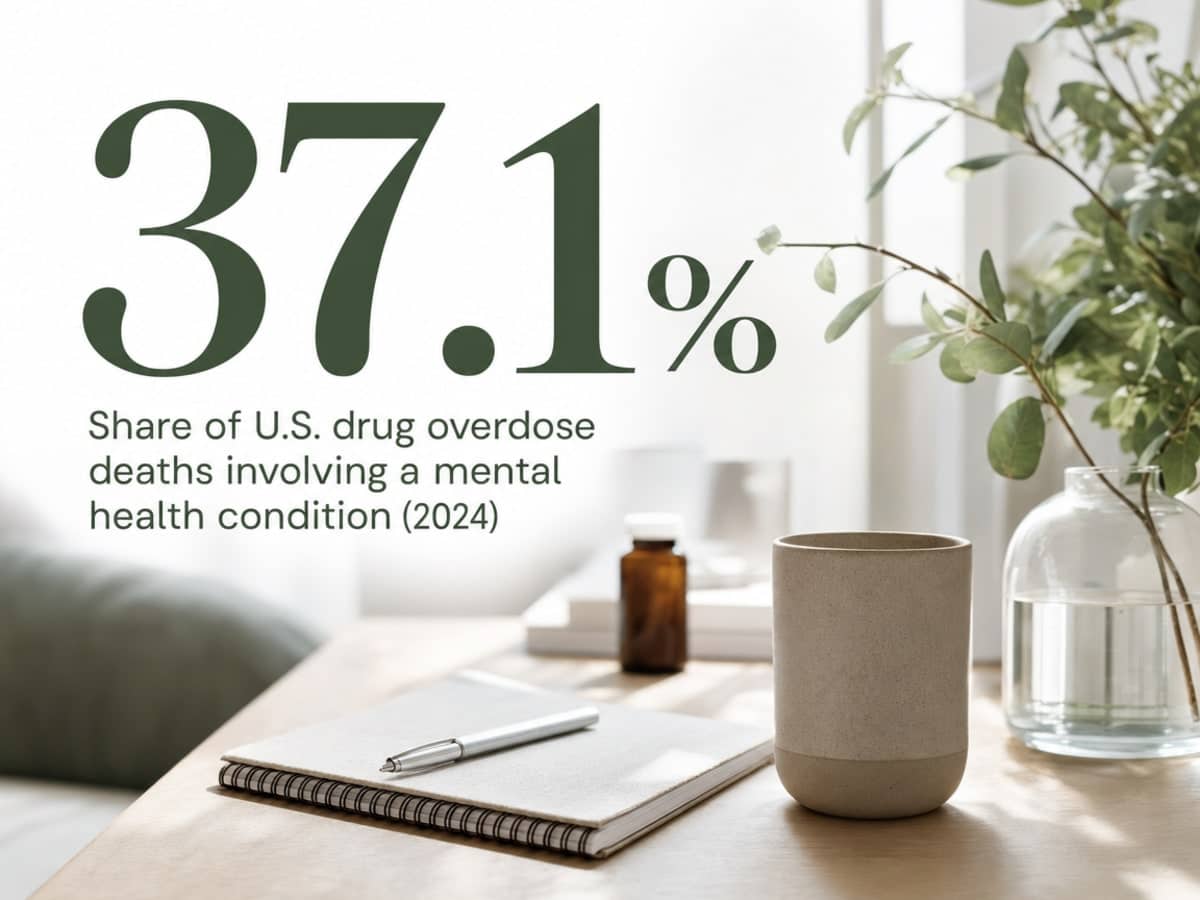
- Evidence Of A Mental Health…. https://www.cdc.gov/mental-health/about-data/substance-use-mental-health.html
- State of the Behavioral Health Workforce, 2025. https://bhw.hrsa.gov/sites/default/files/bureau-health-workforce/data-research/Behavioral-Health-Workforce-Brief-2025.pdf?5056e3d9_page=3&p=1509
- FY 2025: HRSA’s Rural Health Grants — Montana Fact Sheet. https://www.hrsa.gov/sites/default/files/hrsa/rural-health/resources/fy-2025-montana-fact-sheet.pdf
- Licensing Requirements and Application Checklist Licensed Addiction Counselor. https://boards.bsd.dli.mt.gov/Portals/133/Documents/bbh/BBH-LAC-APP_License-App-Checklist.pdf
- 50-5-101. Definitions, MCA. https://mca.legmt.gov/bills/mca/title_0500/chapter_0050/part_0010/section_0010/0500-0050-0010-0010.html
- Drug Overdose Deaths Involving Stimulants — United States, January 2021–June 2024. https://www.cdc.gov/mmwr/volumes/74/wr/mm7432a1.htm