Key Takeaways
- Montana saw suspected opioid overdoses jump to 95 in March 2025 versus a 2024 monthly average near 69, with Yellowstone County flagging a sharp fentanyl cluster 18, 17.
- Montana licenses outpatient, inpatient, residential, and partial hospitalization SUD facilities, and Medicaid covers the full continuum plus medication-assisted treatment when medically necessary 14, 16.
- Buprenorphine induction after fentanyl carries real risk when self-managed, but under clinical monitoring only 9 of 1,200 patients experienced precipitated withdrawal in a recent trial 6, 5.
- Call a Montana program that offers detox and residential care, ask about same-day admission, transport from your town, and insurance verification, and keep naloxone within reach until arrival 12, 19.
Why Fentanyl Changes the Timing of Getting Help
If you are using fentanyl right now, or you love someone who is, the calendar matters more than it used to. Fentanyl is a synthetic opioid strong enough that a dose you cannot see or measure can stop your breathing before help arrives 1. It shows up in counterfeit pills that look like Percocet, Xanax, or oxycodone, and it turns up mixed into powders sold as something else 1, 20. The window between deciding to stop and getting into a supervised setting is where most of the danger lives.
That is the honest reason this page exists. You have probably tried to stop before. Maybe you got a few days in and the withdrawal turned into something you could not sit through alone. Maybe you started a medication at home and it made you sicker instead of better. Neither of those outcomes means you failed. They mean the timing and the setting were wrong for a drug that behaves differently than heroin or prescription pills.
Here is what changes when fentanyl is the opioid in your system: withdrawal starts faster and hits harder, starting buprenorphine takes a specific plan rather than a generic one, and the risk of a fatal overdose is highest in the days right after you stop and your tolerance drops. Getting into a program that expects all three of those things, on the day you decide, is what shortens the dangerous window. The rest of this guide walks through how that actually works in Montana.
Fentanyl Is Not a New Disease. It Is a Harder Version of an Old One.
What Makes Fentanyl Different From Pills or Heroin You May Have Used
Fentanyl is an opioid, the same drug class as heroin, oxycodone, and hydrocodone. Your brain responds to it through the same receptors. The medications that treat opioid use disorder still work on it. What changes is the math on the front end.
Fentanyl is stronger than most other opioids by a wide margin, which means a tiny amount can produce a full dose, and a slightly bigger amount can stop your breathing 1. It is also being pressed into pills that look identical to Percocet, Xanax, or oxycodone from a pharmacy, and mixed into powders sold as heroin, cocaine, or methamphetamine 1, 20. Two pills from the same bag can carry different amounts of active drug, because street pressing is not quality-controlled manufacturing.
That unpredictability is the piece that trips people up. If you used pills or heroin years ago and came back to a supply that now contains fentanyl, your old tolerance is not a reliable guide. If you have been using fentanyl for months, your body has adapted to a level of opioid exposure that is difficult to replicate with anything else, which is part of why the withdrawal feels different and why the medication plan has to account for it 7.
The National Picture, and Why It Matters to Your Decision This Week
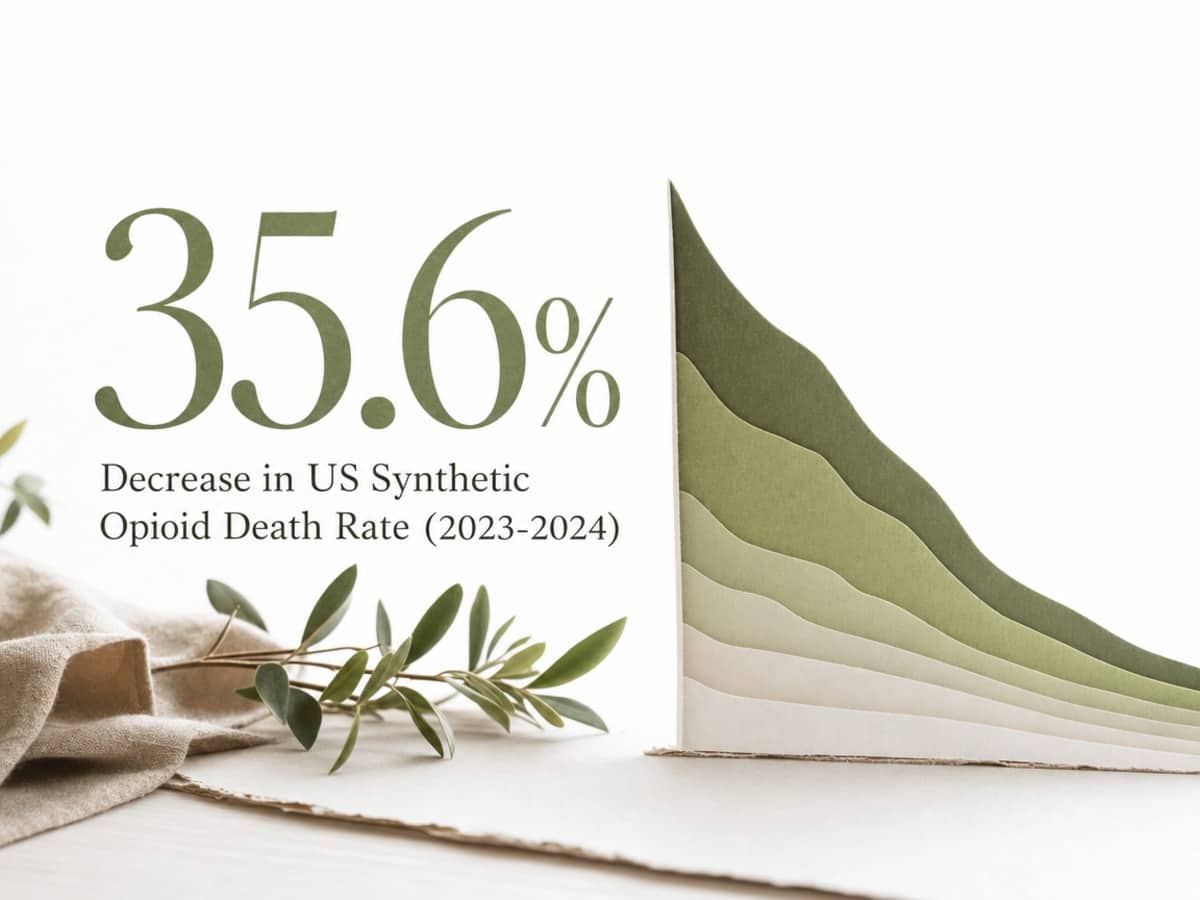
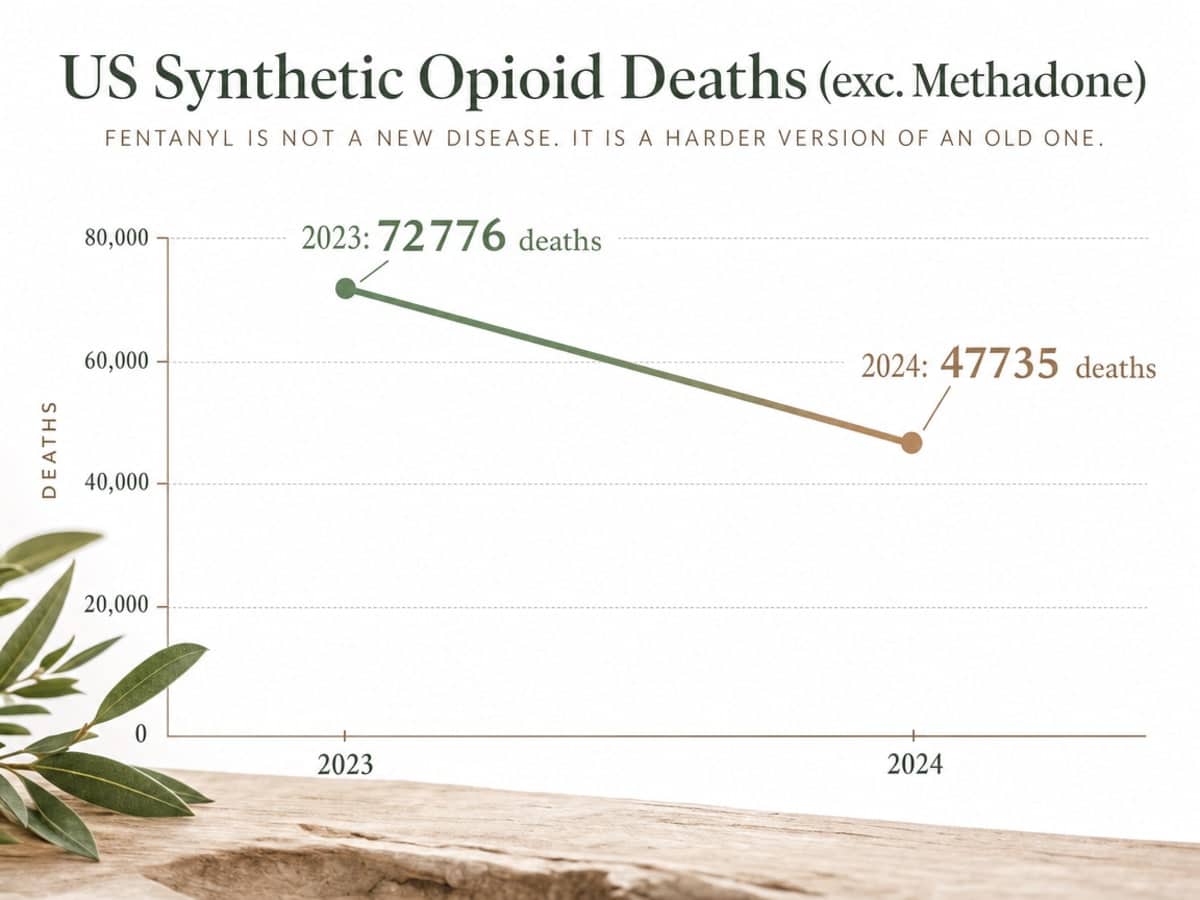
Here is the encouraging part, because you should hear it before the harder numbers. Deaths involving synthetic opioids other than methadone, the category that captures illicit fentanyl, fell from 72,776 in 2023 to 47,735 in 2024, a 35.6% drop in the death rate per 100,000 people 2. Provisional federal estimates put 2025 at 38,084, marking a third consecutive year of decline 3. More people are surviving. More people are getting into treatment and staying there. The story is not only loss.
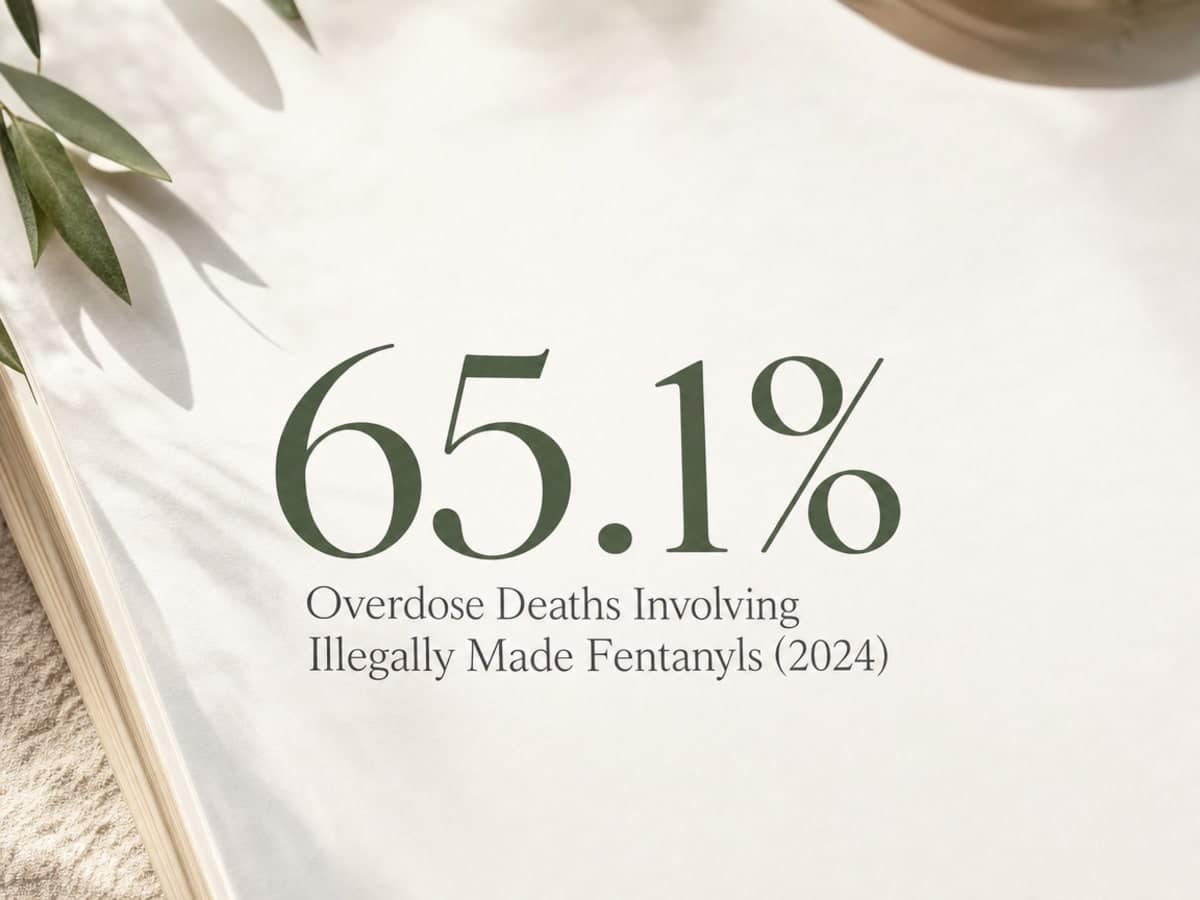
The other side of that same picture is why waiting is not a neutral choice. Even at 38,084, synthetic opioids remain the largest single category of opioid deaths in the country 3. In the CDC dashboard covering 43 jurisdictions for 2024, 65.1% of overdose deaths involved illegally made fentanyls 4. That percentage is the reason “I only take pills, not heroin” is no longer protective information about your risk. It is the reason a slip after a period of not using carries a different weight than it did five years ago.
What that means for your week is straightforward. The national trend is moving in the right direction because treatment works when people can reach it. The specific danger to you sits in the days between deciding and starting.
Withdrawal From Fentanyl: What Actually Happens in the First 72 Hours
Why Fentanyl Withdrawal Hits Harder and Faster
If you have withdrawn from pills or heroin before, your body’s memory of that experience is not a fair preview of what fentanyl withdrawal feels like. The mechanics are different, and the timeline compresses.
Fentanyl is far more potent than most other opioids, which means your brain has adapted to a heavy, steady opioid signal even when the visible dose looks small 1. When that signal drops, the rebound is sharper. You may feel the first symptoms within hours of your last use rather than the half-day or full day you remember from other opioids. Sweating, gooseflesh, restless legs, stomach cramps, diarrhea, and the specific bone-deep ache that makes sleep impossible tend to arrive early and stack quickly.
There is a second layer that people underestimate. Fentanyl stores in fatty tissue and releases back into your system unevenly, so the withdrawal curve is not a clean rise and fall 7. You can feel briefly better on day two and then get hit again. That unpredictability is a big part of why home attempts fall apart, and it is why the medication plan has to be built around your specific exposure, not a generic protocol.
What Medical Supervision Looks Like Day by Day
The point of a medically supervised setting is not to make withdrawal painless. It is to keep you safe, keep you comfortable enough to stay, and get you onto a medication that treats the underlying disorder before your tolerance drops to a dangerous level 13.
On the first day, a nurse or physician assesses you on arrival: vital signs, a withdrawal-symptom score, a review of what you have been using and when, and a medical history that flags anything else going on in your body. You are placed on a schedule of vital checks, typically every few hours during the first 72, because blood pressure, heart rate, and hydration can shift fast. Medications for nausea, muscle aches, anxiety, and sleep are given as symptoms appear rather than on a fixed schedule you have to earn.
By day two or three, the team is watching for the right window to start buprenorphine or discussing methadone or extended-release naltrexone with you, depending on your history and preference 9. You are not making that decision alone at 3 a.m. with your phone. You are making it with a clinician who has done this induction many times in the fentanyl era and knows how to read the symptom pattern. That is the part a home attempt cannot replicate.
The Buprenorphine Induction Problem, and How Programs Solve It
Where the Fear of ‘Getting Sick From Suboxone’ Came From
If you have talked to anyone who tried to start Suboxone after using fentanyl, you have probably heard some version of the same story. They took the film, waited, and instead of feeling the withdrawal ease, they got hit with the worst sickness of their life. That reaction has a name. Clinicians call it precipitated withdrawal, and the fear of it is one of the biggest reasons people put off treatment.
The fear is not made up. An early study of people using fentanyl found that taking buprenorphine within 24 hours of last use was linked to more than five times the odds of severe withdrawal, and use within 24 to 48 hours still carried more than three times the odds 6. That research came out of real clinics watching real patients, and it is what drove clinicians to rethink how induction is timed and dosed in the fentanyl era 7. So if you tried it once, at home, on a friend’s advice, and it went badly, that experience is on the record. It is not a personal failure. It is a timing problem that the field has been actively solving.
What the Current Evidence Actually Shows Under Monitoring
Here is the number that should change how you think about starting medication. In a large multisite trial that started buprenorphine in emergency departments during the fentanyl era, researchers followed 1,200 patients. Nine of them experienced precipitated withdrawal. That is an incidence of 0.76%, with a 95% confidence interval of 0.35% to 1.43% 5. Fewer than one in a hundred.
Read that alongside the older observational data and the picture clarifies. When induction is unplanned, unmonitored, and timed by guesswork, bad reactions are far more common. When induction happens in a clinical setting where staff can assess your symptoms, adjust the dose, and treat any discomfort that shows up, the odds shift dramatically. The trial was done in emergency rooms, not luxury settings, which matters: the safety margin came from the monitoring itself, not from anything exotic.
What this means for you is specific. If your only previous attempt at buprenorphine was a self-managed induction after fentanyl use, you do not have good information yet about how your body responds to it under proper conditions. The reaction you had is not a life sentence. It is data that tells the clinical team to use a different approach this time.
Standard, Low-Dose, and Alternative Induction, in Plain Language
There is no single right way to start buprenorphine after fentanyl, and honest clinicians will tell you that upfront 11. What they do have is a set of three approaches, and the choice depends on your use pattern, your withdrawal severity, and what you can tolerate.
- Standard induction
- What most people picture. You wait until you are in real withdrawal, usually measured by a symptom score, and then take a first dose of buprenorphine and go up from there over the next day or two. It works well for many people, but the wait can be long after heavy fentanyl use because of how the drug lingers in your system.
- Low-dose induction (sometimes called micro-induction)
- Takes a different route. Very small buprenorphine doses are given while a short-acting opioid is still on board, and the amount is slowly increased over several days. You do not have to be deep in withdrawal to start. This approach was developed specifically because of fentanyl 7, 12.
- Alternative options
- Include starting with a long-acting injectable formulation or bridging with other medications during the transition 7. In a residential setting, the team picks the path with you, watches your response, and changes course if the first plan is not working.
The Three Medications That Treat Opioid Use Disorder
The FDA has approved three medications for opioid use disorder: buprenorphine, methadone, and naltrexone 9, 10. All three treat the underlying disorder that fentanyl exploits. Any of them, paired with counseling and structured support, outperforms detox alone at keeping you alive and off illicit opioids 13.
Buprenorphine is a partial opioid agonist, usually taken daily as a film or tablet under the tongue, or given as a monthly injection. It reduces cravings and withdrawal without producing the same high, and it has a ceiling that lowers overdose risk compared with full opioids 11. In the fentanyl era, it is the medication most people in residential care start with, because it can be prescribed and managed in a wide range of clinical settings.
Methadone is a full opioid agonist taken by mouth once a day. It has decades of evidence behind it and is often the right choice when buprenorphine has not held or when your fentanyl exposure has been particularly heavy 9. In the United States, methadone for OUD is dispensed through federally regulated opioid treatment programs, so a residential team typically coordinates with a licensed OTP for daily dosing and eventual transition 8.
Naltrexone blocks opioid receptors entirely. The extended-release injection lasts about a month and cannot be started until you are fully off opioids, which for fentanyl usually means a longer washout than for other drugs 9, 7. For some people, especially those who prefer a non-opioid medication or who have completed a full detox, it is a strong fit.
The choice is not permanent. You can start on one and switch if it is not working. What the evidence is clear about is that being on a medication beats trying to hold recovery on willpower alone 13.
Montana’s Overdose Reality in 2025
Montana is not a small number when it comes to fentanyl. In March 2025, state health officials counted 95 suspected opioid overdoses, compared with a monthly average of about 69 in 2024 18. That is roughly a 38% jump in a single month. From March 1 through April 15, the state estimated seven fatal and 132 nonfatal overdoses, most suspected to involve fentanyl though not all were laboratory confirmed 18.
Yellowstone County, which includes Billings, saw the sharpest signal. Between March 22 and March 25, health authorities identified six suspected fentanyl overdoses in the county, including one death, and warned responders that more than one dose of naloxone may sometimes be needed to reverse a fentanyl overdose 17. The advisory was careful to say it did not know yet whether the spike reflected a longer trend or a particular bad batch. Either way, the practical message for you is the same: what happens in Billings does not stay in Billings, and a supply change in one Montana county tends to ripple outward.
Levels of Care in Montana, and What Medicaid Covers
Detox, Residential, PHP, IOP, Outpatient: What Each One Feels Like
Treatment is not one door. It is a set of rooms with different levels of structure, and you move through them as you stabilize. Knowing what each one feels like helps you picture where you are heading.
- Medical detox is the first few days, sometimes stretching to a week or more with fentanyl. You are in a bed, with staff checking on you around the clock, and the goal is to get you through acute withdrawal safely and onto a medication 13.
- Residential inpatient is the next step. You live at the facility, usually for a few weeks, and your days are built around therapy, groups, medical follow-up, and rest. You are not driving anywhere. Meals, sleep, and the schedule are handled for you.
- Partial hospitalization, or PHP, brings you to the program during the day and lets you sleep somewhere else at night, often a sober living house nearby.
- Intensive outpatient, or IOP, cuts that down to several hours a few days a week, which fits around work or family.
- Standard outpatient is weekly or biweekly visits with a counselor and a prescriber.
- Aftercare and alumni support keep the connection going once formal treatment ends.
Each step lowers the structure as your footing improves.
How Montana Licenses Facilities and What the Member Guide Covers
The state names these levels in its own terms. Montana licenses four kinds of SUD facilities: outpatient, inpatient, residential, and partial hospitalization 14. When you look at a program, that license tells you what the state has verified it is set up to do. A facility can operate at more than one level, which is how a full continuum program moves you from detox through aftercare without a transfer to a different company.
On the coverage side, the 2026 Montana Medicaid Member Guide lists medically monitored inpatient, clinically managed residential, partial hospitalization, intensive outpatient, counseling, case management, drug testing, peer support, and medication-assisted treatment among covered SUD services when they are medically necessary 16. For medication specifically, Montana Medicaid requires a diagnosed moderate or severe opioid use disorder, clinical appropriateness, and your agreement to take part in the treatment plan 15. Private insurance rules vary, but most plans in the state cover the same continuum with prior authorization. Before you commit, ask the program to run your coverage and tell you in plain numbers what your share will be.
Distance, Weather, and Getting There From Where You Live
Montana is not a place where treatment is a short drive from your kitchen. If you live in Libby, the closest major hospital is a couple of hours west or south depending on the pass. From Lewistown, you are looking at two hours to Great Falls, three to Billings. Sidney to almost anywhere is a day. Winter adds ice, closed passes, and headlights on at four in the afternoon. This is worth saying out loud because pretending it is a nonissue is how good intentions turn into another week of using.
Here is what actually helps. A residential program built for Montana handles the logistics on your end. Sober transport can pick you up so you are not driving yourself while sick or asking a family member to make a six-hour round trip in a snowstorm. Once you are admitted, you are not going anywhere for a few weeks anyway, which turns distance from a barrier into a buffer. Kalispell, Missoula, Helena, Bozeman, Billings, Great Falls: if you can get to one, a program can meet you there.
Call before you drive. Weather and beds change hour to hour.
If You Are the Family Member Reading This
You are doing something useful right now. Reading a page like this while someone you love is still using takes a specific kind of steadiness, and it counts.
A few things worth knowing. You do not have to wait for rock bottom, and you do not have to stage a confrontation to get someone into care. Low-threshold access exists because delay increases risk, especially after an overdose or a period of not using when tolerance drops 12. If your person is willing to go today, the program can usually build the plan around whatever shape that willingness takes.
Keep naloxone in the house and in the car, and know how to use it. It reverses fentanyl overdoses and buys the minutes that matter, though it does not treat the underlying disorder 19. When you call a Montana program, ask about admissions, transport from your town, and what they need from you. You do not have to have every answer before you pick up the phone.
What to Do in the Next 24 Hours
You do not need a perfect plan. You need a short one.
- Pick up the phone and call a Montana treatment program that offers medical detox and residential care.
- Tell them what you have been using and when you last used.
- Ask three questions: can they take you today or tomorrow, do they arrange transport from your town, and will they run your insurance or Medicaid before you commit.
Low-threshold access is designed for this exact call 12.
Speak with a Montana Fentanyl Recovery Specialist
Get immediate guidance on safe, structured fentanyl treatment options tailored to your recovery goals.
Frequently Asked Questions
Is fentanyl withdrawal really worse than withdrawal from heroin or pills?
For most people, yes. Fentanyl is far more potent than most other opioids, so your brain adapts to a heavier signal even when the visible dose looks small 1. It also stores in fatty tissue and releases unevenly, which stretches and complicates the timeline 7. Symptoms tend to start faster, hit harder, and rebound unpredictably.
I tried Suboxone before and got violently sick. Will that happen again?
Not necessarily. Older data showed high odds of severe withdrawal when buprenorphine was taken within 24 hours of fentanyl use 6. In a more recent multisite trial that started buprenorphine under monitoring, only 9 of 1,200 patients had precipitated withdrawal, an incidence of 0.76% 5. Timing, dosing, and supervision change the outcome.
Does Montana Medicaid cover residential treatment and medication for opioid use disorder?
Yes, when medically necessary. The 2026 Member Guide lists medically monitored inpatient care, clinically managed residential treatment, PHP, IOP, counseling, peer support, and MAT among covered SUD services 16. For medication specifically, Montana requires a diagnosed moderate or severe OUD, clinical appropriateness, and your participation in the treatment plan 15. Ask a program to verify your coverage.
How fast can I actually get into treatment in Montana if I decide today?
Often within a day or two, depending on bed availability and your location. Low-threshold access exists because delay after overdose or withdrawal raises risk, and rapid buprenorphine start reduces overdose likelihood 12. Call a program directly, tell them what you have been using and when, and ask about same-day admission and transport from your town.
Do I have to stop using fentanyl before I go to detox or a residential program?
No. Programs expect you to arrive still using, and the clinical team plans your induction around your last dose. Trying to quit cold at home before admission is actually more dangerous, because your tolerance drops during that gap, which is the specific window where fentanyl overdoses cluster 1, 12. Come in as you are.
What is the difference between naloxone and the medications used to treat addiction?
Naloxone and nalmefene are emergency medications that reverse an active opioid overdose, including one caused by fentanyl 19. They save lives in the moment but do not treat the underlying disorder. Buprenorphine, methadone, and naltrexone are the three FDA-approved medications that treat opioid use disorder over time, paired with counseling and support 9, 10.
References
- Fentanyl | National Institute on Drug Abuse (NIDA) – NIH. https://nida.nih.gov/research-topics/fentanyl
- Drug Overdose Deaths in the United States, 2023–2024. https://www.cdc.gov/nchs/data/databriefs/db549.pdf
- U.S. Overdose Deaths Decrease for Third Consecutive Year. https://www.cdc.gov/nchs/pressroom/releases/20260513.html
- SUDORS Dashboard: Fatal Drug Overdose Data. https://www.cdc.gov/overdose-prevention/data-research/facts-stats/sudors-dashboard-fatal-overdose-data.html
- Incidence of Precipitated Withdrawal During a Multisite Emergency Department–Initiated Buprenorphine Clinical Trial in the Era of Fentanyl. https://pmc.ncbi.nlm.nih.gov/articles/PMC10064247/
- Evidence of Buprenorphine-precipitated Withdrawal in Persons Who Use Fentanyl. https://pmc.ncbi.nlm.nih.gov/articles/PMC9124721/
- Treating Opioid Use Disorder and Opioid Withdrawal in the Context of Fentanyl. https://pubmed.ncbi.nlm.nih.gov/39879556/
- Federal Guidelines for Opioid Treatment Programs (2024). https://library.samhsa.gov/product/federal-guidelines-opioid-treatment-programs-2024/pep24-02-011
- Primary Care Providers Can Prescribe with Confidence. https://www.fda.gov/drugs/prescribe-confidence/primary-care-providers-can-prescribe-confidence
- Information about Medications for Opioid Use Disorder (MOUD). https://www.fda.gov/drugs/food-and-drug-administration-overdose-prevention-framework/information-about-medications-opioid-use-disorder-moud
- Quick Start Guide to Medications for Opioid Use Disorder. https://integrationacademy.ahrq.gov/products/playbooks/moud-playbook/get-started/quick-start-guide
- The Role of Low-Threshold Treatment for Patients with Opioid Use Disorder. https://integrationacademy.ahrq.gov/products/topic-briefs/oud-low-threshold-treatment
- Medication-Assisted Treatment Models of Care for Opioid Use Disorder. https://effectivehealthcare.ahrq.gov/products/opioid-use-disorder/research-protocol
- OIG-Letter. https://dphhs.mt.gov/assets/oig/LicensureBureau/SUDFLetterUpdated_20251.pdf
- 550 Medication Assisted Treatment (MAT). https://dphhs.mt.gov/assets/BHDD/MedicaidManual/550MAT.pdf
- 2026 Montana Medicaid Member Guide. https://dphhs.mt.gov/assets/hrd/MedicaidMemberGuide.pdf
- DPHHS HAN ADVISORY. https://dphhs.mt.gov/assets/publichealth/HAN/2025/DPHHSHANADVISORY2025-IncreasedinsuspectedfentanyloverdosesinYellowstone.pdf
- State Health Officials Report Significant Increase in Overdoses. https://dphhs.mt.gov/News/2025/April/SignificantIncreaseinOverdoses
- Overdose Reversal Medications – National Institute on Drug Abuse. https://nida.nih.gov/research-topics/overdose-reversal-medications
- FENTANYL (Trade Names: Actiq®, Fentora™, Abstral®, Subsys®). https://www.deadiversion.usdoj.gov/drug_chem_info/fentanyl.pdf