Key Takeaways
- Grief and substance use form a two-way loop: numbing freezes grief in place, while existing addiction strips away the sleep, connection, and honesty needed to metabolize a loss.
- A 2024 screening study found roughly 30.3% of bereaved adults screened positive for problematic alcohol use, with higher risk tied to recent loss, depression, and prolonged grief 2.
- The type of loss shapes the pattern, with overdose bereavement, sudden or suicide deaths, and early parental loss each carrying distinct risks that deserve specific clinical attention.
- Concurrent care is the standard: grief-focused CBT running alongside detox, MAT, therapy, and family work interrupts the loop better than treating either condition in sequence 3, 9.
When a Drink Becomes the Only Thing That Quiets the Room
You know the moment. It’s not the funeral or the phone call. It’s later, when the house has gone quiet and the pour gets a little heavier, or the pill count creeps up because sleep won’t come without it. Something in you learned that this is how the noise stops for a few hours. And maybe you already know how substances work in your body, because this isn’t your first difficult stretch. What may be new is naming the loss underneath.
You are not imagining the connection. A 2024 national screening study of bereaved adults found that roughly 3 in 10 (30.3%) screened positive for problematic alcohol use, with higher odds tied to shorter time since the death, current depression, and probable prolonged grief disorder 2. That’s a screening measure in a national sample, not a diagnosis of alcohol use disorder, and it doesn’t say grief caused the drinking. What it does say is that a lot of people carrying a fresh loss are drinking in ways that concern clinicians, and you are not an outlier for being one of them.
This article is going to give you language for what’s happening: how grief and substance use feed each other, how to spot the pattern in yourself or someone you love, and what treatment looks like when both are handled together instead of passed between offices. The pieces belong in one room.
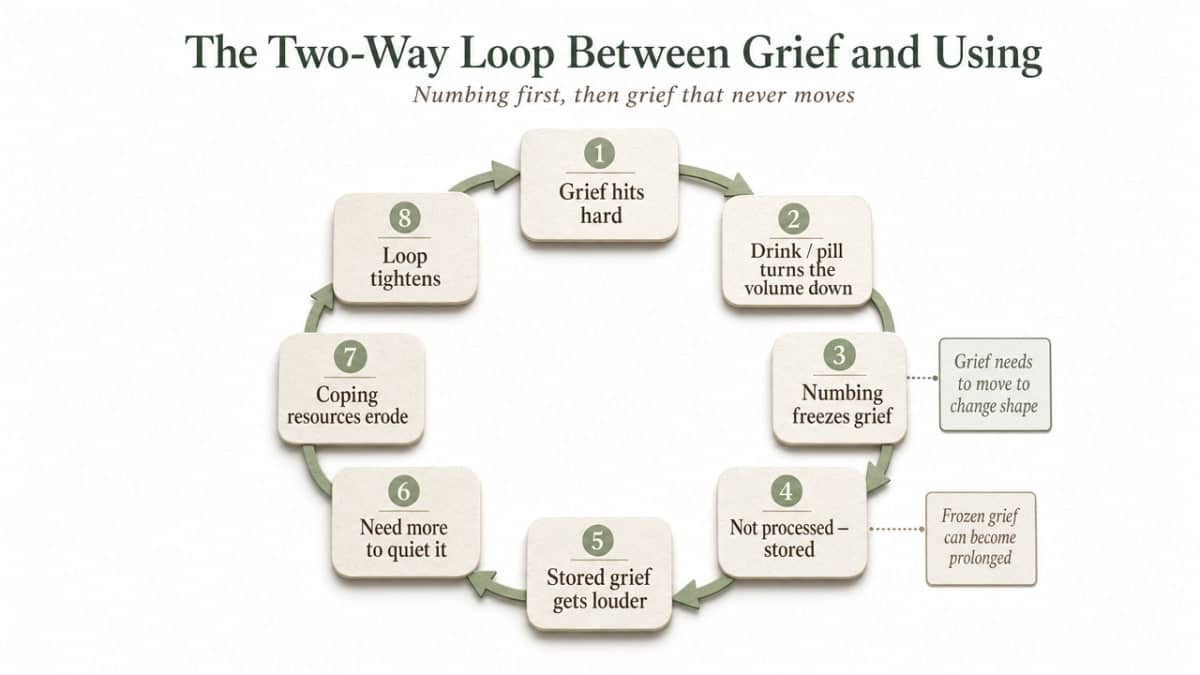
The Two-Way Loop Between Grief and Using
Numbing First, Then Grief That Never Moves
Here’s what the drink or the pill actually does: it turns the volume down on a feeling your nervous system doesn’t know how to hold yet. That’s not weakness. That’s the substance doing exactly what it’s designed to do. The problem is that grief needs to move through you to change shape, and numbing it keeps it frozen in place.
You might notice this if the same wave of feeling hits you every few weeks with the same intensity it had six months ago. Nothing has softened. The photos still knock the wind out of you. The voicemail you can’t delete still sits there. When you drink or use to get around the feeling, you’re not processing it, you’re storing it. And stored grief has a way of getting louder, which means the amount you need to quiet it tends to grow.
Clinicians call the frozen version of this prolonged grief disorder, and it doesn’t mean you’re grieving wrong. It means the grief hasn’t had the conditions it needs to shift. Substances are one of the most common conditions that keep it stuck.
Using That Was Already There, Now With More Weight to Carry
The loop runs the other direction too. If you were already drinking heavily or using before the loss, grief lands on a system that’s less equipped to metabolize it. Substances disrupt sleep, flatten emotional range, and shrink the circle of people you’d normally lean on. When the loss hits, the tools you’d use to get through it, rest, connection, honest conversation, are the exact tools substance use has been quietly taking apart.
So the grief itself becomes harder. Not because you’re doing anything wrong, but because you’re grieving without the internal resources most people rely on to move through a loss. Then the harder grief becomes another reason to use, and the pattern tightens.
What the Research Actually Says About Cause and Direction
A systematic review of 12 studies covering 1,749 participants looked at exactly this question: does grief lead to substance misuse, or does substance misuse lead to complicated grief? The answer the evidence supports is: both. The review found a positive relationship in both directions. Substance misuse increased the risk of later complicated grief, and complicated grief predicted later increases in smoking and alcohol dependence. Grief-focused interventions in some of the studies reduced symptoms on both sides 1.
The honest caveat, which the reviewers named directly, is that the relationship is clearly there but still not fully understood. The studies varied in design and population, and no one has cleanly proven that one condition causes the other. What the research does establish is that the two travel together, feed each other, and respond better when they’re addressed together rather than in sequence.
That framing matters for what you do next. If you’ve been waiting to get “stable enough” from the substance side before touching the grief, or waiting for the grief to “settle” before dealing with the using, the evidence doesn’t support that order. The loop is what needs interrupting, not one side of it.
Recognizing the Pattern in Yourself
The Anniversary Week, the Empty Chair, the Boxes You Haven’t Opened
Grief doesn’t keep a clean calendar, but your body does. The week before the anniversary, you notice you’re pouring earlier. The date of the diagnosis, the date of the phone call, the birthday that no longer gets celebrated, all of them arrive with a kind of pressure your nervous system remembers even when your mind is trying not to. If your drinking or using spikes in the same window every year, that’s not random. That’s your body flagging the loss.
Watch for the smaller markers too. The chair at the table you still don’t fill. The voicemail you save but never play. The boxes in the garage or the closet you’ve walked past for a year and haven’t opened. These aren’t failures of grief. They’re places where the feeling got parked because there was no safe way to hold it. And they often line up with the times you use more, drink harder, or reach for something to sleep.
Naming these moments out loud, to yourself, to a counselor, to one person who can hear it, is the first thing that starts to shift the pattern. The loss stops being invisible pressure and starts being something you can point to.
Using to Fall Asleep, Using to Get Through the Call, Using to Show Up
Pay attention to what the substance is doing for you, not just how much you’re using. Grief tends to hijack specific parts of the day. You drink to fall asleep because the silence at night is when the person you lost gets loudest. You take something before the call with your mother because you can hear the grief in her voice and you don’t have room for both of yours. You use before work, before the family dinner, before the therapist appointment, because showing up while feeling all of it seems impossible.
If you can map your using to moments, sleep, contact with certain people, holidays, the drive past a certain building, you’re looking at grief-driven use. That mapping isn’t a verdict on your character. It’s clinical information. It tells a counselor exactly where the loss is doing its work and where treatment needs to build something else in. Substances that were once recreational often turn into scheduled tools after a loss, and that shift is one of the clearest signals that grief is running the show.
When a Family Member Is the One Watching It Happen
If you’re the person on the outside, watching someone you love drink more or use harder since the funeral, you already know how hard it is to say anything without it landing as an accusation. Start with the loss, not the substance. “I know how much you loved her” opens a different door than “You’re drinking too much.” Both may be true, but only one keeps the conversation going.
Notice the same signals they might not name: the anniversary week, the avoided rooms, the sleep that only comes with help. And notice your own pattern. Grief in a family tends to travel, and if the person you’re worried about is also someone you drank with, mourned with, or covered for, your own use may be shifting too. You don’t have to have it figured out before you reach out. You just have to be willing to name the loss alongside the using when you do.
How the Type of Loss Shapes the Pattern
Overdose Loss: When the Death Itself Is Tied to the Substance
When someone in your circle dies from an overdose, the grief comes tangled in a way most losses don’t. You may be mourning the person and also carrying fear, guilt, and a complicated relationship to the substance that took them. If you use the same class of drug, or drink to manage the weight of what happened, you’re grieving in a minefield.
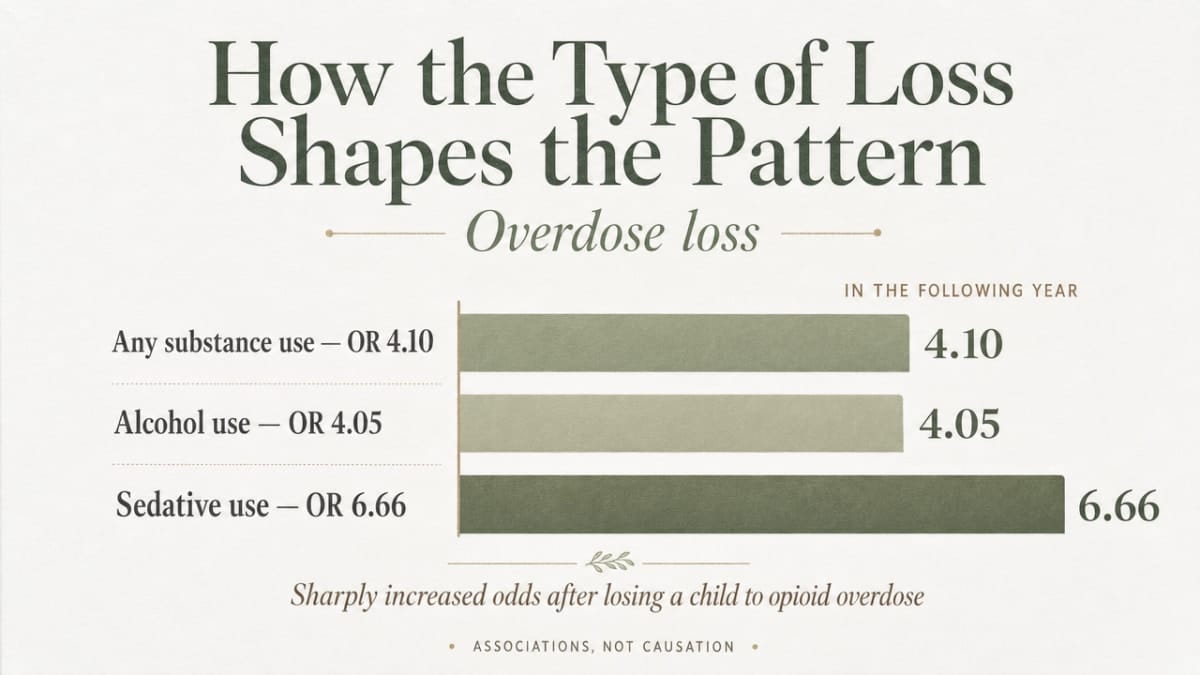
The research on this is sobering. A 2025 study of overdose-bereaved families found that losing a child to opioid overdose was associated with sharply increased odds of substance use during the following year:
- Any substance use (OR 4.10)
- Alcohol use (OR 4.05)
- Sedative use (OR 6.66)
Those who increased use after the loss also reported greater symptoms of prolonged grief, PTSD, substance use disorder, and depression 4. These are associations, not proof that overdose grief causes later use, but the pattern is strong enough that clinicians treat overdose bereavement as a distinct risk category.
If this is your loss, you are not being dramatic for needing more support than a standard grief group can offer. You’re facing a specific kind of grief that the field is only beginning to name honestly, and it deserves specific care.
Suicide and Sudden Death: Sharper Spikes, Longer Tails
Sudden deaths, especially by suicide, tend to leave a different mark than deaths you had time to prepare for. There’s no long goodbye, no chance to say the thing you meant to say. What fills that space is often a mix of shock, replayed conversations, and questions that don’t resolve.
A UK study of young adults after sudden bereavement found that about one-third reported increased alcohol use at some point after the loss, and roughly 12% reported increased drug use. Increases were more common after suicide or other unnatural deaths than after sudden natural deaths 12. The sample was young UK adults, so the numbers don’t automatically transfer to every reader, but the direction is worth taking seriously: unexpected and violent losses tend to produce sharper early spikes and longer tails in substance use.
If your loss was sudden, notice how far out from the death the harder using still lives. That tail is real, and it’s a reason to bring the loss into treatment, not a reason to hide it.
Parental Loss and What Kids Carry Forward
Losing a parent when you’re young shapes how you handle almost everything after, including how you cope. If you lost a mother or father in childhood or adolescence, and you’re now an adult in active addiction, the two may be more connected than you’ve let yourself say out loud.
A longitudinal study following parentally bereaved youth for five years found higher observed rates of alcohol or substance abuse or dependence compared with non-bereaved peers: 13.6% versus 5.6%, with earlier onset in the bereaved group 13. Here’s the important honesty piece: after the researchers adjusted for pre-existing behavioral and functional factors, the overall bereavement association was attenuated and was no longer statistically significant. Losing a parent isn’t a life sentence, and it isn’t a solo cause. But it sits inside a cluster of things that raise risk, and if it’s part of your history, it belongs in your treatment story.
If you’re a parent yourself now, watching your kids grieve someone, this same evidence is why naming the loss with them early matters more than protecting them from it.
What Integrated Grief and Addiction Care Actually Looks Like
One Assessment, Both Conditions, No Handoff
The first thing integrated care does differently is refuse the split. Instead of an intake that screens for substance use in one room and grief in another, you sit through one assessment where both are in the picture from the start. The clinician asks about your using and your loss in the same conversation, because the answers to one shape the answers to the other.
SAMHSA’s framework for co-occurring disorders describes this as the standard, not the upgrade. Screening for substance use, mental-health conditions, trauma, suicidality, and functional impairment together, then building one treatment plan that addresses them concurrently rather than in sequence 3, 9. For you, that means you don’t have to prove sobriety before your grief gets taken seriously, and you don’t have to wait for grief to “settle” before someone helps with the drinking or the pills.
What it looks like at Elk Ridge Recovery is a counseling team that’s mapping the loss into your treatment plan on day one. If the anniversary week is coming, they know. If the person you lost is someone you used with, they know. The loss becomes part of your clinical picture, not a footnote a therapist eventually gets to.
Grief-Focused CBT Alongside Addiction Treatment
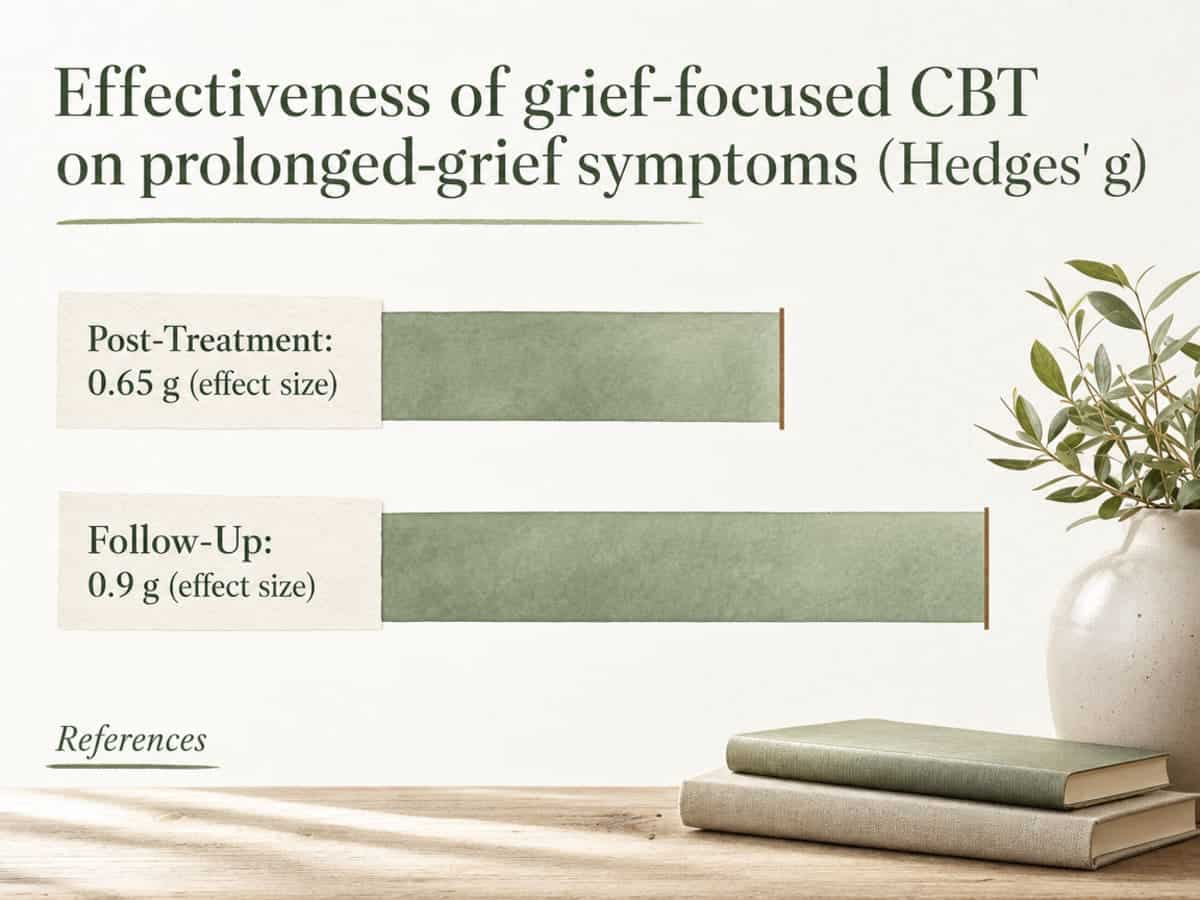
Grief-focused cognitive behavioral therapy is the treatment with the strongest current evidence for prolonged grief symptoms. A 2024 meta-analysis pooling 22 studies and 2,602 bereaved adults found a medium effect at post-treatment (g=0.65, 95% CI 0.49-0.81) and a large effect at follow-up (g=0.90, 95% CI 0.37-1.43), meaning the benefits tended to hold or grow after therapy ended 8. Randomized trials comparing grief-focused CBT to mindfulness-based cognitive therapy and to present-centered therapy have also favored the grief-focused approach on prolonged-grief severity, at least in the shorter term 6, 7.
Here’s the honest piece: those trials studied prolonged grief disorder, not co-occurring substance use disorder. A focused, tested intervention specifically for co-occurring prolonged grief and alcohol or drug use disorder hasn’t been developed yet 2. So grief-focused CBT is not a stand-alone treatment for your addiction. What it does, running alongside medication-assisted treatment, individual therapy, group work, and relapse prevention planning, is target the grief symptoms that keep pulling you back toward using: the avoidance, the intrusive memories, the sense that moving forward is a betrayal.
At Elk Ridge, that means the grief work happens in the same week as your MAT appointment and your relapse prevention group, not after them.
Family Therapy That Names the Loss Out Loud
Grief doesn’t sit in one person. It travels through a family, and when addiction is in the picture, the two often get tangled in ways nobody says out loud. Someone gets labeled the one with the problem. Someone else quietly carries the loss. The person you lost may still be the reason certain rooms go silent at dinner.
Family therapy in an integrated model puts the loss on the table alongside the using. Not to assign blame, but to let everyone in the room name what happened, what changed after, and what they’ve been doing to get through it. SAMHSA lists family involvement as a core component of co-occurring care for a reason 3. When the family can grieve together, the person in treatment stops carrying it alone, and the pattern that kept the loss invisible starts to loosen.
Safety When Grief-Related Use Involves Opioids
If your grief-related use involves opioids, or if the person you’re worried about is using opioids, the safety picture needs to be part of this conversation. Grief scrambles the two things that keep opioid use from turning fatal: consistency and tolerance. You skip a few days after the funeral because you can’t get out of bed, then take your usual amount on the anniversary. Your body isn’t where it was. That gap is where overdoses happen.
Naloxone doesn’t touch the grief. Medication-assisted treatment doesn’t either, on its own. But they keep you alive long enough for the grief work to happen, and that’s the order that has to hold.
Talking to Elk Ridge Recovery About Grief-Related Substance Use
You don’t have to walk in with a diagnosis or a clean way of explaining what’s happened. You can start with the person you lost. You can start with the week the drinking got heavier. You can start with the fact that you’re tired of holding both things alone. The counseling team at Elk Ridge Recovery is used to sitting with people who arrive carrying exactly this weight, and the intake conversation is built to hear both parts at once, not to route you toward one and set the other aside.
What that looks like in practice: a concurrent assessment that treats grief, trauma, mental health, and substance use as one clinical picture, then a plan that runs grief-focused counseling alongside medical detox, residential care, MAT if it fits, individual and group therapy, family sessions, and relapse prevention planning. SAMHSA’s framework for co-occurring conditions is clear that concurrent care is the standard, and the team here builds treatment around that principle rather than as an afterthought 9.
If you’re the family member, you can call too. You don’t need permission from the person you’re worried about to ask questions. Talk to Elk Ridge Recovery about grief-related substance use, and bring the loss with you when you do. It belongs in the room.
Talk through grief and substance use now
Get real answers for grief-driven substance use and guidance on the next step forward.
Frequently Asked Questions
Is it normal to drink more after someone close to me dies?
An increase in drinking after a significant loss is common, and noticing it doesn’t mean you’ve done something wrong. What matters is whether the increase keeps climbing, sticks around past the early weeks, or starts replacing sleep, meals, or conversations you used to have. Those are the signals worth taking to a counselor rather than trying to sort out alone.
How do I know if my grief-related drinking or drug use has become a real problem?
Watch what the substance is doing, not just how much you’re using. If you need it to sleep, to get through calls with family, to walk past certain rooms, or to show up at work, the use has moved from occasional to structural. If you were already in active addiction before the loss, both pieces need attention at the same time.
Should I deal with my grief first or my substance use first?
Neither, in that order. The evidence supports treating them concurrently, because the two feed each other and progress on one tends to stall when the other is ignored. You don’t have to prove sobriety before your grief gets heard, and you don’t have to finish grieving before the using gets addressed. Both belong in the same treatment plan from day one.
Can grief counseling alone treat my addiction?
No. Grief-focused CBT has strong evidence for reducing prolonged-grief symptoms, but it hasn’t been developed or tested as a standalone treatment for co-occurring substance use disorder. It works best paired with medical detox when needed, medication-assisted treatment where appropriate, individual and group therapy, and relapse prevention. The grief work targets what pulls you toward using; it doesn’t replace addiction treatment.
My loved one started using more after an overdose death in our family. What can I do?
Start with the loss, not the substance. Name the person who died, then name what you’ve noticed. If opioids are involved, keep naloxone in the house and tell them where it is. You don’t need their permission to call a treatment center for guidance. Overdose bereavement is a distinct risk category, and asking for help early is not overreacting.
What does integrated grief and addiction treatment look like at Elk Ridge Recovery?
The counseling team runs one concurrent assessment that covers grief, trauma, mental health, and substance use together, then builds a plan where grief-focused counseling happens alongside medical detox, residential care, MAT if it fits, individual and group therapy, family sessions, and relapse prevention planning. The loss goes on your treatment plan from the first week, not after the substance work is done.
References
- The relationship between substance misuse and complicated grief: A systematic review. https://pubmed.ncbi.nlm.nih.gov/31229191/
- Bereavement, prolonged grief, and the prevention of alcohol misuse. https://pmc.ncbi.nlm.nih.gov/articles/PMC11926661/
- Substance Use Disorder Treatment for People with Co-Occurring Disorders. https://library.samhsa.gov/sites/default/files/pep20-06-04-006.pdf
- A hidden crisis: Associations between overdose bereavement, substance use, and mental health. https://pmc.ncbi.nlm.nih.gov/articles/PMC12818955/
- Psychotherapeutic Interventions for Prolonged Grief Disorder. https://pmc.ncbi.nlm.nih.gov/articles/PMC11979903/
- Cognitive Behavior Therapy vs Mindfulness in Treatment of Prolonged Grief Disorder: A Randomized Clinical Trial. https://pmc.ncbi.nlm.nih.gov/articles/PMC11044011/
- Grief-Specific Cognitive Behavioral Therapy vs Present-Centered Therapy: A Randomized Clinical Trial. https://pmc.ncbi.nlm.nih.gov/articles/PMC11561718/
- Grief-Focused Cognitive Behavioral Therapies for Prolonged Grief Symptoms: A Systematic Review and Meta-Analysis. https://pubmed.ncbi.nlm.nih.gov/38573714/
- Managing Life with Co-Occurring Disorders. https://www.samhsa.gov/mental-health/serious-mental-illness/co-occurring-disorders
- Opioid Use Disorder: Treating | Overdose Prevention. https://www.cdc.gov/overdose-prevention/hcp/clinical-care/opioid-use-disorder-treating.html
- Preventing Opioid Overdose. https://www.cdc.gov/overdose-prevention/prevention/index.html
- Self-Reported Patterns of Use of Alcohol and Drugs After Suicide Bereavement. https://pmc.ncbi.nlm.nih.gov/articles/PMC7251259/
- Alcohol and Substance Abuse in Parentally Bereaved Youth. https://pmc.ncbi.nlm.nih.gov/articles/PMC4037812/