Key Takeaways
- Well-run group and individual therapy produce broadly comparable outcomes for adults with substance use disorders, so the real question is how much of each, in what order, and matched to your needs 1, 4.
- Individual sessions handle private history, trauma, medication, and treatment planning, while groups cover psychoeducation, skills practice, and peer connection, meaning the two formats do different jobs rather than compete.
- If you have PTSD, a co-occurring mental health condition, or opioid use, the mix should shift, usually toward more individual work early on, with groups sequenced in as you stabilize 11, 17, 5.
- Group safety depends on structure: an explicit agreement covering confidentiality, clinical placement decisions rather than automatic assignment, and early sessions focused on orientation instead of forced disclosure 8, 9, 10.
- The therapeutic alliance predicts outcomes more reliably than format choice, with a moderate alliance-outcome association (r = .278) across 295 studies, so fit with your therapist matters more than the label on the schedule 14.
The Honest Answer to a Loaded Question
You came here hoping someone would tell you which one wins: group therapy or individual therapy. Pick the right one, get better, go home. That would be simpler, and it would be a lie.
Here is what the research actually shows: when both formats are well-run, they produce broadly comparable outcomes for adults with substance use disorders. A meta-analysis of 33 randomized trials found small differences at best, and no clean victory for either side 1. A 24-study review reached the same conclusion years earlier and the field has not changed its mind since 4.
So the better question is not which one. It is how much of each, in what order, and built around what you specifically need.
That is how Elk Ridge Recovery structures care in Montana. You get individual therapy one to two times a week to work on what is yours alone, alongside daily group sessions for skills, process work, and peer connection. The two formats do different jobs. They are not competing for your time; they are covering different ground.
If group therapy is the part making you nervous, you are not being difficult. You are being reasonable. The rest of this article walks through what actually happens in each room, what the evidence says about who benefits from what, and how to tell whether a program is doing this thoughtfully or just filling a schedule.
What Actually Happens in Each Room
Inside an Individual Session
Picture a small room. Two chairs, a window, maybe a box of tissues on a side table. Your therapist, one door, and no audience.
An individual session is where the specific facts of your life get worked on out loud. The reason you started using at fifteen. The relationship you cannot talk about at the dinner table. The DUI. The custody hearing. The thing that happened when you were eleven that you have never told anyone. This is the room where that kind of material belongs, especially early on, when saying it in front of strangers is not something you can imagine yet.
In most residential programs, individual sessions run roughly one to two times per week, usually around 50 to 60 minutes. Your therapist tracks your history, coordinates with the medical and psychiatric team, and shapes the rest of your week based on what surfaces. If you disclose a trauma history, that changes what happens next. If a medication is not working, that gets flagged. If you are avoiding a specific topic, the therapist notices and decides when to press.
This is also the room where the treatment plan itself is negotiated. Not handed to you. Built with you.
Inside a Group Session (and What It Isn’t)
Now picture the other room. Six to twelve people in a rough circle. A clinician who is running the group, not observing it. A whiteboard or a handout. A start time, an end time, and a topic.
That is closer to reality than the movie version in your head. Groups in SUD treatment are not confessional booths and they are not free-for-alls. Most fall into three types:
- Psychoeducational groups where you learn about how addiction affects the brain and body,
- Skills-development groups where you practice concrete tools like coping with cravings or handling conflict, and
- Support or process groups where members talk through what is coming up week to week 8.
A Tuesday morning CBT skills group looks nothing like a Thursday evening peer-support group. Lumping them together is part of what makes the whole idea feel scarier than it is.
A well-run group is built on an explicit agreement that every member hears at the start. SAMHSA’s clinician guidance names five elements every agreement should cover:
- confidentiality,
- participation,
- contact outside the group,
- use of mood-altering substances, and
- how someone leaves the group 8.
You are told what is expected. You are told what is off-limits. And you are told the honest limits of confidentiality: your clinician has legal obligations, but no one can guarantee that another member will keep every disclosure private 7.
Good programs also do not throw you into a group cold. An initial individual session lets you understand what a specific group is for and whether it fits your stage of treatment before you walk in 7. Placement is a clinical decision, not a room assignment 9. Groups also develop in phases; early sessions focus on orientation and building norms, not on deep personal disclosure 10. If your first group feels more like a class than a therapy scene, that is by design.
What the Evidence Actually Says About ‘Better’
Here is the part where you might expect a scoreboard. There isn’t one.
When researchers hold the treatment content steady and only change the delivery format, the two rooms tend to produce similar results. In one randomized trial of 264 outpatients, the same cognitive-behavioral motivational intervention was delivered either individually or in a group. Both formats produced large reductions in alcohol and drug use during treatment and at 12-month follow-up, with no significant outcome differences between them. The group format did one other thing worth naming: it required 41.4% less therapist time to deliver 2. That is not a story about group being better. It is a story about equivalent outcomes at a lower staffing cost, which is part of why treatment centers can offer daily group programming at all.
A separate randomized trial of 155 alcohol- and drug-dependent patients compared individual and group CBT and found similar consumption, dependence, and problem levels at follow-up in both conditions 3. A review of 24 comparative studies reached the same conclusion: group and individual modalities generally did not show meaningful differences, and no single group format consistently beat the others 4.
Zoom out further and the picture stays honest. A 2023 meta-review synthesized 23 meta-analyses covering 78 effect sizes for psychological SUD treatments and found at-best moderate short-term benefits over inactive controls, with smaller gains for motivational and CBT-based approaches 12. Real, but modest. Anyone promising you a miracle from either format is selling something.
So when you read a program’s website and it claims their approach is proven superior, take a breath. The proven part is that structured, evidence-based treatment works better than none. The superior part is usually marketing.
The Fears About Group That Nobody Names Out Loud
‘What if someone I know is in the room?’
This is the fear you probably haven’t said out loud, especially if you live in a smaller town in Montana, Idaho, or the Dakotas. You walk into a group and there is your cousin’s coworker. The nurse from your kid’s pediatrician. Someone who saw you at your worst last summer.
It happens. Not often, but it happens. And a well-run program has a plan for it. SAMHSA’s clinician guidance recommends that groups open with an explicit agreement covering confidentiality, participation, contact outside the group, mood-altering substances, and how someone leaves the group 8. Members are told upfront that what is said in the room stays in the room. The clinician has legal obligations around confidentiality, though no one can guarantee another member’s behavior 7.
If you recognize someone in the room, tell your individual therapist immediately. Placement is a clinical decision, not a lottery 9. You can be moved. Ask Elk Ridge Recovery how they handle this before you arrive; it is a normal question and a fair one.
‘What if I’m forced to talk before I’m ready?’
You are not going to be dragged into the middle of a circle and interrogated. That image comes from movies, not from actual SUD treatment.
SAMHSA’s guidance on group development is explicit: early sessions focus on orientation, norms, and building safety, not on deep personal disclosure 10. Skills groups and psychoeducational groups often look more like a small class than a therapy scene. You are learning about craving management, or practicing a specific coping tool, or listening to a clinician explain how the brain adapts to substances. Talking is welcome. It is rarely required.
Process groups ask more of you, but even there, a good facilitator reads the room. You are allowed to pass. You are allowed to listen for the first several weeks. What you disclose, when, and to whom is something your individual therapist helps you pace. If a program pressures you to over-share on day two, that is a warning sign about the program, not a rule of group therapy.
‘What if the group makes me worse?’
This one has a real answer, not a reassurance. Groups can go badly when they are poorly matched, poorly led, or poorly composed. That is exactly why SAMHSA built an entire module around placement criteria: group assignment should be a clinical decision, not automatic 9. Someone in acute withdrawal, active psychosis, or an untreated trauma crisis does not belong in a peer-process group on their second day. They belong in individual and medical care first, with group added as they stabilize.
The research also cautions against overclaiming. A 2023 meta-review of 23 meta-analyses found real but modest short-term benefits for psychosocial SUD treatments overall 12. Group therapy is not a magic room. What protects you is the structure around it: an initial individual session so you understand what a specific group is for 7, integrated care if you have a co-occurring diagnosis 17, and a treatment plan that adjusts when something is not working. Ask how Elk Ridge Recovery decides which groups you join, and when.
When Your Situation Should Shift the Mix
Trauma and PTSD
If you have PTSD along with a substance use disorder, the individual room usually needs to do more of the early work. That is not a preference. It is a safety call.
A Cochrane review of psychological therapies for co-occurring PTSD and SUD found that individual trauma-focused therapy combined with an SUD intervention improved PTSD severity compared with usual care, though the evidence was rated very low quality. Non-trauma-focused individual and group therapies showed uncertain or limited benefit across several comparisons 11. Translation: the strongest signal in the research is for individualized, trauma-specific work, not for putting a traumatized person into a general process group and hoping it lands.
That does not mean group is off the table. It means the sequencing matters. Skills groups on grounding, distress tolerance, and craving management can run alongside individual trauma work. Deep disclosure groups usually come later, once you have tools and a stable relationship with your therapist. Ask Elk Ridge Recovery how they screen for trauma at intake and how they decide when a trauma-focused group is appropriate for you.
Co-Occurring Mental Health Conditions
If you are managing depression, anxiety, bipolar disorder, or another mental health condition alongside addiction, treating them separately does not work as well as treating them together. A review of integrated care found that combined treatment for co-occurring disorders has consistently outperformed splitting the two into separate treatment plans 17.
In practice, that shifts the mix toward more individual time, at least at the start. Your therapist coordinates with a psychiatric provider on medication, tracks how symptoms and substance use interact, and adjusts the plan when one destabilizes the other. Group work still plays a role, especially skills-based groups like DBT or CBT that teach tools you use every day. But the treatment plan lives in the individual room, and the groups are chosen to fit it, not the other way around. Ask how Elk Ridge Recovery structures dual-diagnosis care and who coordinates the medical and clinical pieces.
Opioid Use and Medication-Supported Recovery
If opioids are the primary substance, medication is often part of the answer, and the psychosocial work wraps around it. A review of research-supported group treatments found that group therapy combined with pharmacotherapy was more effective for opioid use than pharmacotherapy alone in the reviewed studies 5.
That is a real reason to say yes to groups, even if the format still makes you uneasy. What you get in group here is not confession. It is skills practice, relapse prevention, and time in a room with people who are on the same medication and dealing with the same triggers. Individual sessions handle medication management, dosing conversations, and anything private. Ask Elk Ridge Recovery how their MAT program pairs with group programming.
Women-Specific Considerations
A randomized trial of 155 women with alcohol use disorder compared 12 sessions of female-specific CBT delivered individually or in groups. Both formats produced equivalent reductions in drinking through 12-month follow-up. The wrinkle: women in the group condition attended fewer sessions on average than women in the individual condition 13.
Outcomes were the same, but showing up was harder. That is worth naming. Childcare, work schedules, and simple discomfort with mixed groups all play into attendance. A women-focused group, or a plan that leans more heavily on individual sessions early on, can be a reasonable adjustment. Ask Elk Ridge Recovery whether they offer women-specific groups and how they handle scheduling barriers.
What Actually Predicts Recovery: The Alliance
If you strip away the format debate, one factor keeps showing up in the research as a stronger predictor of outcomes than whether you sat in a chair alone or in a circle: the relationship you build with your therapist.
A meta-analytic synthesis of 295 studies involving more than 30,000 patients found a consistent link between therapeutic alliance and psychotherapy outcome. For face-to-face therapy, the alliance-outcome association was r = .278, a moderate effect that held up across treatment approaches, patient populations, outcome measures, and countries 14. Alliance is correlational, not a magic ingredient, and improvement itself can strengthen how you rate the relationship. But the signal is steady enough that clinicians take it seriously.
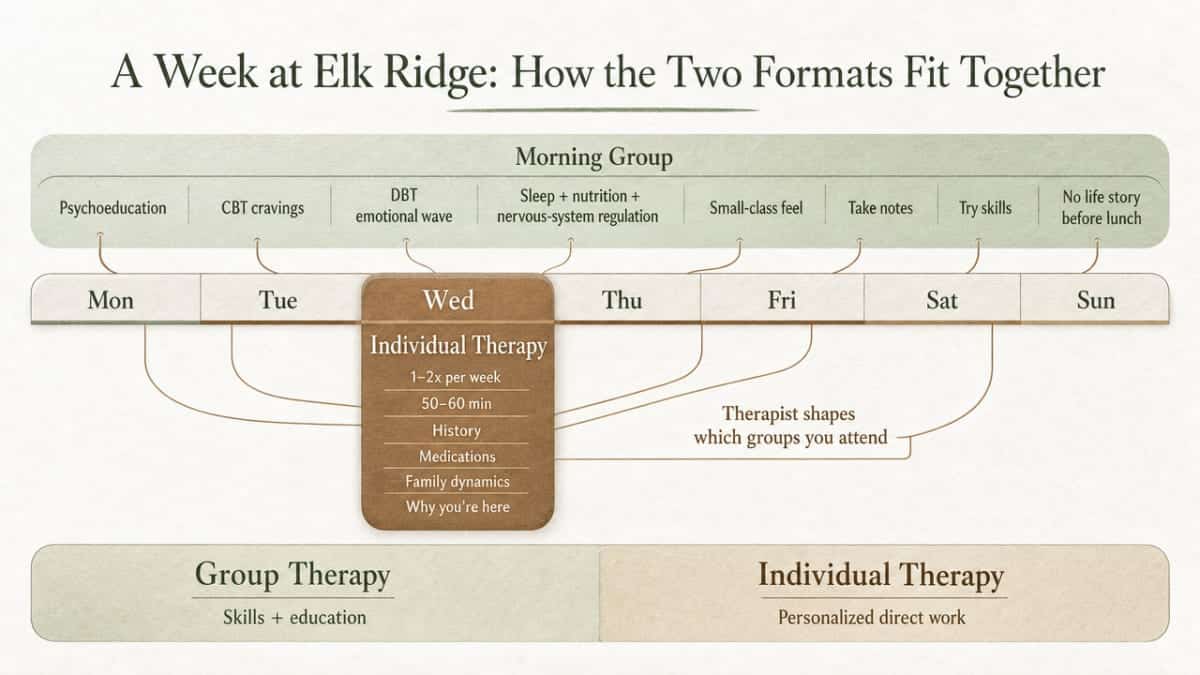
A Week at Elk Ridge: How the Two Formats Fit Together
Enough theory. Here is what a residential week can actually look like when the two formats are built to cover different ground.
Mornings tend to start with a psychoeducational or skills group. Think CBT tools for managing cravings, DBT skills for riding out an emotional wave, or a session on how sleep, nutrition, and nervous-system regulation shape early recovery. These groups look and feel like a small class. You take notes. You try things. You are not asked to spill your life story before lunch.
Mid-week, you meet with your individual therapist. In residential care, that usually happens one to two times per week, running roughly 50 to 60 minutes. This is the room where your history, your medications, your family dynamics, and the specific reasons you are here get worked on directly. Your therapist also shapes which groups you attend based on what surfaces in these sessions 15.
Afternoons often move into process groups, relapse-prevention work, or a peer-support format like 12-step or Wellbriety. Some days include family therapy, adventure or outdoor therapy, and wellness programming. The rhythm is deliberate: structured skills work in the morning, personal work in the individual room, peer connection in the afternoon.
The point of the schedule is not to fill hours. It is to make sure the tools you learn in group get tested against your actual life in individual sessions, and that what you uncover in individual sessions gets practiced in real time with other people in the room. Ask Elk Ridge Recovery how they build your specific week; the answer should sound like a plan, not a template. 15
If Driving to a Building Every Day Isn’t Realistic
Living in Libby, Lewistown, or two hours from the nearest treatment center changes the math. A daily group across the state is not a plan. It is a fantasy.
Hybrid virtual group models have grown into a real option since telehealth expanded. A 2025 scoping review mapped how programs are combining in-person and virtual group delivery for SUD care, along with the implementation considerations that come with it 18. The evidence base is still forming, so this is not a claim that virtual matches in-person on every outcome. It is a claim that a hybrid path exists, and it can be built around residential care, a step-down, or an outpatient rhythm that fits the miles you actually have to drive.
Ask Elk Ridge Recovery how they structure care for people across Montana, Idaho, and the Dakotas: what portion is on-site, what can be virtual, and how individual sessions fit around the drive. Distance is a real barrier, not an excuse to skip treatment.
Questions to Ask Before You Commit to a Program
You are allowed to interview a treatment center. Actually, you should. The way a program answers direct questions tells you more than any brochure.
Bring these to the phone call:
- How often will I meet one-on-one with the same therapist, and for how long? A combined plan usually includes individual sessions one to two times per week alongside daily groups 15.
- How do you decide which groups I join? Placement should be a clinical decision tied to your assessment, not a room assignment 9.
- What is in the group agreement, and how are confidentiality limits explained? A good program can name the elements before you ask and will be honest that no clinician can guarantee another member’s behavior 7, 8.
- How do you handle trauma screening and dual-diagnosis care? Integrated planning outperforms treating the two separately 11, 17.
- What happens if a group is not working for me? The plan should adjust.
Ask Elk Ridge Recovery these questions directly. Vague answers are their own answer.
Talk Through Your Therapy Options With Us
Get personal guidance on building a treatment plan that fits your needs right now.
Frequently Asked Questions
Is group therapy or individual therapy more effective for addiction?
Neither wins on its own. A meta-analysis of 33 randomized trials found small differences at best between formats for adults with substance use disorders, and a 24-study review reached the same conclusion 1, 4. What matters more is that the treatment is evidence-based, matched to your situation, and delivered by someone you can actually work with. Most good programs use both formats on purpose.
Will I be forced to share personal details in group therapy?
No. Early group sessions focus on orientation, norms, and safety-building, not deep disclosure 10. Skills and psychoeducational groups often feel more like a small class than a therapy scene. You are allowed to pass, listen, and let your individual therapist help you pace what you share. If a program pressures you to over-share on day two, that is a warning sign about the program.
How is confidentiality handled in a group setting?
Every group opens with an explicit agreement covering confidentiality, participation, contact outside the group, mood-altering substances, and how someone leaves 8. Clinicians have legal obligations around your privacy, but honest programs will tell you they cannot guarantee another member’s behavior 7. If you recognize someone in the room, tell your individual therapist. Placement is a clinical decision, and you can be moved 9.
What if I have trauma or PTSD alongside my addiction?
The individual room usually does more of the early work. A Cochrane review found that individual trauma-focused therapy combined with an SUD intervention improved PTSD severity compared with usual care, while non-trauma-focused group approaches showed uncertain benefit 11. Skills groups on grounding and craving management can run alongside individual trauma work. Deeper disclosure groups come later, once you have tools and a stable therapeutic relationship.
Can I get treatment if I live too far from a facility?
Yes. A 2025 scoping review mapped hybrid virtual group models that combine in-person and virtual delivery for SUD care, giving people in rural areas a real path in 18. The evidence base is still forming, so this is not a promise of equivalence on every outcome. Ask Elk Ridge Recovery how they structure care for people across Montana, Idaho, and the Dakotas.
How often will I meet with an individual therapist during treatment?
In residential care, individual sessions typically run one to two times per week for roughly 50 to 60 minutes, alongside daily group programming 15. Your therapist tracks history, coordinates with medical and psychiatric providers, and shapes which groups you attend based on what surfaces. Frequency can shift with your diagnosis, trauma history, and stage of care. Ask Elk Ridge Recovery how they build your specific schedule.
References
- Group treatment for substance use disorder in adults: A systematic review and meta-analysis of randomized-controlled trials. https://pubmed.ncbi.nlm.nih.gov/30797382/
- Randomized controlled trial of a cognitive-behavioral motivational intervention in a group versus individual format for substance use disorders. https://pubmed.ncbi.nlm.nih.gov/20025373/
- Comparison of individual and group cognitive-behavioral therapy for alcohol and/or drug-dependent patients. https://pubmed.ncbi.nlm.nih.gov/11399215/
- Group therapy for substance use disorders: what do we know?. https://pubmed.ncbi.nlm.nih.gov/15764469/
- A review of research-supported group treatments for drug use disorders. https://pubmed.ncbi.nlm.nih.gov/34154619/
- TIP 41: Substance Abuse Treatment: Group Therapy. https://library.samhsa.gov/product/tip-41-substance-abuse-treatment-group-therapy/sma15-3991
- TIP 41 Substance Abuse Treatment: Group Therapy. https://library.samhsa.gov/sites/default/files/sma15-3991.pdf
- Quick Guide for Clinicians Based on TIP 41, Substance Abuse Treatment: Group Therapy. https://library.samhsa.gov/sites/default/files/sma15-4024.pdf
- Module 3: Criteria for the Placement of Clients in Groups. https://library.samhsa.gov/sites/default/files/tip41_mod3_0.pdf
- Module 4: Group Development and Phase-Specific Tasks. https://library.samhsa.gov/sites/default/files/tip41_mod4_0.pdf
- Psychological therapies for post-traumatic stress disorder and comorbid substance use disorder. https://pubmed.ncbi.nlm.nih.gov/27040448/
- Meta-review on the efficacy of psychological therapies for the treatment of substance use disorders. https://pubmed.ncbi.nlm.nih.gov/37356250/
- Individual versus group female-specific cognitive behavior therapy for women with alcohol use disorder. https://pubmed.ncbi.nlm.nih.gov/29606224/
- The alliance in adult psychotherapy: A meta-analytic synthesis. https://pubmed.ncbi.nlm.nih.gov/29792475/
- Group Therapy for Substance Use Disorders: A Survey of Clinician Experiences. https://pmc.ncbi.nlm.nih.gov/articles/PMC6289265/
- A review of research-supported group treatments for drug use disorders. https://pmc.ncbi.nlm.nih.gov/articles/PMC8215831/
- Integrated Treatment of Substance Use and Psychiatric Disorders. https://pmc.ncbi.nlm.nih.gov/articles/PMC3753025/
- Hybrid Virtual Group Model for Substance Use Disorder Therapy: A Scoping Review. https://pmc.ncbi.nlm.nih.gov/articles/PMC12086859/
- VA/DoD Clinical Practice Guideline for the Management of Substance Use Disorders: Provider Summary. https://www.healthquality.va.gov/guidelines/MH/sud/VADoDSUDCPGProviderSummary.pdf